Fun Writing Games for Kids to Boost Creativity, Literacy Skills, and Confidence

 Discover a Free Education Video App for Kids
Pastory uses AI to personalize educational video content based on your child’s interests and personality. Safe, engaging, and built for curious young minds. Sign up now to stay updated and enjoy early access with a free trial
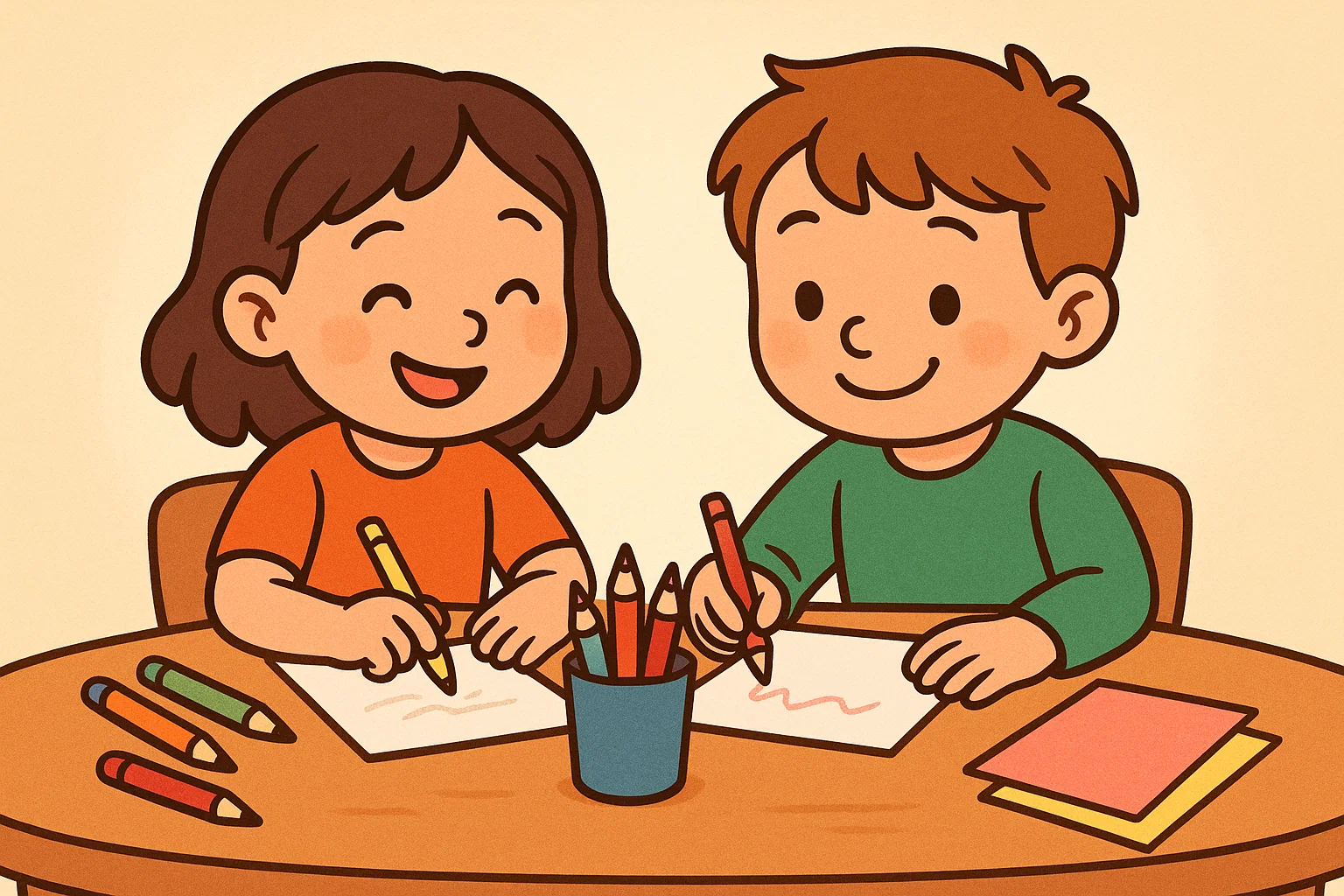
Writing is often introduced to children through rigid exercises and repetitive worksheets, which can quickly extinguish their natural curiosity. Turning writing practice into a playful, low-pressure activity helps parents and educators build lasting literacy skills. Game-based learning works well in living rooms, classrooms, homeschool settings, tutoring sessions, and small peer groups. By reducing the fear of the blank page, these playful activities can help writing feel less like a chore and more like self-expression.
Children need different kinds of writing support at different ages and stages. Writing through play can be easily adapted to each child’s abilities. These writing games can support a wide range of learners, from preschoolers exploring letter shapes to older children developing paragraphs, vocabulary, and narrative voice. Using a game-based approach helps children see writing not as a test of mechanics, but as an open-ended space for imagination.
Key Takeaways
Best Games Build Writing Through Play
Game-based practice provides a distinct advantage by combining skill practice with creative expression. When children play writing games, they can practice sentence building, phonetic spelling, storytelling, and handwriting stamina at the same time. Research on child development suggests that supportive, low-stress learning environments can help children focus, take risks, and stay engaged during challenging tasks. This low-stakes environment helps children build writing confidence while naturally practicing grammar and sentence structure.
Simple Materials Work Best
Implementing highly effective writing games does not require expensive commercial programs or complex digital subscriptions. The most engaging literacy activities rely on accessible, tactile materials that parents and teachers already have. Using simple items such as dice, homemade cards, jars, printed pictures, letter tiles, sticky notes, balloons, playdough, books, and printable prompts keeps the learning environment grounded. These hands-on tools turn abstract language concepts into concrete elements children can touch, arrange, and reshape.
Games Fit Many Ages
A well-designed writing game can be adapted to a child’s current stage of writing development. Younger children can participate by tracing shapes, matching letters, drawing illustrations, or dictating their ideas to a supportive adult. As students grow, the same basic game formats can be expanded to include full stories, complex poems, multi-panel comic strips, persuasive opinion pieces, and collaborative narratives. This multi-age flexibility ensures that siblings or mixed-grade classrooms can play together productively.
Why Creative Writing Games Matter for Kids’ Literacy
Less Stressful Learning
Traditional writing assignments often create performance anxiety in young writers, particularly those who struggle with fine motor skills or executive functioning. A structured writing game replaces this pressure with a clear, engaging goal, making the process feel safer for reluctant writers who feel anxious when facing a blank page. Low-stakes activities can help students practice without feeling that every mistake carries serious consequences. When errors are treated as a natural part of the game, children often become more willing to take creative risks with their words.
Motivation Through Choice
Self-determination theory suggests that autonomy can increase a learner’s intrinsic motivation. Writing games use this principle by incorporating random elements such as story dice, drawing cards, unexpected prompts, quirky characters, and silly rule cards that give children a sense of control. This kind of choice can make the activity more engaging because the child gets to make decisions instead of simply responding to a fixed prompt. Selecting how a narrative unfolds helps young writers develop true ownership over their creative work and their literacy growth.
Whole Skill Growth
Creative writing activities also support many connected literacy skills. Playful writing helps children connect reading comprehension, vocabulary, speaking, listening, and fine motor skills. Early literacy research shows that phonemic awareness supports children’s ability to read and spell, and writing games can reinforce those sound-letter connections in a playful way. By combining these skills through play, children build a stronger foundation for later academic communication.
Different Ways to Learn Through Play
Children engage with writing in different ways, so a single approach may not support every learner equally well. Integrating visual, movement-based, verbal, tactile, digital, and collaborative game styles ensures that different types of learners are fully supported.
- Visual learners thrive when analyzing vibrant picture prompts and designing structured comic panels.
- Active children often build focus when writing tasks are paired with physical movement, such as alphabet hopscotch or scavenger hunts.
- Tactile learners may find grounding by manipulating playdough names, letter tiles, and sand trays to develop fine motor control.
1. Story Cards & Dice
What You’ll Need
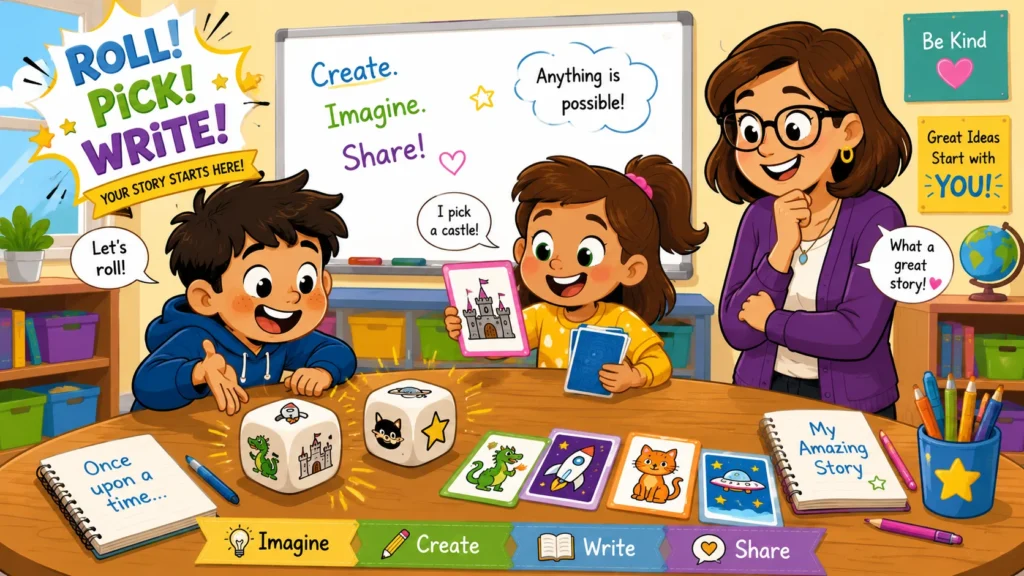
To set up this adaptable narrative game, gather a pair of standard dice, homemade story cards, colorful picture cards, or story dice with clear icons. Divide your index cards into three distinct decks: character cards, setting cards, and problem cards. Provide clean writing paper, primary-lined notebooks, or digital tablets based on your young writer’s fine motor preferences.
How to Play
The child starts the game by rolling the dice or drawing one card from each of the three pre-made decks to establish the foundation of the tale. The combination of dice or cards gives the child the basic story elements to work with. The young writer then creates a story that connects the randomly selected elements. To keep gameplay smooth, have children check off each element as they include it in the final story.
| Component | Purpose | Example Options |
| Character Card | Establishes the protagonist | Astronaut, Detective Squirrel, Talking Toaster |
| Setting Card | Defines the environment | Underwater City, Abandoned Playground, Volcano Kitchen |
| Problem Card | Introduces the central conflict | Lost keys, Sudden loss of gravity, Sudden uncontrollable singing |
Writing Prompts
Pre-populating your story cards or dice labels with vivid, high-interest scenarios prevents kids from getting stuck at the beginning of the writing process. Consider engaging combinations such as a broken-down robot stranded in an ancient whispering forest, a hyperactive dragon attempting to hide on the first day of school, or a lost puppy seeking a way home while exploring the surface of the moon.
Age Variations
For younger children in preschool and kindergarten, this game can focus entirely on oral storytelling, drawing detailed illustrations, or dictating simple sentences to an adult. For older elementary students, make the game more challenging by asking for multiple paragraphs, specific vocabulary words, or a longer story with a clear character arc.
2. Story Map Challenge
Map Sections
The Story Map Challenge uses a visual organizer to make plot planning clear and concrete. The template can include boxes or bubbles arranged in order across a large sheet of paper. Every standard story map should feature designated zones for the narrative’s beginning, middle, and end, alongside sections for character profiles, settings, the central conflict, and the final resolution.
How to Play
Turn this organizational task into an exciting game by introducing an element of competition or collaborative play. Set a visual sand timer to five minutes, challenging the student to quickly fill all map sections with creative ideas before the time expires. Alternatively, initiate a partner map swap where one child outlines the characters and setting, then passes the map to a peer who invents the conflict and resolution based on those visual cues.
Skill Boost
This graphic activity helps children plan stories more clearly and supports reading comprehension. By visualizing the physical boundaries of a narrative, young writers learn how to organize their ideas logically and develop sequential plot structure. The layout can help prevent disorganized, rambling stories by giving children a clear plan before they start writing.
Printable Option
Using a downloadable blank story map template gives busy parents and teachers an easy starting point. Keeping a few blank templates ready makes it easy for a child to start an organized writing session when inspiration strikes.
3. Accordion Stories
Setup
Accordion Stories are an engaging, collaborative writing game that highlights the hilarious outcomes of collective creation. To prepare, take a standard sheet of lined paper and fold it horizontally into four to six equal segments, creating a zigzag accordion pattern. Set clear rules before beginning: each player writes only two lines, and everyone should keep their handwriting readable and their ideas appropriate for the group.
How to Play
The first participant writes the opening sentence or paragraph of a story on the top panel of the folded paper, folds the paper backward to completely hide their words, and passes the sheet to the next writer. The second child writes the next line while seeing only the final word or sentence from the previous author, depending on the difficulty level you choose. This blind cycle continues until every folded segment of the accordion paper contains text.
Funny Reveal
The true magic of this collaborative activity occurs during the final reveal phase of the game. Unfold the paper completely and read the chaotic, unpredictable story aloud to the entire group, celebrating the bizarre narrative shifts and unexpected comedic twists. This lighthearted conclusion reinforces the idea that writing can be a source of shared entertainment and laughter rather than an isolated, stressful task.
Classroom Variation
In a classroom, you can scale this activity by breaking students into small groups or pairs, or by assigning a required class theme. For example, ask groups to create historical fiction accordion stories based on a current social studies unit, encouraging them to use accurate historical terminology in their collaborative sentences.
4. Scavenger Hunt Writing Game
What to Find
This high-energy literacy activity blends physical movement with descriptive composition. Prepare a simple checklist of items for children to find nearby, either inside the house or at a local park. Ask participants to search for household objects, textured outdoor items, color clues, interesting sounds, or hidden slips of paper with mystery words.
Home Scavenger Hunt Checklist Example
- Find something rough and brown.
- Locate an object that fits inside a pocket.
- Discover an item that makes a crinkling sound.
- Spot something metallic and shiny.
How to Write
Once children gather their objects or clues, they return to their writing spot and write about what they found. Depending on their learning goals, kids can write vivid sensory descriptions, alliterative sentences, short descriptive poems, or brief mystery stories that incorporate every item. The collected objects serve as concrete visual anchors that enrich the depth of the child’s descriptive language.
Movement Benefit
Adding movement can support energetic children and reluctant writers by making the writing portion feel more manageable. The movement phase burns off excess physical energy, preparing the child’s brain for a focused period of sitting and writing.
Group Version
To adapt this into a competitive team-based game, separate the children into small groups and establish a points-based scoring system. Teams earn specific point values for discovering items, along with bonus points for crafting complex sentences, using accurate parts of speech, and demonstrating proper punctuation.
5. Poetry Play
Free Verse Poem
Poetry provides a supportive and flexible format for young writers because it frees them from the strict constraints of formal paragraph structure. Introduce free verse poetry as a flexible form that does not require strict rules, rhyme patterns, or fixed sentence lengths. Encourage your child to focus their writing on capturing emotions, sensory images, and interesting details from everyday life.
Acrostic Poem
An acrostic poem offers a simple, reliable structure that gives young learners immediate confidence. To play this poetry game, have the child write a chosen word vertically down the left side of the paper, using each letter to begin a descriptive phrase or sentence. Children can use the letters in their own first name, a favorite animal, a current season, or a hobby they love.
Haiku, Limerick, Concrete Poem
Expand their poetic toolkit by introducing traditional poetic forms that double as engaging language puzzles.
- Haiku: Teaches syllable counting and structure through its classic 5-7-5 syllable arrangement.
- Limerick: Challenges older kids to play with rhythm and sound patterns through its humorous, bouncy AABBA rhyming structure.
- Concrete Poem: Blends visual art with literacy by requiring the child to write descriptive words in the shape of the subject matter, such as writing a poem about rain in the shape of a falling teardrop or a storm cloud.
Simile Poem
A Simile Poem helps young writers practice comparative figurative language through structured sentence starters. Teach your child to construct imaginative comparisons using the words “like” or “as” to create humorous or vivid descriptions. Provide simple, accessible prompts to kickstart their thinking:
- “My brother is as noisy as a __________.”
- “The summer sun feels like a hot __________.”
6. Comic Book Creator
Character Design
Comic book creation is an excellent bridge for highly visual children or for those who resist traditional, text-only writing assignments. Start the process by having the child design their primary characters on an initial character profile sheet. Encourage them to invent unique superheroes, misunderstood villains, quirky pets, mythological monsters, or relatable school characters, detailing their special powers and key personality traits.
Panel Planning
Provide a pre-printed page containing empty comic grid panels to teach the fundamentals of logical narrative sequencing. Guide the child to distribute their story arc evenly across the boxes: the first panel introduces the characters, the second establishes a problem, the third contains the primary action, and the final box delivers a clear ending. This visual framework prevents children from becoming overwhelmed by breaking story composition down into manageable, bite-sized chunks.
Dialogue Practice
The distinct format of comic strip speech bubbles provides an excellent space for practicing natural dialogue and conversational punctuation. Writing inside a confined speech bubble forces young authors to carefully choose concise, high-impact words rather than long, wandering sentences. This practice improves their understanding of voice, tone, and character perspective.
Extension Idea
To build on their enthusiasm, suggest turning a successful short comic strip into a longer narrative chapter book. Alternatively, teachers can bind individual student comic pages together to create a collaborative classroom comic book collection for the school library.
7. Pen Pal Writing
Safe Pen Pal Options
Writing for an authentic, real audience instantly makes literacy practice feel meaningful, purposeful, and rewarding for young writers. To help keep children safe, establish reliable pen pal channels through structured letter exchanges with close relatives, trusted classmates, or peer classrooms in teacher-approved programs. Supervised digital exchange systems or monitored email accounts also offer rapid, secure communication channels for tech-savvy students.
Letter Structure
Using standard correspondence naturally provides a framework for teaching the traditional parts of a letter. Guide your child to properly identify and position the essential components of a standard message. This repeated practice helps children learn to format letters with an appropriate greeting, friendly opening questions, relevant personal news, a warm closing, and a signature.
Prompt Ideas
Keep the correspondence flowing smoothly by providing a rotating list of engaging topic ideas for each exchange cycle. Children can exchange enthusiastic reviews of their favorite books, discuss current hobbies, share updates about family pets, describe funny school day incidents, compare local weather patterns, or explain unique regional holiday traditions.
Skill Boost
Regularly writing to a pen pal provides an ongoing boost to a child’s understanding of audience awareness and empathetic perspective-taking. Young writers practice tailoring their tone to their recipient while learning how to ask clear, open-ended questions that invite a response. This real-world application shows children that clear writing helps people connect.
8. Keep Favorite Book Going
Choose Favorite Story
Fan fiction serves as a useful strategy for reducing initial creative resistance because it allows children to build upon a fictional world that is already developed. Instruct your young writer to select a familiar book series, animated movie universe, or beloved graphic novel that features characters they already love. By using an established world, the child can skip the difficult work of initial world-building and jump straight into writing.
New Ending Challenge
Challenge the student’s critical thinking skills by assigning a New Ending Challenge for a book they recently finished reading. Instruct them to identify a crucial turning point in the original plot and rewrite the conclusion based on an entirely different choice, unexpected problem, or surprise twist. This activity requires children to analyze cause-and-effect relationships within a narrative arc.
Side Character Story
Encourage your child to step away from the primary protagonist and explore the fictional world from the viewpoint of a minor side character. Let them compose a short narrative from the perspective of a loyal family pet, a misunderstood villain, a helpful best friend, or a random background observer. This shift in perspective deepens their understanding of character motivation and point-of-view mechanics.
Reading Connection
This game reinforces reading comprehension and critical analysis. To successfully extend a story, a child must accurately recall existing character behaviors, match the author’s established vocabulary style, and respect the logic of the fictional universe. This creative exercise transforms passive reading into an active, analytical writing prompt.
9. NaNoWriMo-Inspired Writing Challenge for Kids
Mini Word Goal
A NaNoWriMo-inspired writing challenge can be adapted as an exciting, long-form creative writing game rather than an intimidating academic requirement. The key idea is to let children set their own personalized mini word count goals. Depending on age and baseline writing stamina, child-friendly targets can range anywhere from 100 words for an early writer to 5,000 words for an ambitious middle school student.
Suggested Developmentally Appropriate Word Count Goals
| Age or Grade Level | Suggested Goal |
| Preschool / Kindergarten | 50-100 words, dictated or traced phrases |
| Early Elementary, Grades 1-2 | 200-500 total words |
| Upper Elementary, Grades 3-5 | 1,000-2,500 total words |
| Middle School, Grades 6-8 | 3,000-5,000+ total words |
Story Calendar
Maintain momentum throughout the challenge by setting up a visual story tracking calendar on a prominent wall or corkboard. Allow the child to place colorful stickers on a chart or update a progress tracker each day to mark word count milestones. Visualizing progress creates a healthy sense of accomplishment, turning the steady accumulation of text into a rewarding game.
Chapter Ideas
Help your young author map out their long-form project by breaking it down into a sequence of short, bite-sized chapters. Guide them to pitch simple chapter concepts that include an exciting title, a small conflict, and a dramatic cliffhanger ending. This simple structural planning keeps the overarching narrative moving forward and prevents the child from burning out in the middle of the project.
Celebration Finish
When the child reaches their self-selected word count goal, celebrate their dedication with a special finish-line activity. Host a home reading party, print and bind the final manuscript with a custom cover design, or present the child with a personalized author certificate. Recognizing effort builds long-term writing confidence and a strong sense of identity as a capable creator.
10. Picture Prompt Pass
Picture Choices
Visual stimuli provide an immediate access point for children who struggle to generate narrative ideas out of thin air. Gather a diverse collection of compelling, unusual, or humorous images to serve as the game’s creative sparks. Select photographs of funny animal interactions, mysterious ancient doors hidden in brick walls, unusual upside-down landscapes, or illustrations from wordless picture books.
Pass Rules
Picture Prompt Pass is a dynamic, collaborative writing game that works best in pairs or small groups. To begin, each child is handed a unique picture prompt and must write two to three initial sentences establishing the setting and introductory action before a timer sounds. Once the timer rings, players pass both their image and their new piece of writing to the writer on their right, who reads the existing text and adds the next event.
Creative Twist
Introduce unexpected challenges by using a deck of random rule cards that players must draw from during the passing cycles. These cards add sudden constraints that force writers to adapt their plans on the fly:
- “Introduce a sudden loud sound effect.”
- “Incorporate a specific vocabulary word.”
- “Describe a sudden weather change.”
Final Sharing
Once the writing sheets complete a full circle and return to their original authors, dedicate time to an enthusiastic final sharing session. Allow each child to read the completed collaborative tale aloud, analyzing how the plot shifted across different writers. This collective review builds appreciation for distinct writing styles and creative choices.
11. Story Jar Game
Jar Categories
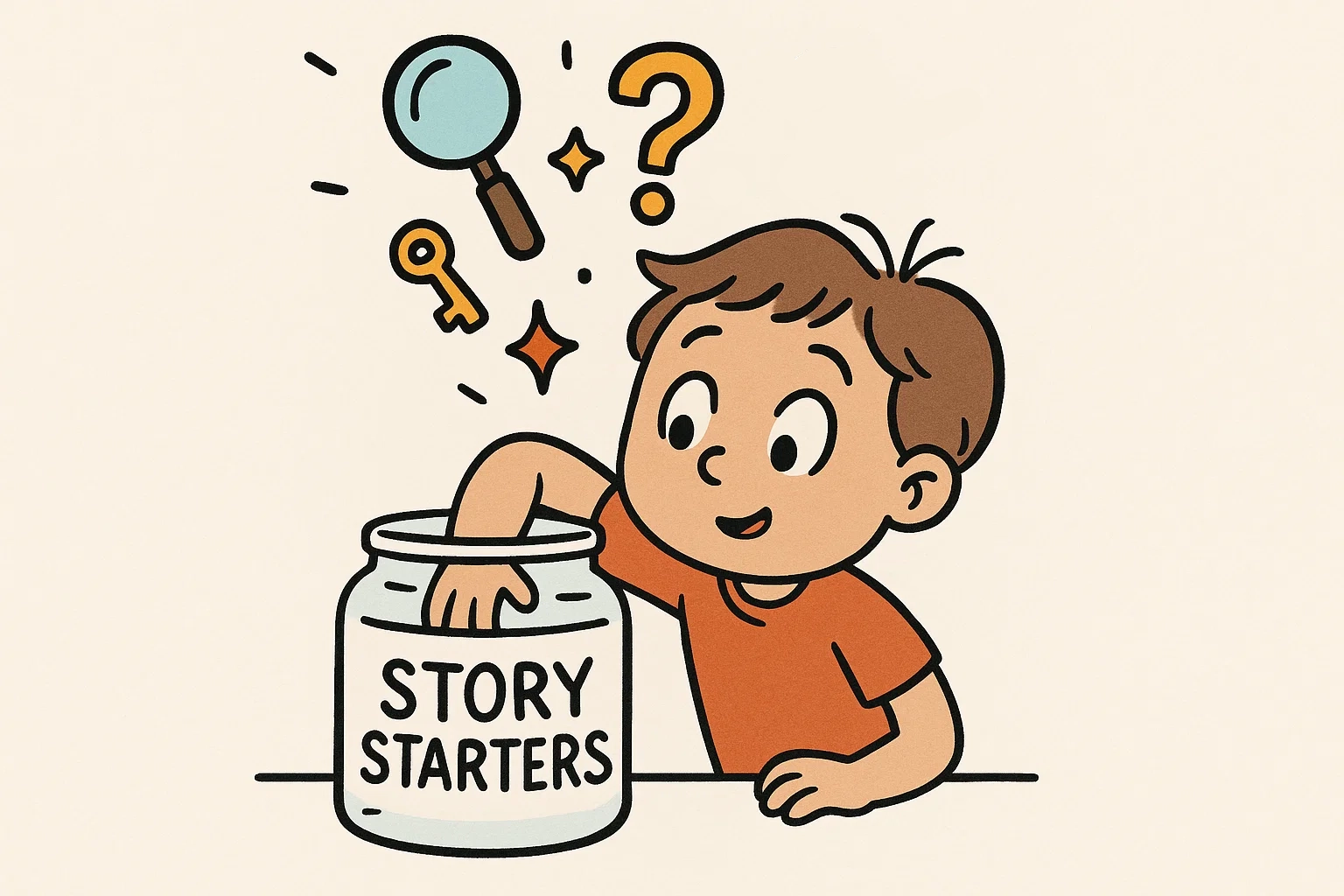
The Story Jar Game relies on a collection of visual or textual elements stored inside clear containers, ready to provide instant inspiration. To set up this reusable game, prepare five distinct glass or plastic jars, each clearly labeled with a specific narrative element. For the best organization, use color-coded slips of paper to fill each jar based on its core category:
- Jar 1, Blue Slips: Main Characters
- Jar 2, Green Slips: Environmental Settings
- Jar 3, Red Slips: Central Conflicts
- Jar 4, Yellow Slips: Random Objects
- Jar 5, Purple Slips: Core Emotions
How to Play
To begin a round of writing practice, the child reaches into each of the five jars to draw one random color-coded slip of paper. The young writer is then challenged to compose a unified short story that naturally weaves together all five selected narrative constraints. The writer must find a believable or funny reason for all these elements to belong in the same plot.
Silly Combinations
Much of the fun comes from the absurd combinations created by the random draw. A child might draw a combination such as a “pirate dentist” exploring a “futuristic alien bakery,” struggling with “uncontrollable hiccups,” holding a “rusty magnifying glass,” and feeling “intensely jealous.” The silliness of the prompt can lower academic pressure and make the activity feel more like creative problem-solving.
Reusable Setup
Keep your labeled story jars displayed on a shelf or classroom counter to serve as a permanent, ready-to-use writing warm-up tool. Whenever a child finishes an assignment early or needs a quick creative break, they can pull a set of slips and start a brief writing session on their own.
12. Silly Sentence Builder
Word Card Sets
The Silly Sentence Builder helps children practice basic sentence structure by turning grammar into a hands-on construction game. Create four distinct color-coded decks of index cards, with each deck dedicated to a specific part of speech. The first deck contains subjects, or “Who”; the second contains actions, or “Did What”; the third represents locations, or “Where”; and the final deck outlines modifiers, or “How.”
Silly Sentence Builder Card Layout Example
| Deck | Category | Example Cards |
| Deck 1, Blue | Who | A hyper pig, The clumsy astronaut, An opera singer |
| Deck 2, Green | Did What | Skateboarded, juggled hot soup, danced a jig |
| Deck 3, Red | Where | Inside a giant shoe, on top of a cloud, under a tractor |
| Deck 4, Yellow | How | With extreme caution, loudly screaming, in slow motion |
Sentence Rules
Players draw one card from each of the four colored decks and arrange them in order to form a complete sentence. While the sentence may be silly, the child must carefully copy the words onto the paper while following standard sentence rules. This requirement provides targeted practice with capital letters, spaces between words, correct spelling, and appropriate ending punctuation.
Grammar Practice
This hands-on game provides direct, contextual reinforcement of basic grammar definitions without relying on rote memorization. By physically moving the color-coded cards, children develop an intuitive understanding of how nouns, verbs, adjectives, adverbs, and prepositions fit together to build a complete sentence. They see firsthand how changing a single part of speech instantly transforms the meaning of a sentence.
Challenge Round
For older elementary students who have mastered basic sentence construction, introduce a challenge round. Instruct the child to select their newly generated silly sentence and use it as the topic sentence for a cohesive, well-developed short paragraph, requiring them to write three supporting sentences that logically explain the absurd scenario.
13. Sentence Scramblers
Setup
Sentence Scramblers is a tactile decoding game that helps children strengthen sentence awareness and editing skills. To prepare, write several complete, grammatically correct sentences on long cardboard strips, making sure the sentences match the child’s reading level. Use a pair of scissors to cut the individual words apart, thoroughly mix the pieces together, and place each scrambled set into an envelope.
How to Play
The child can race against a visual timer or collaborate directly with a partner to rebuild the scrambled words into a clear sentence. To complete the challenge, the student uses syntax clues to place the subject, verb, and descriptive phrases in an order that makes sense. This physical arrangement helps children internalize natural word order and sentence flow.
Punctuation Add-On
Increase the game’s editing value by intentionally leaving out all punctuation marks and capitalization markers from the raw word pieces. Once the child arranges the words into a logical sequence, they must use a colored marker to insert missing capital letters, commas, periods, exclamation points, or question marks. This step reinforces punctuation rules as functional tools for clarifying text meaning.
Difficulty Levels
This activity scales easily to accommodate different stages of a child’s learning development. For early childhood beginners, use short three-word or four-word sentences featuring familiar sight words. For older, more advanced students, increase the complexity by scrambling long sentences that feature dependent clauses, passive voice constructions, and advanced academic vocabulary.
14. Mad Libs Writing Game
Parts of Speech Review
Mad Libs is a classic, effective language game that provides a strong review of essential parts of speech. Before introducing the game template, conduct a brief, interactive review of standard grammatical definitions using clear, kid-friendly examples. Ensure that participants can accurately distinguish between:
- Nouns: A person, place, or thing, such as wizard, playground, or bicycle.
- Verbs: An action word, such as gallop, explode, or whisper.
- Adjectives: Descriptive words that modify nouns, such as slimy, neon, or microscopic.
- Adverbs: Words that describe actions, such as gracefully, frantically, or silently.
Fill-In Story
To play the game, one participant asks their partner to provide specific parts of speech to fill in the blanks of a hidden story template, all without revealing the surrounding context. The child providing the words must rely on their grammatical understanding to select creative nouns, verbs, and adjectives. Once all the blanks are filled, the full story is read aloud.
Laugh and Revise
The true power of this activity lies in the subsequent editing and revision phase. After enjoying the initial silly reading, ask the child to review the text and revise specific sentences to make logical sense or enhance the humor. This exercise helps children learn how replacing generic words with vivid, descriptive language directly changes the tone and impact of a story.
Make Your Own
For an extra challenge, encourage children to write their own Mad Libs templates for friends to solve. Crafting a functional template requires a child to write a coherent story, deliberately remove key structural words, and accurately identify the exact part of speech required to complete each blank.
15. Would You Rather Writing Challenge
Kid-Friendly Questions
Opinion writing becomes more engaging when it is built around funny, exaggerated dilemmas. Provide children with motivating “Would You Rather” choices that spark their imagination and opinions. Strong kid-friendly examples include asking whether they would prefer to have the ability to fly or become completely invisible, or whether they would rather live in a high-tech treehouse or a medieval castle.
Opinion Structure
Use these playful dilemmas to introduce the foundational framework of persuasive writing. Teach your child to organize their written response by following a clear, four-step structure. This simple outline helps young writers learn how to build a logical, evidence-based argument:
- State a clear claim: “I would definitely prefer to live in a high-tech treehouse…”
- Provide a compelling reason: “…because it allows me to stay close to nature while using modern gadgets.”
- Offer a specific example: “For instance, I could use a solar-powered pulley system to bring up snacks.”
- Write a strong closing sentence: “Therefore, a treehouse is clearly the ultimate place to live.”
Debate Option
Before asking children to put pen to paper, initiate a brief verbal debate round where participants share their answers aloud with peers. Speaking their arguments aloud allows children to clarify their thoughts, experiment with different reasoning strategies, and hear opposing viewpoints. This verbal warm-up makes the subsequent writing task feel significantly easier.
Advanced Version
For older or more advanced students, increase the challenge by asking for a persuasive paragraph that includes a counterargument. Instruct the writer to anticipate the opposing choice’s strongest points and respond to them using logical evidence and persuasive vocabulary.
16. Pass-Story Game
Opening Line
The Pass-Story Game is a collaborative writing exercise that builds storytelling flexibility and teamwork. Start the activity by writing a single, high-impact opening line on a clean sheet of paper. Ensure the initial sentence introduces a compelling character or an immediate, pressing problem, such as:
“As soon as Leo turned the brass key, the grandfather clock began to glow with a strange purple light.”
Turn Rules
Participants sit in a circle, and each player is allowed to add exactly one sentence to the page before passing it to their neighbor. Establish clear game boundaries: each added sentence must actively advance the existing plot, respect the established character traits, and avoid ending the story too soon. These rules ensure that every player contributes meaningfully to a continuous narrative.
Teamwork Skills
This collaborative gameplay trains essential cognitive skills like active listening, narrative continuity, and respecting the creative choices of previous writers. Children must set aside their personal story plans and adapt their writing to fit the narrative direction established by their peers. This exercise mirrors the collaborative editing environments common in professional fields.
Ending Round
When the paper has gone around the circle the chosen number of times, announce the final round. The final player is tasked with writing a satisfying resolution that ties up the narrative threads, or a dramatic cliffhanger ending that sets up a sequel. Read the completed piece aloud to celebrate the group’s collective storytelling achievement.
17. Wordless Picture Book Storytelling
Picture Walk
Wordless picture books provide a visually rich canvas for writing development because they convey complex emotional arcs without any pre-written text. Begin the activity by guiding the child through a comprehensive “picture walk” of the book, analyzing the sequence of illustrations from cover to cover. Encourage the young learner to observe visual details and predict the overarching story arc before doing any writing.
Caption Writing
Once the visual structure is clear, the child takes on the role of the book’s author by writing custom text to accompany the illustrations. Depending on their age and skill level, kids can write concise captions, realistic dialogue bubbles, or full, descriptive pages for each image. The illustrations give children visual support and help them pace the story.
Voice Choice
Introduce advanced storytelling concepts by allowing the child to select their preferred narrative voice for the project. Let them experiment with writing the story from the perspective of an omniscient third-person narrator, as the main character using first-person pronouns, or even from the point of view of an objective background observer. This choice deepens their understanding of how narrative voice shapes a reader’s experience.
Younger Child Support
To support younger pre-literate children or struggling writers who tire easily when writing by hand, use adult dictation. As the young child describes the visual action in their own words, the adult writes the sentences down verbatim underneath the picture. This approach allows the child to practice complex story composition without being limited by developing handwriting skills.
18. Spelling and Vocabulary Word Games
Word List Setup
Transform routine vocabulary practice and weekly spelling homework into a lively, competitive writing game. Assemble your target word list using current spelling patterns, new vocabulary words, tricky contractions, or science and social studies terms. Presenting these academic terms within a game framework eliminates the monotony of traditional flashcard drills.
Random Word Mix
Inject an element of fun into the assignment by mixing several absurd, high-interest random words into the child’s academic spelling list. Adding silly terms like “baboon,” “splat,” “pickle,” or “bloop” keeps the writing process lighthearted. This clever addition encourages children to find creative ways to bridge academic terms with funny concepts.
Points System
Implement a transparent, low-stakes points system to gamify the writing process and encourage mechanical accuracy. Reward specific point values to help children focus on details:
- 10 Points: Correct spelling of a target vocabulary word.
- 10 Points: Creative and contextually accurate use of the word.
- 5 Points: Proper capitalization and ending punctuation.
- 15 Points: Crafting a complex sentence instead of a simple one.
Story Challenge
The final challenge is to write a short story that uses every word from the list. This activity encourages students to think about how words relate to one another and how different terms can fit into one logical story.
19. Spin Punctuation
Spinner Setup
Spin Punctuation is an interactive editing game that turns punctuation practice into a hands-on visual puzzle. Construct a simple cardboard spinner divided into six equal wedge sections, with each section displaying a different punctuation mark. Ensure your spinner includes a period, a question mark, an exclamation mark, a comma, quotation marks, and a colon.
How to Play
The child spins the wheel to choose a punctuation mark, then writes an original sentence that uses that mark correctly. For instance, if the arrow lands on a question mark, they must write a question; if it lands on a comma, they must write a sentence with a clear list or a dependent clause.
Dialogue Round
Make the game more challenging by adding a Dialogue Round whenever a player lands on quotation marks. The child must create two distinct characters and write a brief back-and-forth conversation between them. This round requires the correct placement of speech marks, speaker tags, and commas within dialogue structures.
Editing Practice
Alternatively, reverse the game mechanics to practice proofreading and editing skills. Provide the child with a collection of intentionally scrambled, unpunctuated sentences. The student spins the wheel to select a punctuation mark, then searches the worksheet to locate and fix a sentence that requires that exact mark, acting as a “sentence doctor.”
20. Question Sentence Game
Word Count Rounds
The Question Sentence Game helps children practice precise language by giving them exact word-count limits. Separate gameplay into progressive rounds, requiring the child to compose complete, meaningful questions using an exact number of words. Start with a four-word round, then systematically advance to five-word, six-word, and seven-word rounds.
Question Word Count Round Examples
| Word Count Target | Example Question |
| 4-Word Target | Where is my shoe? |
| 5-Word Target | Can dogs eat green apples? |
| 6-Word Target | Why did the blue balloon pop? |
| 7-Word Target | How do airplanes fly across the ocean? |
Question Words
Use this game to practice common question words that help children think more clearly. Ask players to rotate through the essential question words for each round: who, what, when, where, why, and how. This requirement helps children practice using different question structures.
Partner Answers
Turn this individual challenge into a fun two-player interaction by pairing students up. Once Player One writes a grammatically precise question that meets the strict word count rule, Player Two is tasked with writing a corresponding answer. The answer must be written as a complete sentence and must also match a specific word count constraint.
Extension
To build on the game, have children gather their questions and answers and turn them into a simple written format. They can format their sentences into a celebrity magazine interview, a scripted dialogue for a comic strip, or a fictional news report.
21. Letter Tile Writing Games
Word Building
Moving physical letters around is a helpful way to support early literacy and reduce writing fatigue in young children. Gather plastic letter tiles, alphabet refrigerator magnets, wooden blocks, or simple paper cutouts. Challenge your early learner to physically assemble their own name, common high-frequency sight words, or weekly spelling targets before doing any handwriting.
Sentence Build
Once a child builds the target words, move into sentence writing by having them copy the words onto paper. Building the words first acts as a spelling warm-up, making it easier for children to copy word shapes onto paper without tiring their hands too quickly.
Letter Swap
Introduce the concept of word families and phoneme manipulation through an engaging Letter Swap game. Instruct the child to build a simple base word like “cat” using physical tiles, then challenge them to swap out just one letter to generate a brand-new word, like “cap” or “mat.” The child must then write a complete sentence using each new word they discover.
Struggling Writer Support
This tactile approach provides helpful support for struggling writers and neurodiverse learners who find it overwhelming to spell and write by hand at the same time. Separating word building from handwriting makes the task feel less overwhelming. This setup allows children to focus on phonetic spelling principles before worrying about pencil grip and handwriting neatness.
22. Early Writing Games for Preschoolers and Kindergarteners
Disappearing Letters
Early writing activities for preschoolers and kindergarteners should focus on sensory play and confidence with letter formation. Create a high-interest sensory activity called Disappearing Letters by having children paint letter shapes onto outdoor sidewalks using a brush dipped in clean water, or trace letters into shaving cream spread across a tray. The child gets to write letters and watch them naturally fade away as they dry or dissolve.
Hands-On Writing
Reduce early pencil frustration by using sensory trays filled with fine sand, coarse salt, rainbow sprinkles, or finger paint. Children use their bare index fingers to draw swirling lines, geometric shapes, and uppercase letters directly into the textured material. This tactile feedback helps children remember letter shapes without the frustration of using a pencil too soon.
Yarn Letters and Playdough Names
Building hand strength helps children develop handwriting stamina. Have young learners form individual alphabet letters by bending pieces of yarn, or roll playdough into long snakes to spell out their names on a flat surface. These activities build fine motor control and strengthen the hand muscles children will later use for a proper tripod pencil grip.
Squishy Bags and Glitter Glue Lines
Create non-messy tactile tracing tools by filling sealed plastic freezer bags with colored hair gel and bright glitter, taping the bags securely to a table surface. Children can use a finger or a soft cotton swab to smoothly trace letters into the gel, creating bright, clear paths. Alternatively, adults can create raised, dried glitter glue templates that children can trace with their fingertips to build muscle memory through tactile feedback.
23. Movement-Based Writing Games
Alphabet Hopscotch
Many active children retain language concepts better when literacy practice is paired with movement. Draw a large alphabet hopscotch grid on a sidewalk using colorful chalk. The child jumps across the letters to land on a target sound, calls out the phoneme, and runs to a nearby clipboard to write down three words that start with that specific letter.
Reading Relay Race
Set up a Reading Relay Race in an open backyard or school gym to combine physical activity with sentence writing. Separate children into small teams; each runner must dash to a distant station, read a hidden clue card, and write a single, grammatically correct sentence or answer on a shared team whiteboard before running back to tag the next player.
Balloon Letter Toss
Keep energy levels high with a cooperative Balloon Letter Toss game. Inflate a standard balloon and use a permanent marker to write diverse alphabet letters or high-frequency sight words across its surface. Partners gently toss the balloon back and forth; whenever a player catches it, they must look at the word touching their right thumb and write it in a sentence on their notepad before tossing it back.
Four Corners Writing
Adapt the classic childhood recess game of Four Corners into an active literacy prompt center. Position a unique prompt, distinct genre, character card, or punctuation challenge in each of the four corners of a room. Children march around the room to music; when the sound stops, they go to the nearest corner and spend three minutes writing based on that corner’s prompt.
24. Drawing, Matching, and Sound Games
Homemade Pictionary
Blending visual art with literacy practice helps children think more deeply about word meanings. In Homemade Pictionary, a child secretly selects a target vocabulary word from a deck and illustrates the concept on a whiteboard while their partners attempt to guess the word. Once the word is guessed, every participant must immediately write an original, descriptive sentence using that word in their notebook.
I-Spy Sounds
I-Spy Sounds helps young children build foundational phonological awareness. An adult starts the game by calling out a target sound:
“I spy with my little eye, something in this room that starts with the sound /ch/.”
The child searches the room to locate the correct item, like a chair, and practices writing the matching word carefully on their paper.
Leaf Matching Game
Incorporate nature into your language lessons by gathering fresh fallen leaves from a local backyard or neighborhood park. Use a marker to write matching letters, uppercase/lowercase pairs, root words, or rhyming word patterns onto separate leaves. The child searches through the pile to find the correct matches, then glues the pairs into a nature journal and writes descriptive outdoor sentences beneath them.
M Is for Muffin
Transform snack time into an engaging alphabet writing game. Provide a variety of letter-themed foods, such as alphabet cereal, shaped crackers, or a fresh blueberry muffin. Before eating the treat, the child must write down three accurate adjectives that start with that item’s initial letter, such as describing a muffin as moist, sweet, and magnificent.
25. Online Writing Programs and Literacy Games
When Digital Games Help
Digital writing programs and online literacy software can serve as an excellent supplement to traditional offline instruction when implemented thoughtfully. Gamified digital tools can boost motivation in tech-loving children, provide instant feedback on spelling accuracy, offer typing practice, and guide kids through multimedia story creation platforms. These tools can make routine editing practice feel more interactive.
What to Look For
When selecting an educational online writing program for your child, look for platforms that prioritize student privacy and strong learning design. Look for software with age-appropriate prompts, strong privacy settings, an ad-free environment, parent progress tracking, and room for open-ended creativity. Avoid applications that rely purely on multiple-choice quizzes, as they do not provide authentic writing practice.
Screen-Time Balance
To avoid digital fatigue, establish a healthy balance between screen-based writing and offline activities. Use online programs as a brief supplement rather than a complete replacement for traditional paper notebooks. Ensure your child’s weekly routine includes plenty of physical handwriting practice, drawing illustrations, reading physical books, and engaging in rich oral storytelling with family members.
Parent or Teacher Check-In
Never rely on a digital game’s automated score output as the sole measure of a child’s true writing development. Make it a point to regularly sit down with your child to read the stories, paragraphs, and short pieces they create on digital platforms. Discussing their creative choices and providing warm encouragement helps turn independent digital play into a meaningful, shared learning experience.
Tips for Making Fun Writing Games More Engaging
Keep Sessions Short
To prevent cognitive fatigue and maintain enthusiasm, keep your game sessions brief and fast-paced. Limit focused gameplay rounds to 10 to 20 minutes for elementary-aged students, so the activity ends while the child is still having fun. Stopping the game before fatigue sets in leaves them excited to play again next time.
Use Themes Kids Love
Incorporate your child’s current interests into the game to increase engagement. If a child loves dinosaurs, outer space, fantasy wizards, competitive sports, or a specific animated TV series, adapt your character, setting, and problem decks to match those interests. Tailoring the content ensures that even reluctant writers are more likely to dive into the task with enthusiasm.
Pair Students Wisely
When setting up collaborative games in a classroom or with siblings, pair children thoughtfully to reduce pressure and anxiety. Avoid matching a highly advanced, fast-paced writer with a child who struggles with severe motor delays or processing challenges, as this can create a stressful dynamic. Instead, pair confident, encouraging mentors with quieter peers, or form balanced small groups where every participant has a clear, independent role to play without feeling pressured.
Add Points, Badges, or Thumbs Up
Incorporate low-stakes gamification rewards to celebrate participation, creative choices, sustained effort, and thoughtful editing. Provide colorful physical tokens, custom sticker badges, or simple “thumbs up” points for completing tasks. Emphasize that rewards are given for creative effort rather than perfect spelling or punctuation, keeping the learning environment safe and encouraging for every child.
FAQs
What Are the Best Fun Writing Activities for Kids?
The best fun writing activities for kids combine creative choice, simple materials, and playful structure. Story dice, comic book grids, story jars, picture prompts, and pass-the-story games are all a fun way to help children practice writing without pressure. These activities help kids express their ideas, build confidence, and develop stronger writing skills over time.
How Do Writing Games Make Learning Fun?
Writing games make learning feel less like a worksheet and more like play. Instead of staring at a blank page, children can roll dice, draw cards, choose characters, move around the room, or respond to silly creative writing prompts. This keeps the process fun and engaging while helping kids practice vocabulary and sentence structure, spelling, punctuation, and story planning.
How Can Parents Help Kids Learn to Write at Home?
You can help your child learn to write at home by keeping practice short, playful, and low-pressure. A great way to start is by pairing reading and writing: read a favorite story together, then ask your child to write a new ending, describe a character, or create a short scene of their own. This is a great way to help children connect books with their own ideas while laying a strong foundation for literacy.
Take a short quiz to find out what your everyday choices say about your parenting style
When your child is curious about something new, what’s your instinct?
Take a short quiz to find out what your everyday choices say about your parenting style
“Can I download this app?” What happens next?
Take a short quiz to find out what your everyday choices say about your parenting style
When it comes to rules at home, which sounds most like you?
Take a short quiz to find out what your everyday choices say about your parenting style
If you could give your child one life skill today, what would you pick?
Take a short quiz to find out what your everyday choices say about your parenting style
Your child gets to choose what to watch. What would your ideal setup look like?
Take a short quiz to find out what your everyday choices say about your parenting style
Pick your parenting superpower ✨