10 Key Math Concepts and Skills 5th Graders Should Learn

 Discover a Free Education Video App for Kids
Pastory uses AI to personalize educational video content based on your child’s interests and personality. Safe, engaging, and built for curious young minds. Sign up now to stay updated and enjoy early access with a free trial
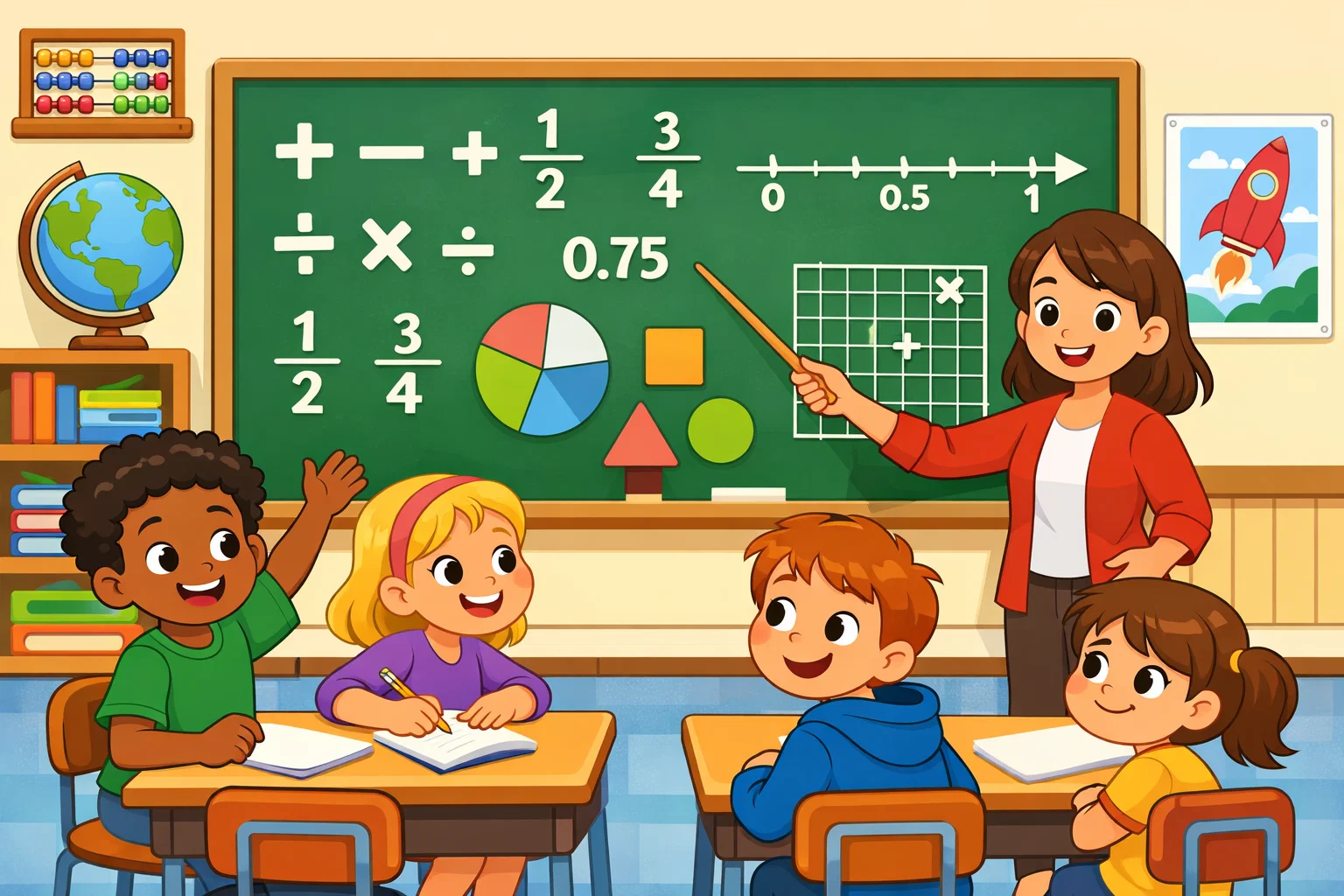
What math should 5th graders learn? In fifth grade, students move beyond basic arithmetic and begin working with fractions, decimals, volume, the coordinate plane, and early algebraic thinking. This year bridges elementary school and the more demanding math ahead in middle school.
This guide covers 10 key math concepts fifth graders are expected to master, along with curriculum goals, practical strategies for parents, and classroom ideas for teachers. Whether you are supporting a child at home or planning instruction, this overview helps you identify what matters most and where to focus.
Key Takeaways
- Fifth grade math centers on fractions, decimals, multi-digit operations, volume, geometry, and the coordinate plane.
- The article outlines 10 key math concepts and skills 5th graders are expected to learn by the end of the year.
- Students shift from concrete arithmetic to abstract, multi-step problem solving as preparation for middle school math.
- Fifth grade introduces early algebraic thinking — such as patterns, expressions, and the coordinate plane — but not formal algebra or calculus.
- Parents can support learning through short daily practice, visual models, word problems, and math games at home.
- The guide also covers curriculum goals, teacher strategies, and real-life examples of how these math skills apply every day.
Why 5th Grade Math Matters
Fifth grade is a critical transition year in which students begin applying basic arithmetic skills to more complex tasks. Rather than simply memorizing facts, students learn to solve problems using multi-step reasoning and visual models. This shift is essential because it prepares 5th graders for the algebraic thinking and data analysis they will encounter in the coming years.
Why Fifth Grade Marks a Big Shift in Math
The curriculum for 5th graders introduces a higher level of abstraction, moving away from simple computation toward numerical expressions and coordinate graphing. Fifth graders are expected to manage multiple operations within a single expression while maintaining accuracy with decimals and fractions. This grade level introduces new concepts such as volume and ordered pairs, requiring students to visualize quantities in new ways.
Why These Skills Support Middle School Success
The core concepts taught in fifth grade – especially fractions, decimals, and early geometry – help prepare students for later work with ratios, proportions, and algebraic thinking. According to NCTM, a strong understanding of fractions is an important foundation for later algebraic thinking. Developing number fluency now helps make later mathematical reasoning feel like a natural progression rather than a sudden hurdle.
Why Logic Shows Up in Everyday Life
The skills acquired in fifth grade have immediate real-world applications, from managing simple budgets to following multi-step instructions. Students learn to calculate the volume of boxes for shipping, subtract costs from a budget, and multiply ingredients for recipes. When fifth graders see how these calculations apply to sports statistics or building projects, they are more likely to stay engaged with math.
10 Key Math Concepts and Skills Fifth Graders Learn
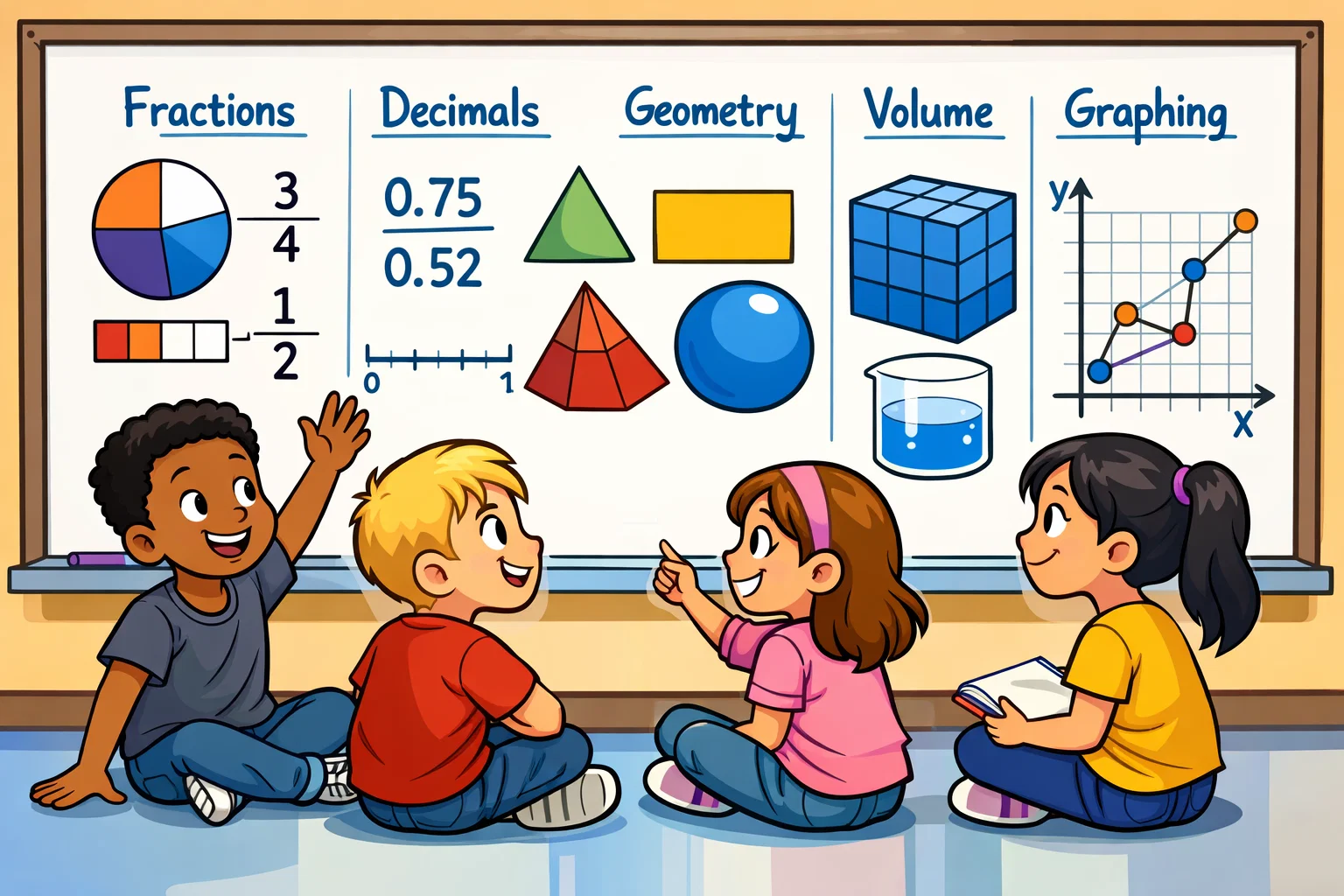
The following key math topics represent the essential math skills defined by most state educational standards. These are the core concepts most fifth graders are expected to learn over the course of the year.
1. Solve Numerical Expressions
Fifth graders are introduced to numerical expressions with grouping symbols and learn to follow the correct order of operations. Students are taught to use parentheses, brackets, and braces when evaluating multi-step numerical expressions.
- Key Skill: Identifying which operation to perform first in a complex numerical expression.
- Common Pitfall: Solving strictly from left to right without respecting grouping symbols.
- Application: Writing numerical expressions to represent calculations.
2. Add, Subtract, Multiply, and Divide Whole Numbers
While basic operations are introduced earlier, fifth grade focuses on building fluency with multi-digit operations using standard algorithms. Students should be able to divide four-digit numbers by two-digit divisors accurately and confidently.
- Standard: Fluently multiply multi-digit whole numbers.
- Strategy: Using estimation to check if a product or quotient is reasonable.
- Focus: Enhancing speed and accuracy in multiplication and division.
3. Work with Decimals
The study of decimals involves understanding place value to the thousandths place. Fifth graders must learn how to add, subtract, multiply, and divide decimals to hundredths. This requires a strong understanding of the base-ten place-value system.
- Concept: Comparing two decimals based on the value of the digits in each place.
- Real-World Use: Calculating money, measuring lengths in metric units, and scientific observations.
- Visualizing: Recognizing that 0.7 is ten times larger than 0.07.
4. Relate Fractions and Decimals
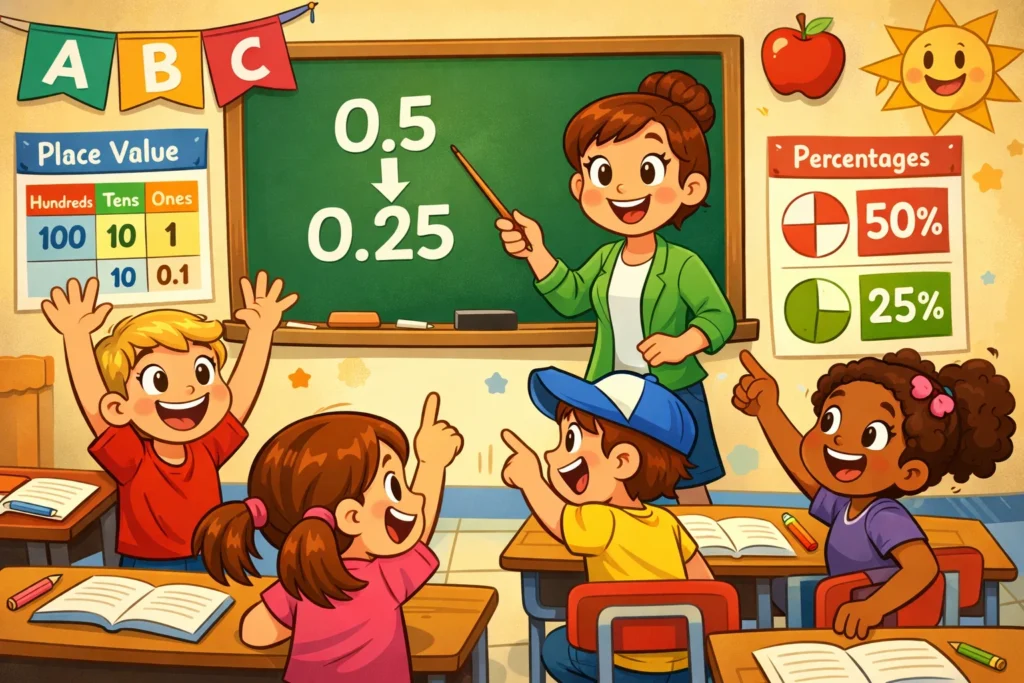
Students learn how fractions and decimals represent the same value, focusing on benchmark examples such as 0.5 = 1/2. This skill is vital for understanding how different numerical forms represent the same value across various contexts.
- Skill: Converting tenths and hundredths into decimal notation.
- Visuals: Using math for 5th graders worksheets with grids to visualize 0.25 as 25/100.
- Benefit: Provides a foundation for learning percentages and ratios in 6th grade.
5. Add and Subtract Fractions with Unlike Denominators
This is often considered one of the most challenging math topics for a 5th grader. Students are introduced to finding a common denominator to add or subtract fractions with different bottom numbers.
- Process: Replacing given fractions with equivalent fractions to produce like denominators.
- Mental Model: Using fraction strips or circles to see why 1/2 + 1/4 equals 3/4.
- Goal: Solving word problems involving addition and subtraction of parts.
6. Multiply and Divide Fractions
In fifth grade, students expand their understanding by learning to multiply fractions and interpret division involving unit fractions and whole numbers. This includes multiplying fractions by whole numbers, dividing unit fractions by whole numbers, and dividing whole numbers by unit fractions.
- Technique: Using area models to represent the product of two fractions.
- Example: Visualizing 1/2 × 1/3 as one half of one third, which equals 1/6.
- Outcome: Ability to solve real-world problems involving fractional measurements in science or construction.
7. Use Patterns, Rules, and Basic Algebraic Thinking
Fifth grade marks the beginning of algebraic reasoning through the use of variables and input-output tables. Students learn to generate numerical patterns from given rules and identify relationships between them.
- Feature: Identifying apparent relationships between corresponding terms in a sequence.
- Tool: Using a coordinate grid to represent the relationship between patterns visually.
- Competency: Forming ordered pairs consisting of corresponding terms from the patterns.
8. Graph Points on Coordinate Plane
Students learn that the coordinate plane is formed by perpendicular x- and y-axes. They also learn to solve problems by graphing points in the first quadrant and using graphs to represent numerical relationships visually.
- Vocabulary: Origin (0, 0), ordered pairs, x-coordinate, and y-coordinate.
- Visual: Plotting (3, 2) to represent a specific location on a map or grid.
- Integration: Connecting algebraic data patterns to visual graphs for easier interpretation.
9. Measure Volume, Length, Weight, and Capacity
Students are taught to find the volume of right rectangular prisms using unit cubes and formulas. The curriculum also requires students to convert within a given measurement system using standard units.
- Formula: Volume = length × width × height, or V = l × w × h.
- Standard: Understanding that volume is an attribute of solid figures and is measured in cubic units.
- Skills: Converting inches to feet or grams to kilograms within a given measurement system.
10. Geometry
The geometry unit in fifth grade focuses on classifying two-dimensional figures based on their properties. Students learn that shapes in one category also belong to subcategories.
- Analysis: Understanding that a square is a rectangle, and a rectangle is a parallelogram.
- Attributes: Focusing on angles, side lengths, and presence of parallel or perpendicular lines.
- Connection: Students may continue reviewing area and perimeter, while formal work with volume is typically taught separately.
5 Key 5th Grade Math Curriculum Goals
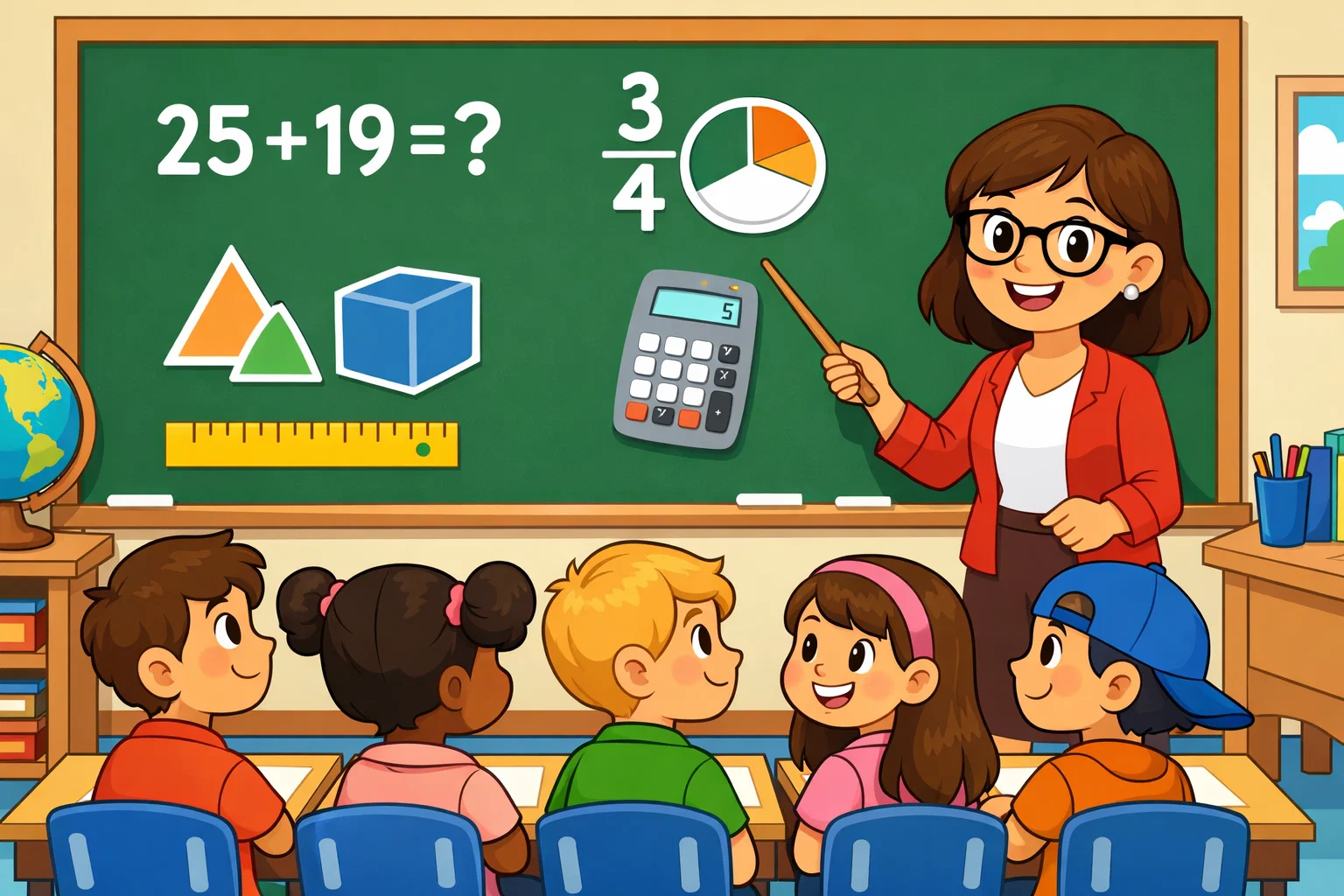
By the end of fifth grade, students should be able to demonstrate key proficiencies aligned with state and national standards. These goals help ensure that a child is ready for higher-level mathematical reasoning.
| Goal Category | Description | Outcome |
| Operational Fluency | Mastery of multiplication and division of multi-digit numbers. | Quick, accurate computation without calculators. |
| Fraction Mastery | Adding and subtracting fractions with unlike denominators. | Ability to manipulate parts of a whole in complex equations. |
| Decimal Precision | Proficiency in adding, subtracting, and multiplying decimals. | Mastery of place value and financial calculations. |
| Geometric Volume | Understanding and applying the concept of 3D space. | Calculating volume using V = B × h or V = l × w × h. |
| Data Interpretation | Using the coordinate plane to represent real-world data. | Visualizing numerical relationships on a grid. |
Build Fluency with Multi-Digit Operations
Students are expected to transition from “learning how” to “applying fluently.” This involves performing multi-digit multiplication and long division accurately and efficiently. Teachers emphasize checking work through estimation to ensure that math problems are solved logically. Achieving this fluency allows the brain to focus on more complex problem-solving rather than basic calculation.
Apply Fraction and Decimal Skills in Word Problems
It is not enough to subtract or divide on a worksheet; students are introduced to real-world problems that don’t explicitly state which operation to use. Success in this area shows that a student understands both the context of the problem and the logic behind the operation used. For instance, determining the cost per ounce of a product combines decimal division with comparative reasoning.
Use Models, Equations, and Visuals to Solve Problems
A significant portion of grade 5 learning involves creating visual representations. Students learn to think spatially by using number lines, area models, and fraction bars. These math topics help bridge the gap between concrete counting and abstract algebra. Visual aids such as “tape diagrams” help children break down complex word problems into manageable parts.
Explain Mathematical Thinking Clearly
Current math standards also emphasize mathematical communication. Fifth graders must be able to write out their steps and justify why a specific strategy was chosen. This practice helps students to think about their own thought processes, a skill known as metacognition. Being able to explain why they multiplied instead of added demonstrates deep conceptual understanding.
Connect Numerical Skills to Real Situations
The ultimate goal is for students to see how these numbers apply to their daily lives. This includes comparing prices while shopping, calculating distances for travel, and measuring ingredients for a larger meal. By connecting classroom math lesson content to home life, children find more value and motivation in their studies.
These curriculum goals align with widely adopted standards, including the Common Core State Standards (CCSS) for Mathematics. Most state frameworks follow a similar scope and sequence, ensuring that fifth graders across the country build the same foundational skills before entering middle school. If you want to see how your child’s curriculum compares, your school or district can provide the specific standards document they follow.
How Parents Can Help 5th Graders Get Better at Math
Support at home can make a significant difference in a child’s progress in math. When parents help students engage with math concepts outside of school, they reinforce the core ideas taught in class.
Make Practice Short and Consistent
Short, focused practice sessions are often more effective than long, exhausting study sessions.
- Frequency: Aim for 10–15 minutes of daily engagement.
- Method: Focus on one specific math skill, such as adding and subtracting decimals, rather than reviewing everything at once.
- Result: Reduced anxiety and improved long-term retention of new concepts.
Use Visual Models at Home
Abstract ideas like fractions and decimals become much clearer when they are tangible. Using physical objects helps solidify the connection between a number and its value.
- Fraction Strips: Cut paper into equal parts to demonstrate equivalent fractions.
- Unit Cubes: Use building blocks or dice to calculate the volume of a box.
- Graph Paper: Use it to help your child keep decimal points aligned during multi-step addition and subtraction.
Focus on Word Problems and Math Talk
Encourage your 5th grader to talk through their homework. Instead of asking for the final answer, ask “How did you arrive at that conclusion?” or “Why did you divide instead of multiply?”. This kind of dialogue builds math problem-solving skills and helps students catch their own errors through verbal self-correction.
Turn Mistakes into Review Points
Mistakes are essential for learning. If a child consistently misses a step in the order of operations, sit down together to identify where the logic broke down. Use these moments to discuss place value or the importance of checking work. Treating an error as a “puzzle to solve” rather than a failure fosters a growth mindset.
Use Worksheets, Games, and Digital Practice
While textbooks are important, variety helps keep fifth graders engaged.
- Printable Worksheets: Great for drilling the standard algorithm for multiplication.
- Board Games: Games like Monopoly can reinforce budgeting and computation, while strategy games such as chess can support logical thinking.
- Adaptive Learning Tools: Digital platforms can provide immediate feedback, which is crucial for building confidence in new concepts.
How Teachers Can Make 5th Grade Math More Engaging
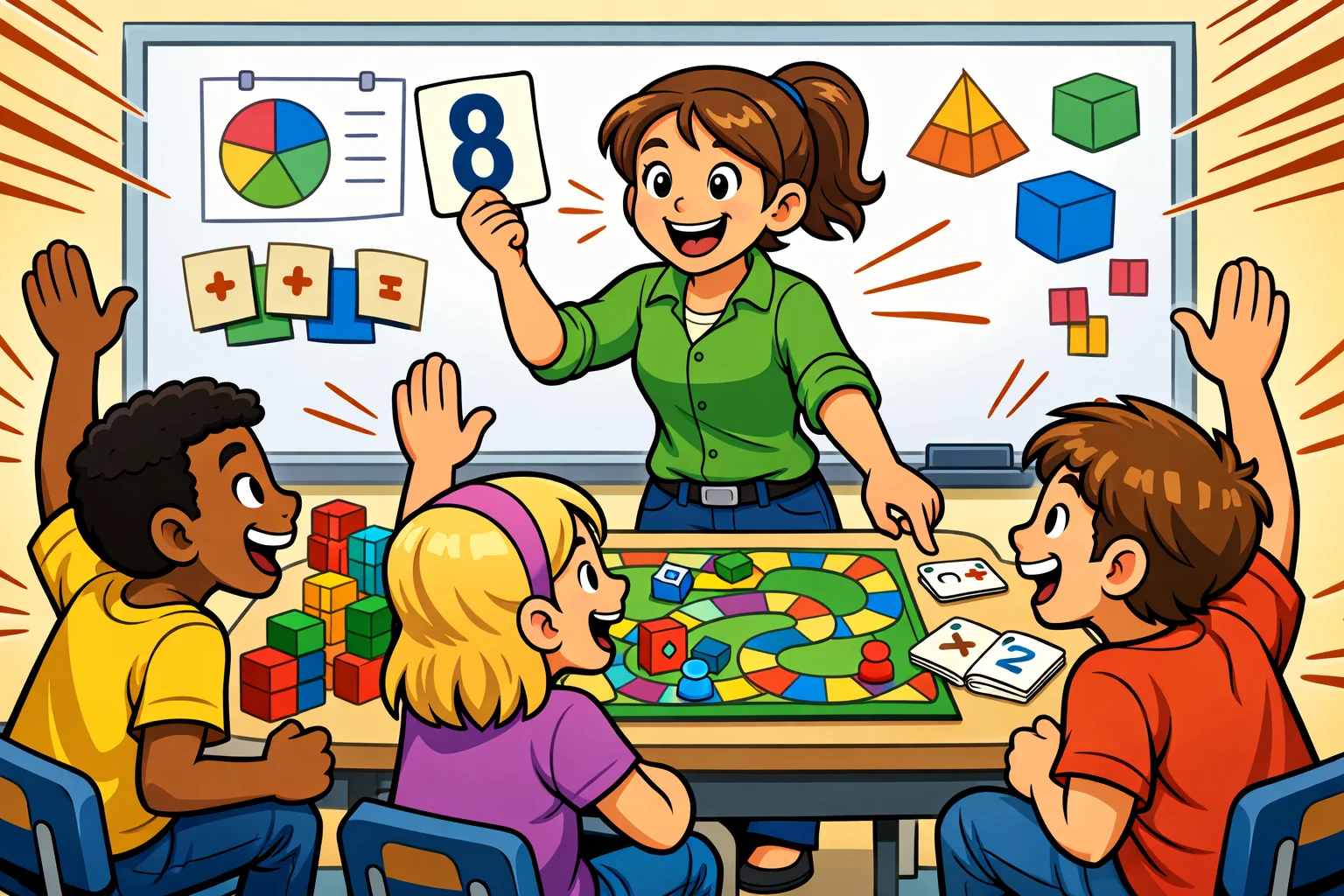
In math class, teachers use a variety of strategies to make learning engaging and accessible. Effective fifth-grade instruction relies on variety, movement, and hands-on learning.
Use Real-World Objects and Examples
Teachers can bring in empty cereal boxes to find the volume or use store circulars to practice decimal addition. When students work with physical objects, abstract ideas about area and perimeter become easier to understand. Analyzing local weather data or sports statistics helps students see that numbers are everywhere.
Use Hands-On Activities
Kinesthetic learning is vital for this age group. Teachers might use “paper nets” (2D shapes that fold into 3D objects) to explain geometry concepts. Number lines taped to the floor can help fifth graders physically ‘walk through’ fraction concepts and decimal reasoning, making the lesson more memorable.
Use Group Projects and Math Games
Collaborative learning encourages students to work through problems together. Scavenger hunts where children must solve an equation to find the next clue turn a standard review into an adventure. Team-based problem solving also allows stronger math students to mentor peers, reinforcing their own understanding in the process.
Use Technology for Differentiated Practice
Digital tools allow for personalized pacing. While one student might need extra help with whole numbers, another might be ready for enrichment in fraction operations, volume, or coordinate graphing. Technology provides the data teachers need to group students effectively and provide targeted interventions.
Essential Math Skills in Everyday Life
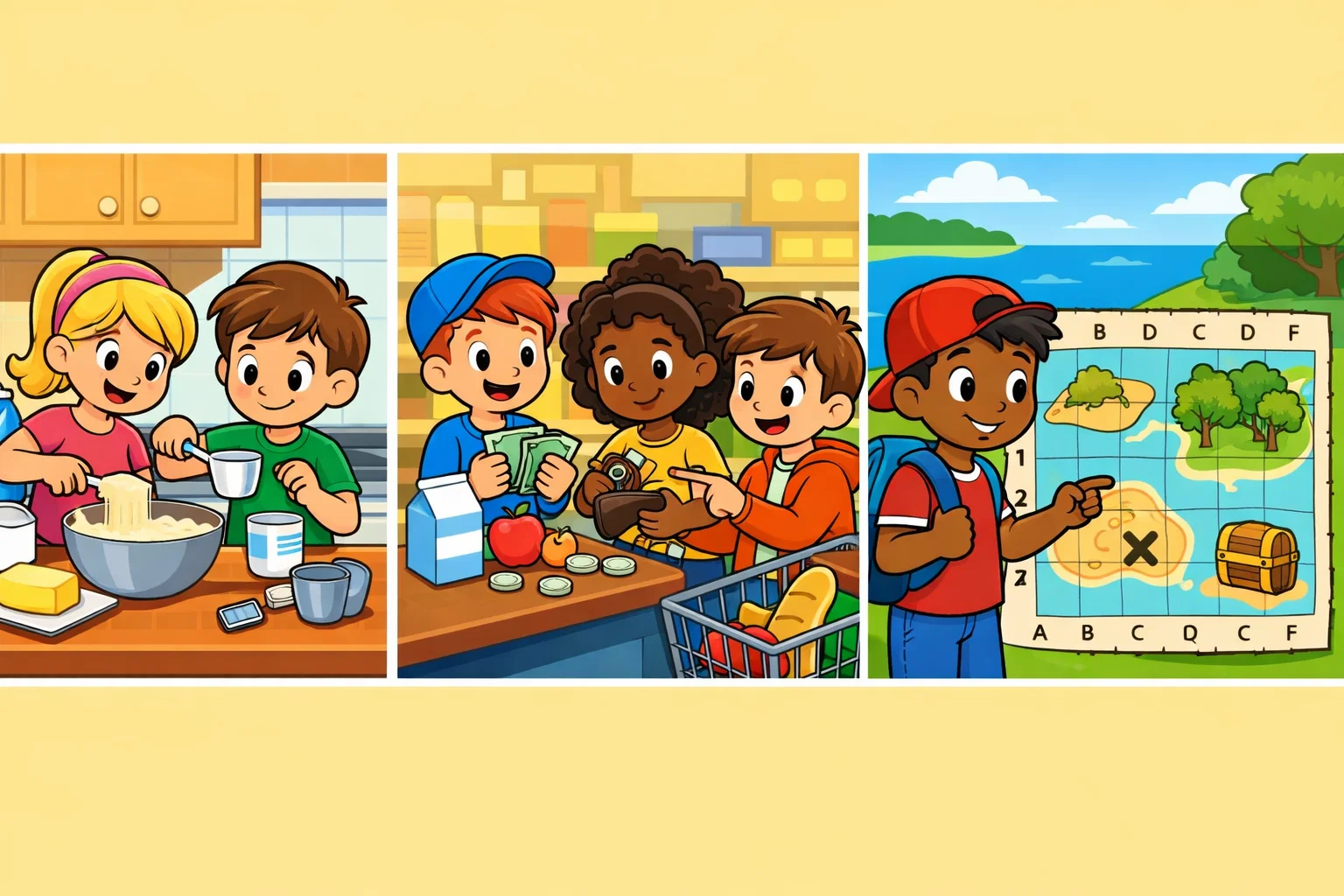
Fifth grade skills are remarkably practical. Highlighting these connections helps students understand why the math they learn in school matters.
Fractions in Cooking and Sharing
Scaling a recipe up or down is the perfect way to multiply and divide fractions. If a recipe for 4 people calls for ¾ cup of flour, a fifth grader can calculate how much is needed for 8 people (¾ × 2 = 1.5 cups). This turns the kitchen into a natural place to practice fraction concepts.
Decimals in Money and Shopping
Shopping is essentially a live math lesson in decimals. Students learn to compare prices (is $2.45 cheaper than $2.54?), calculate change, and understand discounts. This reinforces addition and subtraction skills in a real-world setting where accuracy matters.
Measurement in Sports, Travel, and Building
Whether it is tracking the yardage in a football game or measuring a room for new carpet, 5th graders use their skills to quantify the world. Calculating the travel time based on speed and distance involves multiplication and division, while building a birdhouse requires precise geometry and measurement of perimeter.
Coordinate Planes in Maps and Games
The logic used in the coordinate plane is exactly how digital maps and video games function. When kids learn to plot points, they begin developing spatial reasoning and graphing skills that also support later learning in technology-related fields. Many math games use grid systems to teach these geometry concepts effectively, showing that “plotting points” is the basis for game design.
Does 5th Grade Math Include Algebra or Calculus?
This is a common question from parents and students preparing for fifth grade. The short answer is: not formal algebra or calculus, but fifth grade does introduce early algebraic thinking.
In fifth grade, students work with numerical expressions, identify patterns and rules, use variables informally, and plot points on a coordinate plane. These are the building blocks of algebra, but the structured equation-solving and variable manipulation that most people associate with algebra class typically begins in 6th or 7th grade.
As for calculus, it is not part of the fifth grade curriculum. Calculus concepts such as limits, derivatives, and integrals require a strong foundation in algebra, geometry, and pre-calculus that students build over many years. A 5th grader is not expected to learn calculus, though some advanced learners may explore enrichment topics that touch on mathematical reasoning at a deeper level.
In summary, fifth grade math lays the groundwork for algebra through patterns, expressions, and graphing — but formal algebra and calculus come later.
Frequently Asked Questions About Fifth Grade Math
What should fifth graders know by the end of the year?
By the conclusion of the year, students should be able to perform all four operations with whole numbers, decimals, and fractions. They should also be able to find the volume of rectangular prisms, graph points on a coordinate plane, and use the order of operations to solve complex numerical expressions. These important math concepts are foundational for the following year.
Is 5th grade math journey hard for most kids?
The curriculum is often considered more difficult because it requires students to combine multiple math skills at once. For example, a single word problem might require a 5th grader to multiply a whole number by a decimal and then subtract that result from another value. The jump in multi-step problem solving is what makes fifth-grade math challenging for many students.
What are the most important 5th-grade skills?
The ‘big three’ usually include fraction and decimal fluency, understanding volume, and confidence with numerical expressions and multi-step problem solving. Proficiency in these areas strongly supports success in later middle school math.
How can parents help with homework?
One of the best ways to help is to act as a facilitator rather than simply giving answers. Ask them to “teach” you the math lesson they learned that day. Use visual models like drawing pictures or using coins to represent decimals. Breaking down large math problems into smaller, manageable chunks also helps prevent frustration.
How can teachers make the subject fun?
Incorporating math games, movement, and real-world problem solving can make the subject far more engaging. When teachers turn a lesson into a “math mystery” or a classroom shop, students become more engaged. Allowing for collaboration and using technology for interactive drills also keeps the energy high in the math class.
What common mistakes do 5th graders make?
Common errors include forgetting to find a common denominator when adding and subtracting fractions, misplacing the decimal point during multiplication and division, and ignoring grouping symbols in a numerical expression. Encouraging students to use estimation can help them realize if their final answer is “reasonable,” which is a core part of thinking critically in any scientific field.
How can my child excel in math in fifth grade?
The best way to help a child excel in math is through short, consistent practice and a strong focus on understanding concepts, not just memorizing steps. Visual models, word problems, and daily review can all strengthen problem-solving skills in math.
What does the fifth grade math curriculum usually include?
The fifth grade math curriculum typically includes fractions, decimals, volume, coordinate graphing, and multi-step numerical expressions. These important concepts help students build a strong foundation for future math.

Take a short quiz to find out what your everyday choices say about your parenting style
When your child is curious about something new, what’s your instinct?
Take a short quiz to find out what your everyday choices say about your parenting style
“Can I download this app?” What happens next?
Take a short quiz to find out what your everyday choices say about your parenting style
When it comes to rules at home, which sounds most like you?
Take a short quiz to find out what your everyday choices say about your parenting style
If you could give your child one life skill today, what would you pick?
Take a short quiz to find out what your everyday choices say about your parenting style
Your child gets to choose what to watch. What would your ideal setup look like?
Take a short quiz to find out what your everyday choices say about your parenting style
Pick your parenting superpower ✨