How to Teach Decimals to Children: 10 Practical Steps, Activities, and Examples

 Discover a Free Education Video App for Kids
Pastory uses AI to personalize educational video content based on your child’s interests and personality. Safe, engaging, and built for curious young minds. Sign up now to stay updated and enjoy early access with a free trial
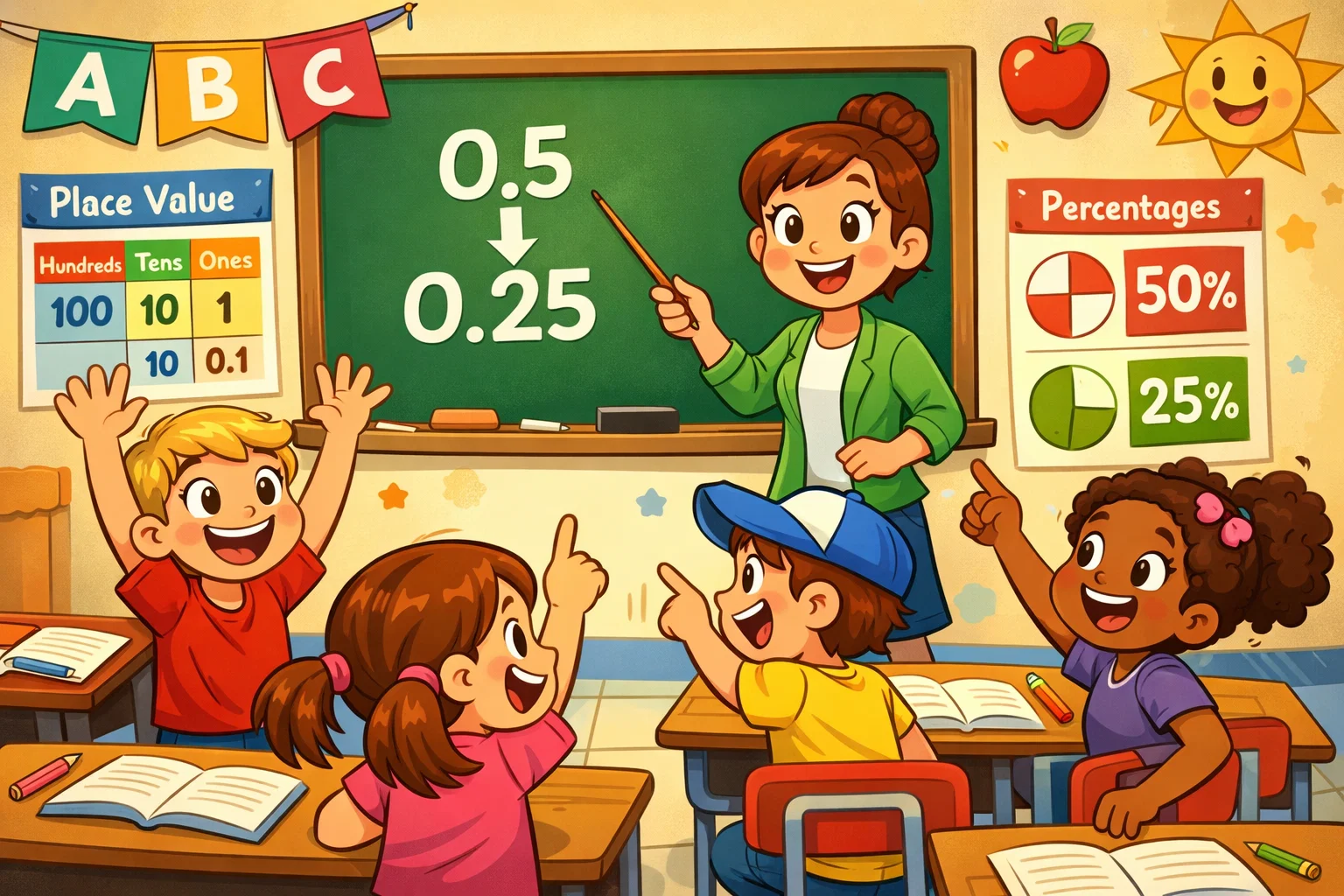
Helping children move beyond working only with whole numbers is a major step in maths. At first, many pupils are comfortable counting objects, comparing larger and smaller numbers, and solving simple problems with whole numbers. The challenge begins when they encounter values that fall between whole numbers. This is where progress often slows down in many classrooms, because children need more than a rule to follow. They need clear models, familiar examples, and repeated practice.
This comprehensive guide is designed for parents and teachers who want practical, classroom-friendly ways to teach decimals. It explains the topic step by step, connects it to fractions, and shows how to use visuals, talk routines, and simple games to build understanding. The aim is not only to help children get correct answers, but to help them explain what they are doing and why it makes sense. In primary school, especially in Year 4 and Year 5, this topic becomes important because it connects number sense, measurement, money, and problem-solving. Once children build confidence here, later topics such as percentages, ratio and proportion, and algebra often feel much less intimidating.
What a Decimal Number Means
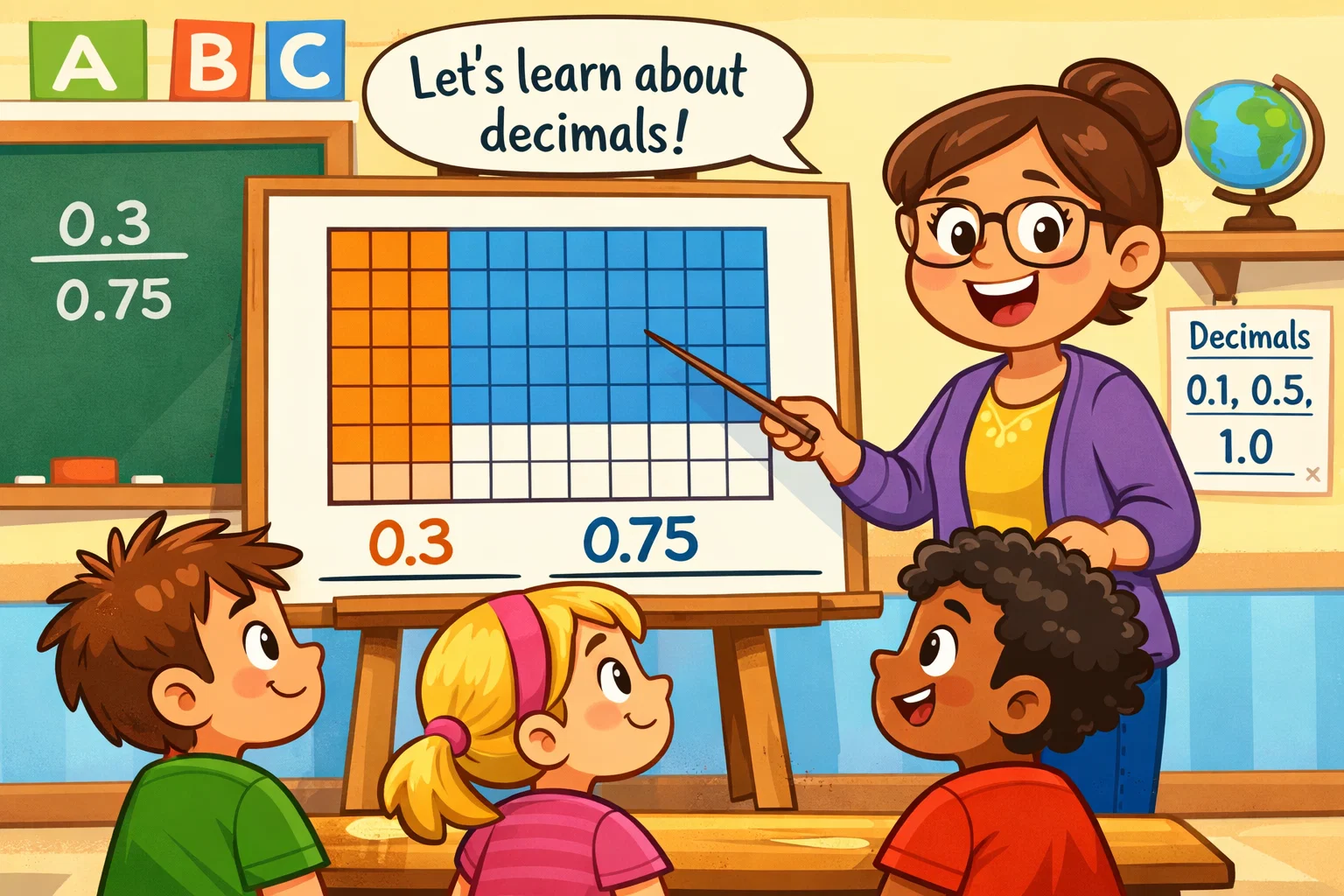
A decimal number can show a value that is not a whole number. It can represent a smaller quantity, such as 0.5, 0.1, or 0.01, and helps children describe amounts more precisely than whole numbers alone.
The easiest way to explain this is through the idea of a part of a whole. If one whole is cut into ten equal parts, each part is a tenth. If the whole is cut into one hundred equal parts, each small piece is a hundredth. If we keep going, we move on to thousandths. Children usually understand this much faster when they can see it, touch it, or draw it.
This is also why it helps to teach fractions and decimals side by side. Children already know that one half means one of two equal parts. They can then see that 1/2 and 0.5 describe the same amount in different ways. The same link works for 1/10 and 0.1, or 1/100 and 0.01. Moving back and forth between these forms supports flexible thinking and prevents the topic from feeling abstract too early.
The decimal point matters because it marks the shift from whole numbers to smaller parts of a whole. The number before the decimal point tells us how many complete units we have. The digits after the decimal point tell us about the smaller pieces. In place-value language, the whole-number part sits to the left of the decimal point, while the fractional part sits in the places to the right.
Why Children Often Find This Topic Difficult
Many pupils are confident with whole numbers, but lose confidence when a decimal point appears in the middle. One reason is that they try to apply whole-number logic to a new idea.
For example, a child may think 0.125 is larger than 0.5 because 125 is larger than 5. This mistake is very common and shows that the child is looking at the digits without thinking about value and position. It is not enough for children to copy methods. They need to see how the structure works.
Another problem is language. Some children hear “point” and treat the two sides as unrelated pieces. Others read the number as a string of digits without understanding the value each position carries. That is why classroom talk matters so much. Instead of reading everything in the quickest possible way, teachers often need to slow down and use place-value wording.
Children also need time. A topic like this cannot be mastered in one lesson. Pupils benefit from seeing it in money, measurement, area models, and spoken explanations. Once they realise that the same idea appears in different settings, their confidence grows quickly.
Decimal Place Value Made Clear
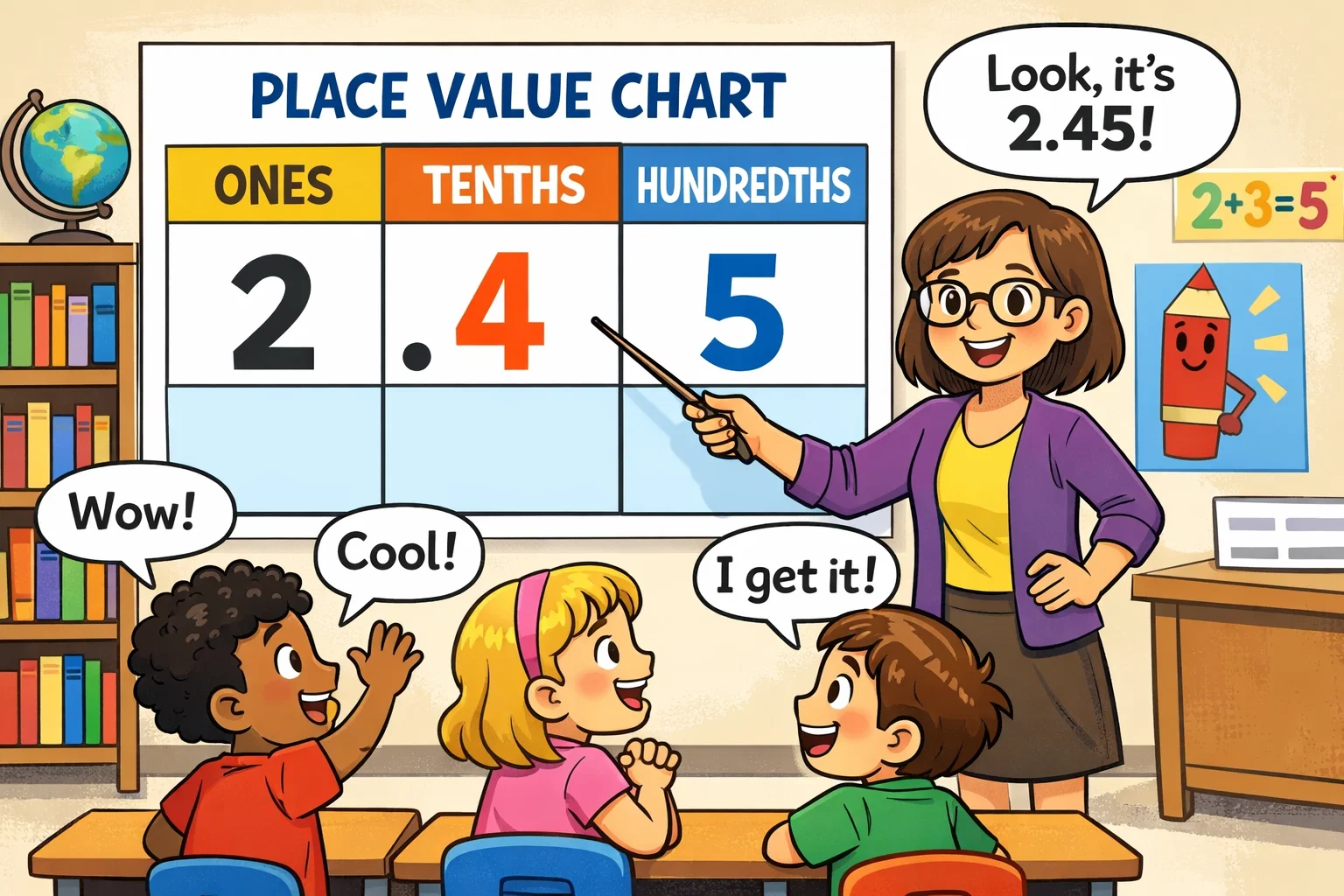
The heart of the topic is decimal place value. This is really just an extension of the system children already know. In base ten, every step to the left makes a value ten times greater. Every step to the right makes a value ten times smaller.
That means the value of each digit depends on its position. A digit does not mean the same thing in every place. The same symbol can stand for ones, tenths, or hundredths depending on where it appears. This is a powerful idea, and children need to meet it again and again in different forms.
Around the decimal point, the sequence usually goes like this:
- ones
- decimal point
- tenths
- hundredths
- thousandths
This is why teachers talk about place values rather than just digits in a row. A child with a good understanding of decimal structure can explain not only what a number represents, but why it is written that way.
One of the most useful tools here is a place value chart. When teachers use a place value chart, the structure becomes visible. Children can line numbers up correctly and see what each column means. Many classrooms rely on place value charts because they reduce confusion and support both speaking and written work.
| Hundreds | Tens | Ones | . | Tenths | Hundredths | Thousandths |
| 0 | 1 | 3 | . | 4 | 5 | 2 |
In this example, the 1 is in the tens column, the 3 is in the ones column, the 4 is in the tenths column, the 5 is in the hundredths column, and the 2 is in the thousandths column. Looking at it this way helps children see the specific place and value of each symbol.
It is also a useful moment to read a decimal in a meaningful way. Instead of racing through the digits, teachers can read it as ‘thirteen and four hundred and fifty-two thousandths.’ That language supports both accuracy and understanding.
Using Visual Models That Help Children See the Idea
Before symbols, children need models. Using visual aids is one of the most effective ways to build early confidence. A good model turns an abstract idea into something a child can point to, shade, compare, and discuss.
A grid with 100 equal squares is one of the best tools because it allows children to represent parts of a whole. If 10 squares are shaded, children can see one tenth. If 1 small square is shaded, they can see one hundredth. A full hundred-square model also makes it easier to compare sizes visually.
Other useful tools include:
- a number line
- money and prices
- base-ten blocks
- counters
- fraction strips
- any hands-on resource that helps children build and compare amounts
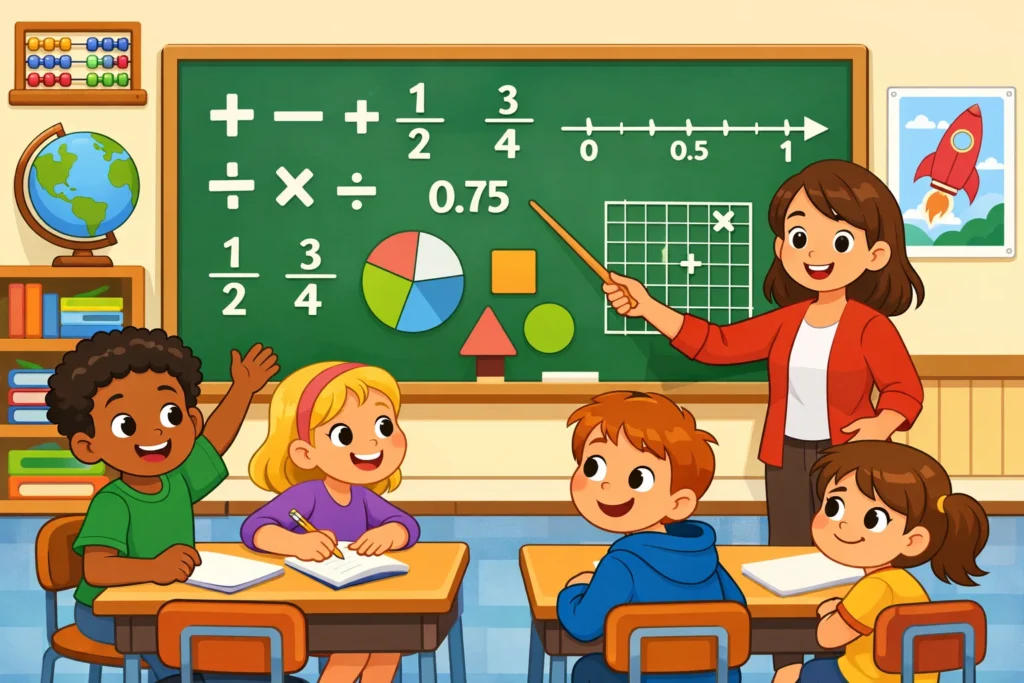
A number line is especially useful for comparison and estimation. When children place values between 0 and 1, they begin to understand relative size. They can see that 0.5 sits halfway between 0 and 1, and that 0.75 is closer to 1 than to 0.
Money is another effective teaching context. Children often understand that 50p is half of £1 long before they can explain the notation formally. Familiar situations reduce anxiety and make the topic feel useful rather than purely academic.
This is why strong teaching often combines area models, linear models, and real-life examples. Different children notice different things, and variety helps the whole class.
10 Progressive Steps for Teaching the Topic Well
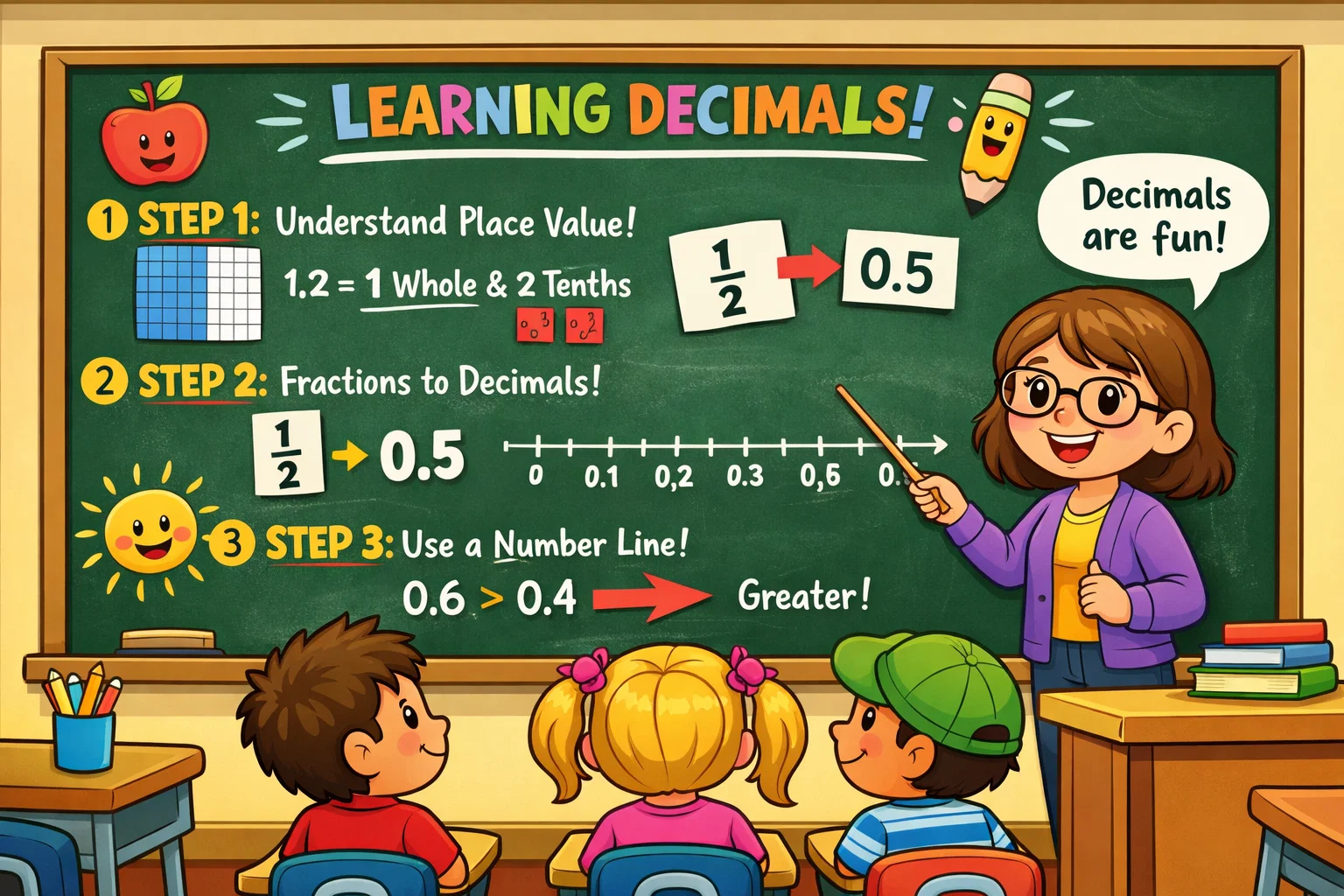
1. Start with one whole split into ten parts
Begin with one unit and divide it into ten equal pieces. Let children point to one tenth, then two tenths, then more. Keep the conversation concrete at first.
2. Move from tenths to hundredths
Once tenths make sense, divide the same unit into smaller equal parts. This is a natural way to introduce a hundredth and show how it compares with a tenth.
3. Connect spoken language to symbols
Say “three tenths” and then show the written form. Let children hear and see the idea together.
4. Connect fractions to decimals
Show simple equivalents such as 1/10 and 0.1, 1/2 and 0.5, 1/100 and 0.01. This helps children see that the notation represents a real quantity.
5. Connect decimals to fractions
Go in the other direction too. If children see 0.6, help them write 6/10 and simplify it. This supports flexible thinking and strengthens number sense.
6. Compare values carefully
Ask children to compare pairs such as 0.5 and 0.45, or 0.4 and 0.39. Encourage them to explain how they know.
7. Use models and a number line
Plot values, estimate positions, and discuss which is greater, smaller, or closer to a benchmark.
8. Practise speaking with place-value language
Instead of always saying digits one by one, encourage phrases such as “six tenths” or “twenty-five hundredths.” This helps children understand decimals more deeply.
9. Teach rounding decimals
Once pupils know place value, they can begin rounding decimals sensibly and explain which position they are rounding to.
10. Move into operations
Only after the concept is secure should teachers focus on adding and subtracting decimals, and later on dividing decimals.
How to Teach Operations Without Confusion
A common mistake is moving too quickly into written methods. Children first need to know what the positions mean. Once that is secure, operations become much easier.
For addition and subtraction, the main rule is to line up the decimal point. This keeps like with like: ones under ones, tenths under tenths, hundredths under hundredths.
Example:
4.50 – 1.25 = 3.25
This kind of layout helps children see why zeros can act as placeholders. It also prevents them from mixing different positions together.
Later, when children begin dividing decimals, they need the same secure understanding of place value. Without that foundation, the procedure can feel random. With it, the method becomes much easier to explain and remember.
Classroom Language That Supports Understanding
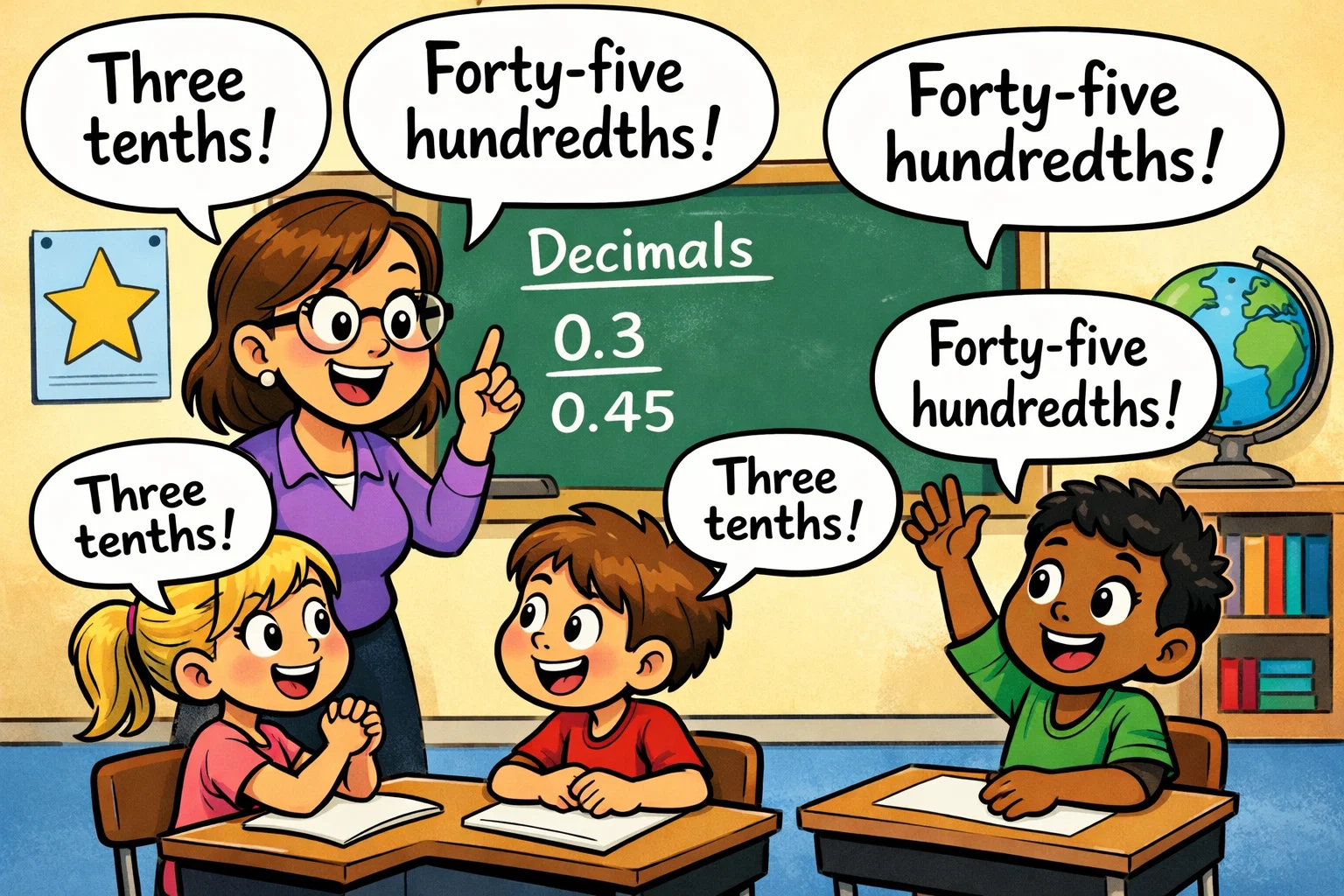
Teacher talk can either clarify the concept or make it harder to understand. Quick speech often hides meaning, while careful language makes structure visible.
Useful prompts include asking pupils what each digit means, giving them a model and asking them to write the value, asking them to explain which value is greater and why, and pausing to ask what changed when a digit moved to a new position.
This is especially helpful in KS2 maths, where reasoning and explanation matter just as much as getting the right answer.
Instead of only saying “point,” teachers can mix in place-value language:
- 0.7 as seven tenths
- 0.25 as twenty-five hundredths
- 1.04 as one and four hundredths
This gives children a better sense of structure and helps with later conversion work.
Real-Life Examples That Make the Topic Feel Useful
Children learn more confidently when the lesson connects to everyday life. Strong everyday examples include:
- money and change
- height and length
- cooking and measurement
- time recorded on stopwatches
- distances in sport
- shopping totals and discounts
These situations show why people use decimal notation in real life. They also help children notice that numbers can describe quantities with more precision than whole units alone.
A shopping task can be especially effective. Children compare prices, estimate totals, and work out change. A measurement lesson can also work well because pupils can physically compare lengths, masses, or capacities.
The more often children encounter the idea in practical settings, the more natural it becomes.
Common Mistakes Teachers Should Avoid
There are a few classroom habits that often create confusion:
- introducing symbols before models
- skipping the link between fractions and decimals
- focusing only on procedures
- rushing into written subtraction
- ignoring speaking routines
- not revisiting comparison often enough
Children need to know that decimals represent amounts, not just written forms on a page. They also need to see that a decimal number represents a quantity built from units and smaller equal parts.
If teachers slow down, revisit models, and keep the language precise, many of these problems disappear.
Skills Worth Practising Again and Again
Over time, children should become able to:
- compare values on a number line
- explain the value of each digit
- identify tenths and hundredths
- work with hundredths and thousandths
- record decimal values accurately in written work
- connect fractions to decimals
- work back from decimals to fractions
- notice when one place is ten times smaller than another
- explain the relationship between decimals and fractions
- name the places to the right of the decimal point confidently
This repeated practice helps children move from recognition to real fluency.
Final Thoughts
Children do best when the topic is introduced gradually, practised in different formats, and linked to things they already understand. Good teaching does not rely on memorising rules too early. It starts with models, moves into precise language, and then develops written methods.
A strong sequence uses place value, connects fractions and decimals, and gives children plenty of time to discuss, compare, estimate, and explain. With that support, pupils become more accurate, more confident, and more willing to tackle unfamiliar problems later on.
When the goal is true understanding rather than speed alone, children usually make much stronger progress.
Frequently Asked Questions
What are the best ways to teach decimals?
The best approaches combine visuals, spoken explanation, real-life contexts, and short repeated practice. Children usually learn fastest when they can see, say, and apply the idea.
How can I help children learn decimals in Year 4?
Keep the focus on tenths, simple hundredths, models, and clear classroom talk. Do not rush into procedures too early.
What should children be doing in Year 5?
In year 5, children often go further with comparison, ordering, conversions, rounding decimals, and problem solving with measurement and money.
How do I explain decimal places?
Explain that each place to the right of the decimal point has a name and a value. Children need to know that each step is ten times smaller than the one before.
What is the role of decimal place value?
It shows how the same digit changes meaning depending on where it is placed. Without this, written methods feel mechanical and confusing.
How do I help children convert fractions to decimals?
Start with familiar examples such as 1/2, 1/10, and 1/100. Use models first, then symbols.
How do I teach children to convert decimals to fractions?
Ask children what the last place tells them. If the last place is hundredths, the fraction is over 100. This makes conversion more logical.
How can children convert decimals with confidence?
They need regular practice moving between written form, spoken form, fractions, models, and number lines.
Why is a place value chart useful?
When teachers use a place value chart, children can line values up clearly and see each position.
Why do some pupils still compare values incorrectly?
Often they are looking only at the digits rather than the place each one occupies.
Take a short quiz to find out what your everyday choices say about your parenting style
When your child is curious about something new, what’s your instinct?
Take a short quiz to find out what your everyday choices say about your parenting style
“Can I download this app?” What happens next?
Take a short quiz to find out what your everyday choices say about your parenting style
When it comes to rules at home, which sounds most like you?
Take a short quiz to find out what your everyday choices say about your parenting style
If you could give your child one life skill today, what would you pick?
Take a short quiz to find out what your everyday choices say about your parenting style
Your child gets to choose what to watch. What would your ideal setup look like?
Take a short quiz to find out what your everyday choices say about your parenting style
Pick your parenting superpower ✨