Inspiring Female Role Models for Kids: 25 Women Every Child Should Know

 Discover a Free Education Video App for Kids
Pastory uses AI to personalize educational video content based on your child’s interests and personality. Safe, engaging, and built for curious young minds. Sign up now to stay updated and enjoy early access with a free trial
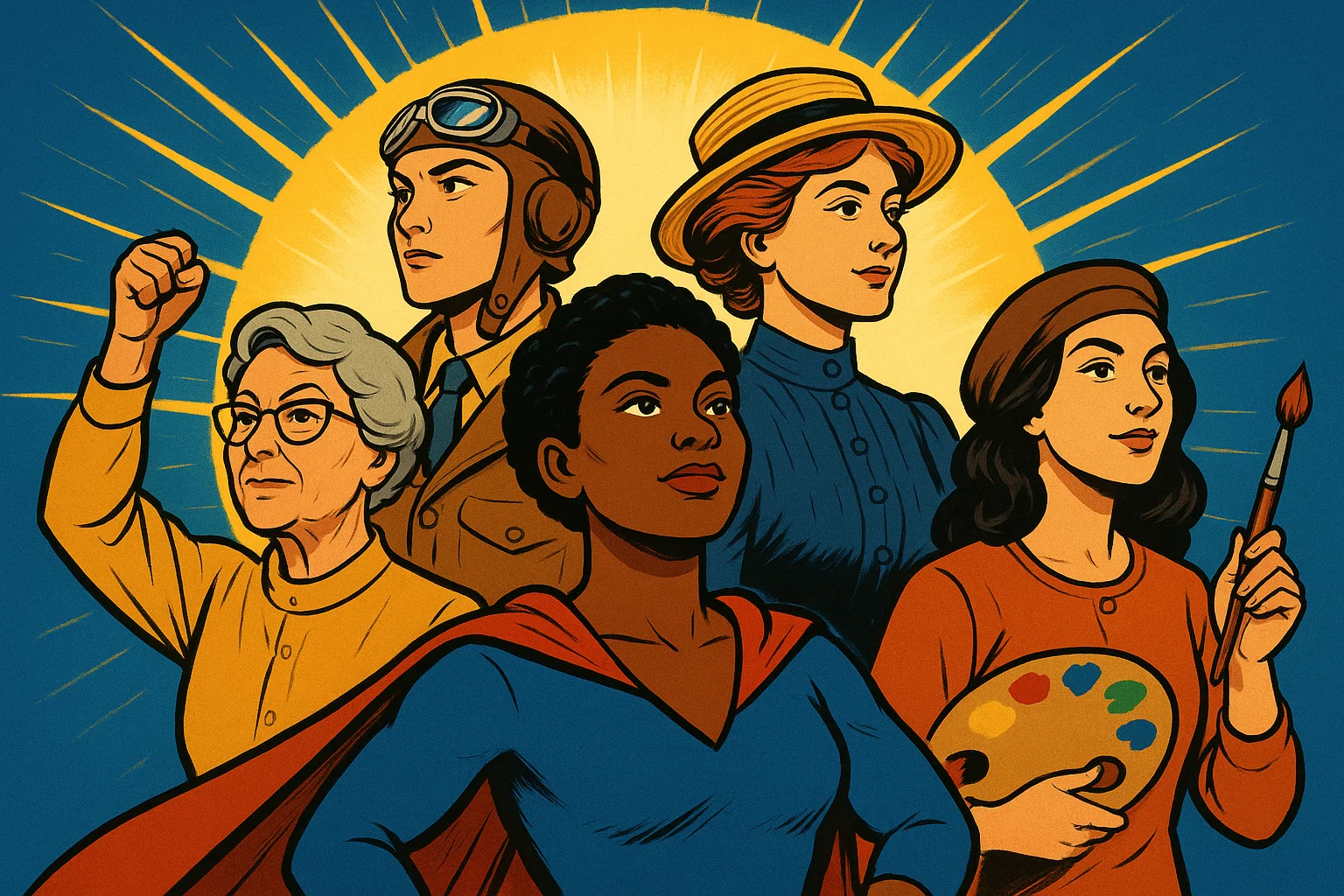
Children begin forming beliefs about their abilities, career possibilities, and social roles early in life. When parents and teachers introduce inspiring female role models for kids across science, sports, activism, leadership, the arts, exploration, and everyday courage, they significantly expand a child’s horizons. Exposure to these stories helps children understand that gender is not a barrier to achievement.
This comprehensive guide gives parents, teachers, and caregivers a curated list of historical icons, modern changemakers, and global figures. It also offers practical activity ideas that turn these achievements into memorable lessons for the next generation.
Key Takeaways
- Holistic Development: Female role models can help kids build confidence, curiosity, resilience, and empathy, supporting emotional and social growth.
- Diverse Fields: Strong role models come from many areas, including science, sports, politics, art, education, activism, and exploration.
- Interactive Learning: Each story can become a simple family or classroom activity that supports retention and critical thinking.
- Broader Representation: The list includes women from different cultures, eras, and backgrounds, helping children build a wider worldview.
- Practical Activities: Parents and educators can use books, videos, crafts, discussion prompts, and projects to make these stories memorable.
Quick List: Inspiring Female Role Models for Kids
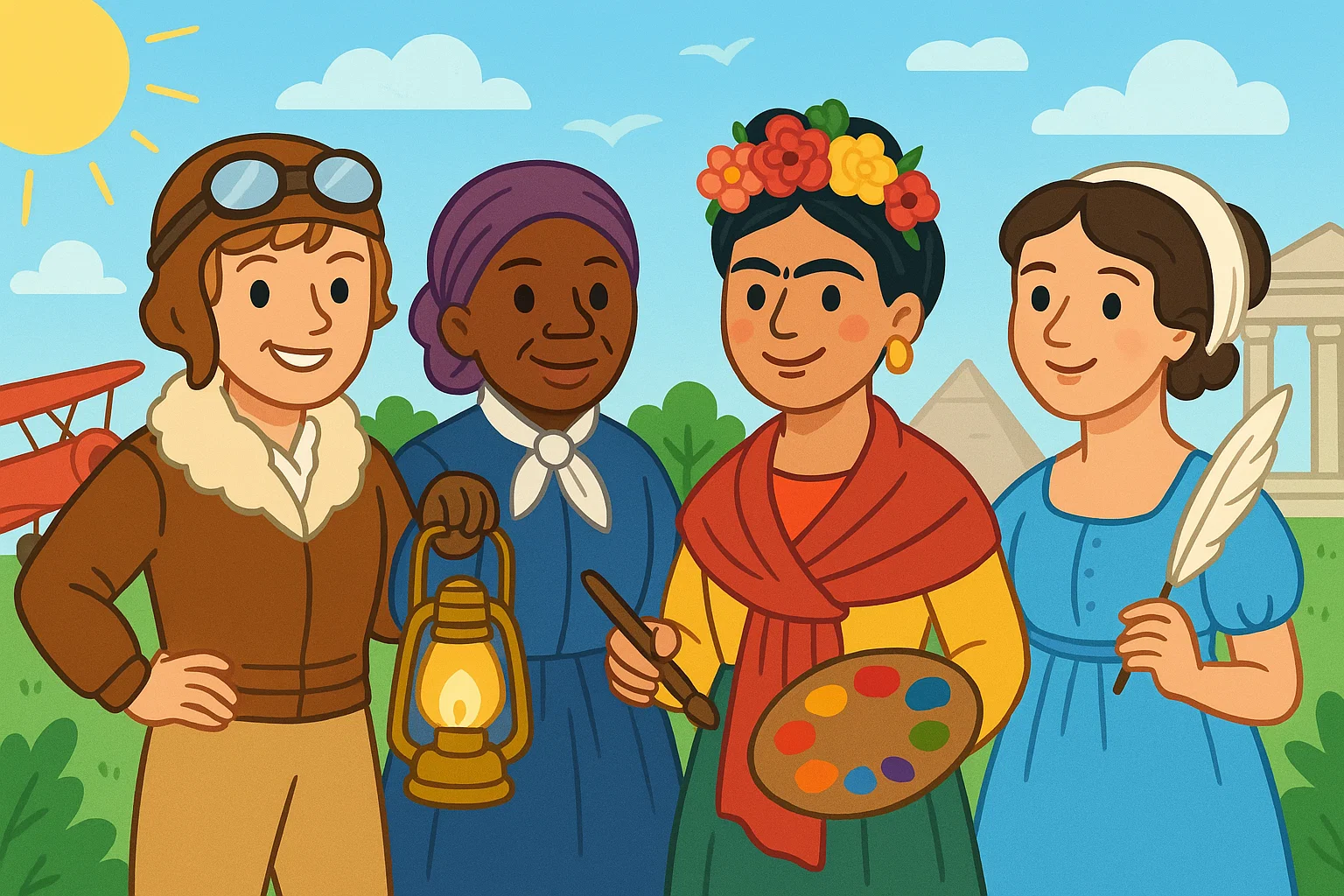
- Marie Curie: The first woman to win a Nobel Prize, whose pioneering research transformed the study of radioactivity and led to major discoveries about radium and polonium.
- Ada Lovelace: A mathematician widely recognized as an early pioneer of computer programming, who combined mathematical logic with creative imagination.
- Grace Hopper: A pioneering computer scientist who developed one of the first compilers and helped make programming more accessible.
- Sally Ride: The first American woman to travel to space, proving that STEM careers belong to everyone.
- Kalpana Chawla: The first Indian-born woman in space, whose journey inspires global scientific ambitions.
- Katya Echazarreta: The first Mexican-born woman to travel to space, showcasing modern engineering pathways.
- Rosalind Franklin: A chemist and X-ray crystallographer whose meticulous work provided crucial evidence for the double-helix structure of DNA.
- Emmanuelle Charpentier and Jennifer Doudna: Joint Nobel Prize winners who developed the CRISPR-Cas9 genome-editing tool.
- Malala Yousafzai: A Pakistani activist and the youngest Nobel Peace Prize laureate, who fights for girls’ education globally.
- Rosa Parks: A civil rights icon whose deliberate refusal to give up her bus seat catalyzed the American civil rights movement.
- Harriet Tubman: A courageous abolitionist born into slavery who led many enslaved people to freedom via the Underground Railroad.
- Rani Lakshmi Bai: A fearless queen and warrior who became a symbol of resistance in Indian history.
- Emmeline Pankhurst: A British political activist who organized the suffragette movement to secure women’s voting rights.
- Coretta Scott King: An author and activist who led long-term human rights campaigns and carried forward the legacy of the civil rights movement.
- Ruth Bader Ginsburg: A pioneering Supreme Court justice who spent her career advocating for gender equality.
- Michelle Obama: A lawyer, author, and former First Lady who uses her public platform to advocate for education, health, and youth empowerment.
- Serena Williams: One of the greatest tennis champions of all time, who won 23 Grand Slam singles titles through discipline and resilience.
- Megan Rapinoe: A retired Olympic gold medalist and World Cup champion who used her athletic platform to advocate for equal pay.
- Mary Kom: An Indian boxer who overcame poverty and stereotypes to win eight World Championship medals.
- Frida Kahlo: A world-renowned painter who transformed physical pain and personal adversity into vibrant, iconic artwork.
- Maya Angelou: An influential poet and civil rights activist whose powerful writing provides comfort and inspires social change.
- Amanda Gorman: The youngest inaugural poet in U.S. history, who uses poetry to drive youth leadership and civic hope.
- Amelia Earhart: An aviation pioneer who became the first woman to fly solo across the Atlantic Ocean.
- Jane Goodall: A primatologist and conservationist whose patient observation of chimpanzees revolutionized animal science.
- Greta Thunberg: A Swedish environmental activist who started a global youth movement demanding action on climate change.
Role Model Categories
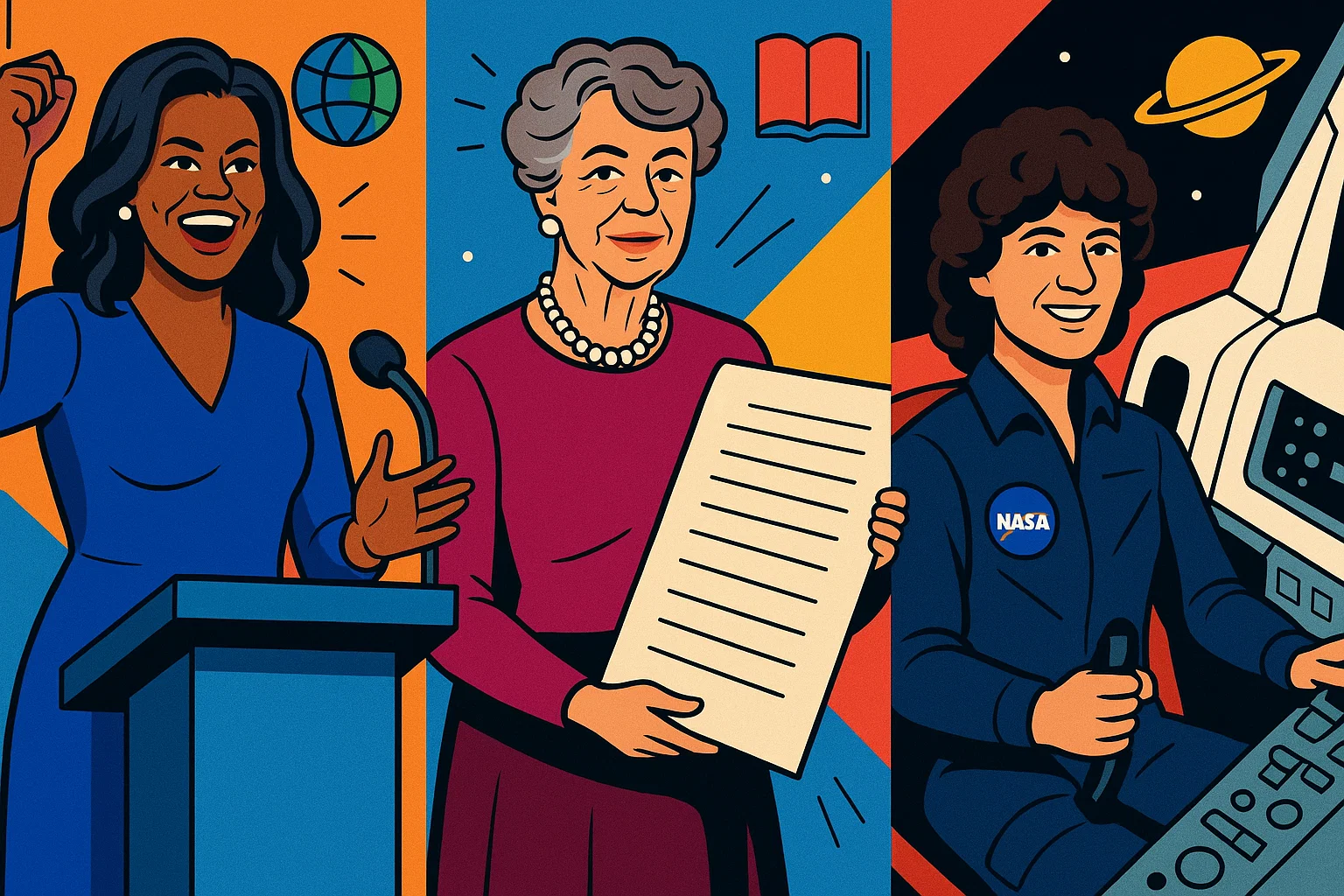
Science, Space, and Technology
This group highlights analytical thinking, innovation, and technological progress. It features Marie Curie, Ada Lovelace, Grace Hopper, Sally Ride, Kalpana Chawla, Katya Echazarreta, Rosalind Franklin, Emmanuelle Charpentier, and Jennifer Doudna.
Courage, Rights, and Leadership
This group emphasizes social justice, civic courage, and responsibility. It features Malala Yousafzai, Rosa Parks, Harriet Tubman, Rani Lakshmi Bai, Emmeline Pankhurst, Coretta Scott King, Ruth Bader Ginsburg, and Michelle Obama.
Sports, Arts, and Creativity
This group highlights physical discipline, resilience, creativity, and emotional self-expression. It features Serena Williams, Megan Rapinoe, Mary Kom, Frida Kahlo, Maya Angelou, and Amanda Gorman.
Exploration, Nature, and Service
This group covers environmental conservation, exploration, service, and care for the natural world. It features Amelia Earhart, Jane Goodall, and Greta Thunberg.
Why Kids Should Learn About Inspiring Women
Builds Confidence in Girls and Boys
Diverse representation can expand a child’s perception of possible career paths. When children learn about women solving complex problems, leading communities, making discoveries, or winning championships, they begin to challenge narrow ideas about gender roles. Seeing diverse leadership models can build self-confidence and help children understand that effort, curiosity, and persistence matter more than gender.
Shows Many Paths to Success
True achievement is not only about fame or money; it can also include empathy, persistence, creativity, and service to others. Learning about inspiring women shows children that success can take many forms, including community service, artistic expression, scientific curiosity, and everyday courage. This perspective encourages a growth mindset and helps children value learning, resilience, and personal growth.
Supports School Learning Across Subjects
Integrating stories of influential women from around the world into a child’s routine can enrich learning across the curriculum. Connecting historical figures to science, reading, history, and geography can turn abstract textbook concepts into relatable human stories.
| Academic Subject | Associated Role Model | Educational Connection |
| Science and STEM | Marie Curie / Rosalind Franklin | Teaches the scientific method, chemistry, and genetics. |
| Social Studies | Harriet Tubman / Rosa Parks | Illustrates the civil rights movement and historical struggles for liberty. |
| Language Arts | Maya Angelou / Amanda Gorman | Demonstrates the power of poetry, metaphor, and persuasive public speaking. |
| Geography | Amelia Earhart / Kalpana Chawla | Explores maps, flight routes, space travel, and cross-cultural journeys. |
How Parents and Kids Can Explore Inspirational Women
Read Books About Female Role Models
Parents can introduce biographical picture books or curated anthologies during evening reading routines. Narrative biographies can help children build vocabulary while learning to recognize character traits such as courage and determination. Caregivers should select books with vibrant illustrations and simple text for younger readers, then transition to chapter-book biographies for older children.
Watch Short Videos About Incredible Women
Educational platforms often offer animated biographies, historical footage, and kid-safe interviews that help bring historical figures to life. Curated video content provides visual learners with context about different historical eras. Parents should preview video content to make sure the historical descriptions are age-appropriate and do not include overly graphic depictions of hardship.
Create a Role Model Journal
A simple reflection journal helps children process and remember what they learn about famous women in history. The child can dedicate one page to each historical figure, recording key facts and personal insights.
- Name: Write the role model’s name.
- Field of Work: Identify the specific field, such as aviation, molecular biology, poetry, or sports.
- Major Obstacle: Describe one major challenge the person faced.
- Key Achievement: List one important achievement or milestone.
- Personal Takeaway: Write one sentence explaining what the child can practice in their own life.
Turn Stories Into Family Discussions
Mealtimes or car rides are good opportunities to turn stories into open-ended conversations. Parents can present simple questions that prompt children to think about choices made by historical figures.
Discussion Prompt: “If you could ask Malala Yousafzai one question about speaking up for education, what would you ask?”
25 Inspiring Female Role Models for Kids
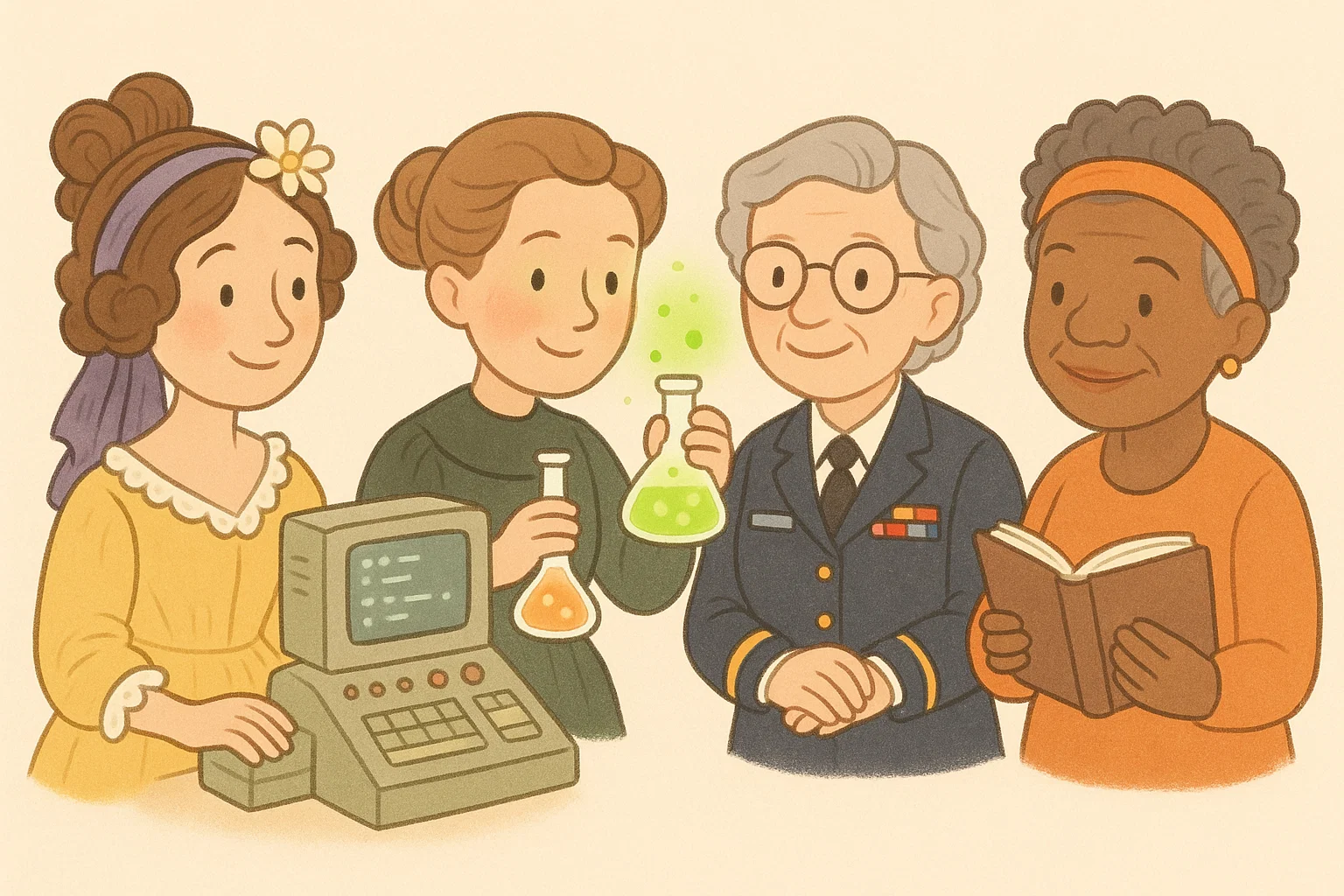
1. Marie Curie
Marie Curie was a Polish-born, naturalized French physicist and chemist who conducted pioneering research on radioactivity. She became the first woman to win a Nobel Prize and remains the only person to win Nobel Prizes in two distinct scientific fields: Physics and Chemistry. Despite poverty and institutional discrimination, Curie pursued her scientific work with extraordinary persistence.
- Kid-Friendly Lesson: Groundbreaking discoveries require patience, thorough experimentation, and brave questions.
- Activity Idea: Create a simple timeline of Curie’s discoveries or use glow-in-the-dark stickers to discuss how some materials release stored energy, while explaining that radioactivity is different and should only be studied safely by scientists.
2. Ada Lovelace
Ada Lovelace was an English mathematician and writer chiefly known for her work on Charles Babbage’s mechanical computer, the Analytical Engine. Lovelace wrote what is widely considered the first algorithm intended for a machine, earning her recognition as an early pioneer of computer programming. She described her approach as “poetical science,” combining mathematical logic with vivid imagination.
- Kid-Friendly Lesson: Analytical thinking and creative imagination work together to solve complex technological problems.
- Activity Idea: Write a “human code” sequence using simple arrows on paper to guide a family member step by step through a living room obstacle course.
3. Grace Hopper
Grace Hopper was an American computer scientist and U.S. Navy rear admiral who helped pioneer early programming technologies. Hopper developed one of the first compilers, helping translate symbolic or English-like instructions into machine-readable code and making programming more accessible. She is also associated with the famous “debugging” story involving a moth found in an early computer, though the word “bug” was already used in engineering.
- Kid-Friendly Lesson: True innovation begins when you look at an existing system and ask how it can be simplified.
- Activity Idea: Look at an everyday household appliance and draw a diagram showing how to improve its design for younger users.
4. Sally Ride
Sally Ride was an American astronaut and physicist who joined NASA in 1978 as part of the first class of astronauts to include women. In 1983, she became the first American woman in space and helped operate the space shuttle’s robotic arm during the mission. Ride dedicated her later years to creating educational programs designed to inspire the next generation to pursue STEM careers.
- Kid-Friendly Lesson: Science, technology, engineering, and mathematics dreams belong to every child, regardless of gender.
- Activity Idea: Use cardboard, string, and recycled plastic containers to build a model space shuttle arm that can lift small household items.
5. Kalpana Chawla
Kalpana Chawla was an Indian-born American astronaut and engineer who became the first Indian-born woman to fly in space. Moving from India to the United States to pursue aerospace engineering, Chawla logged more than 30 days in space across her missions. She maintained a lifelong passion for aviation, encouraging students from her hometown to dream big.
- Kid-Friendly Lesson: Global scientific dreams can grow from childhood curiosity and international educational pursuits.
- Activity Idea: Locate India and the United States on a world map, then draw a simple orbit around Earth to show how a spacecraft travels in space.
6. Katya Echazarreta
Katya Echazarreta is a Mexican-born electrical engineer, science communicator, and citizen astronaut who contributed to NASA missions while working at the Jet Propulsion Laboratory. Echazarreta made history in 2022 by becoming the first Mexican-born woman to travel to space on a suborbital flight. She also advocates for broader access to STEM education and space exploration opportunities, especially for Latin American communities.
- Kid-Friendly Lesson: Modern role models prove that engineering and space exploration are reachable real-world goals for diverse communities.
- Activity Idea: Build a basic electronic circuit using a battery, wires, and a small LED bulb to practice basic engineering principles.
7. Rosalind Franklin
Rosalind Franklin was a British biophysicist and X-ray crystallographer whose work was critical to understanding the structure of DNA. Franklin and her PhD student Raymond Gosling captured “Photo 51,” an X-ray diffraction image that provided crucial evidence for DNA’s double-helix structure. Although Franklin did not receive full recognition during her lifetime, her careful work remains a cornerstone of modern biology.
- Kid-Friendly Lesson: Meticulous, accurate work is valuable and essential, even when public recognition arrives later.
- Activity Idea: Use twisted pipe cleaners or colorful modeling clay to construct a physical model of a DNA double-helix structure.
8. Emmanuelle Charpentier and Jennifer Doudna
Emmanuelle Charpentier and Jennifer Doudna are scientists who collaborated across international borders to study bacterial immune systems. They jointly received the 2020 Nobel Prize in Chemistry for developing CRISPR-Cas9, a powerful genome-editing tool often described as “genetic scissors.” The tool allows scientists to edit DNA with precision, helping researchers explore complex questions in genetics and health.
- Kid-Friendly Lesson: Collaborative scientific partnerships can create tools that solve significant healthcare and biological challenges.
- Activity Idea: Play a game of “genetic editing” by using safety scissors to cut and swap specific colored segments of paper strips.
9. Malala Yousafzai
Malala Yousafzai is a Pakistani activist for girls’ education who openly defied restrictions on girls attending school in her region. As a teenager, she survived targeted violence and turned her experience into a global campaign for education and human rights. Yousafzai became the youngest Nobel Peace Prize laureate in history, demonstrating that youth voices carry immense power.
- Kid-Friendly Lesson: A single young voice, backed by courage and determination, can influence international conversations about education.
- Activity Idea: Write an encouraging letter or draw a picture advocating for equal access to books for children around the world.
10. Rosa Parks
Rosa Parks was an American civil rights activist whose arrest for refusing to surrender her bus seat sparked the Montgomery bus boycott. Parks acted with dignity and a deep commitment to racial justice, inspiring organized civil rights action. Her steady courage showed that standing up for fairness can begin with one deliberate action.
- Kid-Friendly Lesson: Small, purposeful actions can challenge unfair rules when they are rooted in justice and equality.
- Activity Idea: Role-play a scenario where children practice calmly and politely saying “no” to an unfair rule on a playground.
11. Harriet Tubman
Harriet Tubman was an American abolitionist and political activist who escaped from slavery and later risked her life on dangerous rescue missions. Tubman used the Underground Railroad network to guide many enslaved people to freedom and later said she never lost a single passenger. She also served the Union Army as a scout, spy, and nurse during the American Civil War.
- Kid-Friendly Lesson: Genuine bravery means using your own freedom and strength to protect other people from harm.
- Activity Idea: Draw a map of a backyard or classroom, marking hidden paths and safe zones with stars as navigation points.
12. Rani Lakshmi Bai
Rani Lakshmi Bai was the queen of the princely state of Jhansi and a prominent leader during the Indian Rebellion of 1857. She learned martial arts, horsemanship, and military tactics as a young girl, challenging traditional expectations for women of her time. Rani Lakshmi Bai led her armies directly onto the battlefield to defend her kingdom’s independence.
- Kid-Friendly Lesson: Leadership requires standing firm in your convictions, even when facing overwhelming odds.
- Activity Idea: Read a short story about traditional Indian warriors and discuss how leadership styles differ across cultures.
13. Emmeline Pankhurst
Emmeline Pankhurst was a British political activist who founded the Women’s Social and Political Union to campaign for women’s voting rights. Pankhurst organized public demonstrations and rallies, enduring imprisonment to help ensure that women could participate in democratic elections. Her work helped lay the foundation for legislative changes that expanded women’s voting rights in Britain and influenced suffrage movements beyond it.
- Kid-Friendly Lesson: Equal civic rights often require organized public action, persistence, and community cooperation.
- Activity Idea: Hold a mock family vote about weekend activities, ensuring that every family member has an equal ballot.
14. Coretta Scott King
Coretta Scott King was an American author, activist, and civil rights leader who worked alongside her husband, Martin Luther King Jr. After Martin Luther King Jr.’s assassination in 1968, Coretta Scott King carried forward the nonviolent struggle for racial equality and founded the organization that became The King Center for Nonviolent Social Change. She expanded her advocacy to include women’s rights, workers’ rights, and global peace initiatives.
- Kid-Friendly Lesson: Long-term leadership involves continuous commitment, public service, and preserving the memory of justice movements.
- Activity Idea: Create a family peace pledge listing three specific actions to resolve household disagreements without shouting.
15. Ruth Bader Ginsburg
Ruth Bader Ginsburg was an American attorney and Supreme Court justice who dedicated her career to challenging legal gender discrimination. Ginsburg argued influential cases before the Supreme Court, showing that equality benefits both women and men under the law. Her strategic legal reasoning and persistence earned her a lasting legacy as a fierce advocate for women’s rights.
- Kid-Friendly Lesson: Careful analysis, logical writing, and steady determination can help fix unfair rules that affect millions of people.
- Activity Idea: Examine a set of classroom or household chores to ensure they are assigned fairly based on capability rather than gender.
16. Michelle Obama
Michelle Obama is an attorney, author, and former First Lady of the United States; she was the first African American woman to hold that role. During her time in the White House, Obama launched initiatives focused on childhood health, higher education, and supporting military families. She continues to use her public platform to encourage children to dream big, read daily, and lead active lifestyles.
- Kid-Friendly Lesson: Public influence can be directed toward positive community programs that support childhood health and education.
- Activity Idea: Plant a small container garden with vegetables or herbs to encourage healthy eating habits at home.
17. Serena Williams
Serena Williams is an American tennis champion who revolutionized women’s sports with her powerful playing style. Williams won 23 Grand Slam singles titles while facing significant injuries, systemic bias, and intense pressure. Throughout her career, she demonstrated that athletic excellence requires daily physical discipline and mental resilience.
- Kid-Friendly Lesson: Great champions build their success by practicing consistently through setbacks, mistakes, and competitive pressure.
- Activity Idea: Set a physical challenge, such as jumping rope or bouncing a ball, and track performance improvements over seven days.
18. Megan Rapinoe
Megan Rapinoe is a retired American soccer player who helped lead the U.S. Women’s National Team to two World Cup titles. Rapinoe used her athletic platform to advocate for equal pay, contributing to a broader USWNT campaign that helped lead to landmark equal-pay agreements. She showed that a successful athlete’s responsibility can extend beyond scoring goals to promoting fair treatment.
- Kid-Friendly Lesson: True sportsmanship involves standing up for equal treatment and fairness both on and off the field.
- Activity Idea: Write a list of teamwork rules that ensure every player on a sports team gets an equal opportunity to participate.
19. Mary Kom
Mary Kom is an Indian Olympic boxer who became the first boxer, male or female, to win eight World Championship medals. Born into poverty in rural India, she trained in secret to overcome social stereotypes surrounding women in combat sports. Kom balanced motherhood with elite competition, proving that dedication can overcome socio-economic barriers.
- Kid-Friendly Lesson: Persistent practice and personal determination can shatter limiting cultural stereotypes.
- Activity Idea: Complete a basic physical fitness obstacle course while repeating a positive affirmation aloud.
20. Frida Kahlo
Frida Kahlo was a Mexican painter known for her vivid, uncompromising self-portraits exploring identity, pain, and human suffering. After a severe bus accident left her with lifelong injuries, Kahlo used a mirror above her bed to paint what she saw and felt. She mixed traditional Mexican folk art with personal symbols to share her emotional experiences.
- Kid-Friendly Lesson: Visual art and creative self-expression can help individuals transform physical pain into beautiful, powerful stories.
- Activity Idea: Paint a self-portrait using colors that reflect your current feelings, incorporating symbols of your favorite hobbies.
21. Maya Angelou
Maya Angelou was an American memoirist, renowned poet, and civil rights activist who overcame childhood trauma and found her public voice. Her autobiographies and poetry collections describe resilience, dignity, and the human spirit in the face of racial injustice. Angelou’s spoken-word performances demonstrated that lyrical language can comfort communities, build empathy, and inspire social change.
- Kid-Friendly Lesson: Written and spoken words hold immense power to comfort people, build empathy, and inspire social progress.
- Activity Idea: Write a short, four-line poem expressing gratitude for a friend or family member’s kindness.
22. Amanda Gorman
Amanda Gorman is an American poet and activist whose work focuses on issues of oppression, feminism, race, and civic hope. Gorman became the youngest inaugural poet when she read “The Hill We Climb” at the 2021 presidential inauguration. She overcame a childhood speech impediment through disciplined practice, showing that young leaders can use their voices with confidence.
- Kid-Friendly Lesson: Young people do not need to wait until adulthood to use their voices to share hope and inspire unity.
- Activity Idea: Record a short video reading a favorite poem aloud to practice public speaking confidence and vocal expression.
23. Amelia Earhart
Amelia Earhart was an American aviation pioneer and author who set numerous early flight records. Earhart became the first woman to fly solo across the Atlantic Ocean, challenging the notion that aviation was exclusively male territory. Her adventurous spirit and willingness to take risks expanded the boundaries of aviation and exploration.
- Kid-Friendly Lesson: Exploring unknown spaces and breaking old records begins with natural curiosity and personal bravery.
- Activity Idea: Fold three distinct styles of paper airplanes and test which design travels the farthest distance across an open park.
24. Jane Goodall
Jane Goodall was a British ethologist, primatologist, and anthropologist who spent decades studying wild chimpanzees in Tanzania. Goodall discovered that chimpanzees make and use tools, a finding that changed scientific understanding of animal intelligence. Later in life, she traveled the world as a passionate advocate for conservation, urging children and adults to protect nature.
- Kid-Friendly Lesson: Children can care for the environment by carefully observing wildlife, asking questions, and protecting local habitats.
- Activity Idea: Spend 15 minutes outdoors observing the behavior of local birds or insects, then record their activities in a notebook.
25. Greta Thunberg
Greta Thunberg is a Swedish environmental activist who began protesting outside the Swedish parliament at age 15 to demand stronger climate action. Her solitary protest grew into the “Fridays for Future” movement, mobilizing millions of students around the world to demand action based on climate science. Thunberg addresses world leaders directly, urging adults to act responsibly to protect the planet for future generations.
- Kid-Friendly Lesson: Young people can recognize major global problems and challenge adults to take responsible action.
- Activity Idea: Conduct a home energy audit and create a list of three simple ways to save water or electricity every day.
Activity for Kids: Build a Role Model Project
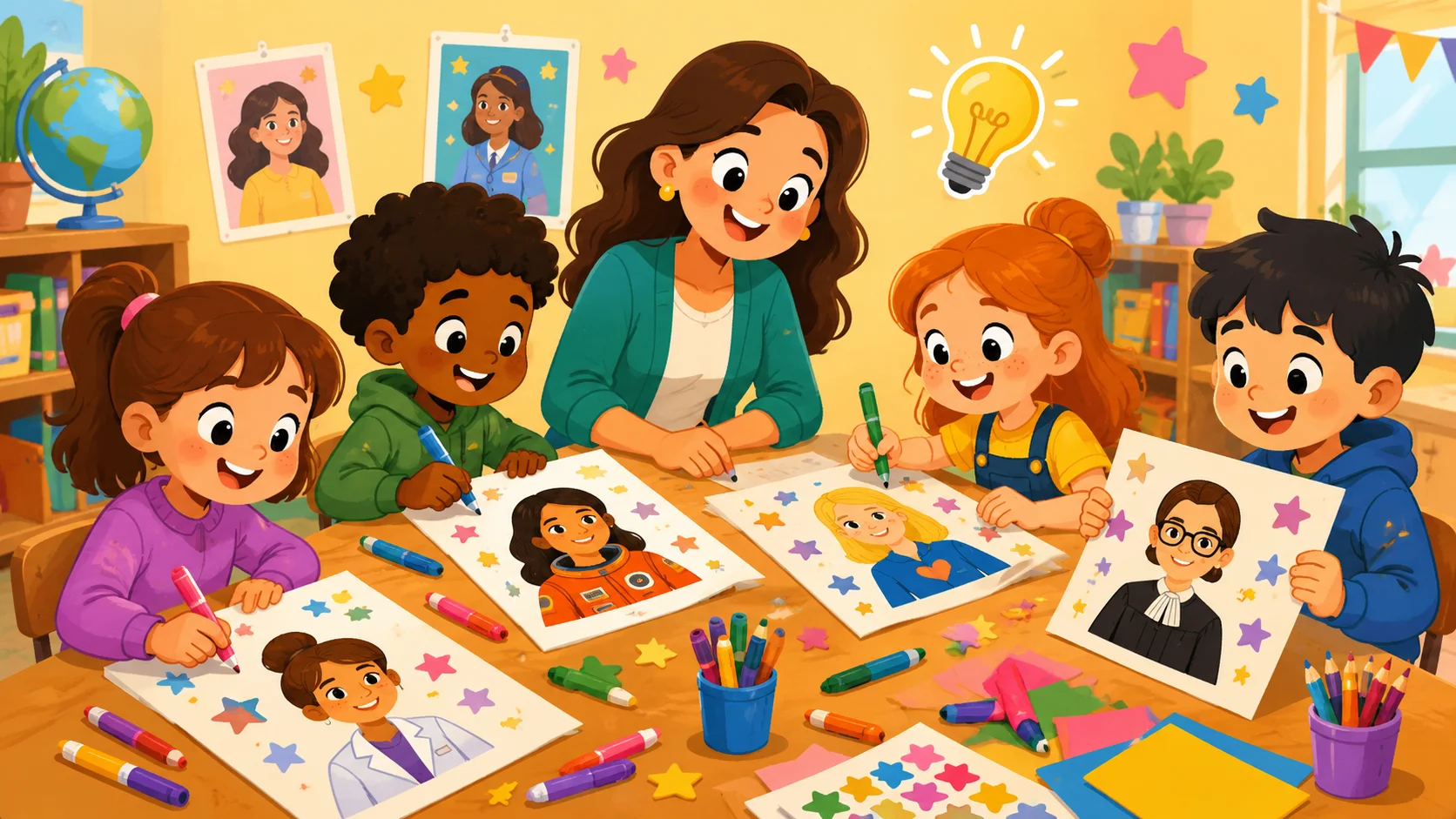
To reinforce these biographies, parents and educators can guide children through a hands-on role model project. This structured activity helps children practice research, creativity, and presentation skills.
Pick One Role Model
Allow the child to choose one person from the list of 25 extraordinary women based on their interests. A child passionate about nature may choose Jane Goodall, while a child interested in coding may choose Ada Lovelace. Choosing their own subject increases the child’s engagement and ownership of the learning process.
Create a Mini Biography Card
Provide the child with a standard index card or piece of cardstock. Ask them to fill out a few simple sections that help them organize and summarize what they learn.
- Front Side: Draw a colored portrait of the chosen woman alongside her name and country of birth.
- Back Side: Write the field of work, one major challenge she overcame, her greatest achievement, and a favorite quote.
Make a Role Model Poster
Glue the biography card onto a larger poster board. Help the child decorate the poster with a simple timeline of the woman’s life milestones. Include a speech bubble containing her most inspiring quote and a dedicated section titled “How I Can Be Like Her Every Day” to encourage personal reflection.
Share a Short Presentation
Have the child deliver a one- to two-minute presentation to family members or classmates while holding their poster. Speaking about historical figures helps children practice communication, confidence, and clear expression. Celebrate the presentation so children associate learning and sharing history with encouragement and pride.
Frequently Asked Questions
Which inspiring role models should kids know first?
The best inspiring role models for kids to learn about first are women whose stories are easy to connect with a child’s interests. Children who love science may enjoy Marie Curie, Ada Lovelace, or Rosalind Franklin, while young athletes may be inspired by Serena Williams, Megan Rapinoe, or Mary Kom. The goal is not to memorize every name at once, but to help your child see that strong female role models exist across many fields.
Why should children learn about women throughout history?
Children can learn a great deal from women throughout history because their stories show courage, curiosity, leadership, and resilience in real-life situations. These women role models help children understand that progress often comes from people who ask difficult questions, challenge unfair rules, and keep going even when success is not immediate.
What can kids learn from strong women?
Kids can learn that strength is not only physical; it can also mean persistence, kindness, creativity, and the courage to speak up. Strong women such as Rosa Parks, Harriet Tubman, Malala Yousafzai, and Jane Goodall show that anyone can achieve great things when they act with purpose and care about others.
Take a short quiz to find out what your everyday choices say about your parenting style
When your child is curious about something new, what’s your instinct?
Take a short quiz to find out what your everyday choices say about your parenting style
“Can I download this app?” What happens next?
Take a short quiz to find out what your everyday choices say about your parenting style
When it comes to rules at home, which sounds most like you?
Take a short quiz to find out what your everyday choices say about your parenting style
If you could give your child one life skill today, what would you pick?
Take a short quiz to find out what your everyday choices say about your parenting style
Your child gets to choose what to watch. What would your ideal setup look like?
Take a short quiz to find out what your everyday choices say about your parenting style
Pick your parenting superpower ✨