
What Do Twelfth Graders Learn in UK Schools? A Complete Guide to Post-16 Education

 Discover a Free Education Video App for Kids
Pastory uses AI to personalize educational video content based on your child’s interests and personality. Safe, engaging, and built for curious young minds. Sign up now to stay updated and enjoy early access with a free trial
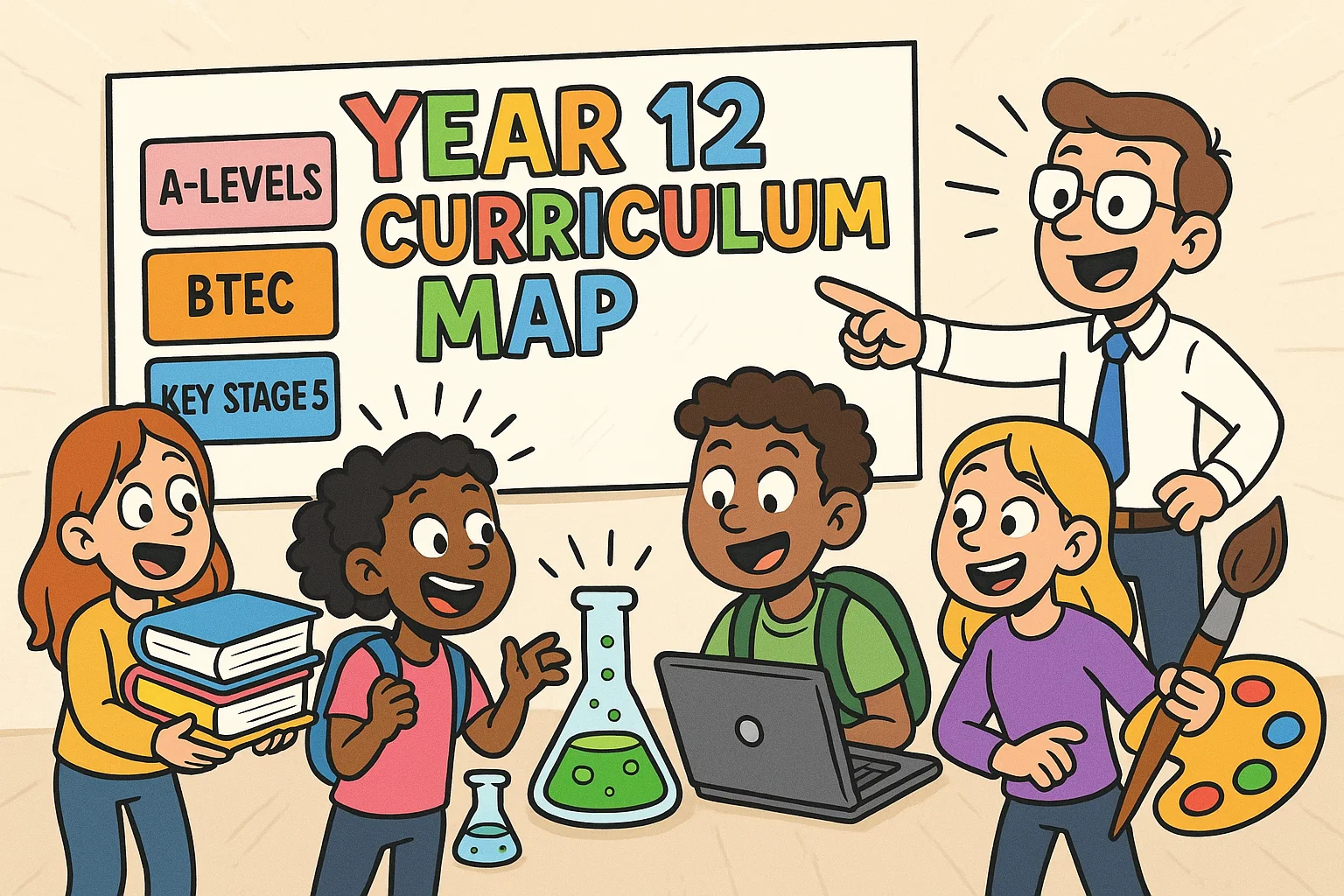
When families move from international school systems to UK education systems, terminology can cause considerable confusion. The term “twelfth graders” is not standard terminology in UK schools. In the United States and many international systems, twelfth grade usually refers to students aged 17–18 who are completing their final year of secondary school. In the UK, the closest equivalent depends on the nation: Year 13 in England and Wales, Year 14 in Northern Ireland, and S6 in Scotland.
Post-16 education is far more specialised than the broad curriculum students follow earlier in secondary school. A student’s programme depends on the UK nation, the type of institution and the academic, vocational or technical route they choose. Many students focus on Level 3 or other post-16 qualifications, such as A levels, BTECs, T Levels in England, Scottish Highers or Advanced Highers, or apprenticeship routes.
Key takeaways
- Year-group equivalence: Twelfth grade is usually closest to Year 13 in England and Wales, Year 14 in Northern Ireland, and S6 in Scotland.
- Specialised curriculum: Unlike many international systems in which students continue a broad subject mix, post-16 students often narrow their focus to three or four subjects, or one larger vocational or technical programme.
- Diverse pathways: Students may choose academic routes such as A levels, vocational qualifications such as BTECs, technical routes such as T Levels in England, Scottish qualifications such as Highers and Advanced Highers, or work-based apprenticeships.
- Progression focus: The final post-16 year usually focuses on final assessments, independent study, university applications, apprenticeship applications, further training or employment.
- Important UK difference: The UK does not have one single education system. England, Wales, Scotland and Northern Ireland each have their own curriculum structures, terminology and qualifications.
Twelfth grade usually means Year 13 in England and Wales
Twelfth grade mostly equates to Year 13 in England and Wales
In England and Wales, the nearest equivalent to a US twelfth grader is usually a Year 13 student. Most Year 13 students are aged 17–18 and are completing the second year of post-16 study in a school sixth form, sixth form college or further education college.
Because “Grade 12” is not standard UK terminology, international families should search for terms such as Year 13, sixth form, college, post-16 education, A levels, Level 3 qualifications or university entrance requirements when looking for relevant local school information.
Northern Ireland and Scotland use different labels
Northern Ireland uses a different year-numbering system. Students usually take GCSEs in Year 12 and complete post-16 study in Years 13 and 14, with Year 14 being the closest equivalent to the final year of twelfth grade.
Scotland uses a different structure again. The closest equivalent is usually S6, or Secondary 6, where students may take Highers, Advanced Highers, vocational qualifications or other awards depending on their school and plans.
Most students follow post-16 or Level 3 courses
In England, post-16 study is often described as sixth form, college, 16 to 19 study, Level 3 study or, in some school contexts, Key Stage 5. However, “Key Stage 5” should be used carefully because it is not a single UK-wide curriculum stage in the same way that international families may expect.
At this stage, students usually study advanced academic, vocational or technical qualifications. These may include:
- A levels
- BTECs or other vocational qualifications
- T Levels in England
- Scottish Highers and Advanced Highers
- Apprenticeships
- Other Level 3 or equivalent study programmes
Subject choice depends on future plans
Upon entering sixth form or college, students experience a significant shift in curriculum breadth. Instead of studying a broad set of compulsory subjects, they usually choose a smaller number of subjects or one larger vocational or technical programme.
A student aiming for mechanical engineering, for example, might choose Mathematics and Physics, and may add Further Mathematics if it is available and useful for their target universities. A student aiming for a creative degree might choose Art and Design, Photography, Media Studies or a portfolio-based qualification. A student aiming for a health or social care pathway might choose Biology, Psychology, Health and Social Care, a T Level in England or a relevant apprenticeship route.
UK pathways include academic and vocational routes
Post-16 education offers several pathways, including academic, vocational, technical and work-based routes.
- A levels: Academic qualifications that usually focus on subject knowledge and are commonly assessed through final examinations, with coursework or practical assessment in some subjects.
- BTECs and other vocational qualifications: Vocational qualifications that combine classroom learning with practical, industry-focused assessment.
- T Levels: Two-year technical qualifications in England that combine classroom-based learning with a substantial industry placement.
- Scottish Highers and Advanced Highers: Scottish qualifications commonly taken in S5 and S6, often used for progression to further or higher education.
- Apprenticeships: Work-based pathways in which apprentices are employed, earn a wage and complete off-the-job training with a provider as part of their programme.
UK school years and the twelfth-grade equivalent
Year 13 as the closest match in England and Wales
In England and Wales, Year 13 is the closest operational match for twelfth grade because it is usually the final year before university, apprenticeships, further training or employment. During this final year, students aged 17–18 focus on completing advanced qualifications, managing coursework where relevant, preparing for final assessments and planning their next step.
Year 14 as the closest match in Northern Ireland
In Northern Ireland, the closest equivalent to twelfth grade is usually Year 14. Students typically take GCSEs in Year 12 and then continue into sixth form for Years 13 and 14 if they choose an academic or post-16 school route.
This distinction is important for international families because Year 13 in Northern Ireland is not the final year in the same way it usually is in England and Wales.
S6 as the closest match in Scotland
In Scotland, the closest equivalent to twelfth grade is usually S6. Students in S6 may take Highers, Advanced Highers, vocational qualifications, college-linked courses or a combination of awards. Some students leave school after S4 or S5, while others remain for S6 to strengthen university, college, apprenticeship or employment options.
Year 12 as a possible match in some international comparisons
In some international comparisons, Grade 12 may align more closely with Year 12 or Year 13 depending on the student’s age, school calendar and prior qualifications. Some international schools operate on a 12-year model rather than the British 13-year model, which can make direct comparisons confusing.
When navigating the UK education system, parents should evaluate the student’s exact date of birth, current qualifications, academic level and target destination rather than relying only on grade numbers.
Age range for twelfth-grade equivalents in UK schools
The closest UK equivalent to twelfth grade is usually a student aged 17 to 18. However, the exact year group depends on the UK nation, school system, admissions context and date of birth.
Students born later in the academic year may be among the youngest in their year group. This can be worth considering when families compare international grade placements, especially if the student is moving between systems with different school-year cut-off dates.
Differences between England, Wales, Scotland and Northern Ireland
The United Kingdom does not have a single unified education system. Education is devolved, meaning England, Wales, Scotland and Northern Ireland each have their own structures.
England and Wales both use Year 13 as the usual final year of school or college-based post-16 study, although Wales now has its own curriculum structure for ages 3–16. Northern Ireland uses Year 14 as the final post-16 school year. Scotland uses S6, with Highers and Advanced Highers rather than A levels as the main national qualifications.
UK Key Stages and curriculum terminology explained
To place twelfth-grade learning within the wider UK context, international families need to understand how curriculum terminology changes across the four nations. England uses Key Stages in the national curriculum up to Key Stage 4. Wales now uses Curriculum for Wales for ages 3–16 rather than organising learning by Key Stages. Scotland uses Broad General Education and Senior Phase terminology. Northern Ireland has its own curriculum stages and year numbering.
The table below uses England as the main reference point because international families often encounter English terms first, then adds notes for other UK nations.
| Stage or route | Typical school years | Typical ages | Main focus | Main assessment or qualification notes |
| Early Years Foundation Stage (EYFS) | Nursery and Reception | 3–5 | Early communication, social development, physical development and early literacy | Reception Baseline Assessment and EYFS Profile in England |
| Key Stage 1 in England | Years 1–2 | 5–7 | Foundational reading, phonics, writing and basic numeracy | Phonics Screening Check in Year 1 |
| Key Stage 2 in England | Years 3–6 | 7–11 | Broader primary curriculum, reading comprehension, mathematics, science and foundation subjects | National curriculum tests at the end of Year 6 in England |
| Key Stage 3 in England | Years 7–9 | 11–14 | Broad secondary curriculum across sciences, humanities, languages, arts and practical subjects | Internal school assessments |
| Key Stage 4 in England | Years 10–11 | 14–16 | GCSE preparation through core and optional subjects | GCSEs and equivalent Level 2 qualifications |
| Post-16 study in England and Wales, with different curriculum frameworks | Years 12–13 | 16–18 | Advanced academic, vocational or technical study | A levels, BTECs, T Levels in England and other Level 3 qualifications |
| Post-16 study in Northern Ireland | Years 13–14 | 16–18 | Advanced academic or vocational study | A levels and other qualifications, with Year 14 as the final year |
| Senior Phase in Scotland | S4–S6 | 15–18 | National Qualifications, Highers, Advanced Highers and other awards | Highers, Advanced Highers, National Qualifications and vocational awards |
Early Years Foundation Stage
The Early Years Foundation Stage (EYFS) includes nursery settings and the first formal year of primary school in England, known as Reception. The curriculum during EYFS focuses on areas of child development such as communication, language, physical development, personal development, literacy and numeracy.
This stage is completely separate from twelfth-grade study, but it forms the earliest foundation for later learning.
Key Stage 1
In England, Key Stage 1 comprises Year 1 and Year 2 in primary school, serving children aged 5 to 7. The curriculum focuses heavily on basic literacy and numeracy, including phonics, early reading, writing and number skills.
In Year 1, pupils take the Phonics Screening Check, which assesses whether they can decode words using phonics.
Key Stage 2
Key Stage 2 in England spans four years of primary school, from Year 3 to Year 6, for pupils aged 7 to 11. The curriculum broadens to include subjects such as science, history, geography, design and technology, computing, art, music and physical education.
At the end of Year 6 in England, pupils take national curriculum tests in English reading, mathematics, and grammar, punctuation and spelling.
Key Stage 3
Key Stage 3 in England marks the transition into secondary school, covering Years 7, 8 and 9 for pupils aged 11 to 14. Schools usually offer a broad secondary curriculum across academic, creative and practical subjects.
This stage helps students develop the analytical, literacy, numeracy and subject-specific skills needed to make informed choices for GCSEs or equivalent qualifications.
Key Stage 4
Key Stage 4 in England covers Year 10 and Year 11 and usually includes preparation for GCSEs or equivalent qualifications taken around age 16. Students normally study compulsory subjects such as English, mathematics and science alongside optional subjects such as languages, humanities, arts, technology or vocational courses.
GCSE results are important because they influence access to sixth form, college courses, apprenticeships and later university options.
Post-16 study
Post-16 study is the most relevant stage for international families comparing Grade 12 with UK education. In England and Wales, this usually includes Years 12 and 13. In Northern Ireland, it usually includes Years 13 and 14. In Scotland, the closest comparison is the Senior Phase, especially S5 and S6.
At post-16 level, students usually move away from a broad compulsory curriculum and focus on selected academic, vocational or technical qualifications.
Main learning stage for twelfth-grade equivalents
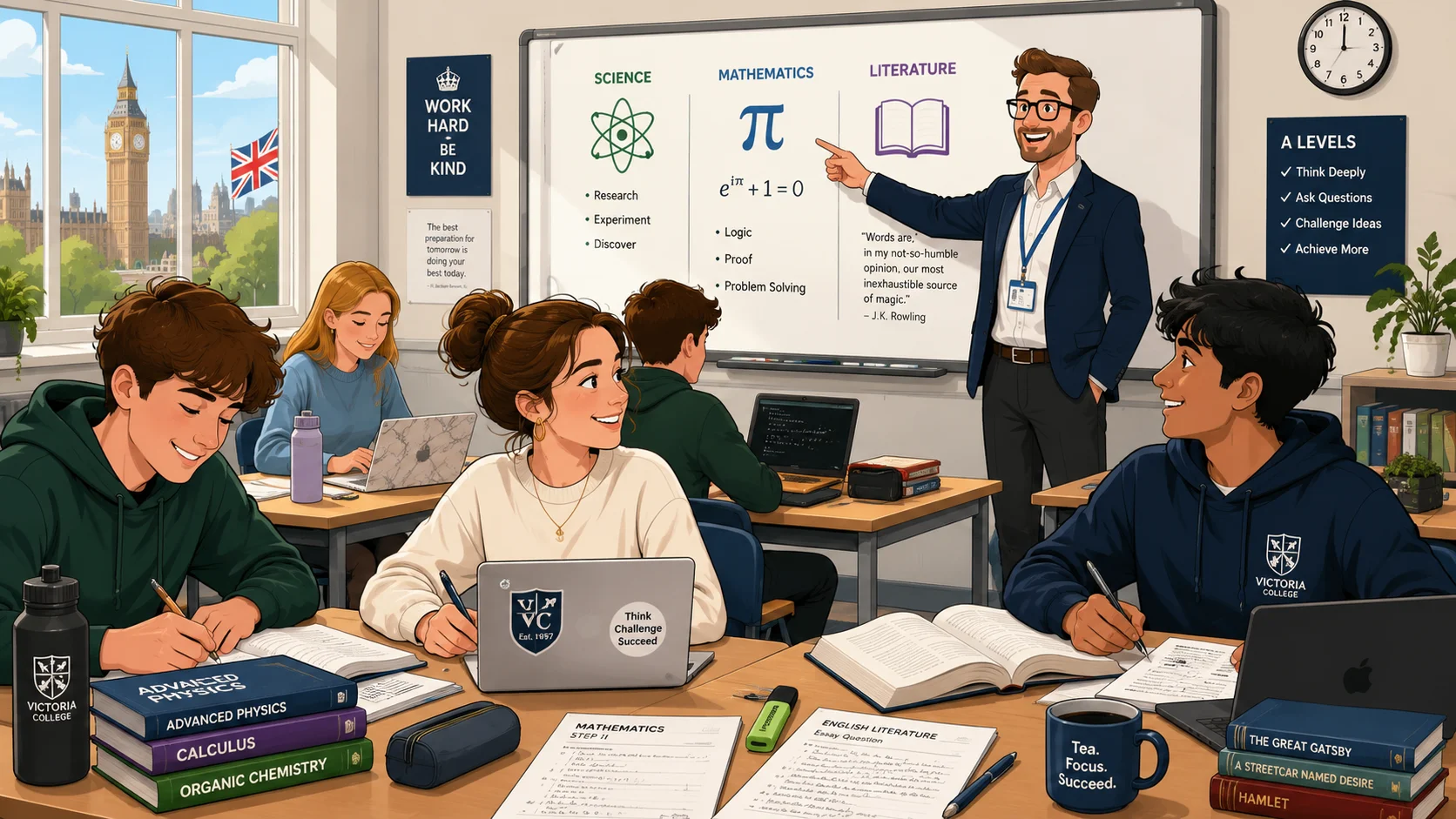
Year 12 and Year 13 learning goals
In England and Wales, the learning goals of post-16 study are often divided between Year 12 and Year 13. Year 12 usually introduces advanced subject content and helps students build the analytical, practical, essay-writing or technical skills needed for final assessments.
Year 13 usually focuses on final assessments, deeper subject understanding, coursework where relevant, and applications for university, apprenticeships, further training or employment.
In Northern Ireland, the same broad pattern often applies across Years 13 and 14. In Scotland, students may build their programmes across S5 and S6 through Highers, Advanced Highers or other qualifications.
Fewer subjects with more depth
A defining feature of post-16 education is the shift from breadth to depth. Instead of continuing with the broad subject mix typical of GCSE or earlier secondary education, many students choose three or four subjects, or one substantial vocational or technical programme.
This format allows teachers to explore subjects in greater depth and encourages students to become more independent learners. It also helps students build a clearer academic or professional profile before applying to university, apprenticeships or employment.
Independent study and research skills
Post-16 study usually involves a significant shift toward independent learning, self-management and more specialised work. Students are expected to complete substantial study outside lessons, including reading, revision, essay planning, laboratory write-ups, practical preparation, portfolio development or problem-solving tasks.
Strong study habits are essential. These include time management, organised note-taking, retrieval practice, active recall, past-paper practice and realistic workload planning.
Preparation for university, apprenticeships or employment
A primary objective of the final post-16 year is to help students prepare for their next step. For some students, this means applying to university through UCAS. For others, it means preparing for apprenticeships, technical training, employment, college-based courses or creative portfolio routes.
Schools and colleges may support students with personal statements, references, interviews, portfolio preparation, mock assessments, work experience, careers advice and apprenticeship applications.
Subjects twelfth-grade equivalents may study in UK schools
Unlike lower secondary school education, there are no universal compulsory core subjects imposed on all post-16 students in the same way as at GCSE level. Instead, students build individual programmes by choosing subjects or routes that fit their strengths, interests and future plans.
English pathways at post-16 level
Students who choose English pathways may study English Literature, English Language, or a combined English Language and Literature qualification. These courses usually develop advanced critical reading, structured textual analysis, essay writing and argumentation.
English A levels can be strong preparation for humanities, law, media, communications and other essay-based degrees because they develop close reading, argument construction and cultural literacy.
Mathematics pathways at post-16 level
Mathematics is a popular A-level choice for students who enjoy problem-solving, abstract reasoning and quantitative work. The advanced mathematics curriculum often includes pure mathematics, mechanics and statistics.
Some schools offer Further Mathematics, an additional qualification covering topics such as complex numbers and matrices. It may be useful or required for highly competitive STEM courses, especially mathematics, engineering, computer science, physics and related degrees.
Science pathways at post-16 level
Post-16 science pathways usually include Biology, Chemistry and Physics. These subjects combine complex theory with practical skills, data analysis and scientific reasoning.
Students move beyond memorising facts by designing experiments, developing practical techniques and analysing data. In A-level science courses in England, students may also complete practical work that is reported alongside the final grade through the Practical Endorsement.
Humanities and social science pathways
Humanities and social science pathways include subjects such as History, Geography, Politics, Psychology, Sociology, Economics, Philosophy, Religious Studies and Law.
These subjects help students evaluate evidence, analyse complex human behaviour, understand social and historical contexts, and construct balanced written and oral arguments. They are useful preparation for degrees and careers involving research, communication, policy, law, education, journalism and public service.
Modern foreign languages
Modern foreign language courses may include French, Spanish, German, Mandarin or other languages, depending on the school or college. At post-16 level, language study moves beyond basic vocabulary and grammar.
Students may debate contemporary issues, study literature or film, develop translation skills and build more advanced speaking and writing fluency. These courses can support careers in international business, diplomacy, law, journalism, translation, education and global organisations.
Common subjects in UK sixth forms and colleges
The subjects available to post-16 students are diverse, spanning academic, vocational, technical and creative areas. The list below gives examples of common subjects offered by many sixth forms and further education colleges.
Academic A-level subjects
- STEM: Mathematics, Further Mathematics, Biology, Chemistry, Physics, Computer Science, Environmental Science.
- Humanities: History, Geography, English Literature, Philosophy, Religious Studies, Classical Civilisation.
- Social sciences: Economics, Psychology, Sociology, Politics, Law, Criminology.
- Languages: French, Spanish, German, Italian, Mandarin, Russian, Latin.
Vocational and technical subjects
- Business and professional: BTEC Level 3 National in Business, Accounting, Financial Studies, Applied Law.
- Health and sciences: BTEC Applied Science, Health and Social Care, T Level in Healthcare Science in England.
- Engineering and technology: T Level in Design and Development for Engineering in England, BTEC Engineering, Information Technology.
- Education and social care: T Level in Education and Early Years in England, Sport and Exercise Science, Public Services.
Creative and performance subjects
- Visual arts: Fine Art, Graphic Communication, Photography, Textile Design, Three-Dimensional Design.
- Performance: Drama and Theatre Studies, Music Performance, Music Technology, Dance, Performing Arts.
- Media and design: Media Studies, Film Studies, Design and Technology, Product Design, Fashion or Creative Digital Media.
Extended Project Qualification
The Extended Project Qualification (EPQ) is an independent research qualification that some students take alongside A levels or other Level 3 qualifications. An EPQ requires the student to choose a topic, conduct research and produce either a dissertation, investigation, performance or artefact with supporting documentation.
Many universities value the EPQ because it can demonstrate independent research, planning, academic writing and presentation skills. Its role in admissions varies by course and provider.
Arts subjects for post-16 students in UK schools and colleges
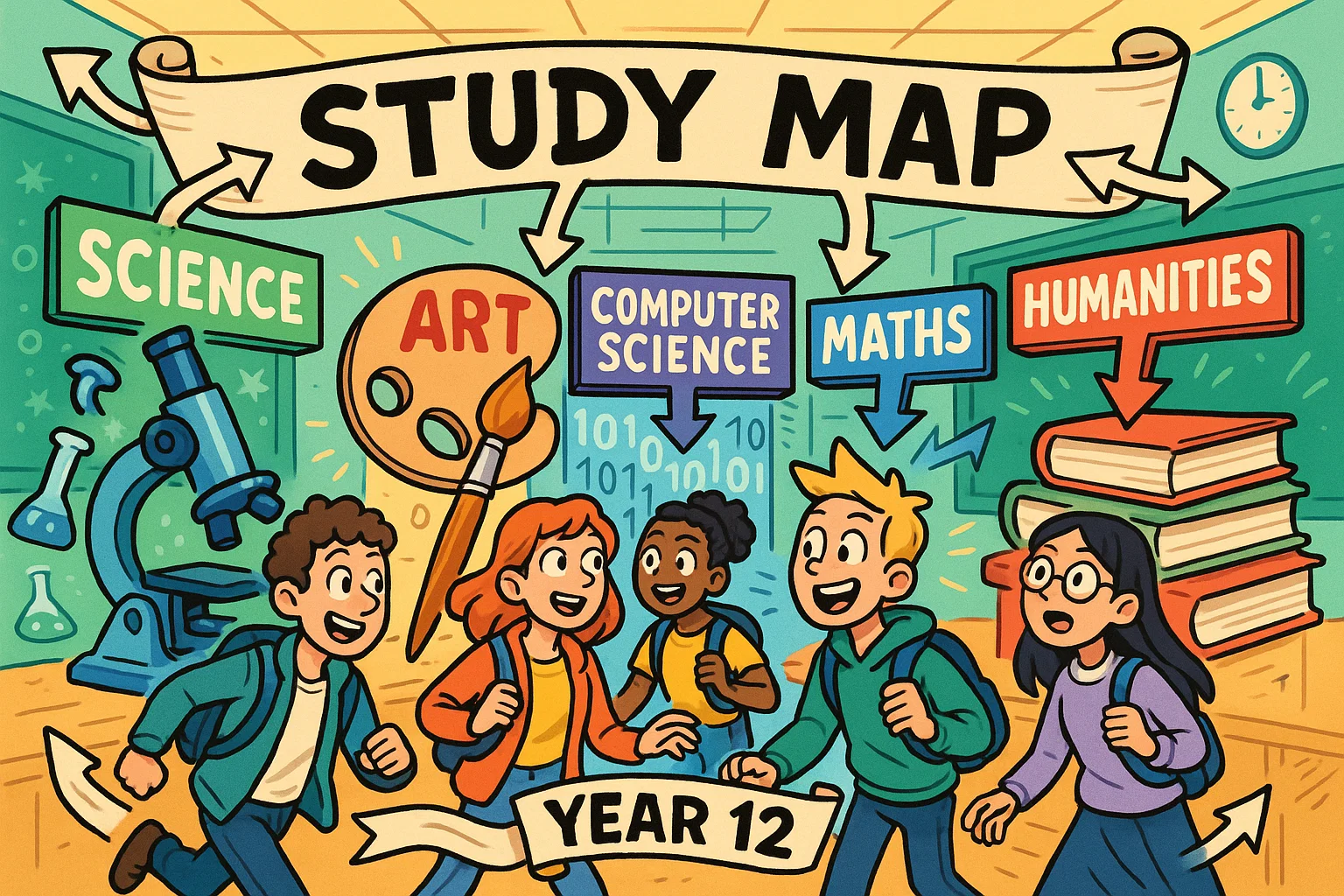
Advanced arts instruction at post-16 level provides an intensive, studio-based or performance-based environment that challenges students both creatively and technically.
Art and Design
Art and Design requires students to build a portfolio that documents their visual research, experimentation, development and final outcomes. Exam boards usually assess not only the final piece but also the student’s ability to analyse artists, test materials, refine ideas and explain creative decisions.
This portfolio focus can support applications to art schools, design courses, architecture programmes and creative degrees.
Music
The advanced study of Music often balances performance, composition and music theory or musicology. Students may demonstrate technical skill on an instrument or voice, prepare practical performances and complete written analytical work.
Students may also specialise in Music Technology, focusing on sound recording, mixing and digital production.
Drama and Theatre
Drama and Theatre combines academic theory with intensive collaborative practical theatre assessments. Students analyse classic and contemporary scripts from a director’s, designer’s and actor’s perspective, while also creating original devised pieces of live theatre.
Advanced drama study can help students develop emotional awareness, public speaking confidence, collaboration and problem-solving skills.
Dance
The advanced Dance curriculum combines physical training with theoretical analysis of choreographic works. Students may be assessed on performance technique, choreography and written critical appreciation.
The course requires physical stamina, creative expression and analytical writing.
Creative Digital Media
Creative Digital Media may cover video production, graphic design, audio editing and production planning. Students analyse media industries and create products such as short films, magazine layouts, digital campaigns or music videos.
This pathway supports students interested in modern creative industries, content production, marketing, design and digital storytelling.
GCSE background before post-16 study
GCSEs before post-16 study in England, Wales and Northern Ireland
To understand post-16 study, international families should understand GCSEs. GCSEs are usually taken around age 16 and provide an important academic record before sixth form, college, apprenticeships or other post-16 routes.
GCSEs are used in England, Wales and Northern Ireland, although curriculum terminology, specifications and assessment arrangements differ by nation and awarding body. Scotland uses a different qualifications system, including National Qualifications, Highers and Advanced Highers.
How GCSE results affect post-16 choices
Progression into advanced Year 12 and Year 13 courses is often dependent on achieving specific minimum grades in relevant GCSE subjects. Many sixth forms and colleges require students to achieve at least five GCSEs at grade 4 or above, often including English and mathematics, although exact entry requirements vary.
For demanding subjects such as A-level Chemistry, Physics, Mathematics or Further Mathematics, schools may ask for higher GCSE grades in the relevant subject to make sure the student can manage the workload.
Why Key Stage 4 matters before Year 13
Key Stage 4 helps students build the knowledge, writing skills, mathematical fluency, scientific methods and revision habits needed for post-16 study.
A student who finds GCSE algebra difficult, for example, may need extra support before moving into A-level Mathematics, where algebraic fluency is important. A student who struggles with extended writing may need to strengthen essay structure before choosing essay-heavy A levels such as History, English Literature or Politics.
GCSE English and mathematics after age 16
In England, students who have not yet achieved GCSE grade 4 or above in English or mathematics usually continue studying English or maths through GCSE, Functional Skills or another approved qualification alongside their main programme.
Colleges usually timetable these English or maths lessons alongside the student’s main course, with assessment opportunities depending on the qualification and provider.
What happens after GCSEs or Key Stage 4
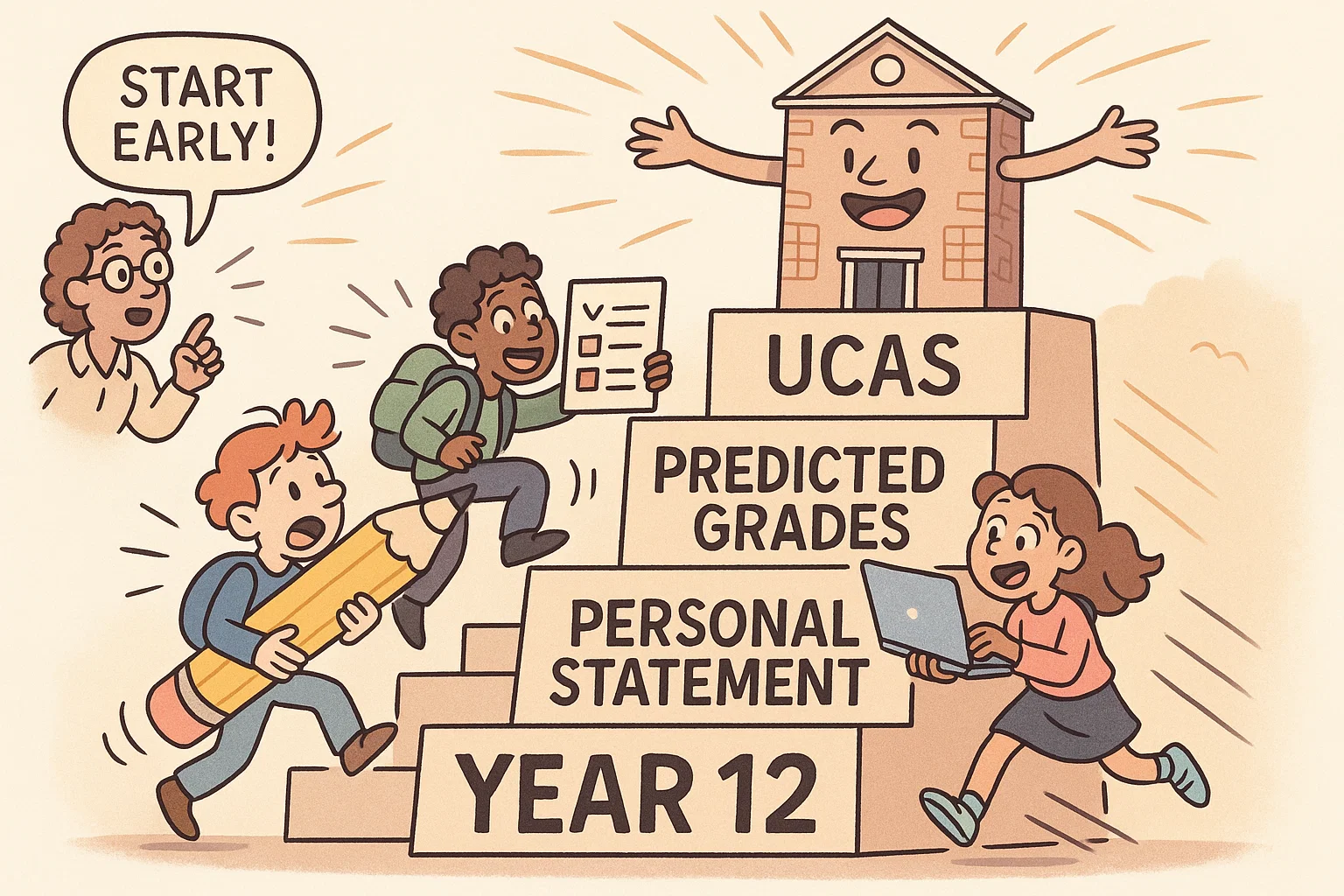
After Year 11 and GCSEs, students usually choose a post-16 route. The main options include school sixth form, sixth form college, further education college, apprenticeships and, in England, T Levels.
| Route | Typical setting | Main focus | Common qualifications or outcomes |
| School sixth form | Attached to a secondary school | Academic study in a familiar school environment | A levels, sometimes BTECs or other Level 3 qualifications |
| Sixth form college | Separate post-16 college | Academic and applied Level 3 study | A levels, BTECs and other qualifications |
| Further Education college | Larger college environment | Vocational, technical and academic courses | BTECs, T Levels in England, apprenticeships, access courses and other programmes |
| Apprenticeship | Employer and training provider | Paid work with structured training | Apprenticeship standard and related qualifications |
| T Level route in England | School, college or training provider | Technical study with industry placement | T Level qualification, equivalent in size to three A levels |
Sixth form route
The sixth form route allows students to remain within a traditional school-based environment, either by staying at their current secondary school or moving to another school with a sixth form.
This pathway often focuses on academic study, especially A levels. It can suit students who prefer familiar routines, close teacher support and a traditional route toward university.
Further Education college route
Further Education (FE) colleges usually offer a more independent environment than school and provide academic, vocational and technical courses. They often have specialist facilities such as workshops, salons, studios, laboratories or industry-standard training spaces.
Students at FE colleges may have greater personal independence and may study alongside a more diverse student body, including older learners and apprentices.
Apprenticeship route
The apprenticeship route is an employer-led pathway for students who want to enter the workplace while continuing their education and training. Apprentices are employed, earn a wage and complete structured training with a college, training provider or employer.
This route allows young people to gain paid workplace experience and recognised qualifications without following the traditional full-time university route.
T Level route in England
T Levels are two-year technical qualifications in England, designed with employers to help students develop knowledge and practical skills for a broad occupational area.
One T Level is broadly equivalent in size to three A levels and combines classroom-based technical learning with an industry placement of at least 315 hours, or about 45 days. This pathway can suit students who want a strong technical route with both classroom learning and substantial workplace experience.
Advantages of a broad post-16 subject choice
Better match between strengths and future goals
The range of subjects available in many sixth forms and colleges allows students to choose a programme that fits their strengths and goals. A student with strong creative skills, for example, might choose Fine Art, Media Studies and Photography. A student interested in medicine might choose Chemistry, Biology and another relevant subject.
This flexibility can help students focus on subjects they are motivated to study and that support their future plans.
Stronger academic and practical skill mix
The flexibility of post-16 education allows students to combine traditional academic study with practical skills where timetables and entry requirements allow. A student might take A levels in Mathematics and Economics while also completing a practical qualification in Digital Media Production, Business or Applied Science.
This kind of combination can help students build both analytical and workplace-relevant skills.
More flexibility for university applications
By choosing specific combinations of courses, students can keep higher education options open or build a specialised pathway for competitive courses.
Students who are undecided may choose subjects that are commonly required or preferred for a range of degrees, such as Mathematics, English Literature, History, sciences or languages. Students targeting competitive courses such as medicine, engineering, architecture or computer science should check each university’s required and preferred subjects before finalising their choices.
Confidence through choice
Giving students a voice in subject choices can increase motivation, confidence and engagement. When students choose subjects that match their interests and goals, they are more likely to take ownership of their learning.
This can support better attendance, stronger independent study habits and a more mature approach to planning for the future.
How schools help students choose the right subjects
Tutor and teacher guidance
Schools provide support networks to help students and parents during major transition points. Form tutors and subject teachers may meet students to review mock exam performance, discuss course workload and consider whether a subject is a realistic fit.
Teachers and tutors can help families decide whether a course matches the student’s prior attainment, working habits, interests and likely workload.
Careers advice
Many schools and colleges provide careers guidance to help students map out future options. Careers advisers may use labour market information to help students understand growing sectors, qualification requirements and possible career routes.
They may also coordinate work experience, employer talks, apprenticeship information sessions, university events and one-to-one guidance meetings.
University course requirements
A vital part of subject guidance is checking university entry requirements. Some degree courses require specific subjects, and highly competitive universities may have preferred subject combinations.
A school’s guidance team may encourage students to check UCAS and university websites so they understand any required or preferred subjects, such as Chemistry for many medicine courses or Mathematics for many competitive computer science and engineering courses.
Parent role in subject decisions
Parents can support their teenager through open, non-judgemental conversations about workload, wellbeing, interests and long-term goals.
The most helpful role is usually to act as a grounded sounding board. Parents can help students think realistically about time management, sleep, stress, travel time, extracurricular commitments and whether the final choice reflects the student’s own goals.
How twelfth-grade equivalents learn in UK classrooms
Teaching at post-16 level is often more independent and discussion-based than earlier secondary education. It helps students prepare for university, apprenticeships, employment and professional settings.
Seminars, lessons and independent tasks
Post-16 classes are often smaller and more specialised than earlier secondary classes, although class size varies by subject and institution. Teachers often combine direct teaching with discussion, debate, feedback and guided analysis.
Students are expected to arrive prepared, complete independent tasks and take responsibility for their own progress.
Coursework, practical work and portfolios
Assessment at post-16 level may include exams, coursework, non-exam assessment, practical work, portfolios or employer-based tasks, depending on the qualification and subject.
Subjects such as Geography or History may involve independent research coursework. Science courses may involve practical work. Creative arts often require extensive studio portfolios. Vocational and technical qualifications may include projects, case studies, workplace tasks or practical assessments.
Exams and assessment
In many A-level subjects, final examinations play a major role, although assessment methods vary by qualification, subject and UK nation. Schools and colleges often run mock examinations during Year 12 and Year 13 to help students practise under timed conditions and identify areas for improvement.
Teachers may use mock results, coursework, class performance and professional judgement to inform predicted grades, which universities consider alongside other parts of the application.
Study skills for final-year success
To achieve strong results, students need to move beyond passive revision methods and develop active study strategies. Successful students often use retrieval practice, flashcards, active recall, past papers, mark schemes and spaced revision.
They also need to manage competing deadlines, protect rest time and plan revision realistically over several months rather than relying on last-minute preparation.
Differences between state schools, independent schools and colleges
The environment, qualification menu and support structure available to a twelfth-grade equivalent student vary depending on the institution.
State school sixth forms
State school sixth forms are usually government-funded sixth forms attached to secondary schools. They provide continuity because students can often complete post-16 education with familiar teachers and peers.
State sixth forms typically offer A levels and sometimes vocational qualifications. They often provide strong pastoral support and are accessible options for many local families.
Independent school sixth forms
Independent schools, often called private schools, are fee-paying institutions. Some are day schools and others are boarding schools.
Many independent schools offer smaller classes, broad subject choices and extensive extracurricular programmes, although provision varies by school. Some provide intensive university preparation, including support for Oxford and Cambridge applications, but this varies and comes with significant fees.
Further Education colleges
Further Education colleges are state-funded institutions that operate separately from secondary schools and usually provide a more independent learning environment.
They often offer a wide range of courses, including A levels, BTECs, T Levels in England, apprenticeships, adult learning and technical qualifications. FE colleges can suit students who want a less school-like environment and a broader choice of academic, vocational and technical pathways.
Specialist schools and alternative provision
Specialist schools and colleges may support students with particular talents, interests or learning needs through more targeted provision. These may include mathematics schools, performing arts schools, technical colleges or specialist SEND settings.
Alternative Provision settings may support students who need a different learning environment because of behavioural, emotional, medical or other needs.
FAQs
How does the British education system compare with twelfth grade?
The British education system does not use the term “twelfth grade” in the same way as the United States. In England and Wales, the closest equivalent is usually Year 13. In Northern Ireland, it is usually Year 14. In Scotland, the closest comparison is often S6. These final years usually prepare students for university, apprenticeships, further education or training, higher education or employment.
What are A-levels?
A-levels are advanced academic qualifications usually studied by students aged 16–18 in England, Wales and Northern Ireland. They are often studied in sixth form or college and are commonly used for entry to UK universities. Most students take three or four A-levels, although some combine them with other qualifications.
What is the General Certificate of Secondary Education?
The General Certificate of Secondary Education, or GCSE, is a qualification usually taken around age 16 in England, Wales and Northern Ireland. GCSE examinations normally come before post-16 study and help determine which A-levels, vocational courses, apprenticeships or college programmes a student can access next.
What is the difference between GCSE and A-level study?
GCSE and A-level study differ mainly in depth and specialisation. GCSEs cover a broad range of school subjects, while A-levels allow students to focus on fewer subjects in much greater depth. For example, a student may study many subjects at GCSE, then later specialise in maths and science, humanities, languages or creative subjects at A-level.

Take a short quiz to find out what your everyday choices say about your parenting style
When your child is curious about something new, what’s your instinct?
Take a short quiz to find out what your everyday choices say about your parenting style
“Can I download this app?” What happens next?
Take a short quiz to find out what your everyday choices say about your parenting style
When it comes to rules at home, which sounds most like you?
Take a short quiz to find out what your everyday choices say about your parenting style
If you could give your child one life skill today, what would you pick?
Take a short quiz to find out what your everyday choices say about your parenting style
Your child gets to choose what to watch. What would your ideal setup look like?
Take a short quiz to find out what your everyday choices say about your parenting style
Pick your parenting superpower ✨



