
40+ Tricky Questions And Riddles for Kids with Answers

 Discover a Free Education Video App for Kids
Pastory uses AI to personalize educational video content based on your child’s interests and personality. Safe, engaging, and built for curious young minds. Sign up now to stay updated and enjoy early access with a free trial
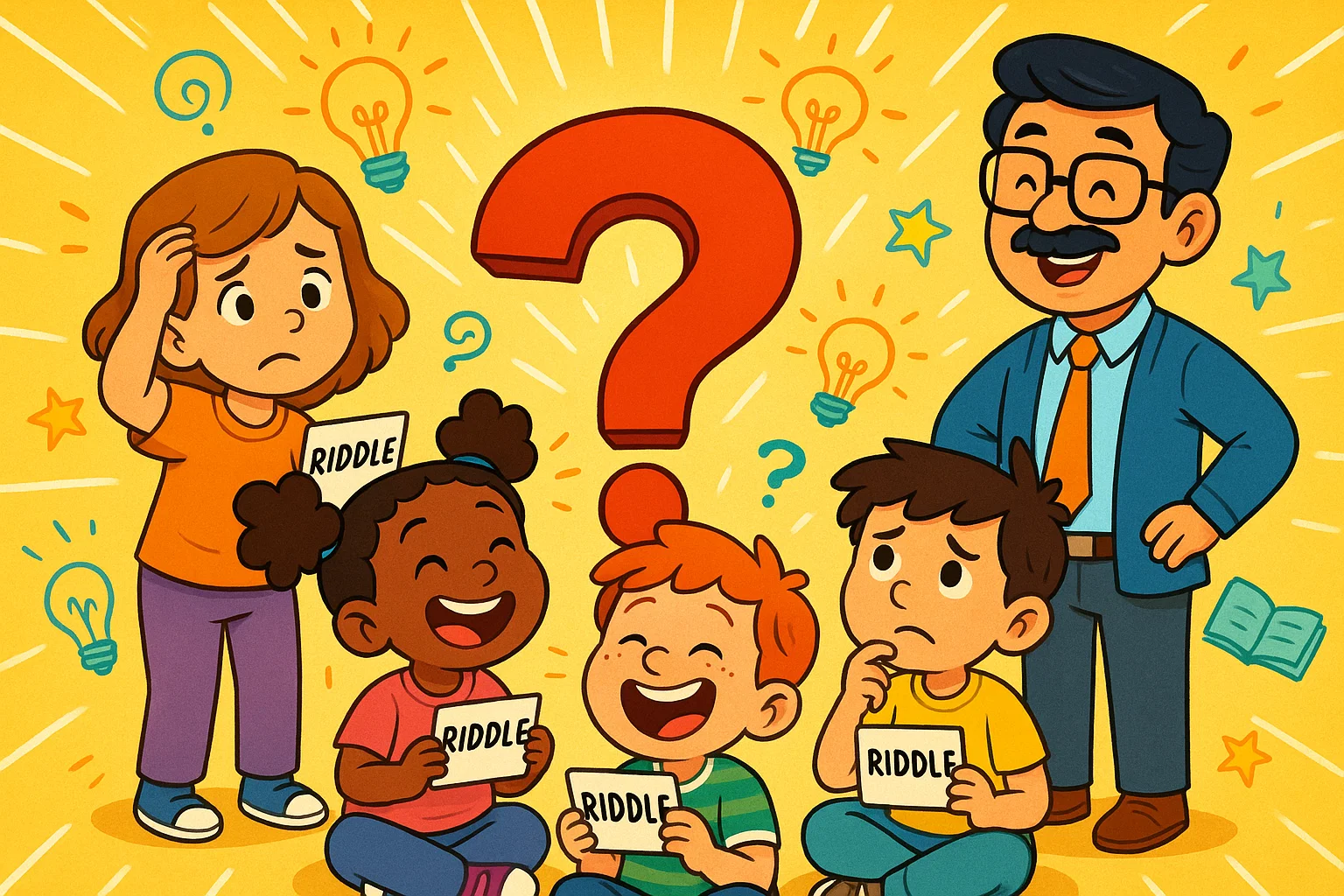
Providing children with a riddle or a tricky question is more than just a way to pass the time; it is a fundamental exercise in cognitive flexibility. This collection of tricky questions for kids offers a practical resource for parents and educators who want to challenge young thinkers while building essential problem-solving skills. Whether it’s a classic puzzle or a more complex brain teaser, these questions and answers are designed to make learning fun for kids of different ages.
Key Takeaways
- Cognitive Benefits: Tricky questions help kids practice logic, attention to detail, wordplay, and math skills.
- Diverse Categories: This article includes easy, hard, funny, animal, math, science, English, and grade-based brain teasers for kids.
- Instant Feedback: Every tricky question includes a clear solution to support quick learning and engagement.
- Versatile Use: Parents and teachers can use these for classroom games, car rides, or family trivia questions.
- Creative Growth: Kids can learn how to reverse-engineer these puzzles and create their own challenging riddles.
Quick Use Guide For Parents And Teachers
This guide is categorized by difficulty and subject matter to ensure you find the best riddles for kids based on their current developmental stage. You can start with the “Easy” section for younger children ages 5–7 or move to the “Hard” section for older students ages 10 and up who are ready for deeper thinking. Use the “Math” and “Science” sections to add these challenges to lesson plans, warm-ups, or homework breaks.
Best Way To Read These Questions With Kids
To get the most learning value from the activity, avoid rushing to the solution. Present the tricky question clearly, then provide the child with 30–60 seconds of “thinking time.” If they are stuck, offer a small hint related to the wordplay or the literal meaning of the words. Once the solution is revealed, explain the trick, such as a play on words, to help kids build analytical thinking skills.
How To Keep Kids Engaged While Solving Riddles
The best sessions are short, playful, and low-pressure. Children usually respond better when the activity feels like a guessing game rather than a test. Let them think out loud, make silly guesses, and explain their reasoning before revealing the solution. This helps them notice patterns, compare different ideas, and build confidence even when they do not solve the puzzle on the first try.
For younger learners, use familiar objects from daily life, such as clocks, eggs, towels, maps, or toys. Older children can usually handle more abstract wordplay, hidden assumptions, and multi-step logic. If a child struggles, offer a small clue instead of giving away the solution immediately. A helpful hint might point to a double meaning, a missing detail, or a literal interpretation of the sentence.
You can also invite children to create their own riddles after they solve a few examples. This turns passive guessing into active thinking. They learn how clues are built, how misdirection works, and why a simple phrase can lead the mind in the wrong direction. Over time, this improves attention, creativity, and flexible reasoning.
What Kids Will Practice
Engaging with tricky riddles allows children to strengthen several core competencies simultaneously.
- Logic and Reasoning: Assessing everyday scenarios to find non-obvious solutions.
- Vocabulary: Understanding homophones, puns, and words with multiple meanings.
- Mathematical Thinking: Solving math riddles that require reading comprehension rather than just calculation.
- Observation: Developing the ability to spot how a riddle works by noticing hidden details in the phrasing.
What Is a Tricky Question?
A tricky question is a type of question where the correct answer depends on spotting a hidden trap, unusual logic, or the literal meaning of a phrase. Unlike standard trivia questions, which test factual recall, this type of brain teaser tests how a person interprets information. These prompts often lead young minds toward an obvious but incorrect conclusion, requiring them to “think outside the box” to find the true solution.
Tricky Question Vs Riddle
While people often use the terms interchangeably, a riddle and a tricky question have subtle differences. A riddle typically uses descriptive clues or metaphors to point to an object, such as: “What has keys but can’t open locks?” In contrast, a tricky question usually relies on misdirection within the sentence itself, such as: “You’re running a race and pass the person in second place; what place are you in?”
Tricky Question Vs Brain Teaser
A brain teaser is a broad category that includes logic puzzles, math problems, and visual patterns that require mental effort. A tricky question is specifically a verbal or written puzzle that uses language to mislead. While many tricky questions are brain teasers, not all brain teasers, such as a Rubik’s Cube or Sudoku, are sentence-based riddles.
Why Kids Enjoy Tricky Riddles
Children are often drawn to tricky riddles because they create a playful “level playing field” where kids can sometimes outsmart adults. The “aha!” moment that occurs when solving riddles makes the process feel like a game. This positive reinforcement can encourage kids to think critically and develop a lasting interest in riddles and learning.
Fun Tricky Questions For Kids
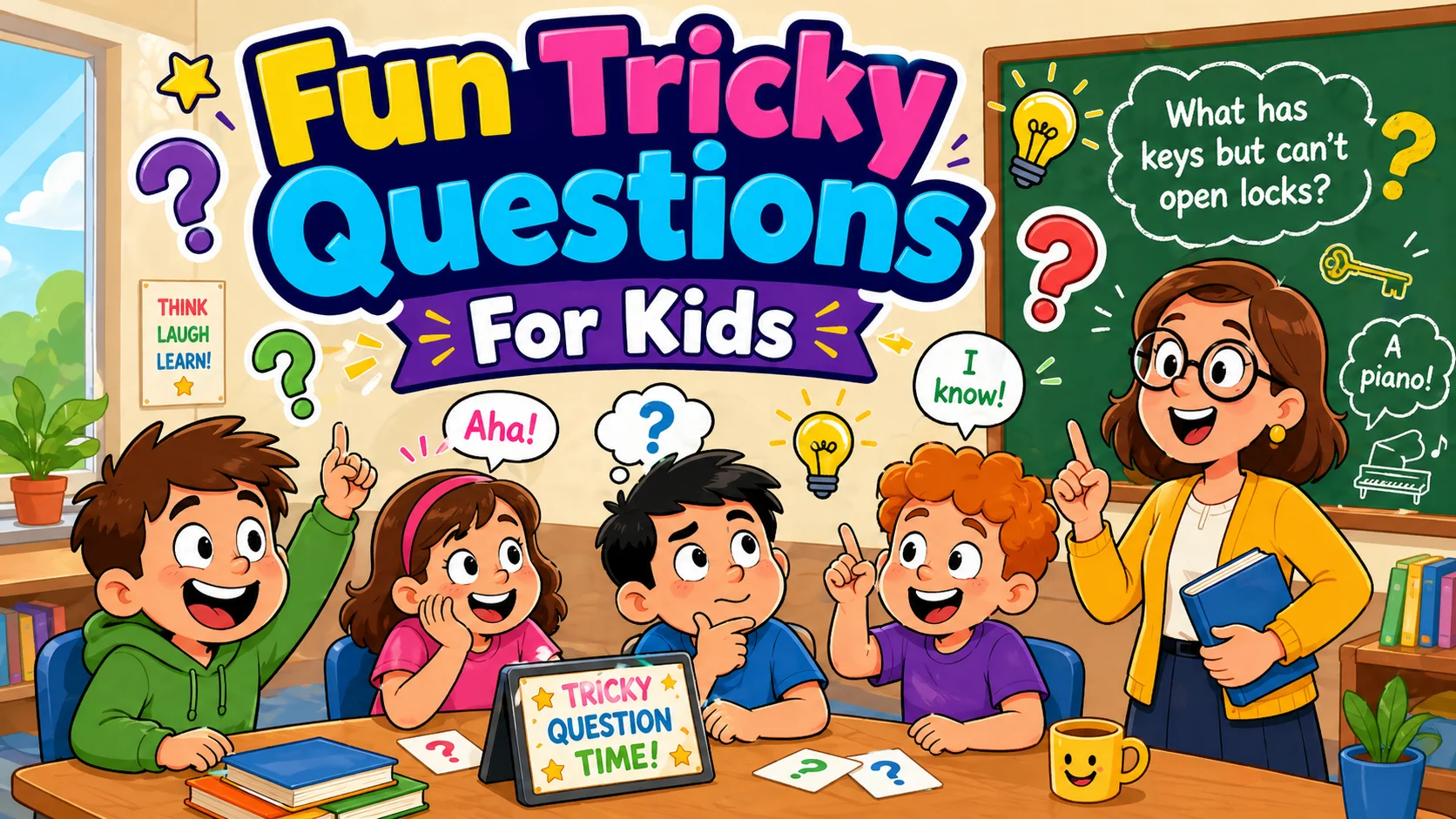
This collection of tricky questions is organized to help you find the right challenge for your child or students. Each category is tailored to different interests and skill levels, with options ranging from easy riddles to more challenging brain teasers.
How This List Is Organized
To make navigation simple, the list is divided into the following sections:
- Easy & Grade-Based: Perfect for younger children and beginners.
- Hard & Logic: For kids who are ready for a bigger mental challenge.
- Funny & Puns: Focuses on humor and wordplay.
- Subject-Specific: Math, Science, and English-themed tricky questions.
- Seasonal: Holiday-themed challenges for year-round fun.
How to Choose the Right Difficulty
If you are unsure where to start, begin with the easy riddles to build the child’s confidence. Once they understand the concept of “misdirection,” move to the funny trick riddles. Save the most challenging riddles and math logic questions for times when the child is focused and ready for a mental workout.
How To Turn These Prompts Into a Game
Turn these challenging brain teasers into a friendly game to increase engagement.
- Point System: Award 1 point for a correct answer and 2 points if the child can explain the trick.
- Timed Rounds: Give 30 seconds for easy trick prompts and 60 seconds for hard logic challenges.
- Teams: In a classroom, split students into groups to encourage kids to think collaboratively.
Easy Tricky Questions For Kids With Answers
These easy riddles are designed for children who are just beginning to explore the world of logic puzzles.
Easy Trick Riddles For Kindergarten Kids
- Riddle: What has a face and two hands but no arms or legs? Solution: A clock.
- Challenge: What has to be broken before you can use it? Solution: An egg.
- Prompt: What month of the year has 28 days? The trick: All of them.
- Riddle: I’m tall when I’m young, and I’m short when I’m old. What am I? Solution: A candle.
- Try this: What is full of holes but still holds water? Solution: A sponge.
Simple Brain Teasers For First Grade Kids
- Riddle: What has keys but can’t open locks? Solution: A piano.
- Challenge: What is as light as a feather, but even the strongest person can’t hold it for more than a minute? Solution: His breath.
- Prompt: What has one eye but cannot see? Solution: A needle.
- Riddle: Where does today come before yesterday? The trick: In the dictionary.
- Try this: What has a thumb and four fingers but is not alive? Solution: A glove.
Beginner Logic Riddles For Second Grade Kids
- Challenge: If you’re running a race and you pass the person in second place, what place are you in? Solution: Second place, because you took their spot.
- Riddle: What has a neck but no head? Solution: A bottle.
- Prompt: What gets wetter the more it dries? Solution: A towel.
- Try this: What can you catch but not throw? Solution: A cold.
- Challenge: Which weighs more: a pound of feathers or a pound of bricks? The trick: They weigh the same because each one weighs one pound.
Hard Tricky Questions For Kids With Answers
These challenging tricky questions require deeper thinking and the ability to look past the most obvious answer.
Hard Logic Challenges
- Challenge: If a plane crashes on the border of the United States and Canada, where do they bury the survivors? Solution: You don’t bury survivors.
- Prompt: An electric train is moving north at 100 mph and the wind is blowing west at 10 mph. Which way is the smoke blowing? The trick: There is no smoke; it’s an electric train.
- Riddle: A bus driver is going the wrong way down a one-way street. He passes several police officers, but they don’t stop him. Why? Solution: He was walking.
- Try this: What can you hold in your left hand but not in your right hand? Solution: Your right hand.
Hard Wordplay Riddles
- Prompt: What word is spelled incorrectly in every dictionary? Solution: The word “incorrectly.”
- Riddle: What has cities, but no houses; mountains, but no trees; and water, but no fish? Solution: A map.
- Challenge: What can travel around the world while staying in a corner? Solution: A stamp.
- Try this: What starts with T, ends with T, and has tea in it? Solution: A teapot.
Hard Brain Workout Riddles
- Challenge: You see a one-story house where everything is yellow. The walls are yellow, the doors are yellow, and the furniture is yellow. What color are the stairs? The trick: There are no stairs; it’s a one-story house.
- Riddle: The more you take away from me, the bigger I get. What am I? Solution: A hole.
Funny Tricky Questions For Kids With Answers
Humor is a great way to spark curiosity and keep kids engaged.
Funny Trick Riddles
- Riddle: I have kernels on the outside and a cob in the middle. People eat the kernels and throw away the cob. What am I? Solution: Corn on the cob.
- Prompt: What kind of room has no doors or windows? Solution: A mushroom.
- Challenge: What has three feet but cannot walk? Solution: A yardstick.
- Try this: How do you make the number one disappear? The trick: Add the letter G and it becomes “gone.”
Funny Brain Trick Riddles
- Prompt: If you throw a white stone into the Red Sea, what does it become? Solution: Wet.
- Riddle: What goes up but never comes down? Solution: Your age.
- Challenge: What kind of tree can you carry in your hand? Solution: A palm tree.
Math Tricky Questions For Kids With Answers
These math riddles help children apply math skills, logic, and careful reading to everyday scenarios.
| Type | Focus Area | Goal |
| Logic-Based | Reasoning | Identifying hidden constraints |
| Arithmetic-Based | Calculation | Precision under pressure |
| Wordplay-Based | Vocabulary | Linking numbers to language |
Trick Riddles About Math
- Challenge: When I was 6, my sister was half my age. Now I am 70. How old is my sister? Solution: 67, because she is always 3 years younger.
- Prompt: Put your thinking cap on: which is heavier, 100 pounds of rocks or 100 pounds of feathers? The trick: They are equal because both weigh 100 pounds.
- Riddle: If there are three apples and you take away two, how many apples do you have? Solution: Two, because those are the apples you took.
Math Logic Challenges
- Challenge: Using only addition, how can you add eight 8’s to get the number 1,000? Solution: 888 + 88 + 8 + 8 + 8 = 1,000.
- Prompt: I am an odd number. Take away a letter and I become even. What number am I? The trick: Seven. Take away “S” and it becomes “even.”
Animal Tricky Questions For Kids With Answers
Animal Brain Teasers
- Riddle: Which animal never walks, never talks, and never sleeps? Solution: A toy animal or a statue.
- Challenge: How many animals did Moses take on the ark? The trick: None. It was Noah, not Moses.
- Prompt: Which animal has a trunk but never packs a suitcase? Solution: An elephant.
Science Tricky Questions For Kids With Answers
Easy Science Brain Teasers
- Prompt: What can fill a room but takes up no space? Solution: Light.
- Riddle: I can be red, orange, yellow, blue, or green. I need oxygen to keep going, but I don’t have lungs. What am I? Solution: Fire.
Weather Riddles
- Challenge: What falls but never breaks? Solution: Nightfall or rain.
- Prompt: What breaks but never falls? Solution: Daybreak.
English Tricky Questions For Kids With Answers
Spelling Riddles
- Riddle: What is the longest word in the English language? The trick: “Smiles,” because there is a mile between the first and last letters.
- Challenge: What word starts with “E,” ends with “E,” but only has one letter in it? Solution: An envelope.
Tricky Questions By Grade Level
Children’s reasoning skills develop with age, so grade-level categories can help parents and teachers choose questions that feel challenging but manageable. Organizing riddles by grade level ensures the challenge is appropriate for their thinking skills.
Tricky Riddles For Kindergarten Students
Focus on literal objects and funny trick questions.
- What has a tail but no body?
Solution: A coin.
Brain Teasers For First Grade Students
Introduce basic wordplay and simple math riddles.
- If you have 2 apples and buy 3 more, what do you have?
Solution: 5 apples.
Logic Riddles For Third Grade Students
Use more challenging riddles that require out-of-the-box thinking.
- What has lots of hair but no brain?
Solution: A brush.
Benefits Of Tricky Questions For Kids
How Tricky Questions Help Kids
Tricky questions can encourage lateral thinking by asking kids to look beyond the most obvious answer. By encouraging children to look for non-obvious paths to a solution, these questions may support stronger problem-solving skills in school.
How Tricky Riddles Improve Problem Solving
When a child encounters a tricky question, they must:
- Analyze the language and concepts used.
- Identify potential traps or pun-based misdirections.
- Evaluate the solution based on logic rather than assumption.
Why Brain Teasers Are More Engaging Than Worksheets
Unlike repetitive worksheets, brain teasers can feel like a game for kids. This can spark curiosity and make students more willing to participate in learning activities without the stress of formal testing.
Classroom And Family Game Ideas
These brain teasers work well as quick warm-ups, transition activities, or family game-night prompts. A teacher can write one puzzle on the board at the start of the lesson and let students discuss possible answers in pairs. Parents can use them during car rides, dinner conversations, or quiet time before bed.
For group play, divide children into teams and ask each team to explain its reasoning, not just guess the final solution. This keeps the focus on thinking rather than speed alone. You can also create themed rounds, such as animals, school objects, weather, numbers, or silly wordplay. Mixing easy and harder examples helps younger players stay involved while still giving older kids a meaningful challenge.
Another useful method is the “make your own” round. After several examples, ask each child to invent a short riddle using a common object. Encourage them to hide the clue in plain sight. This activity strengthens vocabulary, humor, and logical structure while keeping the mood playful.
Tips For Creating Effective Trick Questions For Kids
- Start with an Object: Choose a common item, such as a pencil.
- Brainstorm Clues: It can write but cannot read; it has an eraser but never makes mistakes.
- Think Beyond the Sentence: Use wordplay to hide the solution.
- Test the Question with Kids: Make sure younger children can eventually solve it with a hint.
Frequently Asked Questions (FAQs)
What is a Tricky Question?
A tricky question is a prompt that uses wordplay or misdirection to lead you to the wrong response. For example: “What has legs but cannot walk?” The solution is: a table.
What Age is Best for Tricky Questions?
Children as young as 4 or 5 can begin with easy riddles, while more challenging tricky questions are usually best for kids aged 9 and up.
Can Tricky Questions Help With Learning?
Yes. They can help kids improve focus, reading comprehension, and math skills by encouraging them to pay close attention to details.
Are tricky questions better than riddles?
Tricky questions and riddles are very similar and often overlap. Generally, a riddle is a descriptive statement that requires the solver to guess the described object, while a trick question is a query that uses linguistic misdirection to fool the solver. Both are wonderful tools for cognitive development. The best tricky riddles for kids combine the descriptive element of a riddle with the unexpected twist of a trick question, providing a truly comprehensive mental workout. Using a mix of both ensures maximum engagement and variety in boosting problem-solving skills.

Take a short quiz to find out what your everyday choices say about your parenting style
When your child is curious about something new, what’s your instinct?
Take a short quiz to find out what your everyday choices say about your parenting style
“Can I download this app?” What happens next?
Take a short quiz to find out what your everyday choices say about your parenting style
When it comes to rules at home, which sounds most like you?
Take a short quiz to find out what your everyday choices say about your parenting style
If you could give your child one life skill today, what would you pick?
Take a short quiz to find out what your everyday choices say about your parenting style
Your child gets to choose what to watch. What would your ideal setup look like?
Take a short quiz to find out what your everyday choices say about your parenting style
Pick your parenting superpower ✨



