60+ Tongue Twisters for Kids: Easy, Funny, and Challenging

 Discover a Free Education Video App for Kids
Pastory uses AI to personalize educational video content based on your child’s interests and personality. Safe, engaging, and built for curious young minds. Sign up now to stay updated and enjoy early access with a free trial
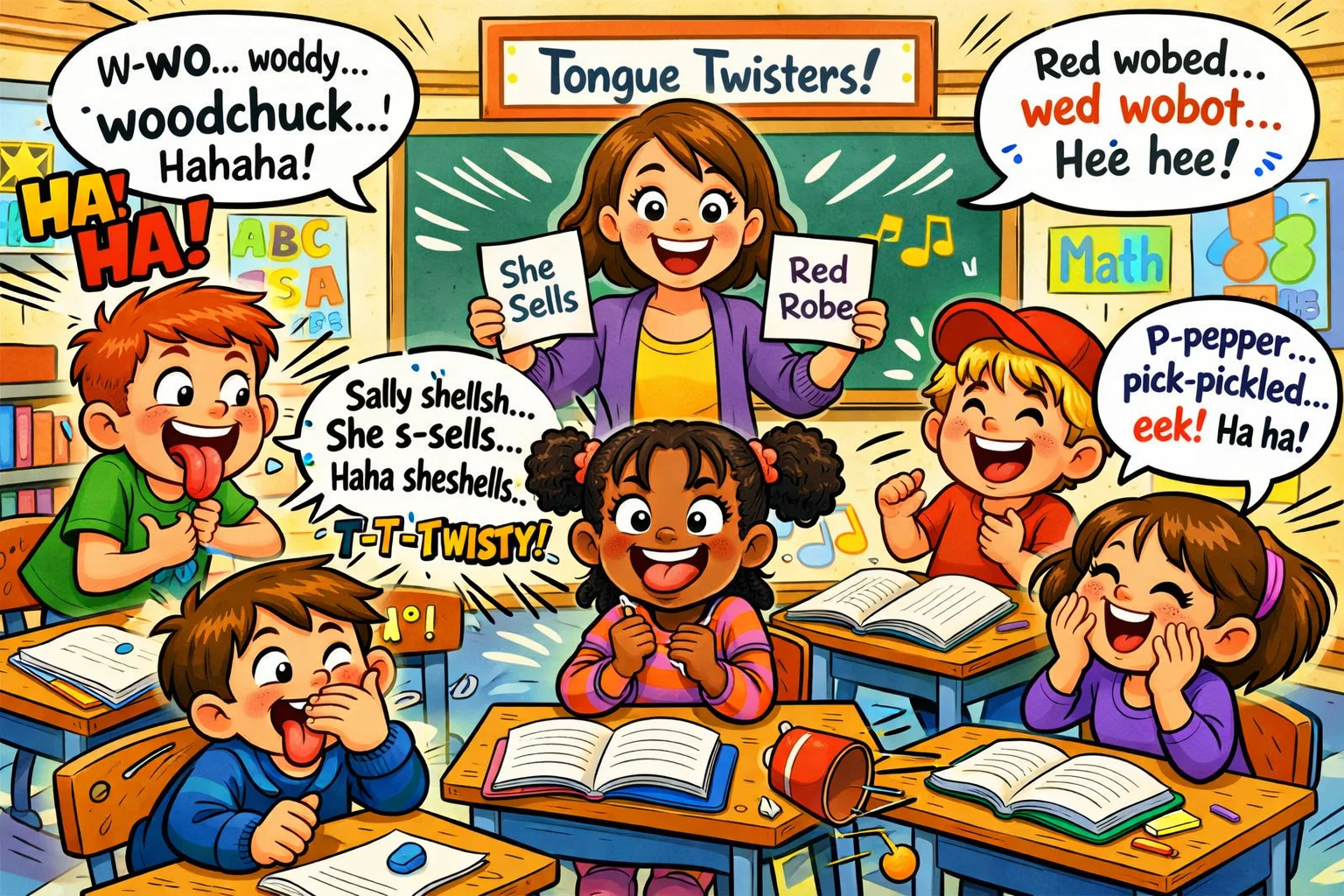
Tongue twisters for kids are a playful and proven way to build speech clarity, sharpen pronunciation, and grow speaking confidence. This collection brings together 60+ examples organized by difficulty, phonetic focus, theme, and age group, so you can find the right fit whether your child is just starting out or ready for a real challenge.
Alongside the tongue twisters themselves, you will find practical tips for parents and teachers, guidance on running effective practice sessions, and age-by-age recommendations for children from 3 to 9 and beyond.
Key Takeaways
- This article includes 60+ tongue twisters for kids organized by difficulty, from easy one-liners to hard fast-speaking challenges.
- Examples are grouped by theme, phonetic focus, and age group to help parents and teachers choose the right fit.
- Tongue twisters support speech development, pronunciation, vocabulary, memory, and speaking confidence in children.
- Practical tips cover how to run daily practice sessions, turn twisters into games, and match difficulty to a child’s skill level.
- Age-by-age recommendations are included for children ages 3–5, 6–8, and 9 and up.
What Are Tongue Twisters for Kids?
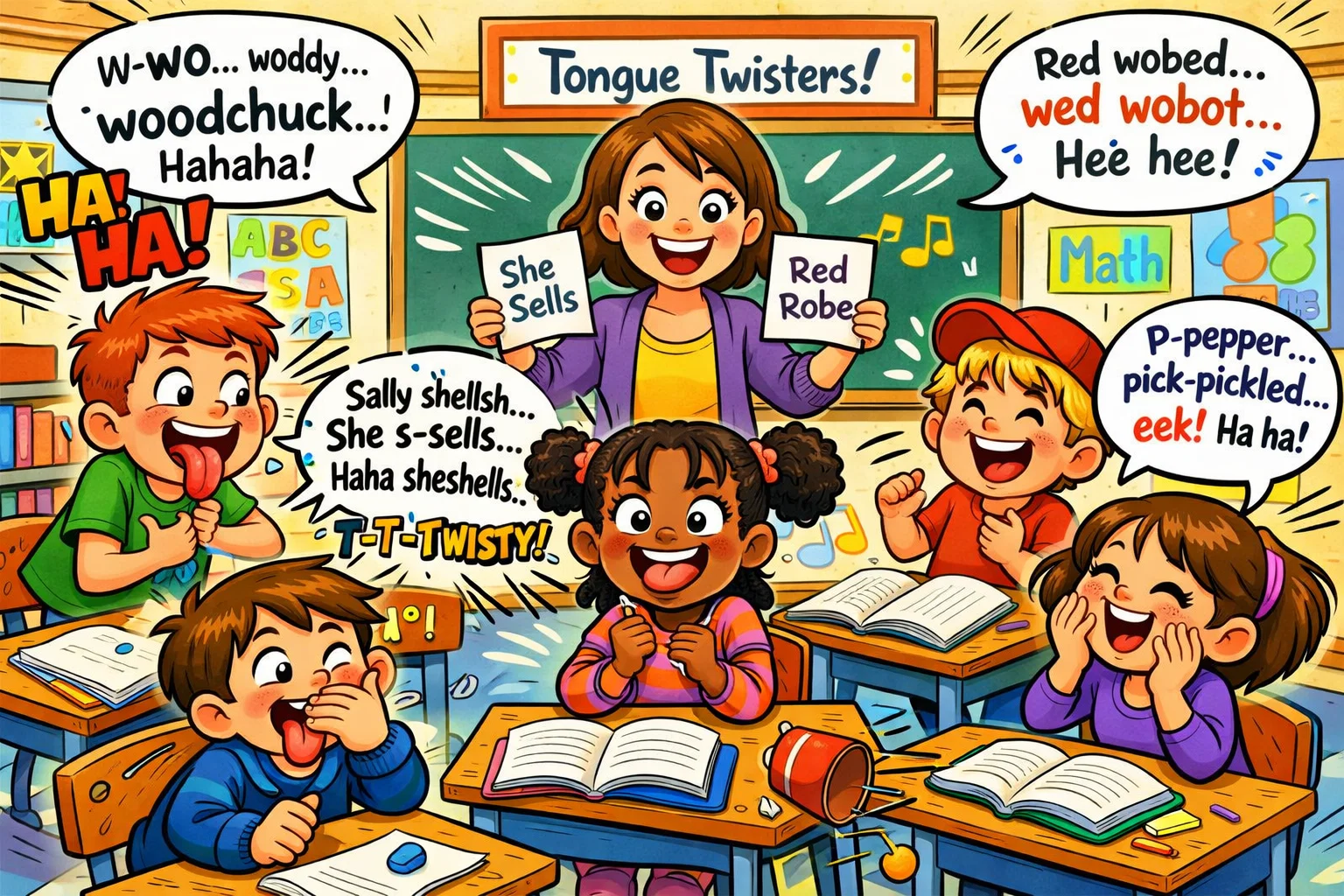
Tongue twisters are phrases or short sentences built around similar sounds that are difficult to say quickly. They often rely on alliteration and quick sound shifts to challenge the speaker’s coordination. Because they require precise movements of the tongue, lips, and jaw, they can act as a kind of workout for speech production.
Children are often drawn to these phrases because they include silly words and a playful, game-like format. The immediate feedback – often a burst of giggles when a child trips over a word – creates a low-pressure environment for experimentation. This sense of play allows kids to compete with themselves or others, turning a technical speech exercise into a rewarding family game or classroom warm-up.
How It Works
A tongue twister typically places similar sounds close together, which makes it harder for the brain and mouth to coordinate speech quickly. For example, alternating between the “s” and “sh” sounds in “She sells seashells by the seashore” requires the tongue to shift position quickly. This repetition of similar consonants and rhythmic patterns encourages the speaker to slow down and focus on clear sound differences.
Why Kids Enjoy It
One of the main reasons children enjoy tongue twisters is the humor of the verbal slip-up. Children enjoy the challenge of mastering a sentence that is hard to say, which gives them a clear sense of achievement. These phrases also often feature funny imagery and silly scenarios that spark the imagination and encourage social interaction through shared laughter.
Best Age to Start
While children develop at different rates, basic phonological awareness often becomes much stronger between ages 3 and 5. For toddlers and preschoolers, it is best to start with very short tongue twisters made up of three to five words. As children grow and their language skills develop, they can begin tackling longer tongue twisters and more complex sound patterns.
Easy Tongue Twisters for Young Kids
Easy tongue twisters are useful for building the coordination needed for clearer speech. For young children, the goal is to enjoy language play without becoming frustrated by overly difficult or unfamiliar words. These selections focus on clear rhythms and relatable concepts like animals and food.
One-Line Starters
These short starters are ideal for a quick 30-second practice session. They focus on repeating one main sound pattern, which helps children build confidence and clarity.
| Tongue Twister | Primary Sound Focus |
| Red leather, yellow leather | Distinguishing “L” and “R” sounds |
| Double bubble gum bubbles double | Practicing “B” and “D” sounds |
| Sheep should sleep in a shed | Distinguishing “sh” and “s” sounds |
| Fresh fried fish | Practicing “f” and “sh” sounds |
Easy Repetition Tongue Twisters
These phrases follow a simple pattern that is easy for children to memorize and repeat.
- “Toy boat, toy boat, toy boat”: Focuses on the transition between vowel and consonant sounds.
- Blue bluebird, blue bluebird: Helps with the “Bl” consonant blend.
- “Six sticky suckers”: Encourages clear “s” and “k” sounds.
Easy Animal Tongue Twisters
Animals are a favorite topic for kids of all ages, making these fun tongue twisters highly engaging.
- A happy hippo hopped and hiccupped: Great for practicing the “H” breath sound.
- “Silly Sally shooed seven silly sheep”: A playful line for practicing “s” and “sh” sounds.
- “Black back bat”: A very short tongue twister that challenges final consonant sounds.
Easy Food Tongue Twisters
Using food as a theme makes practicing tongue twisters feel more relevant to a child’s everyday life.
- “Greek grapes”: A simple two-word phrase for practicing the “gr” blend.
- “Quick cook cupcakes”: Excellent for practicing the “k” sound at the beginning and in the middle of words.
- I scream, you scream, we all scream for ice cream: A famous tongue twister that focuses on “Sk” and “Cr” blends.
Short Tongue Twisters for Quick Practice
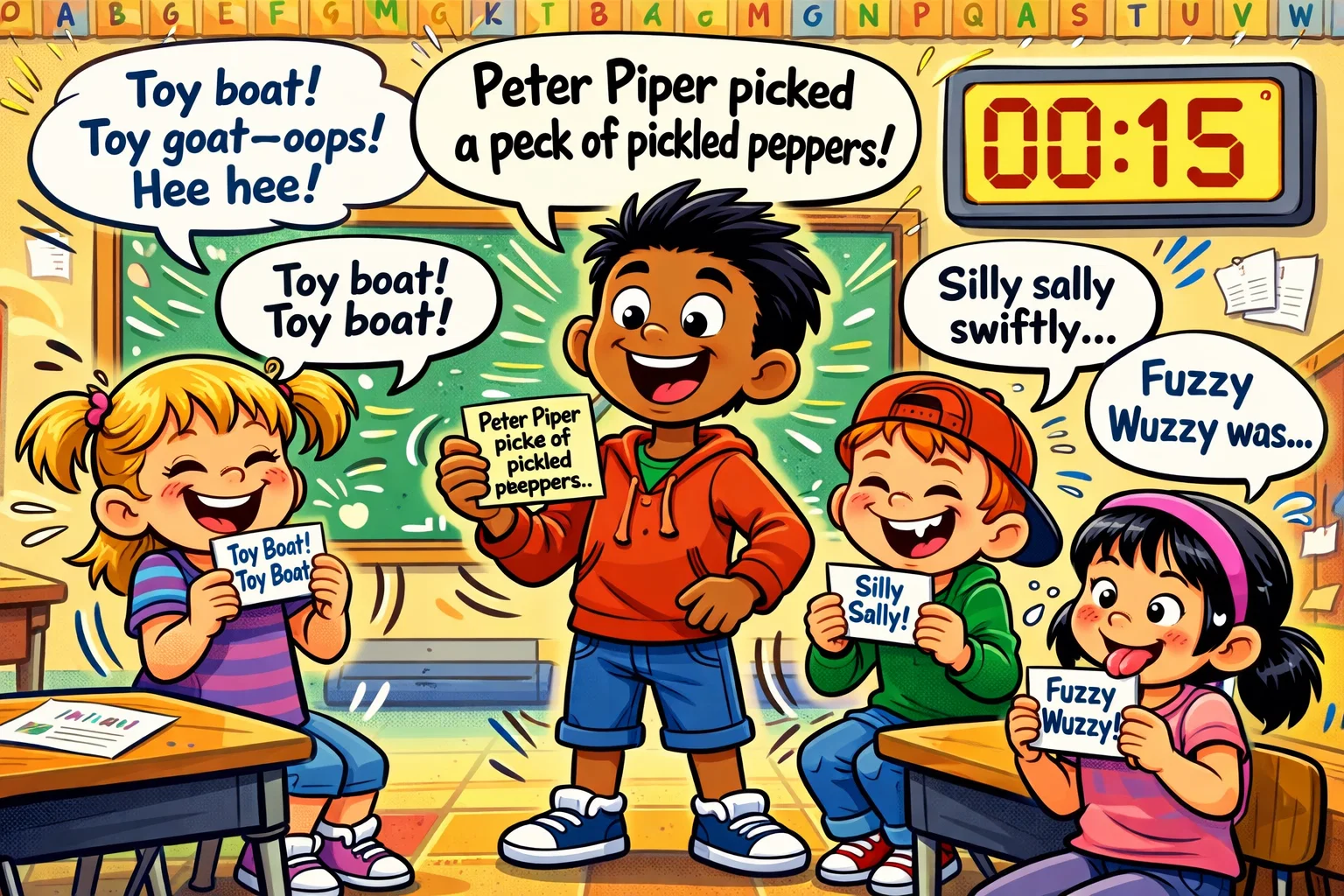
When time is limited, short tongue twisters give children a quick and effective way to practice speech skills. They work especially well in the classroom or during quick practice sessions at home, especially when you want to focus on one sound pattern at a time.
For Morning Warm-Ups
Starting the day with a quick speech warm-up can help children focus and get ready to speak clearly.
- “Truly rural”: Only two words, but extremely difficult to say quickly.
- “Eleven benevolent elephants”: Focuses on vowel clarity and the “V” and “L” sounds.
- “Flash message”: Helps children distinguish between “sh” and “s” sounds.
For Classroom Use
In a school setting, these phrases often work well in a call-and-response format that encourages group participation and speaking practice.
- “Sister Susie sat on the seashore”: A standard for group practice.
- “Proper cup of coffee in a copper coffee pot”: Engaging and rhythmic for older students.
- “Swan swam over the sea; swim, swan, swim!”: Useful for practicing “sw” sounds and noticing changes in verb form.
For Home Practice
For parents, these options are easy to remember and do not require worksheets or extra preparation.
- “Which witch is which?”: A fun way to explore homophones while practicing the “W” sound.
- “Red Buick, blue Buick”: Focuses on color words and the “B” sound.
- “Daddy draws doors”: Good for practicing the “d” sound in a simple phrase.
Funny Tongue Twisters for Kids
Humor can be a powerful learning tool; when children are laughing, they are often more willing to stay engaged. Funny tongue twisters use absurd imagery to make pronunciation practice feel playful instead of repetitive.
Silly Tongue Twisters That Make Kids Laugh
- “A big black bug bit a big black bear”: The imagery of a tiny bug bothering a large bear usually results in smiles while practicing the “B” sound.
- “Silly sally swiftly shooed seven silly sheep”: The visual of a girl chasing sheep is a classic favorite for kids of all ages.
- “The sixth sick sheik’s sixth sheep’s sick”: Widely considered one of the hardest tongue twisters, its sheer absurdity also makes it memorable.
Funny Tongue Twisters With Rhymes
Rhyming can support language development by making sound patterns feel more predictable and memorable.
- “Fuzzy Wuzzy was a bear, Fuzzy Wuzzy had no hair”: This rhythmic rhyme is famous for its playfulness.
- “Betty Botter bought some butter, but she said the butter’s bitter”: A longer tongue twister that helps with “b” and “t” sounds.
- “If a dog chews shoes, whose shoes does he choose?”: Combines humor with a lesson on “Ch” and “Sh” sounds.
Funny Tongue Twisters for Family Game Night
These are designed to be read aloud during a family game session to see who can stay serious the longest.
- “I saw a kitten eating chicken in the kitchen”: Focuses on the “K” sound with a very relatable silly image.
- “How can a clam cram in a clean cream can?”: A great rhythmic challenge that usually ends in a tongue-tied laugh.
- “A loyal warrior rarely worries”: Short but incredibly tricky for the “R” and “L” sounds.
Classic and Famous Tongue Twisters
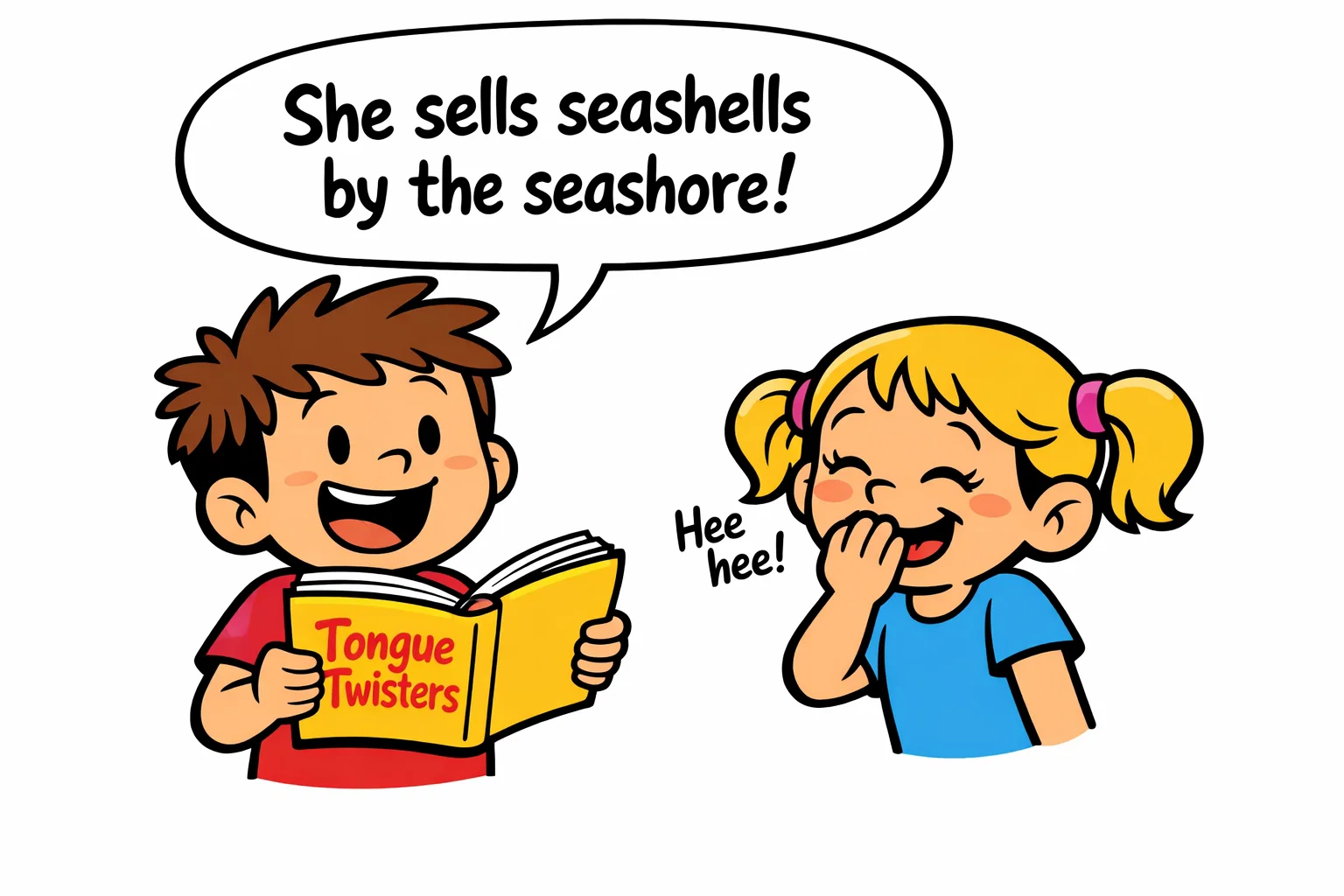
Certain famous tongue twisters have stood the test of time because of their perfect balance of rhythm and phonetic difficulty. These classic examples are widely recognized and are often the first ones parents think of when introducing tongue twisters to children.
Most Popular Tongue Twisters
| Title / Theme | Famous Line Snippet | Goal |
| Peter Piper | “Peter Piper picked a peck of pickled peppers” | Master the “P” sound |
| Sea Shells | “She sells seashells by the seashore” | Distinguish “S” from “Sh” |
| Woodchuck | “How much wood would a woodchuck chuck…” | Fluidity with “W” and “Ch” |
| Betty Botter | “Betty Botter bought some butter…” | Rapid “B” plosives |
Classic Tongue Twisters
As children enter elementary school, they can usually handle longer versions of these classics.
- “I’m sure she sells seashore shells”: A variation of the classic that adds an extra layer of difficulty.
- “Peter Piper picked a peck of pickled peppers; A peck of pickled peppers Peter Piper picked”: Learning the full version improves breath control.
- “Whether the weather be fine, or whether the weather be not”: This classic is great for practicing “th” and “w” sounds together.
These versions remain popular because they have a catchy rhythm and musical quality. The internal rhymes and predictable meters make them easy to memorize, which allows the child to focus entirely on the physical act of speaking. Their cultural recognition also gives children a sense of participating in a shared tradition.
Intermediate Tongue Twisters for Growing Skills
Once a child has mastered easier and shorter tongue twisters, it helps to introduce more challenging ones that require greater coordination. This bridge level introduces longer sentence structures and mixed sound patterns.
Two-Line Tongue Twisters
- “A tutor who tooted a flute / Tried to tutor two tooters to toot.”: This focuses on the “T” and “U” sounds while telling a short story.
- “Give papa a cup of proper coffee in a copper coffee cup.”: A more complex version of the “coffee” drill that adds the “P” and “C” alternating pattern.
- “Yellow butter, purple jelly, red jam, black bread. / Spread it thick, say it quick!”: This is a great exercise for list-making and adjective usage.
Tongue Twisters With Mixed Sound Patterns
These require the child to switch sound patterns mid-sentence, which is useful for speech coordination and overall fluency.
- “The blue bluebird blinks.”: Focuses on the “Bl” and “Nk” sounds.
- “Thin sticks, thick bricks.”: A classic “Th” and “S/K” challenge.
- “Specific Pacific”: Only two words, but the shift between similar sound patterns makes it tricky for many children.
Tongue Twisters for Repetition Challenges
The goal here is to say the phrase three to five times in a row without making a mistake.
- “Toy boat”: Surprisingly hard to repeat quickly.
- “Good blood, bad blood”: Requires careful management of the “G,” “B,” and “D” sounds.
- “Unique New York”: Challenges the “N” and “Y” vowel transitions.
Hard Tongue Twisters for Advanced Practice
Hard tongue twisters are best for children who already have strong English pronunciation and are ready for an extra challenge. These are best treated as a fun bonus level that keeps children motivated and engaged.
Hard Tongue Twisters With Similar Sounds
- “The sixth sick sheik’s sixth sheep’s sick”: Often described as one of the hardest tongue twisters in English.
- “Pad kid poured curd pulled cod”: A sequence of similar vowels and consonants that is nearly impossible to say quickly.
- “Rory the warrior and Roger the worrier were reared wrongly in a rural brewery”: A nightmare for the “R” and “W” sounds.
Fast-Speaking Challenges
- “Six slippery snails slid slowly seaward”: The repetition of “sl” and “s” makes this one especially tricky at speed.
- “I saw Susie sitting in a shoeshine shop”: Requires rapid-fire alternating between “S” and “Sh.”
- “Which wristwatches are Swiss wristwatches?”: The “W,” “R,” and “S” sounds combine for a major technical challenge.
Hardest Twisters Kids Can Try
- “The skunk sat on a stump and thunk the stump stunk, but the stump thunk the skunk stunk”: A long, hilarious story that requires perfect “St” and “Sk” control.
- “Ingenious iguanas improvising an intricate interlude”: Great for older kids to practice multi-syllabic “I” words.
- “A box of biscuits, a box of mixed biscuits, and a biscuit mixer”: Challenges the “B,” “S,” and “K” sounds in rapid succession.
Long Tongue Twisters for Extra Challenge
Long tongue twisters are useful for building concentration and memory because the child has to stay focused for longer. These are often structured as mini-poems or stories.
- “Betty Botter bought some butter / But she said the butter’s bitter / If I put it in my batter, it will make my batter bitter / But a bit of better butter will make my batter better”: This full version is a masterpiece of “B” sound practice.
- “How much wood would a woodchuck chuck / if a woodchuck could chuck wood? / He would chuck, he would, as much as he could, / and chuck as much wood as a woodchuck would / if a woodchuck could chuck wood”: The complete woodchuck poem is a classic test of endurance.
Story-Like Tongue Twisters
- “The great Greek grape growers grow great Greek grapes”: A simple story about farming that repeats the “Gr” sound.
- “Silly Sally swiftly shooed seven silly sheep / The seven silly sheep shilly-shallied”: Adds another line to increase the “sh” challenge.
- “A groundhog could hog all the ground he could hog if a groundhog could hog ground”: A fun variation of the woodchuck theme that focuses on “Gr” and “H.”
Long Tongue Twisters for Performance Practice
Drama teachers often use these as speech warm-ups to help young performers speak more clearly and project their voices.
- “To sit in solemn silence in a dull, dark dock / In a pestilential prison, with a life-long lock”: A rhythmic, theatrical piece for advanced speakers.
- “Amidst the mists and coldest frosts, with stoutest wrists and loudest boasts”: Excellent for practicing ending consonant clusters like “Sts.”
Phonetic Focus Tongue Twisters
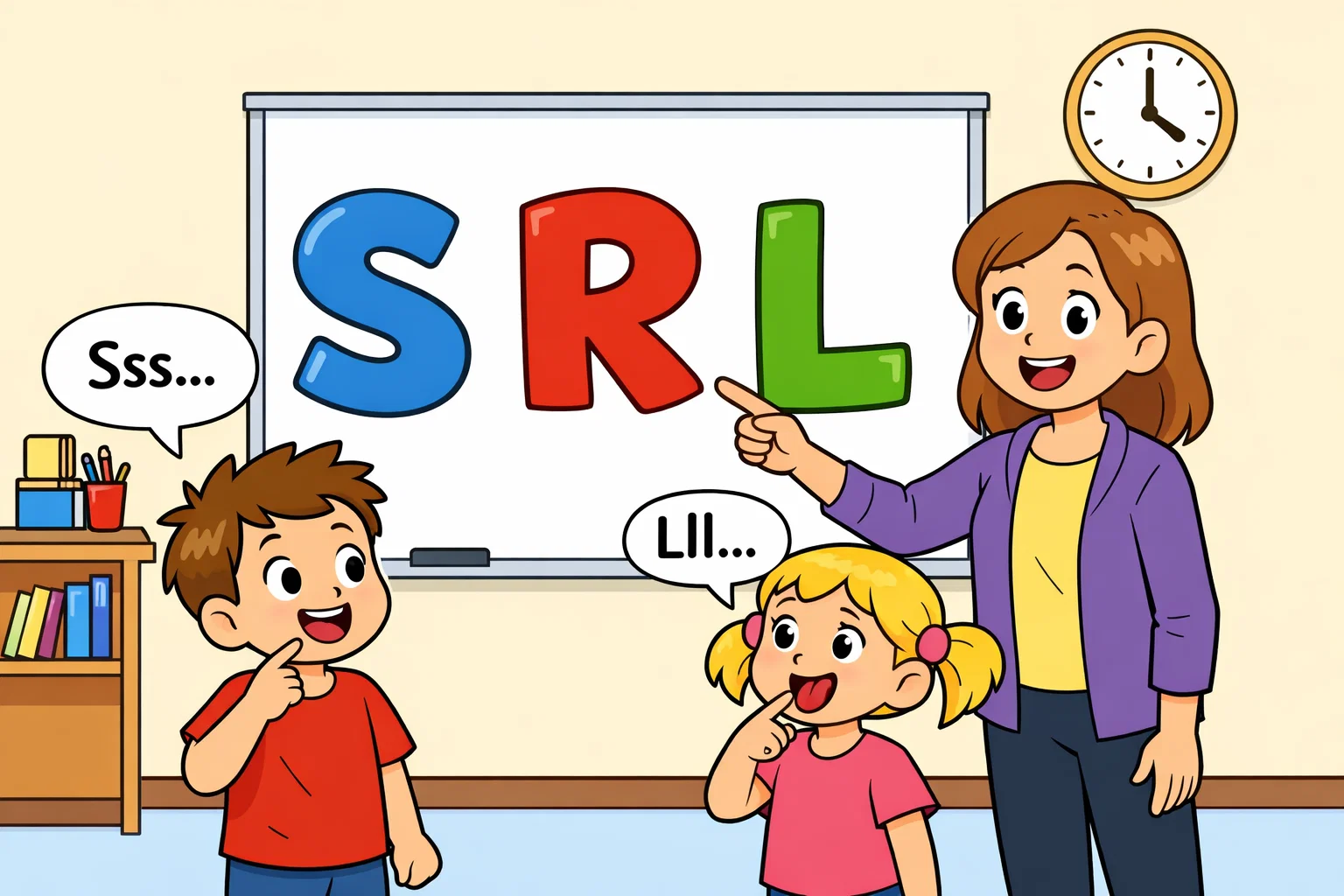
For targeted speech practice, it helps to group tongue twisters by the specific sound they target. This allows parents or teachers to focus on a child’s specific articulation needs.
S and Sh Sound Twisters
The “S” and “Sh” sounds are some of the most common targets for pronunciation practice.
- “She sells seashells by the seashore”
- “Selfish shellfish”
- “Six slippery snails slid slowly”
R and L Sound Twisters
The “R” and “L” sounds are often difficult for children to distinguish clearly.
- “Red lolly, yellow lolly”
- “Red leather, yellow leather”
- “A loyal warrior rarely worries”
B and P Sound Twisters
These plosive sounds require a quick burst of air, which can help children notice the difference between similar speech sounds.
- “Peter Piper picked a peck of pickled peppers”
- “Big black bugs bleed blue blood”
- “Betty Botter bought a bit of better butter”
Th Sound Twisters
The “Th” sound requires specific tongue placement between the teeth, making it a common area for speech development.
- “They think that this thing is their thing”
- “Thirty-three thirsty thieves”
- “Three thin thinkers thinking thick thoughts”
Tongue Twisters by Theme
Themes make these fun phrases more memorable and help categorize them for different activities or lessons.
Animals
- “A flea and a fly flew up in a flue”
- “Two tiny tigers take two taxis to town”
- “A fat cat sat on a mat and ate a fat rat”
- “Freshly fried flying fish”
- “Swan swam over the sea, swim swan swim!”
Food
- “A cupcake cook cooks cupcakes quickly”
- “Double bubble gum bubbles double”
School and Play
- “Six sticky suckers”
- “Toy boat, toy boat, toy boat”
- “I see a sea of C’s”
Benefits of Tongue Twisters for Kids
The benefits of tongue twisters go beyond entertainment and can support a child’s speech and language development. Regular practice can help children become more comfortable with sound patterns, speech coordination, and verbal repetition. By focusing on pronunciation and speech, children can build a stronger foundation for reading aloud, classroom participation, and everyday communication.
- Articulation: Helps children practice the movements needed to form complex sounds clearly.
- Phonemic awareness: Helps children distinguish between subtle differences in similar consonants.
- Rhythm and pacing: Helps children manage their breathing and pace while speaking.
- Cognitive flexibility: Encourages the brain to switch between different sound and movement patterns quickly.
Speech Development and Pronunciation
Tongue twisters can help children practice the mechanics of English pronunciation by highlighting specific sound patterns. Reciting these rhythmic sentences requires a child to articulate every syllable clearly, which naturally discourages “mumbling” and encourages a slower, more deliberate pace. This deliberate practice is essential for mastering the “R,” “L,” and “Th” sounds that are often challenging for developing speakers.
Vocabulary and Language Skills
When reciting tongue twisters, children are exposed to unusual word combinations and sound patterns they might not hear in everyday conversation. They learn to identify patterns of alliteration and rhyme, which are core components of early literacy. This exposure helps them internalize the structure of the English language, making them more adept at recognizing word families and phonetic clusters.
Concentration and Memory
Practicing tongue twisters acts as a fun brain workout that demands high levels of sustained attention. To say a difficult tongue twister correctly, a child must hold a sequence of sounds in working memory while coordinating the movements needed to speak clearly. This dual-tasking improves overall concentration and the ability to recall verbal sequences accurately under pressure.
Confidence in Speaking
Gaining mastery over a challenging tongue twister provides a significant boost to a child’s self-esteem. As they move from stumbling over a phrase to reciting it with fluency, they realize that persistence leads to success. This newfound confidence often leads to more active participation in the classroom and a greater willingness to speak in social settings.
Fun Brain Workout
The combination of auditory perception, rhythmic timing, and physical articulation makes these fun phrases a holistic mental exercise. By engaging multiple language and speech processes at once, tongue twisters can help children stay mentally engaged and alert. They can also be a fun way to warm up before a test, a presentation, or a reading session.
How to Use It
To effectively use tongue twisters, adults should treat them as a collaborative activity rather than a chore. Integrating these exercises into daily routines helps build consistency without making practice feel tiring or repetitive. Following a structured approach – moving from simple tongue twisters to more difficult ones – helps maintain a child’s interest and motivation.
Start Slow, Then Add Speed
The most effective way to practice is to focus on pronunciation before speed. Encourage the child to say the phrase very slowly, ensuring every “S” and “T” is crisp and clear. Once the child can recite the sentence three times perfectly at a slow pace, they can gradually add speed until they reach a conversational tempo.
Progress From Easy to Hard
A successful learning path involves starting with short, easy tongue twisters and gradually progressing as skills improve.
- Level 1: One-line phrases (e.g., “Red lorry, yellow lorry”).
- Level 2: Rhyming couplets (e.g., Fuzzy Wuzzy).
- Level 3: Full paragraphs (e.g., Peter Piper).
- Level 4: Fast repetitions of very similar sounds (e.g., “The sixth sick sheik’s sixth sheep’s sick”).
Turn Practice Into a Game
Transforming tongue twisters into a language game increases engagement and retention. You can use a stopwatch to time how fast a child can say a phrase, or host a family challenge in which everyone tries to say the hardest tongue twister without laughing. Awarding points for “clarity” rather than just “speed” ensures the educational value remains intact.
Use Daily Routines
Incorporate tongue twisters into small gaps in the day so practice feels natural and easy.
- Car rides: Practice during the commute to school to sharpen the mind.
- Transitions: Use a quick rhyme as a signal that it’s time to move from playtime to dinner.
- Bedtime: Recite a silly couplet as a lighthearted way to end the day.
Match Tongue Twisters to a Child’s Needs
Choose specific vocal exercises based on the sounds your child finds most difficult. If they struggle with “s” sounds, focus on a simple “s” tongue twister such as “Silly Sally swiftly shooed seven silly sheep.” If they need help with “w” sounds, a woodchuck tongue twister can be a good choice. Tailoring the content to their specific language and speech needs ensures the time spent practicing is highly productive.
How to Create Your Own Tongue Twisters
Creating your own rhythmic sentences is a fantastic language game that encourages creativity and phonological awareness. It allows children to take ownership of their learning.
Pick One Sound Family
Start by choosing a single consonant (like “B,” “S,” or “T”) or a blend (like “St” or “Br”). This gives you a clear starting point for the rest of the sentence.
Use Repetition and Rhythm
A good articulation puzzle needs a steady beat. Try to use words that have a similar number of syllables or a repeating pattern of stressed and unstressed sounds.
Add Funny Characters and Actions
Give your character a name that starts with your chosen sound. For example, if you chose “M,” you could start with “Molly the Monkey.” Then, give her an action: “Molly the Monkey made messy macaroni.” Adding a location or a funny detail makes it even better: “Molly the Monkey made messy macaroni in the middle of May.”
Test and Simplify
Read your creation aloud. If it’s too easy, add more words with the same sound. If it is too hard to say even once, simplify it by replacing one or two words so the sequence becomes easier to manage.
Best Ways to Practice Tongue Twisters Daily
Consistency is key to improving pronunciation and fluency. Short, daily bursts of practice are much more effective than one long session once a week.
Practice During Car Rides
Use commute time to turn off the screens and practice together in a playful way. It’s a great way to bond while improving language skills.
Add Tongue Twisters to Reading Time
Before starting a bedtime story, try saying three easy tongue twisters. This can warm up the voice and make reading aloud feel more expressive and clear.
Use Tongue Twisters as Speech Warm-Ups
If your child is in a play, sings in a choir, or is giving a presentation at school, two minutes of speech practice can help reduce mumbling and improve clarity.
Keep Sessions Short and Fun
Never let practice become a source of frustration. If a child is struggling, go back to an easier one to rebuild confidence. The goal is to keep them smiling and engaged.
Tips for Parents and Teachers
To make the most of tongue twisters in the classroom or at home, follow these simple guidelines:
| Do | Don’t |
| Praise effort and clarity | Criticize mistakes or stumbles |
| Model the correct sound first | Rush to get to the “hard” ones |
| Use visual aids or simple worksheets | Turn it into a graded assignment |
| Let the child choose the theme | Force practice when they are tired |
Choose Clear, Age-Appropriate Phrases
Ensure the vocabulary is something the child understands. If they do not know what a “peck” or a “woodchuck” is, take a moment to explain it so the phrase feels meaningful rather than just sounding random.
Focus on Clarity Before Speed
Speed should never matter more than clarity in speech practice. The real benefit of tongue twisters comes from the precision of the movement. If they are speaking fast but unclearly, they are not really practicing clear speech patterns.
Celebrate Small Wins
When a child finally masters “Peter Piper,” celebrate the achievement. Small celebrations build the confidence needed to tackle even more difficult challenges in the future.
Stop Before Frustration Starts
If you notice a child becoming tense or upset because they can’t get a sound right, shift the focus to something else. Speech practice should stay positive and low-pressure.
Best Tongue Twisters for Kids by Age
Matching the challenge to a child’s developmental stage helps keep practice in the “Goldilocks zone” – not too easy and not too hard.
Ages 3–5
- Focus: Single sound repetition and very short phrases.
- Examples: “Toy boat,” “Blue bluebird,” and other very short phrases with simple sound repetition.
Ages 6–8
- Focus: Rhyming, longer phrases, and “funny” imagery.
- Examples: “Fuzzy Wuzzy,” “Six sticky suckers,” and shorter versions of “How much wood would a woodchuck chuck?”
Ages 9+
- Focus: Compound sounds, high-speed challenges, and long-form poems.
- Examples: “The sixth sick sheik’s sixth sheep’s sick,” “Betty Botter bought some butter,” and “Specific Pacific.”
FAQ
What are tongue twisters for kids?
Tongue twisters are phrases or sentences that use similar sounds in a sequence that is intentionally difficult to say quickly. They are used as a fun way to improve speech and coordination.
What are the best tongue twisters for kids?
The best ones are usually short, funny, and appropriate for their age. Classics like Peter Piper and She sells seashells are excellent starting points for most children.
Are tongue twisters good for speech practice?
Yes, they are highly effective for practicing pronunciation and fluency. They help train the brain and the mouth muscles to work together more efficiently.
At what age can kids start tongue twisters?
Most kids can start with very simple tongue twisters around age 3 or 4, as long as the phrases are short and the activity remains a game.
How do you teach tongue twisters to kids?
The best method is to read it slowly together, practice the tricky words, gradually increase the speed, and turn the activity into a game.
Can kids make their own tongue twisters?
Yes. Creating their own tongue twisters is a great way to practice alliteration and word choice. Just pick a letter, pick a character, and start building a silly sentence.

Take a short quiz to find out what your everyday choices say about your parenting style
When your child is curious about something new, what’s your instinct?
Take a short quiz to find out what your everyday choices say about your parenting style
“Can I download this app?” What happens next?
Take a short quiz to find out what your everyday choices say about your parenting style
When it comes to rules at home, which sounds most like you?
Take a short quiz to find out what your everyday choices say about your parenting style
If you could give your child one life skill today, what would you pick?
Take a short quiz to find out what your everyday choices say about your parenting style
Your child gets to choose what to watch. What would your ideal setup look like?
Take a short quiz to find out what your everyday choices say about your parenting style
Pick your parenting superpower ✨