43 Social Skills Activities for Autistic Children: Games, Routines, Visual Supports, and Group Practice

 Discover a Free Education Video App for Kids
Pastory uses AI to personalize educational video content based on your child’s interests and personality. Safe, engaging, and built for curious young minds. Sign up now to stay updated and enjoy early access with a free trial
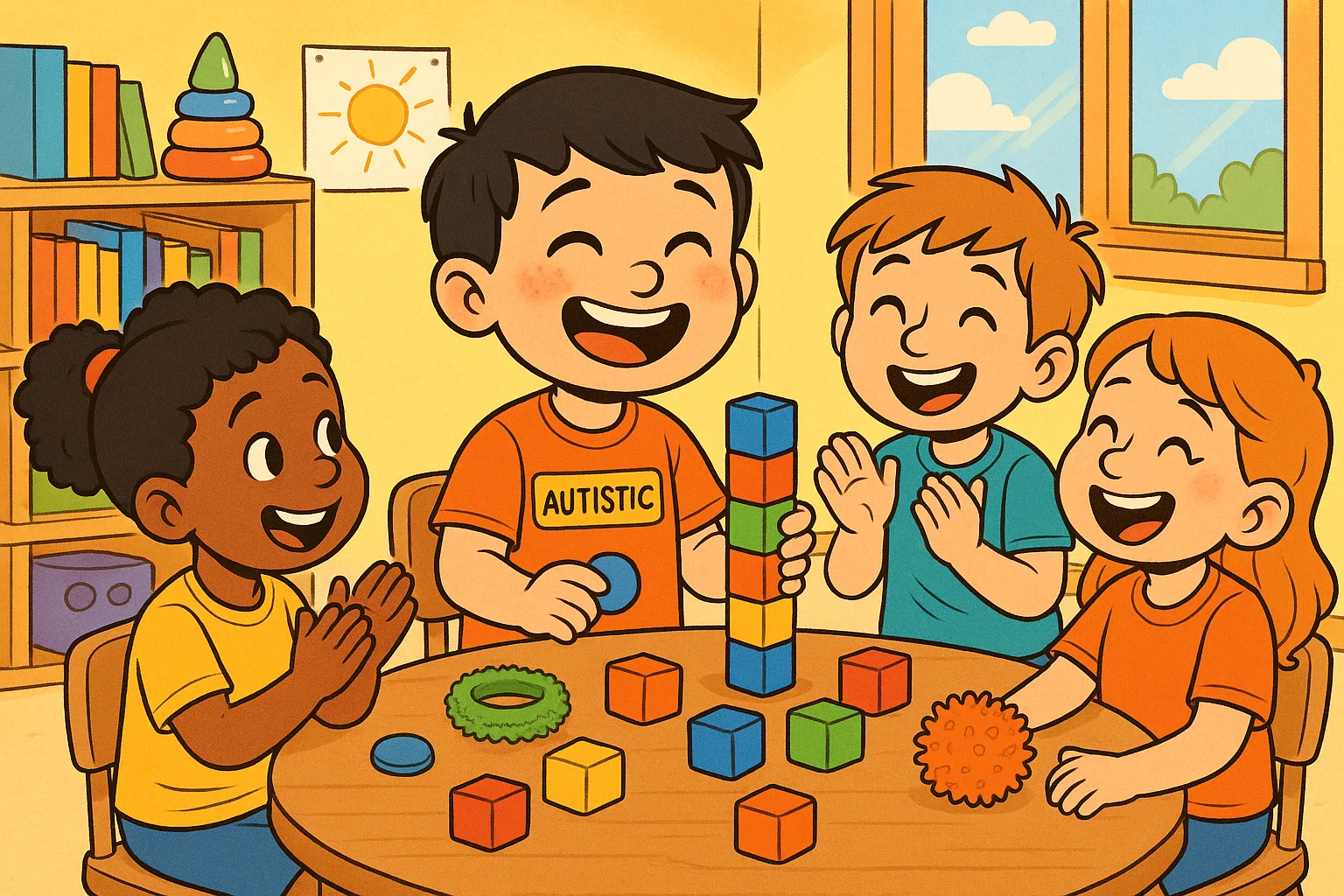
Supporting the social and communication development of autistic children requires intentional, structured, and engaging learning opportunities. Parents, educators, and therapists often look for practical social skills activities that help kids navigate social situations with confidence. These targeted exercises support key parts of social interaction, such as turn-taking, emotion recognition, conversation, and flexible thinking.
By using structured social skills activities, caregivers can help autistic kids develop practical tools for self-advocacy and meaningful social connections. Because every autistic child has a unique profile of strengths, interests, and sensory preferences, these activities should be thoughtfully adapted. Tailoring activities to a child’s developmental level, communication style, and comfort level helps keep social practice encouraging and low-pressure.
Key Takeaways
For readers who need practical guidance right away, effective social development strategies often rely on predictability, visual supports, and short, consistent practice sessions.
- Optimal Frequency: Practice social skills games for 5 to 10 minutes a day to support retention without increasing cognitive or sensory fatigue.
- Activity Selection: Prioritize activities that build on a child’s interests, such as trains or animals, to increase engagement and reduce anxiety.
- Adaptation Strategy: Use visual supports, such as visual schedules or emotion cards, because many autistic kids benefit from concrete representations of abstract social rules.
- Professional Support: Consult speech-language pathologists, occupational therapists, or developmental psychologists if a child experiences ongoing distress or significant difficulty during peer interactions.
Best Activities by Goal
| Target Social Goal | Recommended Activity Type | Primary Developmental Benefit |
| Emotion Recognition | Emotion Cards & Charades | Improves identification of facial expressions and situational social cues. |
| Conversation Practice | Topic Games & Role-Playing | Enhances back-and-forth communication skills and topic maintenance. |
| Peer Interaction | Cooperative Building & Board Games | Teaches vital social skills like taking turns, waiting, and sharing physical space. |
| Transition Navigation | Social Stories & Visual Schedules | Reduces anxiety by previewing upcoming social situations and clearly defined social expectations. |
| Group Dynamics | Structured Team Sports & Scavenger Hunts | Fosters collaborative problem-solving skills and positive social interactions. |
Quick Daily Practice Plan
A structured daily routine provides predictability as autistic children practice social skills. Caregivers should set aside a consistent 5-to-10-minute block each day, using the same physical space and routine structure to reduce transition anxiety.
Focus on one specific skill per week, such as greetings or waiting, to avoid overwhelming the child. Progress can move gradually from one-on-one interaction with a trusted adult to structured practice with a familiar peer and, eventually, to small group activities.
Safety, Sensory, and Comfort Notes
Effective social skills activities should prioritize the child’s sensory comfort and emotional safety over performance goals. Adults should never force eye contact, physical touch, or participation, as these demands can increase anxiety, sensory overload, or compliance-based distress.
Caregivers should offer clear choices between activities, provide easy access to quiet break areas, and use sensory tools such as noise-canceling headphones. Respecting a child’s communication preferences – whether through speech, gestures, or augmentative and alternative communication (AAC) – is fundamental to building authentic self-advocacy.
Social Skills and Autism
Autistic individuals often perceive, process, and interact with the world in distinctive ways that reflect the natural diversity of the human brain. Understanding that communication and play styles vary across the autism spectrum helps adults approach learning from a respectful, neurodiversity-affirming perspective.
Rather than trying to make kids appear less autistic, targeted social practice should equip them with practical tools for expressing needs, understanding expectations, and navigating social situations safely. Developing these abilities can help autistic kids interact safely with their environment, cooperate with peers on their own terms, and navigate daily routines more comfortably.
Core Social Skills to Practice
Targeted supports can help autistic children practice specific skills that support daily participation at home, at school, and in the community. Structured practice can help kids gradually coordinate multiple interactive behaviors, such as listening, waiting, responding, and asking for help.
Caregivers can focus on breaking these nine important social skills into clear, distinct steps:
- Initiating and responding to basic everyday greetings
- Navigating reciprocal turn-taking during structured play
- Active listening by following the speaker, topic, and context
- Making clear verbal, visual, or gestural requests for assistance
- Joining an ongoing peer play activity smoothly
- Reading and identifying diverse facial expressions and body language
- Sharing physical space comfortably without experiencing sensory distress
- Resolving minor interpersonal conflicts using structured choices
- Ending a conversation or play session with clear, polite phrases
Social Communication Skill Examples
Social communication skills include both spoken language and nonverbal cues used in everyday social situations. Examples of these skills include saying hello when a peer enters a room, answering direct questions, and selecting a shared topic of conversation.
Children may also benefit from learning to notice body language, use gestures to support communication, and request a sensory break when overwhelmed. Teaching an autistic child how to ask a peer to play can provide a concrete first step toward positive social interaction.
Strength-Based Social Practice
A strength-based approach intentionally integrates a child’s deep interests – such as trains, marine animals, drawing, or music – into the learning framework. Child development research suggests that using a child’s interests as the theme for an activity can increase motivation to participate.
For example, a turn-taking activity can use train tracks, with each participant adding one piece to the rail line. Centering the interaction around a preferred topic can reduce the cognitive load of social practice and make the skill easier to retain.
Common Social Challenges in Autistic Children
Identifying a child’s processing style, communication preferences, and support needs helps parents and educators choose appropriate activities. Rather than viewing these differences as fixed deficits, adults can understand them as areas where targeted support and environmental accommodations may help.
Difficulties With Communication
Autistic kids may experience differences in expressive and receptive language during rapid social exchanges. A child may struggle with the fast pace of back-and-forth conversation and need extra time to process spoken language.
Many autistic kids interpret language literally, so idioms, sarcasm, and subtle nonverbal cues may lead to confusion. Sometimes, a child’s facial expression or tone of voice may not fully reflect how they feel inside, which can lead to misunderstandings during peer interactions.
Challenges With Social Engagement
Unstructured peer interactions can create anxiety and social stress for an autistic child. Some autistic kids prefer parallel play, which involves playing independently alongside a peer without directly joining the same activity.
A child may have difficulty understanding the unwritten rules of a playground game or finding a clear way to join an established group. During chaotic, unpredictable play periods such as school recess, the lack of clear structure can lead to withdrawal or avoidance.
Repetition and Predictability
A preference for sameness and predictable routines is common in autism and can strongly affect social participation. Unpredictable social situations without clear guidelines or scripts can increase anxiety and resistance.
In contrast, structured rules, clear scripts, and repeated game routines can give the child a sense of predictability. When a social activity has consistent rules and clear expectations, the child can focus more of their energy on practicing the target communication skill.
Sensory Sensitivities
Sensory differences can significantly affect how autistic children participate in everyday activities and community settings. Loud background noise, flickering fluorescent lights, unexpected physical contact, crowds, or intense movement can contribute to sensory overload.
When a child is overwhelmed by environmental stressors, it may become harder for them to process social cues. Therefore, reducing sensory stress and creating predictable environments is often an essential first step in social skills practice.
Why Social Skills Practice Matters at Home, School, and Therapy
Meaningful development of social skills requires consistent, coordinated reinforcement across the primary environments in a child’s life. When adults use consistent expectations and strategies across settings, kids are more likely to turn practiced skills into flexible habits.
Home Practice Benefits
The home environment can provide a safe, familiar place to begin social skills practice. Parents can build social skills practice into daily routines such as meals, family board games, household chores, and bedtime preparation.
Practicing at home allows the child to learn in a low-stakes environment alongside trusted family members and siblings who understand their sensory needs. This consistent, comfortable repetition can help autistic kids build confidence before trying skills in public settings.
School Practice Benefits
The school environment offers important opportunities for autistic students to practice structured peer-to-peer interactions. In the classroom, educators can implement structured peer pairings, facilitate collaborative group projects, and manage predictable group transitions.
During these structured interactions, an autistic child gains experience with peers’ communication styles, boundaries, and play rules. School-based practice can also help students understand expectations in shared spaces such as cafeterias and playgrounds.
Therapy Practice Benefits
Therapy sessions – including speech therapy, occupational therapy, and specialized social skills groups – can provide structured, individualized support. Pediatric speech-language pathologists use focused exercises to practice specific language skills and nonverbal communication cues.
Occupational therapists may address sensory processing, regulation, and fine motor skills that can support participation in group games. These clinical settings allow therapists to adjust the complexity of social scenarios based on the child’s responses and progress.
Progress Across Different Settings
A key goal of social skills practice is generalization: helping a child use a learned skill with different people, in different places, and in different situations. Autistic kids may not automatically transfer a skill learned in a quiet therapy room to a busy school environment.
To bridge this gap, practice can progress systematically. The child may first master the skill with a trusted adult at home, then practice with a familiar peer in a quiet space, and eventually apply the skill in a larger group setting.
Tips for Starting Social Skills Activities for Autistic Children
Introducing new interactive exercises works best with a structured approach that reduces anxiety and prioritizes positive early experiences. Caregivers should create an inviting environment where mistakes are treated as a natural, safe part of learning.
Start With Short Sessions
When starting a new social skills activity program for autistic kids, keep the first sessions to 5 minutes or less. Short, structured sessions help the child experience success before cognitive fatigue or frustration builds.
As the child demonstrates consistent comfort and engagement over several consecutive sessions, adults can gradually extend the duration of the play. Celebrating a brief, successful interaction can build more long-term confidence than pushing through a long, stressful session.
Model the Skill Before Practice
Adults should demonstrate the target behavior clearly before asking the child to try it. For example, if the goal is to practice sharing, two adults or an adult and a sibling can perform a clear, slow demonstration of requesting and passing a toy.
This visual modeling gives the child a concrete example and allows them to observe without the immediate pressure to participate. Clear modeling makes the social expectation easier to understand by turning an abstract rule into a visible action.
Use Prompts and Fade Support
Systematic prompting involves providing decreasing levels of support to assist a child in independently performing a specific social action. Practitioners can use a prompting hierarchy to guide the child toward greater independence:
- Full Physical Prompt: Gently guiding a child’s hands to pass a game piece, used sparingly and only with full consent.
- Gestural Prompt: Pointing directly to a visual schedule card or pointing to a peer whose turn it is.
- Visual Prompt: Pointing to an emotion card or a written conversation starter script resting on the table.
- Verbal Prompt: Offering a direct verbal reminder, such as asking, “What can we say to Joshua now?”
As the child begins to use the behavior independently, the caregiver should gradually fade prompts to prevent prompt dependence.
Celebrate Small Wins
Immediate, specific reinforcement can help autistic kids strengthen newly learned social skills. Avoid generic praise such as “good job”; instead, use specific feedback that clearly identifies the successful behavior.
For example, stating, “You waited patiently for your turn with the blocks,” directly connects the praise to the specific action. If a child prefers physical or material rewards, match the reinforcement strategy to their preferences so the reward feels meaningful.
Interactive Games to Build Social Interaction Skills
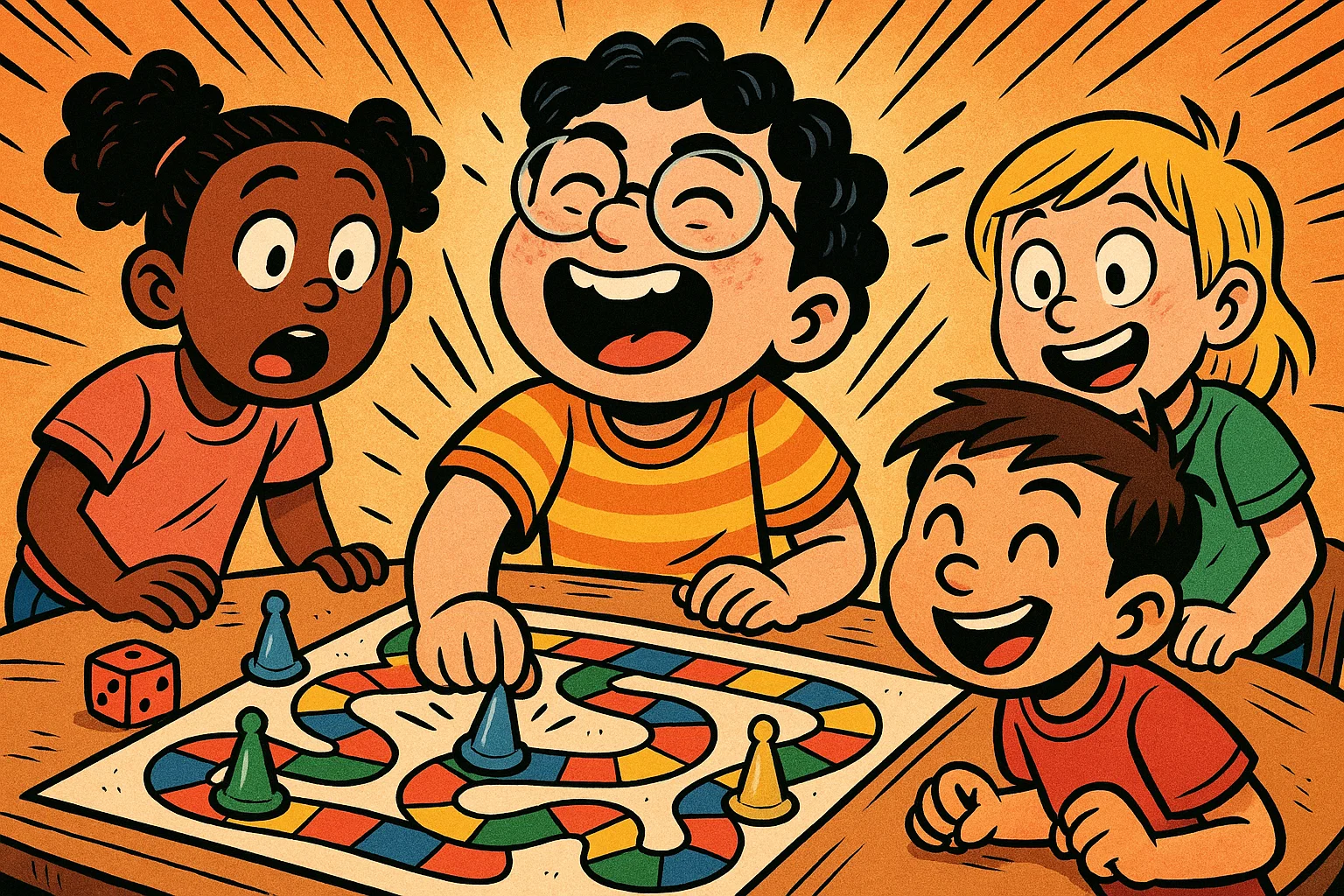
The following activities help build shared attention, turn-taking, and rule-following through predictable, interactive play.
1. Shared Attention Games
Traditional expectations of continuous eye contact can be physically uncomfortable and cognitively exhausting for many autistic people. Shared-attention games should focus on looking toward the same object or activity rather than requiring direct eye contact.
For example, blowing soap bubbles or operating a wind-up rolling toy encourages the child to naturally look toward the object and track its movement. This shared tracking establishes a comfortable point of joint attention between the child and the adult without increasing social pressure.
2. Staring Contest Alternative
Instead of a traditional staring contest, try a playful “Silly Face Pause” game that prioritizes lighthearted, brief visual engagement. The adult and child can briefly face each other or look into a mirror, then freeze into a funny facial expression for three seconds before laughing.
This activity reframes facial orientation as a joyful, low-stakes game rather than a rigid compliance requirement. Participation should remain completely optional, and the game should stop immediately if the child shows signs of avoidance or discomfort.
3. Roll Ball
Sitting across from a child on the floor and rolling a soft ball back and forth is an excellent foundational tool for reciprocal interaction. This simple physical loop teaches anticipation, turn-taking, and active waiting in a highly predictable way.
Caregivers can introduce basic functional phrases during the movement by saying, “My turn to roll,” and “Your turn to catch.” The visual momentum of the ball provides a clear physical cue that helps the child track the back-and-forth flow of the exchange.
4. Turn-Taking Games
Structured games using items like building blocks, puzzle pieces, or color-coded pegboards offer clear, physical representations of reciprocal play. Participants alternate placing one piece onto a shared tower or puzzle frame, creating a visual rhythm to the interaction.
Adults can add concrete visual cues, such as a physical “turn token” passed back and forth, to clarify exactly whose turn it is. Pairing the physical action with simple, repetitive scripts like “my turn,” “your turn,” and “wait” helps reinforce the abstract concept of waiting.
5. Topic Game
The Topic Game is designed to help kids stay focused on one topic during a conversation. Start by selecting a concrete theme card, such as “Dinosaurs” or “Space,” and placing it face-up in the center of the table as a visual anchor.
Participants take turns contributing one sentence or asking one direct question that relates to the central theme card. If the child switches to an unrelated subject, gently point to the theme card to provide a nonverbal reminder to return to the topic.
6. Step Into Conversation
This exercise uses role-playing scripts to teach kids how to join an ongoing peer play activity or conversation. The adult creates a predictable social scenario, such as a sibling building with blocks, and provides the child with written or visual script choices.
The child practices walking up, pausing briefly to observe the activity, and using an opening phrase like “Can I play?” or “What are you building?” Repeated practice with these scripts can reduce the cognitive effort and anxiety often associated with joining peer groups.
7. Token Stack
Token Stack uses physical items such as colorful counters, tokens, or interlocking bricks to visually track the balance of a conversation. Every time a participant contributes a relevant comment or asks an appropriate question, they place one token onto a central shared stack.
This visual accumulation allows the child to see the structural balance of the dialogue, helping them understand when to speak and when to listen. The tangible growth of the stack transforms the abstract flow of conversation into a measurable, shared building project.
8. Decision-Making Games
This activity gives children structured choices so they can practice making decisions, expressing preferences, and responding calmly to different opinions. Using simple choice cards, ask the child to select a preferred activity or item, then ask them to explain their choice using a basic phrase template.
Next, the adult deliberately selects a different option, demonstrating how two people can have different preferences while remaining friendly. This exercise builds flexible thinking and helps children learn to navigate small disagreements constructively.
Emotion Recognition Activities
Recognizing facial expressions, tone of voice, and situational cues can help children interpret social situations and navigate relationships.
9. Emotion Cards
Emotion Cards feature clear photographs or simple illustrations of common emotions, including happiness, sadness, anger, fear, surprise, and calm. Caregivers can use these cards to play matching games, pairing specific facial expressions with simple, realistic social situations described aloud.
For instance, match the “sad” card to a scenario where a child drops their ice cream cone onto the ground. This visual pairing helps children connect abstract facial features – like downturned mouths or furrowed brows – with concrete situational causes.
10. Emotion Charades
Emotion Charades involves physically acting out a specific feeling using body language and facial expressions while the other participant guesses the emotion. To keep the activity structured and accessible, players draw an emotion card from a deck to determine which feeling they will portray.
The game can be adapted to match various comfort levels by using handheld mirrors, puppets, or custom drawings instead of full-body acting. This playful physical movement helps children connect internal emotional sensations with visible, external physical signals.
11. Expression Mimicking Games
This activity uses a large, secure mirror or a digital camera to practice mimicking facial expressions shown in photographs. The child looks at a target picture of an emotion, then attempts to recreate that facial structure in their own reflection.
This exercise focuses on developing physical awareness of facial muscles and noticing how expressions are constructed, without demanding social performance. Keeping the environment lighthearted and playful helps the child remain comfortable while exploring different expressions.
12. How Are They Feeling?
This exercise uses illustrated storybooks, family photographs, or short video clips to help children identify possible emotions in different characters. Pause the media at a key moment and ask the child to evaluate the character’s face, body posture, and current situation for clues.
Ask guiding questions such as, “Her eyebrows are pulled together and her fists are clenched – how might she be feeling?” This practice teaches children to gather context clues from their surroundings to better understand the emotions of others.
13. How Would You Feel?
Present the child with a series of simple, relatable everyday scenarios using illustrated cards or short verbal descriptions. Examples include receiving a long-awaited birthday gift, encountering a loud barking dog, or losing a favorite school pencil.
The child evaluates the scenario and selects an emotion card from a pre-arranged layout to show how that situation would make them feel. This exercise builds self-awareness and helps children understand that different people can react differently to the same situation.
14. Face Games
Face Games use creative materials such as blank face templates, clay, or dry-erase markers to create different emotional expressions. The child manually adds elements like curved eyebrows, wide eyes, or smiling mouths to a blank face structure to match a designated emotion.
For kids who actively avoid looking at human faces or mirrors, this artistic approach offers a low-stress alternative. Building expressions piece by piece helps break down complex, fluid social cues into static, understandable parts.
Role-Playing Scenarios
Role-playing allows kids to practice real-world social interactions in a safe, structured environment before trying them in public.
15. Real-Life Role Play
Real-Life Role Play focuses on practicing specific, high-frequency community interactions that the child may encounter in daily life. Set up structured practice sessions for situations such as ordering food at a counter, asking a school librarian for help, or politely declining an item.
Break the target interaction into clear, predictable steps that the adult and child can practice repeatedly by switching roles. This consistent behavioral rehearsal can reduce the anxiety and cognitive load associated with navigating unfamiliar public environments.
16. Imaginative Role Play
Imaginative Role Play uses familiar, everyday themes like a grocery store, a doctor’s office, a restaurant, or a school classroom to practice flexible interaction. Set up the physical space with realistic props and signs, allowing the child to take turns playing different roles, such as the cashier or the customer.
This playful format encourages kids to practice common scripts while learning to adapt when the interaction changes slightly. By engaging in these pretend scenarios, kids build social confidence and flexible problem-solving skills.
17. What Would You Do?
This exercise involves presenting the child with a realistic social problem scenario and offering two or three distinct behavioral choices to evaluate. For instance, present a scenario where a peer accidentally bumps into the child’s block tower, causing it to fall over.
Walk through each available choice step-by-step, discussing the realistic consequences of each action without using shaming or punitive language. This structured approach helps kids develop problem-solving skills and anticipate the outcomes of their behavioral choices.
18. Play Pretend
Play Pretend focuses on using open-ended imaginative play with toy sets – such as farmhouses, doctor kits, or space stations – to model flexible cooperative interaction. The adult and child collaborate to develop a simple shared storyline, taking responsibility for different characters and moving the plot forward together.
This play structure requires participants to negotiate roles, share physical props, and respond dynamically to each other’s creative contributions. If the child struggles with unstructured play, use a simple visual storyboard to provide helpful direction.
19. Improvisational Stories
Improvisational Stories is a collaborative verbal or visual game in which participants build an original story together, one sentence at a time. The first player contributes an opening sentence, and the next player listens closely, accepts that premise, and adds a logical next sentence.
This game targets communication skills like active listening, maintaining topical relevance, and accepting a partner’s creative ideas without trying to overwrite them. For visual learners, draw quick, simple sketches on a whiteboard to accompany each new sentence added to the story.
20. Video Modeling
Video Modeling uses short, clear video clips that show a target social skill modeled by relatable peers or adults. Select videos that are age-appropriate, visually clear, and focused on a single isolated skill, such as sharing a toy or greeting a neighbor.
After watching the clip together, the adult and child immediately practice role-playing the same sequence of actions observed in the video. This strategy provides a clear visual blueprint that makes abstract social expectations more concrete and easier to replicate.
Communication Activities for Autism
Targeted communication activities help children practice verbal and nonverbal communication, active listening, expressive language, and respectful peer interaction.
21. Name Game
The Name Game is a structured circle activity designed to strengthen peer awareness, name recognition, and attention during group transitions. Participants sit in a small circle and pass a soft ball or beanbag after saying the recipient’s name.
For children who are still building verbal language, this activity can be adapted by using large printed photographs of the participants as visual cues. This game helps children learn to secure a peer’s attention before initiating an interaction or passing an item.
22. Would You Rather?
This classic choice game involves asking simple, engaging questions that compare two distinct preferences, such as, “Would you rather fly like a bird or swim like a fish?” Each participant takes turns stating their personal preference, listening to the other player’s choice, and accepting that different opinions are natural.
This game serves as an accessible tool for teaching preference sharing and practicing polite listening without requiring complex conversational processing. Use clear picture cards to represent both choices so that nonverbal children can participate fully.
23. Storytime
Storytime uses interactive shared reading to explore characters’ thoughts, possible feelings, and social choices. Choose stories that feature clear, relatable social situations, and pause periodically to discuss the illustrations and character choices together.
Ask consistent, predictable questions like, “What is he thinking right now?” or “What do you think she will do next?” Visual graphic organizers can help children map out cause-and-effect relationships within social interactions.
24. Sharing Time
Sharing Time provides a structured, predictable platform where a child can showcase a favorite toy, artwork, or personal object to a small audience. The child practices presenting three basic facts about their item, while the listeners practice looking, listening quietly, and waiting to ask a question.
This activity uses a visual prompt card featuring symbols for “look,” “listen,” “ask,” and “comment” to guide the audience’s responses. This structured format helps children practice both sharing information about their interests and participating as supportive listeners.
25. Productive Debate
For older children and adolescents, Productive Debate teaches the basic structure of polite disagreement and perspective-taking. Participants select a low-stakes topic, such as choosing the best superhero power, and take turns presenting logical reasons to support their perspective.
Players use explicit sentence frames like, “I understand your point, but I think…” to practice delivering respectful, measured responses. This advanced activity helps participants build critical thinking skills, tolerate different viewpoints, and navigate more complex social situations.
26. Icebreaker Games
Icebreaker Games provide children with simple, structured prompts to help them initiate casual conversations with new peers. Use a customized spinner wheel or a deck of question cards featuring clear prompts like “What is your favorite animal?” or “What game do you like to play?”
Participants alternate spinning the wheel and answering the selected question, which removes the anxiety of having to invent a conversation starter on the spot. This activity turns initiating an interaction into a predictable, successful game experience.
Group Activities for Social Skills Development
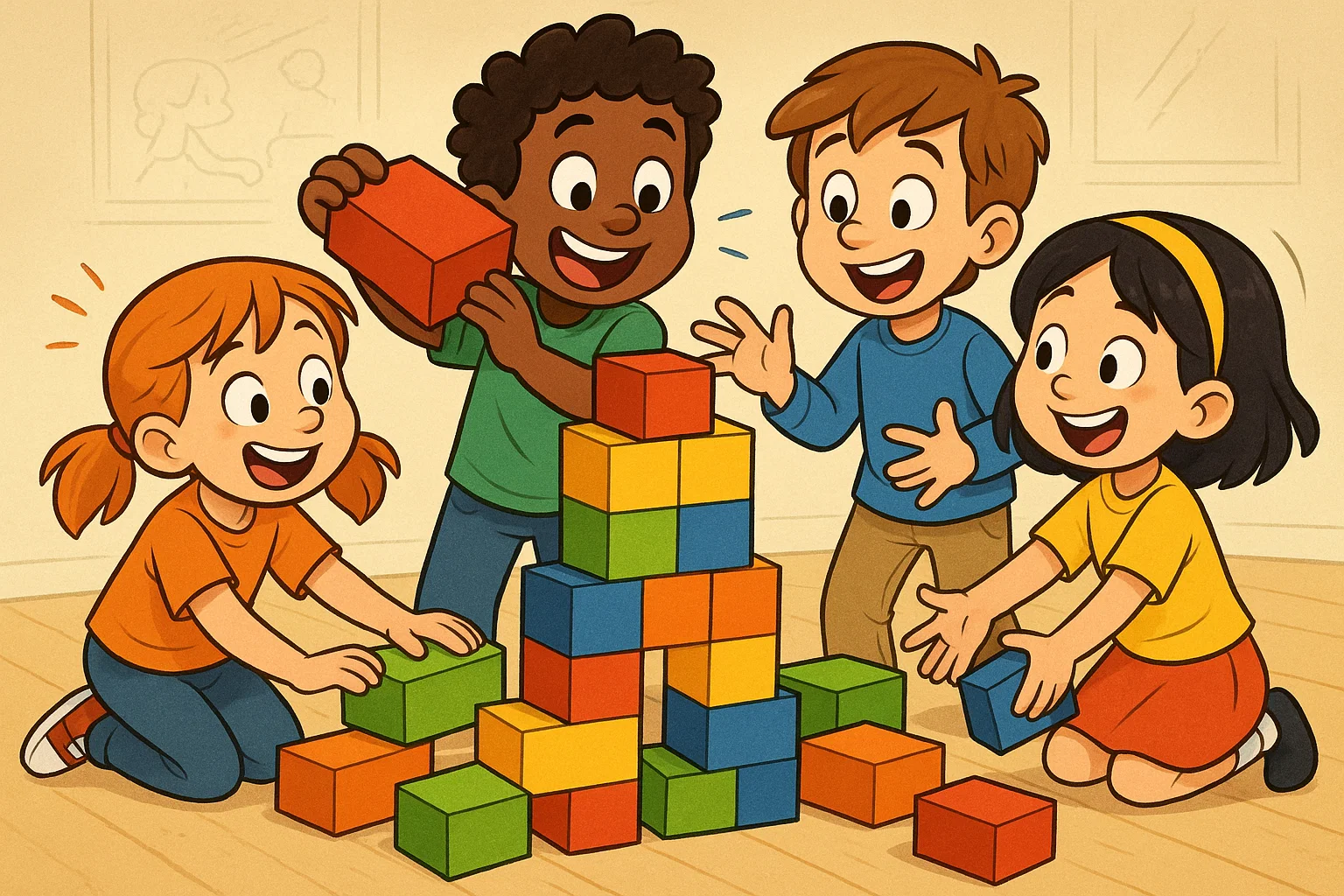
Group activities focus on promoting team cooperation, shared goals, behavioral flexibility, and positive peer-to-peer interactions within a structured environment.
27. Cooperative Play
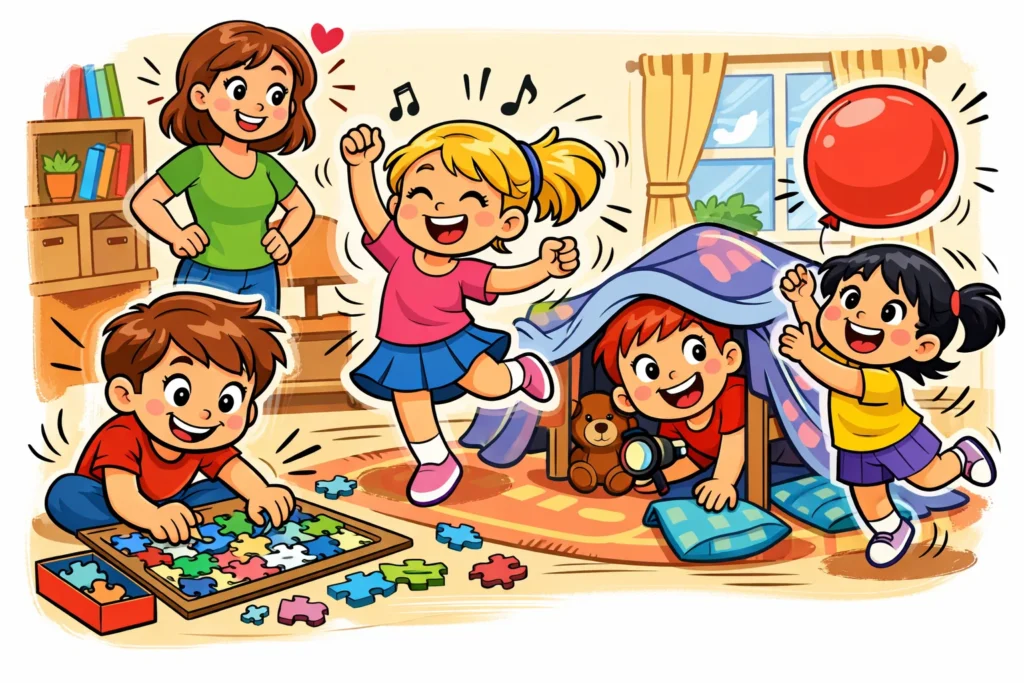
Cooperative Play centers on collaborative activities where children work together to achieve a shared result rather than competing against one another. Examples include assembling a large floor puzzle, painting a shared mural, or constructing a fort out of cardboard boxes.
Because these tasks are designed to be completed collaboratively, they naturally encourage children to share materials and communicate with peers. This shared focus helps children build collaborative problem-solving skills and experience the joy of collective success.
28. Group Storytelling
In Group Storytelling, a small circle of children collaborates to invent an original tale, with each child adding one new detail when it is their turn. A physical object, such as a soft toy or turn-taking card, is passed around the circle to show whose turn it is to speak.
This activity teaches children to wait patiently, listen attentively to their peers’ ideas, and maintain focus on the established theme of the story. The shared nature of the activity reinforces the idea that every individual’s contribution is a valuable part of the whole.
29. Building Game
The Building Game assigns clear, structured roles to children working together on a construction project using blocks or interlocking bricks. Clear roles are distributed among the participants using visual badge cards:
- The Designer: Holds the visual instruction manual and clearly describes which piece is needed next.
- The Helper: Searches the material bin to locate the exact piece described by the Designer.
- The Builder: Receives the piece from the Helper and carefully attaches it to the ongoing structure.
Rotating these roles periodically helps children practice flexibility, follow directions, and cooperate effectively as a team to complete a shared project.
30. Team Sports
Adapted team sports focus on low-pressure, cooperative physical movement games that prioritize rule-following, turn-taking, and cheering for peers over intense competition. Activities such as structured relay races, modified kickball, or cooperative obstacle courses can work well.
The primary instructional focus remains centered on understanding game boundaries, waiting patiently for one’s turn, and delivering supportive praise to teammates. This structured movement environment helps children develop gross motor skills while enjoying positive, connected social interactions with peers.
31. Scavenger Hunts
Scavenger Hunts require pairs or small groups of children to work together to locate specific hidden items using a shared picture checklist. Participants move through the space together, share the checklist, and collaborate to decide where to search for the next item on their list.
This activity naturally encourages children to talk to one another, practice dividing tasks fairly, and celebrate their shared discoveries as a team. Clear visual clues help children of different reading levels participate fully and contribute to the team’s success.
32. Community Gardening
Community Gardening offers a predictable, sensory-friendly group activity where children cooperate to plant, water, and care for a shared garden plot. The structured tasks involved in gardening – such as digging holes, dropping seeds, and watering soil – follow a clear, natural sequence that can reduce anxiety.
Children practice sharing gardening tools, taking turns watering plants, and collaborating to complete necessary tasks. This routine outdoor activity fosters a shared sense of responsibility and provides a calm, predictable environment for positive social interaction.
33. Virtual Playtime
Virtual Playtime uses supervised video calls or structured online cooperative games to support children who find digital interaction more comfortable. Keep these online sessions short, limited to two or three participants, and guided by a clear, pre-arranged activity plan or visual agenda.
Digital platforms may feel less overwhelming for some autistic children because they allow them to interact from the comfort of a sensory-friendly home environment. This format helps children practice communication skills, like taking turns and listening, through an accessible and motivating medium.
Creative Activities
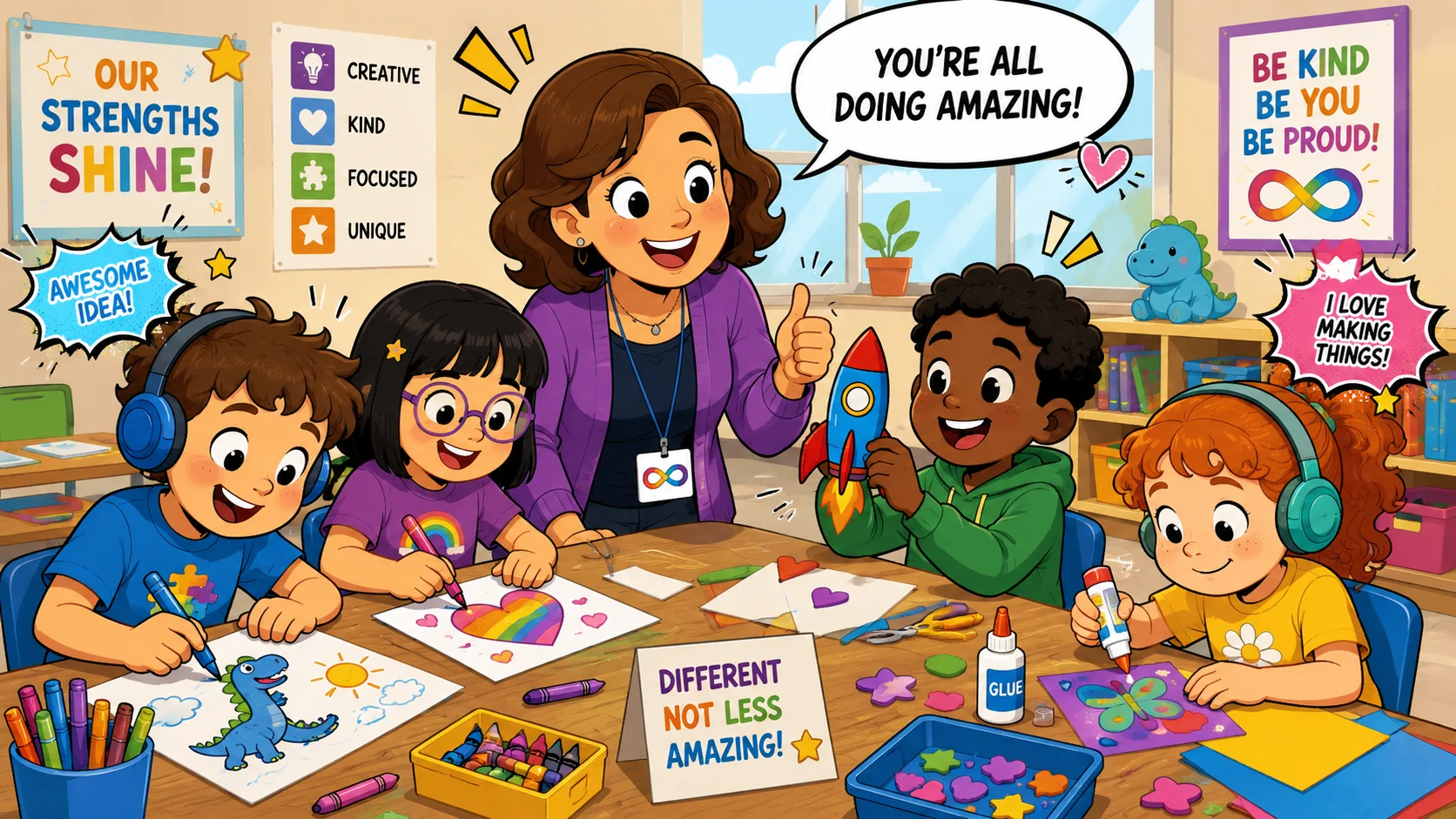
Creative activities use art, storytelling, and imaginative play to help children express themselves, share ideas, and build social connections.
34. Playing With Characters
This activity involves using small action figures, dolls, or plush toys to act out common social scenarios, conflicts, and resolutions. The adult can guide the toys through a realistic playground disagreement, such as two characters wanting to use the same swing at the same time.
The child helps the characters brainstorm helpful solutions and practice phrases for sharing, apologizing, or repairing a social interaction in a safe, third-person format. This playful distance makes it easier for children to process complex social dynamics without feeling personal anxiety or pressure.
35. Charades
Traditional Charades can be adapted into an accessible, nonverbal game where players act out familiar animals, daily actions, or simple routines using only their bodies. Use a deck of clear picture cards to represent each action, allowing children to select a card and participate without needing to generate ideas independently.
This game encourages players to watch their peers’ movements closely, decode physical gestures, and practice waiting patiently for their turn to guess. This format ensures that nonverbal children can participate equally while showcasing strengths in physical expression.
36. Cooperative Art
Cooperative Art involves a small group of children working together to create a single, large drawing, poster, or paper collage. Participants share a central bin of art supplies, which naturally encourages them to practice requesting items politely and waiting for peers to finish using materials.
The structure of the project requires children to negotiate space on the paper, share design ideas, and offer genuine compliments to teammates. This artistic collaboration turns a solo activity into a shared experience that celebrates everyone’s creative contributions.
37. Comic Strip Conversations
Comic Strip Conversations involve drawing a real or hypothetical social interaction in a series of simple comic panels. Use basic line drawings to represent the people involved, with thought bubbles and speech bubbles to clarify the interaction.
This clear visual format helps break down fast-moving conversations, allowing children to analyze what people say, think, and feel during an interaction. It can also help children revisit a confusing event in a calm, structured way.
38. Make a Social Skills Book
This activity involves collaborating with the child to create a personalized, handmade booklet that documents their real-world social successes. Fill the book with actual photographs of the child using helpful social skills, along with simple written scripts and step-by-step visual guides.
For instance, include a page titled “How I Ask to Join a Game,” complete with photos of the child using a visual script card. Reviewing this personalized book regularly helps reinforce positive habits, builds self-esteem, and provides a clear guide for future interactions.
Motion Activities
Motion-based activities use physical movement to help children practice listening attentively, imitating actions, regulating energy levels, and following group rules.
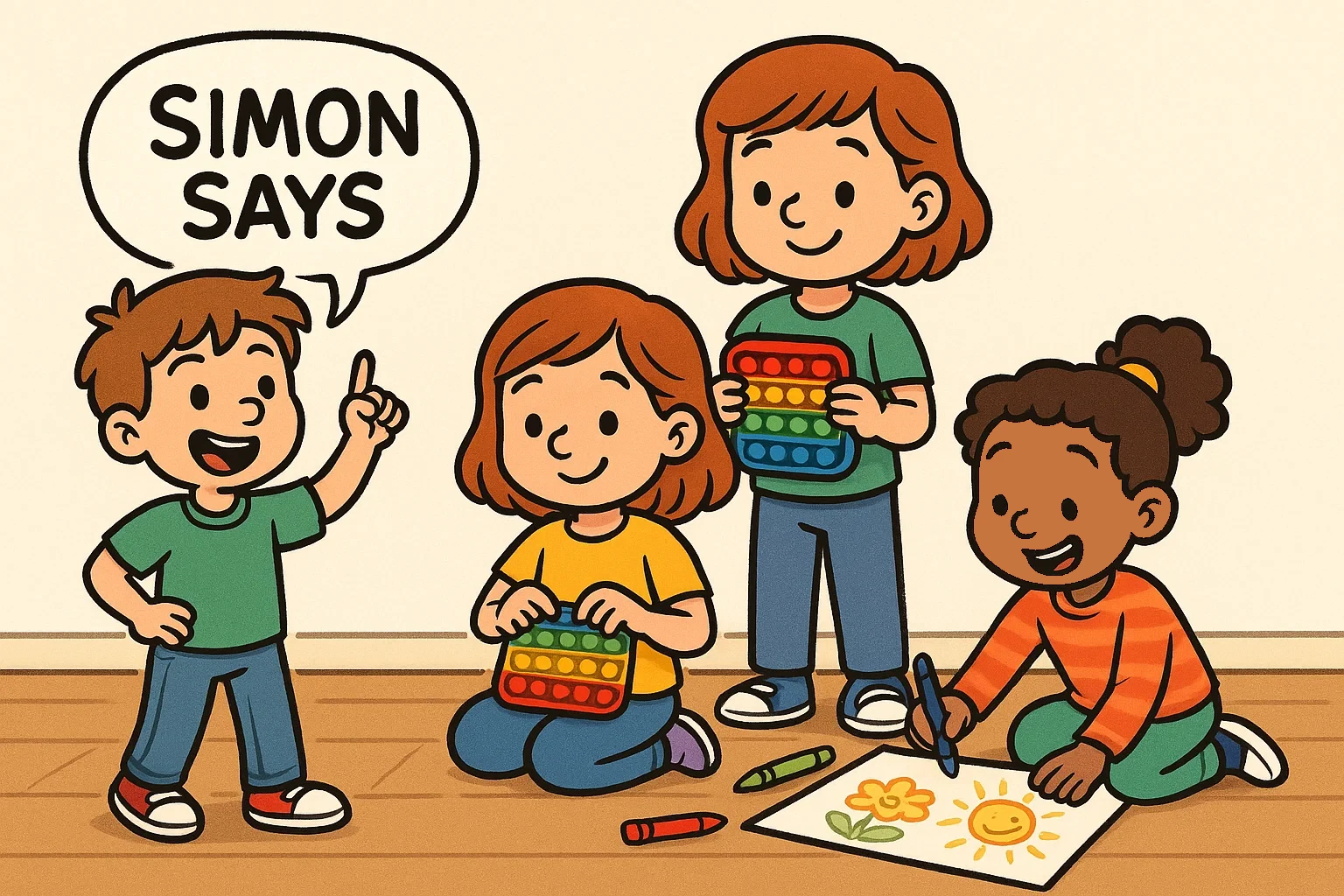
39. Simon Says
The classic game of Simon Says is an excellent tool for practicing active listening, motor imitation, body awareness, and impulse control. Start with simple physical commands, like “Simon says touch your knees,” and provide clear visual demonstrations to support children who process verbal instructions slowly.
The structural rules of the game require children to pay close attention to verbal cues and pause their movements when “Simon” is not mentioned. This playful format helps children practice self-regulation and body control in a structured, engaging way.
40. Rhythm Games
Rhythm Games involve sitting opposite a partner and taking turns mimicking distinct auditory patterns made by clapping, tapping drums, or stomping feet. The adult demonstrates a simple two-beat rhythm pattern, and the child listens closely before attempting to duplicate the sequence.
This rhythmic echoing builds foundational capacities for shared attention, turn-taking, and motor coordination without requiring verbal conversation. The predictable, structured patterns of rhythm can feel organizing and calming for a child’s nervous system.
41. Line Up
Line Up is a cooperative group game where children arrange themselves in a straight line based on a clear attribute. Ask the group to line up by height, birthday month, or the number of letters in their first name; for favorite color, have them form small groups instead.
This task requires children to communicate with one another, share information, and negotiate physical space flexibly to find their correct position. The activity provides a structured framework that helps children practice cooperation and flexible thinking within a group.
42. Mirror Movement
Mirror Movement pairs two children and gives them enough space to copy each other’s slow physical movements comfortably. One child is designated as the “leader” who moves their arms and torso slowly, while the “follower” tracks those movements and copies them in real time.
After a few minutes, a clear visual cue indicates that the roles should reverse, allowing the follower to become the new leader. This exercise builds close visual attention, motor imitation, and a shared sense of control between play partners.
43. Obstacle Course Cooperation
This activity involves designing a simple indoor physical obstacle course that requires two children to work together as a team to complete it. For example, pair children and ask them to carry a large, lightweight foam block between them while moving through a series of cones.
Participants must communicate clearly, coordinate their physical movements, and offer encouragement to their partner to reach the finish line safely. Celebrating shared completion of the course helps build a sense of teamwork and positive social connection.
Applied Behavior Analysis Techniques
When used in a child-centered, consent-based way, Applied Behavior Analysis (ABA) strategies can support social development by prioritizing choice, comfort, and meaningful communication.
Positive Reinforcement
Positive reinforcement involves delivering a preferred reward or specific praise immediately after a child demonstrates a target social skill. The reward or feedback should feel meaningful to the child, whether it involves access to a favorite toy, a colorful sticker, or specific verbal praise.
For instance, immediately after a child shares a toy, stating, “Thank you for sharing your car with Liam,” clearly connects the praise to the action. Providing this immediate validation can build the child’s motivation to use that helpful social behavior again in the future.
Prompting and Fading
Prompting involves providing temporary guidance to help a child perform a specific social action successfully, then gradually removing that support over time. An adult might start by pointing directly to an emotion card to prompt a child to identify a feeling during a story.
As the child begins to recognize the emotion independently, the adult gradually fades the support, moving from a direct point to a subtle look. This systematic fading prevents prompt dependence, helping the child build greater independence and confidence in using their skills.
Shaping Social Skills
Shaping is an instructional strategy that involves reinforcing small, incremental steps that lead toward a larger, long-term social goal. If a child finds joining a peer group overwhelming, reinforce smaller, more accessible steps along the way:
- Step 1: Parallel Play — The child sits near the group.
- Step 2: Passing an Object — The child hands a brick, toy, or material to a peer.
- Step 3: Delivering a Script — The child asks, “Can I play with you?”
By celebrating and reinforcing each small step of progress, adults help the child build confidence without unnecessary stress or pressure.
Generalization Practice
Generalization practice helps support the use of a social skill learned in a quiet, structured setting across different real-world environments. To build this flexibility, practice the same skill with different toys, in different rooms, and with different family members.
For example, after a child practices a greeting script with their therapist, practice the same script with a grandparent at home and later with a teacher at school. This varied practice helps prevent the skill from becoming rigid, allowing the child to use it flexibly in daily life.
Simple Progress Tracking
Simple progress tracking involves maintaining a basic visual log to track a child’s social development, comfort levels, and independence over time. Caregivers can use a simple chart to record the date, the specific activity practiced, the level of prompting required, and the child’s emotional response.
This simple record helps parents and educators identify which activities work well and notice subtle patterns of growth. Tracking progress visually ensures that the intervention remains responsive to the child’s evolving needs while celebrating real wins along the way.
Parent and Educator Support for Consistent Progress
The long-term development of a child’s social abilities depends on consistent, supportive teamwork among the key adults in their life.
Be an Example
Children learn a great deal about social interaction by observing the daily behaviors of the adults around them. Parents and educators should intentionally model positive social interactions, clear boundaries, and calm problem-solving in everyday life.
Let the child see you deliver warm greetings, take turns patiently during conversations, and use calm strategies to resolve minor everyday frustrations. By consistently demonstrating these behaviors, adults provide a living example that reinforces the abstract social values being taught in structured activities.
Home-School Notes
Maintaining a simple, consistent communication log between home and school is highly effective for aligning social development goals. Parents, teachers, and therapists can use a shared notebook or digital document to share updates on the skill being practiced each week.
For example, if a school teacher notes that a child is practicing “asking for a break,” parents can reinforce that same phrase at home. This coordinated approach helps the child experience consistent expectations across environments and supports skill retention and generalization.
Practice Schedule
A structured weekly practice schedule helps ensure that social skills development remains a consistent, manageable part of the child’s routine. Design a simple weekly plan that focuses on one specific social goal, supported by two or three short, low-pressure activities.
- Monday: Watch a short video modeling clip focusing on the target skill.
- Wednesday: Practice the skill through a comfortable, one-on-one role-play game with a parent.
- Friday: Practice the skill in a structured parallel play session alongside a sibling or familiar peer.
This predictable routine helps build habits smoothly while keeping the learning experience engaging and stress-free.
Support Without Pressure
One of the most important factors in supporting long-term social development is maintaining a low-pressure environment that honors the child’s boundaries. Adults should remain sensitive to signs of sensory fatigue, anxiety, or distress, and be ready to stop an activity immediately if the child becomes overwhelmed.
Always offer clear choices between activities, allow the child to choose how they communicate, and never turn social goals into rigid demands for compliance. Prioritizing the child’s emotional comfort and safety builds an authentic foundation of confidence, helping them engage with the world on their own terms.
Summary
Fostering social development in autistic children is a gradual process that relies on consistency, predictability, and a strength-based approach. By breaking complex interactions down into clear, visual steps, caregivers can help children build authentic confidence and functional communication tools.
Keep learning sessions short, playful, and centered around the child’s interests to ensure practice remains a positive experience. With supportive guidance, children can develop the social skills they need to navigate relationships and community life more confidently.
Best Starting Point
The best starting point is to choose one concrete social goal based on the child’s current daily needs and environment. Choose a low-pressure activity that naturally integrates one of the child’s interests, ensuring they feel internally motivated to participate.
Keep the initial session limited to just 3 to 5 minutes, focusing entirely on creating a successful, positive first experience. Starting small minimizes performance anxiety and establishes a secure foundation for long-term engagement and growth.
Most Helpful Activity Mix
An effective social development program combines a variety of structured activities to address different aspects of communication and interaction. Create a balanced weekly mix that includes visual aids, playful games, emotion recognition exercises, and realistic role-playing scenarios.
For instance, combine the structure of emotion cards with the interactive movement of roll ball games and the clear guidance of social stories. This varied approach ensures the child can practice skills in multiple formats, supporting both deeper learning and flexible real-world application.
Next Step for Parents and Teachers
The immediate next step for caregivers is to review the activity list and select three specific exercises to try this week. Dedicate a consistent, predictable time slot each day to practice these chosen activities, keeping sessions short and pressure-free.
Use a simple chart to track the child’s comfort levels, the amount of prompting needed, and successful moments over the week. This hands-on starting point helps adults gather useful real-world information and adjust future practice to better match the child’s needs.
FAQ
How Do You Teach Social Skills to a Child With Autism?
To teach social skills to a child with autism, start with one clear goal at a time, such as taking turns, greeting a peer, asking for help, or requesting a break. Model the skill first, use visual supports when helpful, and keep practice sessions short, predictable, and low-pressure. Children with autism spectrum disorder often benefit from repeated practice in familiar settings before trying the same skill with new people or in busier environments. The goal is not to force a child to behave in a specific way, but to help them build practical tools for communication, self-advocacy, and social confidence.
What Are the Best Social Skills Activities for Children With Autism?
The best social skills activities for children with autism are structured, engaging, and matched to the child’s interests, communication style, and sensory needs. Examples include turn-taking games, emotion cards, role-playing, cooperative building activities, story-based discussions, and simple social skills games for autism that make interaction predictable. These activities can help children with autism develop social and communication skills in a way that feels manageable. For many families, the most effective starting point is a short daily activity that focuses on one skill and ends before the child becomes tired or overwhelmed.
Why Are Social Skills Important for Children With Autism?
Social skills are essential because they help children express needs, understand expectations, participate in routines, and build safer, more meaningful relationships. Developing social skills in children also supports their ability to navigate social situations at home, in school, during therapy, and in the community. For children on the autism spectrum, social development should always be approached with respect for individual differences. The goal is not to erase autistic traits, but to support children with autism as they learn practical strategies for communication, cooperation, and self-advocacy.
Do Children With Autism Often Struggle to Understand Social Norms?
Children with autism often struggle to understand social norms when expectations are unclear, unspoken, or constantly changing. Autism often affects how a child processes social cues, figurative language, facial expressions, tone of voice, and group dynamics. Activities that build an understanding of social norms can be helpful when they are taught explicitly and respectfully. Social stories, visual schedules, comic strip conversations, and role-playing can help children understand the social norms of specific situations, such as joining a game, waiting in line, or asking for personal space.

Take a short quiz to find out what your everyday choices say about your parenting style
When your child is curious about something new, what’s your instinct?
Take a short quiz to find out what your everyday choices say about your parenting style
“Can I download this app?” What happens next?
Take a short quiz to find out what your everyday choices say about your parenting style
When it comes to rules at home, which sounds most like you?
Take a short quiz to find out what your everyday choices say about your parenting style
If you could give your child one life skill today, what would you pick?
Take a short quiz to find out what your everyday choices say about your parenting style
Your child gets to choose what to watch. What would your ideal setup look like?
Take a short quiz to find out what your everyday choices say about your parenting style
Pick your parenting superpower ✨