115 Best Riddles for 13-Year-Olds With Answers: Tricky Brain Teasers For Kids

 Discover a Free Education Video App for Kids
Pastory uses AI to personalize educational video content based on your child’s interests and personality. Safe, engaging, and built for curious young minds. Sign up now to stay updated and enjoy early access with a free trial
Navigating the tween years and the moment kids turn 13 requires a careful balance of engagement and challenge. At around age 13, many kids are developing stronger abstract-reasoning skills, including the ability to test ideas, spot patterns, and think beyond literal meanings. This collection of 115 riddles for 13-year-olds with answers offers the right mix of challenge and fun for teens, younger children who enjoy a challenge, and even adults.
These are not the simple puzzles of early childhood, nor are they the dry riddles for adults that feel more like homework than fun. Instead, this list brings together some of the best riddles for kids who are ready for smarter humor, including math puzzles, wordplay, logic challenges, and funny questions that get their brains working. Whether you are a teacher looking for classroom activities for kids, a parent seeking a dinner-table challenge, or a teen trying to stump your friends, you will find the full list organized by theme and difficulty below.
Key Takeaways
| Key Point | Why It Matters |
| Cognitive Development | These puzzles support abstract reasoning, pattern recognition, and lateral thinking in 13-year-olds. |
| Social Engagement | Sharing funny questions gives teens an easy, low-pressure way to connect. |
| Educational Integration | Math puzzles, wordplay, and logic challenges reinforce school skills through playful learning. |
| Accessibility | All 115 entries include immediate solutions for a smooth reading experience. |
Best Mix for Age 13
The best puzzles for teens avoid babyish themes and instead use smarter humor, clever twists, and more complex logic. At 13, teens are still developing the executive-function skills that support planning, flexible thinking, and problem-solving. Many teens this age enjoy content that respects their growing intelligence while still feeling funny, tricky, and relatable.
Solutions After Each Prompt
To provide the best user experience, every prompt in this guide is followed immediately by its solution. This structure eliminates the frustration of constant scrolling or navigating to separate pages. By placing each solution directly below the prompt, readers can quickly check their guesses and keep the activity moving.
Categories for Quick Navigation
To help you find the right content quickly, these brain teasers for kids and teens are organized into specific groups:
- Mixed set: a balanced variety for any occasion.
- Themed sets: animal, food, science, space, school, seasonal, and Halloween challenges.
- Skill-based puzzles: math, logic, wordplay, and English-language challenges.
- Difficulty levels: easy, medium, and hard challenges.
- Social sets: funny questions, family challenges, and parent-teen icebreakers.
What Is a Riddle?
A riddle is a statement, question, or phrase that has a double or hidden meaning and is presented as a puzzle to be solved. This type of puzzle often uses metaphor, wordplay, misdirection, or unusual clues to make the listener think beyond the obvious solution.
Riddles vs. Jokes
While both forms of wordplay can use punchlines, the main difference lies in the goal and the thinking process required. A joke is designed to make people laugh, often through surprise or a sudden shift in perspective. This type of puzzle is designed to create an “aha!” moment, where the listener decodes the clues to find a logical solution.
Why These Brain Teasers Fit Age 13
Thirteen is a pivotal age when many kids begin seeking more independence and intellectual validation. Solving clever prompts allows them to show their growing intelligence, language skills, and ability to think creatively. Developmentally appropriate puzzles can also help teens practice the shift from concrete to more abstract thinking while strengthening deductive reasoning.
Solution Format
Each entry in the following sections uses this format:
- The prompt.
- The solution in parentheses.
- A short explanation for selected complex or hard entries.
The numbered list below contains exactly 115 entries.
115 Fun Brain Teasers for 13-Year-Olds
This first section begins with a varied selection of brain teasers that help kids and teens warm up their logic skills.
General Mixed Questions
- What has keys but can’t open locks?
(A piano.) - I have cities, but no houses. I have mountains, but no trees. I have water, but no fish. What am I?
(A map.) - The more of this there is, the less you see. What is it?
(Darkness.) - I am tall when I am young, and I am short when I am old. What am I?
(A candle.) - What comes once in a minute, twice in a moment, but never in a thousand years?
(The letter M.)
Easy Starters
These easy starters are designed to build confidence and act as warm-ups for more challenging brain teasers.
- What has to be cracked before you can use it?
(An egg.) - What month of the year has 28 days?
(All of them.) - What is full of holes but still holds water?
(A sponge.) - What has a neck but no head?
(A bottle.) - What question can you never honestly say yes to?
(“Are you asleep yet?”)
Medium Brain Teasers
These brain teasers require a higher level of concentration and the ability to look past literal phrasing.
- I follow you all day long, but when the sun goes down, I am gone. What am I?
(Your shadow.) - What has one eye but can’t see?
(A needle.) - I’m light as a feather, yet the strongest person can’t hold me for much more than a minute. What am I?
(Their breath.) - What can travel around the world while staying in one corner?
(A stamp.) - What has words but never speaks?
(A book.)
Hard Challenges
The following hard challenges feature clever twists that can stump even adults.
- What is so fragile that saying its name breaks it?
(Silence.) - I am not alive, but I can die. What am I?
(A battery.) - What belongs to you, but everyone else uses it more than you do?
(Your name.) - First a fish eats the bait on me, and then the fish may be eaten by the person who used me. What am I?
(A fishhook.)
Explanation: The fish bites the bait on the hook, and the person who catches the fish may later eat it. - I am not alive, but I grow. I don’t have lungs, but I need air. I don’t have a mouth, but water kills me. What am I?
(Fire.)
Tricky Brain Teasers for 13-Year-Olds
This section focuses on tricky questions that use misdirection and semantic ambiguity to challenge the reader’s assumptions.
Lateral Thinking Twists
Lateral thinking involves solving problems through an indirect and creative approach.
- A man is pushing his car and stops at a hotel. He immediately knows he is bankrupt. Why?
(He is playing Monopoly.) - You walk into a room with a match. In the room, there is a stove, a heater, and a candle. What do you light first?
(The match.) - A girl fell from a 20-foot ladder but didn’t get hurt. How?
(She fell from the bottom step.)
Hidden Clues
In these wordplay challenges, the solution is often hidden inside the wording or structure of the sentence.
- What is seen in the middle of March and April but not at the beginning or end of either month?
(The letter R.) - I am the beginning of everything and the end of everywhere. I am the beginning of eternity and the end of time and space. What am I?
(The letter E.) - Which word in the dictionary is spelled incorrectly?
(Incorrectly.)
Stumpers
These are designed to make the reader second-guess their logic.
- What can you catch but not throw?
(A cold.) - What gets wetter the more it dries?
(A towel.) - If you have me, you want to share me. If you share me, you no longer have me. What am I?
(A secret.)
Easy Brain Teasers for 13-Year-Olds
Easy questions are excellent for quick activities for kids during classroom transitions or as a low-stakes way to start a family game night.
Confidence Builders
- What has hands but cannot clap?
(A clock.) - What starts with P, ends with E, and has thousands of letters?
(The post office.) - What has a thumb and four fingers but isn’t alive?
(A glove.)
Quick Classroom Warmups
- What goes up but never comes back down?
(Your age.) - What has a head and a tail but no body?
(A coin.) - What has many teeth but cannot bite?
(A comb.)
Hard Brain Teasers for 13-Year-Olds
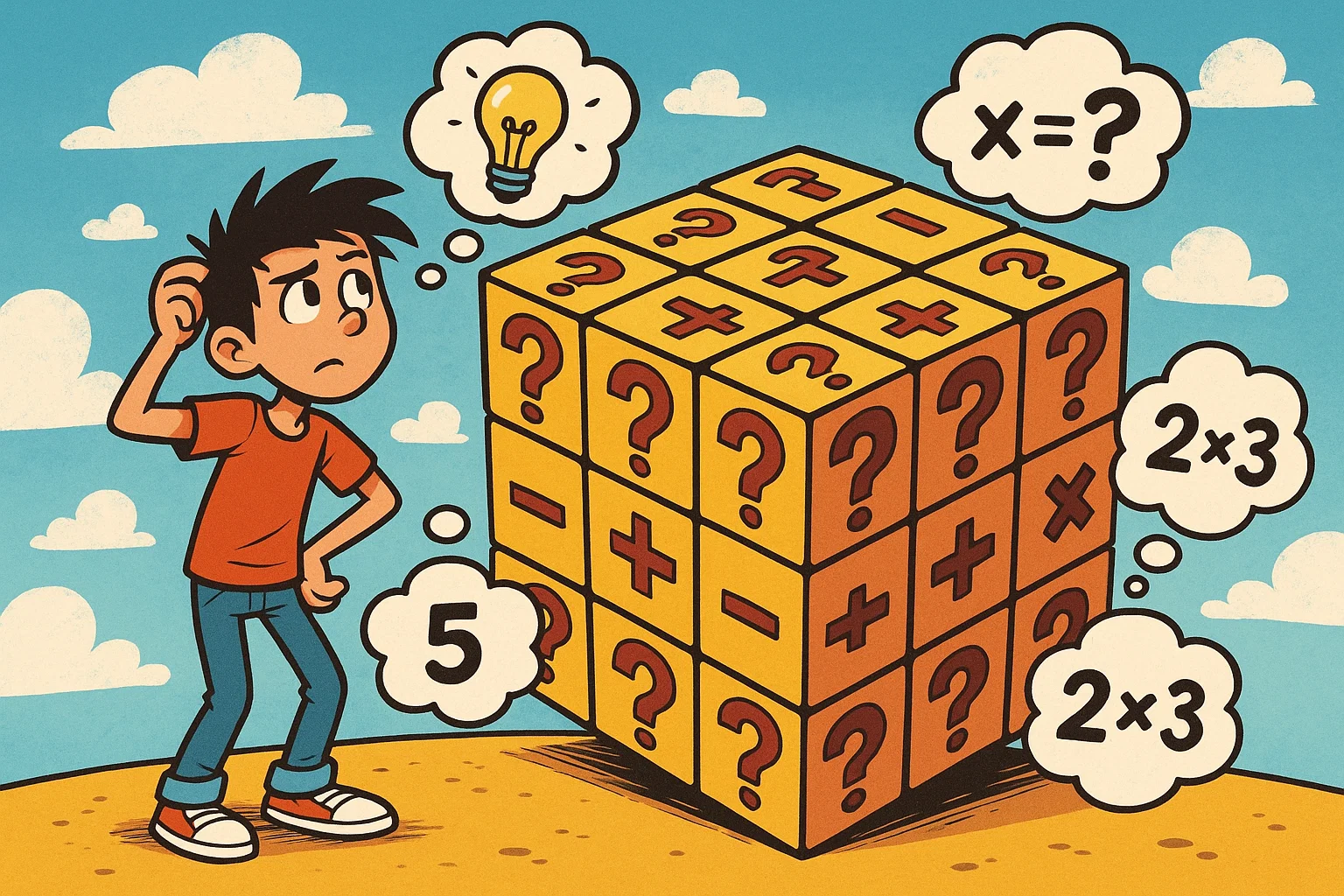
For teens who enjoy a real mental workout, these hard brain teasers provide multi-layered challenges and can also work as hard riddles for adults with solutions included right below each prompt.
Multi-Step Clues
- I am taken from a mine and sealed inside a wooden case. I am used by many people, but I am never fully released. What am I?
(Pencil lead or graphite.) - What is always in front of you but can’t be seen?
(The future.) - What can you break, even if you never pick it up or touch it?
(A promise.)
Misdirection Challenges
- A man calls his dog from the opposite side of a river. The dog crosses the river without getting wet and without using a bridge or a boat. How?
(The river was frozen.) - What is black when you buy it, red when you use it, and gray when you throw it away?
(Charcoal.) - What has many keys but can’t open a single lock?
(A keyboard.)
Bonus Challenge
- Poor people have it. Rich people need it. If you eat it, you die. What is it?
(Nothing.)
Explanation: Poor people may have nothing, rich people may need nothing, and if you eat nothing for long enough, you die.
Funny Questions and Jokes for 13-Year-Olds
Humor is a strong driver of engagement for teens. These selections focus on puns, clean punchlines, and school-friendly jokes. Many of them also work as funny riddles for kids who enjoy quick wordplay.
Clean Punchlines
- What do you call a bear with no teeth?
(A gummy bear.) - Why did the bicycle fall over?
(Because it was two-tired.) - What do you call an alligator in a vest?
(An investigator.)
School-Friendly Humor
- Why was the math book sad?
(Because it had too many problems.) - Why did the teacher wear sunglasses to school?
(Because her students were so bright.) - What is a librarian’s favorite snack?
(Quiet peas.)
Parent-Teen Conversation Starters
- What starts with T, ends with T, and has tea in it?
(A teapot.) - Why don’t scientists trust atoms?
(Because they make up everything.) - What building has the most stories?
(The library.)
Animal Brain Teasers for 13-Year-Olds
Animal riddles for kids and teens are popular because they rely on familiar traits and behaviors.
Pet Clues
- I am your best friend, I love to go for walks, and I wag my tail when I’m happy. What am I?
(A dog.) - I have nine lives, I purr when I’m happy, and I love to sleep in the sun. What am I?
(A cat.) - I live in a bowl, I have scales but I’m not a weighing scale, and I never close my eyes. What am I?
(A goldfish.)
Wildlife Clues
- I have a long trunk but no suitcase. I am the largest land animal. What am I?
(An elephant.) - I am called the king of the jungle, but I’m actually a big cat. What am I?
(A lion.) - I have black-and-white stripes and look a little like a horse. What am I?
(A zebra.)
Creature Comparisons
- I have a shell, but I am not an egg. I am slow, but I always finish the race. What am I?
(A tortoise.) - I can change my color to match my surroundings. What am I?
(A chameleon.)
Food Brain Teasers for 13-Year-Olds
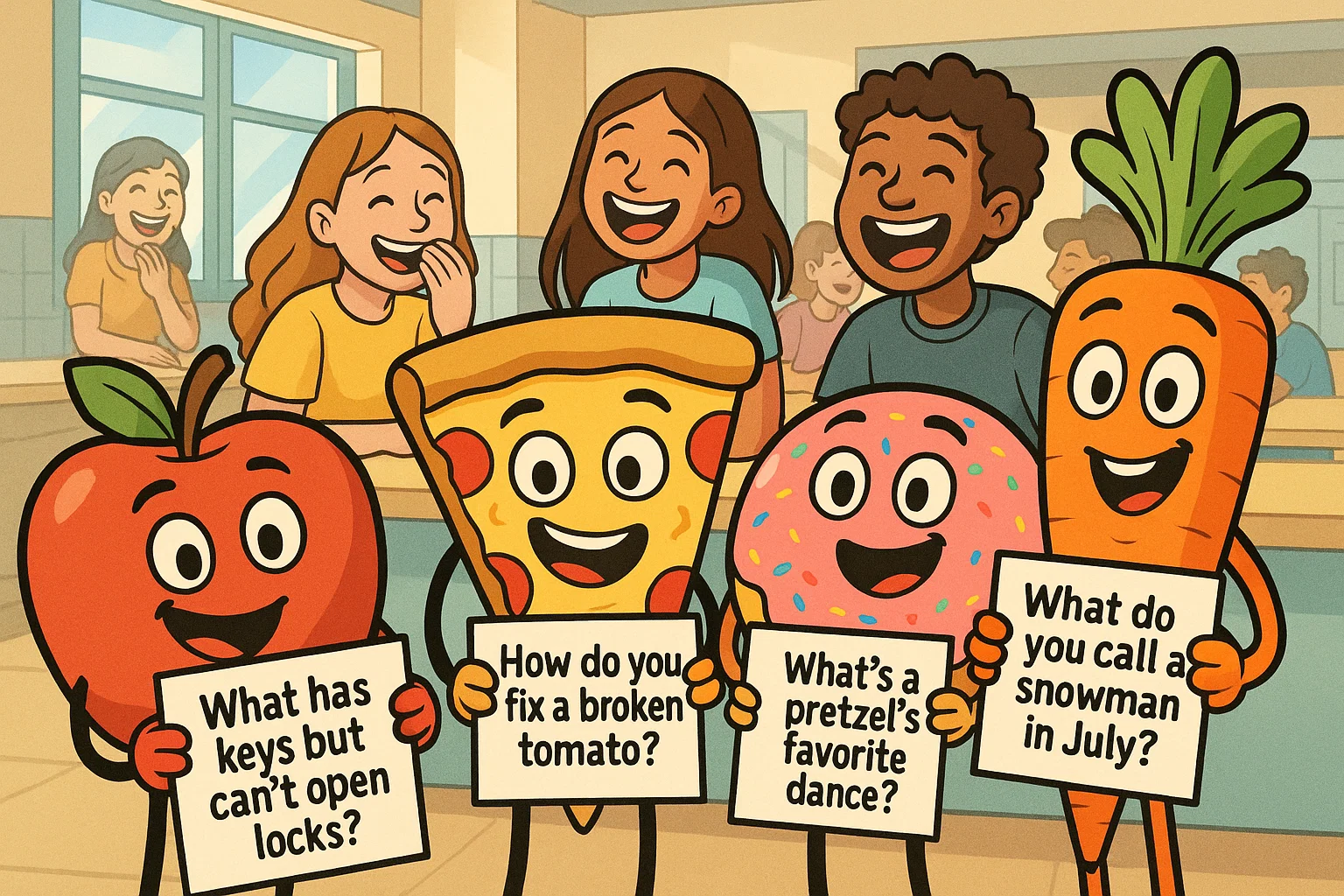
Food riddles for kids and teens are highly visual and help readers connect clues with familiar everyday items.
Snack Clues
- I am a circle of dough with cheese and sauce. What am I?
(Pizza.) - I pop when I get hot, and I usually turn white and fluffy. What am I?
(Popcorn.) - I am made from a potato, sliced thin, fried, and often served in a bag. What am I?
(A potato chip.)
Kitchen Objects
- I have four legs but cannot walk. I am where you eat your dinner. What am I?
(A table.) - I am cold inside, and I help keep your milk from spoiling. What am I?
(A refrigerator.) - I have a face but no eyes, and hands that move but no arms. What am I?
(A clock.)
Fruit and Vegetable Wordplay
- What kind of “apple” isn’t actually an apple?
(A pineapple.) - I am green on the outside, red on the inside, and have many black seeds. What am I?
(A watermelon.)
Math Brain Teasers for 13-Year-Olds
Math puzzles are an excellent way to practice number sense and logical thinking without the pressure of a traditional test.
Number Patterns
- What number comes next: 2, 4, 8, 16…?
(32.) - I am an odd number. Take away a letter and I become even. What number am I?
(Seven.) - Which is heavier: a pound of feathers or a pound of lead?
(Neither; they both weigh exactly one pound.)
Algebra-Free Logic
- If three cats can catch three rats in three minutes, how long does it take one cat to catch one rat?
(Three minutes.) - Using only addition, how can you add eight 8s to get 1,000?
(888 + 88 + 8 + 8 + 8 = 1,000.) - A father is 30 years older than his son. In 20 years, the father will be twice as old as his son. How old is the son now?
(10 years old.)
Geometry Clues
- I have no beginning, middle, or end. I am perfectly round. What am I?
(A circle.) - How many sides does a stop sign have?
(Eight. It is an octagon.)
Logic Brain Teasers for 13-Year-Olds
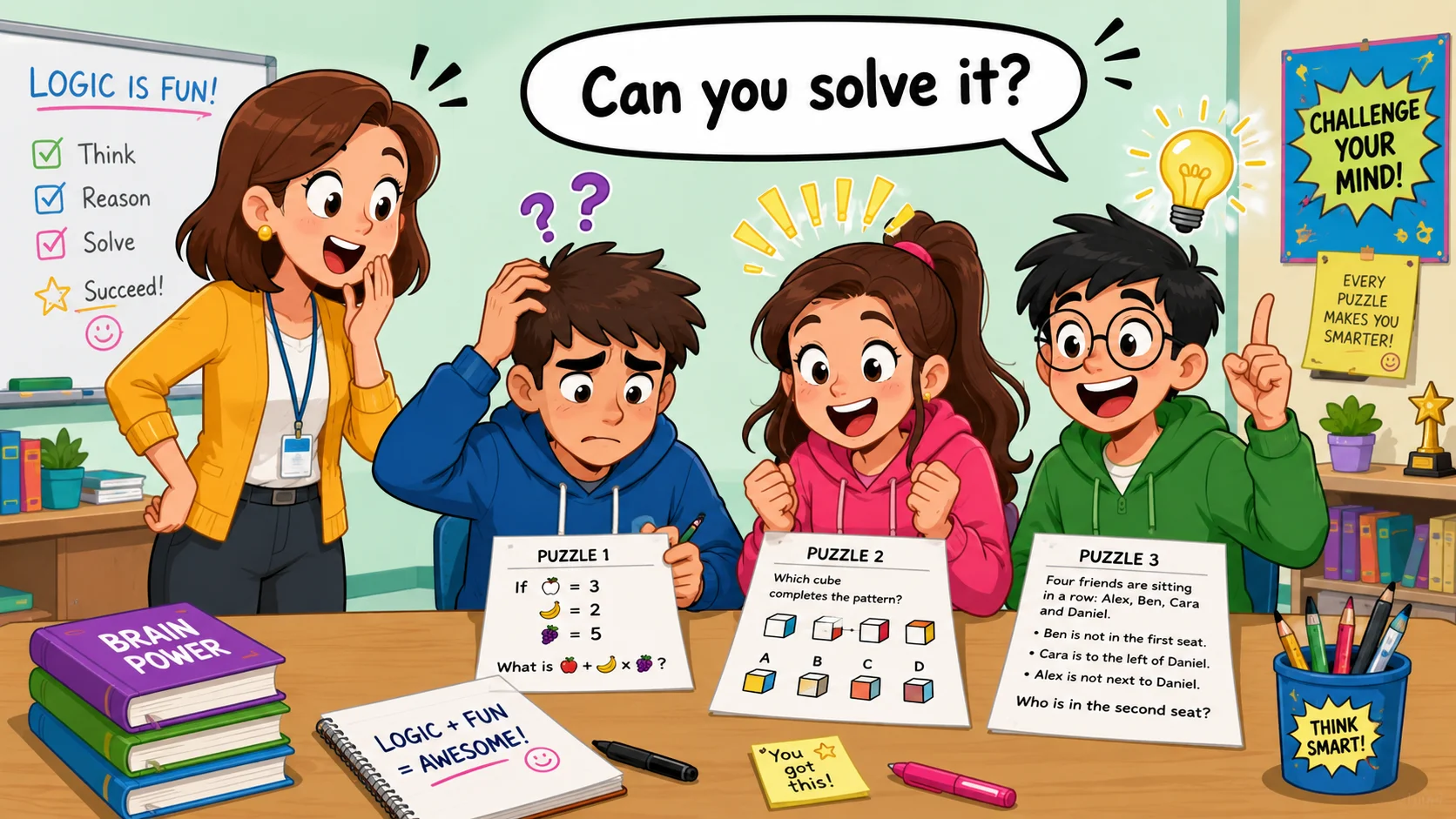
These puzzles reward deductive reasoning over memorization.
Deduction Puzzles
- You see a boat filled with people. It has not sunk, but when you look again, you don’t see any single people on the boat. Why?
(All the people are married.) - A man was driving a black truck. His lights were off. The moon was not out. A woman was crossing the street. How did he see her?
(It was daytime.)
Sequence Clues
- What are the next three letters in this sequence: O T T F F S S?
(E N T — eight, nine, ten.) - If you are running a race and you pass the person in second place, what place are you in?
(Second place.)
Common Trap Solutions
- If a plane crashes on the border between the U.S. and Canada, where do they bury the survivors?
(You don’t bury survivors.) - A rooster lays an egg on top of a roof. Which way does the egg roll?
(It doesn’t. Roosters don’t lay eggs.)
Wordplay Challenges for 13-Year-Olds
These wordplay questions focus on the mechanics of the English language.
Homophones and Double Meanings
- I can be a heavy knock, and I am also a unit of weight. What am I?
(A pound.) - I can be a flat piece of wood, and I can also be a group of people who manage an organization. What am I?
(A board.) - What has a head but no brain, and a bed but no sleep?
(A river.)
More Wordplay
- What has a bark but no bite?
(A tree.) - Name a word that is spelled the same forward and backward.
(Racecar, level, mom, or dad.) - What five-letter word becomes “shorter” when you add two letters to it?
(Short.)
English-Language Brain Teasers for 13-Year-Olds
Language-based puzzles help build vocabulary, reading comprehension, and attention to detail.
Vocabulary Builders
- I can keep something in one place, and I am also a piece of equipment used on a boat. What am I?
(An anchor.) - I am a word that means “not heavy,” but I also help you see in the dark. What am I?
(Light.)
Grammar Clues
- Which noun is usually plural even when it refers to one item?
(Scissors or pants.) - I am a punctuation mark that ends a question. What am I?
(A question mark.)
Reading Practice
- I am a common English word that is spelled with five vowels in a row. What am I?
(Queueing.) - What begins with E, ends with E, and usually contains only one letter?
(An envelope.)
“What Am I?” Questions for 13-Year-Olds
The “What am I?” format is a classic puzzle style that uses personification and object clues.
Object Clues
- I have many needles, but I cannot sew. What am I?
(A pine tree.) - I have a spine but no bones. What am I?
(A book.) - I am white when I am dirty and black when I am clean. What am I?
(A chalkboard.)
Personified Solutions
- I can be cracked, made, told, and played. What am I?
(A joke.) - I speak without a mouth and hear without ears. I have no body, but I come alive with sound. What am I?
(An echo.)
Science Brain Teasers for 13-Year-Olds
Perfect for STEM engagement, these questions cover biology, chemistry, and physics.
Biology Clues
- I am the “powerhouse” of the cell. What am I?
(A mitochondrion.) - I am the hard outer covering of a bug. What am I?
(An exoskeleton.)
Chemistry Clues
- I am the lightest element on the periodic table. What am I?
(Hydrogen.) - I am what you get when you freeze water. What am I?
(Ice.)
Physics Clue
- I am a force that pulls objects toward Earth. What am I?
(Gravity.)
Space Brain Teasers for 13-Year-Olds
Space-themed questions are especially appealing to many middle schoolers.
Solar System Facts
- I am the largest planet in our solar system. What am I?
(Jupiter.) - I am the Red Planet. What am I?
(Mars.)
Space Vocabulary
- I am a giant ball of gas that produces its own light. What am I?
(A star.) - I am the path a planet takes around the Sun. What am I?
(An orbit.)
School Brain Teasers for 13-Year-Olds
These clues resonate with the daily lives of middle school and early high school students.
Back-to-School Clues
- What is taken by students but given by teachers?
(A test.) - I am used to correct your mistakes. What am I?
(An eraser.) - What has an orange body, green hair, and sounds like “parrot”?
(A carrot.)
Seasonal Brain Teasers for 13-Year-Olds
Seasonal questions are useful for classroom activities, holiday parties, and family games.
Summer and Winter Clues
- I am the season when many people go to the beach and eat ice cream. What am I?
(Summer.) - I am made of snow and have a carrot for a nose. What am I?
(A snowman.)
Halloween Brain Teasers for 13-Year-Olds
These spooky questions are playful, clean, and safe for classroom or party use.
Spooky but Safe Clues
- I am white, I say “Boo,” and I can walk through walls. What am I?
(A ghost.) - I am something you carve a face into in October. What am I?
(A pumpkin or jack-o’-lantern.)
Family Brain Teasers for 13-Year-Olds
Family-friendly questions can work as dinner-table games, road-trip challenges, or quick parent-teen icebreakers.
Parent-Teen Icebreaker
- What can you keep after giving it to someone else?
(Your word.)
Best Picks for 13-Year-Olds
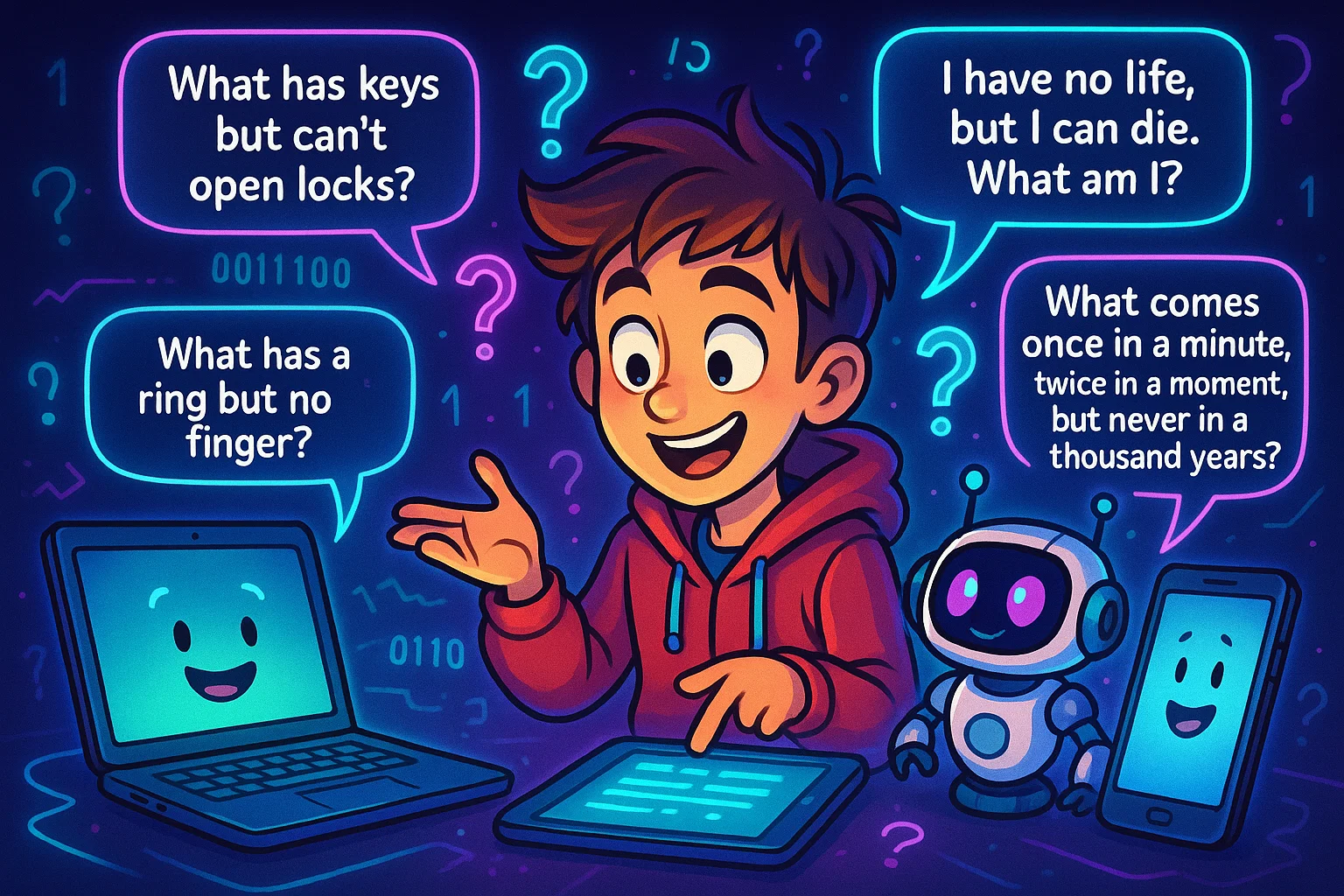
The list above includes 115 entries, but a few stand out as especially strong for teens.
Top Picks
- Best classic pick: #98, the echo puzzle.
- Best logic trap: #80, the plane crash puzzle.
- Best wordplay pick: #87, the “shorter” puzzle.
- Best classroom pick: #108, the test question.
- Best science pick: #99, the mitochondrion clue.
Most Shareable Picks
The most shareable picks are usually short, surprising, and easy to repeat. Good examples from this list include #16, #29, #43, #49, and #87.
Top Stumpers
For teens who want to challenge friends or classmates, try #21, #26, #42, #76, #78, and #98.
Benefits of Brain Teasers for 13-Year-Olds
Critical Thinking Practice
Engaging with puzzles and brain teasers encourages the brain to move beyond linear processing. These activities can encourage analysis, evaluation, and other higher-order thinking skills.
Vocabulary Growth
These puzzles often rely on puns, idioms, double meanings, and unfamiliar words. This can expand a teen’s vocabulary in a way that feels natural rather than forced.
Social Bonding
Shared humor and cooperative problem-solving can make social interaction feel easier for teens, turning these activities into a useful tool for peer bonding.
How to Create Your Own Brain Teasers
Start With the Solution
Choose a common object, like a smartphone.
Brainstorm Clues
Think about the object’s appearance, function, and surprising qualities.
For example:
- Appearance: glass, thin, glowing.
- Function: talking, playing games, taking photos.
- Twist: it “knows” many things but never went to school.
Think Like the Solution
Imagine the object describing itself.
Example:
“I have no mouth, but I can help you talk to the world.”
Add Misdirection
Include a clue that points readers in the wrong direction at first. For a smartphone prompt, a clue about being “smart” may make readers think of a person before they realize the solution is an object.
Write the Final Prompt
Here is a finished version:
“I am thin and glass-faced. I have no brain, but I can help solve many questions. I can talk to people thousands of miles away. What am I?”
(A smartphone.)
FAQ: 13-Year-Old Brain Teasers With Answers
What Makes a Puzzle Good for a 13-Year-Old?
A good puzzle for this age should be intellectually stimulating without being frustrating. It should involve logic, wordplay, or real-world knowledge that rewards a teenager’s growing understanding of language and ideas.
How Many Entries Should a Page Include?
For a comprehensive resource, a list of 75 to 150 entries with solutions usually offers enough variety and depth across multiple categories.
Where Should Solutions Go?
Solutions are most effective when placed directly after each prompt because readers can check themselves quickly without losing momentum.
Are Math Puzzles Good for 13-Year-Olds?
Yes. Math puzzles reinforce number sense and logical deduction in a low-stress format that feels more like a game than a classroom assignment.
Can Brain Teasers Help With School Skills?
Yes. Brain teasers can improve reading comprehension, critical thinking, and the ability to recognize language patterns.
Take a short quiz to find out what your everyday choices say about your parenting style
When your child is curious about something new, what’s your instinct?
Take a short quiz to find out what your everyday choices say about your parenting style
“Can I download this app?” What happens next?
Take a short quiz to find out what your everyday choices say about your parenting style
When it comes to rules at home, which sounds most like you?
Take a short quiz to find out what your everyday choices say about your parenting style
If you could give your child one life skill today, what would you pick?
Take a short quiz to find out what your everyday choices say about your parenting style
Your child gets to choose what to watch. What would your ideal setup look like?
Take a short quiz to find out what your everyday choices say about your parenting style
Pick your parenting superpower ✨