100 Best Riddles for 12 Year Olds (With Answers)

 Discover a Free Education Video App for Kids
Pastory uses AI to personalize educational video content based on your child’s interests and personality. Safe, engaging, and built for curious young minds. Sign up now to stay updated and enjoy early access with a free trial
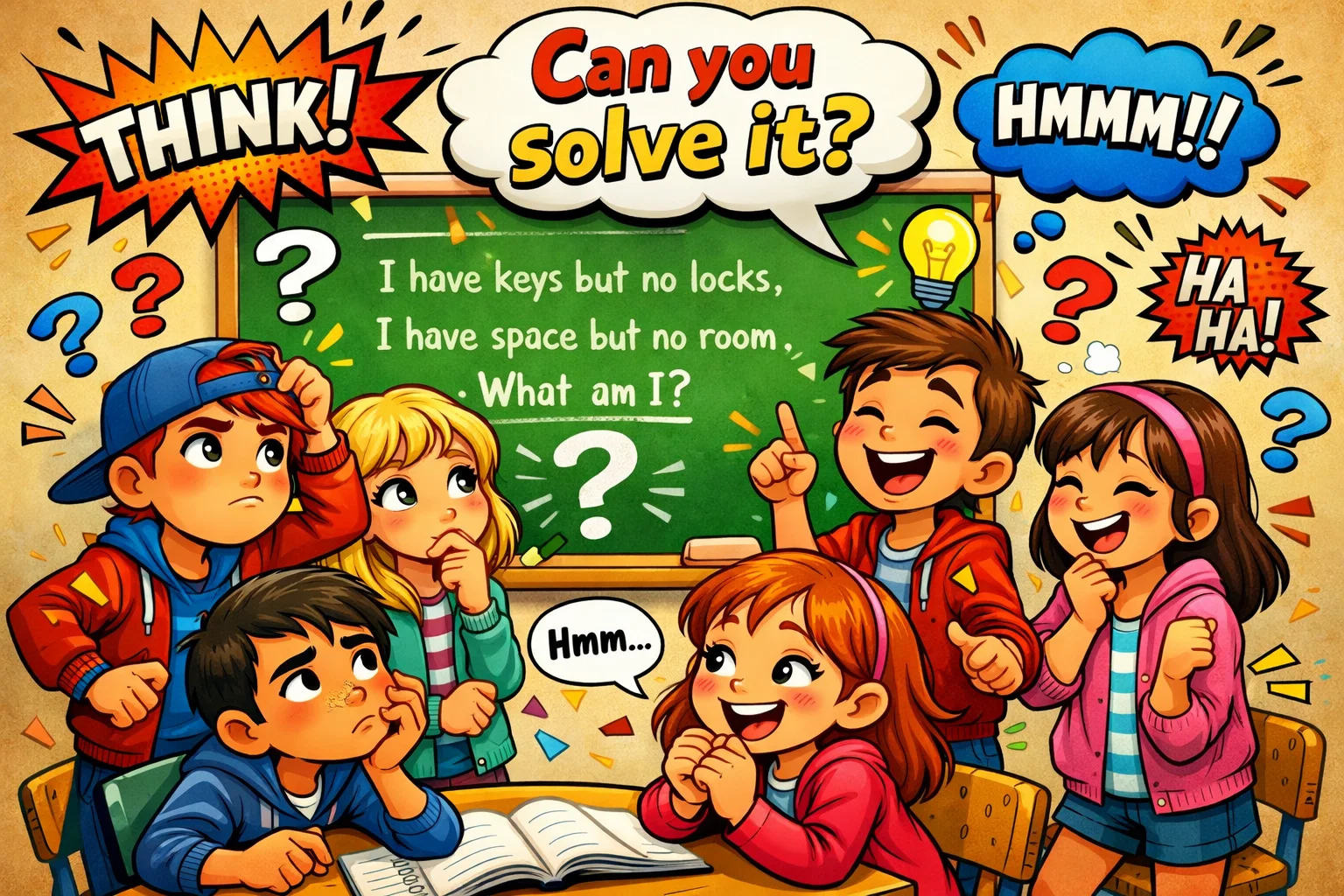
Whether you’re a parent looking for a screen-free activity, a teacher wanting to energize the classroom, or a kid searching for a good challenge, this page has you covered. Below you’ll find a carefully curated collection of riddles for 12 year olds — funny, tricky, school-friendly, and brain-bending — with answers included for every single one. The variety here spans wordplay, math, science, animals, and holidays, so there’s something for every kind of thinker.
What Is a Riddle?
A riddle is a question or statement that seems straightforward but contains a hidden meaning, a trick, or a clever twist that requires creative thinking to solve. They work by presenting a puzzle in plain language while deliberately leading the solver’s mind in the wrong direction — the “aha” moment comes when the real answer clicks into place. For 12 year olds especially, this combination of challenge and surprise makes riddles genuinely engaging rather than just another brain exercise.
How Riddles Challenge the Brain
Riddles develop several key cognitive skills at once. Solving them requires lateral thinking — the ability to approach a problem from an unexpected angle rather than following a straight line of logic.
Research in cognitive development suggests that activities like riddle-solving strengthen working memory, improve flexible reasoning, and encourage children to consider multiple interpretations of language before settling on one answer. These are the same mental muscles used in reading comprehension, math problem-solving, and scientific reasoning.
Why 12 Year Olds Enjoy Riddles
At age 12, children are entering a stage of cognitive development that psychologists refer to as formal operational thinking — the ability to reason abstractly and think hypothetically.
This means pre-teens can appreciate a riddle’s misdirection, enjoy the moment of cracking a clever twist, and feel genuinely satisfied by figuring something out. They tend to prefer questions that are slightly tricky or humorous over simple ones, because the challenge feels rewarding at their level. Funny riddles in particular match the social humor style of this age group, making them great for sharing with friends.
Fun Riddles for 12 Year Olds
This is a broad mix of clever riddles for 12 year olds, tweens, and teens — covering every mood and setting. Whether you’re after funny riddles to share with friends, easy warm-ups to build confidence, or tricky ones that take real thought, you’ll find them all here. All answers are included so kids can check their thinking, and adults can stay one step ahead.
Silly Riddles That Make Kids Laugh
Light, playful, and built for giggles — these riddles are perfect for breaking the ice or just having fun.
- Why can’t a bicycle stand on its own? — Because it’s two-tired.
- What do you call cheese that isn’t yours? — Nacho cheese.
- Why did the scarecrow win an award? — Because he was outstanding in his field.
- What do you call a sleeping dinosaur? — A dino-snore.
- I have a head and a tail but no body. What am I? — A coin.
- What has ears but cannot hear? — A cornfield.
- Why did the math book look so sad? — Because it had too many problems.
- What do elves learn in school? — The elf-abet.
- What do you get when you cross a snowman and a vampire? — Frostbite.
- Why don’t scientists trust atoms? — Because they make up everything.
Trick Questions With Funny Answers
These riddles are designed to mislead — the first answer that comes to mind is almost always wrong.
- A rooster lays an egg on top of a barn roof. Which way does it roll? — Roosters don’t lay eggs.
- How many months have 28 days? — All of them.
- You’re running a race and you pass the person in second place. What place are you in now? — Second place.
- A man lives on the 10th floor of a building. Every morning he takes the elevator down to the ground floor. When he returns, he only takes the elevator to the 7th floor and walks the rest of the way. Why? — He’s too short to reach the button for the 10th floor.
- What gets wetter the more it dries? — A towel.
- I have cities but no houses, forests but no trees, and water but no fish. What am I? — A map.
- If you’re running a race and you pass the person in last place, what place are you in? — You can’t pass the person in last place — you’d have to be behind them to do so.
- What belongs to you but is used more by others? — Your name.
School-Friendly Joke Riddles
Safe for classrooms, hallways, and group activities — these riddles keep things fun without going off-topic.
- What room can a student never enter? — A mushroom.
- Why was the broom late for school? — It over-swept.
- What has a spine but no bones? — A book.
- I speak without a mouth and hear without ears. I have no body, but I come alive with wind. What am I? — An echo.
- What starts with “e,” ends with “e,” and contains only one letter? — An envelope.
- What can you catch but not throw? — A cold.
Easy Riddles for Kids Age 12
Starting with something achievable is a great way to build confidence before moving into harder territory.
- What has hands but can’t clap? — A clock.
- What goes up but never comes down? — Your age.
- What can run but has no legs? — A river.
- What has one eye but can’t see? — A needle.
- What is full of holes but still holds water? — A sponge.
- What has a neck but no head? — A bottle.
Medium Difficulty Riddles
These require a bit more thought and reward careful reasoning.
- The more you take, the more you leave behind. What am I? — Footsteps.
- I have no life, but I can die. What am I? — A battery.
- I’m tall when I’m young, and I’m short when I’m old. What am I? — A candle.
- What can travel around the world while staying in a corner? — A stamp.
- What is always in front of you but can’t be seen? — The future.
- I have keys but no locks. I have space but no room. You can enter, but you can’t go inside. What am I? — A keyboard.
- What can you hold in your left hand but not in your right? — Your right elbow.
Hard Riddles and Brain Teasers for Kids
These are really tricky — closer to teen-level difficulty and great for a genuine challenge.
- What comes once in a minute, twice in a moment, but never in a thousand years? — The letter M.
- A woman shoots her husband, then holds him underwater for five minutes. A little while later they go out to dinner together. How? — She’s a photographer. She shot his photo and developed it in a darkroom.
- The one who makes it sells it. The one who buys it never uses it. The one who uses it doesn’t know they’re using it. What is it? — A coffin.
- A man rode into town on Tuesday. He stayed for three days and left on Tuesday. How is this possible? — His horse’s name was Tuesday.
- What can be measured but has no length, depth, or width, and if you cut it, it gets bigger? — A hole.
- If you have it, you want to share it. If you share it, you don’t have it. What is it? — A secret.
- What has 13 hearts, but no other organs? — A deck of cards.
- I am always coming, but never arrive. What am I? — Tomorrow.
- What has a thumb and four fingers, but is not a hand? — A glove.
- A girl has as many brothers as sisters, but each brother has only half as many brothers as sisters. How many brothers and sisters are there? — Three sisters and two brothers.
Math Riddles for Kids
Math riddles combine number logic with creative thinking, making them useful for STEM practice and genuinely fun at the same time.
Easy Math Riddles
- I am an odd number. Take away one letter and I become even. What number am I? — Seven (remove the “s” and get “even”).
- If you have three apples and four oranges in one hand and four apples and three oranges in the other hand, what do you have? — Very large hands.
- Two fathers and two sons go fishing. They catch three fish — one each. How is that possible? — There are only three people: a grandfather, a father, and a son.
- What number do you get when you multiply all numbers on a phone’s number pad? — Zero (because zero is one of the numbers).
Logic-Based Math Riddles
- If there are 3 apples and you take away 2, how many apples do you have? — Two — the ones you took.
- A farmer has 17 sheep. All but 9 die. How many are left? — Nine.
- How can you add eight 8s to get the number 1,000? — 888 + 88 + 8 + 8 + 8 = 1,000.
- I add five to nine and get two. The answer is correct, but how? — When you add five hours to nine o’clock, you get two o’clock.
- What three numbers have the same answer whether they are added together or multiplied together? — 1, 2, and 3.
Challenging Math Brain Teasers
- I am a three-digit number. My tens digit is five more than my ones digit. My hundreds digit is eight less than my tens digit. What am I? — 194.
- You have a 3-gallon jug and a 5-gallon jug. How do you measure exactly 4 gallons? — Fill the 5-gallon jug. Pour into the 3-gallon until full (leaving 2 gallons). Empty the 3-gallon. Pour the 2 gallons into it. Fill the 5-gallon again. Pour 1 gallon from the 5-gallon into the 3-gallon (which already has 2). You’re left with 4 gallons in the 5-gallon jug.
- What is next in this sequence: 1, 11, 21, 1211, 111221, …? — 312211 – This is the “Look-and-Say” sequence, describing the previous number.
- A rope ladder hangs over the side of a boat. The rungs are 1 foot apart. The tide rises at 6 inches per hour. If 10 rungs are exposed at 10 a.m., how many will be exposed at 4 p.m.? — 10 rungs. The boat floats with the tide.
Word Riddles for Kids
Language-based riddles are among the most popular for this age group because they reward a strong vocabulary and a sharp eye for double meanings.
Letter Riddles
- What letter of the alphabet has the most water? — The letter C (sea).
- What starts with the letter T, is filled with T, and ends in T? — A teapot.
Rhyming Riddles
- I rhyme with “book” and help you cook. I’m in the kitchen — take a look. What am I? — A hook (for hanging pots).
- I rhyme with “day,” I’m used in play, I help you write — what do I say? — Clay.
Vocabulary Riddles
- What word is spelled incorrectly in every dictionary? — “Incorrectly.”
- What word becomes shorter when you add two letters to it? — “Short” (add “er” to get “shorter”).
Science Riddles for Kids
Science riddles turn curious facts about the natural world into puzzles — a great way to make learning feel like play.
Space and Planet Riddles
- I am the brightest star you can see in the daytime, yet I’m really just average in size. What am I? — The Sun.
- I have rings but no fingers. I’m a planet but not the smallest. What am I? — Saturn.
- Astronauts visit me, but no one lives here. I light up your night sky. What am I? — The Moon.
Nature and Animal Riddles
- I fall in winter and spring but never get hurt. What am I? — Rain (or snow).
- I have no mouth but I speak. I have no body but I move. I live in trees and fields. What am I? — The wind.
Simple Science Brain Teasers
- What is always running but never moves, has a bed but never sleeps, and has a mouth but never eats? — A river.
- I’m light as a feather, but even the strongest person can’t hold me for more than a few minutes. What am I? — Breath.
Animal Riddles for Kids
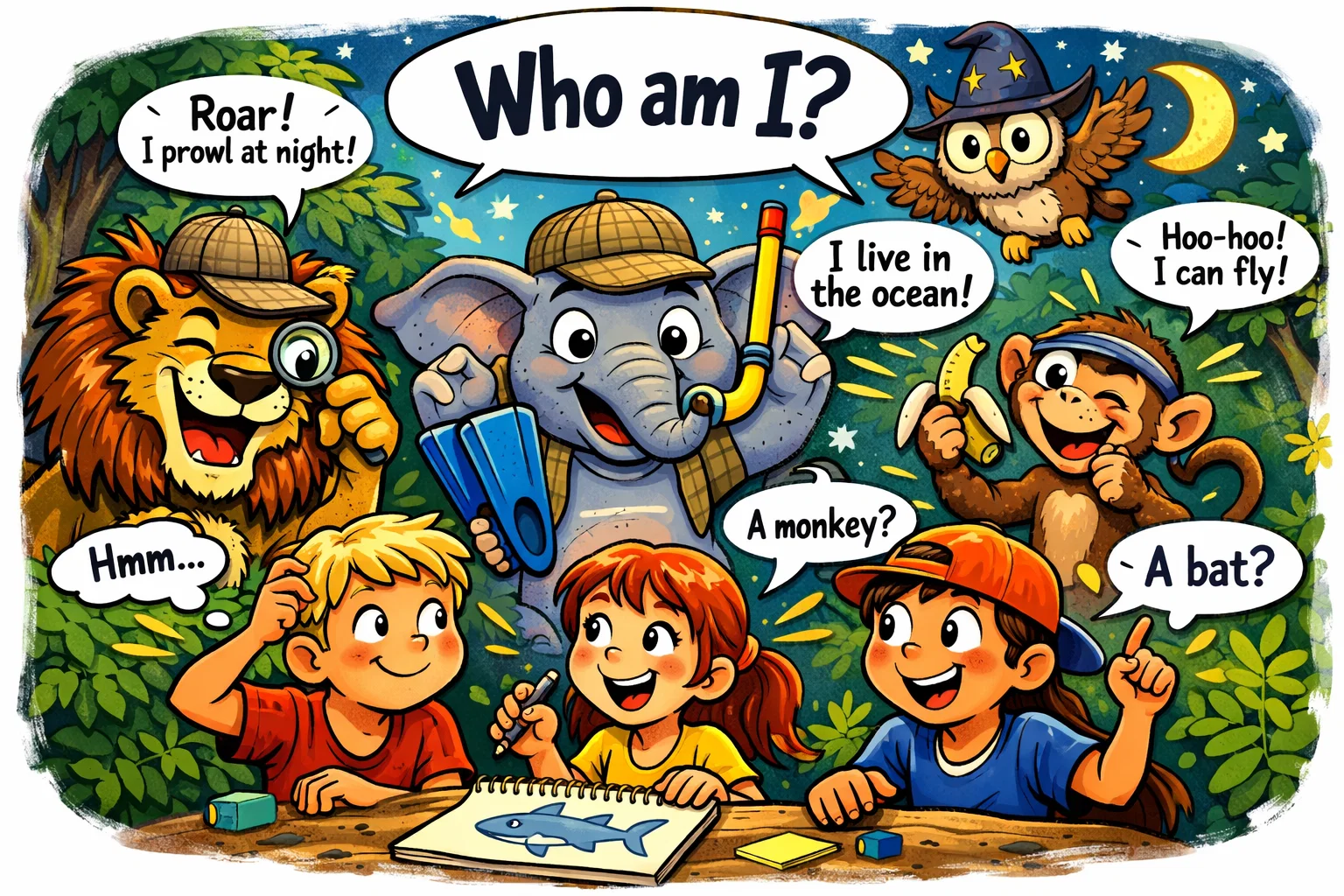
Animal puzzles are a perennial favourite — they’re accessible, imaginative, and work well for all ages within this range.
Tricky Animal Riddles
- I have four legs in the morning, two at noon, and three in the evening. What am I? — A human (crawling as a baby, walking as an adult, using a cane when old). This is one of history’s most famous riddles, known as the Riddle of the Sphinx.
- I have a mane, but I’m not a lion. I carry people but I’m not a car. What am I? — A horse.
- I sleep with one eye open and spend most of my life in water, but I’m not a fish. What am I? — A dolphin.
- I have no voice, but I can tell you what I look like. I live in a warm place, but my coat is white and black. What am I? — A zebra.
- I build a house without brick or wood, and if you break it, my work is done for good. What am I? — A spider.
- I have a great memory, never forget a face, and I live for a hundred years in a sheltered place. What am I? — A tortoise.
Holiday Riddles for Kids
Seasonal puzzles are great for parties, classroom celebrations, and family gatherings.
Halloween Riddles
- What do you call a ghost’s favorite dessert to scream for? — Ice scream.
- What is a witch’s favorite subject in school? — Spelling.
- I have no body, but I will follow you all day until the sun goes down. What am I, perfect for a sunny summer afternoon? — A shadow.
- Why did the skeleton stay calm? — Because nothing gets under his skin.
- What did the fisherman say on Halloween? — Trick or trout.
Christmas Riddles
- I come but once a year, I wear a red suit, and I travel by rooftop. Who am I? — Santa Claus.
- I’m hung by the fireplace with care, hoping someone will fill me. What am I? — A Christmas stocking.
- I have needles but I don’t sew. I stand in living rooms every December. What am I? — A Christmas tree.
- I am often wrapped, but I’m not cold. I’m given, but I’m not a chore. What am I? — A present.
Summer Riddles
- I keep you dry when water falls from the sky. I have a handle and a canopy. What am I? — An umbrella.
- You use me to stay cool, I run on electricity, and I spin round and round. What am I? — A fan.
- I’m full of sand, surrounded by water, and people lie on me all day. What am I? — A beach.
Back to School Riddles
- I have many keys but I open no doors. What am I? — A piano — or a keyboard.
- Teachers write on me every day, but I never learn anything. What am I? — A whiteboard.
- What is black when it’s clean and white when it’s dirty? — A chalkboard.
- I’m full of words and knowledge, but I can’t speak a single sentence. What am I? — A book.
- I bear the weight of knowledge on my shoulders every day. You’ll find me full at dawn and lighter by the hallway. What am I? — A backpack.
- I ring when it’s time to start or end. I’m not a phone, but I’m every student’s friend. What am I? — A school bell.
- I have a lead, but cannot run. I help you write the perfect sentence until I am too short for fun. What am I? — A pencil.
- What room does a teacher always have problems with? — The classroom.
- Why did the math book look sad? — Because it had too many problems.
- Where do pencils go on vacation? — Pencil-vania.
Brain Teasers for 12 Year Olds
Brain teasers are a specific type of riddle that push logical and lateral thinking further than a standard wordplay puzzle. Where a typical riddle relies on a clever twist in language, a brain teaser usually requires you to question your assumptions, spot a hidden pattern, or reason through a problem step by step. For 12 year olds and tweens, they offer a satisfying mental workout that goes beyond the classroom.
Try these brain teasers — each one has a clear answer, but getting there requires careful thought:
- The missing dollar: Three friends each pay $10 for a hotel room ($30 total). The manager refunds $5, so the bellboy keeps $2 as a tip and returns $1 to each friend. Each friend paid $9 (total $27) plus the $2 tip equals $29 — where did the missing dollar go? Answer: There is no missing dollar. The $27 already includes the $2 tip. The correct equation is $25 (room cost) + $2 (tip) + $3 (refund) = $30.
- The two doors: You stand before two doors. One leads to freedom, one to danger. One guard always tells the truth; the other always lies. You can ask one question to one guard. What do you ask? Answer: Ask either guard, “If I asked the other guard which door leads to freedom, what would they say?” Then choose the opposite door.
- The light switches: Outside a room are three switches. Inside is one light bulb. You can flip the switches however you like, but you can only enter the room once. How do you figure out which switch controls the bulb? Answer: Turn on switch 1 for a few minutes, then turn it off. Turn on switch 2. Enter the room. If the bulb is on, it’s switch 2. If it’s off and warm, it’s switch 1. If it’s off and cold, it’s switch 3.
- Crossing the bridge: Four people need to cross a bridge at night with one torch. The bridge holds only two at a time. They walk at different speeds: 1, 2, 5, and 10 minutes. When two cross together, they move at the slower person’s pace. How do they all cross in 17 minutes? Answer: 1 and 2 cross (2 min). 1 returns (1 min). 5 and 10 cross (10 min). 2 returns (2 min). 1 and 2 cross again (2 min). Total: 17 minutes.
These kinds of brain teasers are excellent for group problem-solving sessions, classroom challenges, or simply testing yourself to see how long it takes to crack each one.
How to Create Your Own Riddles
Creating original riddles is a fun creative challenge that also builds writing and critical thinking skills.
Start With the Answer
The most effective technique for writing riddles is working backwards. Choose your answer first — a candle, a river, an umbrella — and then ask yourself: what can I say about this that describes it without naming it? This reverse-thinking method is used by professional riddle writers and puzzle designers alike.
Brainstorm Clues
Once you have your answer, list its properties:
- What does it look like?
- What does it do?
- What does it have in common with something completely different?
- What are its unusual or surprising features?
Pick the two or three most unexpected ones to build your puzzle around.
Use Wordplay and Double Meanings
The best riddles use words that mean more than one thing. A word like “light” can mean “bright” or “not heavy”. A “trunk” belongs to an elephant, a tree or a car. Playing with these double meanings is the core mechanic behind most clever puzzles.
Test and Refine Your Riddle
Share your riddle with a friend or family member before deciding it’s finished. If they solve it too quickly, add another layer of misdirection. If they can’t solve it at all, the clues may be too vague. The goal is a puzzle that feels satisfying — challenging enough to be interesting, fair enough to feel solvable.
Make Learning Fun With Riddles
Riddles for 12 year olds are much more than entertainment — they’re a genuinely effective tool for developing logic, language, and creative thinking in a way that feels natural and enjoyable. Whether used in the classroom, on a car journey, or at the dinner table, riddles spark conversations, build confidence, and make learning feel like play.
This collection covers 100 riddles across seven categories: funny and silly riddles, trick questions, easy warm-ups, hard riddles and brain teasers, math riddles, word riddles, science riddles, animal riddles, and holiday riddles — with every answer included. There’s something here for every kind of thinker, whether they prefer wordplay, number puzzles, or lateral thinking challenges.
The best approach is to mix difficulty levels, switch between categories, and encourage kids to create their own puzzles. When children move from solving riddles to writing them, they’re practising some of the most sophisticated thinking skills available at this age. Bookmark this page to come back to, or share a favourite riddle with a friend and see if they can crack it.
Frequently Asked Questions
What Are Good Riddles for 12 Year Olds?
Good riddles for this age group balance challenge with fairness — they should require genuine thought without being unsolvable. A strong mix of logic riddles, wordplay, and humor works well for most 12 year olds. For example: “What comes once in a minute, twice in a moment, but never in a thousand years?” (Answer: the letter M) hits the right level — tricky but satisfying.
Are Riddles Good for Brain Development?
Yes. Riddles actively support critical thinking, problem-solving, and creative reasoning — all key skills for pre-teens. According to cognitive research, activities that require children to consider multiple interpretations before reaching a conclusion strengthen flexible thinking patterns that are directly useful in academic settings, particularly in reading and mathematics.
How Difficult Should Riddles Be for 12 Year Olds?
The ideal difficulty for most 12 year olds sits at medium to slightly challenging. Starting with easier riddles helps build confidence and momentum, then gradually increasing complexity keeps engagement high without causing frustration. A good rule of thumb: if a child solves a riddle in under five seconds every time, it’s too easy; if they give up every time, it may be too hard.
Can Riddles Help With School Learning?
Absolutely. Riddles support several core school subjects at once. Math riddles reinforce number reasoning and logic. Wordplays build vocabulary and reading comprehension. Science puzzles make abstract concepts memorable. Many teachers incorporate riddles into warm-up routines precisely because they engage students quickly and activate the kind of focused, curious thinking that makes the rest of a lesson more productive.
Take a short quiz to find out what your everyday choices say about your parenting style
When your child is curious about something new, what’s your instinct?
Take a short quiz to find out what your everyday choices say about your parenting style
“Can I download this app?” What happens next?
Take a short quiz to find out what your everyday choices say about your parenting style
When it comes to rules at home, which sounds most like you?
Take a short quiz to find out what your everyday choices say about your parenting style
If you could give your child one life skill today, what would you pick?
Take a short quiz to find out what your everyday choices say about your parenting style
Your child gets to choose what to watch. What would your ideal setup look like?
Take a short quiz to find out what your everyday choices say about your parenting style
Pick your parenting superpower ✨