
51 Preschool & Pre-K Sight Words: Lists, Readiness, and Teaching Tips

 Discover a Free Education Video App for Kids
Pastory uses AI to personalize educational video content based on your child’s interests and personality. Safe, engaging, and built for curious young minds. Sign up now to stay updated and enjoy early access with a free trial
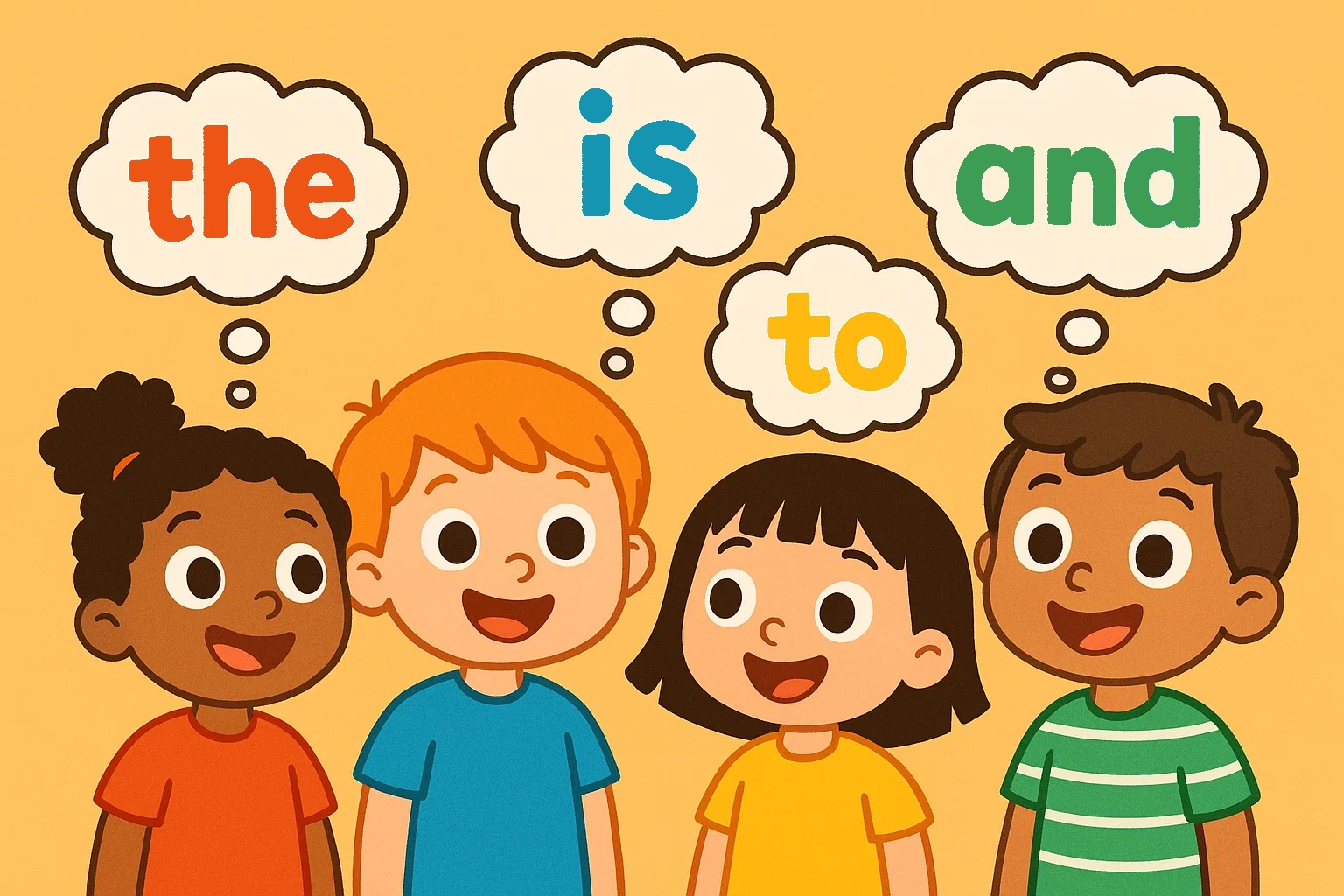
Preschool sight words are high-frequency words that young children learn to recognize automatically, building early reading fluency alongside phonics and phonemic awareness. This guide covers 51 sight words drawn from Dolch Pre-Primer and Fry lists, explains what sight words are, how they differ from decodable words, and which list works best for beginners.
You will also find readiness indicators, realistic expectations for 4-year-olds, and practical teaching strategies that fit naturally into play-based learning. Whether you are a parent or an educator, the focus here is on supporting early literacy at the right pace for each child.
Key Takeaways
- This guide covers 51 preschool and pre-k sight words organized from Dolch Pre-Primer and Fry beginner lists.
- Sight words are high-frequency words children recognize automatically, supporting fluency alongside phonics instruction.
- Readiness matters — sight word practice is most effective when a child shows early print awareness and phonological interest.
- Age expectations vary: most 3-year-olds are building foundational awareness, while many 4-year-olds (pre-k age) may begin recognizing a small set of high-frequency words.
- Realistic expectations for pre-k and preschool children center on exposure and gradual recognition, not full mastery of a long list.
- Play-based activities, movement games, and small learning sets are the most effective approaches for preschool-age children.
Preschool Sight Words Basics
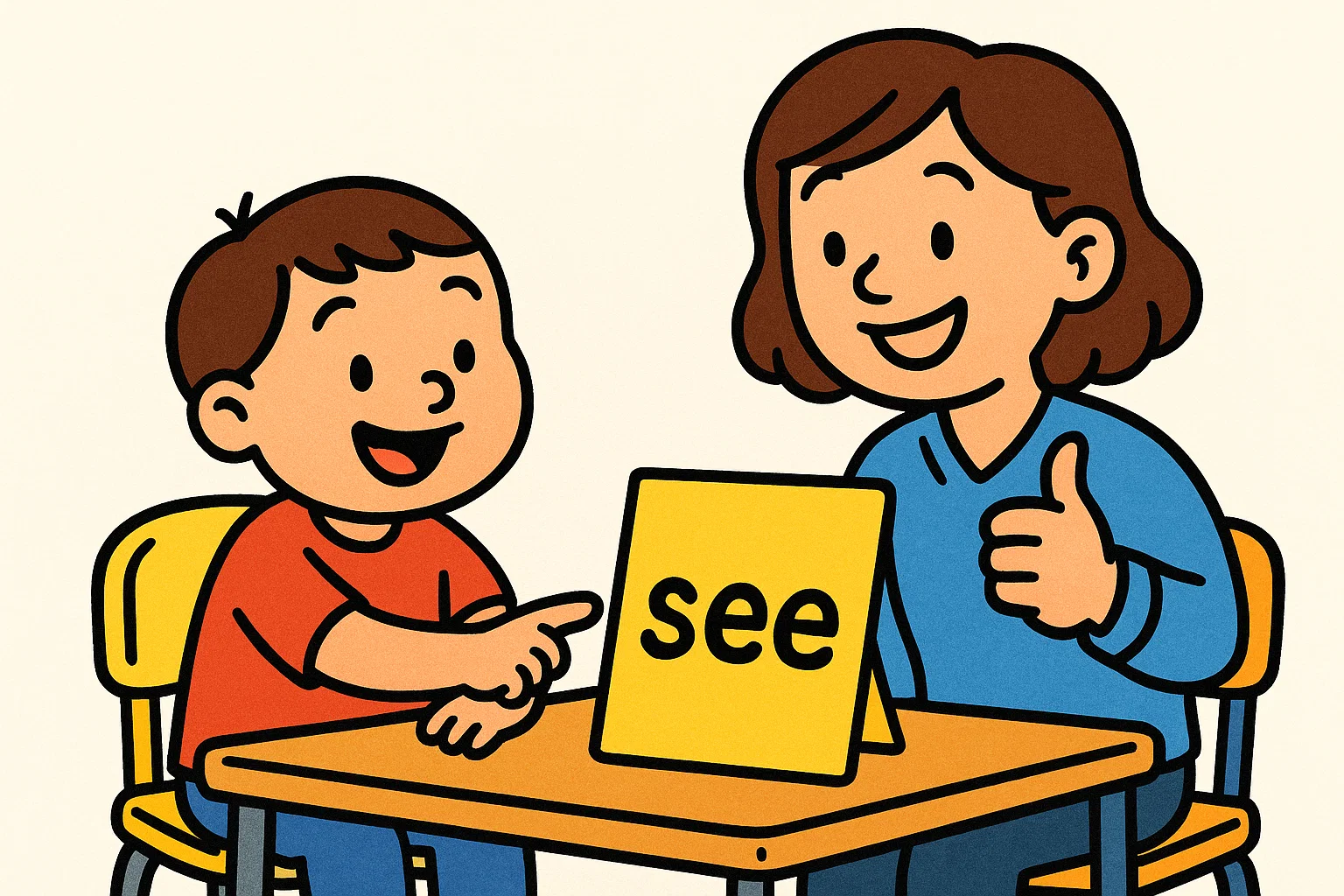
A sight word is a word that a reader recognizes automatically without having to pause and sound it out. Through orthographic mapping, children store familiar spellings in long-term memory by connecting them with their pronunciations and meanings.
As recognition becomes automatic, beginning readers can devote more attention to fluency and comprehension.
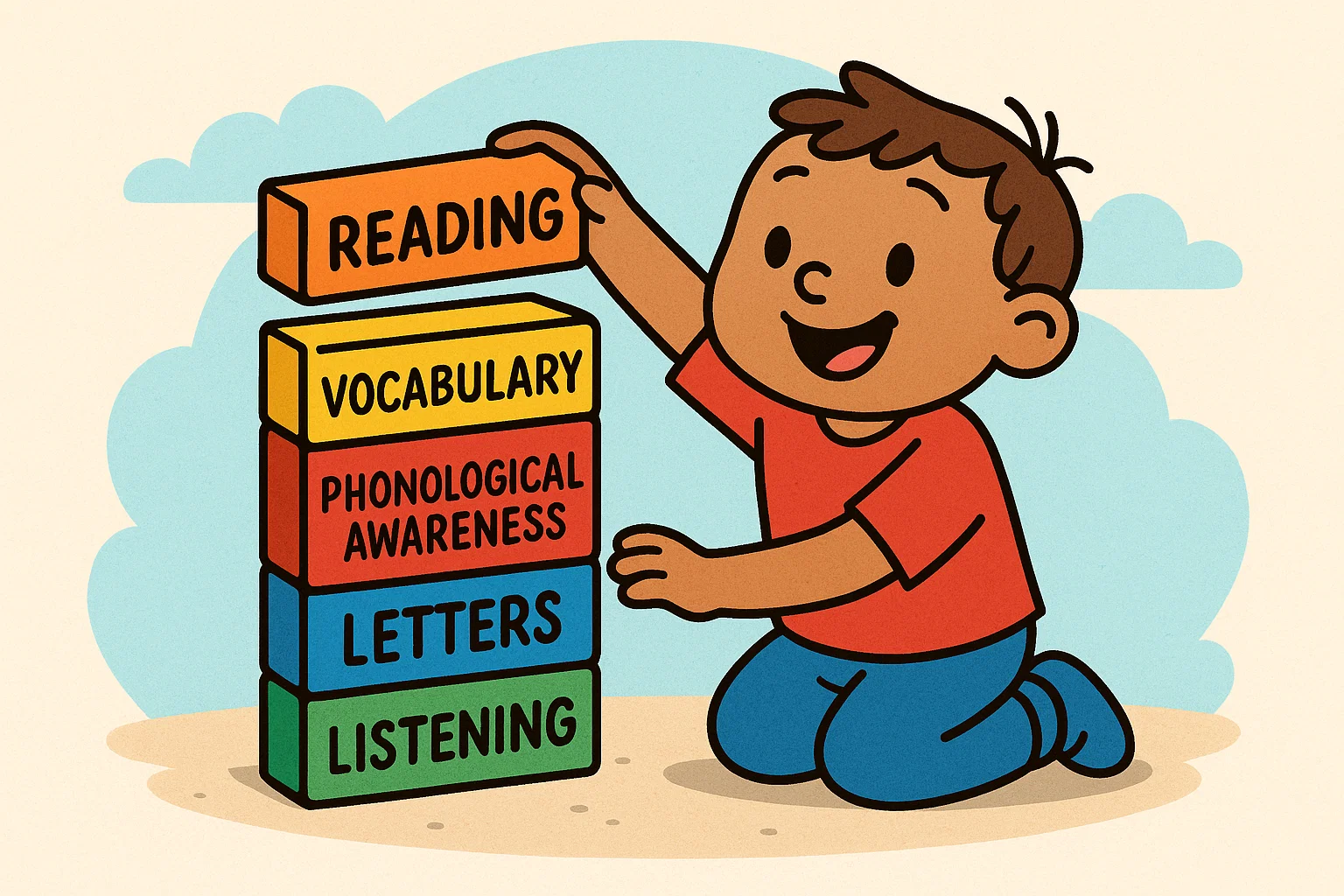
Recommended Learning Order
The following skills generally support early reading, although they often develop together rather than in a rigid sequence:
- Oral Language and Vocabulary: Developing spoken communication skills and expressive and receptive vocabulary.
- Phonemic Awareness: Identifying and manipulating individual sounds in speech without looking at print.
- Letter-Sound Correspondence: Understanding how printed letters and letter combinations represent speech sounds.
- Simple Decoding: Blending sounds to read basic consonant-vowel-consonant (CVC) words.
- High-Frequency Words: Introducing a small number of useful examples and showing how regular and irregular spelling patterns connect to pronunciation.
Effective Practice Approach
An effective routine combines systematic phonics instruction with brief, playful, and repeated practice. The National Reading Panel found that systematic phonics instruction is more effective than teaching that includes little or no phonics.
Parents can support learning by connecting each target word to familiar letter-sound patterns and explicitly pointing out any irregular part. Short, regular interactions with print can help maintain a preschooler’s attention and interest.
What Are Preschool Sight Words?
Sight Words Definition
In early literacy, sight words are forms that a reader can identify instantly and automatically, without conscious decoding effort.
Although the term is often associated with irregularly spelled words, any word that a child learns to recognize automatically can become a sight word for that reader. Automatic recognition develops when a reader connects spelling with pronunciation and meaning through orthographic mapping and repeated encounters.
Sight Words vs. High-Frequency Words
| Category | Definition | Examples | Primary Instructional Focus |
| High-Frequency Words | Words that occur most frequently in written English. | the, and, of, to, a | Selected on the basis of frequency because they appear often in connected text. |
| Sight Words | Any words that an individual reader recognizes automatically without conscious decoding. | No fixed examples; the category depends on the individual reader. | Defined by automatic recognition, not by frequency or spelling pattern. |
Sight Words vs. Decodable Words
Sight words are sometimes incorrectly described as words that cannot be sounded out using phonics. In fact, many high-frequency words are regularly spelled and can be fully decoded once the relevant letter-sound correspondences have been taught. Examples include:
- in
- at
- and
- can
- up
- not
- big
- it
Other common words, such as the and said, contain a pattern that may be irregular or not yet familiar to a beginning reader.
Effective instruction helps children decode the regular parts and remember any letters that represent an unexpected sound.
Role in Early Reading
Automatic recognition helps beginning readers move through a text more fluently. Because a relatively small group of words occurs frequently in English, quick identification can leave more attention available for comprehension.
This automaticity can support oral reading fluency and make simple texts feel more manageable.
Preschool Sight Word List
Common Preschool Sight Words
The following sample words appear frequently in simple sentences and early reading materials. They are not a mandatory or universal preschool sight word list. Select examples that match the child’s current phonics knowledge and the books they are reading.
Two-Letter High-Frequency Words
These short examples can be used to practice left-to-right tracking and basic letter-sound connections:
- am: “I am happy today.”
- at: “Look at the yellow sun.”
- go: “We can go to the park.”
- in: “The ball is in the big box.”
- is: “My dog is very small.”
- it: “Give it to your sister.”
- me: “Come play with me.”
- my: “This is my favorite book.”
- no: “There are no cookies left.”
- on: “Put the hat on your head.”
- to: “We walk to school.”
- up: “Look up at the birds.”
- we: “We can read together.”
Three-Letter High-Frequency Words
This group includes both simple CVC patterns and common function forms with less predictable spellings:
- and: “I see a cat and a small dog.”
- can: “You can paint a big picture.”
- for: “This blue box is for you.”
- not: “That toy is not mine.”
- one: “I have one red apple.”
- see: “I can see the big green tree.”
- you: “You are a very good helper.”
Four-Letter High-Frequency Words
These examples include familiar spelling patterns as well as examples with an irregular or not-yet-taught element:
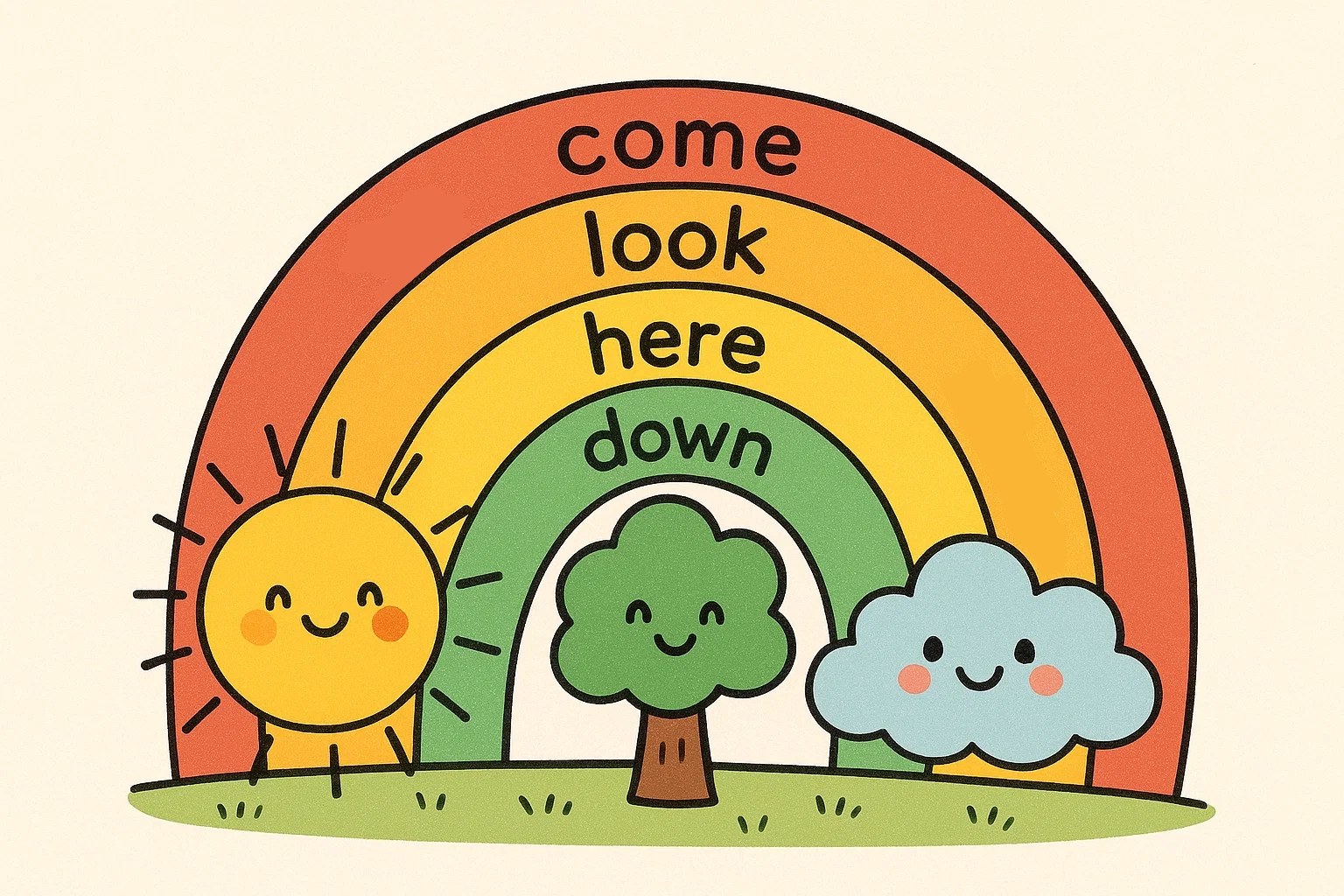
- come: “Come inside the warm house.”
- here: “Sit down here next to me.”
- like: “I like to eat green apples.”
- look: “Look at the funny little frog.”
- play: “We can play outside today.”
- said: “Mom said it is bedtime.”
- this: “This is my favorite toy.”
Action Words for Movement Games
Grouping action vocabulary by meaning and pairing it with movement can make practice more engaging and reinforce comprehension:
- come: Walk toward the instructor when the card is shown.
- go: Move to a designated spot across the room.
- jump: Jump into the air after recognizing the card.
- look: Cup your hands around your eyes like binoculars.
- play: Begin playing with a nearby toy.
- run: Jog safely in place.
- stop: Hold up an open hand and stop moving.
Pronouns and Function Words
Pronouns and other function words help children understand who is speaking, who or what is being referred to, and how ideas are connected within a sentence:
- I / we: I refers to the speaker, while we refers to the speaker and one or more other people.
- he / she / it: He and she usually refer to people, while it commonly refers to an object, animal, situation, or idea.
- my / me / you: My shows possession, me is an object pronoun, and you refers to the person or people being addressed.
- this / that: This usually points to something near the speaker, while that usually points to something farther away.
Dolch Pre-Primer Sight Words
Edward William Dolch published A Basic Sight Vocabulary in 1936. The article presented a 220-word list that excluded nouns and a separate list of 95 common nouns that he did not recommend for the basic sight vocabulary.
Modern classroom versions remain widely used and are often divided into levels from Pre-Primer through Grade 3, although this grouping does not appear in Dolch’s original article.
Dolch Pre-Primer List
A widely circulated Dolch Pre-Primer version contains 40 commonly taught items. The following list is organized alphabetically:
| a | and | away | big | blue |
| can | come | down | find | for |
| funny | go | help | here | I |
| in | is | it | jump | little |
| look | make | me | my | not |
| one | play | red | run | said |
| see | the | three | to | two |
| up | we | where | yellow | you |
Frequency-based versions may arrange the entries differently. Any ranking should therefore identify the source and method used.
Dolch Words Worth Teaching First
When introducing Dolch words, begin with a small, practical set that children can use in simple sentences.
Examples such as a, I, the, see, can, and me can be combined with decodable material the child already knows. This allows the child to read simple sentences such as:
- “I see a big dog.”
- “Can you help me?”
- “I can see the cat.”
Using newly learned vocabulary in meaningful sentences can help children understand the purpose of the activity and build confidence.
Dolch List Limitations
Although the Dolch lists remain widely available, they have several limitations as instructional tools:
- Limitation of List-Only Instruction: A list does not provide the sentence-level context children need to understand how language functions in connected text.
- Dated Source Material: Because the collection was created from early twentieth-century materials and frequency lists, its rankings may not fully reflect the texts children read today.
- Phonics Disconnect: Teaching through visual memorization alone can take attention away from letter-sound relationships and decoding.
- Fixed Grouping: The traditional grade-level groups do not necessarily match every child’s reading development or phonics knowledge.
Fry Sight Words for Preschoolers
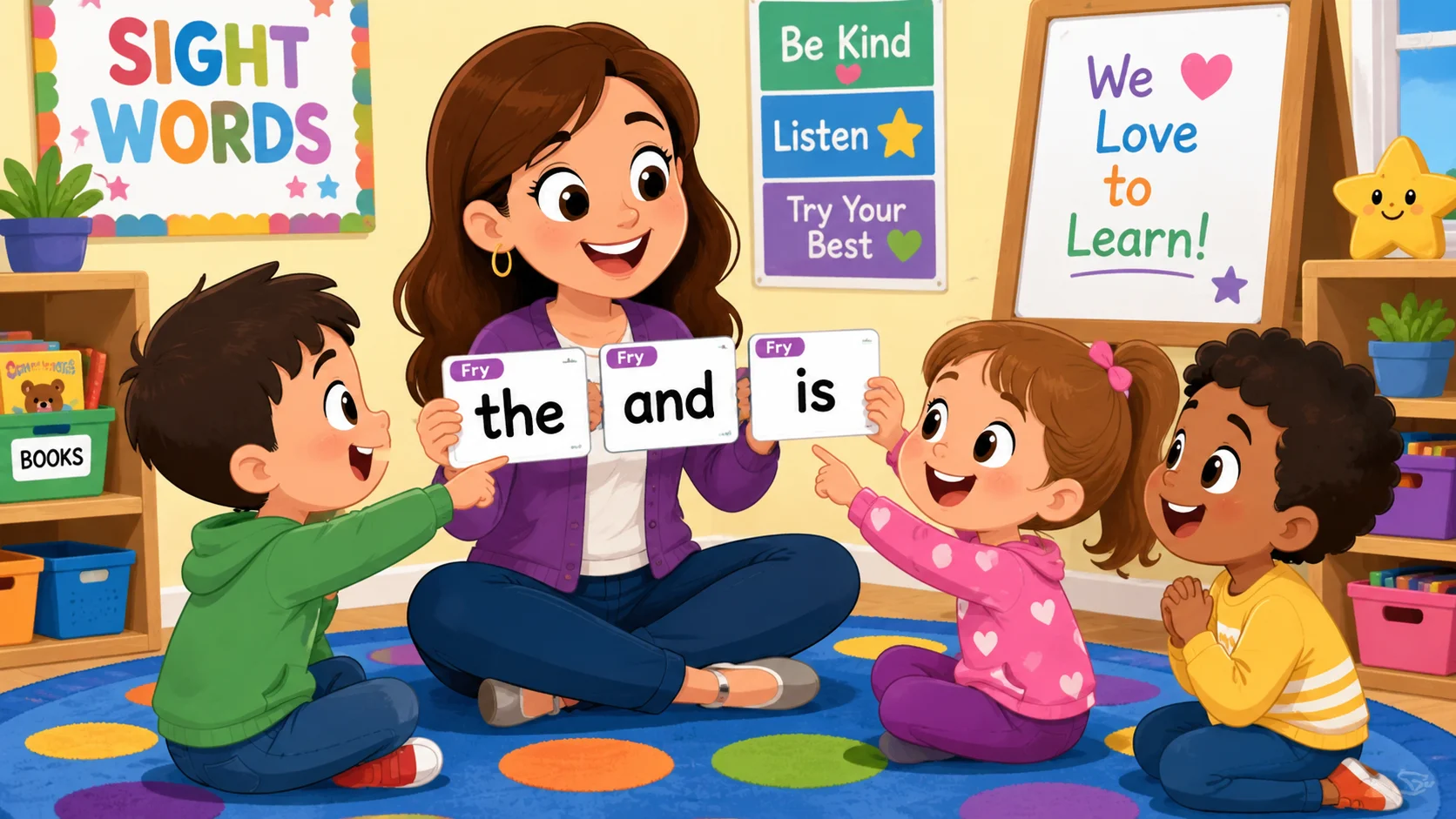
Fry Words Suitable for Beginners
Edward Fry published an initial Instant Word List in 1957 and revised it in 1980 as a frequency-ranked list of 300 items.
Later publications expanded the collection to 1,000 entries, commonly divided into 10 groups of 100. These groups are based primarily on frequency and should not be treated as preschool requirements.
A preschooler who is interested in print and developing early decoding skills may begin with a few useful items from the first group, such as:
- the
- a
- I
- to
- and
- you
- is
- can
- in
- it
Select targets according to the child’s needs rather than attempting to teach the entire first group.
Dolch vs. Fry Lists
| Feature | Dolch Word List | Fry Instant Word List |
| Origin | First published by Edward William Dolch in 1936. | First published by Edward Fry in 1957; revised to 300 items in 1980 and later expanded to 1,000. |
| Total Count | A core list of 220 entries excluding nouns, plus a separate list of 95 common nouns. | An expanded list of 1,000 entries. |
| Organization | Commonly presented in levels from Pre-Primer through Grade 3. | Commonly divided into 10 frequency-based groups of 100. |
| Primary Source Base | Derived from early twentieth-century lists and children’s reading materials. | Based on broader frequency data from educational reading materials. |
| Primary Use | Often used as a reference for common vocabulary in beginning reading materials. | Often used as a frequency-based reference across a wider range of reading levels. |
Choosing Between Word Lists
Rather than following a single list rigidly, select a few targets that appear in the child’s books and align with the letter-sound patterns the child has already learned.
If a book repeatedly uses examples such as look and here, practice them both within the story and in new sentences. This connects new learning to meaningful context rather than isolated memorization.
Do Preschoolers Need Sight Words?
Preschool Learning Goals
Early childhood frameworks do not set fluent reading or mastery of a sight word list as a universal requirement for every four-year-old.
Common preschool literacy goals include:
- oral language and vocabulary
- phonological and phonemic awareness
- print and alphabet knowledge
- listening comprehension
- early writing
- interest in books and stories
Relying on rote memorization before a child understands basic letter-sound relationships is unlikely to build transferable decoding skills.
Sight Words as an Optional Extension
For a child who shows an interest in print, introducing a few useful high-frequency words can complement phonological awareness and phonics activities.
If a child recognizes many letters and their common sounds, shows interest in print, and is beginning to blend the sounds in simple CVC forms such as cat and sit, they may be ready to explore a few common examples.
This should feel like an engaging next step rather than a strict requirement.
Play-Based Learning Priority
The American Academy of Pediatrics emphasizes that play supports young children’s cognitive, physical, social, and emotional development.
Long or repetitive flashcard and worksheet drills may cause frustration or reduce a child’s interest. Instead, use interactive games, shared reading, conversation, and hands-on activities to support early literacy.
When Should Preschoolers Start Learning Sight Words?
Signs a Child May Be Ready
A child may be ready to explore a few high-frequency words when they show several of the following signs:
- The child shows an active interest in books, signs, labels, and environmental print.
- The child recognizes a growing number of uppercase and lowercase letters.
- The child can produce the common sounds associated with several familiar letters.
- The child shows an emerging understanding that English print is read from left to right.
- The child is beginning to blend sounds in simple CVC forms.
- The child enjoys participating in shared reading activities.
These signs are general indicators rather than mandatory prerequisites.
Typical Starting Age
There is no universal age at which children must begin learning sight words.
Some children become interested in reading high-frequency words during the preschool years, while others develop this skill during kindergarten or later. Both patterns can fall within normal development.
Readiness, interest, and foundational literacy skills are more useful guides than age alone.
When Sight Word Practice Should Wait
Reduce or pause structured sight word practice if it consistently causes stress or leads the child to avoid books and print.
Return to enjoyable activities such as:
- reading aloud together
- singing rhyming songs
- playing with alphabet blocks
- listening for beginning and ending sounds
- matching letters with familiar sounds
Seek guidance from the child’s teacher or an appropriate specialist if difficulties with letters, language, sounds, or print persist.
Integrating Phonics and Sight Words
Introduce a few useful high-frequency words as the child develops basic blending skills, rather than treating phonics and sight word learning as separate stages.
For example, after a child learns to decode a regular CVC form such as mat, you can introduce the and point out both its predictable letters and its less predictable vowel sound in the sentence:
“The cat sat on the mat.”
This integrated approach helps children see how decoding and automatic recognition work together in connected text.
How Many Sight Words Should a Preschooler Know? (Ages 3 and 4)
Age-by-Age Expectations: 3-Year-Olds vs. 4-Year-Olds
Sight word readiness looks different across the preschool years. Understanding what is typical at each age can help parents and educators set realistic goals without pressure.
Around age 3: Most 3-year-olds are still building the foundational skills that come before formal sight word practice — oral vocabulary, phonological awareness, and alphabet knowledge. Some 3-year-olds may recognize a handful of environmental words (such as their own name or a familiar logo), but this is different from reliably reading print out of context. Structured sight word drills are generally not developmentally appropriate at this age. Rich read-aloud experiences, rhyming games, and letter exploration are more beneficial.
Around age 4 (pre-k): Children who are approaching kindergarten and showing early print awareness may be ready to begin recognizing a small set of high-frequency words — typically somewhere between 0 and 20, depending on the individual child’s readiness and interest. There is no universal evidence-based target. A pre-k child who can identify a few words such as I, a, the, and my in simple sentences is making meaningful progress.
Around age 2: Sight word instruction is not developmentally appropriate for toddlers. At this stage, language development, play, and shared reading are the most valuable literacy activities.
In all cases, a child’s overall language development, interest in books, and foundational phonological skills are more reliable indicators of readiness than age alone.
Realistic Preschool Expectations
There is no mandatory number of sight words a four-year-old must master. The total varies widely, and there is no universal evidence-based target for this age.
A lack of automatic recognition at age four is not, by itself, necessarily a cause for concern. Broader language, print, and phonological skills provide more useful context.
Focus on the child’s overall development and interest in reading rather than comparing their total with a fixed benchmark.
Mastery vs. Exposure
It is important to distinguish between simple exposure and reliable recognition.
Reliable recognition means that a child can read the same item accurately:
- in an unfamiliar sentence
- in different books
- in different fonts and sizes
- with ordinary changes in capitalization
- without relying on a picture or logo
Recognition in connected text is more meaningful than reciting a long list from familiar flashcards.
Small Learning Sets
Introduce only a few new targets at a time, adjusting the number to the child’s attention, confidence, and current skills.
Review previously introduced material regularly and add new items gradually when the child is identifying most of the current set accurately. There is no need to wait for flawless performance before introducing something new, but previously taught items should remain in the review rotation.
Individual Progress Factors
A child’s progress with automatic recognition can be influenced by several developmental and environmental factors:
- Language Environment: How often the child hears rich and varied vocabulary.
- Shared Reading Habits: Regular exposure to print through enjoyable storytime.
- Phonological Skills: The child’s ability to notice and manipulate sounds in speech.
- Letter-Sound Knowledge: Familiarity with the sounds commonly represented by letters and letter combinations.
- Opportunities for Active Practice: Building and tracing spellings can help children notice the sequence of letters.
- Attention and Interest: Practice is more productive when it matches the child’s current ability to focus.
- Previous Experience: Children who regularly encounter print may recognize familiar spellings earlier than children with less exposure.
Tips for Teaching Preschool Sight Words
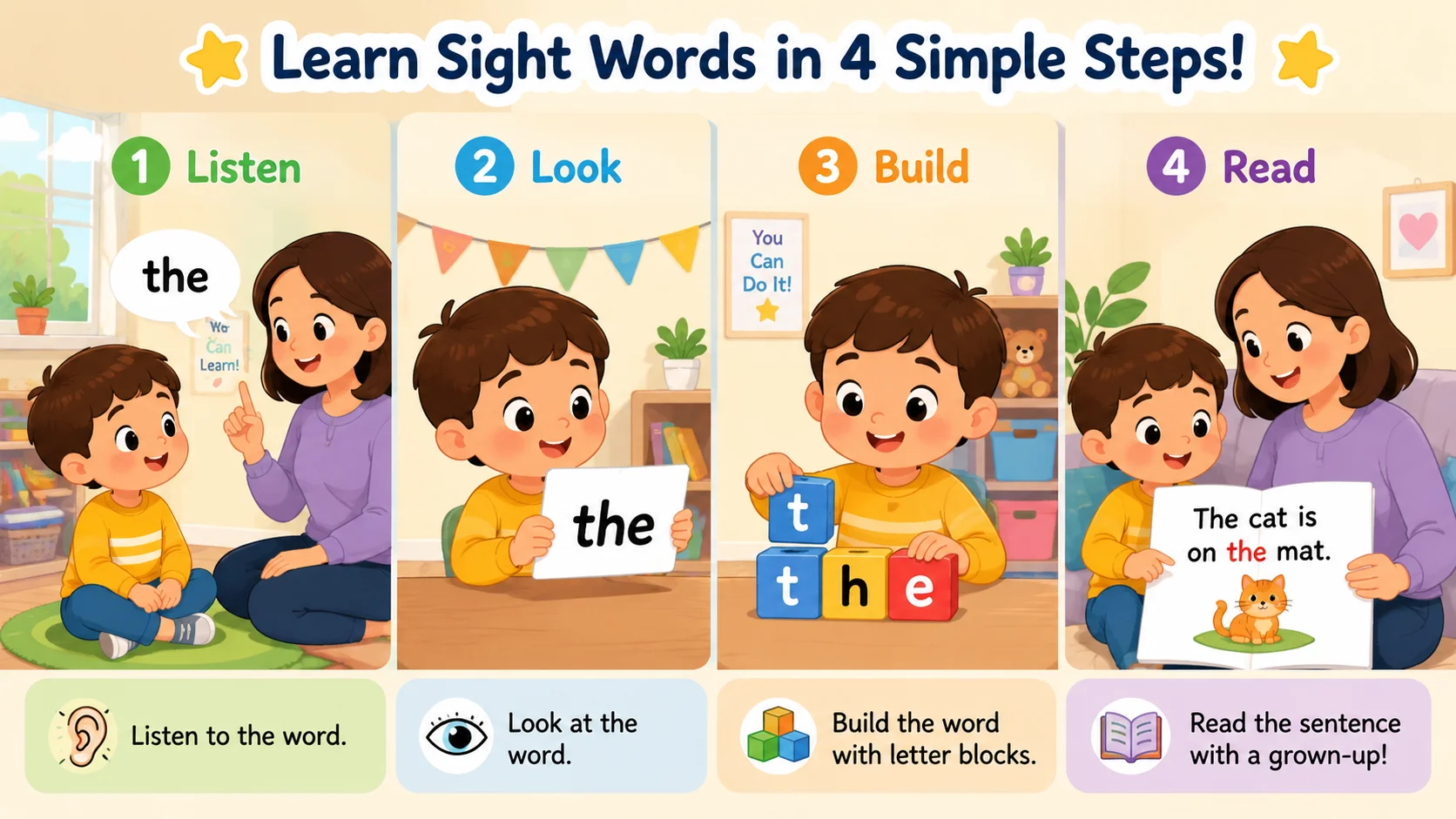
Effective sight word instruction for preschool and pre-k children works best when it is woven into play and everyday routines rather than delivered as formal drills. The following strategies are grounded in how young children learn best.
Play-Based Teaching Strategies
- Word hunts: Write a target word on a card and ask the child to find it in a familiar book or on a page. This builds recognition in context rather than in isolation.
- Sensory writing: Have the child trace a word in a tray of sand, salt, or shaving cream. Multisensory practice supports orthographic mapping.
- Movement games: Use action words such as jump, run, stop, and go in games where the child performs the action when they see or hear the word.
- Building with letters: Provide magnetic letters or letter tiles and ask the child to build a target word, then mix the letters up and rebuild it.
- Shared reading connections: When reading together, pause and point to a familiar high-frequency word. Ask the child if they recognize it before moving on.
- Environmental print: Draw attention to common words on cereal boxes, street signs, and labels. Familiar contexts make recognition feel meaningful.
- Simple sentence strips: Write a short sentence using one or two target words and decodable vocabulary the child already knows. Cut the sentence into individual words and ask the child to reassemble it.
Keeping Practice Short and Positive
Preschool and pre-k children have limited attention spans for structured tasks. Keep practice sessions to five minutes or less and always end on a success. Introduce no more than two or three new words at a time, and review previously learned words regularly. If a child shows frustration or disengagement, shift to a shared reading activity and return to word practice another day.
FAQ
Should Parents Use a Dolch Sight Word List?
This collection can be a useful reference, but it should not become a fixed curriculum. The familiar phrase 220 sight words refers to Dolch’s core collection, while a separate companion list contains common nouns. Modern versions may arrange the material by grade level or in alphabetical order, although neither sequence automatically fits every learner. Treat it as a reference list of words rather than a checklist. Select a few words from the Dolch collection that occur in current reading materials and match the spelling patterns already studied. Teaching Dolch sight words is most useful when the entries are practiced in sentences instead of presented only as isolated cards.
Which Words First, and What Is the Best Order in Which to Teach Them?
There is no universal sequence. Begin with forms that are useful in familiar sentences, largely compatible with current phonics knowledge, and easy to revisit in books. The exact sequence should reflect what the child knows rather than a preset calendar. Introduce one sight word at a time when necessary, then review it beside an established set of sight words. A small set is easier to practice accurately than a long list of sight words, especially during the early stages.
When Are Preschoolers Ready for Sight Words?
Preschoolers are ready for structured practice at different times. Helpful signs include interest in print, knowledge of several letter-sound relationships, and an emerging ability to blend simple forms such as cat and sit. There is no single age or test score that proves readiness. Children do not have to finish phonics and then move on to sight words as a separate stage. A practical way to teach sight words in preschool is to combine short recognition activities with decoding, rhyme, oral language, and shared reading. Sight words for preschool should remain an optional extension rather than a compulsory benchmark.
Why Is Some Vocabulary Described as High-Frequency?
These are high-frequency words because they appear frequently in written English. Many are commonly used words such as the, and, to, and is. Frequency indicates how often an item occurs in text; it does not show whether a particular learner already recognizes it automatically. After a spelling becomes automatic for an individual reader, it may be known as a sight word for that person. This is why different sight words can be familiar to different children.
Are Sight Words Phonetic?
Many common examples follow regular phonetic patterns, while others contain an element that is irregular or has not yet been taught. It is therefore misleading to say that this category consists only of forms that cannot be sounded out. Effective instruction connects letters with sounds, identifies any unexpected element, and provides repeated practice in meaningful sentences. This supports decoding and sight word recognition at the same time.

Take a short quiz to find out what your everyday choices say about your parenting style
When your child is curious about something new, what’s your instinct?
Take a short quiz to find out what your everyday choices say about your parenting style
“Can I download this app?” What happens next?
Take a short quiz to find out what your everyday choices say about your parenting style
When it comes to rules at home, which sounds most like you?
Take a short quiz to find out what your everyday choices say about your parenting style
If you could give your child one life skill today, what would you pick?
Take a short quiz to find out what your everyday choices say about your parenting style
Your child gets to choose what to watch. What would your ideal setup look like?
Take a short quiz to find out what your everyday choices say about your parenting style
Pick your parenting superpower ✨



