33 Music Therapy Activities for Children: Tools, Games, Techniques, Session Ideas

 Discover a Free Education Video App for Kids
Pastory uses AI to personalize educational video content based on your child’s interests and personality. Safe, engaging, and built for curious young minds. Sign up now to stay updated and enjoy early access with a free trial
Targeted music therapy activities for children can provide structured opportunities to support communication, motor skills, emotional regulation, social interaction, sensory processing, and behavioral engagement. Music-based approaches use rhythm, melody, movement, and sound to support engagement and learning, offering an accessible entry point for kids with autism, developmental disabilities, and speech delays.
While music interventions may offer developmental and emotional benefits, each child’s needs, preferences, and sensory responses can vary significantly. Parents, teachers, and caregivers can adapt these music-based activities with appropriate supervision and should consult a credentialed music therapist when working toward specific developmental or clinical goals.
Key Takeaways
- Activity Blueprints: Explore 33 structured music-based activities that target fine and gross motor skills, emotional expression, and social interaction.
- Clinical Adaptation: Learn how a professional music therapist can design an individual session around a child’s needs.
- Essential Tools: Identify instruments, sensory props, digital tools, and visual aids that may be useful in clinical, school, or home settings.
- Safety Protocols: Use volume control, sensory regulation strategies, and transition planning to keep activities safe and supportive.
Best Music Therapy Activities for Children
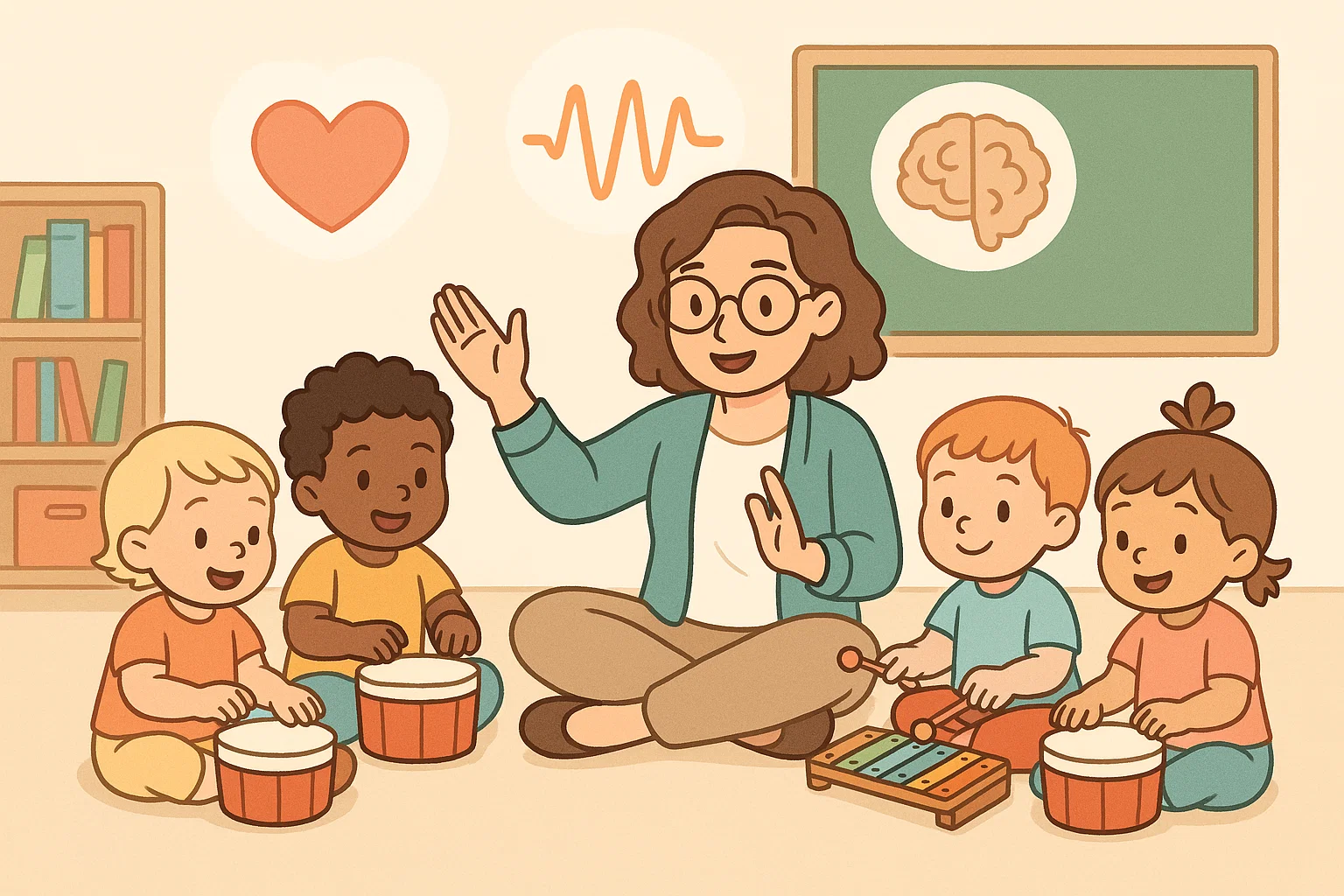
The most effective music therapy activities for kids are simple, repeatable, goal-oriented, and easy to adapt. Children do not need musical training or talent to benefit from therapeutic music activities; the focus is on their responses, engagement, and communication.
Effective activities use structured musical elements—such as predictable rhythms and clear melodic phrases—to match the child’s age, communication level, and sensory preferences.
Main Benefits for Children
Music therapy interventions can support progress across multiple developmental domains, especially when they are individualized and delivered consistently. Research suggests that music-based interventions may support speech, language, social engagement, and emotional regulation, although outcomes vary by child, goal, and intervention design.
| Developmental Area | Targeted Skill | Potential Therapeutic Value |
| Communication & Speech | Receptive and expressive language | May increase vocalizations and support the functional use of augmentative and alternative communication (AAC). |
| Motor Function | Fine and gross motor skills | Can support motor planning and physical coordination through rhythmic cues. |
| Social-Emotional | Emotional regulation and social interaction | May support emotional regulation, shared attention, and peer interaction. |
| Cognitive Processing | Attention span and task focus | May increase purposeful engagement through structured auditory cues. |
Safety Notes for Home, School, and Therapy
Music-based activities should be planned with physical and sensory safety in mind to reduce the risk of injury or distress.
- Volume and Decibel Control: Keep audio at a comfortable level, ideally around normal conversation volume and generally below 70 dBA, to reduce the risk of sensory overload or hearing discomfort.
- Instrument Inspections: Verify that maracas, shakers, and drums are made from non-toxic materials and do not have small, detachable parts that could pose choking hazards.
- Proactive Supervision: Monitor all physical movement games closely to reduce trip risks from cushions, cords, floor markers, or other objects.
- Sensory Awareness: Watch for signs of sensory overload, such as ear-covering, withdrawal, distress vocalizations, or attempts to leave the activity, and offer a calming song or sensory break when needed.
What Are Music Therapy Activities for Children?
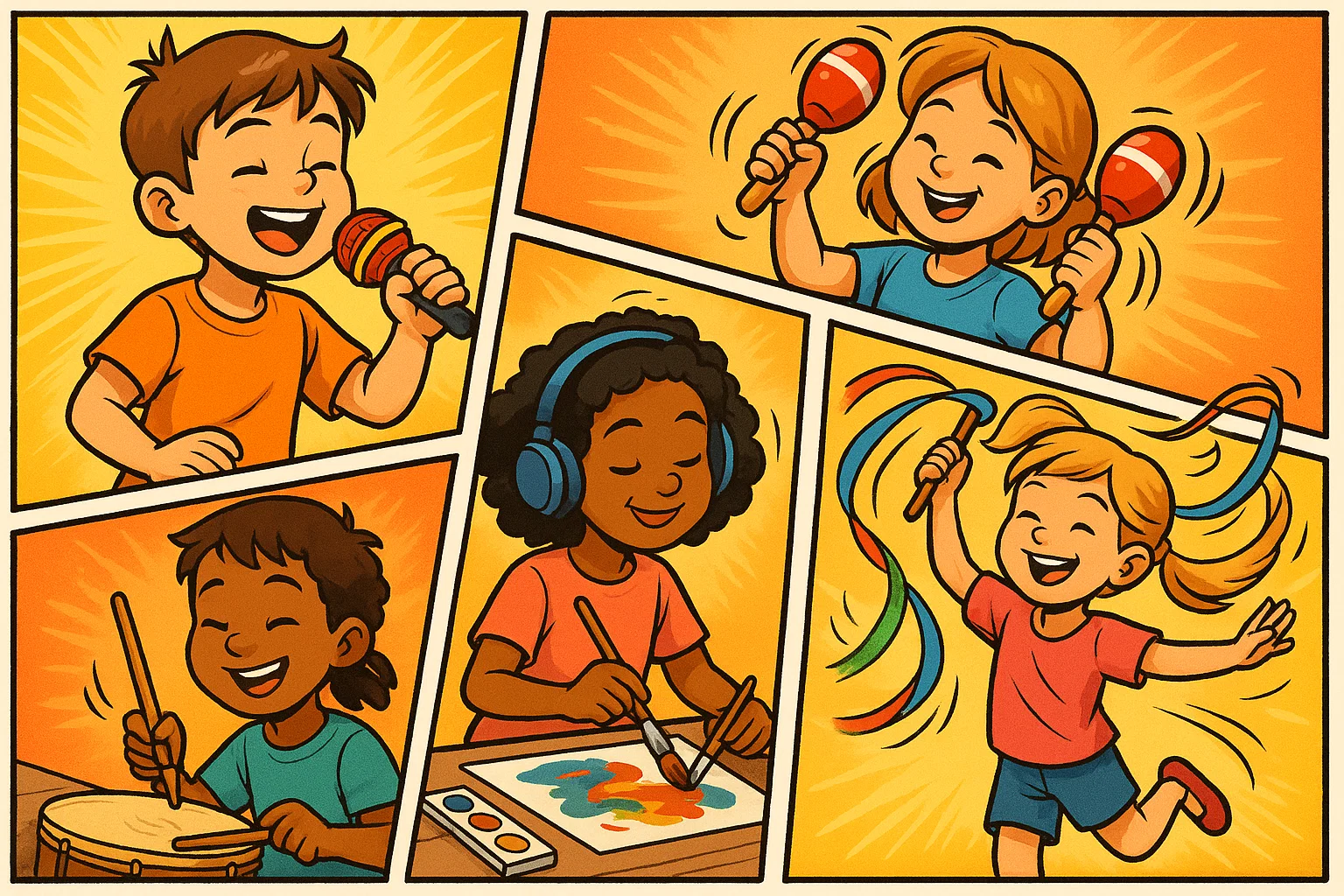
Music therapy activities for kids are structured, evidence-based applications of music within a therapeutic relationship to accomplish individualized developmental goals. These interventions differ from general music entertainment, such as watching children’s music videos or streaming nursery-rhyme playlists, which are usually passive and not tied to individualized therapeutic goals. While digital tools can support learning, clinical music therapy involves a trained professional who guides the child’s musical engagement toward individualized goals.
| Level | Type of Musical Engagement | Description |
| 1 | Passive Entertainment | Unrestricted digital content streaming, such as videos or playlists. |
| 2 | Music-Based Play | Interactive home singing and casual instrument exploration. |
| 3 | Educational Music | Structured classroom activities focused on musical skills, talent, or theory. |
| 4 | Clinical Music Therapy | Goal-driven, individualized intervention led by a credentialed professional. |
Music Therapy Activities Meaning
Within a clinical framework, music therapy interventions use specific attributes of sound—including rhythm, melody, tempo, and harmony—to address non-musical goals. A credentialed music therapist selects activities such as songwriting, instrument play, movement, or listening based on an initial assessment. The objective is to build a therapeutic relationship that supports cognitive, emotional, and physical development.
Music Therapy vs. Music Class
The main difference is the goal of the session. A traditional music class focuses on teaching technical musical skills, instrument proficiency, and music theory concepts. In contrast, a music therapy session uses musical activities as tools to support functional goals, such as social interaction, emotional regulation, communication, or motor skills.
Who Can Use Music-Based Activities
Clinical music therapy should be provided by qualified, credentialed professionals according to local licensing or certification standards. However, supplementary music-based approaches can be effective when integrated into multidisciplinary care.
Occupational therapists, speech-language pathologists, teachers, and caregivers can use structured music-based activities to reinforce learning. When a child has complex developmental disabilities, a significant trauma history, or co-occurring mental health needs, professional clinical planning is recommended.
33 Music Therapy Activities for Children
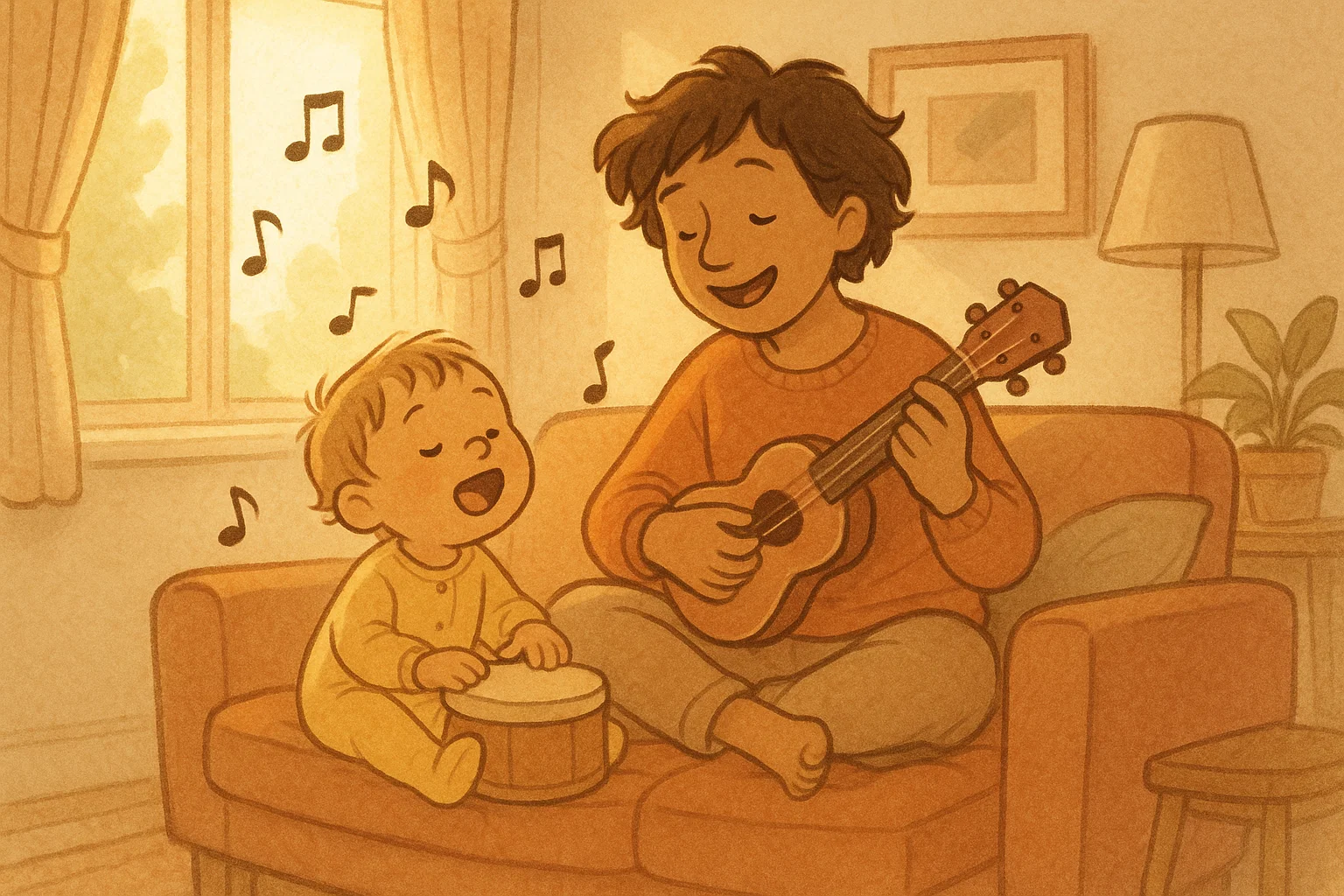
1. Hello Song Routine
Goal: Establish predictability, support transitions, and invite initial vocal or gestural responses.
Materials: Acoustic guitar, ukulele, or simple keyboard.
Steps:
- Sit in a circle facing the child at eye level.
- Sing a structured greeting song that includes the child’s name, such as “Hello [Name], how are you?”
- Pause at the end of the phrase to allow the child to respond through verbalization, a wave, or an AAC button press.
Variations: Incorporate visual aids such as name cards or photographs to prompt identification.
Adaptation/Safety: Keep the arrangement quiet and predictable to minimize transition anxiety.
2. Call-and-Response Drumming
Goal: Enhance sustained attention, auditory processing, imitation, and impulse control.
Materials: Two matching djembes or paddle drums.
Steps:
- Sit directly opposite the child with a drum between you.
- Play a simple, distinct two-beat rhythm pattern, such as tap-tap.
- Lift your hands to cue the child to mirror the pattern on their drum.
Variations: Increase complexity to four-beat patterns for older kids to stretch working memory.
Adaptation/Safety: Use soft mallets, padded beaters, or hands instead of hard mallets if the child is sensitive to loud sounds.
3. Emotion Song Cards
Goal: Promote emotion recognition, self-expression, and emotional literacy.
Materials: Laminated cards depicting happy, sad, angry, calm, and excited facial expressions.
Steps:
- Present two contrasting emotion cards to the child on a choice board.
- Ask the child to select one card to guide the theme of the musical improvisation.
- Sing or improvise a short melody that matches the chosen emotion, such as faster, sharper sounds for anger or slower, smoother phrases for sadness.
Variations: Invite the child to play an instrument using a performance style that matches the selected card.
Adaptation/Safety: Use clear, real-life photographs rather than abstract cartoons for kids with autism to support accurate recognition.
4. Freeze Dance With Feelings
Goal: Develop motor planning, vestibular regulation, and behavioral inhibition.
Materials: Audio speaker and a curated playlist with clear start-and-stop segments.
Steps:
- Invite the child to stand in an open, clear movement space.
- Play a song that represents a specific emotion and encourage the child to move around the space.
- Stop the music and ask the child to freeze in a pose that reflects that emotion.
Variations: Use a visual stop sign alongside the audio pause to provide dual sensory cues.
Adaptation/Safety: Ensure the floor space is entirely free of cords or loose mats to prevent falling injuries.
5. Instrument Choice Game
Goal: Build communication skills, independence, and intentional decision-making.
Materials: A choice board displaying two distinctly different instruments, such as a tambourine and a triangle.
Steps:
- Hold the two instruments within the child’s reach and at a comfortable visual level.
- Prompt the child verbally or visually: “Which instrument do you want to explore?”
- Hand over the chosen instrument as soon as the child makes a clear choice through eye gaze, pointing, vocalizing, or an AAC response.
Variations: Introduce three options for older kids to increase cognitive processing complexity.
Adaptation/Safety: For kids with limited fine motor skills, use adaptive instruments with easy-grip handles or straps.
6. Loud-Soft Sound Play
Goal: Improve volume awareness, auditory discrimination, and self-regulation.
Materials: Shaker eggs or hand drums.
Steps:
- Demonstrate a very soft, quiet shaking motion while whispering the word “quiet.”
- Then model a louder shaking motion while saying “loud” in a slightly stronger voice.
- Guide the child as they alternate between loud and soft playing based on your hand signals.
Variations: Use a visual volume slider graphic to connect acoustic dynamics to a concrete visual aid.
Adaptation/Safety: Keep the maximum volume predictable and comfortable to avoid startling kids with sound sensitivity.
7. Fast-Slow Movement Game
Goal: Develop tempo awareness, gross motor planning, and motor inhibition.
Materials: Lightweight colored organza scarves.
Steps:
- Give one organza scarf to the child and keep one for modeling.
- Play a rapid, high-tempo track and wave the scarf quickly through the air.
- Switch the music to a slow tempo and model slow, sweeping movements.
Variations: Apply this tempo modification directly to walking or marching across a room.
Adaptation/Safety: Watch for signs of dizziness or discomfort during fast movement.
8. Song Fill-In Blanks
Goal: Target expressive speech and language production.
Materials: Familiar, highly predictable children’s songs, such as “Old MacDonald Had a Farm.”
Steps:
- Sing the familiar lyric structure clearly: “And on that farm he had a…”
- Stop singing and look expectantly at the child.
- Wait up to five seconds for the child to insert the missing keyword through speech, sign language, or an AAC device.
Variations: Use physical animal toys as concrete visual cues to assist word retrieval.
Adaptation/Safety: Give the child ample processing time; avoid rushing to supply the missing word too quickly.
9. Name Rhythm Chant
Goal: Reinforce phonological awareness, personal identity, and syllable awareness.
Materials: Clapping hands or a flat paddle drum.
Steps:
- Say the child’s name clearly while breaking it down into distinct syllables, such as “E-li-jah.”
- Clap your hands or strike the drum to match the rhythmic syllable structure.
- Encourage the child to repeat their own name rhythm using their hands or a drum.
Variations: Expand the activity across a small group, chanting each peer’s name in sequence.
Adaptation/Safety: Hand-over-hand assistance may be used gently if the child consents and requires physical guidance.
10. Turn-Taking Drum Circle
Goal: Promote prosocial waiting, peer imitation, and interactive social skills.
Materials: A centralized gathering drum or individual hand drums for a small group.
Steps:
- Arrange participants in a circle.
- Sing a structured turn-taking prompt: “Now it is [Name]’s turn to play the drum.”
- Encourage all other participants to keep their hands still while the designated child plays their solo rhythm.
Variations: Allow the child whose turn it is to choose the next peer, encouraging peer-to-peer interaction.
Adaptation/Safety: Provide a visual token or passing stick to make the concept of turn ownership concrete.
11. Calming Playlist Breathing
Goal: Support relaxation and emotional regulation.
Materials: Audio player and a prepared playlist with slow, predictable music, ideally around 60–80 BPM.
Steps:
- Dim the lights and invite the child to sit or recline comfortably on a mat.
- Play slow, predictable instrumental music.
- Model deep diaphragmatic breathing, synchronized with the slow rise and fall of the musical phrases.
Variations: Place a small stuffed animal on the child’s abdomen to provide a visual aid for breathing depth.
Adaptation/Safety: Avoid music tracks that contain sudden dynamic shifts or unexpected percussion accents.
12. Story Song With Props
Goal: Enhance auditory sequencing, narrative comprehension, and sustained attention.
Materials: A children’s storybook paired with matching hand puppets or animal figures.
Steps:
- Sing the story instead of reading it in a regular speaking voice.
- Hand the matching puppet to the child when that character appears in the song.
- Prompt the child to manipulate the puppet to match the actions described in the sung text.
Variations: Encourage older kids to generate new lyric lines to change the plot direction.
Adaptation/Safety: Ensure all physical props are cleaned thoroughly between sessions to meet infection control standards.
13. Musical Stop-and-Go
Goal: Train executive functioning, auditory attention, and motor control.
Materials: An instrument capable of sustained chords, such as a keyboard or guitar.
Steps:
- Set a clear rule: “When the music plays, you walk. When the music stops, you sit.”
- Play a steady, rhythmic accompaniment pattern while the child moves around the room.
- Stop playing clearly and immediately, then observe how quickly the child transitions to sitting.
Variations: Introduce varied instructions, such as jumping for high pitches and crawling for low pitches.
Adaptation/Safety: Maintain a spacious environment clear of physical hazards.
14. Mirror Movement With Music
Goal: Foster social engagement, movement imitation, and shared body awareness.
Materials: Mid-tempo instrumental background music.
Steps:
- Stand directly in front of the child and maintain comfortable shared attention.
- Initiate slow, rhythmic upper-body movements, such as swaying arms, to the beat of the music.
- Prompt the child to mirror your movements.
Variations: Swap roles to let the child lead the physical movements while you mirror them.
Adaptation/Safety: Match your movement boundaries to the child’s existing physical range of motion.
15. Feelings Drum
Goal: Provide a safe outlet for emotional expression and the release of internal tension.
Materials: A large, durable floor tom drum with soft mallets.
Steps:
- Prompt the child: “Show me what an angry volcano sounds like on the drum.”
- Allow the child to play the drum firmly, within safe limits, to express intense emotions safely.
- Guide the child to gradually reduce the intensity until the drumming becomes a gentle, soft pattern.
Variations: Use a visual emotion chart to help the child connect their sonic expression back to a specific feeling.
Adaptation/Safety: Provide noise-dampening headphones if high-intensity sound causes sensory discomfort.
16. Songwriting With Child Choices
Goal: Support self-expression, cognitive organization, and individual autonomy.
Materials: A whiteboard with a pre-written lyric frame and missing words.
Steps:
- Present a familiar melody structure, such as “Twinkle, Twinkle.”
- Ask the child to supply custom nouns or adjectives to fill the blanks, such as “Twinkle, twinkle, little [animal].”
- Sing the newly co-created song version back to the child to validate their creative input.
Variations: Invite older children to write original lyrics about their daily routines.
Adaptation/Safety: Provide clear icon choices on a board for nonverbal children to support equal participation.
17. Musical Conversation
Goal: Build nonverbal turn-taking patterns and conversational timing.
Materials: Two matching pitched instruments, such as xylophones or tone bars.
Steps:
- Sit opposite the child with the instruments positioned between you.
- Play a brief musical phrase on your instrument to simulate a question.
- Pause completely and look expectantly at the child, waiting for them to play a musical response.
Variations: Reflect the child’s emotional tone musically to communicate empathy without words.
Adaptation/Safety: Secure the instruments firmly to prevent them from sliding or falling during active play.
18. Movement Path With Music
Goal: Improve gross motor skills, balance, and spatial awareness.
Materials: Foam balance cushions, textured floor markers, and painter’s tape.
Steps:
- Lay out a winding path across the room using the physical markers.
- Play an upbeat marching tempo to encourage the child to navigate the course.
- Switch to smoother music to prompt balancing or tiptoeing along the path.
Variations: Integrate specific instrument stations along the course for the child to play before moving on.
Adaptation/Safety: Stand within arm’s reach of the child at all times to provide physical support on balance points.
19. Shaker Direction Game
Goal: Reinforce receptive language concepts and spatial vocabulary.
Materials: Maracas or egg shakers.
Steps:
- Give the child an egg shaker while holding one yourself.
- Sing simple spatial directions to a melody: “Shake your shaker up high, shake your shaker down low.”
- Model the physical positions accurately, prompting the child to match both the auditory directive and the visual model.
Variations: Introduce more advanced spatial concepts, such as “behind your back” or “around your knees,” for older children.
Adaptation/Safety: Inspect shakers regularly to ensure the internal beads are completely contained and secure.
20. Relaxation Soundscape
Goal: Provide sensory calming and ease challenging routine transitions.
Materials: Gentle acoustic instruments such as a rain stick, wind chimes, or an ocean drum.
Steps:
- Have the child sit or recline in a comfortable space at the end of an active session.
- Tilt the rain stick or ocean drum slowly to create a continuous, nature-like sound.
- Encourage the child to listen quietly and focus on the soundscape.
Variations: Combine the acoustic sounds with a soft visual light projector on the ceiling.
Adaptation/Safety: Watch for tactile discomfort if the child reaches out to touch the textured surface of the instruments.
21. Body Percussion Pattern
Goal: Develop bilateral coordination, rhythm processing, and motor sequencing.
Materials: None required; the activity uses body percussion.
Steps:
- Sit facing the child and establish a steady, slow beat.
- Perform a simple two-step physical pattern: pat thighs, then clap hands.
- Encourage the child to copy the physical sequence in synchronization with the steady rhythm.
Variations: Add foot stomps or chest pats to create more complex sequences for older children.
Adaptation/Safety: Modify the movements to gentle taps for children who exhibit tactile hypersensitivity or tend to strike themselves too hard.
22. Animal Movement Songs
Goal: Expand gross motor skills, imaginative play, and descriptive vocabulary.
Materials: Upbeat keyboard or guitar accompaniment.
Steps:
- Sing a customized descriptive lyric line: “This is the way the heavy elephant walks.”
- Play heavy, slow, low-register chords to match the elephant’s weight.
- Model the animal’s physical gait, encouraging the child to adapt their body mechanics to the musical cues.
Variations: Transition to high-register staccato notes to represent a jumping rabbit.
Adaptation/Safety: Clear enough space for safe movement and remove any furniture that could create a hazard.
23. Color Song Sorting
Goal: Reinforce cognitive categorization, color identification, and choice-making.
Materials: Colored sorting buckets with matching handbells or rhythm sticks.
Steps:
- Place blue and red buckets on the floor in front of the child.
- Sing a structured color song: “If you have a red bell, put it in the red bucket.”
- Guide the child to identify the correct item and drop it into the matching color bucket.
Variations: Increase the number of colors to expand the cognitive challenge.
Adaptation/Safety: Ensure the sorting buckets are placed at an accessible height to support comfortable physical reaching.
24. Goodbye Song Routine
Goal: Provide emotional closure, signal routine termination, and ease transition anxiety.
Materials: Guitar, ukulele, or keyboard.
Steps:
- Use the same closing song at the end of each session.
- Sing clear lyric lines that review the day’s achievements: “Music time is finished, we played the drums today.”
- Offer a clear verbal and musical ending, such as finishing on the home note or tonic chord.
Variations: Incorporate a predictable wave or high-five physical routine into the final phrase of the song.
Adaptation/Safety: Keep the performance calm and soothing to help the child transition smoothly to their next daily routine.
25. Instrument Guessing Game
Goal: Sharpen auditory discrimination, selective attention, and working memory.
Materials: A small tabletop screen or barrier, plus three distinct sound-producing instruments.
Steps:
- Demonstrate each instrument’s sound while the child can see it.
- Place the barrier between you and the child to obscure their view.
- Play one instrument behind the barrier, then remove the screen and ask the child to point to the instrument they heard.
Variations: Increase the number of hidden instruments to test more advanced auditory discrimination skills.
Adaptation/Safety: Avoid using instruments with sharp, piercing, or overly high-frequency acoustic properties.
26. Musical Feelings Journal
Goal: Foster emotional reflection, self-awareness, and emotional regulation.
Materials: Paper notebook, colored pencils, and a media player with headphones.
Steps:
- Play an instrumental track with a clear mood, such as calm, playful, sad, or energetic.
- Ask the older child to listen quietly to the music for three minutes.
- Prompt the child to draw or write freely in their journal to express the thoughts and feelings evoked by the music.
Variations: Use pre-printed emotion words or writing prompts to help guide children who experience writer’s block.
Adaptation/Safety: Respect the child’s privacy; allow them to choose whether or not to share their journal entries.
27. Parent-Child Echo Song
Goal: Strengthen parent-child bonding, vocal play, and shared attention.
Materials: None required, or simple matching shakers.
Steps:
- The parent sings a short, simple vocal phrase, such as “La-ba-da,” using an accessible pitch range.
- The parent gestures to the child to invite them to echo the vocal phrase.
- Celebrate the child’s response with a warm smile and positive verbal reinforcement to encourage further connection.
Variations: Transition the activity from vocal sounds to short rhythm patterns using household objects.
Adaptation/Safety: Keep the environment quiet and free from background distractions to help the child focus on the parent’s voice.
28. Choice-Based Playlist
Goal: Promote emotional autonomy, self-regulation planning, and personal agency.
Materials: A tablet or media device with a visual menu of the child’s favorite songs.
Steps:
- Present the visual song menu to the child during a designated relaxation or break time.
- Allow the child to select the track they feel they need to regulate their current emotional state.
- Play the chosen track while providing a comfortable space for the child to rest or listen.
Variations: Help the child categorize their songs into distinct energizing and calming playlists.
Adaptation/Safety: Apply volume-limiting features within the device settings to keep the output at a safe level.
29. Rhythm Walk
Goal: Improve motor timing, coordinated walking, and physical coordination.
Materials: A steady drumbeat or marching track with a clear beat.
Steps:
- Start playing a steady beat at a comfortable walking pace, around 90 BPM.
- Model marching in place, synchronizing each footstep with the beat.
- Encourage the child to step in time with the music, adjusting their pace as they follow you around the room.
Variations: Alter the rhythm style to a light tiptoe or a heavy stomp to practice different motor adjustments.
Adaptation/Safety: Ensure the walking path is completely clear of obstacles to maintain safety during movement.
30. Musical Problem-Solving Game
Goal: Enhance cognitive flexibility, cause-and-effect reasoning, and critical thinking.
Materials: Live instrumental accompaniment and interactive props, such as a toy bridge.
Steps:
- Sing a simple narrative song that presents a clear problem: “The train is moving down the track, but the bridge is broken.”
- Pause the song and ask the child directly: “What should we do next to fix the track?”
- Wait for the child to solve the problem using the props or by suggesting what should happen next before resuming the song.
Variations: Introduce more complex social or logistical dilemmas within the song plot for older children.
Adaptation/Safety: Use durable, child-safe toys and props that can withstand active handling.
31. Sensory Bin Sound Hunt
Goal: Develop tactile exploration, auditory localization, and fine motor grasp.
Materials: A plastic bin filled with dry rice or beans, containing hidden large, sealed sound-making objects.
Steps:
- Hide several large, sealed sound-making objects beneath the sensory-bin filler.
- Shake the bin gently or reach in to create a hidden sound, prompting the child to search through the material.
- Encourage the child to dig through the bin, find the object, and shake it openly once discovered.
Variations: Have the child sort the instruments by sound, such as loud, soft, high, or low.
Adaptation/Safety: Supervise closely, and avoid rice, beans, or small objects for children who may put materials in their mouth.
| Sensory Element | Material Specifications | Safety / Cleaning Metric |
| Tactile Filler | Dry uncooked long-grain rice or garbanzo beans | Inspect daily; replace completely if exposed to moisture. |
| Hidden Objects | Large sealed bells, shakers, or sensory-safe sound objects that are too large to swallow | Clean and disinfect according to the manufacturer’s instructions after each session. |
32. Group Compliment Song
Goal: Build social-emotional literacy, peer empathy, and a sense of group belonging.
Materials: Acoustic guitar or keyboard accompaniment.
Steps:
- Gather a small group of children in a seated circle.
- Sing a structured compliment frame: “I like how [Name] is sharing today.”
- Encourage the other children to clap or play softly to support their peer.
Variations: Allow each child to take a turn passing a musical token and offering a compliment to a peer.
Adaptation/Safety: Ensure every child in the group receives equal recognition to support positive self-esteem.
33. Cool-Down Listening Time
Goal: Assist sensory regulation and ease the transition back to standard daily routines.
Materials: Soft, slow instrumental music paired with comfortable mats.
Steps:
- Transition away from active instrument play by putting the instruments into a storage bin.
- Play a gentle, ambient instrumental track at a low volume, around 55 dB.
- Have the child lie still on a mat, guiding them through gentle stretches or quiet drawing to wind down.
Variations: Guide older children through a progressive muscle relaxation sequence synchronized with the music.
Adaptation/Safety: Keep the room dim and minimize outside noise to create a peaceful environment for cooling down.
Music Therapy Session Structure for Children
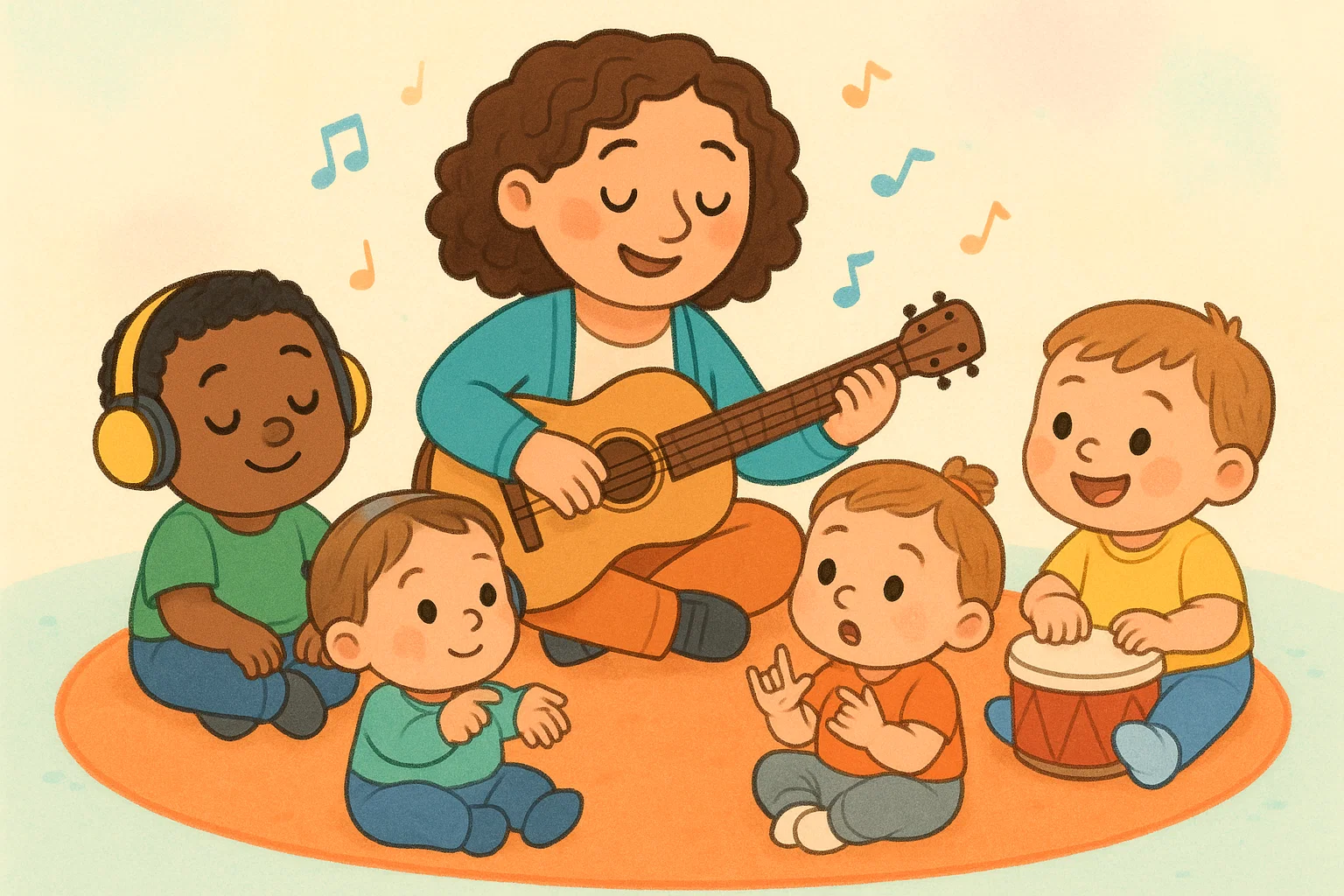
A structured music therapy session provides predictability, which reduces anxiety and helps children focus on their developmental goals. Every session follows a reliable four-part sequence designed to optimize engagement and support learning.
Start Session Right
The opening phase establishes a clear routine and sets expectations through predictable elements.
- Greeting Song: Use a consistent hello song to signal that music therapy has officially begun.
- Visual Schedule Review: Present a visual choice board or schedule that outlines the planned activities.
- Initial Choice: Allow the child to make an easy, successful choice right away—such as picking their seating spot or an opening instrument—to build confidence from the start.
Warm-Up Activity
The warm-up bridges the transition from initial greeting to goal-focused work. This phase uses simple rhythm play, vocal imitation, or basic movement to engage the child’s sensory and motor systems without placing heavy cognitive demands on them.
Main Intervention
The core of the session focuses on one or two specific activities tailored to the child’s therapeutic goals. Whether working on communication, emotional regulation, motor skills, or social interaction, the therapist carefully selects and adjusts musical elements in real time to support the child at an appropriate level and encourage meaningful progress.
Wrap-Up Routine
The final phase helps the child wind down and prepares them to transition back to their regular daily routine. This step includes a predictable closing song, a quick review of the choices made during the session, and a calming activity to leave the child in a balanced, regulated state.
Individual Music Therapy Sessions
Individual music therapy sessions offer a personalized setting for children who need targeted developmental support, experience sensory overload in groups, or benefit from highly customized interventions.
| Stage | Individual Session Design Cycle |
| 1 | Clinical Assessment: Evaluate communication, motor, and sensory profiles. |
| 2 | Goal Customization: Set measurable targets, such as increasing intelligible words, improving turn-taking, or extending attention during a task. |
| 3 | Child-Led Adaptations: Select preferred instruments and modify pacing live. |
| 4 | Progress Metrics: Document response time, engagement duration, communication attempts, and participation. |
Personalized Goals
In a one-on-one setting, a credentialed music therapist creates specific, measurable objectives based on the child’s unique needs. For example, a goal might focus on increasing a child’s attention span from three minutes to seven minutes using structured drumming patterns, or expanding expressive language by targeting specific consonant sounds during songwriting.
Child-Led Music Choices
Individual sessions allow for a high degree of flexibility. The therapist follows the child’s lead, incorporating their favorite songs, preferred instruments, and natural energy level. This responsiveness helps maintain motivation and keeps the child actively engaged throughout the session.
Progress Tracking
Therapists keep detailed clinical notes to monitor progress over time. These records track specific behaviors, such as independent communication attempts, engagement duration, shared attention, or improvements in coordination during motor activities. This ongoing data collection helps the therapist adjust interventions as the child grows and changes.
Tools for Music Therapy Activities
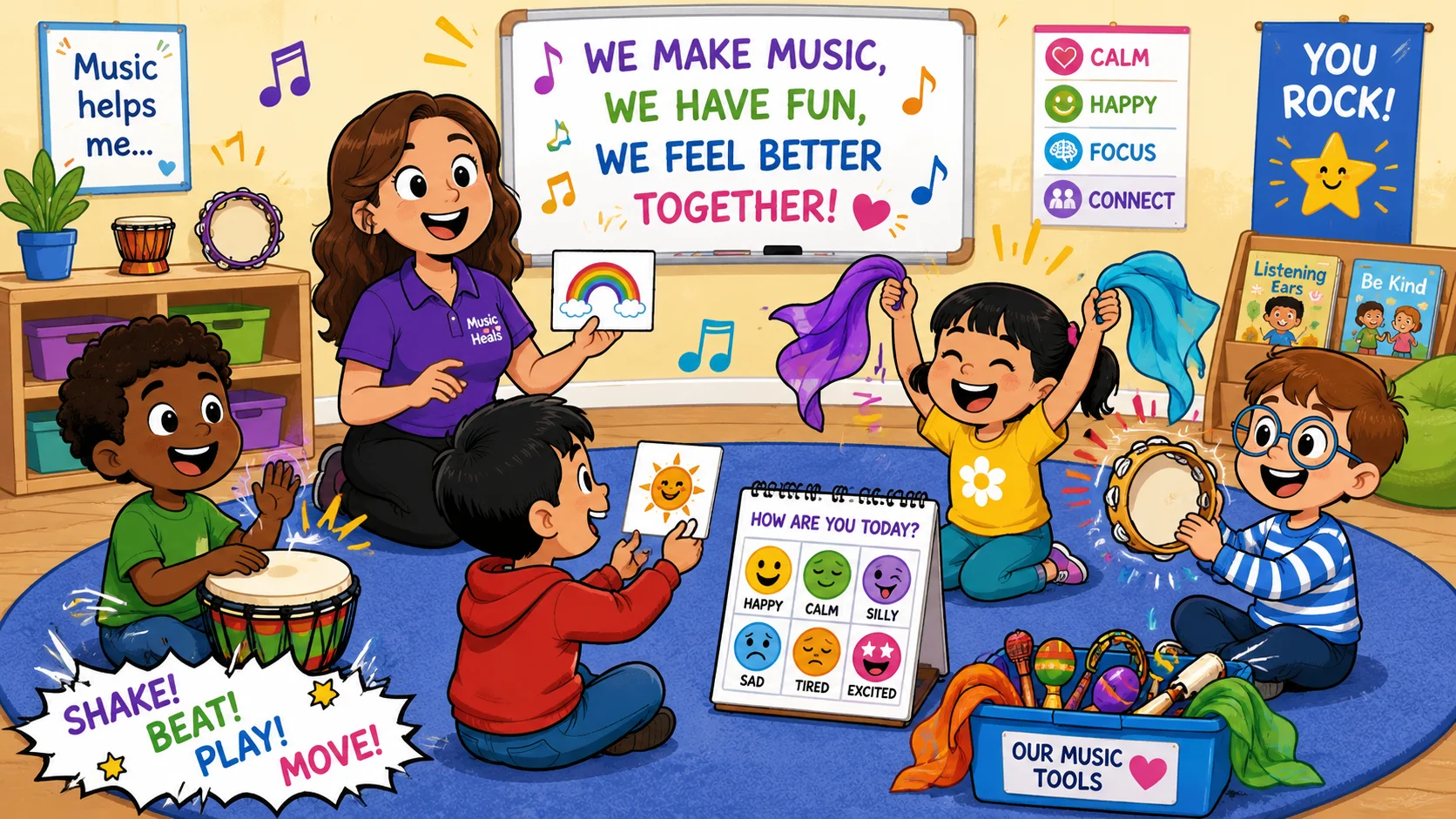
Successful music-based interventions depend on selecting an appropriate combination of instruments, props, digital tools, and visual aids.
| Category | Examples |
| Instruments | Gathering drums, egg shakers, handbells, tone bars |
| Physical Props | Organza scarves, hand puppets, balance pods, emotion cards |
| Digital Tools | Decibel meters, loop recorders, Bluetooth speakers, visual timers |
Musical Instruments
Instruments should be durable, accessible, and selected to match the child’s physical abilities. Frame drums, tambourines, and egg shakers are useful for basic rhythm work and grip development. Pitched instruments, such as colorful handbells or xylophones, provide clear auditory feedback and can support sorting and sequencing tasks.
Props
Physical props help bridge the gap between auditory concepts and visual or physical experiences. Lightweight organza scarves and ribbons make tracking musical tempo easy and engaging. Puppets, balls, and floor markers add a playful, concrete element to storytelling and movement games, helping kids stay focused and organized in space.
Technology and Audio Tools
Technology can make music-based activities more flexible and easier to individualize. High-quality speakers can provide clear sound, while tablet apps can offer accessible visual choice boards. Specialized tools, such as digital decibel meters and visual countdown timers, can help adults monitor volume and support smoother transitions between activities.
Visual and Written Aids
Visual aids provide essential structure, especially for kids with communication challenges. Visual schedules, lyric sheets with pictures, and emotion charts help kids understand expectations and express choices independently. Simple progress notes allow therapists and caregivers to collaborate effectively and maintain consistency across settings.
How Effective Are Music-Based Interventions for Children?
Peer-reviewed research suggests that structured music interventions can support areas of child development, although results vary by population, goal, and intervention type. Pediatric research has explored how music-based approaches may support development, but claims about neuroplasticity should be tied to specific studies and stated cautiously.
What Research Often Measures in Music-Based Interventions
Clinical studies often look at clear, observable outcomes across several key areas:
- Communication: Tracking increases in vocabulary size, sound production, and the functional use of communication tools.
- Social Engagement: Measuring improvements in shared attention, peer imitation, and turn-taking skills.
- Behavior and Mood: Documenting changes in challenging behaviors, mood, and emotional regulation.
- Motor Coordination: Assessing advances in fine motor control, balance, and physical timing.
Why Results Vary
The impact of music interventions can vary based on several interacting factors:
- Individual Profiles: Each child’s developmental profile, sensory preferences, and musical preferences influence how they respond to music.
- Professional Guidance: Interventions designed and led by credentialed music therapists tend to yield more targeted, consistent progress.
- Consistency and Support: Regular sessions and supportive practice at home may improve carryover into daily routines.
When Professional Music Therapy Helps
While everyday musical play can be valuable for enrichment, formal clinical music therapy may be appropriate for kids with complex needs. Credentialed professionals are trained to conduct detailed assessments, manage severe sensory sensitivities, and design targeted interventions for kids with significant developmental disabilities, trauma histories, or mental health challenges.
Common Mistakes With Music Therapy Activities
Avoiding common pitfalls helps keep music activities safe, supportive, and goal-oriented.
Using Music Too Loud
The Risk: Excessive volume can cause sensory overload, physical discomfort, and increased anxiety, particularly in autistic kids or those with sound sensitivities.
The Correction: Use a decibel meter to keep sound levels comfortable, choose instruments with soft acoustic qualities, and offer noise-dampening headphones if needed.
Choosing Songs a Child Dislikes
The Risk: Forcing a child to listen or sing along to music they dislike can reduce motivation and lead to frustration or withdrawal from the activity.
The Correction: Honor the child’s preferences, offer clear choices using visual boards, and secure their engagement before beginning an activity.
Skipping a Clear Goal
The Risk: Playing music without a clear objective can be enjoyable, but it may miss opportunities to support specific developmental goals.
The Correction: Identify a clear focus for every activity—such as targeting fine motor skills or practicing turn-taking—and choose musical elements that directly support that goal.
Ignoring Transition Needs
The Risk: Stopping a favorite musical activity abruptly can cause distress and make transitions to the next routine difficult.
The Correction: Use consistent visual schedules, give clear countdown cues, and use predictable closing routines like a goodbye song to ease transitions.
Frequently Asked Questions
What Are the Best Music Therapy Activities for Children?
The most effective activities include predictable greeting routines, call-and-response drumming, freeze games linked to emotions, simple songwriting, and gentle, calming playlists. The best choices are always tailored to the child’s unique goals and sensory needs.
Can Parents Do Music Therapy Activities at Home?
Parents can use structured music-based activities at home to reinforce learning and encourage bonding. However, formal clinical music therapy should be designed and supervised by a credentialed music therapy professional.
What Instruments Work Best for Children?
Durable percussion instruments such as egg shakers, frame drums, triangles, and tambourines are often good choices for beginners. Colorful handbells and xylophones are useful for introducing melody and cognitive sorting tasks safely.
How Long Should a Child’s Music Activity Last?
Individual activities typically run between 5 and 20 minutes. The overall length should be matched to the child’s age, attention span, and sensory tolerance to reduce the risk of fatigue or overstimulation.
Are Music Therapy Activities Helpful for Autism or ADHD?
Structured music activities may help some children with autism or ADHD improve focus, communication, social interaction, and emotional regulation, especially when activities are individualized and appropriately supervised.
What Music Helps Children Calm Down?
Instrumental tracks with a slow, steady tempo, soft volumes, and predictable rhythms are often useful for relaxation. Avoid songs with sudden changes in volume, complex textures, or sharp percussion accents.
Can Music Therapy Help Children Explore Music Without Musical Talent?
Yes. Music therapy can help children explore music through listening to music, playing instruments, moving to music, and creating simple sounds without needing formal musical talent. In clinical settings or activities adapted for use at home, the focus is not performance, but engagement, expression, and goals and objectives linked to the child’s communication, motor, emotional, or social needs.

Take a short quiz to find out what your everyday choices say about your parenting style
When your child is curious about something new, what’s your instinct?
Take a short quiz to find out what your everyday choices say about your parenting style
“Can I download this app?” What happens next?
Take a short quiz to find out what your everyday choices say about your parenting style
When it comes to rules at home, which sounds most like you?
Take a short quiz to find out what your everyday choices say about your parenting style
If you could give your child one life skill today, what would you pick?
Take a short quiz to find out what your everyday choices say about your parenting style
Your child gets to choose what to watch. What would your ideal setup look like?
Take a short quiz to find out what your everyday choices say about your parenting style
Pick your parenting superpower ✨