35 Learning Shapes Games and Activities for Preschoolers

 Discover a Free Education Video App for Kids
Pastory uses AI to personalize educational video content based on your child’s interests and personality. Safe, engaging, and built for curious young minds. Sign up now to stay updated and enjoy early access with a free trial
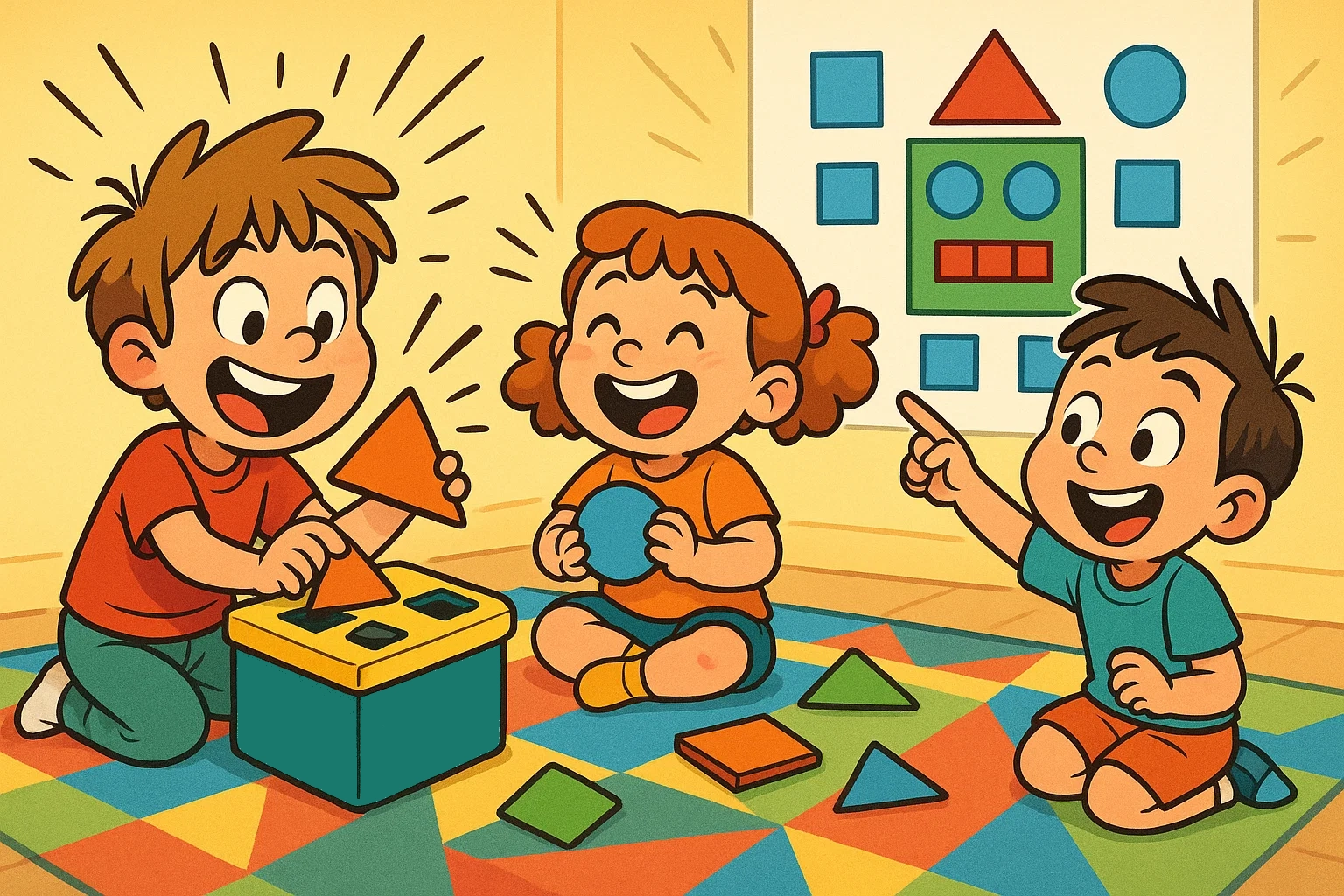
Learning shapes games for kids turn early geometry into hands-on discovery rather than rote memorization. This collection brings together 35 shape activities for preschoolers and kindergarteners, spanning indoor games, outdoor hunts, sensory bins, art projects, movement games, shape snacks, and screen-time options. Each activity is designed to build shape recognition, spatial awareness, and early math language using materials most families already have at home.
Whether you need a full classroom unit or a short weekly home routine, this guide offers flexible ideas that fit different schedules and skill levels. Children absorb shapes fastest when adults point them out naturally, and every activity here is built around that kind of relaxed, curiosity-driven learning.
Key Takeaways
- This guide covers 35 shape activities for preschoolers and kindergarteners, from sensory bins to STEM builds.
- Activities are organized across 12 categories including movement games, food games, fine motor practice, arts and crafts, and digital shape games.
- Shape learning builds visual discrimination, spatial reasoning, early math language, and problem-solving confidence.
- Most activities use everyday materials and work equally well at home or in a classroom.
- A tips section helps parents and educators adapt activities to different ages, skill levels, and learning styles.
Best Age Range for Shape Activities
Every child develops at their own pace, but early geometry usually grows through repeated exposure and playful practice.
Toddlers ages 1–3 can begin with basic shapes such as circles and squares through matching toys, simple puzzles, and simple toddler activities such as placing circle blocks into matching holes. Preschoolers ages 3–5 benefit from preschool shape activities that involve sorting, matching, tracing, building, and naming. Kindergarteners ages 5–6 are often ready to explore 3D shapes and use words such as side, corner, face, edge, and vertex.
For preschool and kindergarten, keep each lesson on shapes brief and active. Children do not need long explanations; they need many examples to see, touch, compare, and use during play.
Best Game Types
To make learning shapes engaging, vary the activities and games you offer:
- Sorting & Matching: Use shape mats, bins, cards, puzzles, or loose parts for matching shape tasks.
- Movement Games: Try hunts, obstacle courses, floor cards, and whole-body challenges.
- Sensory & Art: Use play dough, sand, paint, yarn, or paper shapes children cut out for creative practice.
- STEM & Building: Use blocks, sticks, straws, and 3D shapes to solve simple building problems.
- Daily Routines: Find shapes during snack time, storytime, cleanup, walks, and pretend play.
Skills Kids Practice
Hands-on activities build a strong foundation for learning. Children develop motor skills by tracing, cutting, sticking, threading, and building. They practice spatial reasoning when they rotate objects, fit pieces together, and explore how forms change or stay the same when turned.
These activities also reinforce shape recognition, classification, early math vocabulary, and visual problem-solving. When children learn the names of shapes and compare their features, they are also preparing for later reading, writing, math, and science.
Basic Introduction to Shapes
Before introducing formal worksheets, children should learn shapes through play. Young learners need to see, name, touch, build, compare, and use geometric forms in everyday objects. A child who stacks blocks, sorts buttons, traces outlines in sand, and looks for shapes in everyday life is already practicing early geometry.
Learning shapes is a fun way to help children notice patterns and details. Instead of saying only “This is a triangle,” ask, “How do you know it is a triangle?” This encourages children to identify shapes by sides, corners, curves, and other features.
2D Shapes for Preschoolers
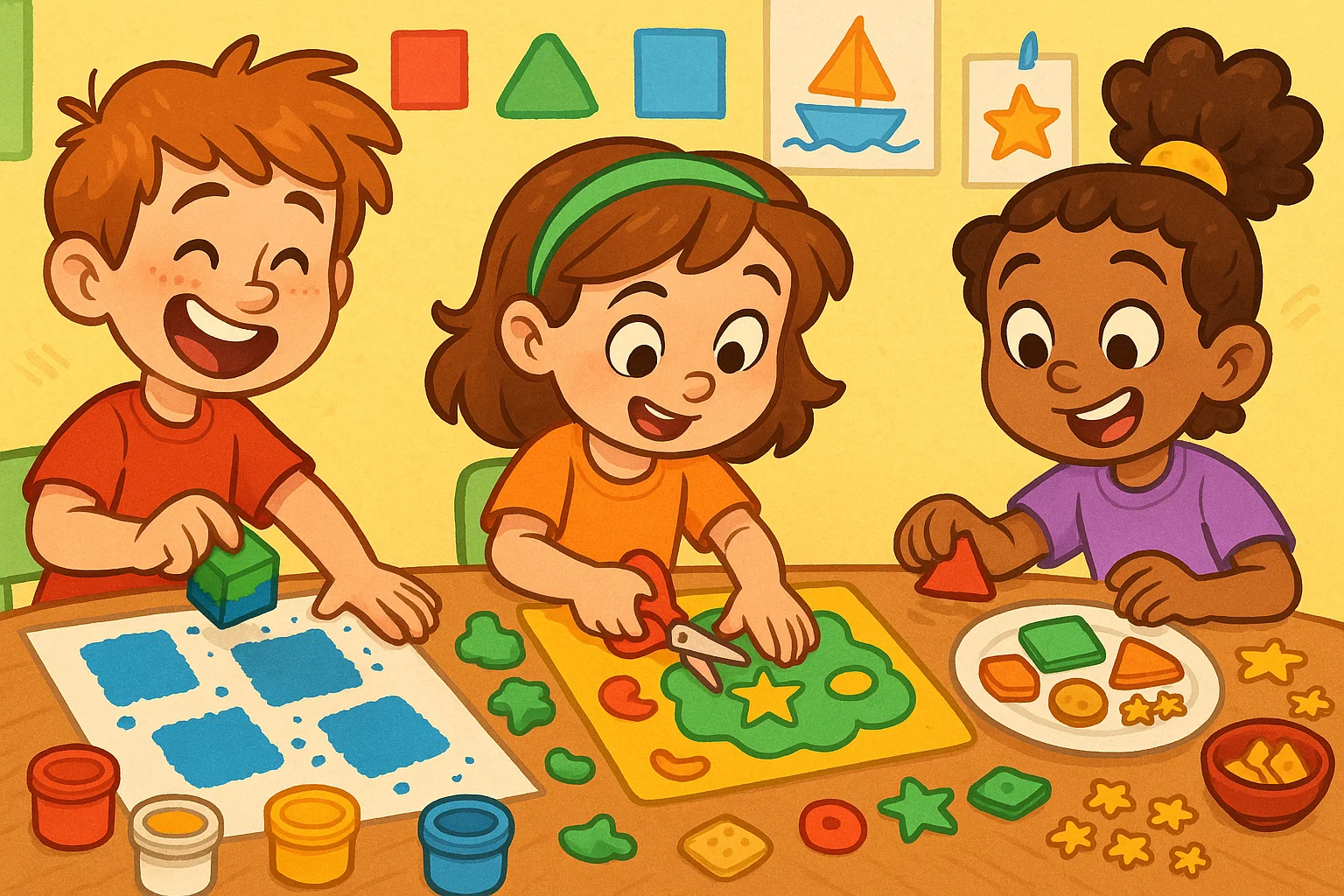
A preschool curriculum usually begins with 2D shapes that children can easily find in their environment. These basic preschool shapes are the most useful starting point:
- Circle: Found in clocks, plates, buttons, and cookies; has one continuous curved boundary and no corners.
- Square: Found in blocks, crackers, tiles, and windows; has four equal sides and four corners.
- Triangle: Found in pizza slices, rooftops, flags, and signs; has three sides and three corners.
- Rectangle: Found in doors, books, phones, and tables; has four straight sides and four corners.
- Oval: Found in eggs, mirrors, leaves, and some stones; looks like a stretched-out circle.
- Diamond/Rhombus: Often seen in kites and patterns; a rhombus has four equal sides, while “diamond” is often used as a classroom term.
- Star & Heart: Common decorative figures that help reinforce shape recognition through art.
- Pentagon & Hexagon: Multi-sided figures with five and six sides, often seen in signs, honeycombs, and soccer-ball patterns.
3D Shapes for Kindergarten
As children move into kindergarten, they begin to explore how forms can be flat or solid. These 3D shapes are useful for early classroom practice:
- Sphere: A ball or globe; round in all directions.
- Cube: A die or building block; has six equal square faces.
- Cone: A party hat or ice cream cone; has a circular base that tapers to a point.
- Cylinder: A soup can, marker, or paper towel roll; has two circular ends and one curved side.
- Pyramid: A toy pyramid or Egyptian pyramid; many classroom examples have a square base and triangular faces.
- Rectangular Prism: A cereal box or brick; usually shown as a box-like solid with six rectangular faces.
Geometry Vocabulary for Kids
To teach shapes naturally, introduce vocabulary during play. Use words like side, corner, vertex, face, edge, straight, curved, flat, solid, same, different, bigger, smaller, longer, and shorter.
Help children learn the names of shapes without overwhelming them. For young learners, the most important step is repeated, meaningful language: “This cracker is a square,” “This ball is like a sphere,” or “This sign has three sides.”
Shape Concepts for Preschoolers
For preschoolers to build early geometry confidence, focus on these core skills:
- Naming: Saying the correct names of the shapes.
- Matching: Finding an identical figure among several choices.
- Sorting: Grouping objects by one feature, such as all circles or all pieces with three corners.
- Composing: Using several shapes to create a new picture, such as a house made from a square and a triangle.
- Comparing: Talking about how objects are the same and different.
- Recognizing orientation: Understanding that a triangle is still a triangle even when it is upside down.
35 Hands-On Shape Activities for Preschoolers
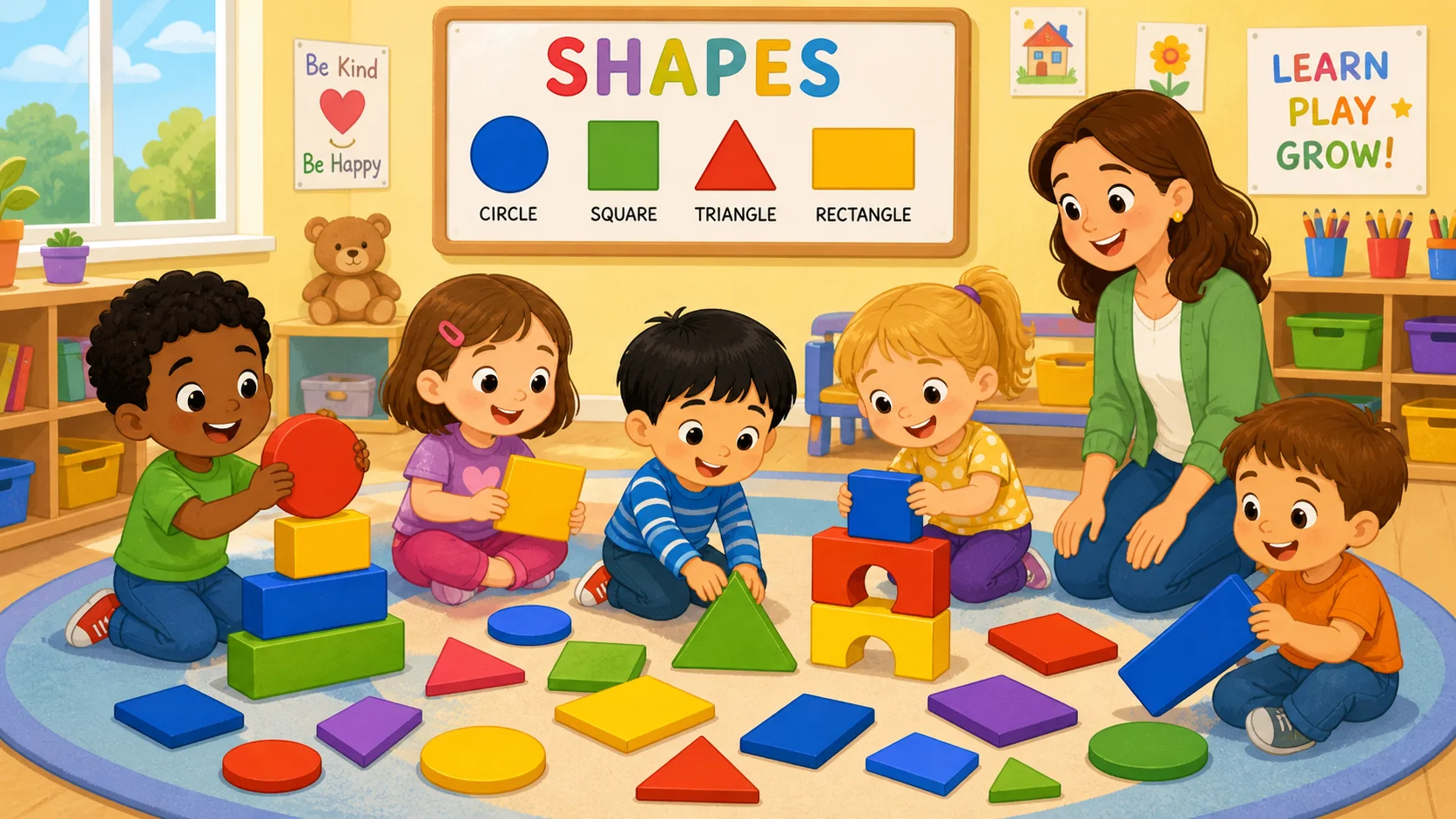
These hands-on activities are designed for home, preschool classroom use, and kindergarten centers. Many require little preparation, and most can be adapted for toddlers or older children.
1. Go on a Shape Hunt at Home
A home hunt helps children notice geometry in everyday objects.
- What You Need: Your eyes, a basket, and a simple list if desired.
- How to Play: Choose a different shape each day and search the room for examples, such as clocks, plates, books, lids, rugs, and blocks.
- Skill Built: Shape recognition and real-world observation.
- Easy Variation: Ask your child to find shapes in everyday routines, such as breakfast, cleanup, or bath time.
2. Nature Walk
Outdoor play is a natural way to explore early geometry.
- What You Need: A park, backyard, garden, or walking path.
- How to Play: Look for shapes like circular stones, triangular leaves, rectangular benches, and oval seeds.
- Skill Built: Connecting math language to nature.
- Easy Variation: Take photos and make a small “Geometry in Nature” book.
3. Free Printable Shape Scavenger Hunt
A free printable shape checklist gives children a clear goal.
- What You Need: A printable list, clipboard, and crayon.
- How to Play: Children check off each item as they find it at home, in the preschool classroom, or in a store.
- Skill Built: Visual scanning and recognition.
- Easy Variation: Add shapes and colors, such as “Find a red circle” or “Find a blue square.”
4. Shape Walk
A movement game helps active learners practice listening and recognition.
- What You Need: Large cards, painter’s tape, or sidewalk chalk.
- How to Play: Place cards on the floor. Call out a name and have the child jump, crawl, tiptoe, or hop to the match.
- Skill Built: Gross motor skills and auditory processing.
- Easy Variation: Play music; when it stops, everyone finds the named card.
5. Shape Sorting Bins
Sorting is one of the simplest and most effective early math activities.
- What You Need: Blocks, buttons, foam pieces, paper cutouts, and several bins.
- How to Play: Ask children to sort items by type, color, size, curves, or number of sides.
- Skill Built: Categorization and logical reasoning.
- Easy Variation: Sort by color first, then by geometry.
6. DIY Sorter Box
A homemade sorter helps children match objects to the outlines of the shapes.
- What You Need: A cardboard box and a utility knife for adult use only.
- How to Play: Cut outlines into the box lid and have children drop matching blocks through the openings.
- Skill Built: Fine motor control and spatial visualization.
- Easy Variation: Label each opening with the correct name.
7. Shape Monster Feed
A shape monster adds pretend play to recognition practice.
- What You Need: Tissue boxes decorated as monsters with shape-specific mouths.
- How to Play: Say, “The Circle Monster is hungry!” Children feed it only circle cards.
- Skill Built: Goal-directed play and visual recognition.
- Easy Variation: Use a shape monster for each target, or add colors for an extra challenge.
8. Bingo
A bingo game is easy to adapt for many ages.
- What You Need: Bingo boards, tokens, and shape cards.
- How to Play: The caller pulls a card, and players cover the match on their board.
- Skill Built: Visual discrimination and turn-taking.
- Easy Variation: Use 3D objects as the calling pieces.
9. Geometry Maze
A maze turns 2D shape games into movement practice.
- What You Need: Painter’s tape, sidewalk chalk, or large paper cards.
- How to Play: Create a grid. Children can step only on triangles, circles, or another target to reach the end.
- Skill Built: Focus and problem-solving.
- Easy Variation: Use handheld mazes with stickers.
10. Shape Treasure Map
A treasure map makes learning feel like an adventure.
- What You Need: A simple map with landmarks, such as “Go to the square rug.”
- How to Play: Children follow clues to find a hidden treasure.
- Skill Built: Map reading and spatial reasoning.
- Easy Variation: Hide cut-out shapes as the treasure.
11. Puzzles
Shape puzzles build part-to-whole thinking.
- What You Need: Wooden puzzles or DIY cardboard pieces.
- How to Play: Match each piece to its corresponding cutout or outline.
- Skill Built: Fine motor control and visual matching.
- Easy Variation: Cut a large paper figure into two or three pieces.
12. Memory Game
This memory game strengthens attention and recall.
- What You Need: Pairs of identical cards.
- How to Play: Lay cards face down. Children flip two at a time to match the shapes.
- Skill Built: Short-term memory and visual recognition.
- Easy Variation: Keep cards face up for younger preschoolers.
13. I Spy
“I Spy” is perfect for car rides, walks, and waiting times.
- What You Need: No materials required.
- How to Play: Say, “I spy something shaped like a rectangle.” The child looks around and guesses.
- Skill Built: Observation and shape recognition in real settings.
- Easy Variation: Give clues about sides, corners, or curves.
14. Shape Books
Books connect early math with literacy.
- What You Need: Books such as Mouse Shapes or The Shape of Me and Other Stuff.
- How to Play: Pause during reading and invite the child to identify figures on the page.
- Skill Built: Early literacy and visual inquiry.
- Easy Variation: Ask the child to predict which figure will appear next.
15. Storytime with Cutouts
Storytelling helps children use cutouts creatively.
- What You Need: Paper figures or felt-board pieces.
- How to Play: Use cutouts as characters, such as “Mr. Triangle met Ms. Circle.”
- Skill Built: Narrative development and creative thinking.
- Easy Variation: Draw faces on the pieces to make them into characters.
16. Collage Art
Collage work helps children use simple cutouts to create pictures.
- What You Need: Construction paper, scissors, glue, and pre-cut pieces.
- How to Play: Provide circles, squares, triangles, rectangles, and ovals. Ask children to make a truck, house, robot, or garden.
- Skill Built: Fine motor skills and composition.
- Easy Variation: Use pre-cut pieces for younger children.
17. Fun Shape Mural
A mural is a fun group activity.
- What You Need: Butcher paper or a large sidewalk area.
- How to Play: Draw large outlines and have children fill them with stickers, drawings, or craft materials.
- Skill Built: Collaboration and understanding of scale.
- Easy Variation: Trace a child’s body and look for circles, rectangles, and lines.
18. Block Painting
Block painting shows how 3D objects can make 2D prints.
- What You Need: Wooden blocks and washable paint.
- How to Play: Dip one face of a block into paint and stamp it onto paper.
- Skill Built: Understanding the relationship between solid objects and flat faces.
- Easy Variation: Stamp different shapes onto paper and discuss the prints.
19. Shape Stamp Painting
Stamping is a hands-on way of enhancing shape recognition.
- What You Need: Sponges, potato halves, cardboard rolls, or foam pieces.
- How to Play: Cut sponges into simple figures and use them as stamps.
- Skill Built: Tactile exploration and pattern making.
- Easy Variation: Squeeze cardboard rolls into ovals or hearts before stamping.
20. Painted Rock Shapes
Painted rocks combine nature, art, and visual recognition.
- What You Need: Smooth stones and acrylic paint or paint markers.
- How to Play: Paint a different shape or design on each rock.
- Skill Built: Recognition, creativity, and outdoor play.
- Easy Variation: Hide the rocks and challenge kids to identify shapes as they find them.
21. Shape Sorting Suncatchers
This is a beautiful way to reinforce shape recognition with light and color.
- What You Need: Contact paper and tissue paper pieces.
- How to Play: Children stick tissue pieces onto a large outline placed on a window.
- Skill Built: Visual-spatial arrangement and color exploration.
- Easy Variation: Group pieces by color before filling the outline.
22. Shape Puppets
Puppets make geometry vocabulary more playful.
- What You Need: Craft sticks, glue, and paper cutouts.
- How to Play: Glue a figure to a stick and use it to “talk” about sides, corners, and curves.
- Skill Built: Oral language and identifying attributes.
- Easy Variation: Create a puppet show where matching pieces find their friends.
23. Play Dough Shape Creations
Play dough is one of the best hands-on activities for early geometry.
- What You Need: Play dough or modeling clay.
- How to Play: Roll “snakes” of play dough to build triangles, circles, squares, and rectangles.
- Skill Built: Hand strength and sensory processing.
- Easy Variation: Use cookie cutters for quick stamping.
24. Play Dough Tracing on Shape Mats
Shape mats give children clear outlines to follow.
- What You Need: Laminated mats and play dough.
- How to Play: Children place play dough directly onto printed outlines.
- Skill Built: Fine motor control and formation.
- Easy Variation: Use yarn, pipe cleaners, or small stones instead of play dough.
25. Sand Tray Drawing
Sand drawing gives children hands-on learning without paper.
- What You Need: A shallow tray filled with sand, salt, or flour.
- How to Play: Use a finger or brush to draw shapes in the tray.
- Skill Built: Pre-writing skills and tactile memory.
- Easy Variation: Hide small 3D objects in the tray for children to find.
26. Sensory Bin
A sensory bin invites preschoolers to explore shapes by touch.
- What You Need: A tub of rice, beans, pasta, or shredded paper and small pieces.
- How to Play: Bury the pieces; children dig them out and identify each one.
- Skill Built: Tactile discrimination.
- Easy Variation: Ask children to find only the pieces with corners or only round pieces.
27. Shape Squish Bag
A squish bag provides mess-free practice.
- What You Need: A resealable plastic bag, hair gel, and foam pieces.
- How to Play: Seal the pieces in the gel-filled bag. Children push them into drawn outlines on the bag’s surface.
- Skill Built: Hand-eye coordination.
- Easy Variation: Add food coloring to the gel for extra visual appeal.
28. Build with Sticks and Connectors
This STEM activity helps children build structures with simple materials.
- What You Need: Marshmallows and toothpicks, or play dough and straws.
- How to Play: Connect vertices with sides or edges to build triangles, cubes, pyramids, and other structures.
- Skill Built: Engineering and structural awareness.
- Easy Variation: Use pipe cleaners for safer, flexible building.
29. Which Structure Is Strongest?
Challenge kids to predict and identify which structure holds the most weight.
- What You Need: Paper formed into a cylinder, triangular prism, and square prism.
- How to Play: Place books on each structure to see which one is strongest.
- Skill Built: Hypothesis testing and basic engineering concepts.
- Easy Variation: Use blocks to test which towers stand longer.
30. 3D Bubble Frames
Bubble frames help children explore how bubble film stretches across 3D frames.
- What You Need: Pipe cleaner frames, such as cubes or pyramids, and bubble solution.
- How to Play: Dip the frames into the solution and observe how the film stretches across the faces.
- Skill Built: Observation of planes and surfaces.
- Easy Variation: Use a circular wand to compare the flat ring with the round bubble.
31. Shadow Game
Light play helps children connect 3D objects with 2D shadows.
- What You Need: A flashlight and various objects.
- How to Play: Shine a light on a 3D object and have the child identify the 2D shadow it casts.
- Skill Built: Predicting and observing perspective.
- Easy Variation: Use hand shadows to make simple figures.
32. Shape Obstacle Course
Movement can make learning active and memorable.
- What You Need: Hula hoops for circles, boxes for rectangular prisms, and triangle floor markers.
- How to Play: Set up a course where children follow directions such as “Jump through the circle” and “Crawl through the rectangle.”
- Skill Built: Gross motor development and following multi-step directions.
- Easy Variation: Use “Red Light, Green Light” rules with geometry vocabulary.
33. Make Shapes with Yoga
Yoga helps children use their bodies to explore forms.
- What You Need: A yoga mat or carpeted area.
- How to Play: Try Triangle Pose, Star Pose, or curling into a circle.
- Skill Built: Body awareness and flexibility.
- Easy Variation: Practice in front of a mirror so children can see the pose.
34. Shape Snacks
Snack time is a simple way to discuss geometric forms on a plate.
- What You Need: Square crackers, triangle cheese slices, circular cucumber slices, and oval grapes.
- How to Play: Before eating, children name, compare, and discuss the shapes they see.
- Skill Built: Real-world application.
- Easy Variation: Cut sandwiches with cookie cutters.
35. Shape Pizza
Pizza is a fun and practical activity for kids.
- What You Need: Pizza dough and toppings.
- How to Play: Make a circular crust, then add rectangular ham strips, circular pepperoni slices, triangle cheese pieces, or square vegetables.
- Skill Built: Early math vocabulary and basic cooking skills.
- Easy Variation: Use felt pizza pieces for a mess-free version.
Shape Arts and Crafts Activities
Art-based activities and crafts help preschoolers use geometry in creative ways. They also support fine motor skills, visual discrimination, and composition.
Block Painting
This activity is excellent for exploring the “footprint” of a 3D object. Use wooden blocks such as cylinders, cubes, and triangular prisms. Press one face of each block into a shallow paint tray, then stamp it onto paper. Encourage children to compare the print with the solid in their hand.
Giant Mural for Preschoolers
Collaborative murals are perfect for the preschool classroom. Roll out a long sheet of paper and draw several large outlines. Provide buttons, scrap paper, yarn, stickers, or glitter, and have small groups fill in specific areas. This builds teamwork alongside visual recognition.
Black Glue Art
Black glue, made by mixing glue with black paint, creates a raised, high-contrast border. Once dry, these borders help children stay within the lines while painting and make each figure stand out visually. This is especially helpful for children developing fine motor control.
Kandinsky-Inspired Art
Introduce art history by showing children works by Wassily Kandinsky. Have them use circles, squares, and triangles to create abstract artwork. This shows that geometry can express emotion, movement, rhythm, and balance.
Recycled Process Art
Gather recyclables such as bottle caps, cereal boxes, and toilet paper tubes. Use these materials to build a “recycled robot” while naming the circles, rectangles, cylinders, and other forms children notice. This activity helps children recognize shapes in everyday objects.
Shape Sensory Activities for Kids
Sensory play is important in early learning because it lets children explore through touch. These activities are especially useful before moving to worksheets.
| Activity Type | Materials Needed | Educational Focus |
| Fizzy Figures | Baking soda, vinegar, droppers | Chemical reaction + shape identification |
| Button Sorting | Buttons in a variety of shapes | Fine motor skills + categorization |
| Squish Bag | Gel, resealable bag, foam pieces | Tactile exploration + mess-free play |
| Sand Drawing | Tray, colored sand | Pre-writing + shape formation |
Shape Sorting Sensory Bin
Fill a large bin with a sensory filler such as dried pasta or shredded paper. Hide plastic 2D figures or 3D solids inside. Ask children to find only the triangles, only the circles, or only the pieces with corners. This encourages children to identify features by touch before they see each object.
Fizzy Shapes Sensory Bin
Mix baking soda with a small amount of water, press the mixture into molds, and freeze it. Give the child a dropper of vinegar. As they drop vinegar onto a circle or square, the frozen piece fizzes away. This creates a high-interest experience while reinforcing math language.
Shape STEM Activities
STEM activities – science, technology, engineering, and math – extend learning by encouraging children to ask “why” and “how.”
Engineering Builds
Challenge children to build the tallest tower using only cubes. Then try adding cylinders or rectangular prisms. Which structure is more stable? Which one rolls? Which one stacks best? This becomes a practical lesson about balance, weight, and structure.
Mathematics Practice
Move beyond naming to counting sides and corners. Use a simple chart to record how many sides a triangle has compared with a rectangle, square, pentagon, or hexagon. Children can also sort figures into groups such as “has curves,” “has corners,” or “has four sides.”
Rotations
Rotating figures is a key part of spatial reasoning. Show a child a triangle, then turn it upside down and ask whether it is still a triangle. This helps children understand that orientation does not change what an object is.
Shape Activities for Kids: Fine Motor Practice
Fine motor development is crucial for future writing. Geometry-based tasks give children lots of shape practice while strengthening their hands.
Sticker Outlines
Draw a large outline and have the child place small stickers along the line. This builds the pincer grasp and strengthens hand control.
Lacing Cards
Use a hole punch around the edge of a cardboard figure. Have the child thread yarn through the holes to reinforce the border and build coordination.
Play Dough Mats
Laminated mats allow for repeated tracing practice using play dough, dry-erase markers, buttons, pebbles, or other small manipulatives. They are especially helpful when children need to recognize a shape without relying on color or size.
Shape Movement Games
For children who learn best through movement, sitting at a desk for math practice can be challenging. Active games can turn the whole environment into a classroom.
Balloon Target Fun
Keep a balloon in the air, but aim it toward the square, circle, or triangle target on the wall. Children practice both gross motor coordination and visual recognition.
Roll-the-Ball Geometry
Roll a ball to the card called out by the teacher. This works especially well with large floor cards or chalk outlines drawn outside.
Songs and Rhymes
Use catchy tunes to help children remember features. For example, a circle goes round and round, while a triangle has three sides. Adding movement makes the language more memorable.
Shape Food Games
Integrating geometry into snack time makes learning feel natural and low-pressure.
Make Shape Cookies
Use cookie cutters to make circles, stars, hearts, squares, and triangles. Before eating, have the child group the cookies by their features.
Cooking Adventure
Cut pancakes into triangles or make a “fruit face” with an oval melon head and circular grape eyes. This encourages children to explore geometry in a creative, edible way.
Shape Books, Toys, and Materials
High-quality resources can reinforce early geometry throughout the day and help children learn their shapes through repeated play.
Block Play
Standard unit blocks are excellent for 3D exploration. Children can stack, compare, rotate, and build with cubes, rectangular prisms, cylinders, arches, and triangles.
Pipe Cleaners
Pipe cleaners are excellent for making flexible figures. One piece can become a circle, then be pinched into a square, triangle, or heart.
Hook-and-Loop Cards
Use hook-and-loop dots on cards for a portable, reusable matching game. Children can match pieces to outlines, sort them by color, or build simple pictures.
Digital Shape Games
Hands-on activities should remain the priority, but digital tools can provide useful repetition and immediate feedback when used thoughtfully.
Online Sorting
Some apps use drag-and-drop mechanics that can support visual-motor integration. Children can sort circles, squares, triangles, and rectangles into matching spaces.
Interactive Tracing
Tablets can allow children to trace outlines or written words with their fingers, with prompts that guide them if they stray from the line.
Screen-Time Balance
For digital tools, keep sessions brief, high-quality, and purposeful. Whenever possible, co-play with the child, talk about what appears on the screen, and connect digital practice to hands-on play with real objects.
Extension Ideas and Variations
As children master basic forms, increase the challenge.
Combining Figures
Ask questions such as, “Can you make a rocket using two triangles and a rectangle?” or “Can you build a house with a square, a triangle, and a rectangle?” These challenges help children use shapes to create something new.
Real-Life Objects
Go on a geometry hunt at the grocery store. Point out that a cereal box is a rectangular prism, an orange is similar to a sphere, and a can is a cylinder. This helps children notice geometry in familiar objects and understand that shapes are everywhere.
Richer Vocabulary
Introduce more complex terms such as symmetry, pattern, angle, face, edge, and vertex as children enter kindergarten and become ready for richer math language.
Why Learning Shapes Matters
Recognizing and comparing forms is not an isolated skill. It supports learning across many areas and helps children build a foundation for learning.
Early Literacy
Letters are made from lines, curves, and spatial patterns. Recognizing circles can help a child notice the letter “O,” while noticing lines and angles can support recognition of letters such as “A,” “L,” “T,” and “V.”
Categorization
Sorting by visual features is one of the early ways children learn to organize their world logically. When children group objects by type, size, color, or number of sides, they practice classification and comparison.
Spatial Reasoning
Understanding how objects fit together supports skills ranging from packing a backpack to building with blocks and, later, engineering thinking. These activities help children rotate, compare, stack, match, and visualize objects.
Tips for Parents and Educators
Embrace Spontaneity
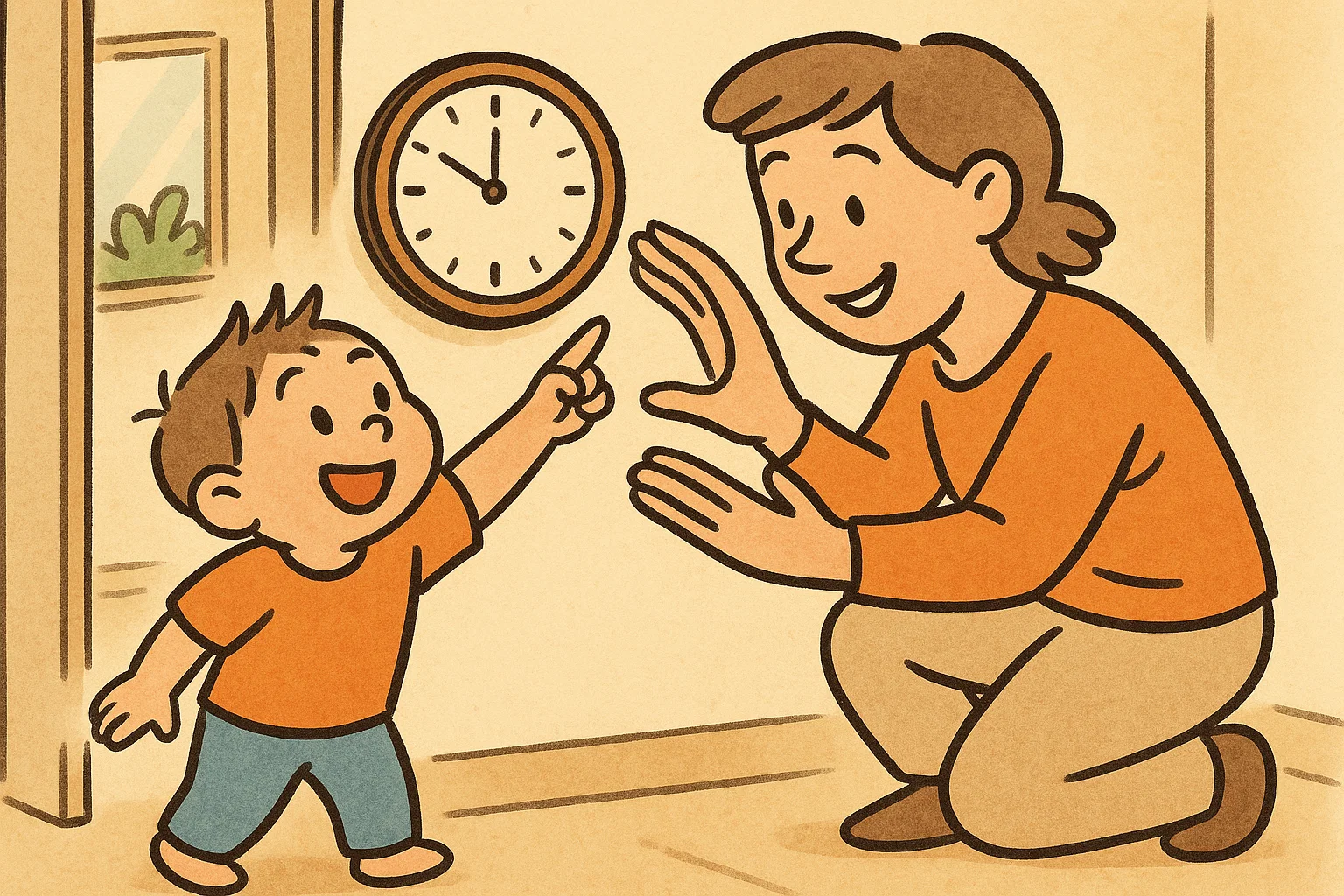
You do not need a formal geometry lesson. Point out circles, rectangles, and triangles while walking the dog, folding laundry, setting the table, or reading a book. This is one of the easiest ways to teach shapes to young children.
Encourage Building
Give children tools such as blocks, sticks, paper, play dough, and recycled materials, and let them create. Building gives children natural opportunities to test balance, size, and structure.
Extend Conversation
Instead of asking only “What do you notice?” ask, “How do you know it’s a triangle?” Encourage answers such as, “Because it has three sides.”
Adapt Lessons
If a preschooler is struggling, return to physical 3D objects before moving back to 2D paper activities. Some children need to hold, rotate, and compare real objects before they can recognize flat pictures.
Frequently Asked Questions
How Do You Teach Shapes in Preschool?
Use a mix of hands-on games, real objects, and repeated naming during daily routines. Start with circles and squares before moving to hexagons or 3D solids. The easiest way to teach kids is to connect the lesson to toys, snacks, books, and movement.
What Shape Concepts Fit Preschoolers?
Preschoolers usually build understanding through naming, matching, sorting by one attribute, and finding familiar forms in everyday life. Understanding the difference between straight and curved lines is also an important milestone.
How Do You Make Learning Shapes Interesting?
Incorporate the child’s interests. If they love art, try collage projects. If they love to move, create an obstacle course. If they enjoy pretend play, use a shape monster, treasure map, or puppet story. Food games and hunts are also fun options for home or class.
What Age Should Kids Start Shape Games?
Toddlers can begin around 18–24 months with simple circle and square sorting toys. The best early options are games that teach shapes through touch, sorting, matching, and movement. By age 3, many preschoolers are ready for more structured activities for learning shapes.
Which Shape Activities Work Best at Home?
At-home hunts, “I Spy,” snack games, puzzles, and block play work well because they require little to no prep and use items families already have. These activities help children notice familiar forms without needing special materials.
Which Shape Activities Work Best in the Classroom?
Bingo, sensory bins, movement games, and large-scale art work well for groups because they encourage social interaction, turn-taking, language development, and collaborative problem-solving. In the preschool classroom, it is helpful to rotate several shapes using cards, mats, puzzles, art, and hands-on centers.
Take a short quiz to find out what your everyday choices say about your parenting style
When your child is curious about something new, what’s your instinct?
Take a short quiz to find out what your everyday choices say about your parenting style
“Can I download this app?” What happens next?
Take a short quiz to find out what your everyday choices say about your parenting style
When it comes to rules at home, which sounds most like you?
Take a short quiz to find out what your everyday choices say about your parenting style
If you could give your child one life skill today, what would you pick?
Take a short quiz to find out what your everyday choices say about your parenting style
Your child gets to choose what to watch. What would your ideal setup look like?
Take a short quiz to find out what your everyday choices say about your parenting style
Pick your parenting superpower ✨