20 Easy and Fun Marble Games for Kids

 Discover a Free Education Video App for Kids
Pastory uses AI to personalize educational video content based on your child’s interests and personality. Safe, engaging, and built for curious young minds. Sign up now to stay updated and enjoy early access with a free trial
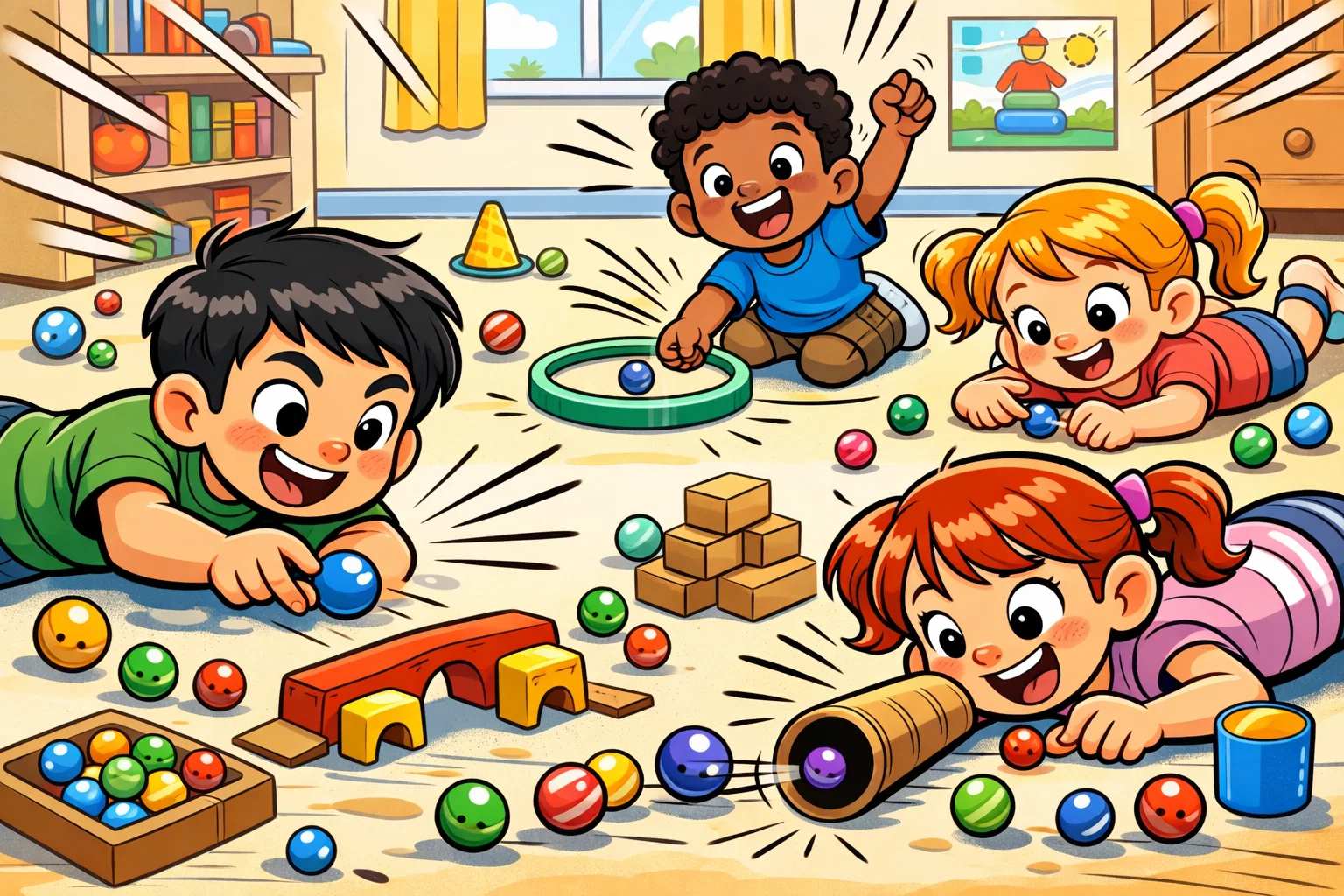
Classic games often offer some of the richest developmental benefits. In an era dominated by screens, this classic toy still encourages hands-on play and supports cognitive and motor development. This guide offers 20 simple activities for rainy days indoors, sunny afternoons in the backyard, and quality family time. Whether you are looking for a DIY track project, competitive game formats, or educational games that sharpen logic, these ideas require minimal preparation and offer a ton of fun for children of all ages.
Why This Kind of Play Builds Real Skills
This type of play is more than just a pastime; it helps children build coordination, concentration, and problem-solving skills. Research in child development suggests that hands-on play with small objects supports coordination, sensory exploration, and spatial awareness in early childhood.
Focus, Logic, and Fine Motor Skills
Engaging in marble play demands a high level of fine motor control and visual-motor integration. To play successfully, a child must control the force of a flick and the angle of release. This process strengthens the small muscles in the hands, directly impacting handwriting and daily self-care tasks. Furthermore, creating a complex maze or a unique ramp system requires advanced problem-solving, as children must predict trajectories and adjust for gravity and friction.
Best Age Ranges and Safety Basics
While kids love this activity, safety should always come first for parents and educators. Most of these games are best suited to children ages 5 and up, since younger children may still put small objects in their mouths. Because these small objects can pose a choking hazard, they are not suitable for very young children, especially those under 3. For preschoolers, provide direct adult supervision or use larger alternatives such as golf balls or oversized wooden beads.
Simple Supplies for Home Play
You do not need expensive kits to create interactive marble games. Most of these activities use household items you probably already have at home or in your recycling bin. Essential supplies for a diy marble run or a custom race track include:
- Cardboard tubes (toilet paper or paper towel rolls)
- Masking tape or painter’s tape
- Plastic cups or containers
- Egg carton and cereal boxes
- Chalk for outdoor classic game setups
- Pool noodles (cut in half for a pool noodle marble race)
Traditional and Active Marble Games
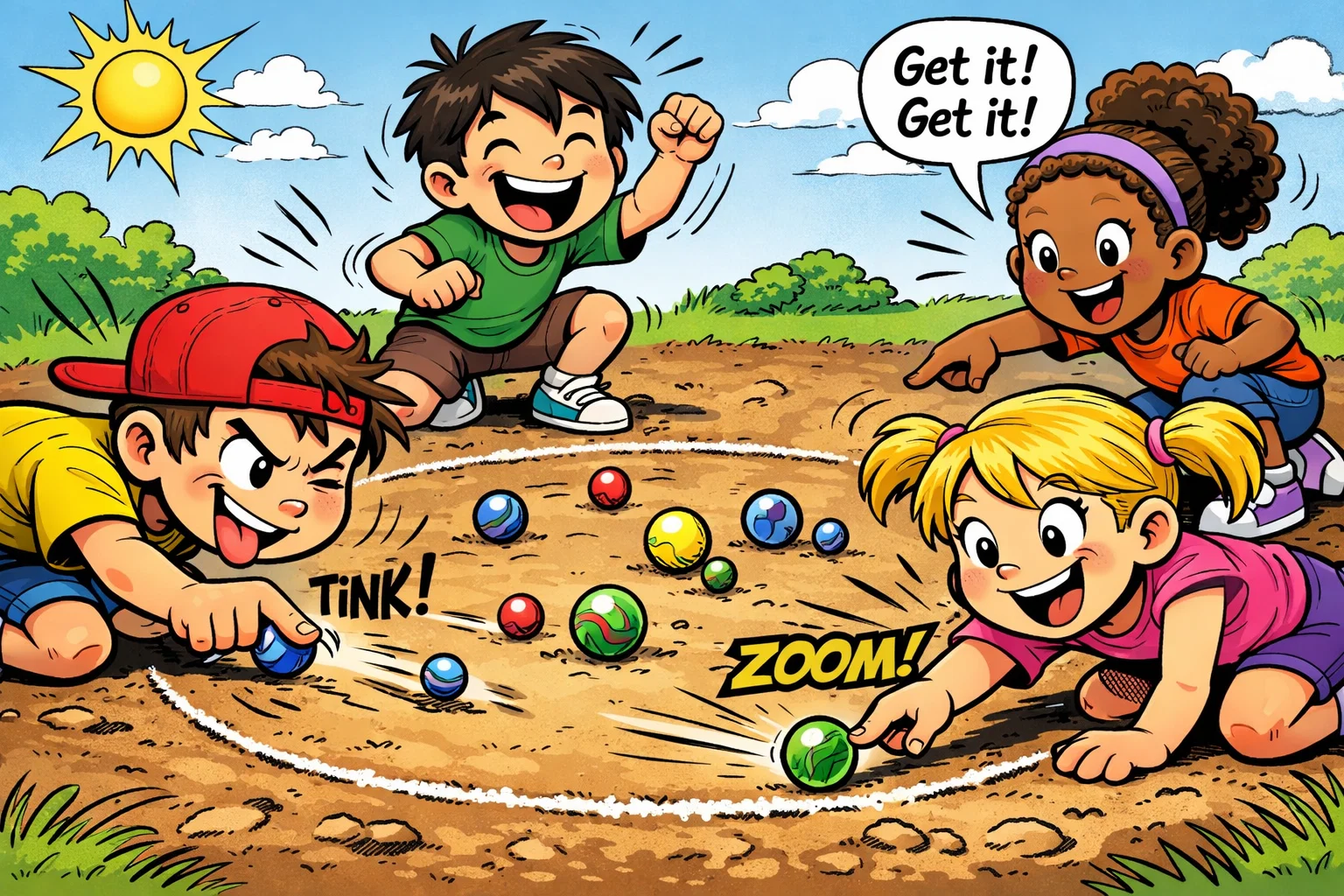
These activities focus on the physical mechanics of marble play, emphasizing accuracy, propulsion, and traditional rules.
1. The Classic Circle
This classic game is typically played inside a 10-foot circle marked on the ground. Players place a specific number of marbles (usually 13) in a cross shape at the center. Using a larger shooter, players try to knock the other pieces out of the ring while keeping their own inside the circle. If you successfully eject a target, you get another turn.
2. Bullseye Circle
This simplified variation is a good fit for younger children. Draw a target with chalk (approx. 2 feet wide) and place many marbles inside. Players stand about 3 feet away and roll one piece toward the center. The goal is to see whose marble stops closest to the bullseye without rolling past it.
3. Hollows and Holes
For a simple hole game, you need either a small depression in the ground or a cardboard box with holes cut into the sides. Players attempt to flick their glass marbles into the openings from a distance. Assign different point values to different holes to encourage strategic thinking and risk-taking.
4. The Distance Toss
A marble toss is a high-energy game to play that tests arc and trajectory. Line up plastic cups or containers at varying distances. Players gently toss the pieces underhand, trying to land them inside the cups. This is a good way to build hand-eye coordination and spatial awareness.
5. Precision Roll
For a simple game involving rolling, use masking tape to create a narrow “lane” on a hardwood floor. Players roll their marbles down the lane, trying to stop the glass ball as close to a target line as possible without crossing it. This requires precise hand control and a good sense of force.
6. Mini Table Golf
Transform your hallway into a mini marble golf course. Use cups or containers laid on their sides as “holes,” and create obstacles out of books or LEGO bricks. Players use their fingers to “putt” their pieces through the maze toward the target, counting their total “strokes” for a competitive game feel.
7. Target Scoring
Draw a target with three concentric circles on a piece of cardboard. The center ring is worth 50 points, the middle 20, and the outer 10. Players roll from 5 feet away. This fun game helps with basic addition and subtraction as children tally their scores.
8. Wall Bounce Challenge
This variation uses a vertical surface, such as a wall or the side of a large cardboard box. Players must bounce their marbles off the wall so that they land in a designated target zone on the floor. This introduces the concept of angles of reflection in a fun way.
9. Obstacle Navigation
Create a “Gauntlet” using household items like shoes, blocks, and bottles. Players must guide their marbles through the course by flicking them. To make it even more fun, use a timer to see who can finish the obstacle race the fastest without hitting any “mines” (obstacles).
10. Handheld Tilt Maze
Place a few marbles inside a shallow box lid. Draw a maze or a path on the bottom. The player must get the marble from the start to the finish line solely by tilting the box. This activity is excellent for developing hand-eye coordination, control, and patience.
Modern and Interactive DIY Projects
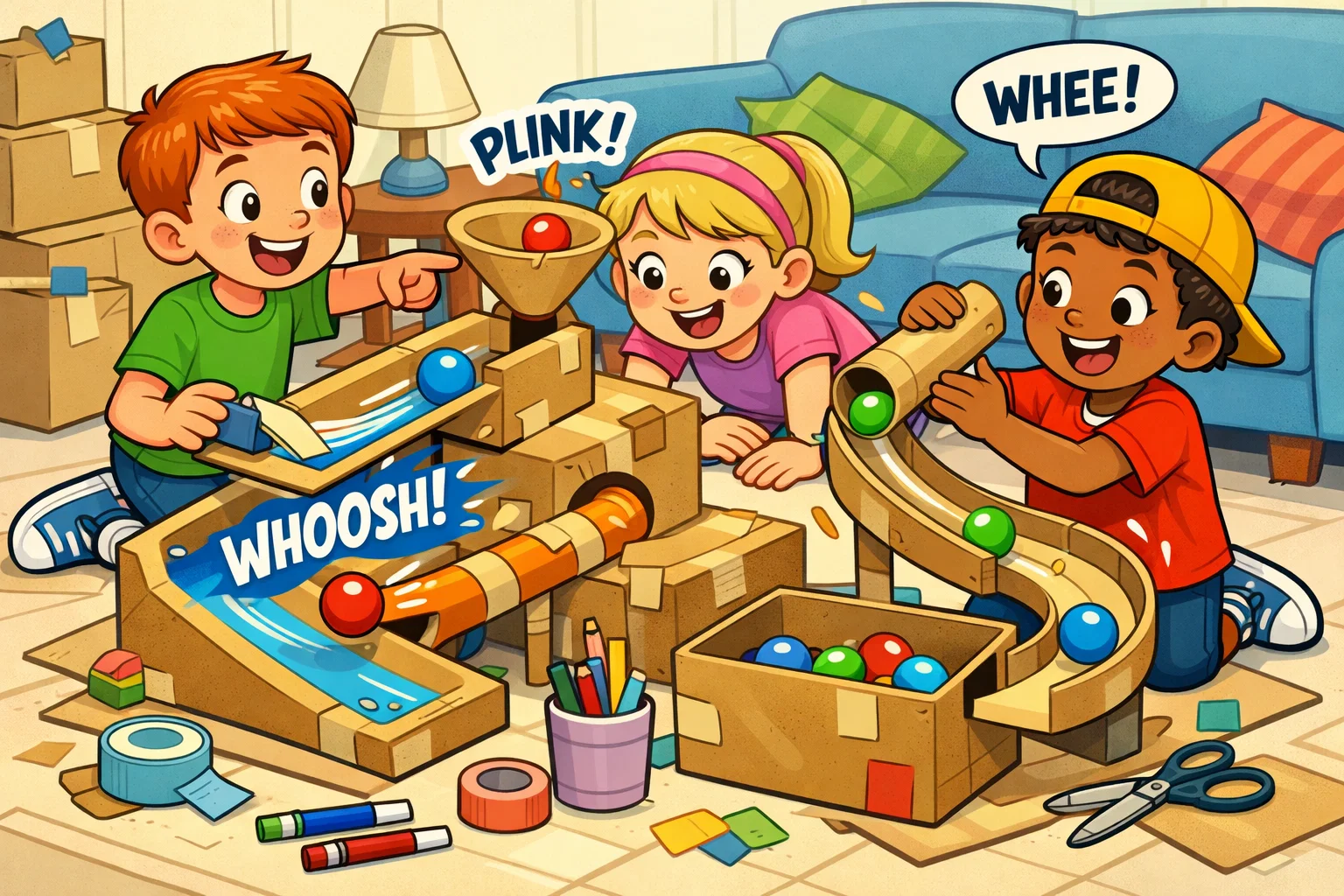
These activities leverage diy marble run mechanics and creative engineering to keep kiddos engaged with STEM concepts and logic.
11. Cardboard Maze Engineering
A marble maze is both a creative project and an engineering challenge. Using a cardboard base, glue down toilet paper rolls or strips of scrap material to create walls. The goal is to create a complex path where the object can travel from top to bottom without getting stuck.
12. Modular LEGO Lab
A LEGO maze is a flexible family activity that can be rebuilt again and again. Build a baseplate with bricks acting as the walls. The benefit of this interactive marble game is that it is infinitely reconfigurable, allowing children to test different maze designs and logic puzzles on the fly.
13. Gravity Race Track
A marble race track can be built against a wall using masking tape and cardboard gutters. Kiddos love to see which unit is the fastest. Use pieces made of different materials or sizes to compare how weight, friction, and surface texture affect the race.
14. Pool Noodle Split
For a pool noodle marble race, slice a foam tube in half lengthwise to create two long tracks. Lean them against a couch or a play structure. Two players release their pieces at the same time to see which one reaches the bottom first. This is a staple for fun marble games.
15. The Vertical Drop
A recycled marble drop uses toilet paper tubes taped to a wall in a vertical zig-zag pattern. This simple game demonstrates gravity. Children must align the tubes so each piece drops neatly from one into the next, which helps build planning and hand control.
16. Pattern Matching
This is a logic-based game to play for younger children. Provide a set of cards with colored dots. The child must place corresponding glass marbles onto the dots. This supports educational games focused on pattern recognition and color identification.
17. Tongs and Sorting
In a Color Match challenge, set out several plastic cups in different colors. Use a spoon or a pair of tongs to move individual marbles into the matching colored cup. This builds fine motor skills and helps children sort objects by color.
18. Ancient Mancala DIY
Mancala is a classic game of strategy. You can make a simple version using an empty egg carton and 48 marbles or counters. This competitive game teaches counting, tactical planning, and “sowing” mechanics, which are excellent for developing early math skills.
19. Estimation Jars
The classic guessing game involves filling a container with a number of marbles. Children must use visual estimation to guess how many are hidden inside. This is a great way to introduce mathematical vocabulary like “estimate,” “volume,” and “quantity.”
20. Kinetic Art Painting
Marble painting is a movement-focused art project. Place a piece of paper inside a box, add a few drops of craft paint, and drop in several spheres. As the child tilts the box, the balls roll through the paint and across the paper, creating unique abstract tracks.
Recommended Store-Bought Options for Long-Term Play
While DIY projects are great, commercial sets often offer better durability and more precise construction.
Gravity Logic Puzzles
Commercial logic sets like “Gravity Maze” are designed to build critical thinking. These sets provide specific challenges where the player must arrange towers to ensure the sphere reaches the target. They are highly recommended by educators for developing sequential reasoning.
Structural Race Sets
Ready-made marble run kits often include translucent marbles and glowing tracks. These are excellent for long-term engagement as they allow for massive, multi-level constructions that might be difficult to achieve with just scraps of cardboard.
Family Board Game Classics
Games like Kerplunk or high-quality wooden Mancala boards are staples for children and adults. These interactive marble games are durable and provide a “plug-and-play” experience for families who want to engage in structured activities without a long setup time.
Digital Integration and Online Versions
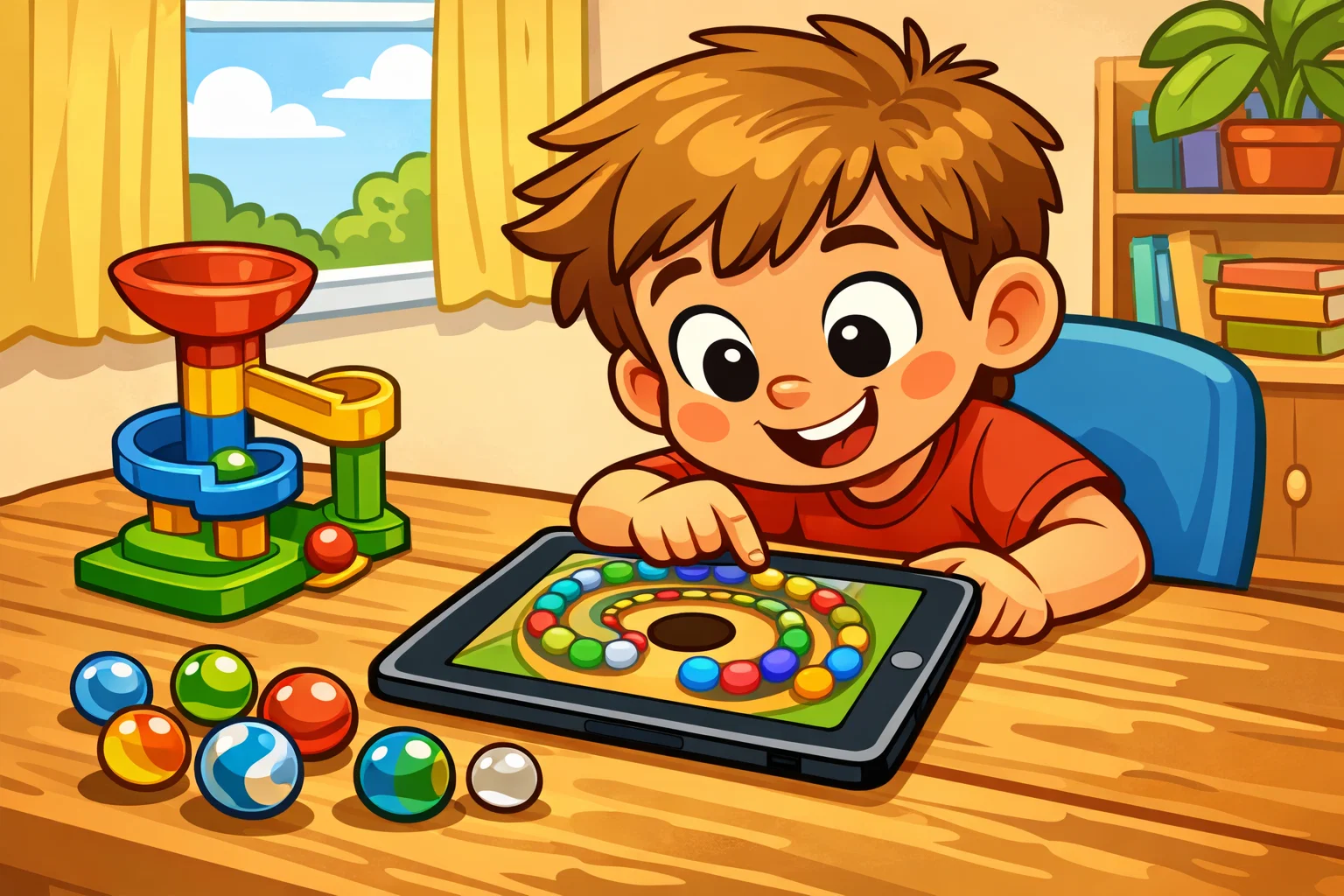
Digital versions of these activities can serve as a supplementary tool for developing logic when physical materials aren’t available, such as during long trips.
When Virtual Play Makes Sense
Digital marble maze apps are useful as a quick warm-up. They provide a controlled environment to practice logic and timing without the physical cleanup of many marbles. However, they should supplement, not replace, tactile play.
Skills Supported by Screens
Online versions primarily support:
- Strategic Planning: Deciding moves three steps in advance.
- Visual Tracking: Following fast-moving objects on a display.
- Problem Solving: Finding solutions in increasingly complex levels or layouts.
The Hybrid Strategy
A “Hybrid” approach involves using a digital design app to plan a maze, then attempting to recreate that exact design using toilet paper rolls and cardboard in real life. This bridges the gap between abstract planning and physical execution.
Brief History
Marbles is one of the oldest recorded games, with marble-like objects reportedly found in Egyptian tombs dating back to around 3000 BCE. This longevity is due to the simplicity of the materials and the complexity of the skill required.
Playground Classics Kids Still Love
The classic game of “Ringer” has remained largely unchanged for centuries. These traditional games rely on a player’s shooter marble to knock other marbles out of a marked circle or boundary. These activities persisted through the generations because they offer a perfect balance of skill-building and social negotiation, teaching children how to take turns and manage competition fairly.
DIY, STEM, Sensory Twists for Home
Modern marble play has also expanded to include educational games that incorporate STEM principles. Today, a custom marble run is often a physics lesson in disguise, focusing on potential and kinetic energy. Sensory ideas, such as rolling marbles through the paint, blend art with physics, allowing children to visualize the path of a moving object through a movement-focused art project.
Different Spheres and Best Uses
A varied set of pieces can make play more interesting. Clear or translucent marbles work especially well for art projects and light tables, while larger marbles are useful for games that involve more force or impact.
| Object Type | Best Use | Key Attribute |
| Standard Glass Marbles | General play/racing | Consistent weight and smooth surface |
| Translucent Marbles | Art projects/Light tables | Visual clarity and light refraction |
| Shooter Pieces | Competitive play | 2x the mass of standard units |
| Steel Pieces | Sturdier runs | High momentum and durability |
How to Organize the Perfect Play Session
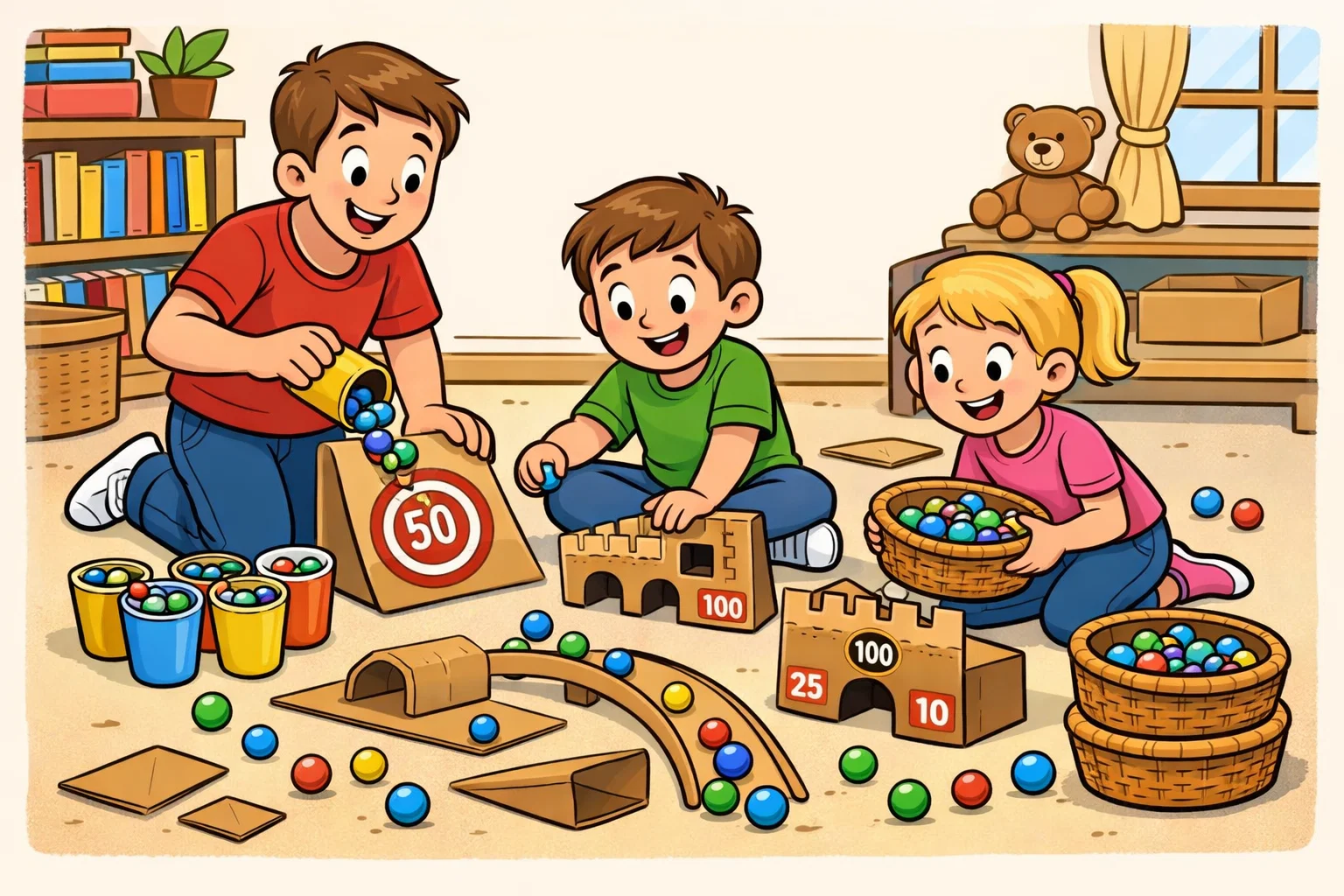
A successful marble play session depends on the setup. A well-organized space helps keep marbles contained and makes cleanup easier.
Indoor Organization
To prevent spheres from rolling under furniture, play on a low-pile rug or inside a “play arena” made of masking tape on the floor. Using a large tray for an art project ensures the paint and the glass ball stay contained.
Outdoor Field Setup
The driveway or sidewalk is the perfect “canvas” for chalk circles and target games. Use natural inclines in the yard to create a marble race track on the grass or in a sandpit for added friction and challenge.
Cleanup and Storage Solutions
Store your marble collection in a clear jar or a drawstring bag.
- Sorting: Have the kiddos sort their pieces by size or color during cleanup to turn it into a simple game.
- Safety Check: Audit the number of marbles after every session to ensure none are left on the floor where they could be a tripping hazard.
Pro Tips for Mastering the Game
To become the best player in the house, children can apply these basic physics and coordination principles during their next game of marbles.
Aim, Angle, and Velocity
The secret to a successful roll is the “knuckle-down” technique. Keeping the hand steady and flicking with the thumb provides the most power. Experimenting with different ramps teaches children that a steeper angle equals more speed, but often results in less control.
Rule Adaptations for Different Ages
For younger children, use a larger plastic cup as a target and shorten the distance significantly. For older children, introduce “bank shots,” where the marble must hit a wall before entering the goal, increasing the difficulty of the shot.
Encouraging Fair Play
Use a shared pool of marbles so that no one feels upset about losing pieces from a personal collection. Implementing a strict “hand-off” rule where players take turns prevents conflicts and keeps the session moving smoothly and peacefully.
Related Creative Activities
Extend the experience with these supplementary sensory and motor tasks.
- Sensory Bin: Fill a bin with rice and hide marbles inside for a “find and count” challenge.
- Spoon Balance Contest: Carry a marble on a spoon while walking to build balance and coordination.
- Sticky Trap: Place tape sticky-side up and try to roll objects so they stop on the adhesive.
- I-Spy Discovery Bottle: Fill a bottle with sand and colorful marbles for a quiet visual-search activity.
- Physics Lab: Use your spheres to demonstrate Newton’s laws of motion by colliding them and observing the transfer of energy.
FAQ
What are the best indoor activities with these items?
The best indoor options are marble mazes, cup toss games, and marble painting projects. These are contained and utilize common household items.
Do these games really help with motor development?
Absolutely. Picking up, pinching, and flicking marbles helps strengthen finger muscles and supports the pincer grasp needed for future writing and tool use.
Which options are best for teaching logic?
Building a DIY marble run or a LEGO marble maze are the best for logic, as they require the child to understand cause-and-effect and spatial reasoning.
What can we build using recycled materials?
Kiddos can build ramps, tunnels, maze walls, and even a vertical marble drop using cardboard and tape.
Is this hobby safe for preschool-aged children?
Only with close adult supervision. For preschool-aged children, larger balls are a safer choice, and standard marbles should be used only during closely supervised play.

Take a short quiz to find out what your everyday choices say about your parenting style
When your child is curious about something new, what’s your instinct?
Take a short quiz to find out what your everyday choices say about your parenting style
“Can I download this app?” What happens next?
Take a short quiz to find out what your everyday choices say about your parenting style
When it comes to rules at home, which sounds most like you?
Take a short quiz to find out what your everyday choices say about your parenting style
If you could give your child one life skill today, what would you pick?
Take a short quiz to find out what your everyday choices say about your parenting style
Your child gets to choose what to watch. What would your ideal setup look like?
Take a short quiz to find out what your everyday choices say about your parenting style
Pick your parenting superpower ✨