How Not to Get Distracted While Parenting: 14 Focus Tips for Parents

 Discover a Free Education Video App for Kids
Pastory uses AI to personalize educational video content based on your child’s interests and personality. Safe, engaging, and built for curious young minds. Sign up now to stay updated and enjoy early access with a free trial

Modern parenting often feels like a high-stakes balancing act, with your sanity and your child’s well-being on the line. You sit down to answer a work email or pay a utility bill, and suddenly a notification pings, a toddler asks for a snack, or your mind starts wandering toward the million things on your to-do list.
Feeling unable to focus is not a personal failure. It is often a byproduct of a parent’s brain trying to navigate a world designed to distract us. This guide offers a practical framework to help you stop getting distracted by managing your environment, your digital habits, and your mental load. By using structured time blocks and learning to reduce distractions, you can regain focus and give your best attention to what matters most – both in your professional life and in your family relationships.
Key Takeaways
- Environmental control: Physically remove distractions, such as by placing your phone in another room, to reduce the urge to scroll.
- Micro-focus blocks: Use the Pomodoro Technique, starting with 25 minutes or less, to make daunting tasks feel doable.
- Mental decluttering: Use a “parking lot” notepad to capture unplanned thoughts so they do not interrupt the task at hand.
- Modeling behavior: Children learn to stay focused by observing their parents set digital boundaries and follow family routines.
- Evidence-based insight: Task switching can cost a significant amount of productive time, so single-tasking is a practical way for parents to protect limited attention.
Focus Starts with Fewer Triggers

The primary goal for a focused parent is not to develop superhuman willpower but to remove the distractions that trigger the urge to drift away from a task. If you often feel distracted, it may be because your environment is saturated with external triggers: noise, visual clutter, and phone notifications.
By proactively clearing your physical and digital space, you train your brain to associate certain areas with deep work or meaningful family connection.
The Parent Brain Needs a Clear Next Step
Overwhelming mental load is a primary reason parents procrastinate on complex chores or work projects. When a task feels too large, the brain naturally seeks the quick reward of a TikTok feed, a new message, or an email inbox.
To combat this, define the single most doable next step. Instead of setting a vague goal like “clean the house,” make the goal concrete: “Put three toys in the bin.” This clarity reduces the internal friction that causes us to get distracted in the first place.
Kids Learn Focus from Family Systems
Child development experts emphasize that focus is a regulatory skill built through consistent family systems. When parents set clear boundaries around smartphones and quiet time, they create a predictable framework that helps children develop executive-function skills.
Establishing a phone-free zone during dinner or homework hours teaches children that something important deserves undivided attention. Over time, this supports patience, emotional regulation, and stronger family connection.
Why Parents Keep Getting Distracted
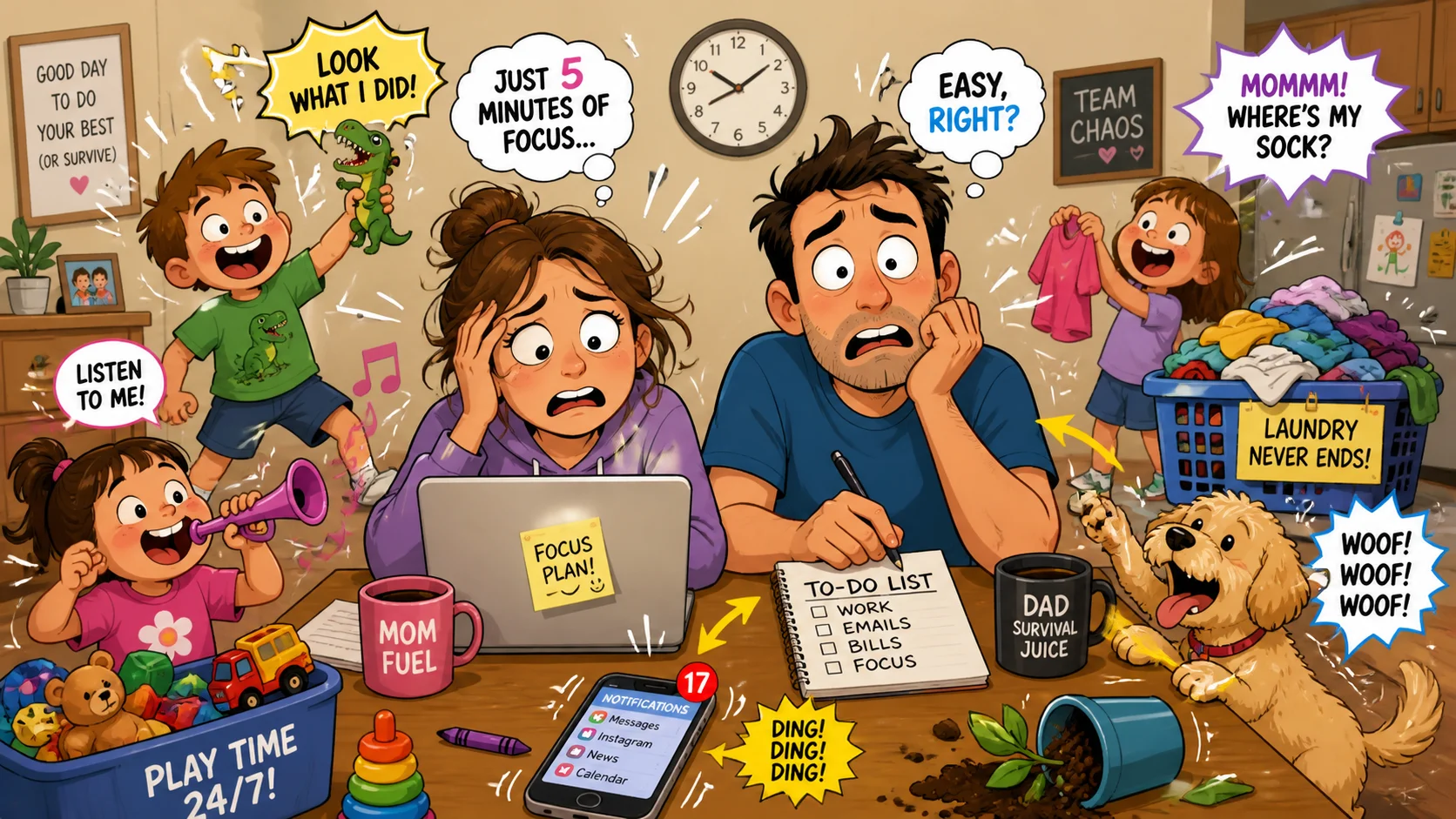
Understanding why you keep getting distracted is the first step toward solving the problem. Many parents operate in a state of continuous partial attention: they are primed to respond to their children’s needs at any moment.
While this can be useful for safety, it becomes a hindrance in a world of constant information streams.
External Distractions at Home
The home environment is a minefield of potential interruptions. You may sit down to check your email, only to be pulled away by a text message, a loud toy, or the visual cue of a full laundry basket.
Workplace research suggests that people may resume interrupted work only after about 23 minutes on average, which helps explain why frequent interruptions make deep work difficult. For many parents, these interruptions happen multiple times an hour, making deep work exceptionally difficult.
Internal Distractions, Stress, and Mental Load
Internal triggers are often more powerful than a buzzing notification. The “mental load” refers to the invisible labor of managing a household: remembering doctor appointments, school spirit days, grocery needs, and family logistics.
This internal mind-wandering often happens because the brain is trying to solve open loops. If you always feel distracted, it may be your mind’s way of reminding you about unplanned responsibilities that have not been written down.
Mind-Wandering During Parenting Tasks
It is common for parents to feel distracted even while playing with their child, often thinking about work or chores instead. Conversely, while working, they may feel distracted by guilt or by thoughts about their child.
This kind of “leaky attention” prevents you from being fully present in either area of life. Recognizing this sensation without judgment is key to using mindfulness to return your attention to what is happening in the moment.
The Multitasking Trap for Busy Parents
Many parents believe they must multitask to survive, but the American Psychological Association notes that task switching can make tasks take longer. When you try to cook dinner while answering a work email and helping with a puzzle, your brain is not doing three things at once; it is rapidly switching between them.
This can increase stress and make you more likely to get distracted or make mistakes.
How Not to Get Distracted: 14 Parent-Friendly Steps

To take back control of your time, you need actionable strategies tailored to the chaotic reality of family life.
1. Put Your Phone Away During Focus Blocks
Physical proximity to a smartphone can reduce cognitive capacity, even if the phone is turned off. To truly avoid distraction, place your phone in another room or in a dedicated drawer during focus blocks.
For parents, this might mean 20 minutes of dedicated play with a child where the phone is out of sight, or a 90-minute work session while the child is at school.
2. Turn Off Nonessential Notifications
Every notification competes for your attention. Disable nonessential alerts for social media, news apps, shopping sites, and promotional emails.
Keep emergency exceptions active for specific contacts, such as your child’s school, your partner, or a caregiver. By silencing the constant stream of pings, you eliminate distractions that would otherwise interrupt your focus.
3. Reduce External Distractions
Before starting a task, do a 60-second sweep. Close the door, turn off the TV, and close any browser tabs that are not relevant to the task.
Creating a low-stimulus zone helps signal to your brain that it is time to focus. If you are working in a common area, having a clear work surface that is free of toys and mail acts as a visual cue for focus.
4. Create a Good Environment
A designated focus spot can be a powerful psychological cue. Whether it is a specific chair at the kitchen table or a corner of the bedroom, use this space only for tasks requiring high attention.
Research on situated cognition suggests that physical surroundings can influence your ability to refocus and stay productive.
5. Close Extra Tabs, Windows, and Apps
Digital clutter is just as damaging as physical clutter. Having twenty tabs open makes it easy to distract yourself.
Before you begin, close everything except the one or two windows necessary for the task at hand. Using Focus Mode on your computer can help hide your inbox and other temptations that make it difficult to focus.
6. Use Headphones or a Focus Playlist
If your environment is noisy, use noise-canceling headphones or a specific focus playlist, such as lo-fi beats, instrumental music, or white noise. For parents, this should only be done when the child is safe and supervised.
Listening to music without lyrics can help you enter a deep-work state by masking background distractions in a busy household.
7. Make a List Before Starting
A chaotic to-do list creates anxiety. Before your focus block, write down exactly three things you want to accomplish. Categorize them by high priority and low energy if that helps you choose where to begin.
Having a clear roadmap prevents you from getting distracted by the question, “What should I do next?”
8. Capture Ideas on a Notepad
When an unplanned thought pops up – such as “I need to buy more milk” – do not act on it immediately. Write it down on a physical notepad or in a dedicated digital parking lot.
This allows you to acknowledge the thought and safely ignore it until your current session is over, preventing an interruption in your cognitive flow.
9. Set a Timer for a Short Focus Sprint
The Pomodoro Technique involves working for 25 minutes and then taking a five-minute break. For busy parents, even a 10-minute sprint can be effective.
Setting a visible timer provides a sense of urgency and a clear finish line, which makes it easier to stay focused and ignore the urge to scroll.
10. Take Breaks Before Burnout
Productivity is a marathon, not a sprint. Taking a real break – such as a short walk, a stretch, or a glass of water – replenishes your mental resources.
Avoid using every break to check your inbox or scroll TikTok, as digital breaks do not always give the brain the rest it needs. High-quality breaks are essential if you want to regain focus for the next round.
11. Do One Thing at a Time
Practice single-tasking. If you are reading to your child, just read. If you are writing an email, just write.
By giving your full attention to one specific task, you can complete it faster and with less emotional fatigue. This is a core principle for becoming less distractible.
12. Start the Hard Thing with a Tiny Step
Procrastination often stems from a task appearing too difficult. To lower the barrier, commit to just two minutes.
“I’ll just open the spreadsheet,” or “I’ll just clear the first five items from the floor.” This micro-start bypasses the brain’s resistance and helps you learn how to stay focused through momentum.
13. Set Work and Relaxation Boundaries
In the work-from-home era, the lines between parent and professional are blurred. Create physical or visual signals for your family.
A closed door or a visible focus timer on the desk tells children that you are in deep-work mode. Consistently enforcing these boundaries helps the whole family understand when you cannot be interrupted.
14. Designate Time for Texts and Email
Stop treating your inbox like a live chat. Designate two or three times a day to check email and respond to text messages.
Outside of these windows, keep communication apps closed. For parents, this includes school portals and parent group chats, which are notorious for causing distractions throughout the day.
How to Deal with Distractions from Kids, Noise, and Big Feelings
Parenting is unpredictable. Even with the best plans, you will get distracted. The key is how you handle the interruption and how quickly you refocus.
Use Coping Skills for Parenting Stress
When a child’s tantrum or a household mess causes a spike in stress, your ability to stay focused can vanish. Use grounding techniques: take three deep breaths, drink a glass of cold water, or step into another room for a moment if your child is safe.
Recognizing that stress is a physiological response helps you avoid the shame spiral of feeling like you “should” be able to focus no matter what.
Ground Yourself in the Present Moment
If you catch yourself in a scroll hole on your phone, use the 5-4-3-2-1 grounding technique: identify five things you see, four you feel, three you hear, two you smell, and one you taste.
This pulls your attention out of the digital loop and back into the physical world, making it easier to return to your goal.
Do the Task You Cannot Stop Thinking About
Sometimes, an unplanned task is so urgent that it creates a cognitive itch. If a task takes less than two minutes, such as signing a permission slip or replying to a necessary school message, just do it.
Closing that open loop can often provide the mental clarity you need to focus on larger, more important work later.
Shift Mind-Wandering Back to Family or Work
When you realize your mind has drifted, name what is happening. Say to yourself, “I am thinking about work, but I am currently playing with my daughter.”
This verbal acknowledgment acts as a manual reset for mind-wandering, allowing you to gently guide your attention back to what is relevant.
Give Procrastination a Small Container
It is unrealistic to expect yourself never to be distracted. Instead of banning all fun, give your distractions a container.
For example: “I’ll read that newsletter for exactly five minutes after I finish this report.” This allows for gratification without letting the distraction take over your entire afternoon.
How to Help Kids Stay Focused
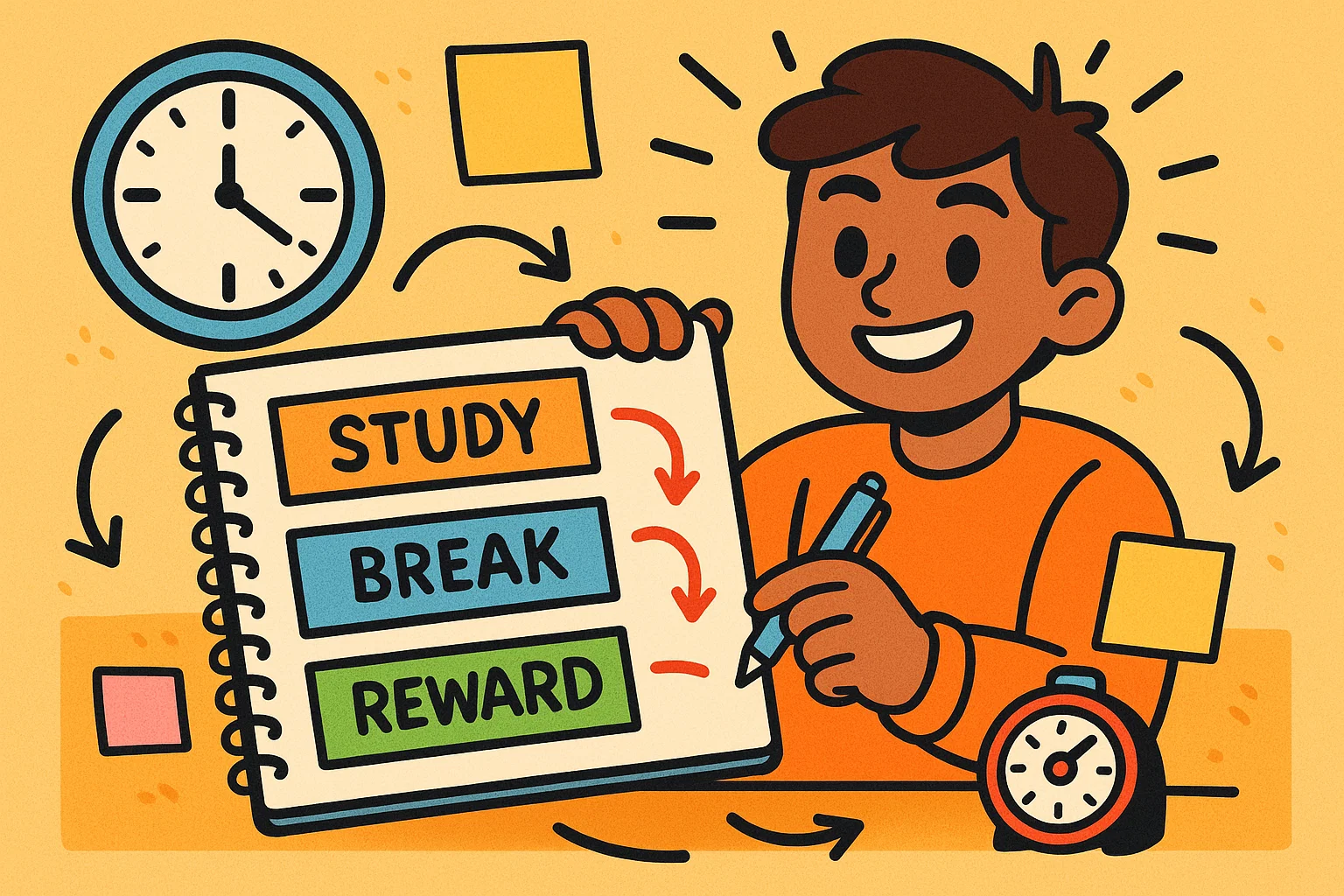
Helping children learn how to stay focused is an investment in their future academic success and emotional well-being.
Build a Distraction-Free Homework Space
A child’s study area should pass a simple environmental audit. Make sure there are no smartphones, tablets, loud toys, or unnecessary screens within their line of sight.
Providing a consistent, well-lit space with all necessary materials – pencils, paper, and water – reduces how often they need to stop working to find something.
Put Screens Away before Homework
The transition from high-stimulation activities, such as video games or TikTok, to lower-stimulation tasks, such as math homework, can be jarring for a child’s brain.
Implement a 10-minute buffer between screen time and study time. This could involve a short walk, a snack, or a quick movement break, allowing their brain to shift into a calmer state before homework begins.
Use a Visual Timer
Children often have a poor sense of time. A visual timer, such as a sand timer or digital countdown, helps them see how much focus time is left.
Start with small, doable chunks, such as 10 minutes of reading followed by a five-minute movement break. This builds the focus muscle gradually.
Break School Tasks into Small Steps
A large project can cause a child to procrastinate. Help them break it down into a numbered list of micro-tasks.
This approach reduces the feeling of being overwhelmed and provides frequent moments of satisfaction as they check off each small step.
Model Focus with Family Rules
You are your child’s primary model for behavior. If you are always distracted by your phone during dinner, they may learn that deep focus is unimportant.
Lead by example: when a child speaks to you, put your phone down and look them in the eye. Show them how you set a goal and work toward it without letting phone notifications pull you away.
Identify and Eliminate Distractions at Home
To make lasting changes, conduct a distraction audit of your daily routine.
| Distraction Category | Common Trigger | Solution |
| Digital | Phone notifications, inbox, browser tabs | Put your phone in another room; close extra tabs |
| Physical | Toys, visual clutter, TV | Create a designated focus spot; do a 60-second sweep |
| Social | Family members, text messages, calls | Set boundaries; designate check-in times |
| Internal | To-do-list anxiety, mind-wandering | Use a notepad parking lot; practice mindfulness |
Audit Your Phone, TV, Toys, and Browser Tabs
For one day, keep a log of every time you become distracted. You might find that you check your email 40 times a day or that background TV makes it difficult to focus.
Once the triggers are identified, you can systematically eliminate distractions one by one.
Map Family Interruptions
Notice the patterns. Do your kids always interrupt you at 4:00 p.m.? That might be when they are hungriest, tiredest, or most in need of connection.
Instead of fighting it, plan for it. Make that your break time, and schedule deep-focus blocks for when they are more independent or asleep.
Choose a No-Wi-Fi or Low-Stimulus Zone
For tasks that require extreme concentration, such as tax prep, budgeting, or deep writing, consider a no-Wi-Fi zone.
If you do not need the internet, turn it off. Removing the ability to scroll or check your inbox creates a useful constraint that helps you stick with the task at hand.
When Focus Problems Need Extra Support
Sometimes, the inability to stay focused is not just about bad habits. It may indicate underlying health, emotional, or neurological factors.
Signs Distraction Is Becoming Unmanageable
If you or your child consistently cannot finish even basic tasks, or if your attention is so fragmented that it affects daily life, it may be time to seek professional advice.
Constant mind-wandering can sometimes be a sign of an underlying issue, especially when it interferes with school, work, relationships, or safety.
ADHD, Anxiety, Sleep, and Burnout Considerations
Conditions such as ADHD, chronic anxiety, severe sleep deprivation, or burnout can all affect focus. A parent suffering from burnout will naturally find it difficult to concentrate because their cognitive reserves are depleted.
Recognizing that these are medical or physiological states – not personality flaws – is crucial for seeking the right support.
How to Talk with a Pediatrician or Therapist
If you are concerned about your child’s focus, prepare a list of observations for their pediatrician or therapist.
Note when the distractions occur, how long they can stay focused on preferred versus non-preferred tasks, and how the issue affects their schoolwork. A professional can help determine whether the issue is environmental, developmental, or clinical.
FAQ: How Parents Can Avoid Distractions
How Can Parents Stop Getting Distracted While Working from Home?
The most effective strategy is a combination of physical separation and time-blocking. Use a dedicated workspace, physically place your phone in another room, and work in Pomodoro sprints.
Communicate your focus hours to your family, and use noise-canceling headphones or a visible timer to signal that you are at work.
How Can I Stop Checking My Phone Around Kids?
Set phone-free zones and times, such as the dinner table or the first hour after school. Turn off all non-emergency phone notifications.
If you must use your phone, explain what you are doing – for example, “I’m checking the weather for our bike ride” – to show that technology has a specific purpose.
What Helps Kids Stay Focused on Homework?
Provide a consistent, low-stimulus environment and break large assignments into doable steps. Use a visual timer to show them that their effort has a clear endpoint.
Make sure they have had a chance to move and eat a snack before they sit down, since physical needs often show up as an inability to stay focused.
How Many Breaks Should Parents or Kids Take?
The 25/5 rule – 25 minutes of work followed by a five-minute break – is a great baseline for adults and older children.
Younger children may need shorter bursts, such as 10 to 15 minutes of focus followed by three to five minutes of movement. The goal is to take a break before you feel mentally exhausted.
Can Multitasking Make Distraction Worse?
Yes. Multitasking can reinforce a habit of frequent task switching. By constantly switching, you increase mental switching costs, making it harder to regain focus later.

Take a short quiz to find out what your everyday choices say about your parenting style
When your child is curious about something new, what’s your instinct?
Take a short quiz to find out what your everyday choices say about your parenting style
“Can I download this app?” What happens next?
Take a short quiz to find out what your everyday choices say about your parenting style
When it comes to rules at home, which sounds most like you?
Take a short quiz to find out what your everyday choices say about your parenting style
If you could give your child one life skill today, what would you pick?
Take a short quiz to find out what your everyday choices say about your parenting style
Your child gets to choose what to watch. What would your ideal setup look like?
Take a short quiz to find out what your everyday choices say about your parenting style
Pick your parenting superpower ✨