100 Fun Facts for Kids Age 5: Fun, Easy, and Silly Facts Kids Love

 Discover a Free Education Video App for Kids
Pastory uses AI to personalize educational video content based on your child’s interests and personality. Safe, engaging, and built for curious young minds. Sign up now to stay updated and enjoy early access with a free trial
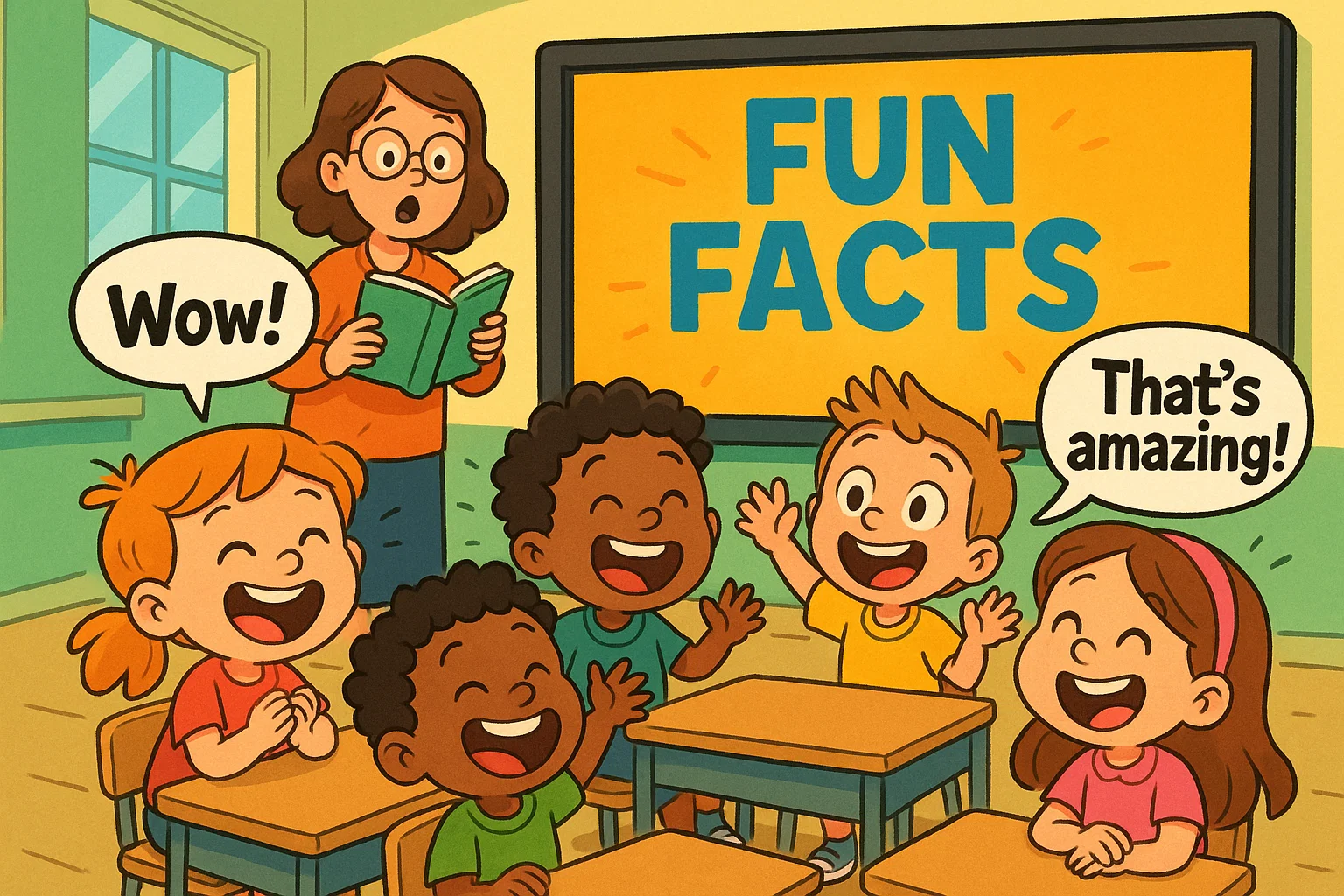
Welcome, parents, teachers, and curious caregivers! At age five, children are like sponges, ready to soak up the wonders of the world. This collection of amazing facts is designed specifically for the developmental needs of 5-year-olds. We’ve chosen these fun facts for kids because they are short, safe, and easy to understand, so they spark joy rather than confusion.
Whether you are looking to inspire a young scientist or simply want some cool trivia for a car ride, these facts cover everything from the human body and space to animals and geography. We’ve grouped them into clear categories to help you explore the mysteries of our planet together.
Key Takeaways
- Curiosity Boost: Learning random facts can enhance vocabulary and cognitive development in early childhood.
- Safety First: All content is age-appropriate, avoiding scary or overly complex topics.
- Engagement: Short, 1–2 sentence facts work best for a 5-year-old’s attention span.
- Interactive Learning: Facts are most effective when paired with “Try this” activities or drawing prompts.
The Best Facts Match a 5-Year-Old’s Curiosity
A 5-year-old is in a “discovery” phase where they begin to understand that the world exists beyond their immediate surroundings. They love facts that are surprising, silly, or highly visual. Using fantastic trivia about animals or the brain helps them build a framework for how the world works.
Short Facts Work Best
To maintain a child’s focus, information should be delivered in bite-sized pieces. The National Association for the Education of Young Children (NAEYC) emphasizes meaningful, active learning through play, exploration, and inquiry, so keep facts brief, playful, and interactive.
Try this: After reading a fact, ask your child, “Can you repeat that back to me in a silly voice?”
A Topic Mix Keeps Kids Engaged
A mix of topics keeps learning fresh. By mixing space, food, weather, and history, you keep curiosity alive. If a child loses interest in planet facts, a quick pivot to lion facts or a story about who invented the ice pop can re-engage their brain.
Facts Can Start Fun Questions
These amazing facts are more than just data; they are conversation starters. Use them during breakfast, bedtime, or preschool circle time to encourage critical thinking. One random fact about a shark can lead to a whole afternoon of discovery about the ocean.
Fun Facts for Kids: Quick Overview
Using these facts should feel like play, not a lesson. At this age, learning happens best through interaction and joy.
How to Use These Facts
Parents can introduce 3–5 facts at a time to avoid overwhelming the child. Encourage a curious mind by asking which fact was their favorite and why. Turning these into a guessing game — “I bet you can’t guess what a butterfly tastes with!” — makes the information incredible and memorable.
Best Times for Fact Fun
- Breakfast: Start the day with a science fun fact.
- Car Rides: Use geography or animal facts to pass the time.
- Bedtime: Gentle space or star facts can be calming.
- Rainy Days: Perfect for deeper discovery and drawing activities.
Simple Fact Rules
To keep the experience fantastic, follow these simple guidelines:
- Keep it Short: No more than two sentences.
- Stay Positive: Focus on the incredible parts of nature.
- Be Visual: Use your hands or household items to show what a fact means.
Random Fun Facts for 5-Year-Olds
Sometimes the most random facts are the ones that amaze kids the most.
1. Square Watermelons Can Be Grown in Japan
In Japan, some farmers grow watermelons inside clear boxes so they take on a square shape. This makes the fruit look funny and easier to store or give as a special gift.
2. Opposite Sides of a Die Add Up to Seven
On a standard six-sided die, the numbers on opposite sides always add up to seven.
Activity: Grab a die and check! If you see a 1, look at the bottom — it will be a 6.
3. The Letter Q Is Missing from U.S. State Names
There are 50 states in the United States, but none of them has the letter “Q” in its name. You can search the whole map, but you won’t find that curious letter anywhere!
4. Play-Doh Started as a Wallpaper Cleaner
Before it became a toy, the material that became Play-Doh was used as a wallpaper cleaner. People later realized it was much more fun to squish and shape, so it became the modeling compound kids love today.
Silly Facts Kids Can Repeat
These facts are surprising and engage a child’s sense of humor.
5. Most People Cannot Lick Their Own Elbows
The way most human bodies are built makes it almost impossible to touch an elbow with the tongue.
Try it: Give it a try safely! It’s okay if you can’t do it — most grown-ups can’t either!
6. Humming Stops When You Pinch Your Nose
When you hum with your mouth closed, sound vibrates through your nose. If you pinch your nose shut while humming, the hum will stop almost immediately.
7. Chef Hats Can Have Many Folds
A traditional tall white chef’s hat often has many pleats, or folds. According to an old legend, the pleats showed how many different ways a chef knew how to cook an egg!
Human Body Facts for 5-Year-Olds
The human body is a fascinating machine with incredible secrets.
8. Babies Have More Bones Than Grown-Ups
Newborn babies have about 275 to 300 bones, which is more than adults have. As a child grows, some of these small bones fuse together to make stronger, bigger bones.
9. Skin Is the Body’s Largest Organ
The skin is actually the largest organ of the human body, covering you from your head to your toes. Its main job is to protect your insides and keep you safe from germs.
10. Your Heart Beats All Day
Your heart is a very strong muscle that works like a pump to move blood through your body.
Try this: Jump up and down ten times, then put your hand on your chest to feel your heart thumping!
11. Tongue Patterns May Be Unique
Just like everyone has different fingerprints, every person has a different pattern on their tongue. Scientists have studied tongue patterns as a possible way to identify people.
Food Facts for 5-Year-Olds
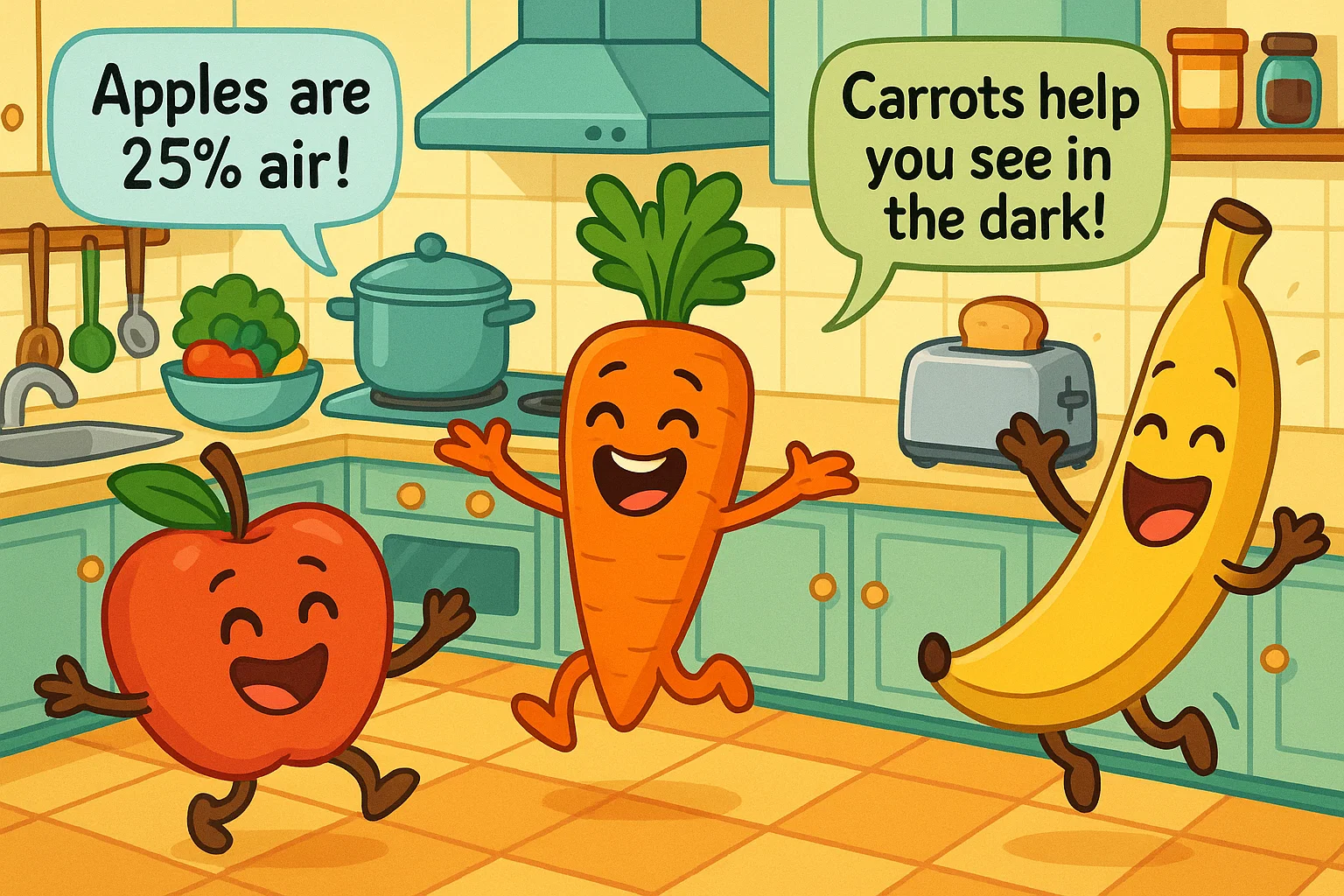
Learning about what we eat can be a fantastic way to spark curiosity at the dinner table.
| Food Item | Fun Attribute |
| Strawberry | Has tiny seed-like dots on the outside. |
| Tomato | Botanically a fruit, not a vegetable. |
| Cranberry | Can bounce like a rubber ball when ripe. |
| Apple | Has tiny air pockets, which help it float. |
12. Strawberries Have Tiny Dots Outside
Most fruits keep their seeds inside, but strawberries wear tiny seed-like dots on the outside. A single strawberry usually has about 200 of these tiny dots!
13. Tomatoes Count as Fruit
Even though we often eat them in salads, tomatoes are botanically fruits because they grow from flowers and have seeds inside.
14. Cranberries Can Bounce
A fresh, ripe cranberry is full of tiny air pockets. These air pockets allow the berry to bounce and even float in water!
15. Apples Belong to the Rose Family
Apples, pears, and even plums are cousins to the rose flower. They all come from the same large plant family, which is why apple blossoms look so pretty.
Animal Facts for 5-Year-Olds
fun-facts-about-animals.webp Alt Attribute: Fun facts about animals, cartoon lion, elephant, and rabbit with kids.
Animal facts for kids are often the most popular because creatures are so fascinating.
16. Pandas Eat Lots of Bamboo
A giant panda can spend 10 to 16 hours a day eating bamboo. They need to eat a lot of it — often a huge pile every day — to get enough energy.
17. Tigers Have Striped Skin
A tiger’s stripes are not just on its fur. If you could look under a tiger’s fur, you would see that the stripe pattern is on its skin too!
18. Koalas Sleep Many Hours
Koalas live in Australia and eat eucalyptus leaves, which don’t give them much energy. Because of this, they can sleep for up to 20 hours every day!
19. Lions Live in Groups
Unlike many other cats that like to be alone, lions live in big family groups called prides. They work together to protect their cubs and find food.
Ocean Facts for 5-Year-Olds
The ocean is a place of mystery and amazing life.
20. Oceans Cover Most of Earth
If you look at a globe, you will see a lot of blue; that’s because the ocean covers about 70% of our planet. The ocean is home to blue whales, the biggest animals on Earth.
21. Sharks Keep Growing New Teeth
A great white shark can go through thousands of teeth in its lifetime. If one falls out, a new tooth can slide forward to take its place like a conveyor belt.
22. Whales Sing Underwater
Humpback whales make long, beautiful sounds that scientists call “songs.” These sounds can travel for many miles through the deep, blue water.
23. Sea Stars Can Regrow Arms
If a sea star, also called a starfish, loses an arm, it can often grow a brand-new one. Some sea stars can even grow a whole new body if part of the center is still attached.
Insect Facts for 5-Year-Olds
Insects may be small, but they have incredible bodies.
24. Bees Help Flowers Grow
Bees are like tiny garden helpers. As they fly from flower to flower, they carry a powder called pollen that helps plants make new seeds.
25. Butterflies Taste With Their Feet
A butterfly has taste sensors on its feet. This helps the butterfly “taste” a leaf to see if it is the right place to lay eggs or find food.
26. Ants Work as Teams
Ants are very strong and love to work together. They can carry things that are much heavier than they are by helping their friends lift and pull.
27. Ladybugs Can Eat Plant Pests
A single ladybug can eat hundreds of tiny bugs called aphids that try to hurt garden plants. This makes them a gardener’s best friend!
Space Facts for 5-Year-Olds
Facts about space help kids look at the star-filled sky with wonder.
28. The Moon Has Astronaut Footprints
Because there is no wind or rain on the Moon to erase them, astronauts’ footprints can stay there for a very, very long time.
29. The Sun Is Our Closest Star
The Sun is actually a giant, glowing star. It looks bigger than other stars only because it is much closer to our planet and gives us light and warmth.
30. Neptune Has Shorter Days Than Earth
Even though Neptune is very far away, it spins around very fast. One day on Neptune lasts only about 16 hours, which is much shorter than an Earth day.
31. Saturn Has Giant Rings
Saturn is famous for its beautiful rings. These rings aren’t solid; they are made of billions of pieces of ice and rock.
Earth Science Facts for 5-Year-Olds
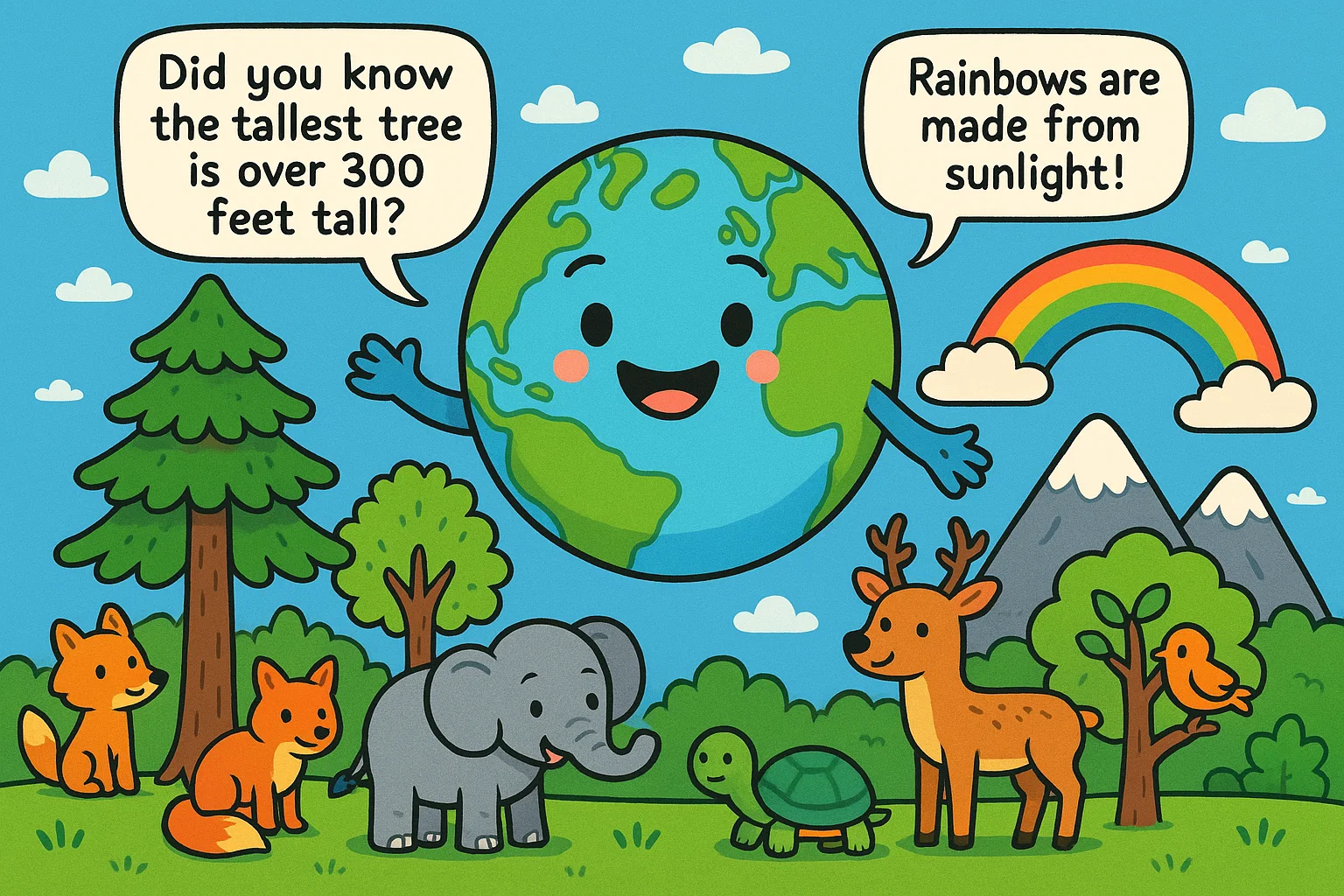
Science is all around us, from the ground under our feet to the air we breathe.
32. Natural Chalk Comes From Tiny Fossils
Natural chalk rock is made from tiny ancient sea organisms. Many sidewalk chalks, however, are made from a material called gypsum.
33. Gravity Pulls Things Down
Gravity is the invisible force that keeps our feet on the ground. It is why an apple falls from a tree instead of floating up into the sky.
34. Wind Is Moving Air
You can’t see wind, but you can see it move leaves! Wind happens when air moves from one place to another.
35. Clouds Can Be Very Heavy
Even though clouds look like fluffy cotton candy, they are made of millions of water droplets. A big fluffy cumulus cloud can contain as much water as about 100 elephants weigh!
Weather Facts for 5-Year-Olds
The weather changes every day, and it is always surprising.
36. Lightning Can Strike the Same Place Twice
You might hear that lightning never strikes twice, but that isn’t true! Tall buildings like the Empire State Building get hit by lightning many times every year.
37. Rainbows Need Sunlight and Rain
A rainbow is a beautiful science surprise. It appears when sunlight shines through tiny drops of rain, which bends the light into beautiful colors.
38. Tornadoes Spin Like Giant Funnels
A tornado is a very strong, spinning wind that looks like a funnel reaching down from the sky. Adults watch the weather closely to make sure everyone stays safe when tornadoes happen.
39. Hurricanes Are Huge Storms
Hurricanes are massive storms that form over warm ocean water. They bring lots of rain and strong winds as they move toward land.
Volcano Facts for 5-Year-Olds
Volcanoes are some of the most amazing features of our Earth.
40. Volcanoes Can Be Active or Dormant
Some volcanoes are “active,” which means they have erupted before and could erupt again. Others are “dormant,” which means they are quiet for now, or “extinct,” which means scientists do not expect them to erupt again.
41. Lava Is Hot Melted Rock
Inside a volcano, it is so hot that rocks melt into a liquid called magma. When it flows out of the volcano, it is called lava and is hotter than your oven at home!
42. Some Islands Come From Volcanoes
Over millions of years, lava from underwater volcanoes can pile up so high that it reaches the top of the water and creates a brand-new island, like Hawaii.
Geography Facts for 5-Year-Olds
Geography helps us discover where we are on the map.
43. Earth Has Seven Continents
The land on our planet is divided into seven huge pieces called continents: Africa, Antarctica, Asia, Australia, Europe, North America, and South America.
44. Antarctica Is the Biggest Desert
A desert is any place that is very, very dry. Because Antarctica gets very little precipitation, the icy continent is actually the largest desert in the world!
45. Vatican City Is Very Small
The smallest country in the world is Vatican City. It is so tiny that you could walk across the whole country in just a few minutes!
46. The Ocean Makes Earth Look Blue
Blue is the main color of our planet from space. Earth looks blue because the ocean covers most of its surface.
Place Facts for 5-Year-Olds
There are special places on Earth that are truly incredible.
47. The Amazon Rainforest Has Many Animals
The rainforest is a warm, wet place with giant trees. It is home to more types of animals and plants than almost anywhere else on the planet.
48. Greenland Is a Giant Island
Even though its name is Greenland, this place is covered in white ice! It is the world’s largest island that is not a continent.
49. Istanbul Sits on Two Continents
The city of Istanbul is special because parts of it are in Europe and parts of it are in Asia. You can cross a bridge and be on a new continent!
50. Mount Everest Is Very Tall
Mount Everest is the highest mountain on Earth above sea level. It is so tall that its peak reaches way up into the clouds where the air is very cold.
History Facts for 5-Year-Olds
History is the story of people who lived long ago.
51. Ice Pops Were Invented by a Kid
In 1905, an 11-year-old boy named Frank Epperson accidentally left a cup of soda with a stir stick outside on a cold night. It froze solid, and this gave him the idea for the ice pop!
52. Old Photos Needed Long Still Poses
Long ago, cameras were very slow. If you wanted your picture taken, you had to sit perfectly still for a long time.
53. Flags Can Be Designed by Students
Some important flags were designed by students. This shows that kids can have big ideas too.
54. Ancient People Built Huge Places
Thousands of years ago, people did not have modern trucks or machines, but they still built giant stone pyramids and temples that we can still see today.
Ancient Egypt Facts for 5-Year-Olds
The people of Ancient Egypt lived near the Nile River and built a fascinating culture.
55. Egyptians Built Pyramids
The pyramids are massive stone buildings shaped like triangles. They were built as special tombs for Egyptian kings, called pharaohs.
56. Cats Were Special in Egypt
In Ancient Egypt, people thought cats were very important and lucky. They took great care of them and even made statues of them!
57. The Nile River Helped Crops Grow
Every year, the Nile River would flood and leave behind rich, wet soil. This helped the Egyptians grow lots of food for their families.
Ancient Greece Facts for 5-Year-Olds
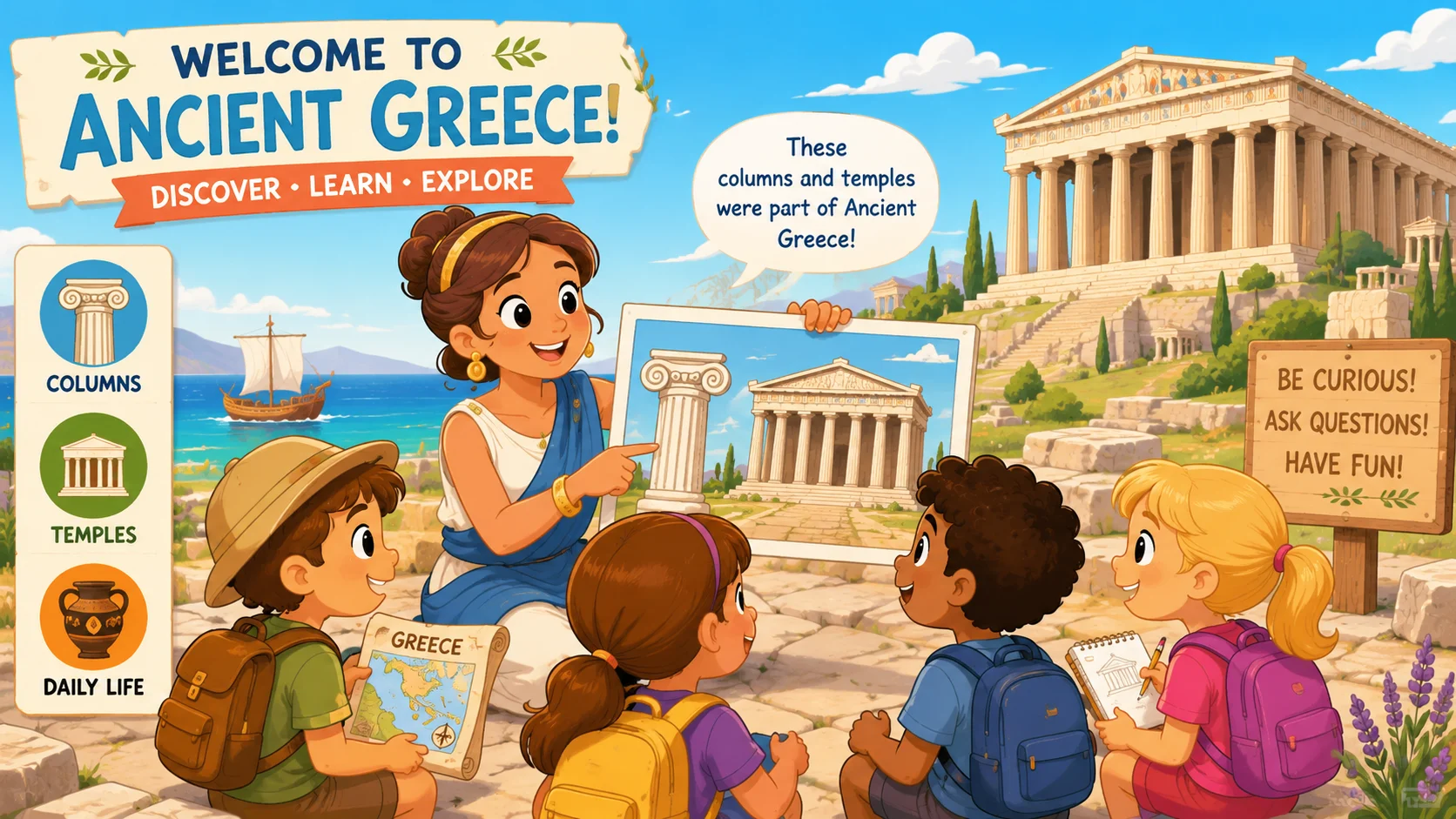
The Greeks loved sports, stories, and asking curious questions.
58. The Olympics Started Long Ago
The first Olympic Games were held in ancient Greece more than 2,000 years ago. Athletes competed to see who was the fastest and strongest.
59. Greek Pots Told Stories
Instead of books, the Greeks often painted pictures on their clay pots. These pictures showed scenes of heroes, monsters, and everyday life.
60. Ancient Greeks Loved Big Ideas
The Greeks spent a lot of time thinking about the stars, numbers, and nature. They wanted to understand how everything in the world worked.
Ancient Rome Facts for 5-Year-Olds
The Romans were amazing builders who made things to last.
61. Romans Built Long Roads
The Romans built thousands of miles of straight roads made of stone. These roads were so strong that some of them are still there today!
62. Roman Numerals Look Different
Instead of numbers like 1, 2, and 3, the Romans used letters.
Example: “I” means one, “V” means five, and “X” means ten.
63. Romans Built Big Arenas
They built huge stone buildings called amphitheaters. These were like giant outdoor stadiums where thousands of people could watch shows and games.
Viking Facts for 5-Year-Olds
Vikings were travelers from the north who were fantastic sailors.
64. Vikings Sailed Longships
Viking ships were called longships. They were very fast and could sail in both deep oceans and shallow rivers.
65. Viking Helmets Had No Horns
You might see Vikings with horns on their hats in cartoons, but real Vikings didn’t actually wear horns! Their helmets were made of plain, strong metal.
66. Vikings Told Many Stories
Because they didn’t write many books, Vikings told sagas. These were long stories about brave heroes and magical creatures like dragons.
Peace and History Facts for 5-Year-Olds
During hard times in history, many people helped one another.
67. People Helped Each Other During Hard Times
When things were difficult long ago, neighbors would share their food and clothes to make sure everyone in the community was okay.
68. Children Sometimes Sent Letters
Before the internet, kids wrote letters to their family members who were far away. These letters helped everyone feel loved and connected.
69. Remembrance Helps People Value Peace
We remember the past so we can understand how important it is to be kind to one another and live in a world that is peaceful and safe.
Royal Facts for 5-Year-Olds
Kings, queens, and other monarchs live in a world of palaces and ceremonies.
70. Some Monarchs Have More Than One Birthday Celebration
In some countries, a monarch can have a real birthday and a second “official” birthday for a parade.
71. Crowns Can Be Very Heavy
Royal crowns are made of gold and covered in heavy jewels. They are so heavy that the person wearing them has to practice sitting very still!
72. Palaces Have Many Rooms
A royal palace is a giant home that can have hundreds of rooms, beautiful gardens, and special guards who stand at the gates.
Sports Facts for 5-Year-Olds
Even sports have funny and amazing facts!
73. Tug of War Was an Olympic Sport
Believe it or not, pulling on a rope in tug of war used to be a real sport in the Olympic Games many years ago!
74. Golf Balls Were Once Stuffed With Feathers
A long time ago, early golf balls called featheries were leather pouches stuffed tightly with feathers.
75. Robots Can Play Soccer
Engineers have built robots that can kick a ball and play soccer. There is even a special competition called RoboCup, where robot teams play against each other.
76. Toe Wrestling Exists
There is a silly competition called toe wrestling. It is just like arm wrestling, but people use their big toes instead!
Football Facts for 5-Year-Olds
Football can mean different sports, and many kids love playing it.
77. Football Means Different Games
In many parts of the world, “football” is what Americans call “soccer.” In the U.S., “football” is the game played with an oval-shaped ball.
78. Teams Wear Matching Colors
Every team has its own special colors and a shirt called a jersey. This helps the players and fans know who is on their team.
79. Goalkeepers Use Hands in Soccer
In soccer, the goalkeeper is the only player who can use their hands, but only inside the penalty area.
Math Facts for 5-Year-Olds
Math is like a puzzle made of numbers and shapes.
80. The Number Four Has Four Letters
The word “four” is very special in English. If you count the letters — F-O-U-R — you will see there are exactly four of them!
81. Dice Help Kids Count Dots
When you play a game with dice, you are practicing math! By looking at the dots, your brain learns to recognize numbers quickly.
82. Shapes Are Everywhere
Look around! A clock is a circle, a window is a square, and a slice of pizza is a triangle. Shapes are the building blocks of everything we see.
83. Patterns Help With Counting
A pattern is something that repeats, like “Red, Blue, Red, Blue.” Recognizing patterns helps your brain get ready to do harder math later on.
Science Facts for 5-Year-Olds
These science fun facts are perfect for little explorers.
84. Magnets Stick to Some Metals
Magnets have an invisible pull. They love to stick to things made of iron or steel, but they won’t stick to wood, plastic, or your skin!
85. Bubbles Are Pockets of Air
When you blow a bubble, you are trapping a little bit of air inside a thin skin of soapy water. That’s why bubbles are so light and floaty!
86. Sound Travels Through Air
We hear many things because sound moves through the air in tiny waves, almost like ripples in a pond, until it reaches our ears.
87. Ice Is Frozen Water
When water gets very cold, below 32°F or 0°C, it turns into a solid called ice. When it warms up again, it turns back into a liquid.
Planet Care Facts for 5-Year-Olds
We can all work together to take care of our planet.
88. Earth Needs Clean Air
Just like we need clean water to drink, the Earth needs clean air for people, animals, and plants to stay healthy.
89. Trees Help the Planet
Trees help clean the air. They take in carbon dioxide and release oxygen, which helps people and animals breathe.
90. Kids Can Help Nature
You are never too small to help! You can help by turning off the lights when you leave a room or picking up litter with a grown-up.
Frog Life Cycle Facts for 5-Year-Olds
Frogs go through an amazing change as they grow.
91. Frogs Start as Eggs
A mother frog lays her eggs in the water. They look like tiny black dots floating in a clump of clear jelly.
92. Tadpoles Look Like Tiny Fish
When the eggs hatch, out come tadpoles! They have long tails and breathe underwater through gills, just like fish.
93. Some Frogs Can Jump Far
Once a frog grows up and gets strong back legs, it can jump very far. Some frogs can jump up to 20 times their own body length in one single hop!
Bushfire Safety Facts for 5-Year-Olds
We stay safe by understanding how fire works in nature.
94. Bushfires Need Heat and Dry Plants
When the weather is very hot and the grass and trees are very dry, a fire can start more easily. This is why we are extra careful on hot days.
95. Firefighters Help Keep People Safe
Firefighters are helpers who have special trucks and tools to put out fires. They always have a plan to keep families and animals safe.
96. Some Plants Grow Back After Fire
Even though fire can be dangerous, many wild plants are very tough. Some plants even have seeds or seed pods that open after heat from a fire.
Cat Facts for 5-Year-Olds
Domestic cats are fascinating creatures that live in our homes.
97. Cats Use Whiskers to Feel Spaces
A cat’s whiskers are very sensitive. Cats use them to sense nearby objects and figure out if they can fit through a small space without getting stuck.
98. Cats Purr When They Feel Cozy
When a cat is happy and relaxed, it makes a soft vibrating sound called a purr. It’s their way of saying, “I feel safe with you.”
99. Kittens Are Born With Closed Eyes
When baby kittens are first born, their eyes are shut tight. They use their sense of smell to find their mother until their eyes open about a week later.
Shark Facts for 5-Year-Olds
Sharks are amazing ocean animals.
100. Sharks Have Many Teeth
A shark doesn’t just have one row of teeth; it has many! If a shark loses a tooth while eating, a new one is always ready to grow in.
Bonus Facts to Keep the Fun Going
These extra facts are not part of the main list of 100, but they are great for curious kids who want to keep learning.
Bonus Shark Facts
- Sharks are important predators that help keep ocean food chains balanced.
- Some sharks, like the dwarf lantern shark, are so small they could fit in the palm of your hand.
Bonus Lion Facts
- Lions are often called the “kings of the jungle,” even though many live in savannas, grasslands, and open woodlands.
- Lions love to be together. Their family groups, called prides, can include up to about 40 lions.
- A lion has a very loud voice! When a lion roars, you can hear it from five miles away.
- Just like kids, lion cubs love to play, chase, and wrestle. This helps them learn how to be fast and strong when they grow up.
Bonus Left-Handed Facts
- Most people use their right hand to draw or write, but about 1 out of every 10 people prefers to use their left hand.
- Being left-handed is another normal way to use your body.
- Many famous artists and even some U.S. presidents were left-handed.
- Sometimes, one hand does the heavy work, like holding the paper still, while the other hand does the detail work, like drawing a star.
Did-You-Know Bonus Facts
- Did you know? Bananas can glow blue under a special black light.
- Did you know? About half of Earth’s oxygen is produced in the ocean by tiny plant-like organisms and other photosynthetic life.
- Did you know? There are more than 1,500 potentially active volcanoes on Earth.
- Did you know? A mouse can squeeze through a very small gap — about the width of a pencil.
Quiz for 5-Year-Olds
Test your new knowledge with these easy questions!
Animal Quiz Questions
- Which big white and black bear loves to eat bamboo?
Answer: Panda. - Do tigers have stripes on their fur, their skin, or both?
Answer: Both. - What is a group of lions called?
Answer: A pride.
Space Quiz Questions
- Which planet has giant rings made of ice and dust?
Answer: Saturn. - What is the name of the closest star to Earth?
Answer: The Sun. - Are there astronaut footprints on the Moon?
Answer: Yes!
Food Quiz Questions
- Which red fruit has tiny seed-like dots on the outside?
Answer: Strawberry. - Which fruit can bounce like a ball when it is ripe?
Answer: Cranberry. - Is a tomato a fruit or a vegetable?
Answer: Botanically, it is a fruit.
Fun Learning Activities for 5-Year-Olds
Take the learning further with these engaging games.
Fact of the Day Game
Pick one fact every morning, such as the heartbeat fact. Ask your child to draw a picture of it or act it out. This helps the information stick in their brain.
Guessing Game
Play “True or Silly?” Say a fact, like “Sharks have many rows of teeth,” and let your child guess whether it is real or just a silly story you made up.
Drawing Prompt
Give your child a piece of paper and ask them to draw:
- A square watermelon.
- The planet Saturn with its rings.
- A great white shark with a funny hat.
Family Trivia Time
During dinner, have a “Quick Quiz” round. It’s a great way to show off what kids have learned and encourage them to ask their own curious questions.
Interesting Facts for 5-Year-Olds: FAQ
What Facts Are Good for 5-Year-Olds?
The best facts for this age are short, visual, and related to things children see in daily life. Focus on animals, the human body, and weather. Avoid topics that are scary or have too many big numbers.
How Many Facts Should Kids Learn at Once?
Because of their developing attention spans, 3–5 facts per session is ideal. This allows the child’s brain to process and remember the information without feeling tired.
How Can Parents Make Facts Fun?
Turn facts into an experience! If you learn about gravity, drop a small toy and watch how it falls. If you learn about heartbeats, do jumping jacks. Learning through movement is highly effective for preschoolers.
Can 5-Year-Olds Learn Science Facts?
Absolutely. When science is explained with simple words and “Try this” examples, 5-year-olds can begin to understand ideas like gravity, evaporation, and astronomy.
Are Random Facts Useful for Preschool Learning?
Yes! Random facts can help build a child’s vocabulary and general knowledge. When paired with play, questions, and conversation, these “knowledge nuggets” can help build curiosity about the world.

Take a short quiz to find out what your everyday choices say about your parenting style
When your child is curious about something new, what’s your instinct?
Take a short quiz to find out what your everyday choices say about your parenting style
“Can I download this app?” What happens next?
Take a short quiz to find out what your everyday choices say about your parenting style
When it comes to rules at home, which sounds most like you?
Take a short quiz to find out what your everyday choices say about your parenting style
If you could give your child one life skill today, what would you pick?
Take a short quiz to find out what your everyday choices say about your parenting style
Your child gets to choose what to watch. What would your ideal setup look like?
Take a short quiz to find out what your everyday choices say about your parenting style
Pick your parenting superpower ✨