
125 Fun Facts of the Day for Students: Cool, Weird & Surprising

 Discover a Free Education Video App for Kids
Pastory uses AI to personalize educational video content based on your child’s interests and personality. Safe, engaging, and built for curious young minds. Sign up now to stay updated and enjoy early access with a free trial
A great fun fact of the day for students can spark curiosity, start a conversation, and make learning feel effortless. This collection brings together 125 kid-friendly facts across 18 topics, including animals, space, the human body, history, math, and more, so parents and teachers always have something surprising ready to share.
Whether you use one fact at breakfast, during a classroom transition, or on a long car ride, these short and memorable facts are organized by category to make daily discovery simple and fun.
Key Takeaways
- This article includes 125 fun facts of the day for students, organized across 18 topic categories.
- Topics range from space, animals, and the ocean to history, math, weather, and famous people.
- Facts are written to be short, surprising, and easy for kids of different ages to understand and remember.
- Parents and teachers will find tips on how to build a simple daily trivia routine using these facts.
- A FAQ section answers common questions about using fun facts effectively with kids and students.
Best Ways to Use Daily Fun Facts

Adding fun facts to daily routines can turn ordinary moments into active learning. A simple approach is to share one fact during natural transition times, such as breakfast or a classroom morning meeting. Teachers can display a single fact on a bulletin board and use it as a writing prompt, encouraging students to research the idea behind it. At home, families can share these facts during car rides or bedtime chats to build conversation skills and strengthen family bonds.
Quick Benefits for Kids
Exposure to new, age-appropriate information can support vocabulary growth, background knowledge, and curiosity in children. Learning random trivia also helps children discover topics they may want to explore more deeply, such as astronomy, marine biology, history, or geography. Successfully sharing an amazing discovery with friends or family can also build social confidence and improve communication skills.
Daily Trivia Routine Ideas
A simple daily routine helps children get more value from short trivia over time. A daily trivia habit creates predictable, low-stress learning that kids can look forward to each morning.
- Weekly Themed Topics: Spend five days on one subject, such as “Deep Sea Week,” to help kids build deeper knowledge.
- Printable Trivia Cards: Create physical flashcards that children can collect, sort, and review independently during quiet periods.
- Family Quiz Bowls: Organize a weekly Friday night trivia game based on the facts covered throughout the previous days.
- Daily Trivia Boards: Maintain a dry-erase board in the kitchen or classroom where the daily prompt is written visually for reading practice.
Daily Fun Facts for Kids Quick Overview
Kid-friendly content works best when it is short, safe, accurate, surprising, and easy to explain. Children process information most effectively when it challenges what they already know while still being simple enough to understand. The entries below avoid unnecessary jargon and are designed to deliver quick, memorable learning moments.
What Makes a Fun Fact Great for Kids
A great trivia item for young learners uses simple language and vivid, relatable examples instead of abstract explanations. Children often have a “wow” reaction when a fact connects an extraordinary idea to an everyday object they can picture. For example, comparing the size of a blue whale’s heart to a small car helps kids understand scale more clearly. This kind of concrete example helps children understand the fact and explain it to others.
How Many Facts Kids Should Read Daily
It is better to read 1–5 facts per day than to rush through a long list all at once. Too many unrelated facts can overwhelm children and make it harder for them to remember what they learned. A small daily selection gives kids time to think about each fact, ask questions, and connect it to what they already know.
Parent and Teacher Tips
Adults can make trivia more meaningful by asking questions instead of simply asking children to memorize facts. When presenting a fact, ask open-ended follow-up questions such as “Why do you think that happens?” or “Can you find another fact like this?” This approach encourages children to ask questions, think critically, and look for more information with help from a trusted adult.
Random Fun Facts for Kids That Feel Silly and Surprising
Weird Everyday Facts
Coins themselves do not have a natural “metal smell”; that smell usually comes from reactions between metal and oils on human skin. School supplies also hold surprises: a wooden pencil can draw a surprisingly long line, with some estimates reaching about 35 miles depending on how it is used. Before mechanical clocks became common, some people used candle clocks with metal nails that dropped onto a plate as the candle burned down.
Silly Word Facts
The English word “uncopyrightable” is often cited as one of the longest common words with 15 letters and no repeated letters. In geographical naming, “Maine” is the only U.S. state name with exactly one syllable. The phrase “twelve plus one” is an exact anagram of “eleven plus two,” and both phrases equal the number 13.
Surprising Invention Facts
Play-Doh was originally made as a wallpaper cleaner that helped remove coal soot before it became a popular children’s toy. Some food inventions happened by accident: 11-year-old Frank Epperson created what later became the Popsicle brand after leaving a cup of soda with a stirring stick outside overnight.
| Invention | Original Use or Origin | Modern Child Usage |
| Play-Doh | Wallpaper cleaning paste | Modeling compound toy |
| Bubble Wrap | Textured plastic wallpaper | Protective packing material |
| Popsicle | Accidental frozen soda drink | Frozen treat |
Human Body Fun Facts for Kids
Bones and Muscles Facts
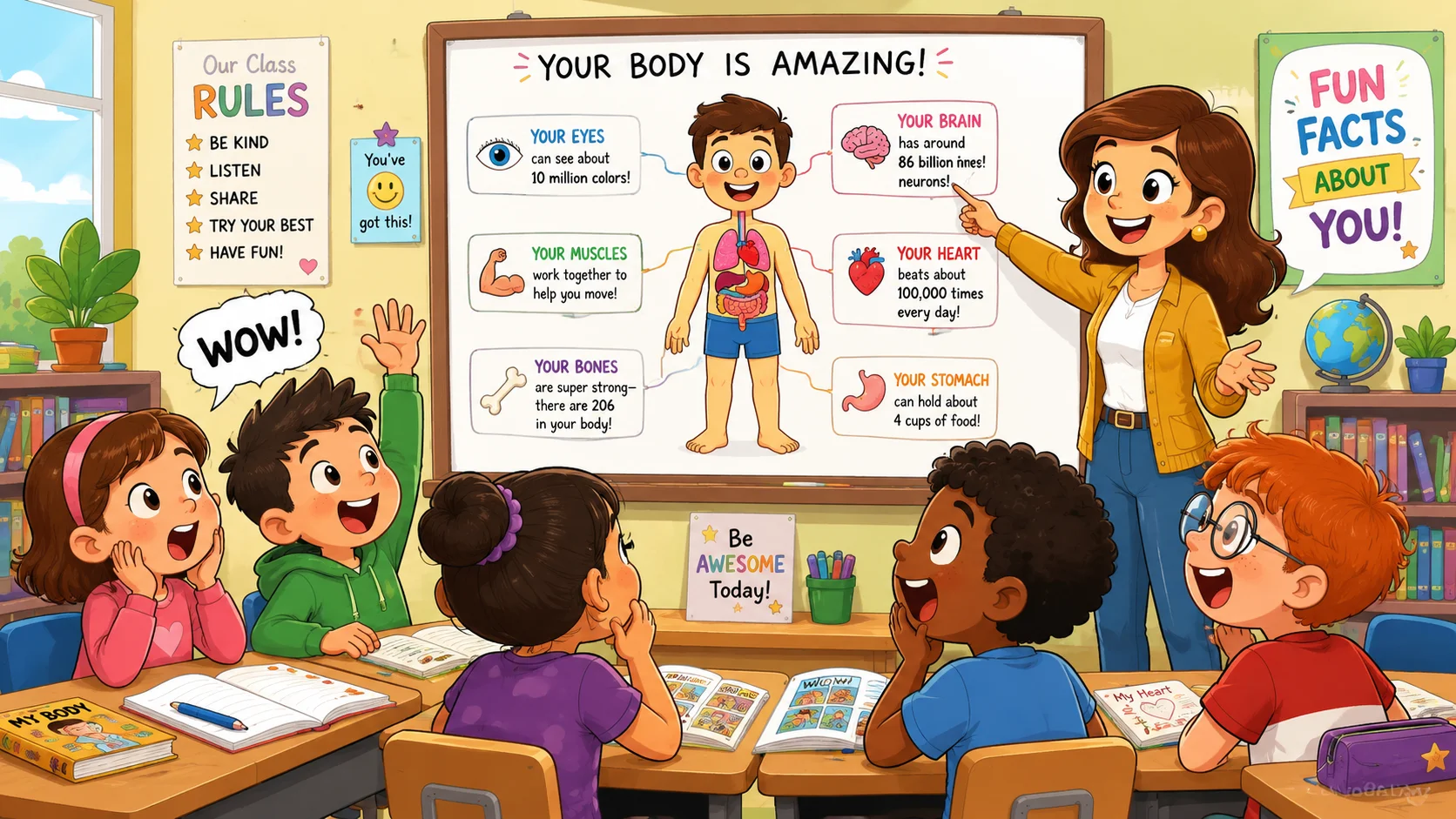
Human babies are born with about 300 bones, many of which gradually fuse as they grow. As a child grows, these separate structures gradually join together, leaving an adult human with 206 bones. A child’s arm span, measured from the tip of the left middle finger to the tip of the right middle finger, is usually close to their height.
Brain and Senses Facts
The human sense of smell is incredibly powerful, and researchers have suggested that people may be able to distinguish a huge number of different scents. Taste cells are regularly replaced throughout life, which helps the sense of taste keep working. Even during sleep, the brain stays active, processing memories, emotions, and sensory information.
Heart, Skin, and Tongue Facts
The human heart is a powerful muscular pump, beating about 100,000 times every day to circulate blood through the body. Skin is the body’s largest organ, and it constantly sheds tiny dead cells as new cells grow underneath. Just like fingerprints, every person has a unique pattern of ridges on the surface of their tongue.
Food Fun Facts for Kids
Fruit and Vegetable Facts
Botanically speaking, an avocado is a single-seeded berry, while a strawberry is not considered a true berry. Cranberries have four tiny air pockets inside them, which allows fresh cranberries to float on water during harvesting. Fresh strawberries contain more natural sugar by weight than lemons, but lemons taste much more sour because they contain high levels of citric acid.
Snack and Dessert Facts
Froot Loops pieces are different colors, but they are widely reported to have the same fruity flavor blend. In one unusual food experiment, McDonald’s reportedly tested bubblegum-flavored broccoli to encourage children to eat more vegetables, but the idea never made it onto menus.
Food History Facts
In the 1830s, some American doctors promoted tomato-based pills as a treatment for digestive problems, long before ketchup became a common table condiment.
| Food History Step | What Happened |
| Tomato-based medicine | Some doctors promoted tomato-based remedies |
| Pills | Tomato-based pills were sold for digestive problems |
| Table condiment | Ketchup later became a popular everyday sauce |
In ancient Mesoamerica, Aztec and Maya people used cacao beans not only to make drinks but also as a form of money for buying everyday goods.
Science Fun Facts for Kids
Physics Facts Kids Can Picture
A single bolt of lightning can heat the surrounding air to about 50,000°F, which is roughly five times hotter than the surface of the Sun. Sound travels through physical matter as a wave, moving through liquid water about four times faster than it travels through open air. This happens because water molecules are packed closer together than gas molecules, allowing energy to transfer more quickly.
Chemistry Facts for Curious Kids
Water is unusual because its solid form, ice, is less dense than its liquid form, which is why ice floats on water. The human stomach contains hydrochloric acid that helps break down food and kill many germs, while the stomach lining protects the body from the acid. When baking soda and vinegar mix, they create carbon dioxide gas, which can inflate a balloon without anyone blowing into it.
Fossil and Rock Facts
Natural chalk is a soft limestone formed from the tiny remains of ancient marine organisms called coccolithophores, although many modern classroom chalks are made from other materials. Volcanic eruptions can produce a light igneous rock called pumice, which is filled with tiny gas bubbles that allow the solid rock to float on water.
| Rock Type | Geological Origin | Unique Physical Property |
| Pumice | Volcanic lava cooling | Floats on water |
| Chalk | Microscopic marine shells | Dissolves in weak acids |
| Obsidian | Rapid lava cooling | Can form sharp edges |
Space Fun Facts for Kids

Moon Facts
Apollo astronaut footprints can remain preserved on the lunar surface for millions of years because the Moon has almost no atmosphere, no wind, and no flowing liquid water to erode them. The Moon has much lower gravity than Earth, exerting only about one-sixth of Earth’s gravitational pull. In theory, the Moon’s lower gravity means a child who can jump 2 feet high on Earth could jump much higher on the Moon.
Planet Facts
The solar system contains extreme planetary behaviors. Venus takes 243 Earth days to complete one full rotation on its axis but only 225 Earth days to travel around the Sun. This means one full rotation on Venus takes longer than one Venusian year. The distant ice giant Neptune has winds that can reach more than 1,200 miles per hour, making it the windiest planet in our solar system.
Astronaut and Rocket Facts
Astronauts living aboard the International Space Station see about 16 sunrises and 16 sunsets every 24 hours as the station orbits Earth at about 17,500 miles per hour. To help protect their bones and muscles in microgravity, astronauts exercise for about two hours a day using special equipment that keeps them from floating away.
Earth and Nature Fun Facts for Kids
Earth Structure Facts
Planet Earth consists of four primary structural layers: the crust, the mantle, the outer core, and the inner core. The inner core is a solid iron and nickel sphere with a temperature of roughly 10,000°F, similar to the heat of the Sun’s surface. This immense heat remains trapped beneath a rocky crust that is broken into large tectonic plates, which shift at about the same speed that human fingernails grow.
Volcano and Earthquake Facts
Underwater volcanic eruptions help form long mountain chains beneath the ocean. Mauna Kea in Hawaii measures over 33,500 feet from its underwater volcanic base to its peak, making it taller than Mount Everest when measured from base to summit. When tectonic plates suddenly slip past each other, they release seismic energy that causes the ground to shake during an earthquake.
Weather and Climate Facts
The water cycle creates massive clouds, and an average white cumulus cloud can weigh about 1.1 million pounds, which is roughly the weight of 100 adult elephants. Rainbows form full circles of color when viewed from high above the ground, such as from an airplane, though people on the ground usually see only an arc because the horizon blocks the lower part.
Animal Fun Facts for Kids
Mammal Facts
The blue whale is the largest known animal ever to have lived on Earth, and its tongue can weigh as much as an adult elephant. Koalas have fingerprint ridges that are so similar to human fingerprints that they can be difficult to tell apart, even under a microscope. Polar bears have hollow fur that helps them appear white, while their skin underneath is black.
Bird Facts
The peregrine falcon is the fastest animal, reaching diving speeds of more than 240 miles per hour when hunting prey from high altitudes. Penguins are flightless birds that have adapted their wings into stiff, flat flippers, allowing them to swim underwater at speeds reaching 22 miles per hour. Owls have fixed eye sockets that prevent them from moving their eyes, so they rotate their heads instead and can turn them up to 270 degrees.
Reptile and Amphibian Facts
The wood frog has an incredible survival adaptation: it can freeze much of its body during cold winter months, stop its heart, and then thaw safely in the spring. Green iguanas have a special light-sensitive “third eye” on top of their heads called a parietal eye. It cannot see clear images, but it can detect changes in light that may warn them about predators overhead.
Ocean Fun Facts for Kids
Deep Sea Facts
NOAA notes that more than 80% of the ocean remains unmapped, unobserved, and unexplored. In the deepest zones, such as the Mariana Trench, the water is completely dark and under immense pressure. Many organisms in these zones use bioluminescence to create their own cold light through chemical reactions.
Sea Animal Facts
Marine animals have remarkable features designed for life in water. The octopus has three functioning hearts and a nervous system in which about two-thirds of its neurons are located in its eight arms.
- Great White Sharks: These apex predators track prey by detecting tiny electrical fields using specialized nose pores called the ampullae of Lorenzini.
- Dolphins: These marine mammals sleep by resting only one brain hemisphere at a time, keeping one eye open to watch for predators.
- Immortal Jellyfish: This species can revert to an earlier life stage after reaching maturity, which is why it is often nicknamed “immortal.”
Ocean Planet Facts
Microscopic ocean plankton produce roughly half of the oxygen generated on Earth. Oceans also contain vast quantities of dissolved mineral salts, which enter the water through river runoff, seafloor vents, and the weathering of rocks. The average global salinity of seawater is about 35 grams of salt per liter.
Insect Fun Facts for Kids
Bee and Butterfly Facts
Honeybees are important pollinators, and they may need to visit about 2 million flowers to gather enough nectar to make a single pound of honey. Monarch butterflies complete an incredible multi-generational migration each autumn, flying up to 3,000 miles from Canada and the northern United States to central Mexican forests using an internal compass guided by the Sun.
Ant and Beetle Facts
Ant colonies are highly organized societies, and leafcutter ants can carry leaf fragments weighing many times more than their own bodies. Bombardier beetles defend themselves by mixing chemicals inside their bodies and spraying a hot, irritating liquid at predators.
Bug Myths and Cool Truths
A common point of confusion for children is the difference between insects and spiders. Insects have six legs and three body segments, while spiders have eight legs and belong to the arachnid family. Fireflies create their glow through bioluminescence, a highly efficient chemical process that produces very little heat.
Sports Fun Facts for Kids
Olympic Facts
From 1912 until 1948, the modern Olympic Games included official competitive medals for fine arts, awarding prizes for architecture, literature, music, painting, and sculpture. In ancient Greece, one of the earliest Olympic events was a footrace called the stade, which was about 192 meters long.
Strange Sports Facts
Local communities around the world host unusual athletic competitions, such as the annual World Toe Wrestling Championship in England, where competitors link toes and try to force their opponent’s foot to the ground. Another unusual event is the Cooper’s Hill Cheese Rolling, where participants race down a steep hill after an 8-pound wheel of Double Gloucester cheese that can reach very high speeds.
Sports Equipment Facts
Sports equipment has changed a lot over time, helping athletes play faster, safer, and better.
| Sport | Historical Material | Modern Standard Material |
| Golf | Carved hardwood / leather with feathers | Core polyurethane and Surlyn |
| Ice Hockey | Frozen cow dung / carved wood | Vulcanized rubber |
| Basketball | Heavy stitched leather with laces | Pebble-textured synthetic leather |
Geography Fun Facts for Kids
Country and Continent Facts
Vatican City is the world’s smallest fully independent nation-state, covering about 0.17 square miles and surrounded by Rome, Italy. Australia is both a country and the world’s smallest continent.
Island and Desert Facts
Antarctica is considered the largest desert on Earth because it receives very little precipitation, even though it is covered by a massive ice sheet. Greenland is the largest non-continental island on Earth, with most of its landmass buried under a massive ice sheet that can measure up to 2 miles thick.
City and Border Facts
Istanbul, Turkey, is one of the world’s most famous transcontinental cities, with parts of the city lying in both Europe and Asia. In the United States, the Four Corners Monument lets visitors stand in four states at once: Arizona, New Mexico, Utah, and Colorado.
Place Facts for Kids
Famous Landmark Facts
The Eiffel Tower in Paris, France, changes slightly with temperature because its iron frame expands in heat and contracts in cold. During hot summer days, the tower can grow by up to about 6 inches. In Asia, Mount Everest is the highest mountain above sea level, with its peak rising about 29,032 feet into the atmosphere, where winds can reach extreme speeds.
National Park Facts
Yellowstone National Park sits above a major volcanic system, and its underground heat helps power more than 500 geysers, including Old Faithful. Farther west, Yosemite National Park features incredible granite cliffs like El Capitan, which rises over 3,000 feet straight up from the valley floor and attracts rock climbers from all over the world.
World Culture Facts
Societies around the world practice distinct cultural traditions, such as the annual Songkran festival in Thailand, where many people celebrate the traditional New Year with water fights and symbolic washing away of bad luck. In Japan, many elementary school students take part in a routine called o-soji, spending part of the school day cleaning their classrooms with their classmates and teachers.
History Fun Facts for Kids
Weird History Facts
During the Victorian era in the 19th century, early photography required long exposure times, so people often had to sit very still to keep the picture clear. Some photographers reportedly told people to say “prunes” instead of “cheese,” which helped create the serious expressions seen in many old portraits.
Ancient Civilization Facts
Ancient civilizations engineered advanced structures and infrastructure that influenced the modern world.
- Ancient Egypt: Workers constructed the Great Pyramid of Giza using over 2.3 million individual stone blocks, each weighing an average of 2.5 tons, without modern cranes.
- Ancient Rome: Engineers built massive aqueducts with gentle downward slopes, allowing fresh water to travel long distances by gravity.
- The Vikings: Navigators designed longships with shallow drafts, allowing them to sail across open oceans and navigate shallow rivers only a few feet deep.
Famous People from History
The Egyptian ruler Cleopatra lived chronologically closer to the 1969 Apollo Moon landing than to the construction of the Great Pyramid of Giza, which had already stood for more than 2,500 years during her reign. Abraham Lincoln remains the only U.S. president to hold a patent; in 1849, he registered a device designed to lift boats over shallow river shoals.
Math Fun Facts for Kids
Number Facts
The number zero is not represented in traditional Roman numerals, because the ancient Roman system used letters for positive values. In standard American number spelling without “and,” the letter “A” does not appear until “one thousand.”
Shape and Pattern Facts
Honeybees build honeycombs from hexagons because this shape stores a lot of honey while using very little wax. This repeating geometric pattern without gaps or overlaps is called a tessellation, and similar patterns can also be seen in pineapple skins and alligator scales.
Everyday Math Facts
A standard cube die used in board games has a special layout where the dots on any two opposite sides always add up to seven. A common calendar year has 365 days, which equals 31,536,000 seconds; leap years have 366 days.
Weather Fun Facts for Kids
Cloud and Rain Facts
Raindrops are not shaped like the teardrops often shown in drawings; as they fall, air pressure flattens them so they look more like tiny hamburger buns. When winter temperatures drop, snowflakes form hexagonal crystal patterns around tiny particles, and large natural snowflakes are extremely unlikely to be exactly alike.
Storm Facts
Thunder is created when lightning rapidly heats the surrounding air. The air expands faster than the speed of sound, creating the loud sound wave we hear as thunder. In large tornadoes, winds can reach rotating speeds of over 300 miles per hour, generating enough force to lift heavy vehicles off the ground.
Season Facts
Earth has seasons because its axis is tilted at an angle of about 23.5 degrees relative to its path around the Sun. This tilt changes how much direct sunlight different regions receive throughout the year, creating seasonal cycles. Other planets have much longer cycles; Saturn takes about 29 Earth years to orbit the Sun, meaning each season on Saturn lasts for more than seven Earth years.
Climate and Planet Facts for Kids
Climate Change Basics
Climate scientists distinguish between short-term weather conditions and long-term climate patterns by tracking global trends over 30-year observation windows. Current data show that rising global temperatures are melting polar ice sheets, adding water to the oceans and raising sea levels. Scientists also study ancient glaciers by drilling ice cores that contain air bubbles trapped thousands of years ago.
Planet Helper Facts
Trees act as natural air filters, absorbing carbon dioxide from the atmosphere while releasing oxygen. Recycling aluminum beverage cans also provides a major benefit, because making a new can from recycled material uses far less energy than producing one from raw materials.
Kid-Friendly Eco Challenges
Children can take simple, everyday actions to support environmental sustainability and protect local ecosystems.
- The Light Switch Rule: Turn off lights and electronics when you leave a room to save electricity.
- Two-Minute Timer: Turn off the sink faucet while brushing your teeth to save clean water.
- Paper Conservation: Use both sides of every sheet of drawing paper before placing it in a recycling bin.
- Trash Patrol: Pick up three pieces of litter whenever you visit a public park or beach to help keep plastic waste away from local wildlife.
Famous People and Culture Fun Facts for Kids
Scientist and Explorer Facts
British naturalist Sir David Attenborough has had dozens of animal and plant species named in his honor, including insects, plants, and prehistoric animals. In space exploration, scientist Sally Ride became the first American woman in space in 1983 and later wrote science books for children to encourage them to explore space and science.
Writer and Artist Facts
William Shakespeare is credited with helping popularize or record more than 1,700 English words, often by using familiar words in creative new ways. Spanish painter Pablo Picasso showed remarkable artistic skill from an early age and completed his first known oil painting, The Picador, when he was still a child.
Leader and Royal Facts
During her 19th-century reign, Queen Victoria became the first British monarch to travel by train, taking a historic journey in 1842. In American history, President George Washington used dentures made from materials such as hippopotamus ivory, human teeth, brass screws, and gold wire, not wood as many people mistakenly believe.
Fun Facts for Kids FAQs
What Are the Best Daily Fun Facts for Kids?
The most effective daily fun facts for children are short, surprising, accurate, and free of complex jargon. Great topics include animal adaptations, space exploration, the human body, and surprising moments from history. These topics create an immediate “wow” reaction and encourage kids to share what they learned with others.
How Can Parents Use Daily Fun Facts?
Parents can naturally integrate daily facts into regular family routines without making them feel like schoolwork. Excellent opportunities include sharing a fact during breakfast, discussing one during car rides, using facts as bedtime conversation starters, or hosting a short weekend family trivia game.
How Can Teachers Use Fun Facts in Class?
Teachers can use fun facts as quick learning hooks during daily transitions. A teacher might write a fact on the board as a morning greeting, use it as a creative writing prompt, feature it on a science bulletin board, or turn it into a trivia question to refocus attention after recess.
Why Do Kids Like Random Facts?
Children are naturally drawn to random facts because they satisfy curiosity about how the world works. Surprising trivia provides a quick dose of novelty and humor, giving children an exciting piece of knowledge that builds confidence when shared with friends.
How Many Fun Facts Should Kids Learn per Day?
For most children, 1 to 5 fun facts per day is a good range. Limiting daily facts prevents cognitive overload and gives children time to process, understand, and remember each new piece of information.

Take a short quiz to find out what your everyday choices say about your parenting style
When your child is curious about something new, what’s your instinct?
Take a short quiz to find out what your everyday choices say about your parenting style
“Can I download this app?” What happens next?
Take a short quiz to find out what your everyday choices say about your parenting style
When it comes to rules at home, which sounds most like you?
Take a short quiz to find out what your everyday choices say about your parenting style
If you could give your child one life skill today, what would you pick?
Take a short quiz to find out what your everyday choices say about your parenting style
Your child gets to choose what to watch. What would your ideal setup look like?
Take a short quiz to find out what your everyday choices say about your parenting style
Pick your parenting superpower ✨



