100+ Fun Riddles for Kids With Answers

 Discover a Free Education Video App for Kids
Pastory uses AI to personalize educational video content based on your child’s interests and personality. Safe, engaging, and built for curious young minds. Sign up now to stay updated and enjoy early access with a free trial

Finding the best riddles for kids is a great way to combine fun with cognitive development. This collection of fun riddles for kids gives little ones age-appropriate challenges that help them build critical thinking, vocabulary, and problem-solving skills while having fun. Whether you are a teacher looking for activities for kids or a parent trying to keep children entertained on a long drive, these quick brain teasers are a simple screen-free solution.
Riddles are a great way to encourage kids to think outside the box. When children work through a brain teaser, a tricky question, or a clever clue, a child’s brain gets practice processing information through logic, wordplay, and lateral thinking. This list of riddles includes funny questions, word riddles, math challenges, and tricky riddles for kids, so kids of all ages can find something they will enjoy solving.
Key Takeaways
Before you dive into the list, here is a quick overview of what this guide offers:
- 100+ fun riddles for kids with answers across multiple categories.
- A balanced list of riddles organized by difficulty, topic, age group, and grade level.
- Specific sections for animals, food, math, science, space, seasons, and word riddles.
- Activities for kids that work well at home, in the classroom, during car rides, or at parties.
- Tips for getting kids to think, solve clues, and create their own clever riddles.
Best Ways to Use These Riddles
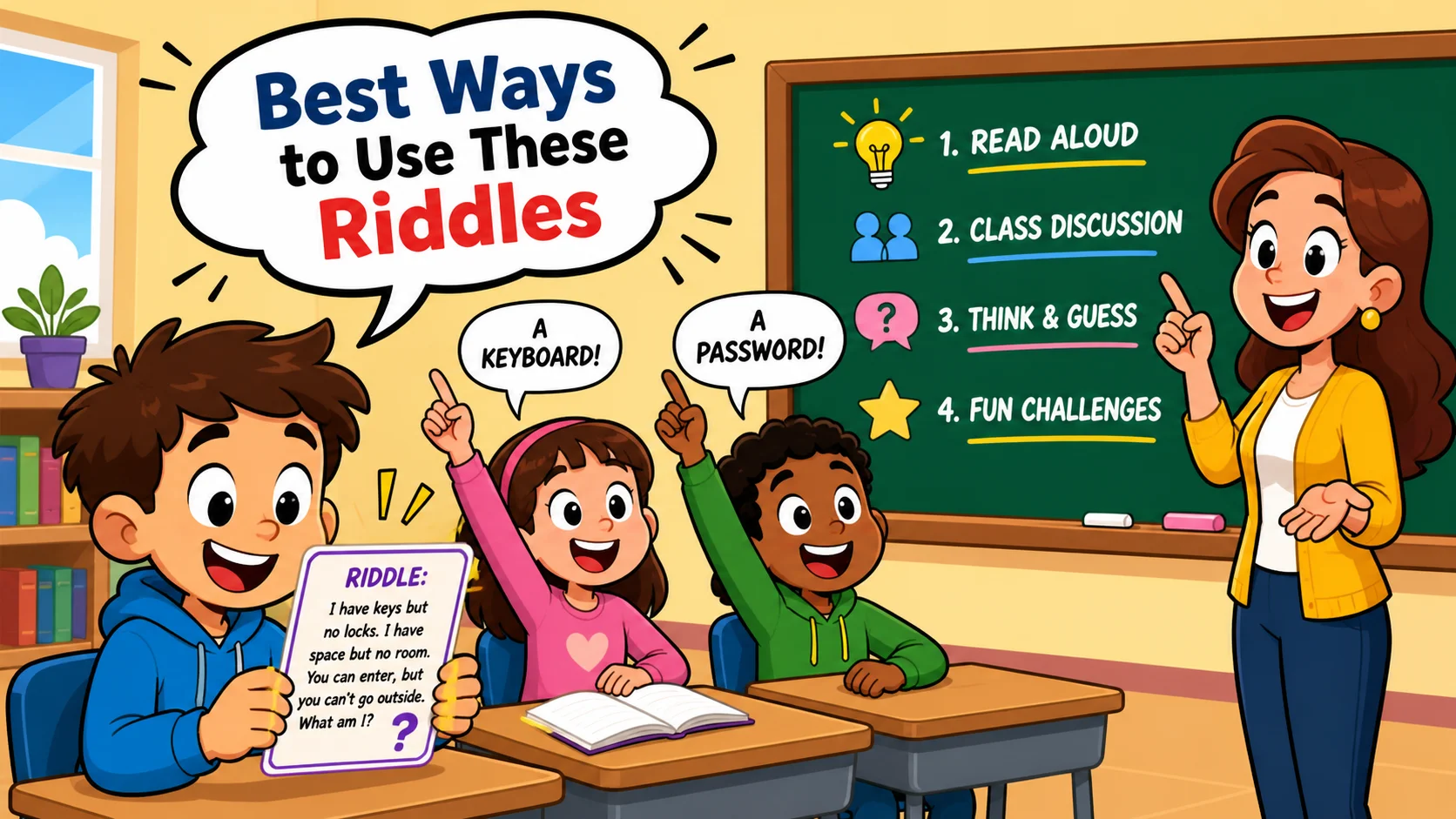
Teachers can use these prompts as morning warm-ups, English language arts activities, or quick “brain breaks” between lessons. Parents can use riddles to keep kids occupied during car rides, family game nights, birthday parties, or quiet time at home.
Kids love these short challenges because they feel like a game. Adults appreciate them because they get their brains working without screens, supplies, or complicated rules. If you are looking for riddles that are easy to use anywhere, this collection is a practical place to start.
Difficulty Levels
This collection includes riddles that are easy enough for little ones and challenging riddles for older kids who need a bigger mental workout. The goal is to help kids find the right level: not so simple that it feels boring, but not so hard that it becomes frustrating.
For younger children, start with animals, colors, food, and everyday objects. Older kids might enjoy clever riddles, wordplay, logic puzzles, and tricky questions that make them think twice before answering.
Learning Benefits
Riddles may look simple, but they can support several important learning skills. Word riddles can help with English language arts by expanding vocabulary, improving reading comprehension, and encouraging children to notice double meanings. Math-based questions can support math knowledge and problem-solving skills by presenting numbers and patterns in a playful format.
These challenges are also great for kids because they make thinking feel like a fun activity. When children listen to clues, compare possible answers, and explain their reasoning, they build focus, confidence, and brain power over time.
What Is a Riddle for Kids?
A riddle is a type of word puzzle that describes an object, person, animal, or idea in a mysterious way and invites the listener to guess the answer. For children, these clue-based games are a great way to connect play with learning.
Simple Definition
For a young child, a riddle is simply a word-based guessing game. It gives a set of clues that point toward a specific answer.
Example:
“I have a face and two hands, but no arms or legs. What am I?”
Answer:
(A clock.)
How These Puzzles Work
These challenges use descriptive clues, hidden meanings, and clever wordplay to lead children toward a “lightbulb moment.” Most simple word puzzles rely on surprise or double meaning, which encourages kids to think about words in more than one way. By analyzing the clues, children use deductive reasoning to find the answer.
Riddles Versus Jokes
While both riddles and jokes can be funny, they work in different ways. A joke is designed to make people laugh through a punchline, while a clue-based question is a challenge that requires active thinking. The “win” comes from figuring out the logic of the answer rather than simply laughing at the setup.
A Brief History of Word Puzzles for Kids
Clue-based guessing games have been part of human culture for thousands of years, appearing in ancient mythology, folklore, and storytelling traditions from around the world. Historically, they were often used to test the wisdom of kings, heroes, and travelers in stories. Today, they remain common in language arts lessons and children’s books because they are simple, timeless tools that encourage kids to think.
Easy Riddles With Answers
This collection is designed to keep kids entertained and thinking. Try reading each question aloud and giving children at least 30 seconds to solve it before offering a hint.
Easy Starter Questions
- I have to be broken before you can use me. What am I? (An egg.)
- I am tall when I am young, and I am short when I am old. What am I? (A candle.)
- What month of the year has 28 days? (All of them.)
- What is full of holes but still holds water? (A sponge.)
- What question can you never answer yes to? (Are you asleep yet?)
- What is always in front of you but can’t be seen? (The future.)
- There’s a one-story house where everything is yellow. The walls are yellow, the doors are yellow, and all the furniture is yellow. What color are the stairs? (There are no stairs – it’s a one-story house.)
- What can you break, even if you never pick it up or touch it? (A promise.)
- What goes up but never comes down? (Your age.)
- A boy fell off a 30-foot ladder but didn’t get hurt. Why? (He fell off the bottom step.)
- What has a thumb and four fingers but is not a hand? (A glove.)
- What has a neck but no head? (A bottle.)
- What has a head and a tail but no body? (A coin.)
- What building has the most stories? (A library.)
- What has many keys but cannot open a single lock? (A piano.)
- What can you catch but not throw? (A cold.)
- What has hands but cannot clap? (A clock.)
- What has one eye but can’t see? (A needle.)
- What gets wetter the more it dries? (A towel.)
- What belongs to you, but everyone else uses it more than you do? (Your name.)
- I follow you all day long, but when the sun goes away, I am gone. What am I? (Your shadow.)
- What has legs but cannot walk? (A table.)
- What has bark but no bite? (A tree.)
- If you drop me, I’m sure to crack, but give me a smile and I’ll always smile back. What am I? (A mirror.)
General Brain Teasers for Kids
- What is orange, wears a green hat, and sounds like a parrot? (A carrot.)
- What falls but never gets hurt? (Snow.)
- What has a mouth but cannot eat? (A river.)
- What has a face and two hands but no arms or legs? (A clock.)
- What goes through cities and over hills but never moves? (A road.)
- What has teeth but cannot bite? (A comb.)
- What kind of coat is always wet when you put it on? (A coat of paint.)
- What has many words but never speaks? (A book.)
- What travels around the world but stays in one corner? (A stamp.)
- I am easy to lift but hard to throw. What am I? (A feather.)
- What can you hear but not see or touch, even though you control it? (Your voice.)
- What starts with “P,” ends with “E,” and has thousands of letters? (A post office.)
- I have cities but no houses. I have mountains but no trees. I have water but no fish. What am I? (A map.)
- What is so fragile that saying its name breaks it? (Silence.)
- What has one horn and gives milk? (A milk truck.)
- What gets bigger the more you take away from it? (A hole.)
- What is always coming but never arrives? (Tomorrow.)
- What is black and white and read all over? (A newspaper.)
- I have a heart that doesn’t beat. What am I? (An artichoke.)
- What is at the end of a rainbow? (The letter W.)
- What can run but never walk? (Water.)
- I have many needles but do not sew. What am I? (A pine tree.)
- What goes up and down but stays in the same place? (Stairs.)
- What is the easiest way to double your money? (Put it in front of a mirror.)
- What has four eyes but can’t see? (Mississippi.)
Short Questions for Quick Play
- What has a ring but no finger? (A telephone.)
- What has a foot on each side and one in the middle? (A yardstick.)
- What kind of dog never bites? (A hot dog.)
- What has a spine but no bones? (A book.)
- What has an ear but cannot hear? (Corn.)
Best Ways to Use Brain Teasers at Home or in the Classroom
These questions work especially well in the classroom when they are presented as a group challenge. Teachers can read the prompt once, ask students to visualize the clues, and then call on volunteers. This encourages kids to think creatively while practicing active listening.
At home, these quick activities can become a simple family routine. Try asking one question at breakfast, during a walk, or before bedtime. The goal is not only to find the answer but also to enjoy the thinking process.
Funny Riddles for Kids
Funny riddles combine a small cognitive challenge with humor. These kid-friendly prompts are clean, safe, and surprisingly clever.
Silly Questions With Easy Answers
- What do you call a bear with no teeth? (A gummy bear.)
- Why did the student do her multiplication problems on the floor? (The teacher told her not to use tables.)
- What is a witch’s favorite subject in school? (Spelling.)
Laugh-Out-Loud Answers
| Question | Answer |
| What do you call a sleeping dinosaur? | (A dino-snore.) |
| Why did the golfer wear two pairs of pants? | (In case he got a hole in one.) |
| What do you call an elephant that doesn’t matter? | (An irrele-phant.) |
Funny Animal Questions
- What do you call a cold dog? (A chili dog.)
- What animal is best at hitting a baseball? (A bat.)
- Why do cows wear bells? (Because their horns don’t work.)
Funny School Questions
- Why was the broom late for school? (It over-swept.)
- Why was the math book sad? (Because it had too many problems.)
- Why did the student eat his homework? (Because the teacher said it was a piece of cake.)
Animal Guessing Games for Kids
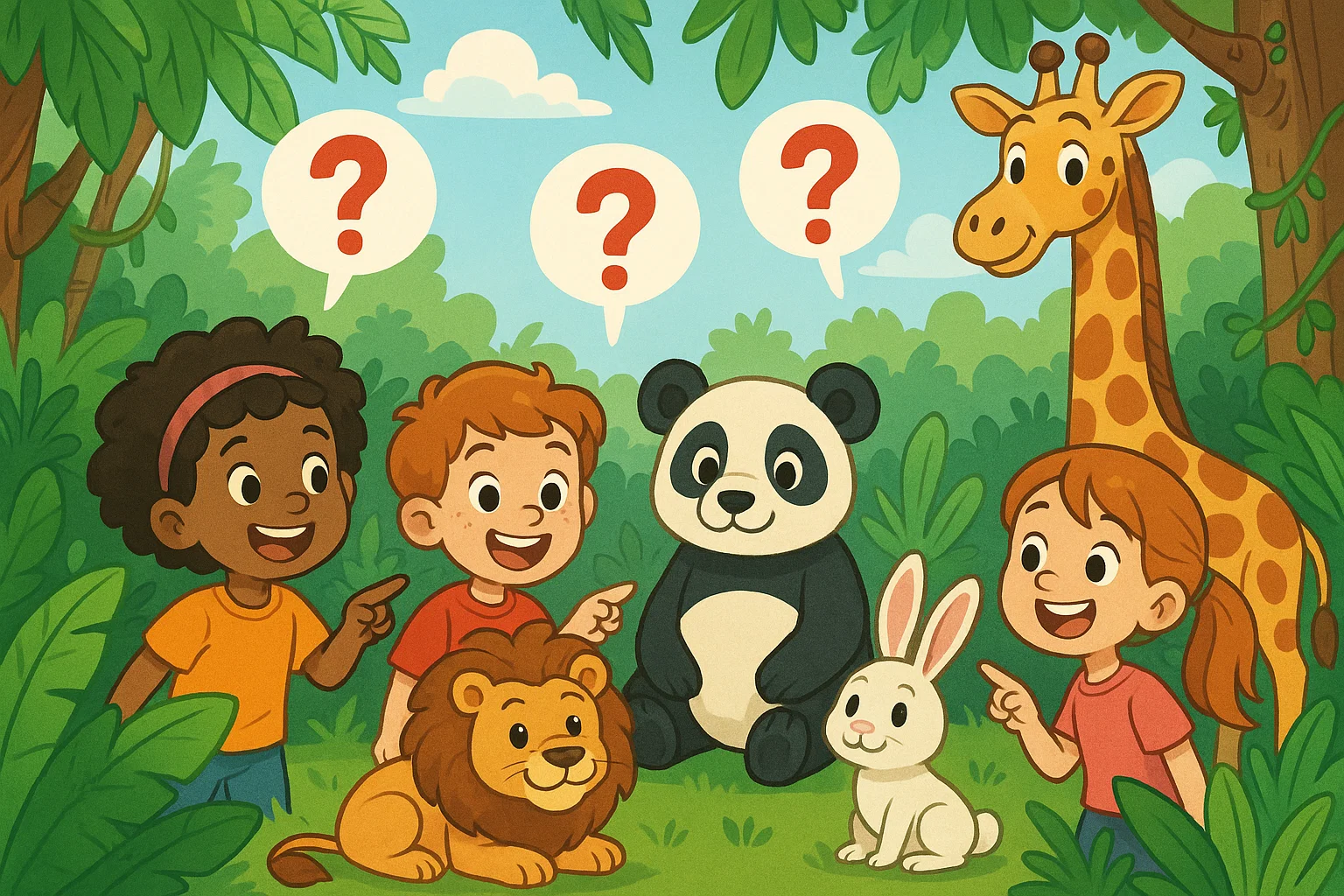
Animal-themed clues are often some of the most popular activities for children because kids naturally enjoy learning about animals.
Pet Clues
- I am your best friend, I have four legs, and I love to bark. What am I? (A dog.)
- I am quiet, I like to chase mice, and I say “meow.” What am I? (A cat.)
- I live in a bowl and I can swim, but I never say a word. What am I? (A fish.)
Farm Animal Clues
- I give you milk and I say “moo.” What am I? (A cow.)
- I have feathers and lay eggs. What am I? (A hen.)
- I am pink, I have a curly tail, and I love mud. What am I? (A pig.)
Wild Animal Clues
- I have a long trunk and big ears. What am I? (An elephant.)
- I have a mane and a loud roar. What am I? (A lion.)
- I have a very long neck to reach leaves in trees. What am I? (A giraffe.)
Ocean Animal Clues
- I have eight arms and live in the sea. What am I? (An octopus.)
- I am the biggest animal in the world. What am I? (A blue whale.)
- I have a hard shell and I walk sideways. What am I? (A crab.)
Food-Themed Word Puzzles for Kids
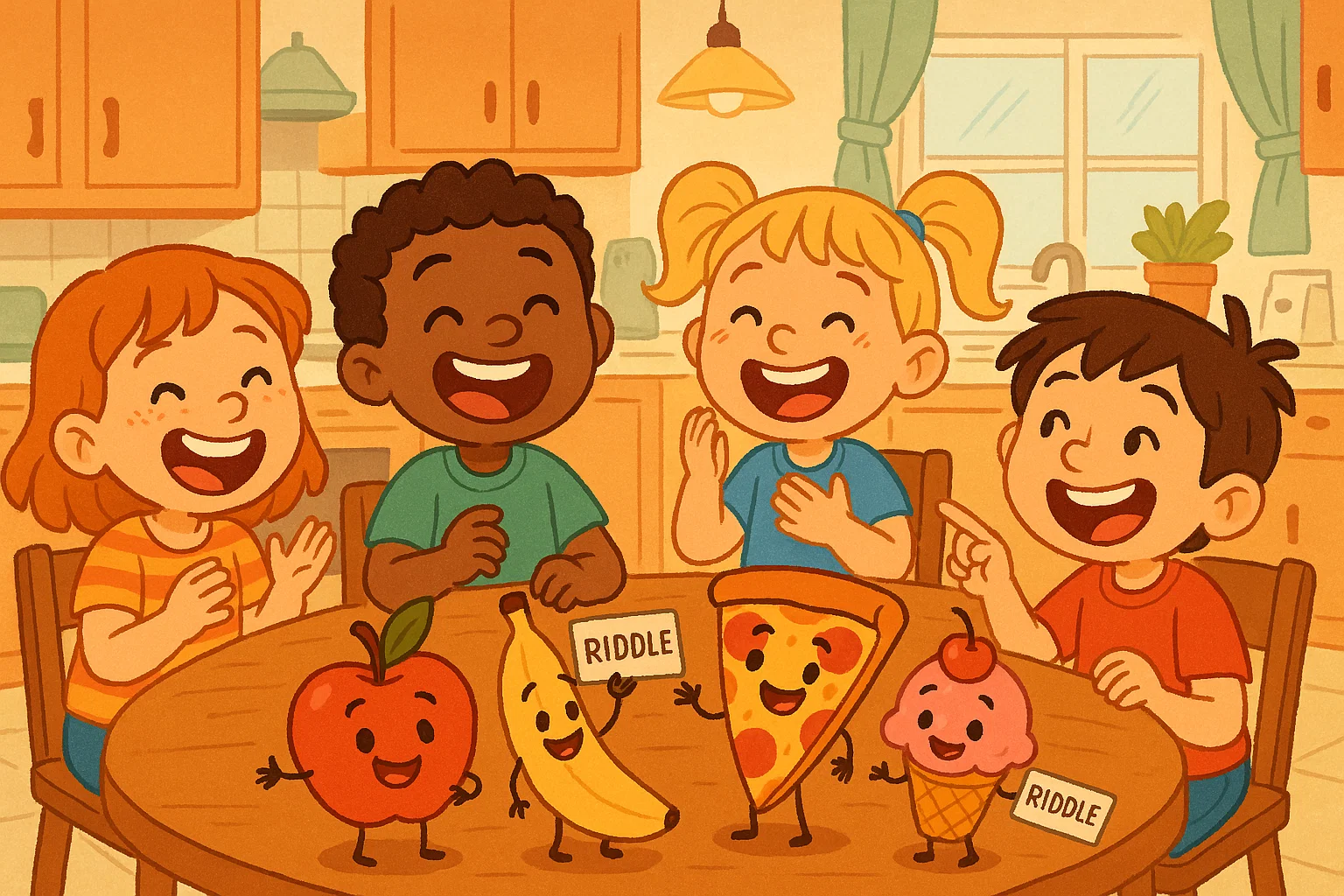
Food-themed clues use visual descriptions of everyday items to build critical thinking and vocabulary.
Fruit Clues
- I can be red and crunchy, and teachers are often pictured with me. What am I? (An apple.)
- I am yellow and long, and you have to peel me to eat me. What am I? (A banana.)
- I am a fruit that is always sad. What am I? (A blueberry.)
Vegetable Clues
- I am orange and crunchy, and people often say I am good for your eyes. What am I? (A carrot.)
- I have many eyes but cannot see. What am I? (A potato.)
- I look like a tiny green tree. What am I? (Broccoli.)
Snack and Breakfast Clues
- I start out as a kernel and go “pop” in the heat. What am I? (Popcorn.)
- I am round, I have a hole in the middle, and I’m great with cream cheese. What am I? (A bagel.)
- I am sweet, cold, and often eaten in a cone. What am I? (Ice cream.)
Math Brain Teasers for Kids
Math-based questions focus on logic rather than complex equations. These activities help build number sense, math knowledge, and problem-solving skills.
Counting Questions
- I am an odd number. Take away one letter and I become even. What number am I? (Seven.)
- What number comes next in the sequence: 2, 4, 6, 8…? (10.)
- I am more than 5 but less than 7. What number am I? (6.)
Addition and Subtraction Questions
- If there are three apples and you take away two, how many apples do you have? (Two – the ones you took.)
- You have a basket with 10 bread rolls. You eat one every morning. How many days until the basket is empty? (10 days.)
- There are five birds on a fence. Two fly away. How many are left? (Three.)
Shape Questions
- I have four equal sides and four corners. What am I? (A square.)
- I am perfectly round and have no corners at all. What am I? (A circle.)
- I have three sides and three corners. What am I? (A triangle.)
English Word Puzzles for Kids
English word puzzles focus on wordplay, spelling, rhyming, and the playful side of the English language. They can also support English language arts skills by helping kids notice sounds, letters, and meanings.
Wordplay Questions
- What is at the beginning of eternity, the end of time and space, the beginning of every end, and the end of every place? (The letter E.)
- What starts with T, ends with T, and has tea in it? (A teapot.)
- What word becomes shorter when you add two letters to it? (Short.)
Rhyming Questions
- I am cold and white. I can fall from the sky, and I rhyme with “glow.” What am I? (Snow.)
- I fly in the sky and rhyme with “night.” What am I? (A kite.)
- I am small, furry, and rhyme with “bat.” What am I? (A cat.)
Science Brain Teasers for Kids
These science-themed questions introduce simple ideas about nature, weather, space, and the human body in a fun way.
Nature and Weather Questions
- I have no wings, but I can fly. I have no eyes, but I can cry. What am I? (A cloud.)
- I come after the rain and have seven colors. What am I? (A rainbow.)
- I am bright, warm, and help plants grow. What am I? (The Sun.)
Body Questions
- I help you see the world around you. What am I? (Your eyes.)
- I pump blood and never stop. What am I? (Your heart.)
- I help you hear music, voices, and sounds. What am I? (Your ears.)
Space and Planet Brain Teasers for Kids
Space-themed questions are excellent for cross-curricular learning because they combine science vocabulary with reading and reasoning skills.
Solar System Questions
- I am the star at the center of the solar system. What am I? (The Sun.)
- I am called the “Red Planet.” What am I? (Mars.)
- I have beautiful rings made of ice and dust. What am I? (Saturn.)
Space Vocabulary Questions
- I am a person who travels to space in a rocket. What am I? (An astronaut.)
- I am a ball of ice, dust, and rock that can form a glowing tail near the Sun. What am I? (A comet.)
- I orbit a planet and can shine brightly at night. What am I? (A moon.)
Hard Brain Teasers for Kids
For older kids who need a bigger challenge, these harder prompts require deeper critical thinking.
Tricky Logic Questions
- What has branches but no leaves, trunk, or bark? (A bank.)
- What has keys but no locks, space but no room, and an Enter key but no door? (A keyboard.)
- The more of this there is, the less you see. What is it? (Darkness.)
Brain Teasers for Older Kids
- What has many hearts but no other organs? (A deck of cards.)
- What can fill a room but takes up no space? (Light.)
- What gets sharper the more you use it? (Your brain.)
Grade-Level Questions for Kids
Matching a question to a child’s grade level helps keep the activity developmentally appropriate. Younger children usually need concrete clues, while older children can handle wordplay, abstract thinking, and trick questions.
Kindergarten and 1st Grade Questions
Focus on colors, animals, and familiar objects.
- I am the color of most grass and many leaves. What color am I? (Green.)
- I am white, dusty, and used to write on a chalkboard. What am I? (Chalk.)
- I say “woof” and wag my tail. What am I? (A dog.)
2nd and 3rd Grade Questions
Introduce simple logic, animals, and word clues.
- What has a neck but no head? (A shirt.)
- What can you find in the middle of “nowhere”? (The letter H.)
- I have pages, pictures, and a cover. What am I? (A book.)
4th and 5th Grade Questions
Use more complex wordplay and trick questions.
- What word is spelled incorrectly in every dictionary? (Incorrectly.)
- What has a bottom at the top? (Your legs.)
- What has 13 hearts but no lungs or stomach? (A deck of cards.)
Seasonal Brain Teasers for Kids
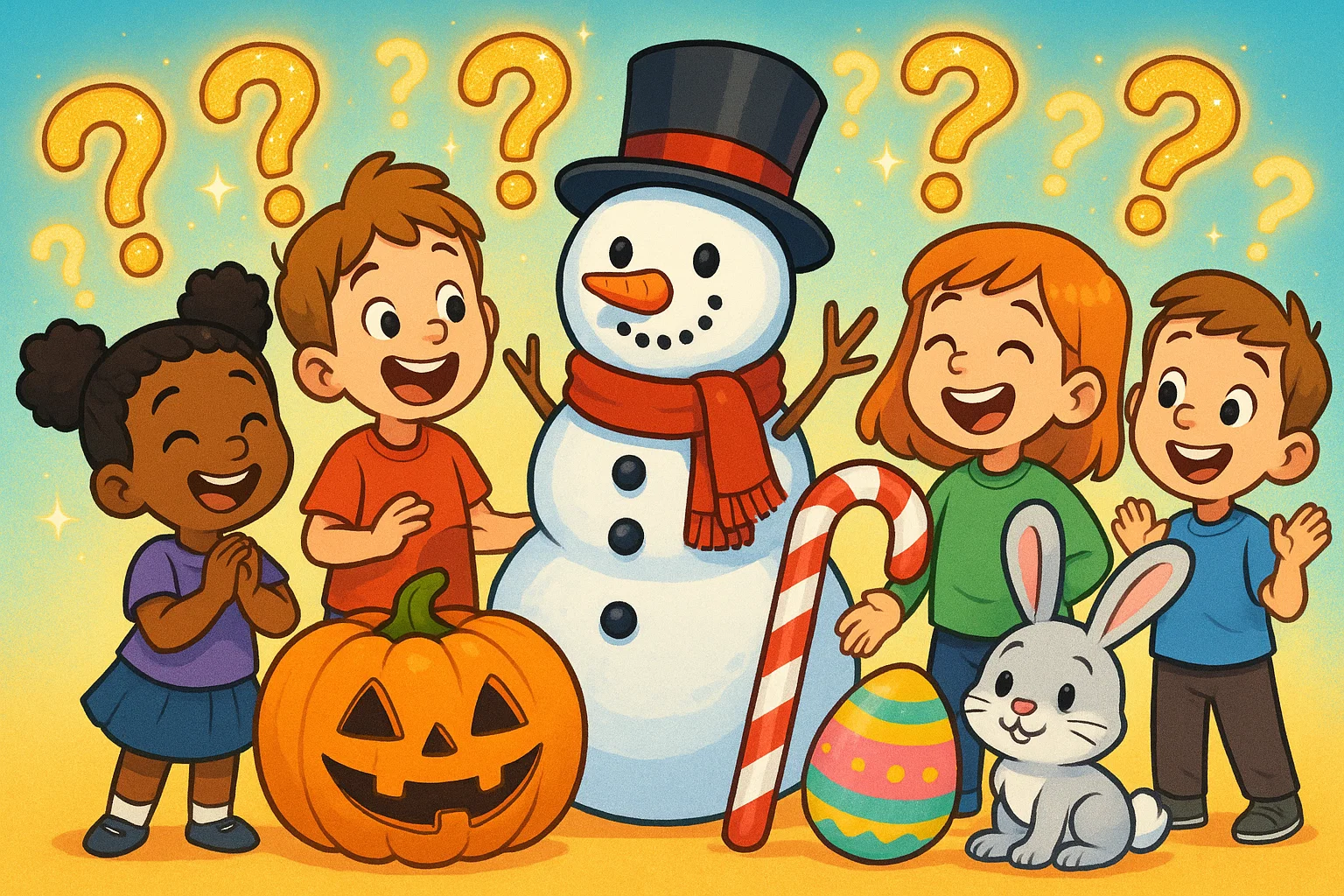
Seasonal questions are great for holidays, classroom celebrations, and themed family activities.
December and Holiday Questions
- I am made of snow and often have a carrot nose. What am I? (A snowman.)
- I am green all year, and many people decorate me in December. What am I? (A Christmas tree.)
- I come wrapped in paper and may have a bow on top. What am I? (A gift.)
Summer and Halloween Questions
- I am a large orange pumpkin with a carved face. What am I? (A jack-o’-lantern.)
- You wear me on your face to hide who you are on Halloween. What am I? (A mask.)
- I am bright, hot, and perfect for beach days. What am I? (The summer sun.)
Family Guessing Games
These clue-based games are great for family bonding. Here are a few simple ways to incorporate them into daily life.
Car Ride Brain Teasers
Keep kids entertained during travel by having a “Brain Teaser Marathon.” One person acts as the question master, and the others compete to find the answer. To make the game easier for younger children, give category hints such as “animal,” “food,” or “something in the house.”
Party Clue Games
Create a “Clue Scavenger Hunt.” Each prompt gives a hint about the location of the next hidden prize. This turns puzzle-solving into an active game that gets kids moving and thinking.
Bedtime Questions
Use one or two calm prompts before bed as a simple screen-free routine. Choose easy questions with familiar answers so the activity stays fun and relaxing.
Benefits of Brain Teasers for Kids
Adding clue-based games to a child’s routine can support thinking, language development, and social interaction. They are simple, flexible, and easy to use almost anywhere.
Critical Thinking Skills
These word games help kids practice analyzing information. Children must listen carefully, identify important clues, ignore distractions, and test possible answers. This type of lateral thinking can support stronger problem-solving skills over time.
Vocabulary Growth
When children encounter new words in the context of a brain teaser, they can expand their vocabulary naturally. These activities also help children understand that words can have more than one meaning.
Memory and Focus
To solve a tricky prompt, a child must hold multiple clues in working memory. This practice can improve concentration and help children stay engaged with language-based tasks.
Social Confidence
Clue-based games are fun to solve in pairs or groups. When children share answers, explain their thinking, or laugh at a surprising solution, they practice communication and build confidence.
How Kids Can Create Their Own Word Puzzles
Teaching children to write their own clue-based questions is a powerful creative exercise. It helps them think about details, descriptions, and word choice. Here is an example of how riddles can be built step by step.
- Start with the answer: Pick a simple object, such as a pencil.
- Brainstorm clues: What color is it? Yellow. What does it do? It writes. What is it made of? Wood and graphite.
- Describe it in the first person: “I am yellow and skinny.”
- Add a tricky clue: “I have an eraser for a hat.”
- Write and test the question: “I am yellow, made of wood, and wear a pink hat. What am I?” (A pencil.)
Tips for Parents and Teachers
- Match difficulty to age: Start with easy clues for younger children and save harder ones for kids who are 8 or older.
- Give hints without spoilers: If children are stuck, give a category hint, such as “It’s an animal,” rather than giving the answer immediately.
- Encourage explanations: Ask children why they chose an answer. This helps them practice reasoning.
- Use them in the classroom: They are perfect for transitions between subjects or as a reward for finishing work early.
- Keep it playful: The goal is to make thinking feel fun, not stressful.
FAQs About Riddles for Kids
What Makes a Riddle Easy for Kids?
Riddles that are easy for kids usually use familiar objects, simple clues, and direct descriptions. They avoid obscure metaphors and focus on things children see every day, such as a clock, shoe, apple, dog, or book. The best riddles for kids are simple enough to understand but clever enough to make children pause and think.
Which Riddles Work Best for Kindergarten?
For the youngest learners, animal clues, color-based questions, and food-themed word puzzles usually work best. These are great for little ones because they match their developing vocabulary and basic world knowledge.
Can Riddles Help With Math Skills?
Yes. Math-based riddles promote logic, counting, pattern recognition, and problem-solving. By solving word-based math puzzles, kids can build number sense, math knowledge, and problem-solving skills in a low-pressure environment.
Are Fun Riddles for Kids Good for All Ages?
Yes. Fun riddles for kids can work well for kids of all ages when the difficulty matches the child. Little ones usually enjoy simple animal or food clues, while older children may prefer tricky riddles for kids, clever wordplay, and more challenging riddles.
How Can I Use Riddles to Keep Kids Occupied?
If you are looking for riddles to keep kids occupied, start with a short, age-appropriate list that matches their interests. These quick challenges work well during car rides, classroom breaks, family game nights, and other screen-free activities for kids. They can help keep children entertained for longer when used as part of a game, scavenger hunt, or family challenge.
Why Should Parents Introduce Riddles to Their Child?
There are many reasons to introduce riddles to your child. They help with getting kids to think, encourage kids to think outside the box, and turn learning into a fun activity. Riddles may also support vocabulary growth, focus, confidence, and social interaction when children solve them with others.
Take a short quiz to find out what your everyday choices say about your parenting style
When your child is curious about something new, what’s your instinct?
Take a short quiz to find out what your everyday choices say about your parenting style
“Can I download this app?” What happens next?
Take a short quiz to find out what your everyday choices say about your parenting style
When it comes to rules at home, which sounds most like you?
Take a short quiz to find out what your everyday choices say about your parenting style
If you could give your child one life skill today, what would you pick?
Take a short quiz to find out what your everyday choices say about your parenting style
Your child gets to choose what to watch. What would your ideal setup look like?
Take a short quiz to find out what your everyday choices say about your parenting style
Pick your parenting superpower ✨