
36 Boys’ Birthday Party Activity Ideas for Kids, Tweens, and Teens

 Discover a Free Education Video App for Kids
Pastory uses AI to personalize educational video content based on your child’s interests and personality. Safe, engaging, and built for curious young minds. Sign up now to stay updated and enjoy early access with a free trial
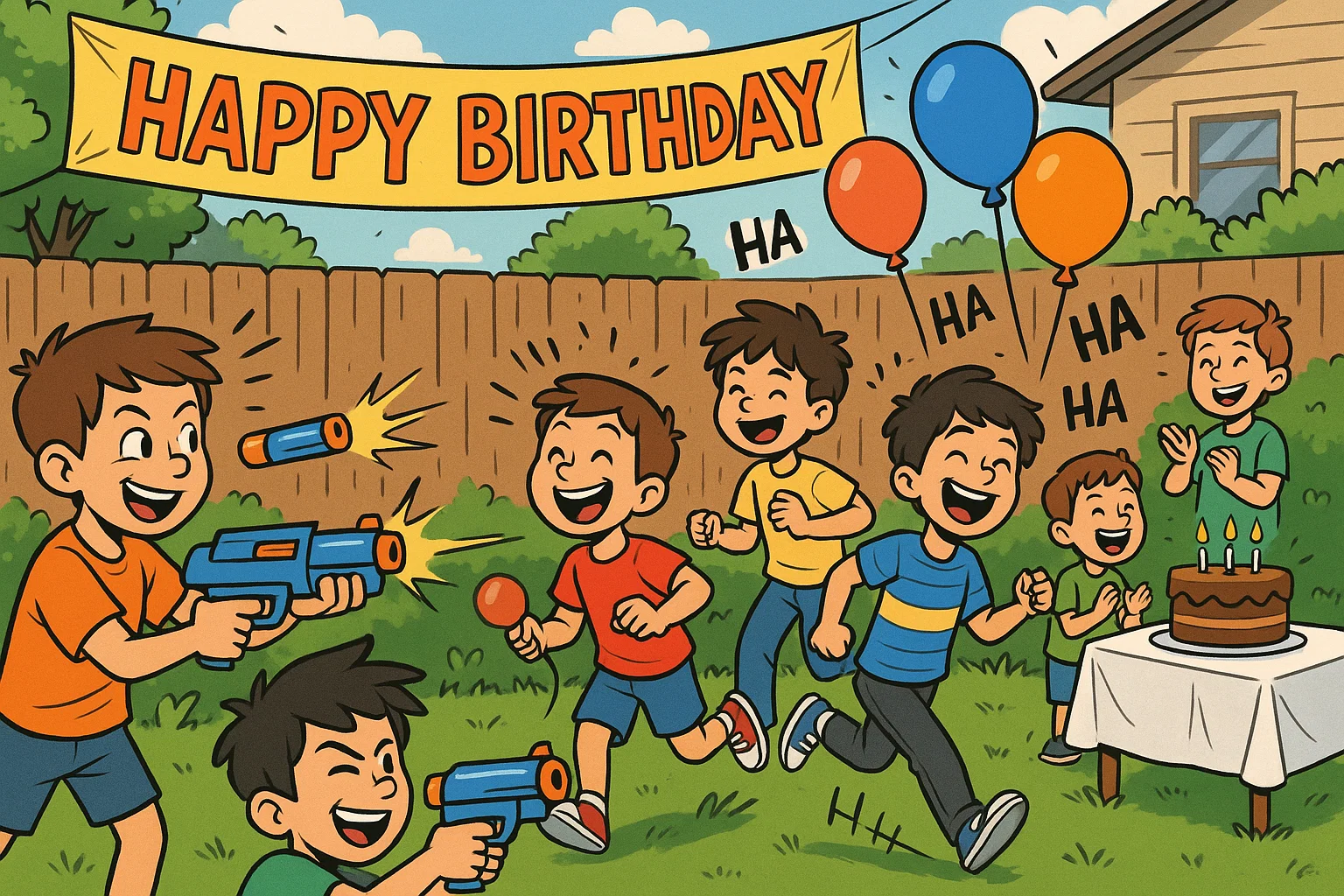
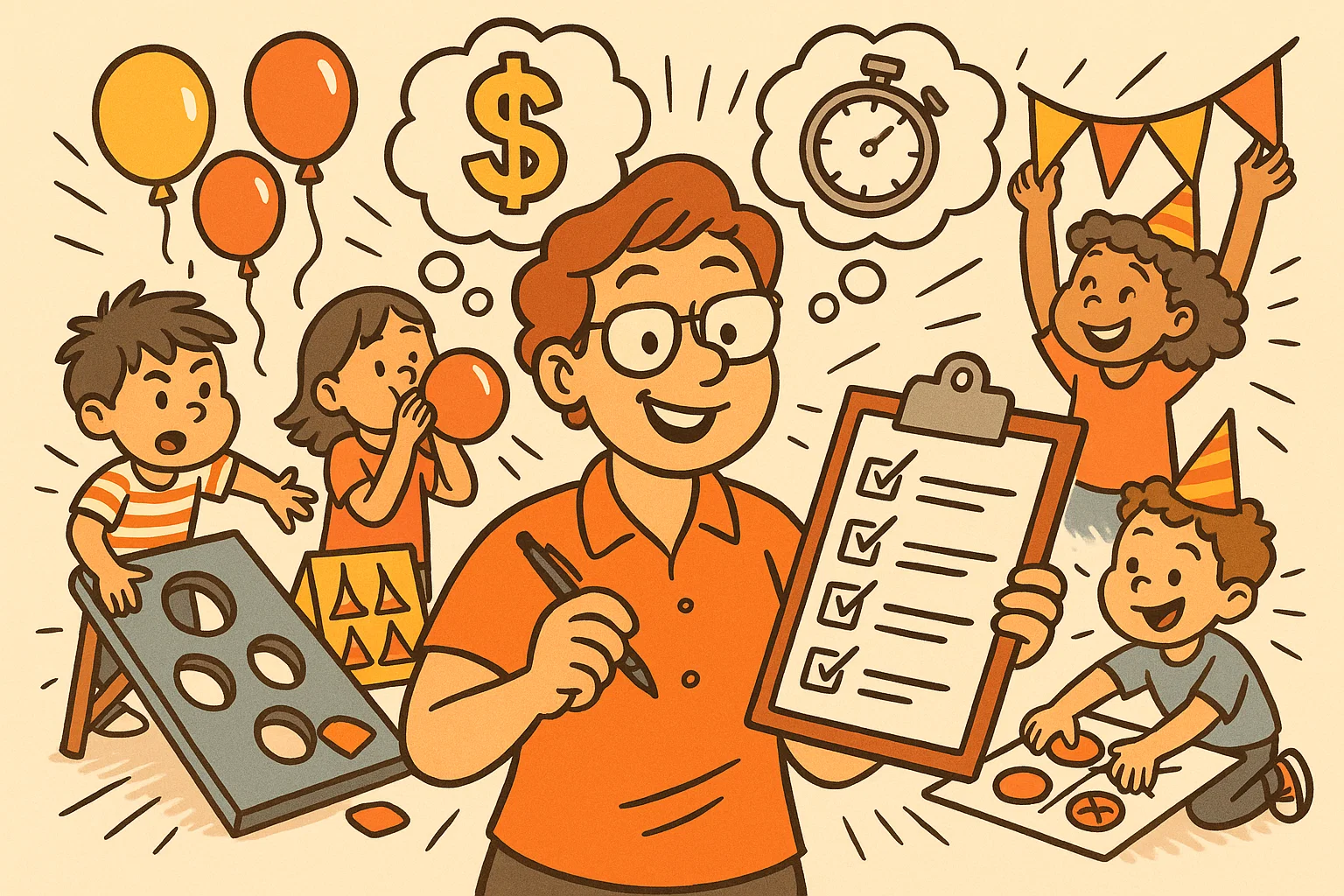
Planning a fun, memorable birthday party for boys means balancing high-energy play with structured activities. Active party games can support gross motor skills, cooperation, and social-emotional development. Choosing the right mix of birthday party activities helps the birthday boy and his guests stay engaged throughout the event.
Key Takeaways
Best activity mix
A successful kids’ birthday party works best with a structured, predictable timeline that helps prevent overstimulation and fatigue. A strong birthday party activity plan usually includes four segments:
- One Main Activity: A primary, highly structured event lasting 45 to 60 minutes, such as a foam-dart battle or an organized scavenger hunt.
- One Backup Game: A flexible, low-prep 15-minute game, such as freeze tag or balloon stomp, to use if the main activity finishes early.
- Food and Cake Time: A dedicated 30-minute block for party food, drinks, cake, and singing to the guest of honor.
- One Closing Activity: A calm, low-energy 15-minute wind-down activity, such as a piñata or handing out party bags, that signals to guests that the party is ending.
Best picks by party style
Choosing between an at-home birthday party and a venue party depends largely on your budget, space, and tolerance for cleanup. An at-home party provides maximum scheduling flexibility and works especially well for foam-dart games, backyard scavenger hunts, outdoor movie nights, science experiments, and DIY obstacle courses.
By contrast, booking a venue takes cleanup off parents’ plates and provides a ready-made setting for soft play, farm visits, ice skating, sports complexes, or theme parks.
Best planning rule
The most reliable planning rule is to choose activities based on seven practical factors: the children’s age group, guest energy level, guest count, weather, available indoor or outdoor space, budget, and cleanup effort.
In general, younger kids do better with shorter, more structured play and clear physical boundaries, while older kids and tweens often enjoy more open-ended team challenges that encourage problem-solving.
Quick Picks: Boys’ Birthday Party Activity Ideas
Best at-home activity ideas
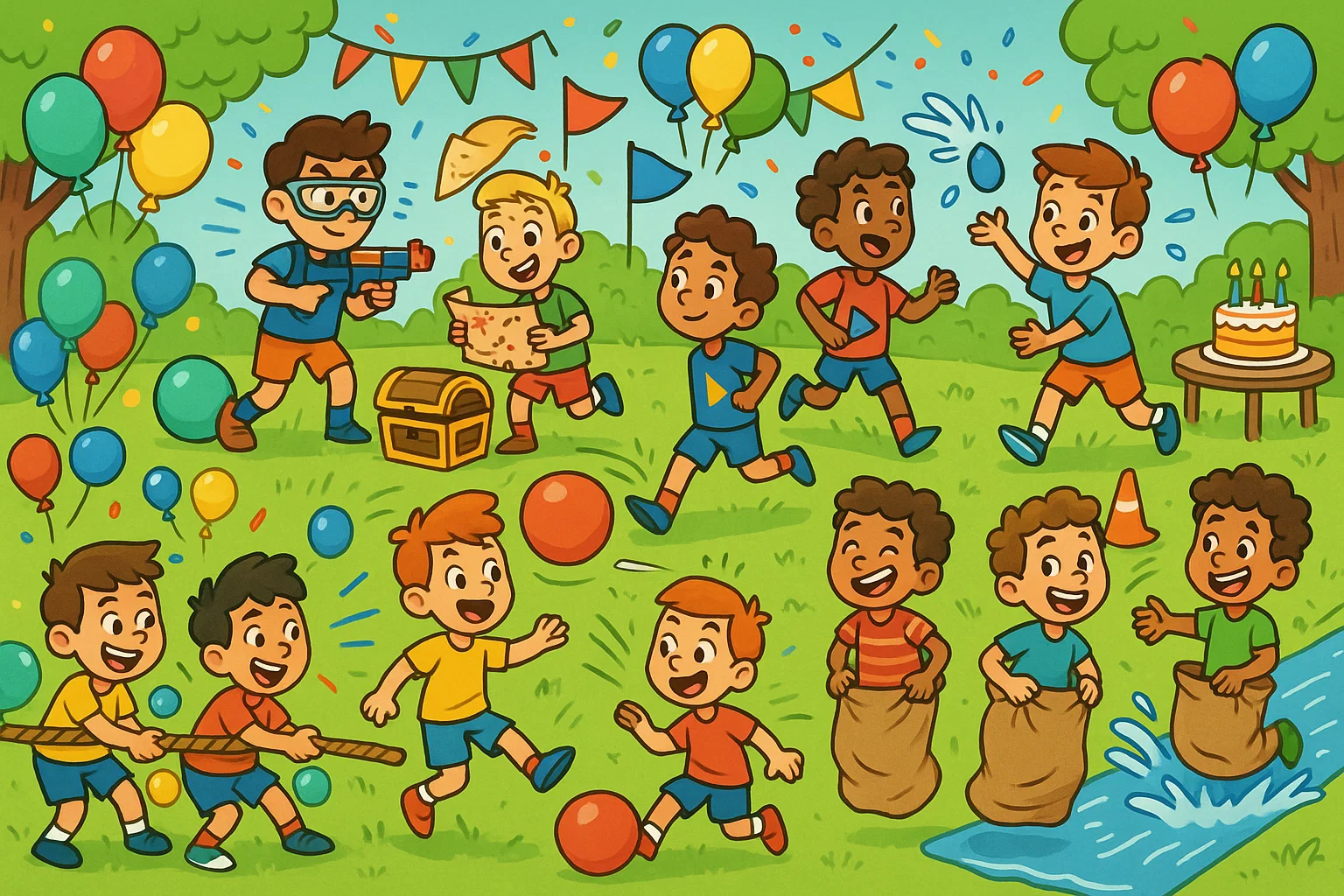
At-home birthday parties allow parents to maximize personalization while using existing household resources. The following options are engaging but still manageable to set up:
- Foam-Dart Battle: Transform a living room or lawn into a foam-dart arena with pop-up barriers; this setup encourages teamwork and active play.
- DIY Obstacle Course: Arrange lawn chairs, pool noodles, and hula hoops to create a physical coordination challenge that helps kids burn energy in a structured way.
- Science Experiments: Set up a table in the garage with baking soda, vinegar, and food coloring for safe, hands-on reaction demonstrations.
- LEGO Building Challenge: Place a bin of blocks in the center of the room and set a 15-minute timer for kids to build the ultimate spaceship or fortress.
- Backyard Campout: Pitch a tent on the lawn for a summer birthday party, using flashlights and sleeping bags to create an outdoor adventure atmosphere without leaving home.
- Movie Night and Popcorn Bar: Stream a favorite film indoors or outdoors on a white sheet, pairing the movie with a custom station featuring popcorn, pretzels, and sweet toppings.
- Treasure Hunt: Hide themed clues around the house that lead to a final treasure chest filled with small party favors.
- Pizza Making Party: Provide pre-made mini crusts and small bowls of toppings, turning dinner preparation into a hands-on, creative food activity.
Best outdoor activity ideas
Outdoor spaces reduce the risk of indoor damage and give kids room for active, large-group birthday games. These activities work especially well outside:
- Backyard Olympics: Organize a series of simple track-and-field-style events using chalk lines and stopwatches to track scores.
- Capture the Flag: Divide a large field into two zones using cones, encouraging teams to strategize as they try to steal the opponent’s flag.
- Tug of War: Use a thick natural-fiber rope on grass to test group strength under direct adult supervision.
- Kickball Tournament: Set up four soft bases on a baseball diamond or lawn for a classic, low-barrier sports activity that works for mixed age groups.
- Water Balloon Toss: Arrange pairs of children facing each other, moving one step backward after every successful catch to test hand-eye coordination.
- Relay Races: Divide guests into teams of four for classic relay variations using beanbags, batons, or balloons.
- Potato Sack Races: Provide durable burlap sacks for a high-energy jumping race that challenges balance on flat turf.
- Backyard Water Slide Challenge: Lay a water-slicked slide mat on a gentle lawn incline to help kids cool off on hot summer afternoons.
Best low-cost activity ideas
Hosting a fun party does not require expensive rental equipment or commercial entertainment packages. These budget-friendly ideas rely almost entirely on everyday household items:
- Balloon Stomp: Tie a single balloon to each child’s ankle using string; players protect their own balloon while trying to step on and pop their peers’ balloons.
- Paper Airplane Cornhole: Instruct guests to fold custom paper airplanes from colored sheets, then award points for landing them inside laundry baskets or cardboard targets.
- Classic Hide and Seek: Set clear indoor or outdoor boundaries, and use a buddy system for younger kids.
- Freeze Dance: Play upbeat music through a portable speaker; when the music stops, all players must freeze in place.
- DIY Color-Dot Game: Paint colored circles directly onto a section of the lawn using temporary, water-based lawn spray paint to accommodate large groups.
- Neighborhood Scavenger Hunt: Print a checklist of common neighborhood sights, such as a red door, a fire hydrant, or an oak leaf, for teams to find.
- Lawn Bowling: Fill ten empty plastic soda bottles with a small amount of water to use as pins, then use a playground ball as the bowling ball.
- Board Game Marathon: Set up multiple stations on dining tables with accessible, fast-paced card and board games.
Best low-hassle activity ideas
For parents who want less planning stress and cleanup, outsourcing the activity or booking a rental can be an excellent strategy. These low-hassle options keep the workload to a minimum:
- Bouncy House Rental: Hire a local party company to deliver and inflate an inflatable jumper on the lawn, providing active entertainment with proper adult supervision.
- Soft Play Venue Booking: Rent a local indoor playground designed to keep younger kids active in a supervised, age-appropriate space.
- Community Hall Rental: Book a large community room to keep party noise and mess away from your home.
- Professional Magician: Hire an experienced children’s entertainer to perform a structured 45-minute show that keeps guests seated and engaged.
- Skating Rink Party: Book a birthday package at a local roller or ice skating rink that includes a dedicated party host, food and drinks, and skate rentals.
- Board Game Café Excursion: Take a small group of older kids to a local board game café where a staff member can explain rules and help manage the game flow.
- Private Movie Theater Rental: Book a small auditorium at a local movie theater for a hassle-free screening with prepackaged snacks.
Birthday Party Activities for Boys
1. Foam-Dart Battle
A foam-dart battle turns an open space into a lively team game that channels competitive energy into structured play. To set this up safely at home, create battle zones using large cardboard moving boxes, pop-up tents, and patio furniture as defensive barriers.
Because projectile toys can cause eye injuries, provide protective eyewear for every participating child before any foam darts are handed out. Set firm rules: no close-range shots, no aiming at faces, no physical tackling, and a clear sit-out or reset rule when a player is hit.
Keep game rounds short, approximately 5 to 7 minutes each, using formats like “Capture the Flag” or “Protect the VIP” to keep the pacing fast and engaging. For indoor versions, swap heavy cardboard for soft couch cushions and bed sheets draped over chairs to protect home fixtures.
2. Movie Night

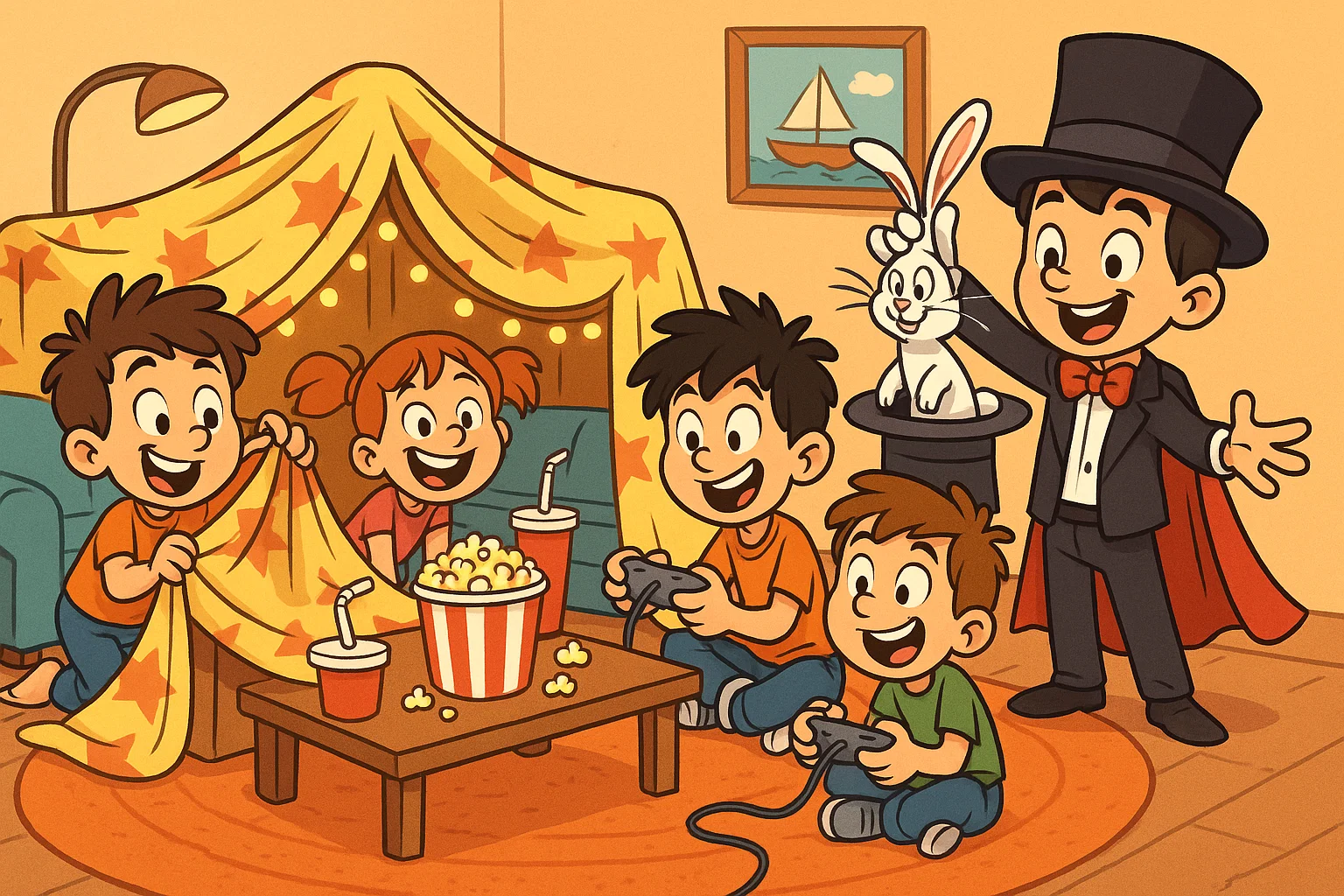
An organized movie night turns a simple film screening into a theater-style party activity with a calmer, more controlled atmosphere. Begin by printing ticket-style invitations that guests present upon arrival at the “box office” door.
Create a dedicated popcorn bar with a large bowl of freshly popped corn alongside smaller bowls of savory salts, M&Ms, pretzels, and gummy bears, allowing kids to customize their own snack boxes. Arrange the viewing area with sleeping bags, floor pillows, and cozy blankets so everyone has a comfortable spot.
To balance the energy, schedule a 15-minute outdoor game before the movie starts to burn off initial excitement. You can also host a brief trivia game after the credits with small themed prizes for correct answers.
3. Fortnite-Inspired Fort Night
A Fortnite-inspired fort night brings the appeal of a battle royale game into a screen-free, active, creative building challenge. Supply teams of children with large stacks of flattened cardboard boxes, heavy-duty duct tape, markers, and team flags.
Each squad receives 20 minutes to build its ultimate base or defensive fort in a designated area of the yard or living room. Once the building phase ends, introduce soft foam balls or rolled-up socks as “boogie bombs” for a structured, elimination-free target challenge.
This activity encourages basic engineering thinking, spatial reasoning, and teamwork as kids decide where to place walls and doors. Conclude the building phase with a snack break featuring “Slurp Juice” (blue sports drink) and “Med Kits” (wrapped crispy rice treats).
4. Treasure Hunt or Scavenger Hunt
A structured scavenger hunt builds problem-solving and spatial awareness by turning a familiar space into an interactive puzzle. Write a series of rhyming riddles or picture clues tailored to the birthday boy’s age, making sure each clue points clearly to the next location.
For an indoor route, hide clues near distinct landmarks like the kitchen refrigerator, a bookshelf, or a bathroom mirror. For outdoor versions, use trees, garden gates, and patio steps.
Divide the children into small cooperative teams of three to four players, giving each group a decorative map or checklist to guide its mission. The final clue should lead the entire group to a shared treasure bag or chest filled with bubble wands, stickers, and custom party favors.
5. Backyard Campout
A backyard campout gives kids the thrill of outdoor exploration in the safer, familiar setting of home. Erect two or three multi-person tents on the lawn, lining the floors with insulated sleeping pads, sleeping bags, and heavy blankets.
As twilight approaches, organize low-light flashlight games such as “Flashlight Tag” or “Manhunt” within clearly marked fence boundaries. If a permanent backyard fire pit is available, gather the kids under strict adult supervision to roast marshmallows for custom s’mores combinations.
When open flames are impractical or unsafe, parents can use a portable electric s’mores maker or serve campfire-style snacks indoors. Conclude the evening with casual stargazing or mild, age-appropriate adventure stories inside the tents before guests settle down or get picked up.
6. Flag Football Game
A flag football game is a non-contact sports party option that teaches strategy and agility without the risks of tackle football. Mark a rectangular playing field with bright plastic cones, and give every child a hook-and-loop flag belt with two detachable side flags.
Divide the guests into balanced teams based on height and running speed. Explain the simple rule: play stops immediately where a defender removes the ball carrier’s flag.
Break the game into four brief 10-minute quarters, with a halftime break for water, fruit slices, or sports drinks. This structured format can work well for mixed age groups, helping younger kids participate alongside older siblings.
7. Tug of War
Tug of war is a classic test of group strength and teamwork that can serve as a strong centerpiece for an outdoor children’s party. To reduce the risk of injury, use a thick, unknotted manila or cotton rope that is easier for kids to grip.
Always conduct this game on a soft, clear grass surface or a gymnastics mat. Avoid concrete or gravel setups to reduce the risk of injury from falls.
Balance the teams by age and size, and place a bright red ribbon in the center of the rope above a chalk line on the ground. An adult should stand at the center line to referee the match and enforce a strict “no wrapping the rope around hands or waists” safety rule.
After the match, reward both sides with humorous certificates or medals to emphasize participation over winning.
8. Capture the Flag
Capture the flag is a dynamic, fast-paced game that challenges children’s endurance and group strategy. Divide a large, open field or park lawn into two equal territories using a visible line of cones, placing a brightly colored cloth flag at the back boundary of each side.
Players cross the center line into the opposing team’s territory to steal the flag. If tagged by a defender while in that territory, they must go to a designated “jail” zone.
Jailed players can only be freed if a teammate crosses the line and tags them back into play without getting caught. Keep rounds limited to 10 minutes to prevent exhaustion, and introduce glow sticks for an exciting nighttime version if you are hosting an evening party.
9. Kickball Game
A structured kickball game combines the familiar format of baseball with easy-to-learn rules, making it an ideal main activity for a sports-loving birthday kid. Arrange four rubber base pads in a traditional diamond configuration on a flat grass lawn or public park field.
Use a standard 10-inch playground ball, and have the pitcher roll it smoothly across home plate so every child has a better chance to make contact. Implement an inclusive rotation rule where every child on the batting team gets an opportunity to kick during an inning, regardless of how many outs are recorded by the defense.
This elimination-free adaptation keeps engagement high, prevents frustration among younger guests, and allows the game to function smoothly as a 45-minute block of entertainment.
10. Dodgeball
Dodgeball is a fast-paced reaction game that can be made safer, more inclusive, and fun for a boys’ birthday party with the right equipment and rules. Parents should avoid heavy rubber playground balls and use ultra-soft foam balls instead to reduce the risk of painful impacts or bruising.
Set clear boundaries within an indoor gym or outdoor backyard court. Use a strict below-the-shoulder throwing rule: any hit to the head does not count, and the thrower must sit out briefly or reset.
To maximize participation, use elimination-free variations: when a player is hit, they complete five jumping jacks or step to the sideline for 60 seconds before rejoining the game.
Backyard Olympics and Sports Day Ideas
| Olympic Event Name | Primary Materials Required | Skill Focus | Recommended Age Bracket |
| Relay races | Plastic batons, boundary cones | Team coordination and speed | Kids ages 5–14 |
| Three-legged race | Soft elastic straps or bands | Interpersonal coordination and balance | Younger kids to tweens (6–12) |
| Potato sack races | Burlap or heavy canvas sacks | Gross motor skills and balance | Kids, tweens, and teens (7–14) |
| Egg and spoon race | Wooden spoons, plastic eggs | Fine motor focus and pacing | Younger kids (4–10) |
| High jump competition | Foam pool noodles, vertical stands | Agility and spatial awareness | Tweens and teens (9–15) |
| Long jump competition | Measuring tape, soft sand or grass | Jumping power and distance control | Kids of all ages (6–14) |
| Beach ball shot put | Lightweight inflatable beach balls | Core control and playful movement | Little kids to kids (4–8) |
| Backyard baseball | Foam bats, lightweight plastic balls | Hand-eye coordination and base running | Kids and tweens (6–12) |
11. Relay Races
Structured relay races foster team spirit and healthy peer encouragement during a backyard children’s party. Divide the kids into equal teams behind a starting line, and give the first runner on each team a lightweight plastic baton, cone, or cup of water.
Set clear turnaround points with brightly colored cones positioned 30 to 50 feet away. Runners must navigate around the cone, return, and pass the object to the next teammate in line.
To make the races more engaging, add creative variations to successive heats, such as asking players to skip, hop on one foot, or move while holding a balloon between their knees. Keep score across three heats, and award small ribbons or themed medals to all participants to keep the focus on effort.
12. Three-Legged Race
The three-legged race is a timeless coordination challenge that teaches children teamwork, rhythm, and clear communication. Pair children by similar height and size, and secure their inside legs together with soft, wide bands or Velcro straps that are snug but not tight.
Mark a clear, straight finish line on a flat, soft grass lawn that provides some cushion in the event of a stumble. Keep the race distance short, ideally between 20 and 30 feet, as extended distances can lead to frustration among younger guests.
Run the race across multiple brief, fast-paced rounds, allowing pairs to adjust their strategies between heats.
13. Potato Sack Races
Potato sack races are energetic and funny, challenging children’s balance, core stability, and jumping power. Provide each participant with a clean, durable burlap sack or heavy-duty canvas storage bag that fits comfortably up to the waist.
Instruct racers to stand inside the sacks along a flat, stone-free lawn starting line, holding the top edge of the material firmly with both hands. Add funny race formats, such as backward jumping or sideways hopping, to level the playing field for kids of different heights.
To reduce the risk of injury, make sure an adult monitors the finish line so children do not slip, tumble, or collide with hard landscaping.
14. Egg and Spoon Race
The egg and spoon race adds concentration and fine motor control to an otherwise high-energy sports day program. Give each child a wooden kitchen spoon and a brightly colored plastic egg as a safe, mess-free alternative to raw eggs.
If a child drops the plastic egg during the race, they must stop, place the egg back onto the spoon, and take two steps backward before continuing toward the finish line. For older kids and tweens, increase the difficulty by turning the game into a team relay or having players hold the spoon handle in their mouths.
15. High Jump Competition
A backyard high jump competition gives kids a safe, structured way to test vertical agility and body control without traditional track-and-field equipment. Build a low-impact jumping setup using two vertical plastic stands or lawn chairs to support a lightweight foam pool noodle or a loose piece of soft yarn as the crossbar.
If a child touches the bar while jumping, it should fall away easily, reducing the risk of tripping or tangling. Hold the competition on a soft grass surface, and avoid wooden decks, concrete, or other hard landing areas.
Use humorous scoring categories, such as the most creative mid-air pose or the funniest landing, rather than judging only by height.
16. Long Jump Competition
The long jump competition channels children’s jumping power into a clear, measurable activity that emphasizes individual improvement. Use bright sidewalk chalk on a paved driveway or lay out tape markers on a soft grass lawn to create a clear takeoff line.
Have each child do a running or standing long jump, then mark the spot where their back heel lands with numbered flags or color-coded tape. Use a flexible measuring tape to determine the total distance of each jump, recording the values on a central leaderboard.
To maintain an inclusive and supportive environment, award customized prizes not just for the longest distance, but also for the greatest personal effort, the most unique style, or the funniest landing.
17. Beach Ball Shot Put
The beach ball shot put turns traditional shot put into a lightweight, funny game that works for kids of all ages. Instead of a heavy metal sphere, provide participants with large air-filled beach balls that must be pushed from the shoulder using proper shot put form.
Create distance zones on the lawn using colorful string or chalk lines, assigning higher point values to zones farther from the launch line. Because beach balls are easily affected by the wind, their paths are unpredictable, which makes the game fun and lowers the pressure for less athletic guests.
18. Backyard Baseball
Backyard baseball offers a streamlined, fast-paced version of the traditional sport that fits neatly into a 45-minute party window. Replace hard leather baseballs and heavy wooden bats with an oversized foam or lightweight plastic bat and a hollow plastic ball to make the game safer in a backyard.
Set out flat plastic cones to serve as bases, keeping the distances between bases short to maximize frequent safe hits and fast base-running opportunities. Structure the game with short, three-run innings so teams rotate frequently between offense and defense, keeping kids involved without long periods of waiting.
Classic Outdoor Games
19. Hide and Seek
Hide and seek remains a foundational childhood game that exercises spatial evaluation, stealth, and independent problem-solving. Before play begins, set clear, non-negotiable boundaries with the children, such as “only in the fenced backyard; the garage and front driveway are completely out of bounds.”
The designated “seeker” closes their eyes at a home-base tree and counts aloud to 30 while the other players find hiding spots. To support safety for younger kids, use a buddy system where children hide in pairs, helping prevent isolation or fear.
For rainy days or winter birthday parties, adapt the game as an indoor backup, limiting hiding spots to ground-level rooms and banning high shelves or utility closets.
20. Freeze Tag
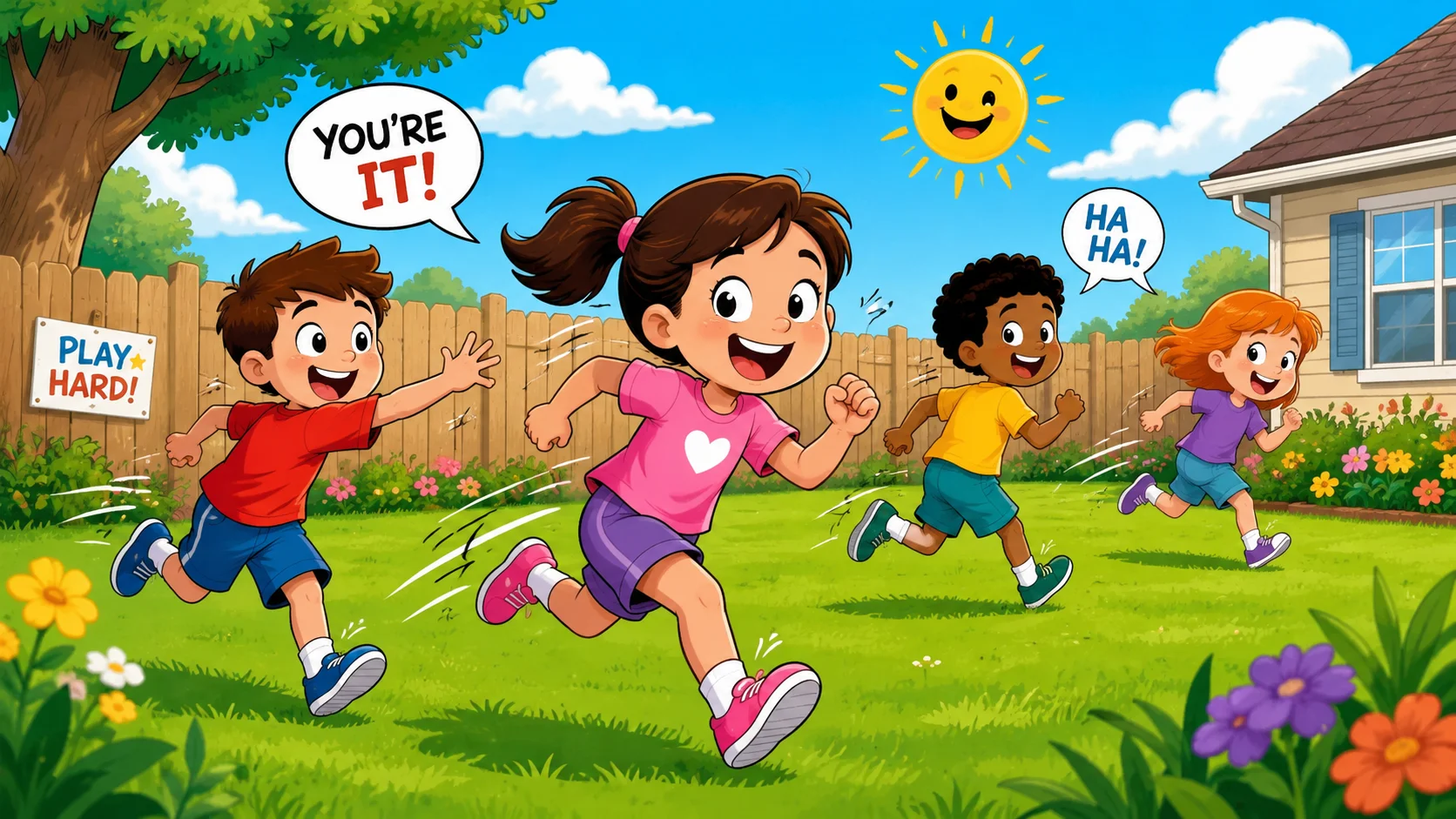
Freeze tag is a high-energy running game that builds spatial awareness and gives kids plenty of movement. Choose a flat, open lawn space free of tree roots or garden hoses to serve as the active running area.
Choose one or two children to be “it.” When they tag another player, that player freezes in place with their arms out to the sides.
Frozen players can only be unfrozen and returned to active play if a non-tagged player runs past and touches their hand. To make the game more fun, play upbeat music through an outdoor speaker or add a superhero theme where tagged players freeze in an action pose.
21. Tunnel Tag
Tunnel tag is an active variation of classic tag that requires flexibility and teamwork. In this version, when a player is tagged by the designated chaser, they freeze in place while standing with their legs spread wide apart to form a “tunnel.”
To unfreeze a caught player, an active runner must safely crawl through the space between the frozen player’s legs from front to back. This crawling rule also slows the pace of the game, which can reduce the risk of collisions in mixed-age groups.
22. Bandage Tag
Bandage tag is a funny twist on regular tag that adds a physical challenge and helps slow down the fastest runners. When a player is tagged by the chaser, they do not freeze; instead, they place one hand over the exact spot on their body where they were tagged, as if applying a bandage.
If they are tagged a second time, they place the other hand over the new spot, forcing them to run while awkwardly holding both positions. If they are tagged a third time while both hands are already occupied, they go to a designated “hospital” zone, complete five jumping jacks, and re-enter the game.
23. Stuck-in-the-Mud Tag
Stuck-in-the-mud tag combines freeze tag with a fun rescue element that encourages teamwork. When a player is tagged by an “it” chaser, they stop running immediately and stand still with their feet together, shouting “I’m stuck in the mud!” to alert their teammates.
The only way for an active player to free a stuck teammate is to run over and crawl through their legs or high-five both hands while shouting “You’re free!” This setup keeps the game social, as children must balance running away from the chaser with rescuing their friends.
24. Sly Fox
Sly fox, often known as “Red Light, Green Light,” is a structured, low-impact outdoor game that focuses on impulse control, balance, and quiet movement. One child is chosen as the Fox and stands facing a wall or tree about 40 feet away from the rest of the group.
While the Fox’s back is turned, the other players creep quietly forward across the lawn. At any random moment, the Fox can spin around to face the group.
Anyone the Fox catches moving must return to the starting line. This game works well as a transition activity when parents want to help kids calm down between high-energy games.
25. Spud
Spud is a structured ball game that combines throwing accuracy with fast reaction timing. Assign each child a number, then have the group stand in a circle around an adult or leader holding a soft foam ball.
The leader tosses the ball straight up into the air while loudly calling out one of the assigned numbers. The child with that number runs forward to catch the ball while all other children scatter across the yard.
The moment the catcher grabs the ball, they shout “SPUD!” and all other players freeze where they are. The catcher then takes three large steps toward any player and tries to tag them below the shoulders with a gentle throw.
Water Balloon and Summer Party Ideas
26. Water Balloon Games
Water balloon games are a fun way for kids to cool off and stay active during a hot summer birthday party. To set up a structured water balloon toss, arrange children into two parallel lines facing one another at a starting distance of three feet.
Each successful catch requires one line to take a large step backward, increasing the distance and difficulty until the balloon pops. Parents can use reusable silicone water balloons or soft, water-absorbent sponges as eco-friendlier alternatives that reduce cleanup from broken balloon pieces.
Keep a large bucket of clean water nearby so kids can refill balloons or sponges throughout the game.
27. Water Slide and Grab
A water-slide-and-grab game adds a simple collection challenge to a backyard slide and helps kids practice coordination. Lay out a backyard water slide on a flat lawn or gentle incline, and keep it wet with a steady spray from a garden hose. Add soap only if the product instructions allow it.
Scatter a dozen soft floating rings or brightly colored foam tokens along the middle and end of the slide path. As children slide down on their stomachs, they try to grab as many tokens as possible.
This turns a simple slide into a game that rewards focus and timing.
28. Water Blob
A water blob is a large, squishy, water-filled mat that lets kids enjoy water play without being submerged. Adults can make a water blob by folding a large sheet of heavy-duty 4-mil plastic sheeting in half, sealing the three open edges with waterproof duct tape, and filling it with a garden hose until it forms a large, squishy pad.
Position the finished blob on a flat, clear patch of grass, keeping it lightly misted with a sprinkler to reduce friction. With continuous adult supervision, kids can roll, balance, or lounge on the cool, shifting surface, making it a fun sensory activity for younger children.
29. Pool Party
An organized pool party can be a highlight for older children, but it requires strict safety rules and close supervision. Parents should follow local pool rules, designate focused adult water watchers, and consider hiring a certified lifeguard for larger groups, younger children, or weaker swimmers.
Organize structured pool games like water polo, kickboard relay races, or supervised diving-toy searches to keep the energy focused. Offer food and drinks during planned breaks, keep swimmers hydrated, and maintain a dedicated dry zone with extra towels and sunscreen.
30. Under-the-Sea Party
An under-the-sea party combines creative decorations with simple water-themed games for an engaging themed party. Transform a backyard or patio area into an ocean floor using blue streamers, green balloon kelp structures, and hanging paper fish decorations.
Fill a clean plastic kiddie pool with water and hide plastic sea creatures, play coins, and fake pearls under large smooth stones, giving kids small nets for a treasure dive. Pair these physical games with an indoor craft station where guests can customize plastic bubble wands or paint miniature wooden treasure chests using washable acrylic paints.
Indoor Birthday Activities
31. Board Game Café
Recreating a board game café at home offers a structured, low-stress indoor option that encourages focus, teamwork, and friendly competition. Set up three tabletop stations in a living room or dining room, equipping each with an easy-to-learn game that can be explained and completed within 20 minutes, such as Sushi Go!, Catan Junior, or Connect 4.
Place small bowls of easy-to-eat snacks like popcorn, pretzels, and fruit chews at each station, and use timers to rotate groups of three or four children between tables. Award custom tokens or points for sportsmanship, strategic thinking, and teamwork, which kids can exchange for prizes at a small prize table.
32. Game Night
An indoor game night works well for older tweens and teens by balancing video game tournaments with hands-on party games. Choose multiplayer games that support split-screen play or quick round rotations, such as Mario Kart or Super Smash Bros., and set a 15-minute timer per round to keep screen time balanced.
Balance the video game stations with oversized floor games, such as giant cards or checkers laid out on rugs. This mix helps prevent screen fatigue, keeps guests involved, and makes it easier for parents to manage the room’s energy level.
33. Giant Stacking-Block Game
A giant stacking-block game is a suspenseful coordination activity that builds spatial awareness and fine motor control as players remove blocks from an unstable tower. Arrange a starting stack of oversized wooden or lightweight foam blocks on a perfectly flat, solid floor or low patio surface, making sure the initial tower stands approximately two to three feet tall.
To make the game more engaging, write challenge prompts on the underside of individual blocks with a marker, such as “sing Happy Birthday in a robot voice” or “balance on one leg for 30 seconds.” When a child successfully removes a block, they complete the challenge before placing the block on top of the tower.
34. DIY Color-Dot Game
A DIY color-dot game scales up a classic flexibility challenge so larger groups can play indoors or outdoors. To create an indoor version, cut a grid of colorful circles from heavy felt or construction paper and secure them firmly to a large canvas drop cloth or non-slip floor mat using double-sided carpet tape.
An adult acts as the caller, announcing positions such as “right hand on blue” or “left foot on yellow” using a cardboard spinner or a draw bag. This activity builds balance, flexibility, and core strength while keeping kids laughing and engaged.
35. Escape Room
An at-home escape room turns an ordinary room into an interactive puzzle that encourages critical thinking, deduction, and code-breaking. Choose a theme that fits the birthday kid’s interests, such as a pirate shipwreck, deep-space mission, or detective mystery, and lock a prize box in a container with a simple three-digit combination padlock.
Hide age-appropriate clue cards, cipher wheels, and invisible-ink messages throughout the room so kids can work together to solve the puzzles in order. Set a large visible countdown timer to 45 minutes on a tablet or television screen to create an exciting sense of urgency.
36. Magic Show
A magic show combines seated entertainment with hands-on fun by pairing a performance with a simple instructional workshop. Parents can hire an experienced local children’s magician to perform a 30-minute comedy magic show that keeps the group seated and engaged.
After the main show, transition the kids into a DIY magic workshop station where each child receives a small kit with basic props like trick cards, foam balls, and plastic cups. The magician or parent can then guide guests through two or three simple tricks, giving them a fun skill to practice at home.
FAQ
What is a good birthday party idea for boys who have lots of energy?
A good birthday party idea for high-energy kids is one that gives them room to move but still has clear rules. Foam-dart battles, relay races, capture the flag, kickball, and backyard obstacle courses are all great ideas because they keep the kids entertained while giving the party a clear structure. For the best party flow, choose one main fun activity, one backup game, and one calmer closing activity so the group does not become overstimulated.
How do I choose the right party theme for a boy’s birthday party?
The best party theme usually depends on the birthday child’s interests, age, and energy level. For example, a science party works well for kids who enjoy experiments, while a sports party is better for active guests who love running games. A garden party, rainbow party, movie night, or under-the-sea theme party can also work well if you want decorations and cake to feel more coordinated. When choosing birthday party themes, keep the setup realistic. A simple theme with two or three strong details often works better than an overcomplicated idea that makes party planning stressful.
What are the best birthday ideas for a party at home?
Some of the best birthday ideas for a party at home include a treasure hunt, movie night, LEGO building challenge, pizza making party, science experiments, or a backyard campout. These kids birthday activities are flexible, affordable, and easy to adjust based on the number of guests. A party at home can also feel more personal because parents can customize the schedule, snacks, decorations, and games around the birthday boy or girl.

Take a short quiz to find out what your everyday choices say about your parenting style
When your child is curious about something new, what’s your instinct?
Take a short quiz to find out what your everyday choices say about your parenting style
“Can I download this app?” What happens next?
Take a short quiz to find out what your everyday choices say about your parenting style
When it comes to rules at home, which sounds most like you?
Take a short quiz to find out what your everyday choices say about your parenting style
If you could give your child one life skill today, what would you pick?
Take a short quiz to find out what your everyday choices say about your parenting style
Your child gets to choose what to watch. What would your ideal setup look like?
Take a short quiz to find out what your everyday choices say about your parenting style
Pick your parenting superpower ✨



