Animals That Start with K: The Ultimate List, Facts, Pictures, and Activities

 Discover a Free Education Video App for Kids
Pastory uses AI to personalize educational video content based on your child’s interests and personality. Safe, engaging, and built for curious young minds. Sign up now to stay updated and enjoy early access with a free trial
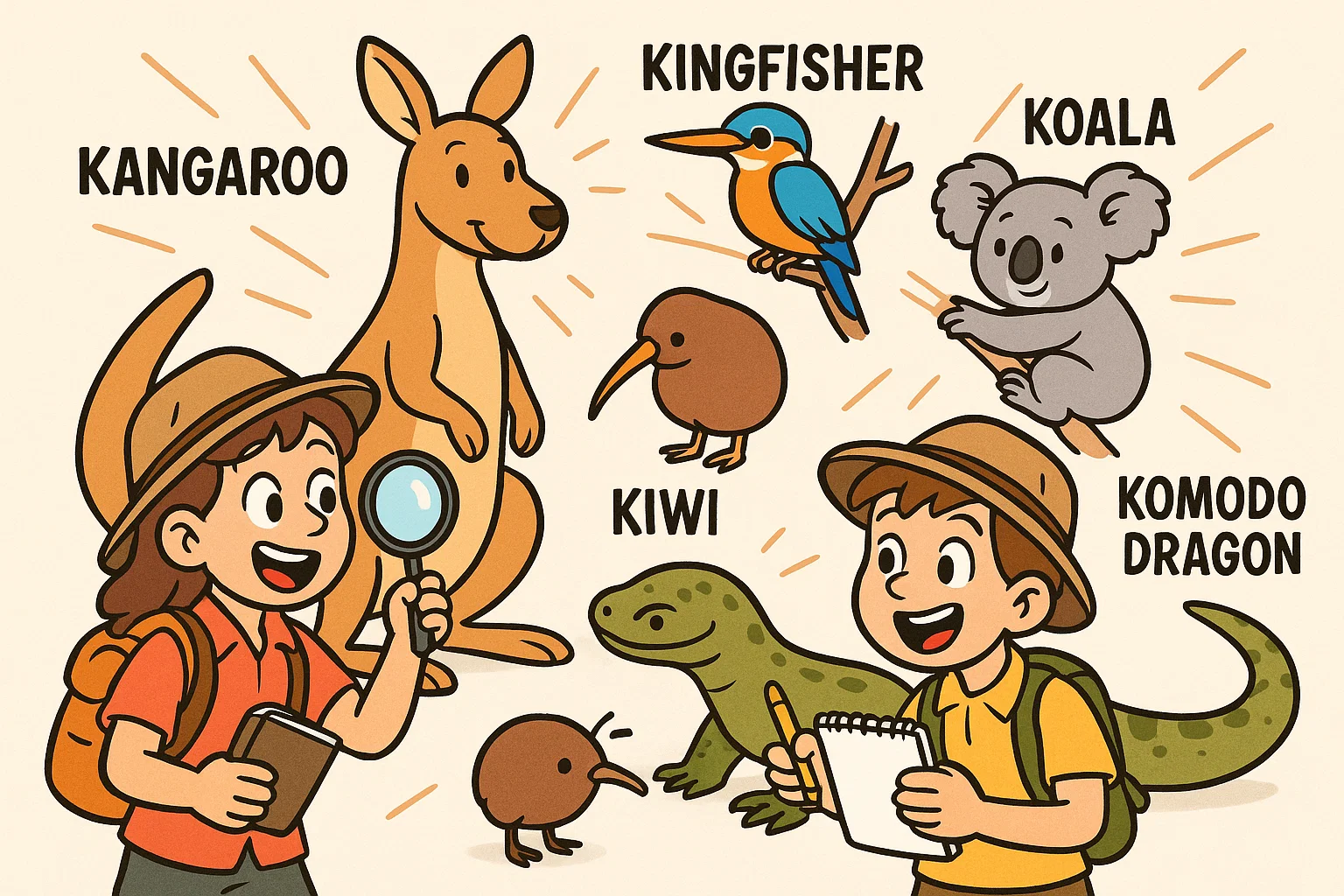
Exploring the animal kingdom is an effective way to support early childhood learning. For young learners, exploring categories such as animals that start with the letter K supports phonemic awareness, expands vocabulary, and strengthens categorization skills. This comprehensive guide provides a curated, kid-friendly overview of common animals, rare species, aquatic creatures, and insects starting with the letter K. Parents, teachers, and homeschoolers can use these structured profiles, educational activities, and printable ideas to encourage critical thinking and keep young learners engaged.
Key Takeaways
- Most Recognized Species: The kangaroo, koala, kiwi, kingfisher, and Komodo dragon are among the most familiar K animals used in early educational materials.
- Taxonomic Diversity: The list spans multiple scientific groups, including mammals, birds, reptiles, fish, insects, mollusks, and crustaceans.
- Conservation Awareness: Several animals starting with K, such as the kākāpō and kagu, are endangered or critically endangered, while Kitti’s hog-nosed bat is listed as Near Threatened. These examples can help introduce children to conservation.
- Educational Utility: This guide is structured for school projects, alphabet recognition lessons, interactive coloring activities, and vocabulary building.
Fast Answer
For educators or parents who need immediate examples for lesson plans, the following ten animal names provide a diverse selection of animals beginning with K:
- Kangaroo (marsupial)
- Koala (marsupial)
- Kiwi (flightless bird)
- Kudu (antelope)
- Krill (tiny ocean crustacean)
- Kinkajou (mammal)
- King cobra (reptile)
- Killer whale (marine mammal)
- Kookaburra (bird)
- Katydid (insect)
Best Known K Animals
Some animals are especially familiar to children because of their memorable looks, behaviors, or roles in books and classroom activities. The kangaroo and koala are useful examples in early childhood lessons because their marsupial traits introduce children to unique reproductive adaptations. Similarly, a kingfisher’s dramatic diving behavior and the Komodo dragon’s massive size can spark children’s curiosity. Using these widely recognized animals allows educators to build on existing knowledge, making it easier for children to understand more complex biological concepts.
Coverage Snapshot
To ensure a comprehensive educational experience, this guide categorizes animal species across a wide variety of ecological niches and geographic zones. The content spans common terrestrial species, highly specialized rare animals, diverse marine life, and tiny organisms. By exploring creatures from habitats such as the Australian outback, African savannas, and the deep ocean, children learn how different animals adapt to their environments. This global scope supports spatial reasoning and geographic literacy as children map species to their native regions.
Quick Intro
Animals starting with the letter K represent a remarkably diverse cross-section of global biodiversity. These creatures inhabit nearly every major biome on Earth, ranging from dense tropical rainforests and arid deserts to freshwater river systems and frozen polar oceans. Introducing children to varied habitats helps them understand how animals survive in very different environments.
What Counts as a K Animal?
In educational settings, classification clarity is important for accurate learning. For this guide, an animal qualifies if its widely accepted common name, species name, or recognized group name begins with the letter K. This includes specific species like the king cobra as well as broader categories like krill. Clarifying these naming conventions helps children understand the difference between everyday animal names and formal scientific terminology.
How This List Is Organized
To support structured learning, this guide organizes animal profiles by popularity, habitat, and biological group. Readers move from highly familiar land mammals to rare terrestrial species, followed by marine life, insects, and birds. This layout aligns with standard child development practices by moving from concrete, familiar concepts to more abstract or unfamiliar ones.
Who Can Use This Guide
This resource is designed for parents, primary school teachers, speech-language pathologists, and homeschooling educators. It includes prompts and examples that support early reading, vocabulary building, and simple biology projects. Independent young readers can also explore the sections on their own for simple research or classroom projects.
Common Animals That Start with K
1. Kangaroo
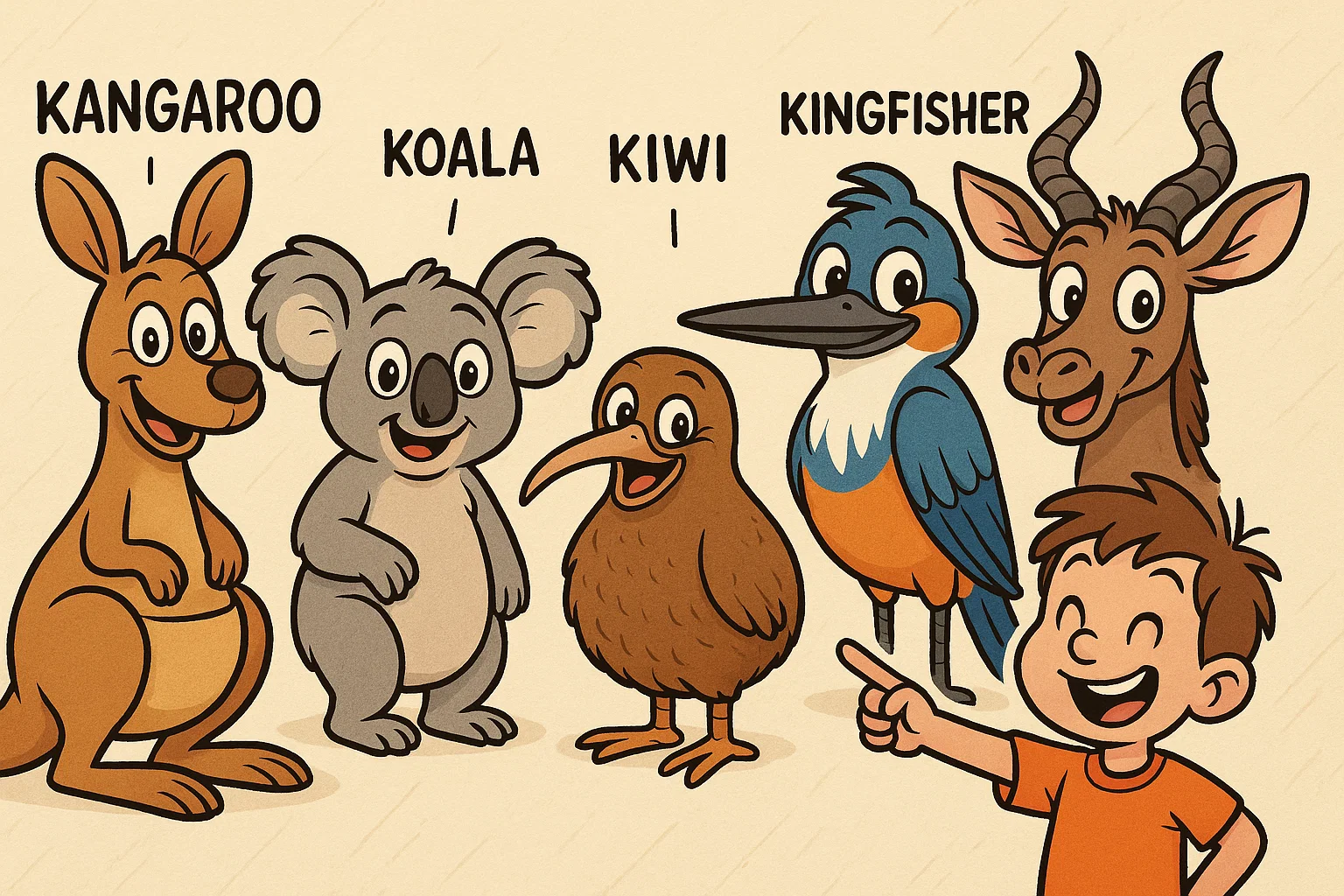
The kangaroo (pronounced kang-guh-roo) is a well-known marsupial native to Australia and, in the case of tree kangaroos, New Guinea. This mammal thrives in open grasslands and woodlands, using its highly specialized, powerful hind legs to hop great distances at high speeds.
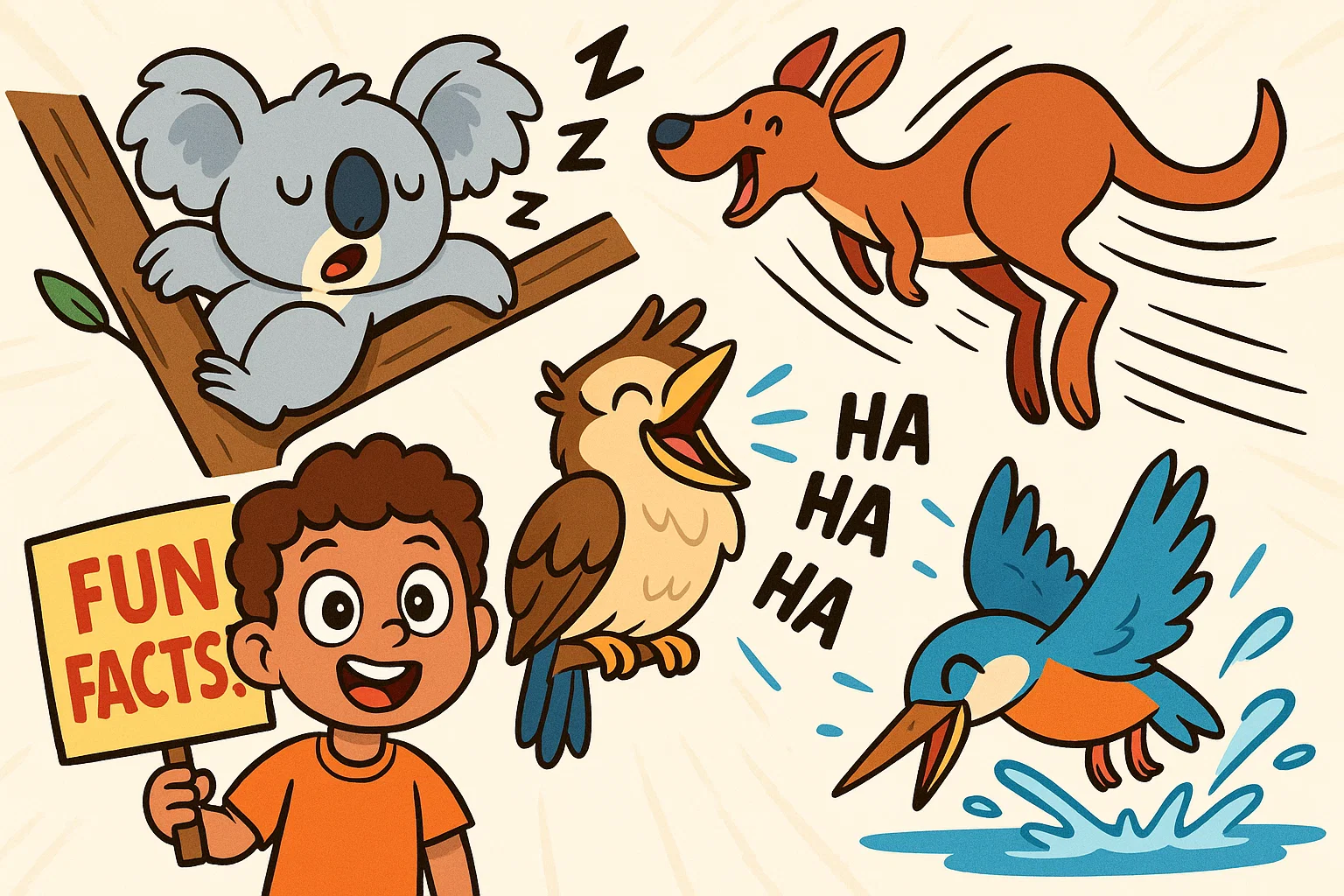
Red kangaroos can reach speeds of more than 35 miles per hour and cover about 25 feet in a single leap.
As herbivores, kangaroos mainly eat grasses and other plants, using specialized stomachs to ferment and digest tough plant matter. The most iconic educational feature of the kangaroo is the female’s abdominal pouch, where a tiny, underdeveloped baby, known as a joey, climbs immediately after birth to nurse and develop safely for several months.
2. Koala
The koala (pronounced koh-ah-lah) is an arboreal, or tree-dwelling, marsupial native to eastern Australia. The koala feeds almost exclusively on eucalyptus leaves, using specialized digestive and liver adaptations to process the leaves’ tough fibers and toxic compounds. Because eucalyptus leaves provide relatively little energy, koalas have a low metabolic rate and often sleep for 18 to 20 hours a day.
| Attribute | Value / Specification |
| Scientific Class | Mammalia (marsupial) |
| Native Habitat | Eucalyptus forests of eastern Australia |
| Primary Diet | Eucalyptus leaves (herbivore) |
| Average Sleep Time | 18 to 20 hours per day |
While frequently mislabeled as a “koala bear” because of its round ears and black nose, childhood educators should clarify that the koala is a marsupial and is not related to true bears.
3. Kiwi
The kiwi (pronounced kee-wee) is a unique, chicken-sized flightless bird endemic to the forests and grasslands of New Zealand. This nocturnal bird has several unusual traits, including a highly developed sense of smell and nostrils positioned at the tip of its long beak.
The kiwi uses this beak to probe the forest floor for insects, worms, and berries under the cover of darkness. Notably, the female kiwi lays an extraordinarily large egg that can weigh up to 20% of her own body mass, a proportional ratio unmatched by almost any other bird species.
4. Kingfisher
The kingfisher (pronounced king-fish-er) belongs to a widespread family of small to medium-sized birds known for bright colors, including iridescent blue and deep orange. Many kingfishers live near rivers, wetlands, and lakes, where they use sharp eyesight and fast dives to catch prey.
Equipped with eyesight that adjusts for water refraction, a kingfisher can plunge headfirst from an overhanging branch to seize fish with its dagger-like bill. The presence of some kingfisher species can also indicate healthy water quality and a strong aquatic food chain.
5. Kookaburra
The laughing kookaburra (pronounced koo-kuh-bur-uh) is one of the largest members of the kingfisher family and is native to eastern Australia. Unlike many fish-eating kingfishers, the laughing kookaburra usually hunts on land, eating insects, frogs, small reptiles, rodents, and sometimes snakes.
This bird is famous for its loud, laughing call, which sounds similar to human laughter and helps family groups defend their territory. Educators frequently incorporate the kookaburra into auditory perception lessons to teach children how wild animals use vocalizations for social communication.
6. Komodo Dragon
The Komodo dragon (pronounced kuh-moh-doh drag-uhn) is the largest living lizard species on Earth and is found only on a few Indonesian islands in the Lesser Sunda archipelago. This massive reptile can reach lengths of 10 feet and weigh over 150 pounds, acting as an apex predator in its island ecosystem.
The Komodo dragon hunts by ambush, relying on sharp, serrated teeth, a powerful bite, an acute sense of smell aided by its forked tongue, and venom that can prevent blood from clotting. Studying this reptile helps children understand how isolation on remote islands can lead to the evolution of unusually large animal species.
7. Killer Whale
The killer whale (pronounced kil-er weyl), also known as the orca, is a widespread marine mammal found in every ocean. Despite its common name, the killer whale is the largest member of the dolphin family, Delphinidae.
These highly intelligent apex predators live in complex, matriarchal family groups called pods, which can display unique regional dialects and specialized cooperative hunting methods. Orcas use echolocation to navigate dark waters and hunt a wide range of prey, from schooling fish and squid to large marine mammals such as seals and baleen whales.
8. Kudu
The kudu (pronounced koo-doo) refers to two species of large, elegant antelope native to the brushlands and savannas of eastern and southern Africa. The greater kudu is famous for the male’s spectacular spiral horns, which can grow up to six feet long and take several years to develop fully.
These herbivores have a browsing diet, using their tall stature to feed on leaves, shoots, and fruits high up in thorny acacia trees. To evade predators such as lions and leopards, the kudu relies on a coat marked with vertical white camouflage stripes that break up its outline in dense thickets.
9. King Cobra
The king cobra (pronounced king koh-bruh) is the longest venomous snake species in the world, inhabiting the dense tropical forests and wetlands of South and Southeast Asia. This formidable reptile can reach lengths of up to 18 feet and is distinguished by its dramatic hood display, which it expands when threatened while emitting a low, dog-like hiss.
Unlike most snakes, the king cobra has a specialized snake-focused diet, preying largely on other serpents, including pythons and venomous kraits. For children’s safety lessons, educators should emphasize that although the king cobra has dangerous neurotoxic venom, it is naturally reclusive and avoids human contact unless cornered.
10. Kakapo
The kākāpō, or kakapo, (pronounced kah-kuh-poh) is an extraordinarily rare, flightless parrot native to New Zealand. This heavy, nocturnal bird relies on moss-green plumage for camouflage, moving along the forest floor and climbing trees with its strong claws.
The kākāpō is critically endangered internationally and listed as Threatened – Nationally Critical in New Zealand due to historical hunting and introduced mammalian predators such as stoats and feral cats. Intensive conservation efforts led by New Zealand’s Department of Conservation have helped protect the remaining population on predator-free islands and fenced sanctuaries.
11. Knifefish
The knifefish (pronounced nahyf-fish) comprises a group of freshwater fish named for their extremely elongated, compressed bodies that taper into a blade-like shape at the tail. Found predominantly in the slow-moving rivers and tropical basins of Central and South America, these fish lack dorsal fins and move instead by undulating a long anal fin running beneath their bodies.
Many knifefish species are nocturnal and have evolved weak electric sensing systems. This organic electrical generation allows them to navigate murky river bottoms, locate hidden prey, and communicate with other knifefish in darkness.
12. Kinkajou
The kinkajou (pronounced king-kuh-joo) is a small, arboreal mammal that inhabits the dense tropical rainforest canopies of Central and South America. Often called the “honey bear” because of its golden fur and habit of raiding wild beehives, the kinkajou is actually a close relative of the raccoon.
This nocturnal mammal feeds heavily on fruit, nectar, and insects, using an exceptionally long, five-inch tongue to extract food from deep floral tubes. Its most remarkable adaptation is a fully prehensile tail, which acts like a fifth limb and helps it stay secure while foraging high in the canopy.
Rare & Unique K Animals
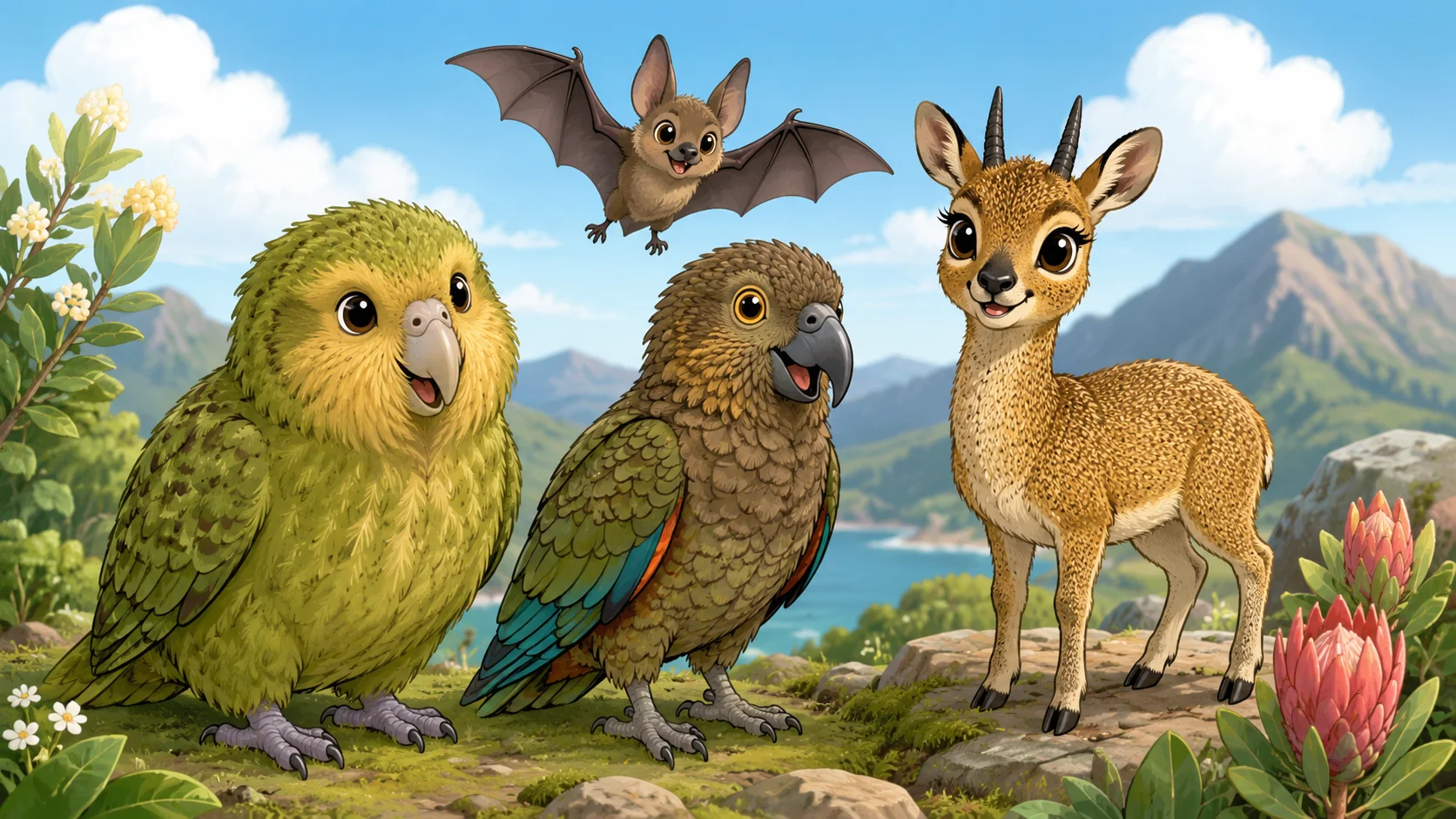
Expanding a child’s animal vocabulary beyond household names stimulates cognitive flexibility and deepens their appreciation for global biodiversity. Introducing unique animal species encourages critical thinking about evolutionary adaptations and ecosystem dependencies.
Kakapo
The conservation story of the kākāpō provides a meaningful case study for teaching children about human environmental responsibility. Because New Zealand evolved for millions of years without terrestrial predatory mammals, the kākāpō lost its ability to fly, developing a ground-based lek breeding system where males gather to emit deep, booming calls to attract females. When European settlers introduced rats, cats, and stoats, the flightless kākāpō had no natural defenses, causing populations to fall dramatically in the 20th century. Today, carefully managed recovery programs use radio-tracking, artificial incubation, and predator-free habitats to rebuild this iconic parrot’s numbers.
Kagu
The kagu is an unusual, ghost-gray bird found only in the dense mountain forests of New Caledonia, an island group in the South Pacific. This nearly flightless bird is ground-dwelling and forages through leaf litter for earthworms, snails, and small lizards. The kagu has a spectacular, erectile crest of feathers that it raises during territorial displays or courtship rituals. Because of habitat loss and predation by dogs and other introduced animals, the kagu is endangered and has become an important symbol of island conservation.
Kea
The kea is widely recognized by ornithologists as one of the most intelligent bird species on Earth, occupying the harsh alpine valleys of New Zealand’s South Island. This large, olive-green mountain parrot displays intense curiosity and advanced problem-solving skills, often interacting with human structures by unlatching backpacks, opening trash bins, and inspecting cars.
Studies conducted by animal behaviorists demonstrate that keas can work cooperatively to solve complex mechanical puzzles to access food rewards. This high level of cognitive flexibility helps them locate varied food sources in high-altitude environments where resources change rapidly with the seasons.
Kipunji
The kipunji is a medium-sized monkey first recorded by scientists in Tanzania’s high-altitude forests in the early 2000s. This rare primate is distinguished by a long, erect crest of hair on its head and a unique vocalization known as a “honk-bark,” which differs from the calls of other monkey species. The kipunji lives in cooperative social groups within the tree canopy, feeding on a diverse diet of leaves, shoots, bark, and invertebrates. Because its total habitat footprint is very small, the kipunji faces extreme conservation pressure from illegal logging and agricultural encroachment.
Kiang
The kiang is the largest living species of wild ass, native to the alpine meadows and cold deserts of the Tibetan Plateau at elevations up to 17,000 feet. This robust equine has a dense, chestnut-colored coat that thickens significantly during winter to protect it from sub-zero temperatures. Kiangs travel in cohesive herds led by a dominant matriarch, migrating long distances across barren terrain to find seasonal grasses and shrubs. Their survival relies on strong running endurance, which helps them escape predators such as Himalayan wolves across vast, open plains.
Kulan
The kulan is a type of Asiatic wild ass that inhabits arid plains, deserts, and scrublands in parts of Central Asia. This mammal is built for desert survival, capable of enduring extreme temperature swings and going multiple days without drinking water by extracting moisture from desert plants. Kulans can sprint at speeds up to 40 miles per hour to outrun predators across hard-packed clay soils. Due to historical overhunting and competition with domestic livestock for scarce water sources, the kulan is highly protected within specialized nature reserves.
Klipspringer
The klipspringer is a tiny, specialized African antelope whose name translates to “rock jumper” in Afrikaans. This herbivore occupies steep rocky outcrops, koppies, and mountain ridges across eastern and southern Africa.
The klipspringer exhibits a remarkable hoof adaptation: it walks on the very tips of its cylindrical, rubbery hooves, which absorb impact and provide traction on stone faces. Combined with a dense, hollow-haired coat that cushions the animal against rocky falls and helps regulate temperature, this miniature antelope can jump across wide crevices with impressive precision.
Kitti’s Hog-Nosed Bat
Kitti’s hog-nosed bat, found in limestone caves along rivers in Thailand and Myanmar, is recognized as the world’s smallest mammal by body length. Often called the “bumblebee bat,” this tiny creature weighs less than a U.S. penny and measures about 1.1 to 1.3 inches in body length.
| Metric | Value / Dimension |
| Average Weight | 0.05 to 0.07 ounces (1.5 to 2 grams) |
| Body Length | 1.1 to 1.3 inches (29 to 33 mm) |
| Wingspan | Approximately 5.7 inches (145 mm) |
| Primary Habitat | Limestone caves near rivers |
This bat leaves its cave roosts for brief periods during dawn and dusk, using high-frequency echolocation to hunt tiny insects over tropical forest canopies.
Kowari
The kowari is a small, carnivorous marsupial native to the stony deserts and gibber plains of central Australia. This nocturnal mammal lives in deep underground burrows during the heat of the day, emerging at night to hunt insects, small lizards, and rodents. The kowari features a distinctive brush of black hairs on the end of its tail, which scientists believe may confuse predators or assist in social signaling. Because its fragile desert habitat is easily degraded by cattle ranching and introduced foxes, the kowari is classified as a vulnerable species that requires active monitoring.
Marine & Aquatic K Animals
Aquatic ecosystems are home to a huge variety of animals. Investigating aquatic K animals allows children to explore the distinct biological adaptations required for life underwater, from tiny organisms to massive ocean predators.
Killer Whale (Orca)
The killer whale represents the apex of many marine food webs, maintaining populations from ice-bound polar zones to warm equatorial seas. Marine mammal researchers have documented that orca pods use highly structured social communication, including distinct click and whistle dialects that vary among family groups. Their hunting strategies are exceptionally sophisticated; for example, Antarctic pods cooperate to swim in unison toward ice floes, creating localized waves that wash sleeping seals into the water. This complex behavioral transmission across generations represents a form of non-human cultural inheritance.
Krill
Krill are small, translucent, shrimp-like crustaceans that inhabit open ocean waters, especially the Southern Ocean around Antarctica. Despite their small individual size, averaging about two inches in length, krill can gather in massive swarms that extend for miles and contain millions of tons of biomass.
Krill swarms form a foundational food source for baleen whales, penguins, seals, and many fish species.
Krill feed on microscopic phytoplankton, converting solar-driven plant energy into animal protein. This makes krill one of the most important links in the marine food chain, supporting giant baleen whales, seals, penguins, and numerous fish species.
Koi
Koi are brightly colored ornamental carp, often kept in outdoor ponds and public water gardens around the world. Developed through centuries of selective breeding in Japan, koi display an array of patterns featuring red, white, yellow, and black scales. These robust freshwater fish require clean, aerated water, can grow up to three feet long, and often live for decades under proper care. In Japanese culture, koi are recognized as symbols of perseverance, strength, and good fortune because of their association with swimming up swift currents.
Killifish
The killifish comprises a large family of small, vibrant freshwater fish distributed across tropical and temperate regions of North America, Africa, and South America. These adaptable fish occupy a wide variety of habitats, including shallow streams, swamps, and temporary rainwater pools that dry up completely during seasonal droughts.
To survive these extreme cycles, certain annual killifish species have developed an incredible reproductive adaptation: they lay drought-resistant eggs in the mud. These eggs undergo an extended pause in development, hatching successfully only when seasonal rains refill the pools months later.
Knifefish
Freshwater knifefish, such as the black ghost knifefish found in the Amazon River basin, rely heavily on specialized anatomy to navigate complex aquatic structures. Because their long, undulating anal fin allows them to swim backward just as easily as forward, they can move through narrow spaces among submerged tree roots with ease. Their low-voltage electrical field acts like an organic radar system, allowing the knifefish to map its surroundings and locate tiny worms and insect larvae hidden in river mud, compensating for poorly developed eyesight.
King Crab
The king crab, specifically the red king crab native to the cold subarctic waters of the Bering Sea and the Gulf of Alaska, is one of the largest crustaceans on Earth. This bottom-dwelling invertebrate has a heavily armored exoskeleton covered in sharp spines, along with a leg span that can reach up to five feet across.
King crabs walk along the muddy ocean floor in large groups, using powerful, asymmetrical claws to crush hard-shelled prey such as clams, sea urchins, and barnacles. They play an important role in benthic ecosystems as both active predators and scavengers of organic detritus.
King Salmon
The king salmon, also known as the Chinook salmon, is the largest species of Pacific salmon, ranging from the cold rivers of North America to North Asia. This anadromous fish has a complex life cycle: it hatches in freshwater streams, migrates to the open Pacific Ocean to feed and grow for several years, and eventually returns to its natal river to spawn.
During this upstream migration, the king salmon undergoes major physical changes, often turning olive brown, red, or purplish, while males may develop a hooked jaw. This species is vital to coastal ecosystems, transferring ocean nutrients deep into inland forest food webs through predators such as bears and eagles.
Kokanee Salmon
The kokanee salmon is a landlocked form of sockeye salmon that spends its entire life cycle inside freshwater lakes and reservoirs rather than migrating to the open ocean. Found predominantly in mountainous lakes across western North America, kokanee salmon feed primarily on tiny zooplankton, which keeps their body size much smaller than ocean-going salmon. During the autumn spawning season, these fish migrate into shallow gravel streams, where their scales change from an understated silver hue to a brilliant crimson red before they deposit their eggs.
Kelp Bass
The kelp bass, also known as the calico bass, is a popular marine fish native to the coastal waters of the eastern Pacific, particularly around the extensive kelp forests of California. This predator has a mottled brown and green camouflage pattern that allows it to blend with vertical giant kelp fronds. The kelp bass plays a stabilizing role within local kelp-forest food webs by hunting small fish, crabs, and squid.
Kitefin Shark
The kitefin shark is a deep-sea shark found in dark offshore waters, often hundreds to thousands of feet below the surface. This dark brown, blunt-snouted shark has very large eyes adapted for low-light vision, allowing it to hunt fish, crustaceans, and other small sharks in the ocean’s twilight zone. Notably, researchers have documented bioluminescence in the kitefin shark, making it the largest known luminous vertebrate. Its underside glow may help with counterillumination in deep water.
Insects & Tiny Creatures Starting with K
Insects offer an accessible way for children to observe anatomy, life cycles, and microhabitats directly. Exploring tiny creatures starting with K reveals specialized survival strategies, from leaf mimicry to complex relationships with native plants.
Katydid
The katydid is a fascinating insect in the family Tettigoniidae, instantly recognizable by its long, thread-like antennae and leaf-like camouflage that helps it blend in with green foliage. Found in backyards, fields, and forests around the world, katydids feed on leaves and stems, using their hind legs to make powerful jumps when threatened by birds or lizards.
During warm summer nights, male katydids rub their specialized forewings together to create a loud, rhythmic chirping sound designed to attract female mates, a process known to entomologists as stridulation.
Kissing Bug
The kissing bug is the common name for a group of assassin bugs found primarily across the warmer, arid regions of North and South America. These nocturnal insects get their unusual name because they tend to bite humans near the lips or face while people sleep to feed on blood.
While fascinating from a biological standpoint because of their heat-seeking navigation sensors, educators should include a factual, non-alarming safety note: certain wild kissing bugs can carry a parasite that transmits Chagas disease, making it important to avoid handling them in areas where they are common.
Kudzu Bug
The kudzu bug is a small, olive-green, beetle-like insect native to East Asia that was introduced to the southeastern United States in 2009. This insect feeds primarily on the sap of the fast-growing kudzu vine, using its piercing-sucking mouthparts to drain plant nutrients. While it can help control the invasive kudzu plant, the bug has also become an agricultural pest because it feeds on valuable soybean crops, illustrating the complex ecological chain reactions that can occur when non-native insects enter a new ecosystem.
Karner Blue Butterfly
The Karner blue butterfly is a small, endangered insect native to the oak savanna and pine barren ecosystems of the Great Lakes region in North America. The male has beautiful, silvery-blue wings edged with black, while the female displays a more muted gray-brown color pattern.
The life cycle of this butterfly is deeply dependent on a single plant species: the wild lupine. Because Karner blue caterpillars feed exclusively on wild lupine leaves, the survival of this butterfly is tied to the preservation and restoration of its native, fire-dependent grasslands.
Kamehameha Butterfly
The Kamehameha butterfly is one of only two native butterfly species in Hawai‘i and is named after the House of Kamehameha. This striking insect has orange, brown, black, and white markings and flits through native forest canopies. The caterpillars feed on plants belonging to the nettle family, using specialized camouflage to blend in with leaf stems. It has been Hawaii’s official state insect since 2009 and is often used to teach students about native habitat preservation.
Keyhole Limpet
The keyhole limpet is a small marine mollusk found clinging tightly to rocks along intertidal coastlines around the world. This creature is named for the distinct keyhole-like opening at the top of its conical shell.
The limpet moves slowly across wave-swept rocks using a muscular foot, grazing on film-like coatings of marine algae with a file-like tongue called a radula. The specialized hole in its shell allows water to flow through its gills, providing an efficient way to expel respiratory waste products without exposing its soft body to predators or drying out at low tide.
More Interesting K Animals
Kit Fox
The kit fox is a small, desert-adapted canine native to the arid grasslands and scrublands of western North America. Weighing about four pounds, this miniature fox has exceptionally large ears that serve two purposes: they detect the faint sounds of moving prey, such as kangaroo rats, in darkness, and they help radiate excess body heat to keep the fox cool without wasting water. Kit foxes are strictly nocturnal, spending hot desert days inside deep, complex underground burrows that have multiple escape exits.
Kodiak Bear
The Kodiak bear is a distinct subspecies of the brown bear found only on the islands of the Kodiak Archipelago in southwestern Alaska. Alongside the polar bear, the Kodiak bear is one of the largest bears on Earth, with large males weighing up to 1,500 pounds and standing over 10 feet tall on their hind legs.
These massive mammals are omnivorous, consuming a diverse seasonal diet of emerging spring vegetation, wild berries, and abundant protein-rich Pacific salmon during summer spawning runs. Their exceptional physical strength and thick fat reserves allow them to survive long winter hibernation cycles in high-mountain dens.
Kestrel
The kestrel, including species such as the American kestrel and the Eurasian kestrel, is a small, highly agile falcon found across open fields, pastures, and parklands. This raptor has a specialized hovering hunting style, beating its wings rapidly to remain almost stationary in midair while scanning the ground below for insects, mice, and small lizards. Equipped with sharp vision that can detect ultraviolet light, a kestrel can spot the urine trails left by small rodents in the grass, allowing it to dive with impressive accuracy to seize its prey.
Kite
The kite refers to a diverse group of graceful birds of prey, many of which have long, narrow wings and forked tails. Kites are known for buoyant, soaring flight, riding warm thermal air currents for hours with minimal wing flapping as they scan open landscapes for food. Many kite species are opportunistic feeders, eating carrion, insects, amphibians, or small prey caught from the ground or water surface.
Killdeer
The killdeer is a medium-sized plover species found across North America, uniquely classified as a shorebird that frequently nests far from water in open fields, gravel driveways, and lawns. This bird is named for its loud, piercing “kill-deer” call, which it repeats continuously when disturbed.
To protect its vulnerable ground nest, an adult killdeer may perform a convincing broken-wing display, fluttering along the ground as if injured to lure predators away from its eggs before flying away.
Kob
The kob is a medium-sized antelope native to moist savannas, floodplains, and open grasslands in Central and East Africa. These herbivores live in dynamic herds and feed mainly on short, nutrient-rich grasses near permanent water sources. Kobs are known for their lek breeding behavior, where dominant males establish and defend small circular territories grouped close together, displaying their ringed horns and vocalizing to attract passing female herds.
Kafue Lechwe
The Kafue lechwe is a highly specialized, water-loving antelope subspecies found only within the seasonal swamps and floodplains of the Kafue Flats in Zambia, Africa. This mammal has unique physical adaptations for wetland life, including elongated, splayed hooves that help it move through soft wetland mud. The Kafue lechwe feeds on aquatic vegetation and may wade into deep water to graze. It faces ongoing conservation challenges due to river damming projects that alter seasonal flooding patterns.
Kirk’s Dik-Dik
Kirk’s dik-dik is an incredibly small antelope species that inhabits the dry, thorny bushlands and scrub deserts of eastern and southwestern Africa. Standing about 14 inches tall at the shoulder, this miniature herbivore often lives in monogamous pairs that defend small territories using scent markings from glands beneath their eyes. Kirk’s dik-dik has an elongated, trunk-like snout that contains a specialized cooling chamber where blood vessels are cooled by rapid breathing, allowing the animal to survive extreme desert heat without needing to find standing water.
Alphabetical List of Animals Starting with K
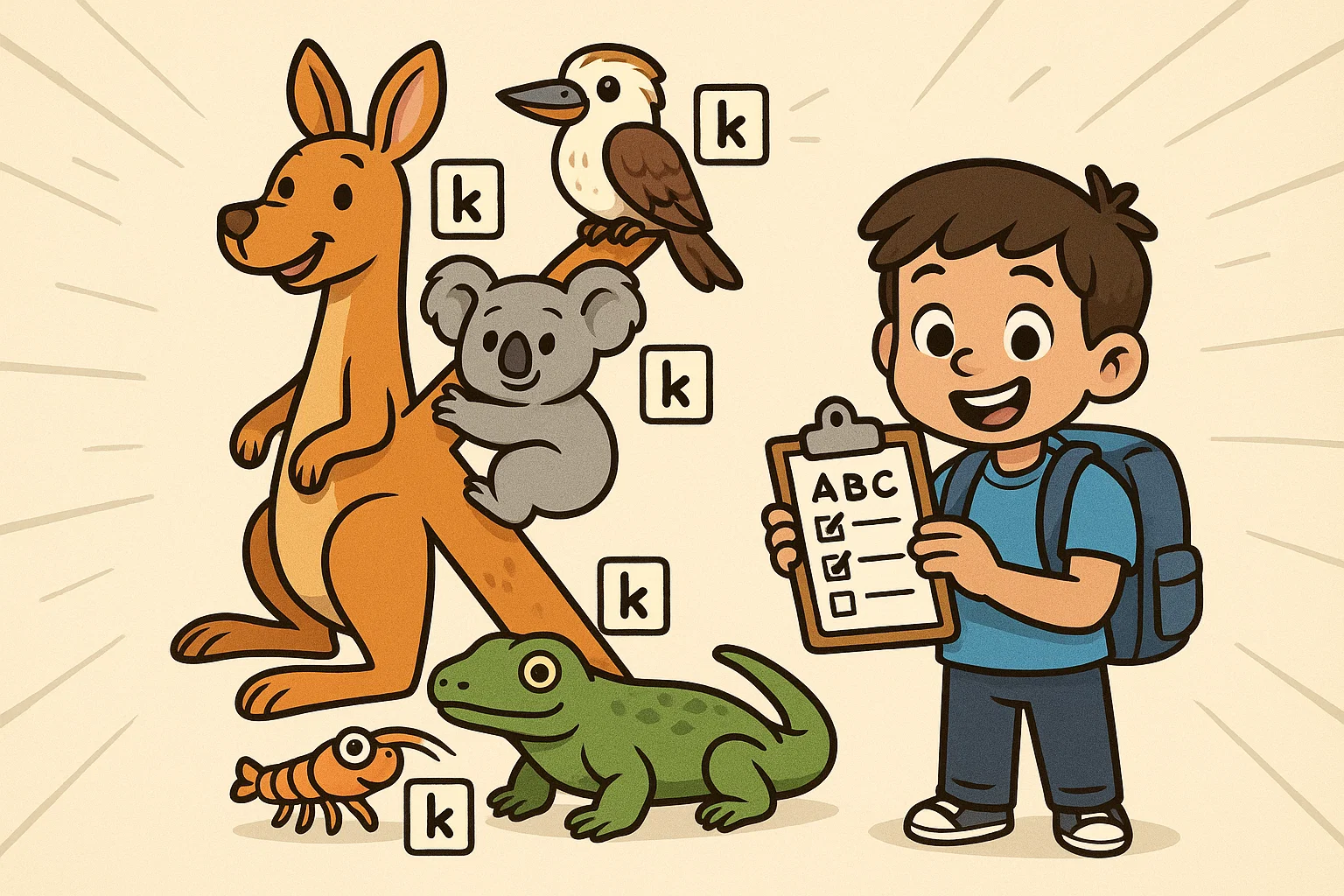
This scannable index serves as a quick reference tool for classrooms, homework assignments, and structured vocabulary projects.
K Animal Name Table
| Animal Name | Animal Type | Primary Habitat | Kid-Friendly Fact |
| Kafue Lechwe | Mammal | African wetlands | Wades into water to eat swamp plants. |
| Kagu | Bird | New Caledonia forests | A gray, ground-dwelling bird with a tall feather crest. |
| Kakapo | Bird | New Zealand islands | The world’s only flightless parrot; sleeps by day. |
| Kamehameha Butterfly | Insect | Hawaiian forests | Bright orange state insect native to Hawaii. |
| Kangaroo | Mammal | Australian grasslands | Uses a pouch to carry its tiny baby, called a joey. |
| Kangaroo Rat | Mammal | North American deserts | Can survive without drinking liquid water, getting moisture from seeds. |
| Karner Blue Butterfly | Insect | Oak savannas | Caterpillars eat only leaves from the wild lupine plant. |
| Katydid | Insect | Forests and backyards | Looks like a green leaf to hide from predators. |
| Kea | Bird | New Zealand mountains | A smart parrot that can solve tricky puzzles for food. |
| Kelp Bass | Fish | Pacific kelp forests | Hides vertically inside giant kelp seaweed to hunt. |
| Kestrel | Bird | Open fields | Can hover almost still in the air while hunting. |
| Keyhole Limpet | Mollusk | Ocean tide pools | Has a tiny hole at the top of its shell that looks like a keyhole. |
| Kiang | Mammal | Tibetan Plateau | The largest wild donkey; grows a thick winter coat. |
| Killdeer | Bird | Open fields and lawns | Fakes a broken wing to lead predators away from its nest. |
| Killer Whale | Mammal | Oceans worldwide | Actually the largest member of the dolphin family. |
| Killifish | Fish | Streams and mud pools | Eggs can survive for months in dry mud until it rains. |
| King Cobra | Reptile | Asian rainforests | The longest venomous snake; eats other snakes. |
| King Crab | Crustacean | Cold ocean floors | Has giant, prickly legs that can span five feet across. |
| Kingfisher | Bird | Rivers and lakes | Dives headfirst into water to catch fish with its sharp beak. |
| King Salmon | Fish | Rivers and oceans | Travels from the ocean back to the stream where it was born. |
| Kinkajou | Mammal | Rainforest canopies | Uses its long prehensile tail like a hand to hold onto trees. |
| Kipunji | Mammal | Tanzanian forests | A rare monkey with a distinctive crest of hair on its head. |
| Kirk’s Dik-Dik | Mammal | African bushlands | A tiny antelope that grows to be only 14 inches tall. |
| Kissing Bug | Insect | Warm, arid regions | Named because it bites near the face while people sleep. |
| Kit Fox | Mammal | North American deserts | Has huge ears that act like built-in air conditioners. |
| Kite | Bird | Open skies | Can soar for hours on wind currents without flapping its wings. |
| Kitefin Shark | Fish | Deep ocean waters | Glows using light-producing organs called photophores. |
| Kitti’s Hog-Nosed Bat | Mammal | Limestone caves in Thailand and Myanmar | The smallest mammal by body length; about the size of a bumblebee. |
| Kiwi | Bird | New Zealand forests | A flightless bird with nostrils at the very tip of its beak. |
| Klipspringer | Mammal | Rocky cliffs | Walks on the tips of its hooves like a ballet dancer. |
| Koala | Mammal | Eucalyptus trees | Sleeps up to 20 hours a day because its food gives little energy. |
| Kodiak Bear | Mammal | Alaskan islands | One of the biggest bears on Earth; loves catching salmon. |
| Kokanee Salmon | Fish | Freshwater lakes | Turns bright red during the spawning season. |
| Komodo Dragon | Reptile | Indonesian islands | The largest living lizard; uses venom to hunt large prey. |
| Kookaburra | Bird | Australian woodlands | Makes a loud call that sounds a lot like human laughter. |
| Kowari | Mammal | Australian deserts | A tiny nocturnal hunter with a brush of black hair on its tail. |
| Krill | Crustacean | Cold ocean waters | Tiny shrimp-like creatures that giant whales eat by the millions. |
| Kudu | Mammal | African savannas | Male kudu grow spectacular, twisting spiral horns. |
| Kulan | Mammal | Central Asian deserts | A rare wild donkey built to sprint across hard desert soils. |
Frequently Asked Questions About Animals Starting with K
Which animals start with K?
Common examples of animals that start with the letter K include mammals like the kangaroo, koala, kudu, and kinkajou. The list also includes birds like the kiwi and kingfisher, reptiles like the Komodo dragon and king cobra, and aquatic life like the killer whale and krill.
Which K animals live in Australia?
Australia is home to several famous K animals, including marsupials like the kangaroo and koala. It is also home to bird species such as the laughing kookaburra, along with many katydid species.
Which rodents begin with K?
The most common rodents that begin with K are the kangaroo rat and the kangaroo mouse. These small mammals are native to the arid desert regions of North America and are named for their elongated hind legs, which allow them to hop like miniature kangaroos to escape predators.
Which K animals live in water?
Numerous animals starting with K thrive in aquatic environments. This group includes marine mammals like the killer whale, large invertebrates like the king crab, freshwater fish like koi and killifish, and tiny ocean crustaceans like krill.
Which K animals are endangered?
Several K animals are endangered due to habitat loss and introduced predators. Key examples include the flightless kākāpō parrot of New Zealand, the crested kagu bird of New Caledonia, and the Karner blue butterfly of North America.
Which K animal is biggest?
The killer whale, or orca, is the largest animal starting with K, reaching lengths of up to 32 feet and weights of up to 11 tons. On land, the Kodiak bear is one of the largest animals on the list, with large males weighing up to 1,500 pounds.
Which K animal is smallest?
The smallest mammal starting with K is Kitti’s hog-nosed bat, which measures about 1.1 to 1.3 inches in body length. In the ocean, individual krill are among the smaller creatures on this list, often measuring less than two inches long.
Why do koalas sleep so much?
Koalas sleep up to 18 to 20 hours a day because their diet consists almost entirely of eucalyptus leaves. These leaves are tough to digest, low in energy, and contain compounds that koalas have special adaptations to process.
Can kangaroos jump 9 meters?
Large species of kangaroos, such as adult red kangaroos, are capable of making horizontal bounds that approach 8 to 9 meters (25 to 30 feet) when sprinting at top speeds across open territory.
Are kinkajous carnivores?
Kinkajous belong to the scientific order Carnivora because of their evolutionary lineage, but their everyday diet is mostly fruit, nectar, and some insects. They are therefore not carnivores in the everyday dietary sense.

Take a short quiz to find out what your everyday choices say about your parenting style
When your child is curious about something new, what’s your instinct?
Take a short quiz to find out what your everyday choices say about your parenting style
“Can I download this app?” What happens next?
Take a short quiz to find out what your everyday choices say about your parenting style
When it comes to rules at home, which sounds most like you?
Take a short quiz to find out what your everyday choices say about your parenting style
If you could give your child one life skill today, what would you pick?
Take a short quiz to find out what your everyday choices say about your parenting style
Your child gets to choose what to watch. What would your ideal setup look like?
Take a short quiz to find out what your everyday choices say about your parenting style
Pick your parenting superpower ✨