How Old Do You Have to Be to Pawn Something?

 Discover a Free Education Video App for Kids
Pastory uses AI to personalize educational video content based on your child’s interests and personality. Safe, engaging, and built for curious young minds. Sign up now to stay updated and enjoy early access with a free trial
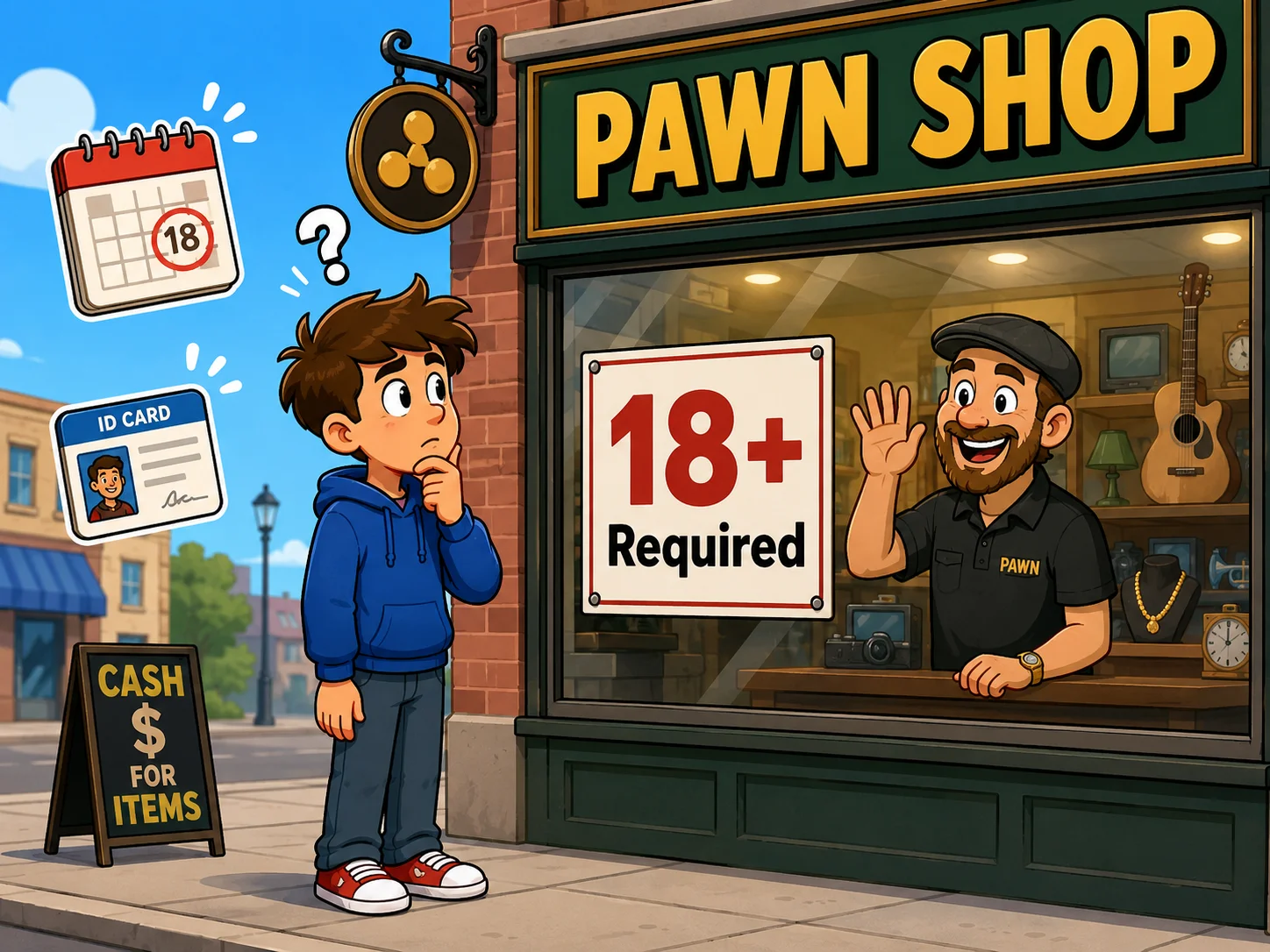
In most places, you must be at least 18 years old to pawn an item, sell an item, or take out a pawn loan. Some states, local jurisdictions, or store policies may set a higher minimum age, especially where the age of majority or the item category creates additional restrictions.
Key Takeaways
- Age Requirement: In most U.S. jurisdictions, customers must be at least 18 to enter into a pawn agreement.
- Identification: Pawn shops usually require a valid, government-issued photo ID for pawn and sale transactions.
- Legal Contracts: Minors generally cannot pawn items because they may lack the legal capacity to enter into a binding contract.
- Alternatives for Minors: Anyone under 18 should speak with a parent or legal guardian about lawful financial options.
Minimum Age Requirement
In most U.S. jurisdictions, a person must be at least 18 years old to sell an item, use it as collateral, or take out a short-term loan from a licensed broker. Because these loans are contracts, licensed shops generally require customers to be legal adults under the applicable state or local law.
People below the applicable minimum age generally cannot complete this type of transaction because it requires a legally binding contract.
ID Requirement
Licensed shops are generally required to verify a customer’s identity before accepting an item as collateral or buying it outright. Customers usually must present a valid, unexpired government-issued photo ID that shows their legal name, photo, and date of birth.
Many pawnbrokers use digital ID scanners or point-of-sale systems to help verify age, record required information, and comply with local reporting rules.
Minor Restrictions
Minors cannot enter into pawn contracts because the transaction involves a legally binding agreement that requires valid legal consent. Under general contract-law principles, agreements signed by minors may be voidable, which can expose a pawnbroker to financial and compliance risks.
As a result, these businesses typically refuse transactions from anyone below the applicable legal age.
State Law Differences
Pawn shop regulations vary significantly by state, city, and municipality. Although 18 is the common minimum age in many U.S. locations, state law, local ordinances, or store policies may require a higher age in some cases.
Consumers should check local requirements before visiting a shop because laws and licensing rules can vary by location.
Best Option for Anyone Under 18
The most secure and lawful path for anyone under 18 who needs to raise short-term funds is to wait until they reach the legal age or discuss the matter directly with a parent or legal guardian.
If an adult chooses to assist, the adult should own the item or have the legal right to pawn it, present their own valid identification, sign the pawn agreement, and take responsibility for repayment.
Minors should not attempt to complete pawn transactions independently because pawn shops are generally required to reject underage transactions.
What Is a Pawn Shop?
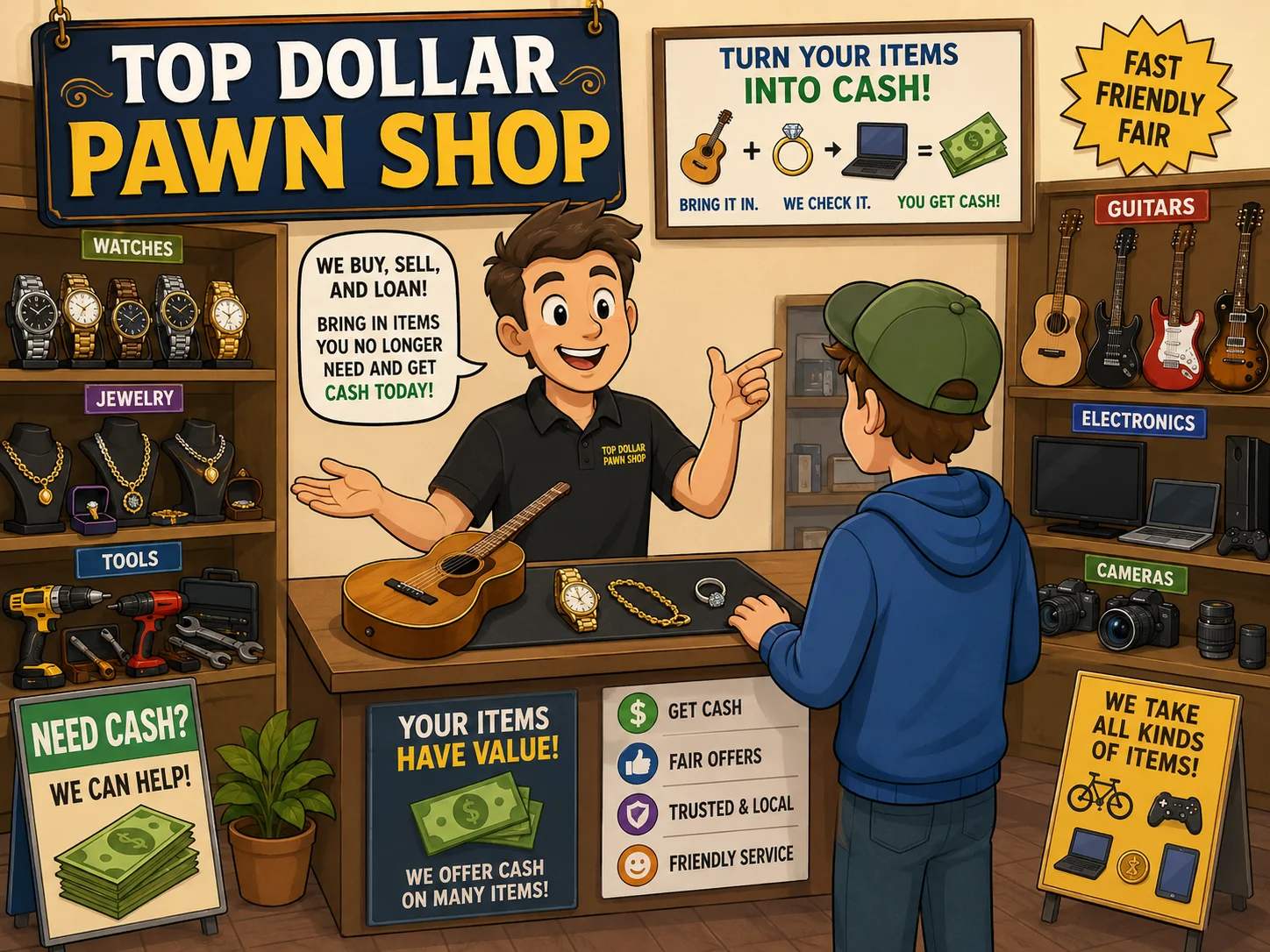
A pawn shop is a business that offers short-term loans secured by personal property and may also buy and sell secondhand goods. These businesses give customers a way to access quick cash without using a traditional bank or credit line.
| Feature | Pawn Loan Transaction | Outright Sale Transaction |
| Primary Objective | Secure quick cash while keeping the option to recover the item | Permanent exchange of an item for a direct cash payment |
| Ownership of Item | Retained by the customer if the loan is repaid within the required period | Transferred completely to the pawn shop |
| Credit Impact | No credit check is usually required for approval | No credit impact; the customer sells the item for cash |
| Average Return | Generally a percentage of the item’s estimated resale value | Often yields a slightly better price than a loan offer |
Pawn Shop Role
A pawn shop functions primarily as a secured lender that provides a short-term loan in exchange for a physical item of value held as collateral. The pawnbroker assesses the resale value of the item, stores the property safely, and issues cash to the borrower.
The business returns the item to the customer once the borrower repays the principal, interest, and any required fees within the agreed time frame.
Items Pawn Shops Commonly Accept
These shops accept a wide range of consumer goods, especially portable items with strong resale demand. Common items accepted by pawnbrokers include fine jewelry, gold, high-end electronics, luxury watches, professional power tools, musical instruments, rare collectibles, and designer goods.
The business evaluates each item based on current resale demand, condition, authenticity, and market liquidity.
How Pawn Shops Make Money
These businesses generate revenue through interest, finance charges, processing fees, and the resale of unredeemed collateral or outright purchases.
If a borrower does not repay the loan within the agreed period, the pawnbroker may take ownership of the item and sell it to recover the loan amount. Pawn shops also make money by buying secondhand goods outright and reselling them at a markup.
What Is Pawning?
Using an item as collateral means getting a short-term loan by leaving valuable property with a licensed broker. It gives people a way to get quick cash without going through a traditional credit application.
Pawn Loan Basics
The process begins when a customer brings an item to a licensed shop for evaluation. The broker makes a loan offer based on a percentage of the item’s assessed value and lists the terms on a ticket or loan agreement.
The ticket outlines the loan amount, interest, fees, due date, and what the borrower must do to get the item back.
Collateral-Based Lending
Unlike traditional banks, this type of lender bases approval on the tangible value of the physical item used as collateral. The pawnbroker typically does not require a credit check, employment verification, or personal financial statements.
Because the item secures the loan, pawn loans usually do not require collections activity or credit reporting if the borrower does not repay. Instead, the shop may keep and sell the collateral according to the terms of the pawn agreement and local law.
Common Reasons People Pawn Items
Consumers often use valuable items as collateral to address unexpected expenses, such as emergency medical bills, utility disruptions, or sudden car repairs. Pawning can provide quick cash without permanently giving up sentimental or valuable belongings, as long as the borrower repays the loan on time.
This option allows eligible adults to cover short-term cash needs while keeping a path to reclaim their property.
What Parents Can Teach Teens About Pawn Shops
Parents can use the topic of pawn shops to teach teens about contracts, interest, repayment deadlines, and the risks of short-term borrowing. Understanding how asset valuation, interest rates, and contractual obligations work can provide real-world context for financial decision-making.
Financial Literacy and Decision-Making
Discussing the difference between pawning and selling can help teens understand how financial decisions affect ownership and future costs. These conversations can help teens compare the short-term benefit of quick cash with the longer-term cost of fees and interest.
This approach also encourages young people to think carefully before using valuable items to solve temporary cash problems.
Resource Management
Learning how short-term loans work can help teens understand the connection between financial stress, repayment obligations, and the value of personal property.
Understanding that valuable items have resale value can help young adults make calmer, more practical financial choices.
What Is a Pawnbroker?
A pawnbroker is a licensed individual or business authorized to provide short-term collateral loans and purchase secondhand goods under applicable regulations. Pawnbrokers operate under licensing and consumer-protection rules, which separates them from informal or unverified buyers.
Pawnbroker Responsibilities
A licensed pawnbroker has legal obligations designed to protect consumers and reduce the risk of stolen goods entering the market. Depending on local law, the pawnbroker may need to verify ID, record transaction details, evaluate items, and report certain information to law enforcement.
These practices help reduce the risk of accepting stolen property or completing an unauthorized transaction.
Licensed Pawnbroker vs. Informal Buyer
| Evaluation Criteria | Licensed Pawnbroker | Informal Buyer |
| Regulatory Oversight | Bound by federal, state, and local rules where applicable | Usually limited or no formal oversight |
| Identity Verification | Usually required for pawn and sale transactions | Often optional or informal |
| Consumer Protection | Uses written agreements with disclosed terms, fees, and repayment rules | Limited protection; transactions may be final and harder to dispute |
| Transaction Safety | Conducted in a licensed storefront with business records | Varies; may involve meeting unknown individuals in public or private spaces |
Pawnbroker Regulations
Pawnbrokers operate under a mix of municipal, state, and federal compliance requirements. These laws may set licensing requirements, loan terms, interest or fee limits, recordkeeping rules, and storage obligations.
Failure to follow applicable rules can lead to fines, licensing action, or other penalties.
Federal Law vs. State Law
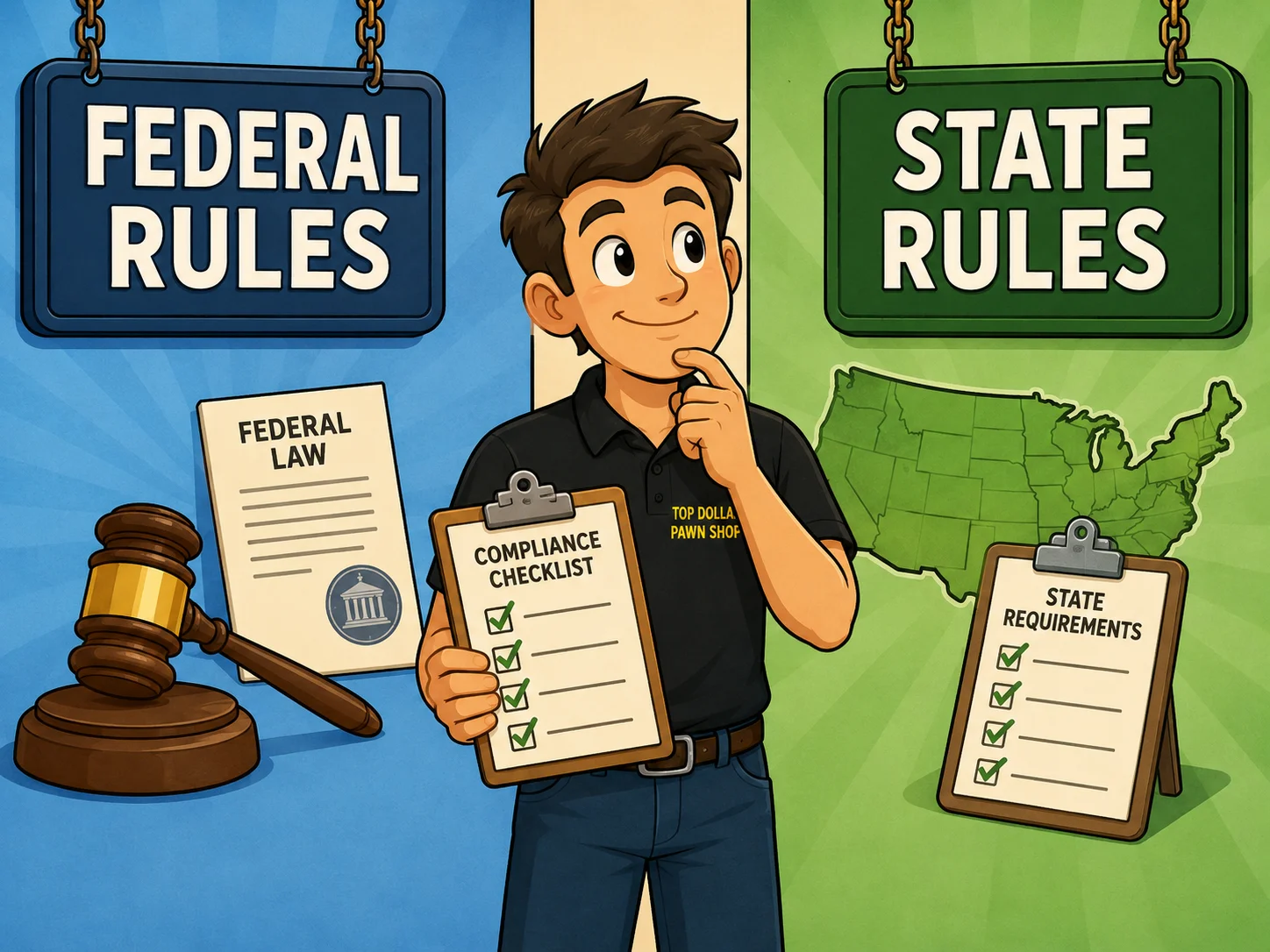
The operations of pawn shops are governed by both broad federal compliance requirements and more specific state or municipal rules. Federal laws may set consumer-protection and disclosure requirements, while states and cities often set more specific rules for licensing, reporting, fees, and age eligibility.
Federal Rules Affecting Pawn Shops
Pawn shops may need to comply with federal consumer-credit disclosure rules and customer-information safeguards, depending on the transaction and business model.
These rules can require clear disclosure of credit costs and safeguards for customer information. Additional reporting, anti-fraud, or anti-money-laundering obligations may apply depending on federal, state, and local rules.
State and local recordkeeping and reporting systems also help law enforcement identify stolen goods and investigate suspicious transactions.
State-Level Age Requirements
Federal consumer-credit laws do not set one national pawn shop age limit. Age eligibility is usually determined by state contract law, state pawn statutes, local ordinances, and store policy.
Many states and local rules effectively use 18 as the minimum age because pawn transactions require a valid adult contract. However, some places may require a higher age because of state age-of-majority rules, local ordinances, or restrictions tied to specific regulated items.
Local Pawn Shop Policies
Beyond federal and state legislation, municipal governments and individual store owners may implement local pawn shop policies to manage operational risk. A local city council may pass ordinances requiring additional records, ID checks, or limits on certain types of transactions.
A pawnbroker may also adopt stricter internal policies for regulated or high-risk items, especially firearms, to reduce legal and compliance risk.
What Age Do You Have to Be?
To legally complete a transaction at a pawn shop, an individual must meet the age requirements established by the applicable jurisdiction and store policy. The law regulates the age threshold to help ensure that all parties have legal accountability for the agreement they sign.
Standard Minimum Age
In many U.S. and UK contexts, the standard minimum age to pawn or sell items through a pawnbroker is 18. This threshold usually reflects the age at which a person can enter into binding contracts and take responsibility for financial decisions.
Pawn shops commonly use this benchmark as their baseline operational standard.
When Age May Be 19 or 21
In certain territories or specialized scenarios, the legal age requirement may be higher than 18. Some states define the age of majority above 18, which may affect contract capacity and how businesses set age policies.
If a customer wants to pawn or sell regulated items, such as firearms, additional age, licensing, or background-check rules may apply.
Pawn Loan Age vs. Selling Age
In many pawn shops, the same minimum-age policy applies to both pawn loans and outright sales because both involve a contract or transfer of ownership.
Pawn shops generally do not lower age limits for direct sales because buying from a minor can still create ownership and contract-validity risks.
How Old Do You Have to Be to Consent to Pawning?
Legal consent in a commercial transaction requires the customer to have the legal capacity to understand and accept the agreement’s terms, risks, and obligations. Pawn shops generally avoid transactions where valid legal consent cannot be verified.
Legal Capacity to Contract
The concept of legal capacity means that a person must be of sufficient legal age and sound mind to enter into a commercial contract. Under general civil-law principles, minors may lack full capacity to contract, and agreements they sign may be voidable.
Because a pawn loan is a financial contract, a minor generally cannot provide the legal consent needed to complete the transaction.
Why Consent Matters
Valid consent helps ensure that the customer understands the pawn ticket, including the interest, due date, fees, and what happens if the loan is not repaid.
If a customer pawns an item, they must understand that failure to repay the loan may allow the pawnbroker to keep or sell the property under the terms of the agreement and local law.
Without valid adult consent, the transaction may expose the store to ownership disputes, contract challenges, and compliance problems.
Store Liability Risks
Pawn shops typically reject transactions with minors to reduce legal, financial, and licensing risks. If a pawnbroker accepts an item from someone below the legal age, a parent, guardian, or rightful owner may challenge the transaction and seek return of the item.
Regulatory agencies may also impose administrative sanctions, fines, or licensing consequences for underage transactions, depending on local law.
Why Does Pawning Have an Age Requirement?
Age requirements in pawnbroking exist to protect minors, support valid contracts, and reduce ownership and fraud risks. These rules are enforced through a mix of state laws, local ordinances, licensing rules, and store compliance policies.
Pawn Loans Are Contracts
A pawn loan is not a casual swap of goods. It is a short-term, collateral-based credit agreement governed by consumer-finance rules.
The paperwork documents the loan amount, interest, fees, due date, and the possible transfer of ownership if the borrower fails to repay. Because these terms create financial obligations and the risk of losing the item, pawn shops generally limit these contracts to legal adults.
Ownership Must Be Verified
Licensed shops typically require customers to confirm that they own the item or have the legal right to sell it or use it as collateral. Requiring adult ID helps the shop document who brought in the item and supports any ownership or law-enforcement review that may follow.
This measure reduces the risk of people pawning items that do not belong to them, such as family property, employer-owned equipment, or stolen goods.
Stolen Property Prevention
Mandatory ID checks and transaction records help law enforcement trace items and discourage the sale of stolen goods through secondhand lending businesses.
These safeguards make it harder for minors or unauthorized sellers to pawn stolen or disputed property.
Why Minors Can’t Pawn or Sell Items
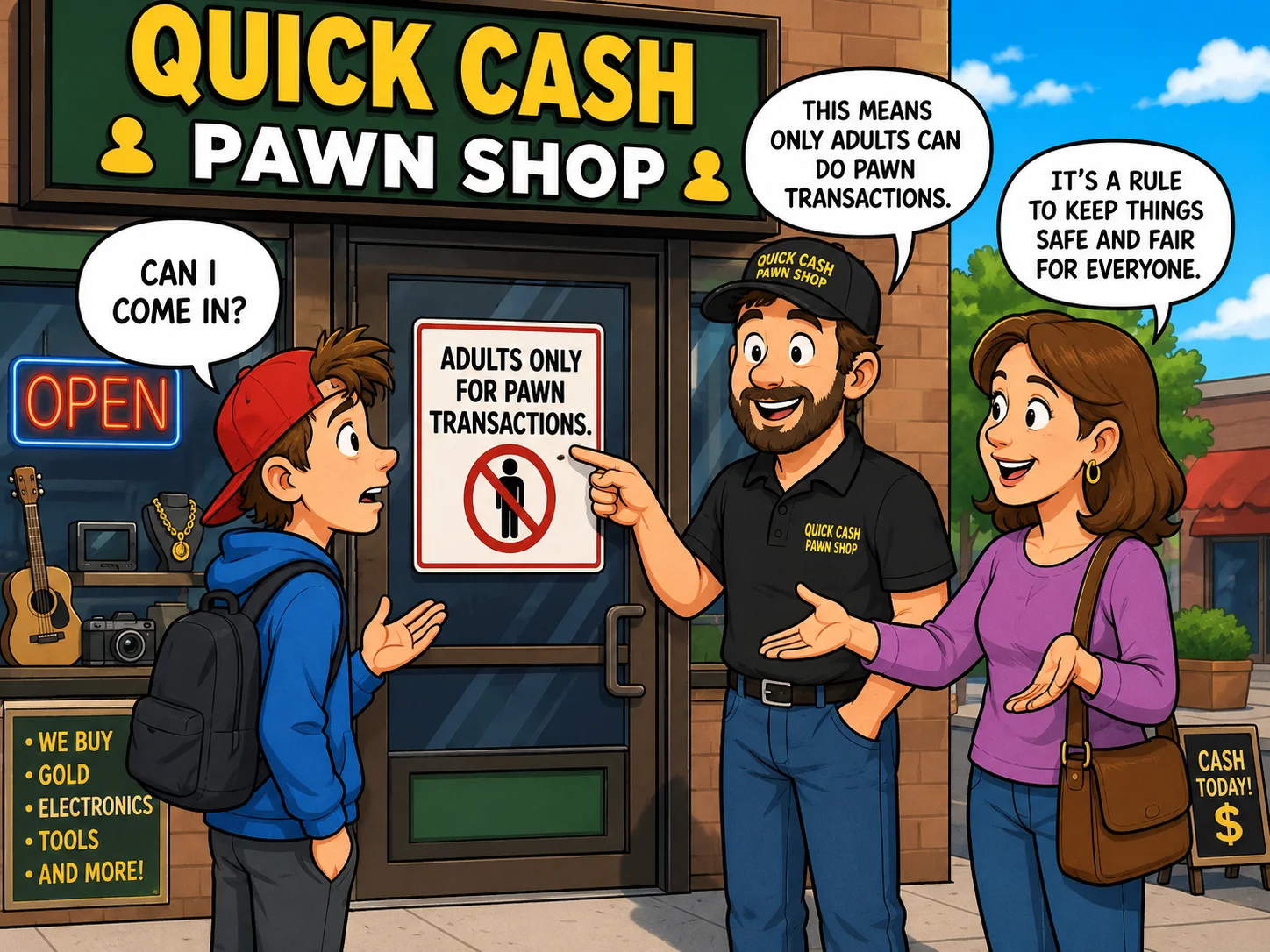
Pawn shops maintain restrictions against minor transactions because of contract-law concerns, ownership disputes, and the regulatory penalties tied to compliance failures.
Contract Limitations for Minors
Minors face contract limitations because civil law generally protects children from entering into complex or potentially disadvantageous financial obligations.
Because contracts with minors may be voidable or difficult to enforce, a pawnbroker generally cannot rely on a pawn ticket signed by someone below the legal age.
Ownership Disputes
When a minor tries to pawn an item, the shop may face questions about whether the minor owns the property and has authority to sell or pledge it.
If a minor pawns or sells an item without proper authority, a parent, guardian, or rightful owner may challenge the transaction and seek to recover the property.
Compliance Penalties for Shops
The penalties for a pawn shop violating age-compliance rules can be serious. Municipal licensing boards and state regulators may monitor pawnbroking activities through audits, reports, or inspections.
A verified underage transaction can lead to fines, licensing action, employee discipline, or other penalties depending on local law.
What If You’re Under the Legal Age?
If you are under the legal age in your jurisdiction and need money or want to sell an item, use lawful options instead of trying to complete a pawn transaction yourself.
Wait Until Legal Age
The most direct and legally compliant strategy is to wait until you reach the legal age of majority in your jurisdiction.
While waiting, you can research the value of your item, gather purchase receipts, and preserve the condition of the item to improve your future loan or sale offer.
Talk With a Parent or Guardian
If you need money right away, talk with a parent or legal guardian about the situation. If an adult recognizes the need and agrees to help, they may choose to visit the pawn shop on your behalf.
The adult should own the item or have the legal right to pawn it, present their own government-issued ID, sign the agreement, and take responsibility for repayment.
Avoid Fake ID or Misrepresentation
A minor should never use a fake ID or misrepresent their age to bypass pawn shop rules. Many modern pawn shops use ID scanners or verification systems that can flag suspicious IDs.
Using a fake ID can be a criminal offense and may lead to police involvement and long-term consequences.
What Happens If a Minor Pawns Something?
If a pawn shop mistakenly completes a transaction with a minor, the transaction may be challenged, reviewed, or voided once the issue is discovered.
Transaction May Be Voided
If the customer was below the legal age at the time of the transaction, the pawn agreement may be voidable under applicable law.
A parent, legal guardian, rightful owner, or legal representative may be able to challenge the contract. Because the customer may have lacked legal capacity, the terms of the pawn ticket may be difficult or impossible to enforce.
Item May Need to Be Returned
If the transaction is voided, the shop may be required to return the item to the rightful owner, parent, or legal guardian, depending on the law and the facts.
Depending on local law, the shop may lose the item and may not be able to recover the money paid out.
Shop May Face Compliance Review
An underage transaction may trigger a compliance review by regulators, licensing authorities, or law enforcement.
The pawn shop’s records, surveillance footage, and employee training procedures may be reviewed to determine how the transaction happened. Repeated compliance failures can result in fines, license suspension, license revocation, or closure.
How Pawn Shops Verify That Someone Is Over 18
Pawn shops use ID-verification procedures to confirm that customers meet the applicable minimum age. In many shops, these steps are built into the point-of-sale system.
Government-Issued Photo ID
To prove legal age, customers usually must present a valid, unexpired government-issued photo ID. Pawn shops commonly accept:
- State driver’s licenses
- State identification cards
- Passports
- Military ID cards
Digital printouts, school IDs, workplace badges, and birth certificates without photo identification are generally not accepted.
ID Verification Process
A typical ID-verification process may look like this:
Customer Presents ID → ID Is Checked or Scanned → Date of Birth Is Verified → Transaction Is Recorded
Date of Birth Check
Pawn shop personnel are trained to check the customer’s date of birth before starting a transaction. The clerk checks that the photo matches the customer, confirms that the ID has not expired, and verifies the customer’s age from the date of birth.
Automated point-of-sale systems may also block the transaction if the customer does not meet the minimum age requirement.
Digital Records and Reporting
Many jurisdictions require pawn shops to maintain digital records of consumer transactions and submit certain information to local law enforcement.
Depending on local requirements, these records may include the customer’s legal name, address, ID details, a description of the item, and sometimes a thumbprint or ID image. These records can help police trace items and review suspicious transactions.
Do Pawn Shops Ask for ID?
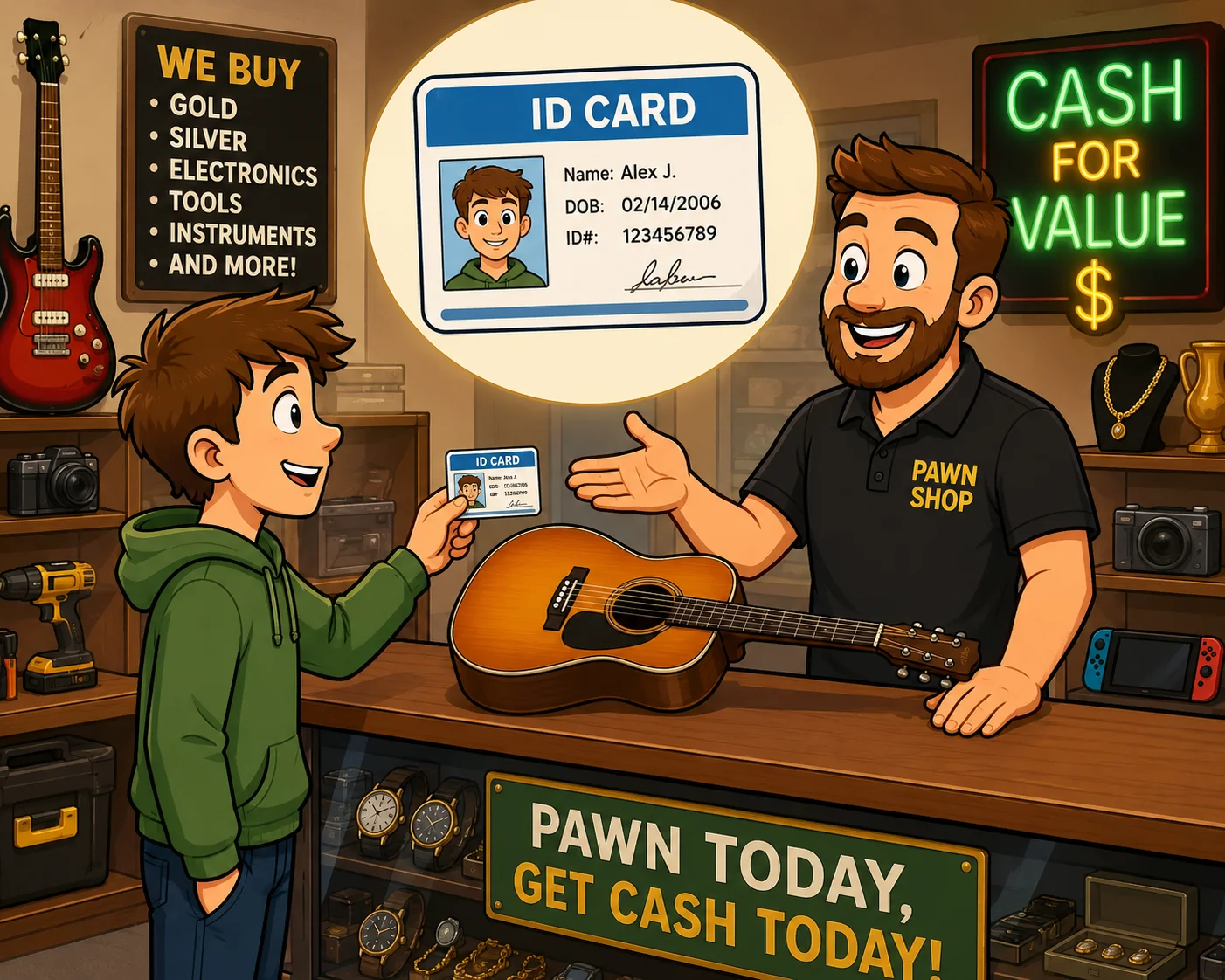
Yes, pawn shops generally ask for ID for pawn loans and outright purchase transactions. For pawn and sale transactions, ID is typically required regardless of the customer’s apparent age or the item’s value.
Why ID Is Required
Pawn shops require identification to verify age, confirm identity, deter fraud, and comply with local reporting rules.
By linking items to verified customer information, the shop helps law enforcement identify the person who brought in an item if it is later reported stolen. This standard level of security supports transparency in the secondhand goods market.
What Counts as Valid ID
- State Driver’s License: A current, unexpired driver’s license issued by a U.S. state or territory.
- State Identification Card: A valid photo identification card issued by a state agency for non-drivers.
- United States Passport: An unexpired federal travel document verifying identity.
- Military ID Card: A military identification credential containing a clear photograph and date of birth.
What Happens Without ID
If a customer arrives without a valid, intact photo ID, the pawnbroker will usually refuse the pawn or sale transaction.
Employees generally cannot bypass this requirement based on personal acquaintance, a lost wallet, or a promise to return with ID later. The physical identification card usually must be present and processed before cash can change hands.
What You Need to Pawn or Sell an Item
To complete a pawn or sale transaction efficiently, gather the required documents and item accessories before visiting the shop.
Valid ID
Bring an unexpired, government-issued photo ID that accurately shows your current legal name and date of birth.
Make sure the card is not damaged, expired, or hard to scan or read.
Item and Accessories
To get the best possible loan offer or purchase price, bring the item with its original accessories whenever possible.
This may include:
- Power chargers
- Remote controls
- Connecting cables
- Original boxes
- Instruction manuals
- Certificates of authenticity
- Warranty documents
These extras can increase the item’s resale value and may lead to a higher offer.
Proof of Ownership
Although proof of ownership is not always required for lower-value goods, bringing it can speed up the appraisal process and reduce questions about the item’s origin.
Helpful documentation may include:
- Original purchase receipts
- Product registration cards
- Warranty certificates
- Insurance appraisals
- Photos or documents showing long-term ownership
Presenting these documents can help show that you have the right to pawn or sell the property.
U.S. vs. UK Pawn Age Rules
The basic principles governing pawnbroking are similar in the United States and the United Kingdom. Both countries generally focus on consumer protection, valid contracts, identity verification, and age restrictions.
U.S. Pawn Shop Age Rules
In the United States, pawn laws are primarily set at the state and local levels, with 18 serving as the common minimum age in many areas.
Some municipalities or stores may set stricter requirements depending on local law, age-of-majority rules, or the type of item involved. Many U.S. pawnbrokers must keep transaction records and may need to report certain information to local law enforcement, depending on state and local rules.
UK Pawnbroking Age Rules
In the United Kingdom, pawnbroking is regulated as consumer credit under the Consumer Credit Act framework, and firms offering regulated credit must be authorised by the Financial Conduct Authority.
To sign a pawnbroking credit agreement in the UK, a customer generally must be at least 18 years old; many brokers also require adults only for secondhand purchase transactions. UK pawnbrokers usually require reliable proof of identity and age, such as a passport or photocard driving licence, before agreeing to a pawn loan.
Why Location Matters
Specific rules, fee limits, identification requirements, and reporting obligations can vary by location. A pawn shop in one city or county may follow different rules than a shop only a few miles away.
Understanding local laws helps prevent transaction rejections and allows customers to prepare the right documents before visiting a storefront.
Concerned About Repaying a Pawn Loan?
Before signing a pawn agreement, customers should make sure they can repay the loan within the required time frame.
Review the Payoff Amount Before Signing
Before signing a pawn ticket, ask the pawnbroker for the full payoff amount required to get your item back.
This figure may include:
- The original loan amount
- Interest
- Storage fees
- Handling fees
- Other applicable charges
Plan around the full payoff amount, not just the cash you receive upfront.
Ask About Renewal Options
If you think you may have trouble repaying the loan before the due date, ask the pawnbroker about renewal or extension options.
Some jurisdictions and shops allow borrowers to extend or renew the loan by paying the accrued interest and fees. This can help you avoid losing the item immediately, but it increases the total cost of the loan.
Avoid Pawning Essential Items
Avoid pawning items you rely on for work, school, transportation, or daily life, such as your main laptop, essential tools, or transportation-related items.
If you cannot repay the loan, you may permanently lose the item. Using only non-essential items as collateral can reduce the impact if you cannot repay the loan.
Final Thoughts: How Old Do You Have to Be to Pawn Something?
Main Rule to Remember
The basic rule is that you usually must be at least 18 years old to pawn an item, sell property, or take out a pawn loan at a licensed pawn shop.
This minimum age is enforced to support valid contracts, protect consumers, and help shops comply with state, local, and consumer-finance rules.
Best Preparation Tip
Before visiting a pawn shop, make sure you have a valid, unexpired government-issued photo ID. Clean your item, gather original accessories, and bring proof of ownership if available.
Good preparation can help you get a better offer and complete the ID-verification process more smoothly.
Safe Decision Reminder
Always review the full terms, interest, fees, and repayment deadline on the pawn ticket before finalizing your transaction.
Compare a short-term pawn loan with an outright sale, and avoid risking essential items if you are not sure you can repay the loan.
FAQ
Can you pawn anything at a shop?
No, you usually cannot pawn anything. These businesses take items that have resale value, are legal to accept, and can be verified as authentic. Common items include jewelry, electronics, watches, tools, musical instruments, and collectibles. Regulated or restricted goods may be subject to additional rules and regulations.
What do you need in order to pawn something?
In order to pawn something, you generally need to be at least eighteen years old, have a valid government-issued photo ID, and bring an item you legally own. Some shops and brokers may also ask for proof of ownership, especially for high-value goods.
What happens if you fail to repay the loan?
If you fail to repay the loan by the due date and do not renew it, you usually won’t get your item back. The shop may keep the item and sell it to recover the money it lent in exchange for your item. This is one of the main risks involved in using personal property as collateral.
Are you allowed to use an item as collateral if you’re under 18?
In most places, you are not allowed to sell or use an item as collateral if you’re under 18. These agreements are legal contracts, and people under the age of eighteen usually cannot enter into a binding agreement with a broker. If you need cash quickly, talk with a parent or legal guardian about lawful alternatives.
How do pawn shops work?
Pawn shops work by lending money against the value of an item. You use an item as collateral, receive cash, and then pay back the loan plus any interest and fees to get the item back. If you are not familiar with these shops and how they work, make sure you understand the basics before signing a ticket.

Take a short quiz to find out what your everyday choices say about your parenting style
When your child is curious about something new, what’s your instinct?
Take a short quiz to find out what your everyday choices say about your parenting style
“Can I download this app?” What happens next?
Take a short quiz to find out what your everyday choices say about your parenting style
When it comes to rules at home, which sounds most like you?
Take a short quiz to find out what your everyday choices say about your parenting style
If you could give your child one life skill today, what would you pick?
Take a short quiz to find out what your everyday choices say about your parenting style
Your child gets to choose what to watch. What would your ideal setup look like?
Take a short quiz to find out what your everyday choices say about your parenting style
Pick your parenting superpower ✨