
25 Kindergarten Graduation Games and Activities for a Memorable Celebration

 Discover a Free Education Video App for Kids
Pastory uses AI to personalize educational video content based on your child’s interests and personality. Safe, engaging, and built for curious young minds. Sign up now to stay updated and enjoy early access with a free trial

The end of kindergarten is an important milestone for young children and their families. A thoughtful celebration balances meaningful recognition with plenty of joyful, age-appropriate play. This guide brings together graduation games, crafts, ceremony ideas, keepsakes, decorations, and party activities for kindergarten teachers and families. It includes indoor and outdoor options, low-prep ideas, printables, group activities, and quieter reflection prompts for different schedules, spaces, and class sizes.
Key Takeaways
- Developmental focus: The activities support age-appropriate social, emotional, cognitive, and physical development.
- Inclusivity first: The games and ceremony ideas offer flexible ways for every child to participate and be recognized.
- Balanced pacing: A well-planned program alternates active games with calm, reflective activities.
- Practical guidance: The recommendations emphasize age-appropriate play, inclusion, safety, and manageable pacing.
- Budget-friendly options: Simple classroom supplies can still create a festive, polished celebration.
Best Ideas at a Glance

- Active games: Movement-based activities for classrooms, playgrounds, and outdoor party spaces.
- Keepsakes and crafts: Memory books, personalized graduation-themed crafts, and certificates that preserve favorite kindergarten memories.
- Ceremony components: Step-by-step guidance for traditional graduation elements, including photo booths and the classic cap and gown ceremony.
- Low-prep printables: Activity mats and puzzles that give children something calm to do during transitions.
- Inclusive structures: Flexible formats designed to support neurodivergent children and children with different mobility needs.
Planning Priorities for Teachers and Families
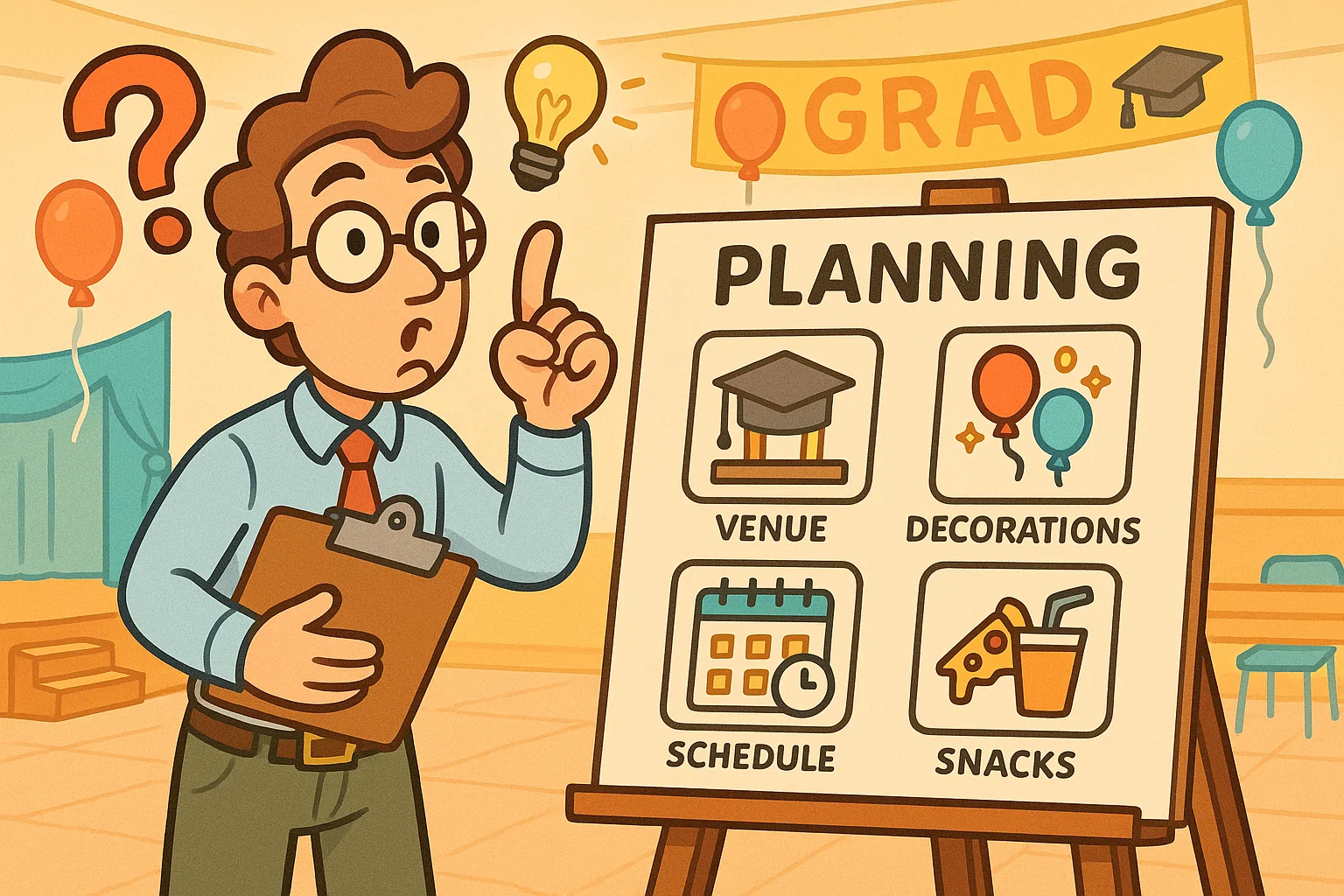
Choosing the right mix of graduation activities starts with a few practical considerations. NAEYC‘s guidance on developmentally appropriate practice emphasizes considering children’s ages, individual needs, strengths, and social and cultural contexts when planning activities. Teachers and families should consider the available time, group size, setting, budget, and children’s energy levels. When families attend, clear seating, activity zones, and walking routes can reduce crowding and help the event run safely and smoothly.
25 Kindergarten Graduation Games and Activities
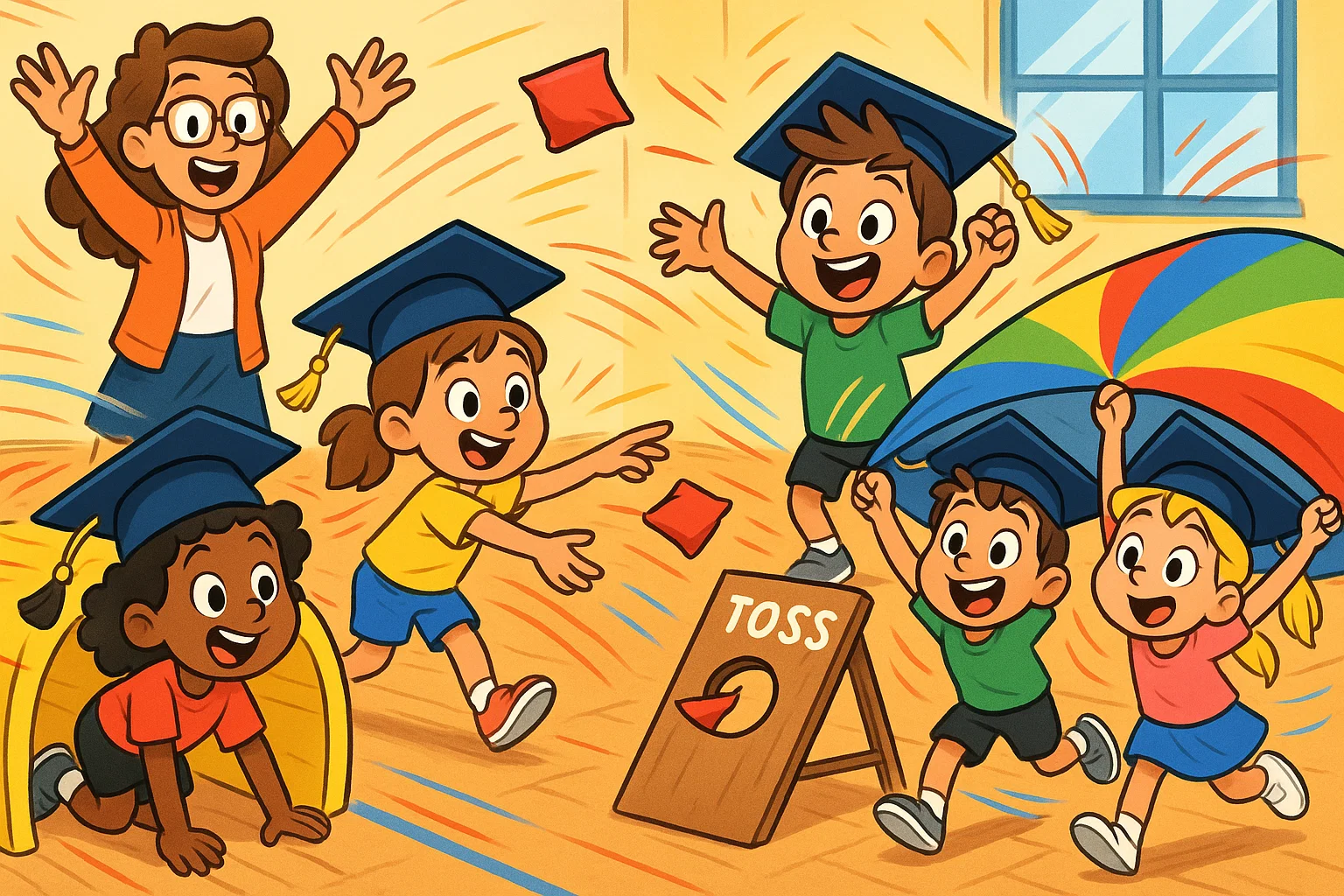
The following list offers practical ideas for celebrating kindergarten graduates. Use the activities on their own or combine several of them into a ceremony and reception.
How to Choose the Right Mix
For a balanced program, choose a manageable combination of ceremony, movement, creativity, reflection, and closure. Young children often respond well to a varied schedule that includes both movement and quieter activities. A simple program might include:
- One ceremonial recognition element.
- One active game.
- One creative craft station.
- One reflective memory activity.
- One unified closing moment.
Quick Planning by Time, Space, and Group Size
| Environment or constraint | Recommended activity mix | Group-size guidance | Suggested duration |
| Indoor classroom with limited space | Memory books, activity mats, craft stations | Small to medium groups | About 45–60 minutes |
| Outdoor playground | Tassel relay, scavenger hunt, chalk activities | Medium to large groups | About 60–90 minutes |
| School hall or stage | Cap and gown ceremony, student performances, slideshow | Adaptable to the venue and available staffing | About 45–75 minutes |
1. Personalized Recognition Certificates
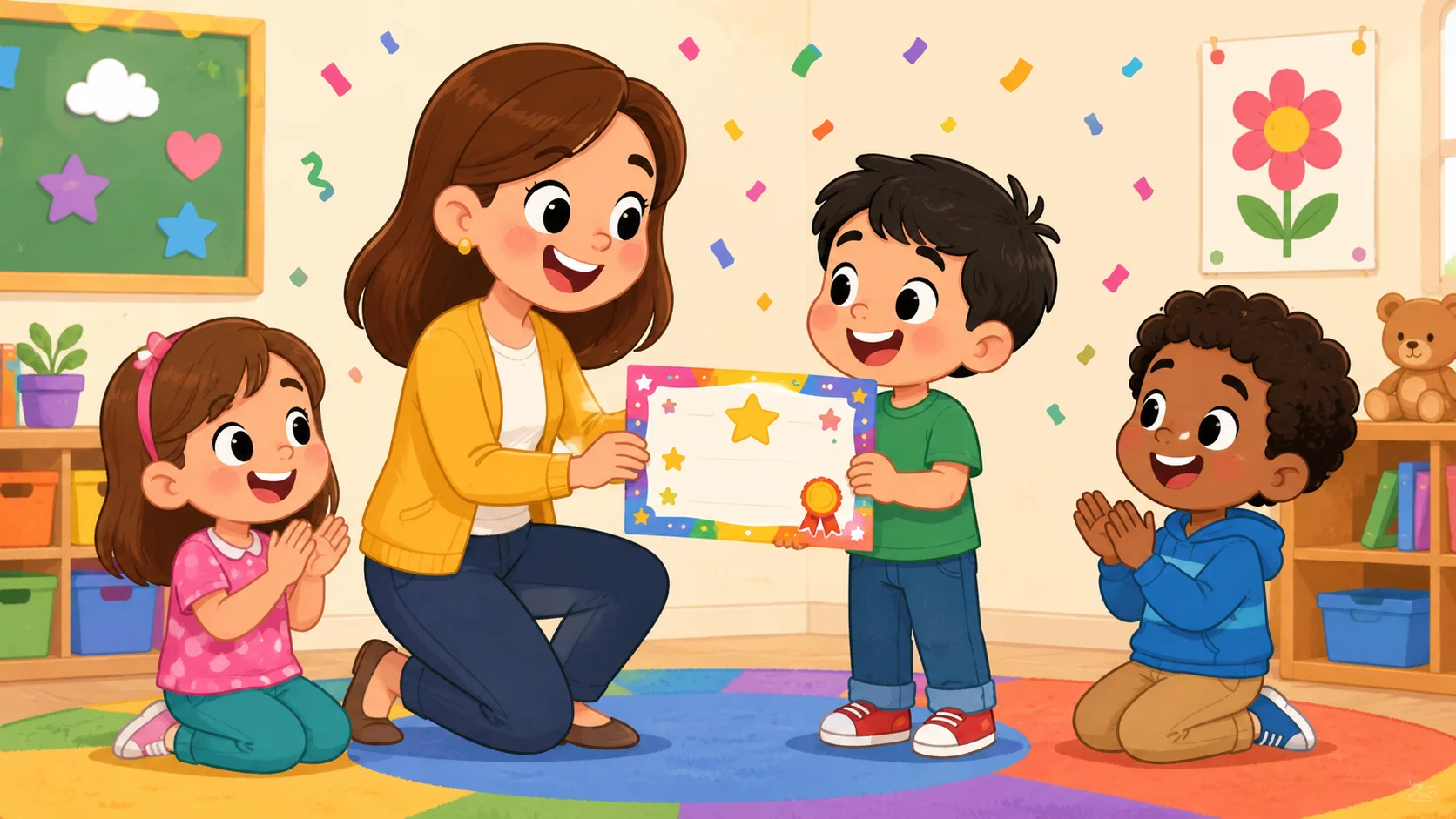
A personalized graduation certificate can recognize each child’s growth and contribution to the class. Instead of ranking children academically, personalized award titles can highlight kindness, creativity, curiosity, effort, and helpfulness. Noncompetitive awards help keep the focus on each child’s individual strengths.
Certificate Categories for Every Child
Using varied, non-comparative categories helps each child feel recognized for their individual strengths.
- Kindness Champion: Recognizes consistent empathy, sharing, and supportive behavior toward peers.
- Creative Thinker: Honors original problem-solving, innovative artwork, and imaginative play patterns.
- Helpful Friend: Celebrates active collaboration, classroom cleanup assistance, and community spirit.
- Curious Scientist: Recognizes enthusiasm for experiments, nature exploration, and asking thoughtful questions.
- Classroom Cheerleader: Highlights optimism, encouragement of others, and joyful participation in activities.
Personalization and Presentation Tips
Display the child’s name prominently and add school colors and the teacher’s signature to make the certificate feel special. Placing a photo from the beginning of the year beside a recent one creates a simple visual record of how much the child has grown. During the presentation, read a brief note describing a specific example of the child being kind, creative, helpful, or persistent during the year.
2. Cap and Gown Ceremony
A kindergarten graduation ceremony marks the end of the school year. This familiar format can help children understand the occasion while keeping the atmosphere supportive and low-pressure.
Ceremony Order and Student Roles
A clear sequence helps the event run smoothly and lets children know what to expect.
- The processional: Students enter in pairs while a steady, upbeat march or another piece of traditional graduation music plays.
- The welcome: The teacher gives a brief opening, welcomes families, and explains what the class is celebrating.
- Student performance: The class sings a chosen graduation song or recites a poem together.
- The diploma presentation: Each child walks across a small stage or designated area as their name is called to receive their kindergarten diploma.
- The recessional: The graduates leave together and move to the refreshment or photo area.
Cap and Gown Alternatives
Traditional caps and gowns make memorable photos, but simpler alternatives can be just as special and more affordable. Teachers can make paper caps with yarn tassels in the school colors. Another option is to give each child an oversized graduation T-shirt featuring the year on the back. Children can decorate their shirts with fabric markers in the days leading up to the event.
3. Memory Books and Writing Frames
Simple writing frames can help children reflect on kindergarten and look ahead to first grade. Recording favorite memories also gives children meaningful practice with drawing, dictation, and early writing.
Kindergarten Memory Book Pages
A memory book can include a few sections about the child’s school day, interests, and relationships. Teachers can include pages about a favorite kindergarten memory, a friend or classmate, a favorite book, and something the child is proud of. A short, personalized message from the teacher makes the book especially meaningful for the child and their family.
Writing Prompts for Young Graduates
For children who are still developing writing skills, simple sentence starters can make it easier to share ideas.
- “This year, I learned how to…”
- “My favorite kindergarten activity was…”
- “I felt proud of myself when I…”
- “Next year in first grade, I hope to explore…”
4. Student Performances
A class performance gives children a chance to sing, recite, move, or share something they practiced together.
Performance Ideas for Different Confidence Levels
Offer several ways to participate so children can choose a role that matches their comfort level. Children who enjoy performing can take short speaking roles, while others can join a group recitation, use simple hand motions, or hold a prop. A child who does not want to perform live might contribute a drawing or, with family and school approval, a short prerecorded message.
Rehearsal Tips for Young Children
Keep rehearsals short, positive, and predictable. Use visual position markers, such as colored painter’s tape, to show each child where to stand. Use clear, predictable cues instead of long verbal instructions, and have a calm backup plan in case a child decides not to participate on the day.
5. Photo Slideshow
A photo slideshow can highlight memorable moments from the school year and create a warm focal point for the celebration.
Photo Selection and Slideshow Structure
Organize the slideshow chronologically, moving from the first day of school to winter events and final spring projects. This progression helps families see the children’s experiences and growth across the year. Include a balanced mix of classroom learning, creative projects, play, special events, and portraits, and make sure every child is represented fairly.
Music, Captions, and Privacy
Choose gentle instrumental music or familiar classroom songs, and use audio the school is permitted to play and share. Keep captions brief and positive, focusing on group achievements or shared memories. Follow school or district privacy policies, obtain any required family consent, and share the slideshow only through an approved private channel.
6. Decorative Themes and Graduation Displays
A simple visual theme can make the space feel festive and help the decorations look coordinated.
Popular Kindergarten Graduation Themes
A cohesive theme makes it easier to coordinate invitations, backdrops, and table settings.
- Our Future Looks Bright: Use bright colors, sun motifs, and student cutouts wearing sunglasses.
- Reach for the Stars: Use deep blue and gold, star and planet shapes, and a simple galaxy backdrop.
- The Adventure Begins: Use maps, hot-air balloons, and paths to suggest the next chapter.
Classroom and Ceremony Display Ideas
To keep the space welcoming, use a few clear focal points instead of covering every surface with decorations. Teachers can turn the entrance into a cheerful “doorway to first grade” and frame it with student self-portraits. Secure banners and bunting firmly and hang them at a height that frames children well in family photos without blocking walkways.
7. Graduation Songs and Sing-Alongs
Music can signal transitions during the ceremony and give children a familiar, predictable cue.
Song Types for Kindergarten Graduation
Use a mix of lively and gentle songs to shape the pace of the ceremony.
- Upbeat welcome songs: Lively tunes that greet guests and help children settle into the event.
- Friendship and memory songs: Mid-tempo tracks focused on sharing, kindness, and favorite kindergarten moments.
- Farewell sing-alongs: A familiar class song or gentle melody that gives the ceremony a warm, clear ending.
Movements, Props, and Simple Choreography
Add simple movements to help children stay engaged during songs. Simple motions, such as waving paper stars, raising rolled paper diplomas, or swaying ribbons, can make the performance more engaging to watch. Keep props lightweight and easy to hold so children can focus on the song and movements.
8. Graduation Craft Stations
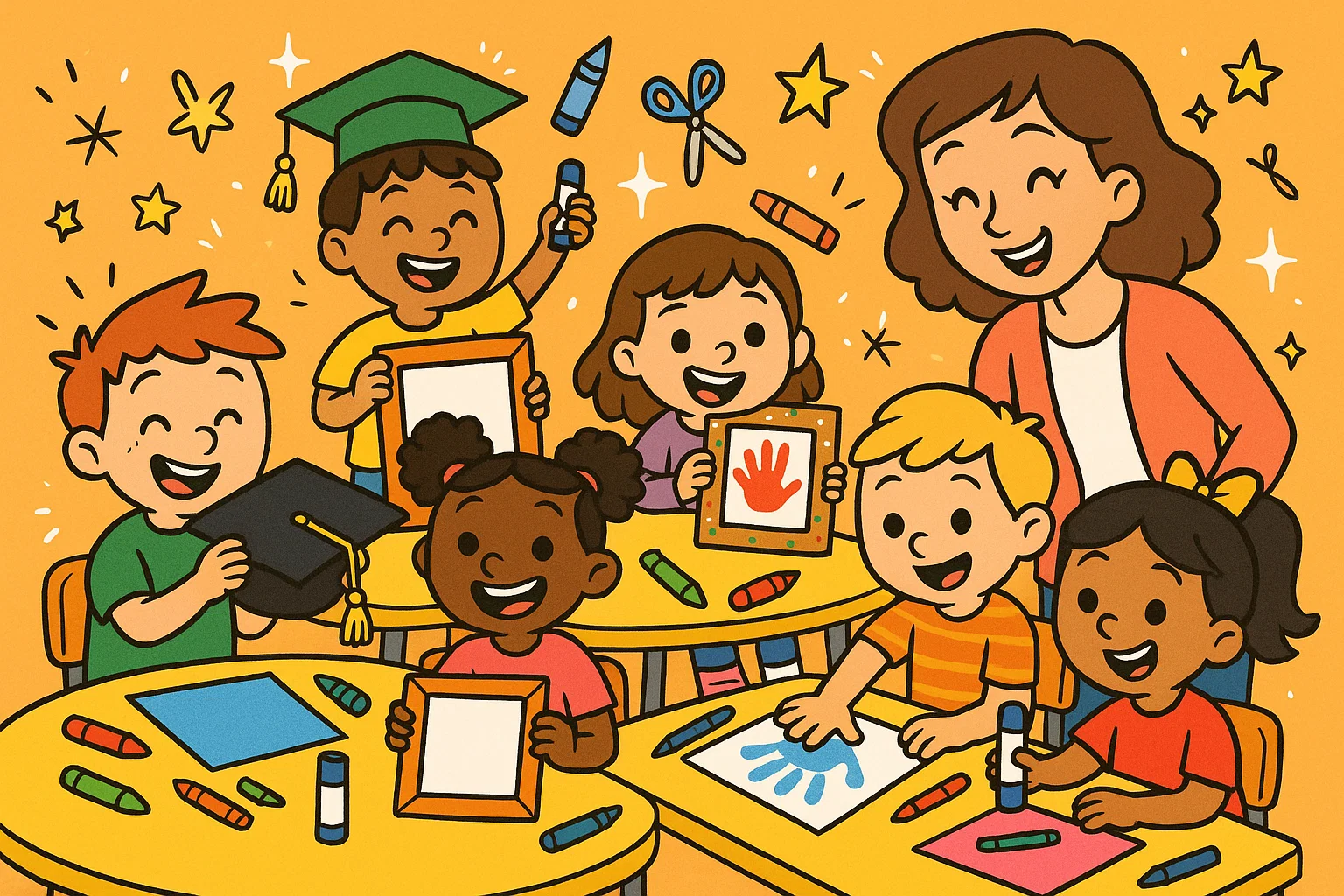
Cartoon scene of kids working at graduation craft stations with bright creative materials.
Graduation craft stations give children a creative activity while supporting fine-motor practice.
Low-Prep Craft Station Ideas
Set up clearly labeled stations so small groups can rotate through activities at a comfortable pace. One station can feature diploma decorating, where children use stamps and ribbons to personalize a keepsake scroll. Another station can offer graduation-cap coloring or tassel making with precut yarn, while a third can feature cards on which children draw what they hope to learn or explore in first grade.
Materials, Timing, and Cleanup
| Station type | Key materials required | Recommended rotation time | Cleanup strategy |
| Diploma decorating | Prerolled paper, ribbons, washable stamp pads | 8–10 minutes | Disposable table covers, wet wipes |
| Cap customization | Cardstock bases, nontoxic glue sticks, stickers | 10–12 minutes | Centralized scrap bins at the table |
| First-grade goals cards | Preprinted writing frames, crayons, colored pencils | 8–10 minutes | Labeled supply trays for immediate sorting |
9. Awards, Diplomas, and Certificates
Diplomas and completion awards provide a simple way to recognize the end of kindergarten.
Diploma Wording and Design
A kindergarten diploma should use clear, legible wording that states what the child has completed. Include the child’s name, the school or class name, a brief statement of completion, the date, and the teacher’s signature. A simple border in the school colors can make the diploma look polished and ready to frame.
Fair and Inclusive Award Presentation
Make sure every child is recognized in a thoughtful and equally respectful way. Awards should celebrate character, effort, and individual growth rather than rank children against one another. Avoid labels that might embarrass a child or draw attention to a difficulty; keep the presentation warm and respectful for everyone.
10. Graduation Gifts and Keepsakes
A small gift can mark the end of the school year and give children a keepsake from kindergarten.
Affordable Gift Ideas
Meaningful gifts do not need to be expensive; practical, personal items often work well. Consider age-appropriate picture books signed by the teacher, personalized bookmarks, or pencils for first grade. Another option is a small packet of locally appropriate seeds labeled “Ready to Grow in First Grade” for families to plant together at home.
Keepsakes Preserving Classroom Memories
Keepsakes can capture the friendships, routines, and shared experiences of the class. Classmates can sign a photo mat around a graduation picture or add small fingerprint drawings to the border. Class handprint posters, jars of student quotes, or a short audio collection of class messages can preserve memories from the year.
11. Graduation Character Cone Craft
This three-dimensional craft gives children fine-motor practice and creates a personalized keepsake figure.
Craft Assembly Steps
- Body formation: Children roll a precut semicircle of sturdy cardstock into a cone and secure it with nontoxic glue or tape.
- Head attachment: Children attach a precut paper circle to the top of the cone for the character’s face.
- Adding details: Children glue yarn to the paper circle for hair, then add a square paper cap and a small tassel.
- Clothing decoration: Children use crayons or markers to color the cone in the school colors or any colors they prefer.
Personalization Options
Provide a range of materials so children can make figures that look like them. Offer construction paper in a range of skin tones and yarn in different textures and colors so children can represent themselves. Children can add their names to the base of the cone and draw an accessory, such as a paper stethoscope or an artist’s palette, to show an interest or future dream.
12. Our Future Looks Bright Cutouts
This display project combines art with early writing and creates a colorful centerpiece for the classroom or celebration.
Future Dream Writing Prompts
Children complete a short writing prompt on the back or base of the cutout. Prompts might include “In first grade, I want to learn more about…” or “When I grow up, I would like to create…” The prompt encourages children to think about what they are curious to learn next.
Bulletin Board Display Layout
Place a large message such as “Our Future Looks Bright!” in the center of the board. Arrange the children’s sunglasses-shaped cutouts around the text and label each one with the child’s name. Use a simple border and leave enough open space for each child’s work to stand out to visiting families.
13. Graduation Activity Mats and Packs
Printable activity mats are a low-prep way to keep children engaged during transitions and waiting periods.
Printable Activity Types
A useful activity pack includes several puzzle types for different interests and skill levels. The mats might include a simple word search, picture matching, a maze in which a graduate finds the way to school, and letter-tracing prompts for “Grad” and “First Grade.” Simple counting puzzles and spot-the-difference pictures add more quiet, independent options.
Classroom and Party Uses
These packs work well during transitions at a ceremony or reception. Place activity mats on tables so early arrivals have something quiet to do while families find their seats or between parts of the program. A self-directed station can reduce waiting and free teachers to help with other parts of the event.
14. Graduation Banners, Headbands, and Bunting
Wearable crafts let children contribute to the decorations and feel part of the celebration.
DIY Graduation Headbands
Children can make personalized headbands from strips of sturdy construction paper cut to fit comfortably. Children color and decorate the front panel, which can feature printed outlines of graduation caps, stars, or celebratory text. After decorating, an adult can tape the ends together or staple the band closed and cover the staple ends with tape.
Banner and Bunting Placement
Use student-made bunting to mark a few key areas of the celebration space. Hang a banner above the stage or classroom entrance to welcome guests and mark the main area. Additional bunting can mark the photo booth, refreshment table, and keepsake display while keeping the theme consistent.
15. Graduation Photo Booth and Props
A graduation photo booth gives families a fun activity and a memorable picture to take home.
Graduation Prop Ideas
Keep a sturdy container of lightweight, age-appropriate props that children can hold easily.
- Classic symbols: Rolled cardstock diplomas, miniature graduation caps attached to wide paper straws or rounded craft sticks, and signs showing the graduation year.
- Expressive speech bubbles: Phrases printed in bold text such as “First Grade, Here I Come!” or “Bye, Kindergarten!”
- Playful costumes: Oversized sunglasses, paper bow ties, and simple career-themed props such as a pilot hat or magnifying glass.
Photo Booth Setup and Rotation
Position the photo booth backdrop against a flat wall away from direct sunlight to ensure even lighting and prevent harsh shadows. Use a stable tripod for the camera or phone, and mark where children should stand with a line of colored tape. To reduce waiting, let children visit the booth in small groups during craft rotations or free-play periods.
16. End-of-Year ABC Countdown
An ABC countdown gives the final weeks of school a fun, predictable structure and builds excitement for graduation.
ABC Activity Examples
Assign each day a letter of the alphabet and a matching activity or reflection prompt.
- A for Art Day: Students create a collaborative watercolor mural celebrating their year together.
- B for Bubble Day: Students explore surface tension and bubble shapes outdoors.
- C for Chalk Day: Children use sidewalk chalk to draw their favorite kindergarten memories on the playground.
- D for Dance Day: A movement break with simple dance steps and rhythm games.
- M for Memory Day: Children assemble their memory books.
- Z for Zoom Into Summer: Children play an active outdoor game that gives the countdown a lively finish.
Shortened Countdown Options
If there is not enough time for a 26-day countdown, shorten it to fit the remaining school days. For a shorter version, choose 10 favorite letters or use the five vowels as daily themes. You can also turn the idea into a party station with five quick letter-themed challenges and a small sticker or certificate at the end.
17. Graduation Invitations
A clear invitation helps families understand the event details and feel welcome.
Essential Invitation Details
Use a clear, easy-to-scan layout and include the essential event details.
- Date and time: State when guests should arrive and when the event is expected to end.
- Location and parking: Give the exact venue, parking information, and any accessibility details.
- Guest policy: Note any limit on guests per family and follow the venue’s capacity and safety rules.
- RSVP deadline: Give families a response date so you can plan seating, supplies, and refreshments.
Student-Made Invitation Activity
Making invitations in class adds a personal touch and gives children a simple writing activity. Children can decorate the front cover of a folded cardstock invitation using colorful handprints or illustrated self-portraits. On the inside panel, students can practice fine-motor skills by writing the word “Welcome!” Children who are not yet ready to write can dictate a short, personalized message for their family members.
18. Class Yearbook Scrapbook
A class yearbook or scrapbook helps children remember shared experiences and express appreciation for classmates.
Suggested Scrapbook Sections
Organize the scrapbook into a few clear sections. Include pages about classmates, with small portraits and favorite shared activities. Include sections for field trips and special events, funny class quotes, and summer or first-grade wishes that children can illustrate.
Signing Day Activity
A structured signing activity gives every child a chance to receive messages or drawings from classmates. Seat children in small groups of four or five with their scrapbooks. Children can add a sticker, draw a star, or write their names as groups rotate on a simple color-coded schedule.
19. Graduation Adventure Scavenger Hunt
An adventure-themed scavenger hunt gets children moving and encourages teamwork.
Scavenger Hunt Clues
Use picture-based clue cards for children who are not yet reading independently. Clues can show familiar classroom objects, such as a favorite storybook, an easel, building blocks, or the backpack cubbies. At each location, place a graduation-themed symbol or a puzzle piece that contributes to a final class display.
Indoor and Outdoor Versions
Adapt the hunt to the space you have available. For an indoor version, hide clues in labeled bins, under tables, or near bulletin boards, and keep the route short and clear. For an outdoor version, add movement checkpoints, such as walking to the swings or walking along a marked line, while keeping children within a clearly supervised area.
20. Balloon-Free Memory Reveal
This balloon-free activity lets children reveal and discuss favorite memories from kindergarten.
Memory Prompts in Paper Balloons
Write a reflection prompt on a slip of paper and place it inside a colorful paper envelope shaped like a balloon. Children take turns choosing a paper balloon, and the child who chooses it or the teacher then reads the prompt aloud. Prompts should focus on positive recollections, such as describing their funniest day, naming a kind action a classmate performed, or sharing their proudest learning achievement.
How to Set It Up
Using paper envelopes instead of latex balloons eliminates loud popping sounds and avoids possible latex exposure. It also removes the choking or suffocation hazard associated with uninflated or broken balloons. Make colorful paper envelopes shaped like balloons and attach them securely to a bulletin board. Children take turns selecting an envelope and lifting a flap, pulling a tab, or peeling off a sticker to reveal the hidden memory prompt.
21. Graduation Cap Tic-Tac-Toe
This themed version of tic-tac-toe gives children simple practice with strategy and turn-taking.
DIY Game Board
Make a large, reusable game board with inexpensive classroom supplies. On carpet, use painter’s tape or masking tape to lay out a 3-by-3 grid about one meter on each side. For outdoor celebrations on asphalt or concrete playgrounds, draw the grid lines directly onto the surface using bright sidewalk chalk. Game markers can consist of simple laminated cardstock cutouts shaped like graduation caps and rolled diplomas.
Tournament and Team Options
For a cooperative version, organize children into small teams instead of pairs. Teams discuss each move before placing a marker on the grid. Keep the rounds brief, let every team play, and emphasize participation rather than winning.
22. Don’t Drop the Tassel Relay
This active relay encourages balance, movement, and teamwork in a structured format.
Relay Setup and Rules
Mark a clear start line and turning point with cones, adjusting the distance to suit the children’s ages and the available space. Divide the class into small teams of roughly equal size to minimize the time children spend waiting in line. At the signal, the first player carries or balances a tassel or lightweight paper cap, goes around the cone, and returns to pass it to the next teammate.
Inclusive Movement Variations
Offer several movement options so children with different mobility needs can participate comfortably.
- The balancing walk: A steady, focused pace that prioritizes object control over speed.
- The seated passing chain: Teams sit in a line and pass the prop from one person to the next at a comfortable height.
- The partner carry: Two students walk side-by-side holding a small tray containing the graduation items, encouraging direct teamwork.
23. Graduation Toast Circle
A speaking circle gives children a gentle way to share a memory or wish with the group.
Positive Toast Prompts
Children sit in a circle with small, unbreakable cups of water. Going around the circle, each child may lift a cup and share a short “toast” using a simple prompt. Children can name an activity they enjoyed, thank a classmate, or share a wish for first grade.
Alternative Ways to Participate
Offer comfortable alternatives for children who do not want to speak to the whole group. A child can use a prerecorded message, ask a partner or teacher to read a card, or simply show a drawing. The group can respond with a wave, quiet applause, or another class-approved gesture.
24. Diploma Word Challenge
This team word game practices letter recognition, spelling, and vocabulary with graduation-themed words.
Word-Building Rules
Display a long word such as “DIPLOMA,” “GRADUATE,” or “KINDERGARTEN” in large magnetic letters on the board. In small teams, children rearrange letter tiles to build shorter words from the main word. For example, the word “GRADUATE” can form smaller words such as “RAT,” “RED,” “DATE,” and “GATE.”
Age-Appropriate Literacy Variations
Adjust the difficulty to match the range of reading skills in the class.
- For emerging readers: Children match letter cards to the letters on the board or identify beginning sounds.
- For intermediate learners: Children look for selected vowel or consonant cards hidden around the room.
- For confident spellers: Teams work together to build as many familiar two- and three-letter words as they can in a few minutes.
25. Smarty-Pants Quiz
A playful trivia quiz can review skills and memories from the year while giving families a glimpse of the class’s shared jokes, routines, and experiences.
Quiz Question Categories
Mix simple learning questions with questions about classroom routines and favorite memories. Include simple counting and phonics questions as well as questions about favorite stories read during circle time. Add a light teacher-trivia category, such as “What is the teacher’s favorite morning snack?”
Team and Whole-Class Formats
To reduce individual pressure, run the quiz as a whole-class activity or in table teams. Provide each group with a set of large, color-coded answer cards or mini whiteboards to display their answers simultaneously. You can also use movement responses, such as standing for “Option A” and raising both hands for “Option B,” while offering a seated alternative.
Kindergarten Graduation Games FAQ
How Is a Kindergarten Graduation Party Different from a Preschool Graduation?
A preschool graduation often celebrates a child’s first experience in a structured learning environment, while a kindergarten graduation marks the transition from kindergarten to elementary school. Both events can include songs, certificates, crafts, and simple interactive games, but activities for graduating kindergarteners may involve more independent reading, writing, and reflection. In either case, the celebration should match the children’s ages, interests, and comfort levels.
How Can Families Choose a Kindergarten Graduation Party Theme?
Choose a party theme that is easy to carry through the decorations, invitations, photo area, and one or two activities. Themes such as “Our Future Looks Bright,” “Reach for the Stars,” or “The Next Exciting Chapter” work well because they connect the special day with the children’s educational journey. Good party planning does not require every table or activity to match perfectly; a few coordinated details are usually enough to create a memorable setting.
What Are Some Fun Graduation Party Games for a Small Space?
For a classroom or another limited space, choose graduation party games that use simple movements and do not require children to run. Graduation Cap Tic-Tac-Toe, a seated tassel-passing challenge, a memory reveal, and a whole-class quiz are all practical options. These interactive games keep little learners involved while reducing long lines and helping the celebration remain manageable.
Which Activities Work Best for an Outdoor Graduation Celebration?
An outdoor graduation works well with a scavenger hunt, chalk drawings, a tassel relay, bubbles, or rotating craft and photo stations. Keep boundaries clearly marked, provide shade and water, and prepare an indoor backup plan in case the weather changes. Short activity rounds are usually more successful than one long game, especially when little ones are excited about the big day.
What Makes the Diploma Presentation the Highlight of the Ceremony?
The diploma presentation often becomes the highlight of the ceremony because every child receives an individual moment of recognition. Call each child’s name clearly, keep the walking route simple, and allow enough time for a quick photograph. A brief personalized comment can make the moment feel special without making the ceremony too long for kindergarten students and their families.
What Is an Appropriate Party Favor for a Child’s Graduation Party?
A party favor should be simple, useful, and age-appropriate. Personalized bookmarks, pencils, small notebooks, seed packets, or a class photo are thoughtful options that do not add unnecessary clutter. School supplies that children can use in first grade can also connect the child’s graduation party with the next stage of their educational journey.
How Can Teachers Make Kindergarten Graduation Day Memorable for Everyone?
To make kindergarten graduation day memorable for everyone, include different ways to participate. Some children may enjoy speaking or performing, while others may prefer holding a prop, displaying artwork, or joining a group activity. Clear routines, quiet spaces, accessible games, and equal recognition help make this special occasion comfortable and fun for graduating kindergarteners, families, and teachers.

Take a short quiz to find out what your everyday choices say about your parenting style
When your child is curious about something new, what’s your instinct?
Take a short quiz to find out what your everyday choices say about your parenting style
“Can I download this app?” What happens next?
Take a short quiz to find out what your everyday choices say about your parenting style
When it comes to rules at home, which sounds most like you?
Take a short quiz to find out what your everyday choices say about your parenting style
If you could give your child one life skill today, what would you pick?
Take a short quiz to find out what your everyday choices say about your parenting style
Your child gets to choose what to watch. What would your ideal setup look like?
Take a short quiz to find out what your everyday choices say about your parenting style
Pick your parenting superpower ✨



