31+ Halloween STEM Activities for Kids: Spooky Science, Engineering, Coding, and Math Projects

 Discover a Free Education Video App for Kids
Pastory uses AI to personalize educational video content based on your child’s interests and personality. Safe, engaging, and built for curious young minds. Sign up now to stay updated and enjoy early access with a free trial
Engaging children in hands-on learning during seasonal celebrations can improve retention and increase enthusiasm. This comprehensive guide features 31+ curated Halloween STEM activities for educators, homeschoolers, and parents who want to combine festive fun with meaningful learning.
These projects include science experiments, engineering challenges, coding tasks, and math games that use accessible materials like candy, slime, pumpkins, cardboard, and household supplies. Each activity is designed to make science, technology, engineering, and math feel approachable, memorable, and fun.
Key Takeaways
- Integrated Learning: Activities combine science, technology, engineering, and math concepts.
- Flexible Age Range: Projects are adaptable for early childhood through middle school classrooms.
- Low-Prep Activities: Most challenges use standard household items and leftover Halloween candy.
- Standards-Friendly: Many activities can be adapted to support NGSS-aligned skills and computational thinking.
Best Activities at a Glance
The following table highlights standout activities based on student engagement, material accessibility, and the depth of the core concept.
| Activity Name | Core Subject | Primary Material | Target Age Group |
| Pumpkin Volcano | Chemistry | Fresh Pumpkin, Baking Soda | Pre-K to Grade 5 |
| Flying Ghost Tea Bag | Thermodynamics | Herbal Tea Bags, Lighter | Grades 6 to 8 |
| Candy Catapult | Physics & Engineering | Craft Sticks, Rubber Bands | Grades 2 to 8 |
| Halloween Lava Lamp | Density & Chemistry | Vegetable Oil, Colored Water, Antacid Tablet | Grades K to 5 |
| Haunted House Engineering | Structural Design | Cardboard, Recycled Goods | Grades K to 6 |
| Halloween Digital Escape Room | Computer Science | Printable Clues / Digital Forms | Grades 5 to 8 |
| Pumpkin Clock | Electrochemistry | Small Pumpkins, Zinc/Copper Strips | Grades 6 to 8 |
Subject Coverage Snapshot
This activity plan provides broad coverage across the core STEM disciplines. The science activities focus on chemical reactions, surface tension, thermodynamics, and biological decomposition. The technology and coding sections introduce algorithmic thinking, cryptography, and electrical circuits. Engineering projects emphasize structural integrity, mechanical advantage, and projectile motion. Mathematics concepts appear across the activities through measurement, data collection, budgeting, and geometric design.
Prep Time and Age Fit
- Quick Demos (10–15 Minutes): These are ideal for classroom transitions or sensory learning stations, such as Floating Ghost Drawing and Magic Milk.
- Standard Lab Activities (30–45 Minutes): These structured lessons fit well into standard elementary or middle school class periods, such as Candy Catapult and Density Jars.
- Multi-Day Investigations: These long-term observation projects emphasize the scientific method and data tracking over time, such as the Rotting Pumpkin Investigation.
How to Use These Activities as a Halloween STEM Countdown
Turning October into a continuous learning experience gives children a flexible countdown to Halloween. By presenting daily challenges, educators can use seasonal excitement to build problem-solving habits and critical thinking skills.
Halloween STEM Activities for Kids
Hands-on activities for kids succeed when they blend high-interest themes with structured exploration. By framing science, technology, engineering, and math around spooky concepts, children shift from passive consumers of information to active investigators. These activities use familiar objects – such as pumpkins, bats, and seasonal candy – to make technical subjects feel less intimidating and help children access complex concepts in different ways.
Spooky Halloween STEM Challenges
A formal STEM challenge requires students to solve design problems within specific constraints, mimicking real-world engineering scenarios. Learning frameworks that ask students to define problems, design solutions, test models, and improve their work can strengthen analytical skills. Each challenge below includes material limits and testing parameters that encourage iterative design and logical reasoning.
Halloween STEM Countdown Plan
Using a Halloween STEM countdown plan gives parents and teachers a flexible roadmap. This countdown plan can be used as a daily activity rotation, a weekly lab, an after-school enrichment program, or a dedicated homeschool unit.
Halloween Science Experiments
Spooky science experiments allow students to explore fundamental physics and biology concepts through an engaging, seasonal lens. These activities focus on objective observation, variable isolation, and data recording.
Flying Ghost Tea Bag Experiment
The Flying Ghost Tea Bag Experiment demonstrates thermal convection and changes in air density and should be treated as an adult-led demonstration. When an emptied, cylindrical tea bag is ignited at the top, the flame heats the air inside the cylinder. The heated air expands and becomes less dense than the surrounding air, creating an updraft that lifts the remaining ash.
Safety Note: This experiment requires strict adult supervision, a flame-resistant surface, long matches or a lighter handled only by an adult, and a clear space free of flammable materials. Remove any staples, strings, or tags from the tea bag before lighting it.
Magnetic Flying Ghosts
The Magnetic Flying Ghosts activity demonstrates magnetic field forces and non-contact interactions. It can be adapted to support NGSS MS-PS2-3 when students collect data on magnet strength, distance, or force effects. Students construct lightweight paper ghosts from tissue paper and attach a small steel paper clip to the base. By positioning a neodymium magnet slightly above the ghost without making direct contact, students can observe how magnetic force can partially counteract gravity.
Spooky Spider Magnetic Science
The Spooky Spider Magnetic Science project expands on magnetic field theory by introducing a physical barrier between the magnet and the object. Students draw a maze on a sheet of cardstock and place a plastic spider with an attached steel washer on top of the paper. By moving a magnetic wand underneath the cardstock, students investigate how magnetic forces can act through thin, nonmagnetic materials and create motion.
Floating Ghost Drawing
The Floating Ghost Drawing experiment introduces the concepts of solubility and density through dry-erase marker chemistry. Dry-erase marker ink contains pigments, alcohol, and a silicone-based release agent that prevents it from firmly adhering to smooth surfaces. When students draw a ghost on a glossy ceramic plate and slowly pour water over it, the insoluble ink film releases from the plate and floats on the surface because it is less dense than water.
Glow-in-the-Dark Science
Glow-in-the-Dark Science helps students compare types of luminescence, including chemiluminescence in glow sticks, fluorescence in materials that react to UV light, and phosphorescence in glow-in-the-dark pigments that store light. Students use an observation chart to record the duration, intensity, and required energy inputs for each material type under different lighting conditions.
Halloween Magic Milk
The Halloween Magic Milk activity illustrates the molecular properties of surface tension and amphiphilic interactions. Whole milk provides a fluid matrix rich in water, proteins, and suspended fat globules. When dish soap – a surfactant that interacts with fat molecules and reduces surface tension – is added to milk mixed with orange and green food coloring, the soap spreads across the surface and creates dynamic, swirling color patterns.
Rotting Pumpkin Investigation
The Rotting Pumpkin Investigation is a long-term biology study that tracks decomposition and microbial growth over three to four weeks. Students observe a carved pumpkin under controlled environmental conditions, documenting visible mold growth, structural collapse, and weight loss.
Variable Tracking: Students can divide pumpkins into testing groups to evaluate how variables like ambient light, moisture levels, or temperature fluctuations impact the rate of organic decay.
Pumpkin Preservation Experiment
The Pumpkin Preservation Experiment applies the scientific method to real-world preservation techniques. Students test various preservation treatments to evaluate how effectively they slow fungal and bacterial growth on carved pumpkin flesh.
Testing Groups
| Group | Treatment |
| Control Group | Untreated pumpkin section |
| Barrier Group | Pumpkin section coated in petroleum jelly |
| Acidic Group | Pumpkin section sprayed daily with white vinegar |
| Antimicrobial Group | Pumpkin section soaked in a diluted bleach solution, such as 1 part household bleach to 9 parts water, with adult supervision |
Students maintain a daily observation log for 14 days, rating mold coverage on a scale of 0 to 5 to determine which preservation method works best.
Monster-Eye Egg in Vinegar Experiment
The Monster-Eye Egg in Vinegar Experiment demonstrates an acid-base reaction and osmosis across a semipermeable membrane over 72 hours. When a raw chicken egg is submerged in white vinegar, a chemical reaction occurs with the calcium carbonate eggshell, producing carbon dioxide gas and dissolving the hard shell. The remaining membrane acts as a semipermeable barrier, allowing students to place the “monster eye” egg in colored water or corn syrup and observe mass changes caused by osmosis.
Halloween Density Jar
The Halloween Density Jar visualizes liquid density and buoyancy by stacking immiscible liquids with different densities. Students carefully layer corn syrup colored purple, green dish soap, water colored orange, and clear vegetable oil into a transparent cylinder.
Density Jar Stratification
| Position | Liquid | Density Role |
| Top Layer | Vegetable Oil | Lowest density |
| Layer 2 | Colored Water | Medium-low density |
| Layer 3 | Green Dish Soap | Medium-high density |
| Bottom Layer | Corn Syrup | Highest density |
Once the layers settle, students drop small items like plastic spiders, candy corn, and plastic beads into the jar to observe how objects sink or float depending on their density relative to each liquid layer.
Halloween Chemistry Experiments
Halloween chemistry activities focus on chemical changes, gas production, polymer formation, and endothermic or exothermic reactions.
Pumpkin Volcano Experiment
The Pumpkin Volcano Experiment uses a classic acid-base reaction inside a hollowed-out pumpkin cavity. When baking soda, or sodium bicarbonate, mixes with vinegar, the reaction produces carbonic acid, which quickly decomposes into carbon dioxide gas and water. The trapped gas forces its way out of the pumpkin’s carved openings, carrying liquid and foam along with it.
Puking Pumpkin Eruption
The Puking Pumpkin Eruption modifies the basic volcano experiment by changing the texture and behavior of the foam. By adding dish soap and liquid watercolor to the internal baking soda mixture before introducing the vinegar, the escaping carbon dioxide gas gets trapped inside the soap film. This creates a dense, viscous foam stream that oozes steadily out of the pumpkin’s carved mouth, creating a strong visual contrast with a standard vinegar-and-baking-soda eruption.
Oozing Pumpkin Eruption
The Oozing Pumpkin Eruption uses a different reaction: hydrogen peroxide breaks down with the help of yeast, which acts as a catalyst inside the pumpkin. For classroom use, stick to 3% household hydrogen peroxide and adult supervision. This decomposition reaction breaks hydrogen peroxide down into water and oxygen gas and may release warmth depending on the concentration used. When mixed with liquid dish soap, the rapid release of oxygen molecules creates thick foam often known as “elephant toothpaste,” which displays a slower, highly tactile oozing profile compared to vinegar-based reactions.
Halloween Balloon Experiment
The Halloween Balloon Experiment demonstrates gas expansion and pressure within a closed system. Students place two tablespoons of sodium bicarbonate inside an uninflated latex balloon decorated with a ghost face drawn in permanent marker. The balloon is stretched over the neck of a plastic bottle containing 100 mL of vinegar. Tilting the balloon drops the powder into the liquid, producing carbon dioxide that inflates the ghost balloon.
Bubbling Brew Experiment
The Bubbling Brew Experiment introduces students to chemical indicators and multi-step reactions with safe household materials. Students mix citric acid, baking soda, and red cabbage juice, which acts as a natural pH indicator, inside small plastic cauldrons. As the acid and base react to create bubbling foam, the shifting pH causes the cabbage juice to change color from deep purple to bright pink, illustrating chemical transitions in real time.
Halloween Bath Bombs
The Halloween Bath Bombs project explores the chemistry of dry reactants that remain stable until introduced to a solvent. Students combine solid citric acid and sodium bicarbonate with cornstarch as a stabilizer and coconut oil as a binding agent in spherical molds. Without water, the acid and base remain mostly inactive; when the bath bomb is dropped into water, the ingredients dissolve and react, releasing carbon dioxide bubbles.
Growing Halloween Crystals
The Growing Halloween Crystals activity teaches kids about supersaturated solutions and crystallization patterns. With adult help, students dissolve borax powder into very hot water until the solution reaches its saturation point, meaning no more borax can dissolve. Pipe cleaners bent into the shapes of pumpkins, spiders, or ghosts are suspended in the cooling liquid overnight. As the temperature drops, the solution can no longer hold as much dissolved borax, so crystals form along the pipe cleaner framework.
Safety Note: Borax and very hot water require adult supervision. This activity is not recommended for preschoolers or children who may put materials in their mouths. Students should avoid touching their eyes or mouths during the activity and wash their hands afterward.
Halloween Lava Lamp Experiment
The Halloween Lava Lamp Experiment demonstrates liquid immiscibility and gas-driven movement. A transparent jar is filled three-quarters full with vegetable oil and one-quarter full with colored water. Because water molecules are polar and oil molecules are nonpolar, the two liquids do not mix; the water also settles at the bottom because it is denser than oil. When an effervescent antacid tablet is dropped into the jar, it sinks to the water layer and dissolves, releasing carbon dioxide bubbles that lift droplets of colored water up through the oil layer. At the surface, the gas escapes, and the water droplets sink back down.
Glow-in-the-Dark Milk Plastic
The Glow-in-the-Dark Milk Plastic experiment illustrates how acid can separate casein proteins from milk. When milk is heated and mixed with an acid like vinegar, the drop in pH causes the suspended casein proteins to unfold and clump together, separating from the liquid whey. Students strain the casein curds, knead in a small amount of non-toxic phosphorescent powder, and shape the material into glowing monster teeth or spooky charms that harden as they dry.
Frozen Frankenstein Brains
The Frozen Frankenstein Brains lab explores thermal energy transfer and states of matter. Students freeze green-colored water mixed with small plastic toys inside brain-shaped silicone molds. During the activity, students apply different melting agents – such as coarse rock salt or drops of warm water – to evaluate which substance melts the ice fastest, recording melting rates and structural changes over time.
Halloween Engineering Projects
Halloween engineering activities use structural design principles, simple machines, and forces to solve physical problems under set constraints.
Haunted House Engineering Challenge
The Haunted House Engineering Challenge requires students to construct a freestanding, multi-level spooky structure using only craft sticks, corrugated cardboard, and low-temperature hot glue or tape.
Engineering Constraints: The finished structure must stand at least 30 centimeters tall, support the weight of a heavy plastic monster toy for a minimum of 60 seconds, and withstand a lateral force test, such as simulated wind from a handheld fan. Students sketch blueprints and calculate material costs before starting construction.
Spider Web Engineering Task
The Spider Web Engineering Task introduces tensile structures and load distribution. Students construct a structural frame out of wooden skewers or paper straws, then weave a web layout using yarn or cotton string. The engineering goal is to maximize the web’s load capacity. Students test their designs by sequentially adding metal washers or plastic spiders to the web until the structural fibers deform or collapse, mapping how different weaving patterns impact weight distribution.
Halloween Candy Catapult
The Halloween Candy Catapult focuses on mechanical advantage, potential energy, and projectile motion. Using craft sticks, rubber bands, and a plastic bottle cap, students construct a Class I lever system. Students launch candy pumpkins or candy corn across a measured field, adjusting the position of the fulcrum to analyze how changing the distance between the fulcrum and the load affects speed, trajectory angle, and overall distance.
Ghost Marshmallow Launcher
The Ghost Marshmallow Launcher explores elastic potential energy using a handheld slingshot-style launcher. Students cut the bottom off a plastic cup and stretch a knotted latex balloon securely over the opening. By placing a ghost-faced marshmallow inside the cup against the balloon membrane, pulling back on the knot, and releasing it, stored elastic energy transfers into kinetic energy, launching the projectile forward. Students compare launch distance by testing mini marshmallows and standard-sized marshmallows.
Halloween Candy STEM Tower
The Halloween Candy STEM Tower is a spatial structural challenge using vertical stability principles. Students are provided with exactly 30 candy pumpkins and a set number of toothpicks, then build the tallest possible freestanding tower within 20 minutes. This activity emphasizes geometric reinforcement and shows students how a wide base and triangular supports can improve structural stability.
Candy Engineering and Math Challenge
The Candy Engineering and Math Challenge expands basic building activities by adding budget and design constraints. Students receive a pricing sheet in which every building component has a virtual cost, such as $5 for each craft stick, $1 for each toothpick, and $2 for each candy connector. Students must design a stable bridge structure that spans a 15-centimeter gap while staying under a fixed $50 budget. They calculate total expenses and test weight capacity to determine the most cost-effective design.
Build a Skeleton Hand
The Build a Skeleton Hand project introduces biomechanics, anatomy, and tendon-like mechanical systems. Students trace their hand on cardstock and attach cut plastic straws to represent individual phalanges and metacarpal bones. Threading lengths of string through these straw segments and anchoring them at the fingertips mimics the function of flexor tendons. Pulling the strings at the base of the wrist causes the paper fingers to curl inward, demonstrating how muscular forces move skeletal joints through tendons.
Halloween Bone Bridge Challenge
The Halloween Bone Bridge Challenge requires students to construct a weight-bearing bridge deck using cotton swabs, or “bones,” and masking tape. The structure must span a clear 20-centimeter chasm between two classroom desks. Students test structural failure points by suspending a small bucket from the center of the bridge and filling it with plastic skeleton toys or gravel until the bridge buckles, allowing them to identify specific structural weaknesses.
Pumpkin Pulley System
The Pumpkin Pulley System introduces simple machines and mechanical advantage. Students use rope, plastic pulleys, and wooden dowels to construct fixed and movable pulley configurations designed to lift small pumpkins or lightweight jack-o’-lantern models. By connecting a spring scale to the pull line, students gather quantitative data showing that a single fixed pulley changes the direction of force, while an ideal movable double-pulley system can cut the required lifting effort in half.
Paper Bat Competition
The Paper Bat Competition explores aerodynamic lift, drag, and center of gravity. Students fold paper bats using different wing shapes, fold patterns, and weight placements.
Testing and Iteration: Each bat design undergoes three controlled flight trials to measure total distance and flight stability. Students then modify their designs by adding small paper clips to change weight distribution or by cutting wing flaps to analyze changes in aerodynamic performance.
Ghost Bottle Rockets
Ghost Bottle Rockets demonstrate Newton’s Third Law of Motion – action and reaction – through compressed air and water propulsion. Students decorate a clean, two-liter plastic bottle with a ghost design and build a stable three-fin launch base at the neck. The bottle is partially filled with water and inverted over a launch pad plug connected to a bicycle pump. Pumping air into the bottle builds internal pressure until the plug releases, forcing water downward and launching the ghost rocket upward.
Safety Note: This outdoor activity requires eye protection, adult supervision, and a clear launch area.
Frankenstein Candy Dispenser DIY
The Frankenstein Candy Dispenser DIY challenge requires students to design and construct a working mechanical dispenser using recycled cardboard, craft sticks, and rubber bands. The machine should include a working lever or gravity-fed slider mechanism that dispenses exactly one piece of fun-size Halloween candy per activation. This requires precise measurements and several design iterations to prevent jams.
Halloween Coding and Circuit Projects
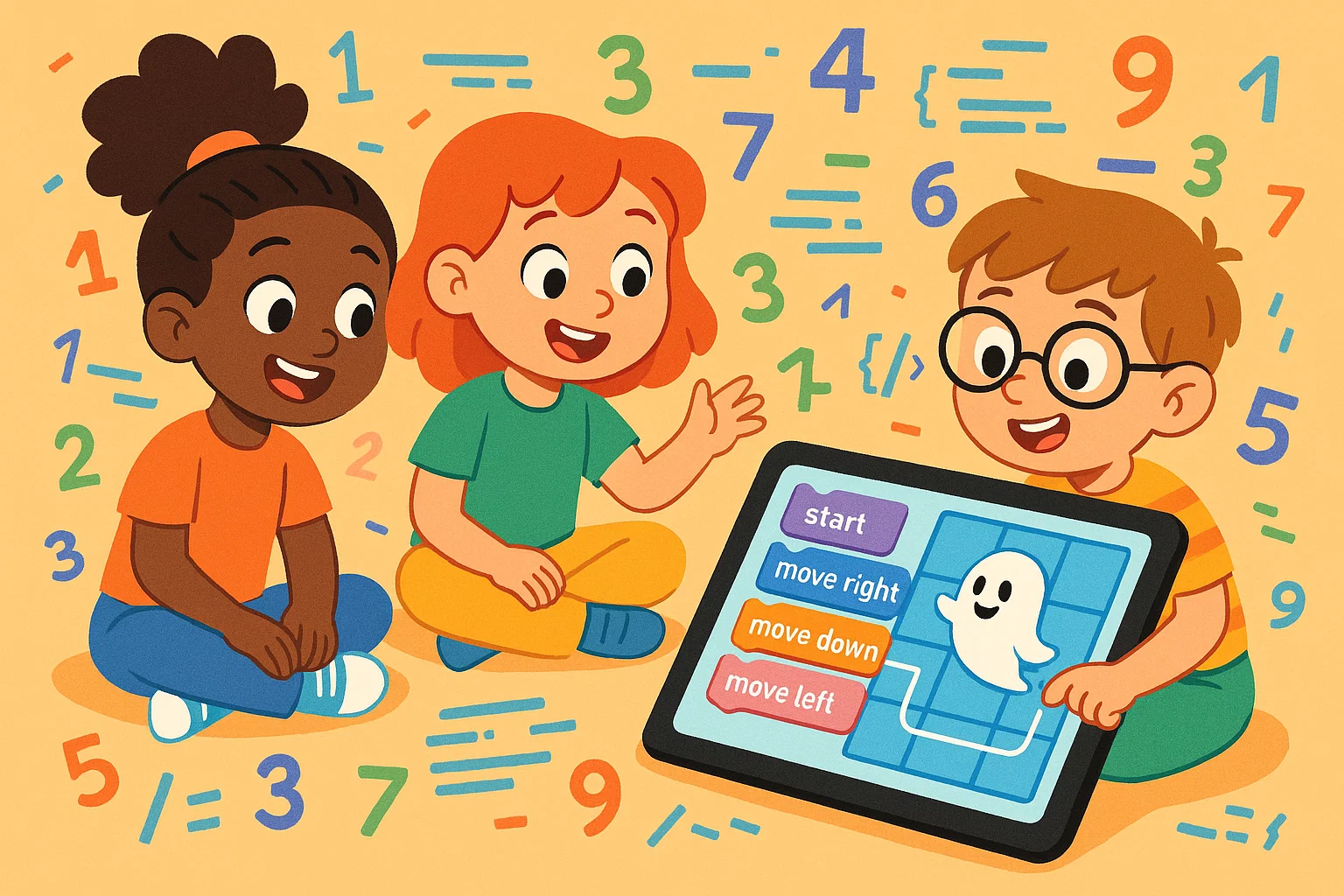
These digital and electrical activities introduce computational logic, algorithms, encryption patterns, and physical circuit components.
Halloween Coding Activity
The Halloween Coding Activity provides an unplugged introduction to fundamental programming concepts like sequencing, loops, and conditional logic. Students work with a physical grid map filled with obstacles such as haunted houses and ghosts. Using arrow command cards such as Forward, Backward, and Rotate 90°, students write a step-by-step program to guide a miniature pumpkin safely across the grid without hitting an obstacle, manually debugging the sequence whenever a collision occurs.
Halloween Code Breaking
Halloween Code Breaking introduces computational thinking and data encryption through cryptography. Students are presented with an alphanumeric cipher matrix where specific spooky symbols represent distinct letters or numerical values. To unlock a mystery sequence or solve a logic puzzle, students apply systematic decoding strategies that reinforce pattern recognition and logical thinking.
Cipher Wheel
The Cipher Wheel project provides a tactile tool for exploring substitution ciphers, specifically the Caesar shift algorithm. Students cut and align two concentric cardstock circles marked with the alphabet, pinning them at the center with a brass brad. By rotating the inner wheel to a predetermined key position, such as a shift of +3 places, students encrypt and decrypt hidden Halloween phrases, gaining insight into the foundations of modern data security.
Halloween Digital Escape Room
The Halloween Digital Escape Room applies game-based learning to reinforce math, logic, and scientific facts. Built with web forms or conditional logic branching, the activity requires students to solve a series of digital puzzles to obtain access codes for the next room. Each lock requires students to complete tasks such as balancing a chemical equation, solving a geometric pattern, or decoding a logic sequence under a fixed countdown timer.
Zombie Teacher Escape Room Team Builder
The Zombie Teacher Escape Room Team Builder is a cooperative learning activity designed specifically for middle school students. Working in structured teams of four, each student is assigned a specific role: Data Recorder, Resource Manager, Cryptographer, or Timekeeper. The group must decipher five physical STEM clues scattered around the laboratory to find the hidden “antidote” formula before time expires, promoting collaboration and leadership under structured time constraints.
Halloween Mummy Circuit Craft
The Halloween Mummy Circuit Craft introduces physical computing, current flow, and electronic components. Students construct a mummy silhouette out of cardboard and wrap it in gauze tape. Using self-adhesive copper tape, a 3V coin-cell battery, and a light-emitting diode (LED), students build a continuous conductive path under adult supervision. The LED lights up when the circuit is closed, teaching students about electrical polarity and closed circuits.
Safety Note: Keep coin-cell batteries away from young children. They are a serious choking and ingestion hazard. Do not use loose coin-cell batteries with young children; use them only under direct adult control and store batteries immediately after the activity.
Glow Salt Circuits
Glow Salt Circuits demonstrate the conductivity of ionic solutions within a malleable medium. Students mix a batch of dough using flour, water, and a high concentration of table salt, adding neon glow paint for visual appeal. Because the salt dissolves into mobile sodium and chloride ions, the dough acts as a conductor. Students attach jumper wires from a low-voltage battery pack to two separate dough mounds and bridge the gap with an LED to build a working circuit.
Graphite Circuits
The Graphite Circuits lab demonstrates electrical resistance in conductive graphite. Students use a soft 4B or 6B graphite pencil to draw a thick, dark path on a sheet of paper. By connecting a coin-cell battery and LED to different points along a thick graphite path, students can observe how brightness may change as the conductive path gets longer, illustrating how conductor length affects resistance.
Witch or Wizard Circuit Wand
The Witch or Wizard Circuit Wand combines structural assembly with a simple switch mechanism. Students roll a sheet of cardstock into a rigid wand shape, running insulated copper wiring down the interior cavity. A button battery is secured at the base, and an LED is positioned at the tip. By leaving a small gap in the copper tape near the handle, students create a momentary contact switch that lights up the wand only when pressed.
Pumpkin Squishy Circuits
Pumpkin Squishy Circuits teach kids to distinguish between electrical conductors and insulators by using two different types of homemade dough. Students shape conductive salt dough into a pumpkin body and insert an insulating sugar-and-distilled-water dough layer directly down the middle. If an LED’s metal leads are inserted across the insulating barrier into both conductive halves, current flows through the bulb. Removing the insulating layer can cause a short circuit, showing how layout affects current pathways.
Pumpkin Clock
The Pumpkin Clock project demonstrates electrochemical oxidation-reduction reactions. Students insert a galvanized zinc nail as the anode and a solid copper wire as the cathode directly into the flesh of a fresh pumpkin. The natural acids and moisture in the pumpkin act as an electrolyte, helping generate a small voltage between the two metals. Several pumpkin cells may need to be connected in series to power a low-voltage digital clock.
Pumpkin Fruit Battery
The Pumpkin Fruit Battery expands on electrochemical concepts through comparative data collection. Students build a series of testing stations with different organic materials to measure and compare voltage output.
Voltage Testing Protocol
| Test Subject | What Students Measure | Key Variable |
| Pumpkin | Voltage output | Medium acidity and high moisture |
| Lemon | Voltage output | High citric acid concentration |
| Potato | Voltage output | Moisture and starch matrix |
Students compile their multimeter readings into a comparison table to analyze how acidity and moisture content influence electrochemical output.
Candy-Based Halloween Science
Candy-based science activities use high-interest confectionery products to teach concepts such as solubility, diffusion, density, and physical changes.
Safety Note: Candy used in these experiments should not be eaten afterward, especially if it touches non-edible liquids, chemicals, laboratory tools, or shared classroom materials.
Halloween Skittles Experiment
The Halloween Skittles Experiment illustrates the principles of water solubility and concentration gradients. Students arrange orange and purple Skittles candies in a concentric circle along the perimeter of a white plate and pour warm water into the center until it touches the base of the candy. The water dissolves the sugar and food coloring on the candy shells, creating colorful streams that move outward as the dissolved sugar and dye spread through the water. Because the water is shallow and the dissolved dyes move slowly at first, the color streams do not mix immediately, creating sharp, vibrant boundaries.
Pumpkin Skittles Experiment
The Pumpkin Skittles Experiment adapts the core principles of solubility into a targeted design challenge. Students arrange candies into the shape of a pumpkin or jack-o’-lantern face, using green candies for the stem and orange candies for the body when those colors are available. By changing water temperature – such as testing cold water versus hot water – students gather data on how temperature affects molecular motion and the speed of color diffusion.
Dissolving Candy Corn Experiment
The Dissolving Candy Corn Experiment applies chemical solvent theory to structured data tracking. Students drop candy corn pieces into different liquids to compare how water, vinegar, oil, soda, and other test liquids affect dissolving.
| Liquid Solvent | Primary Chemical Property | Observed Dissolving Time | Structural Changes |
| Distilled Water | Polar solvent | Time varies | Dissolution and color bleeding depend on candy size, temperature, and water volume |
| White Vinegar | Acidic polar solvent | Time varies | Color bleeding and surface changes may occur |
| Vegetable Oil | Nonpolar solvent | Time varies | Little to no observable change is expected |
| Carbonated soda | Carbonated acidic solvent | Time varies | Surface changes and color stripping may occur |
Students record data every three minutes and use the results to draw conclusions about how different liquids affect sugar-based candies.
Halloween Candy Sink or Float
The Halloween Candy Sink or Float activity teaches kids about density and buoyancy through structural composition. Students drop various unopened snack-size candies into a basin of water to see whether they float or sink, noting that water has a density of about 1.0 g/cm³. Candies containing aerated matrices, like puffed rice or whipped nougat, displace a volume of water that weighs more than the candy itself, allowing them to float. In contrast, dense caramel or solid chocolate bars may sink, demonstrating that physical size alone does not determine buoyancy.
Candy Corn Gears
The Candy Corn Gears project introduces mechanical engineering, rotational motion, and gear ratios using physical models. Students use the wedge-like shape of candy corn pieces as model gear teeth, pressing them into a circular base of clay or dough. By interlocking two model gear wheels – one small circle with 8 teeth and one large circle with 16 teeth – students observe how rotational direction changes between connected gears and calculate how gear ratios affect speed.
Halloween Marshmallow Science
Halloween Marshmallow Science explores gas law properties and volume expansion through thermal interaction. Marshmallows consist of a sugar-and-gelatin foam filled with tiny pockets of air. When students place a marshmallow ghost in a microwave for about 30 seconds, the water inside heats up, and trapped air pockets expand as the temperature rises. As the marshmallow cools, the drop in gas pressure causes the structure to deflate and collapse.
Safety Note: This activity requires adult supervision, microwave-safe materials, and caution with hot sugar.
Gummy Mummies
The Gummy Mummies lab demonstrates water absorption and osmosis in a gelatin matrix. Students measure the initial mass and dimensions of a standard gelatin-based gummy candy worm, then submerge it in a cup of water overnight. Because the gummy candy has a high concentration of sugar and low water content, water molecules pass through the gelatin matrix via osmosis to equalize concentration levels. This can cause the candy to swell to more than twice its original size and develop a soft, fragile texture.
Layered Lollipops
The Layered Lollipops experiment tracks physical phase changes and density adjustments through melting techniques. Students crush hard candies into fine powders, layer the contrasting colors into silicone molds, and heat them in an oven until they melt. Once fused, the candies cool into a solid, multi-colored disc, demonstrating how heat breaks down crystalline structures into an amorphous solid matrix.
Safety Note: This activity requires adult supervision because it involves an oven and hot melted sugar.
Glow-in-the-Dark Jello
The Glow-in-the-Dark Jello project demonstrates fluorescence using edible materials. Students replace some or all of the water with tonic water when mixing a batch of lime gelatin dessert. Tonic water contains quinine, a chemical compound that absorbs invisible ultraviolet light and re-emits it as visible blue light. When placed under a UV blacklight, the finished dessert fluoresces with a blue glow, providing a safe way to explore how some materials absorb UV light and re-emit visible light.
Build Edible Haunted House
The Build Edible Haunted House project applies engineering design constraints to food components. Students construct a freestanding house using graham crackers for walls, royal icing as structural mortar, and various candies for decoration or support. To pass the engineering check, the structure must remain standing for five minutes while supporting a specific load, such as a heavy chocolate eyeball candy placed on the roof. Students must optimize wall angles and joint placement to succeed.
Halloween STEM and Art Projects
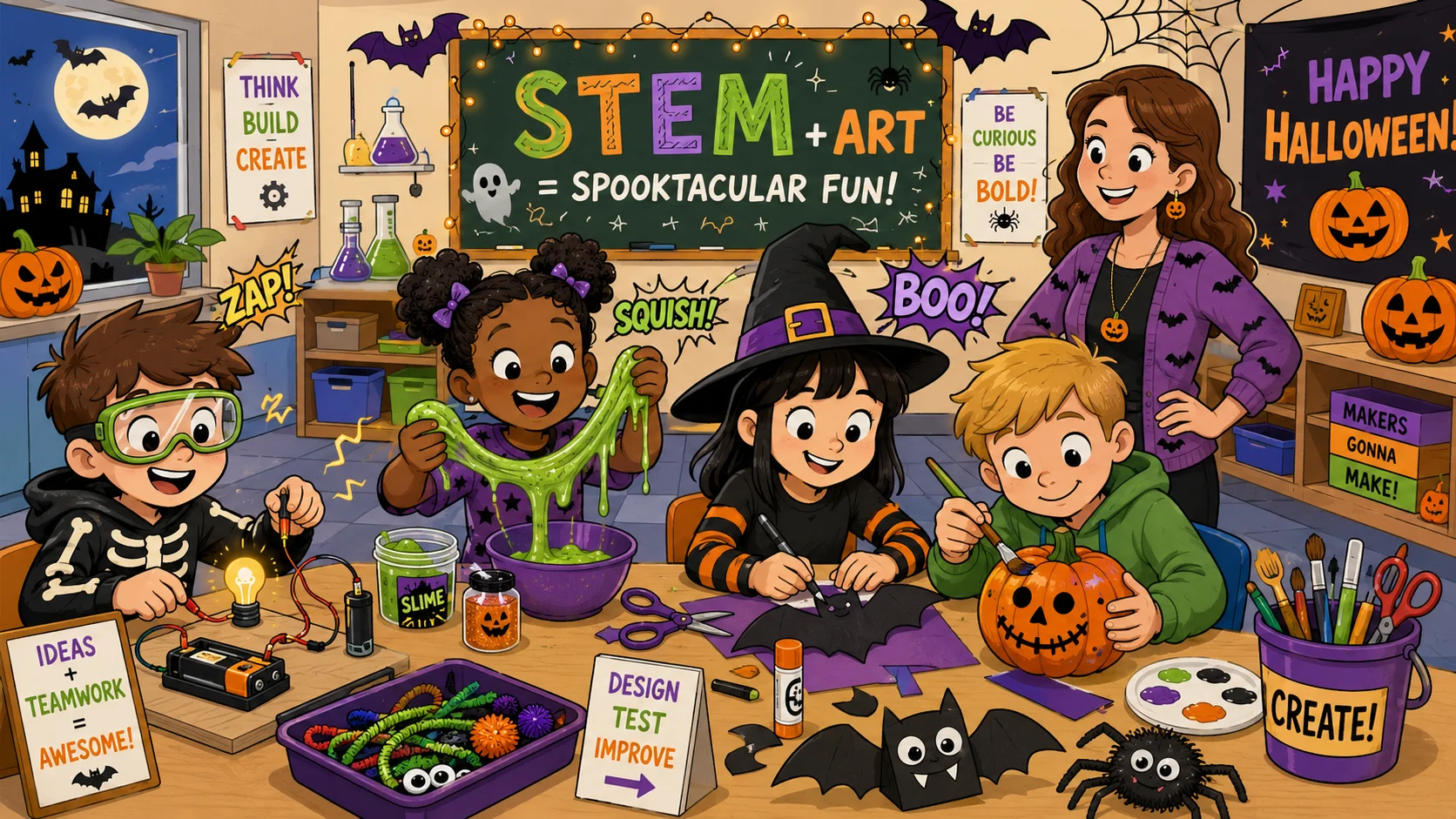
These integrated projects add a creative element to core STEM concepts, using visual arts to explore physics, geometry, and mechanical movement.
Halloween Thaumatropes
The Halloween Thaumatropes project explores optical illusions and the visual phenomenon known as persistence of vision. Students draw a birdcage or an empty pumpkin outline on one side of a white paper disc and a ghost or scary face on the opposite side. When two strings attached to the edges are twisted rapidly, the two independent images merge into a single visual composition in the viewer’s brain, showing how the human eye retains an image for a fraction of a second after it disappears.
Halloween Agamograph Project
The Halloween Agamograph Project uses geometric folding to explore perspective and visual perception. Students create two distinct drawings on a single grid: one of a pumpkin and one of a bat. The paper is then folded into an alternating accordion pattern. Viewing the piece from the left side reveals the pumpkin image, while viewing it from the right side reveals the bat, demonstrating how viewing angle affects visual perception.
3D Halloween Art Project
The 3D Halloween Art Project teaches spatial awareness, form, and structural volume. Students transition from flat, two-dimensional paper sheets to three-dimensional structures by building hollow paper pumpkins and bats. This activity reinforces geometric properties by showing how scoring, curving, and joining paper strips can create a rigid, load-bearing structure.
Halloween Pumpkin Melted Crayon Art
The Halloween Pumpkin Melted Crayon Art project explores thermal phase transitions and fluid dynamics. Students glue wax crayons around the top stem of a pumpkin and use a handheld hair dryer to apply targeted thermal energy.
Fluid Observations: As the solid wax reaches its melting point, it turns into a liquid. Gravity pulls the colored wax down the sides of the pumpkin, allowing students to observe how surface texture, viscosity, and cooling rates affect the resulting flow patterns.
Halloween Salt Dough Ornaments
The Halloween Salt Dough Ornaments project explores mixtures, evaporation, and material preservation. Students combine a precise ratio of flour, table salt, and water to create a uniform dough matrix, shaping it into bats and ghosts. Baking the dough removes water through evaporation, leaving behind a rigid structure that is less likely to decay quickly.
Halloween Spinning Pop-Up Card
The Halloween Spinning Pop-Up Card explores mechanical motion, torque, and stored potential energy. Students construct a greeting card featuring an internal cutout window. A paper ghost is suspended in the opening using a twisted rubber band or thread; closing the card winds up the thread and stores potential energy. When the recipient opens the card, the release of tension causes the ghost to spin rapidly, demonstrating how stored energy can be released as motion.
Spooky Pop-Up STEAM Project
The Spooky Pop-Up STEAM Project expands paper engineering principles by introducing complex mechanisms like internal tabs, parallel folds, and V-fold levers. Students design an original pop-up book page in which opening the card activates a multi-stage mechanical motion, such as a skeleton rising out of a coffin while moving its arms. The project requires precise geometric measurement and alignment.
Make Animation
The Make Animation project introduces stop-motion technology, frame rates, and digital sequencing. Using a tablet camera and clay figures of pumpkins or skeletons, students record a series of still images, making minor physical adjustments to the figures between shots. Playing the images back at about 12 frames per second creates the illusion of fluid movement and shows how digital media can sequence still images to simulate motion.
Moving Skeletons
The Moving Skeletons project focuses on biological mechanical frameworks and joint articulation. Students cut out paper bone structures and assemble a full human skeleton model using metallic brads at the joints. By manipulating the limbs, students analyze how different joint configurations – such as hinge joints at the elbows and knees – allow or limit specific ranges of motion.
Halloween Pomander Project
The Halloween Pomander Project explores sensory science, natural preservation, and desiccation. Students pierce the skin of whole oranges with rows of dried cloves, creating geometric patterns. Cloves contain eugenol, an organic compound with antimicrobial properties, and the drying process helps slow mold growth while demonstrating traditional preservation techniques.
FAQ
What Are Halloween STEM Activities?
Halloween STEM activities are hands-on lessons that teach science, technology, engineering, and math through a Halloween theme. Instead of using worksheets alone, children explore real concepts through pumpkins, candy, simple circuits, spooky challenges, and seasonal materials. These activities make STEM learning feel more approachable, playful, and memorable.
What Are the Best Halloween STEM Activities for Kids?
The best Halloween STEM activities for kids are simple to set up, safe for the age group, and connected to a clear learning goal. Great examples include pumpkin volcanoes, Halloween lava lamps, candy catapults, density jars, ghost rockets, and Halloween slime. Kids love activities that feel like Halloween fun but still help them test ideas, collect data, and solve problems.
How Can Teachers Use 31 Days of Halloween STEM Activities?
A 31 days of Halloween STEM plan can work like a Halloween advent calendar for learning. Teachers and parents can choose one small challenge each day, rotate activities through classroom stations, or save the bigger projects for weekly STEM lessons. The goal is not to complete every project perfectly, but to keep students engaged throughout the Halloween season with hands-on STEM.
Which STEM Activities Work Best for Middle School?
STEM activities for middle school should include more testing, measurement, and analysis than early elementary projects. Strong options include the Flying Ghost Tea Bag Experiment, Pumpkin Clock, Halloween Digital Escape Room, Ghost Bottle Rockets, and Rotting Pumpkin Investigation. These Halloween STEM activities for middle school students work well because they add a spooky theme while still focusing on data, variables, engineering constraints, and scientific reasoning.
How Can You Add a Halloween Twist to a Classic STEM Project?
A Halloween twist on a classic STEM project usually comes from changing the materials, story, or design challenge without changing the core concept. A baking soda volcano becomes a pumpkin volcano, a bridge challenge becomes a bone bridge, a circuit lesson becomes a mummy circuit craft, and a coding maze becomes a Halloween escape room. This keeps the science behind the activity intact while making the lesson feel seasonal and exciting.
Are Halloween STEM and Halloween STEAM Activities the Same?
Halloween STEM activities focus on science, technology, engineering, and math, while Halloween STEAM activities add art and design. Both approaches can support strong STEM learning. For example, a circuit wand is mainly STEM, but decorating the wand adds a STEAM element. The best STEM and STEAM projects combine creativity with a clear learning objective.
What Makes a Halloween STEM Project Fun and Educational?
A strong Halloween STEM project gives students a real question to answer or a problem to solve. Fun Halloween STEM activities often include a visible reaction, a build-and-test challenge, or a mystery to decode. The activity should feel like spooky fun, but students should still understand what they are learning, such as density, force, motion, chemical reactions, circuits, or coding logic.
What Are Some Simple Halloween STEM Activities for Classroom Stations?
Simple Halloween STEM activities for classroom stations include Halloween Skittles, Halloween Density Jar, Floating Ghost Drawing, Candy Sink or Float, Graphite Circuits, and unplugged coding grids. These activities are low-prep, easy to rotate, and perfect for Halloween classroom centers. They also give students a chance to make predictions, observe results, and compare outcomes.
Take a short quiz to find out what your everyday choices say about your parenting style
When your child is curious about something new, what’s your instinct?
Take a short quiz to find out what your everyday choices say about your parenting style
“Can I download this app?” What happens next?
Take a short quiz to find out what your everyday choices say about your parenting style
When it comes to rules at home, which sounds most like you?
Take a short quiz to find out what your everyday choices say about your parenting style
If you could give your child one life skill today, what would you pick?
Take a short quiz to find out what your everyday choices say about your parenting style
Your child gets to choose what to watch. What would your ideal setup look like?
Take a short quiz to find out what your everyday choices say about your parenting style
Pick your parenting superpower ✨