
55 Friendship Activities for Kids: Games, Crafts, SEL Ideas, and Worksheets

 Discover a Free Education Video App for Kids
Pastory uses AI to personalize educational video content based on your child’s interests and personality. Safe, engaging, and built for curious young minds. Sign up now to stay updated and enjoy early access with a free trial

Structured friendship activities give parents, teachers, counselors, and group leaders practical tools for supporting children’s social and emotional development. This article outlines versatile exercises for different ages, settings, and social-skill goals, helping children navigate everyday social situations. By integrating targeted crafts, cooperative games, age-appropriate literature, social-emotional learning (SEL) prompts, and printable worksheets, these resources can be easily adapted for classroom lessons, small groups, or home environments. The following sections target core competencies, including verbal communication, empathy, perspective-taking, and proactive conflict resolution.
Key Takeaways
The Best Friendship Activities Build Social Skills Through Play
Engaging children in cooperative games, creative crafts, interactive books, and structured role-play allows them to practice kindness, active listening, sharing, and problem-solving in a low-stakes environment.
A Mix of Activities Works Better Than a Single Lesson
Combining different activity types—such as movement games, creative arts, reflective writing tasks, and interactive worksheets—helps children with different strengths and needs practice friendship skills more effectively.
Parents and Teachers Can Use These Activities Right Away
Using simple household or classroom supplies, these activities can be adapted for different ages, group sizes, and social-emotional needs.
Why Friendship Matters for Kids
Social Skills Growth
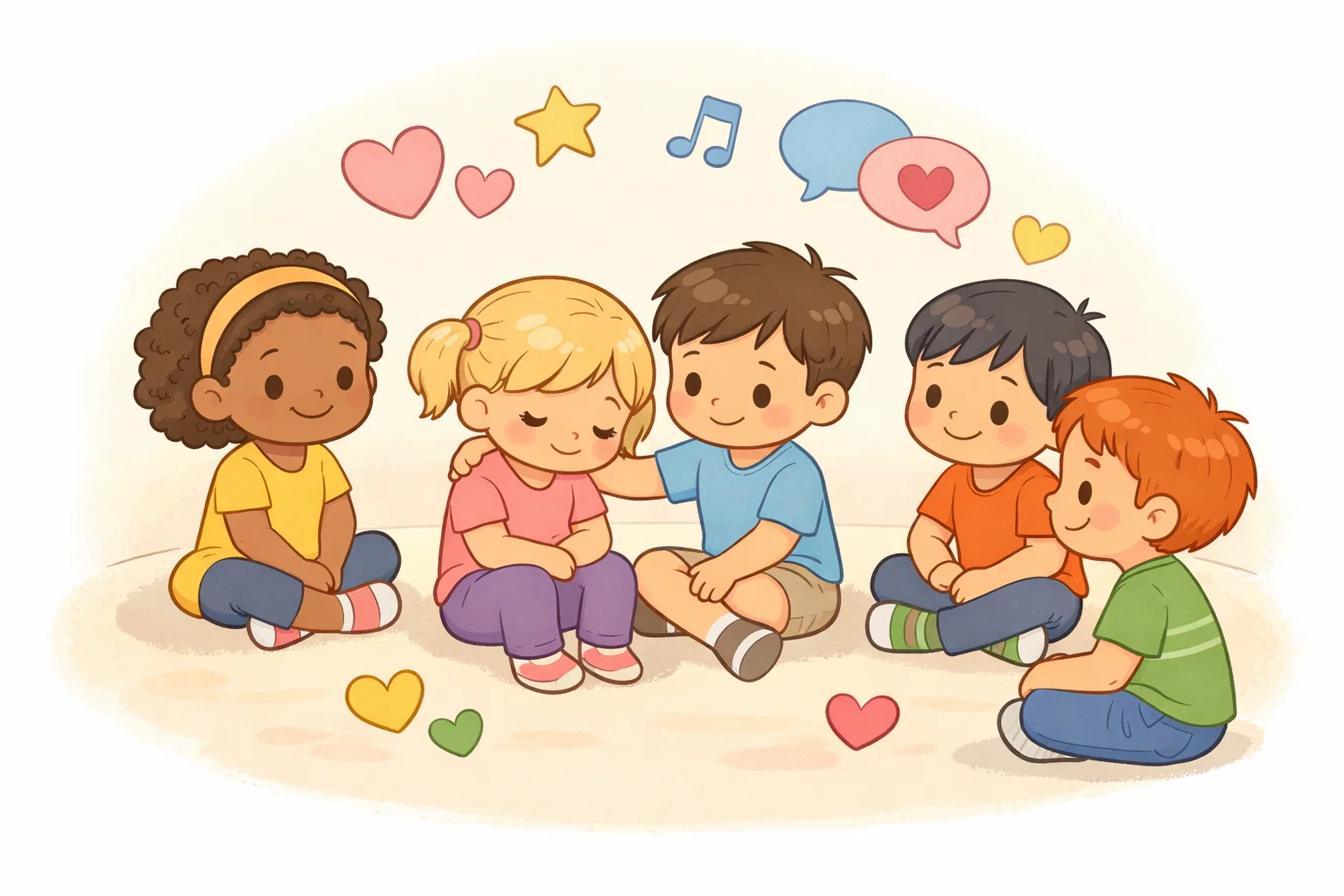
Peer interactions are one of the main ways children build social skills outside the family. Engaging with peers requires children to practice conversation, turn-taking, cooperation, compromise, and the recognition of personal space. Structured peer interactions in early childhood can support group participation skills, which may help children adjust more easily to primary school.
Emotional Regulation Practice
Navigating close friendships gives children important, real-world opportunities to practice emotional regulation. Interpersonal dynamics naturally expose children to moments of frustration, jealousy, excitement, and disappointment. Child-development research suggests that children who learn to repair mistakes in peer relationships may develop stronger emotional resilience and fewer behavioral difficulties.
Confidence, Belonging, and Peer Support
Experiencing positive friendship dynamics supports a child’s need for belonging and peer support. When children feel valued and included by their peers, their overall confidence can grow. Educational research suggests that students with stable peer connections are often more willing to participate in school, extracurricular clubs, and cooperative group play.
Healthy Relationship Habits
Early experiences with peers help shape the foundation for healthy relationships later in life. By learning to identify and show positive friendship behaviors, children internalize core values such as kindness, respect, mutual boundaries, honesty, trust, and empathy. Cultivating these habits early can help children handle negative peer pressure and make safer, more constructive friendship choices as they grow.
What Makes a Good Friend
Kindness, Respect, and Sharing
The core characteristics of a good friend include observable behaviors such as kindness, respect, and a willingness to share. In a primary school setting, children demonstrate these traits by taking turns with popular materials, using polite phrasing, and noticing when a classmate feels excluded or upset. Prosocial actions help children feel safer and more included in a peer group.
Listening, Communication, and Turn-Taking
Effective communication is the foundation of any positive friendship. Children practice these skills by using appropriate body language, waiting for a peer to finish speaking without interrupting, asking relevant follow-up questions, and using encouraging words. Balanced turn-taking during conversations helps ensure both participants feel valued.
Trust, Cooperation, and Negotiation
Maintaining strong friendships beyond initial interactions requires trust, cooperation, and negotiation skills. Children build trust by keeping small promises and working dependably as partners during collaborative tasks. When personal preferences clash, children can use basic negotiation to solve small disagreements and find fair solutions that respect both people’s needs.
Conflict Repair and Apology Skills
Because disagreements are inevitable, conflict resolution and repair skills are critical components of a lasting relationship. A healthy peer connection requires children to learn how to give a sincere apology, take responsibility, offer to make things right, and move forward without lingering shame or resentment.
| Friendship Quality | Observable Child Behavior | Developmental Benefit |
| Prosocial kindness | Sharing physical materials; inviting excluded peers to join play. | Builds group safety and reduces playground isolation. |
| Active listening | Waiting for a peer to finish speaking; asking follow-up questions. | Enhances perspective-taking and mutual respect. |
| Collaborative negotiation | Finding a middle ground when play preferences conflict. | Prevents peer dominance and encourages joint problem-solving. |
| Proactive repair | Delivering a structured apology and taking accountability. | Re-establishes trust after interpersonal friction. |
How Friendship Activities Help
Practice Through Play
Children often understand social situations and emotional concepts best through hands-on practice rather than passive lectures. Games and crafts provide concrete ways for kids to experiment with different friendship behaviors safely. Play lowers children’s defenses, allowing social-emotional learning concepts to become part of their everyday behavior.
Safe Role-Play for Tricky Moments
Structured role-play activities offer children a predictable framework for navigating social situations that typically cause anxiety. By rehearsing clear scripts for joining group play, setting personal boundaries, handling peer exclusion, asking for adult help, or responding to mild teasing, children build practical habits they can use during stressful real-world interactions.
Group Reflection and Discussion
Any friendship activity becomes more useful when it is paired with intentional group reflection. A brief post-activity discussion encourages children to think about what happened and how they interacted with others. Educators can pose targeted reflection prompts to solidify the lesson:
- “What specific action made teamwork easier for your group today?”
- “In what way did your partner help you complete the task successfully?”
- “What is one thing a friend could do next time to make this game more inclusive?”
Tips for Success Before Starting
To make these activities more effective, adults should establish clear guidelines before starting. Group sizes should be kept small, ideally two to four children, to avoid overwhelming sensitive participants. Adults should model helpful phrases, emphasize that mistakes are a normal part of learning, avoid forced “best-friend” pairings, and celebrate collaborative effort over final outcomes.
Creative Friendship Craft Activities
1. Friendship Bracelets
Age Range: 6–11 years (KS2 / Primary School)
Supplies Needed: Embroidery floss, masking tape, scissors.
Steps:
- Cut three or four strands of contrasting colored embroidery floss to 24-inch lengths.
- Knot the strands together at the top and tape the knot securely to a desk or table surface.
- Teach the child to weave the strands sequentially using alternating over-under patterns until the length reaches 6 inches.
- Knot the loose end and assist the child in tying it around a classmate’s wrist.
Friendship Skill Practiced: Patience, fine motor skills, and intentional gifting behavior.
2. Affirmation Friendship Bracelet
Age Range: 7–12 years
Supplies Needed: Elastic jewelry cord, plastic alphabet beads, colored pony beads.
Steps:
- Instruct each child to select a positive word that represents a peer’s strength, such as “KIND,” “HELPFUL,” or “BRAVE.”
- Thread the corresponding alphabet beads onto a 9-inch piece of elastic cord.
- Fill the remaining space on the cord with decorative pony beads.
- Secure the cord with a square knot to complete the wearable friendship affirmation.
Friendship Skill Practiced: Identifying positive traits in others and expressing appreciation.
3. Painted Friendship Rocks
Age Range: 4–10 years
Supplies Needed: Smooth river stones, acrylic paint or paint pens, clear sealant.
Steps:
- Wash and dry river stones to ensure a clean painting surface.
- Have children paint a base coat and write an encouraging phrase or draw a kind symbol.
- Once dry, seal the stones with a non-toxic clear coat.
- Direct children to exchange their rocks with a peer or hide them around the playground as part of a random-acts-of-kindness activity.
Friendship Skill Practiced: Generosity and cultivating community connection.
4. Friendship Paper Chain
Age Range: 5–9 years
Supplies Needed: Pre-cut strips of colored construction paper, glue sticks, markers.
Steps:
- Provide each student with three paper strips.
- Ask each child to write a specific compliment, a shared interest, or a recent kind act on each strip.
- Loop the first strip into a circle and secure the ends with a glue stick.
- Thread the next student’s strip through the previous loop before gluing it, creating a continuous classroom wall display.
Friendship Skill Practiced: Celebrating group cohesion and recognizing individual contributions.
5. Friendship Flowers
Age Range: 4–8 years
Supplies Needed: Colored paper circles, pre-cut paper petals, green pipe cleaners, glue.
Steps:
- Glue a yellow paper circle with the child’s name on it to the top of a green pipe cleaner.
- Provide five paper petals to each child.
- Instruct the child to write a different quality that people often look for in a good friend, such as “shares” or “listens,” on each petal.
- Glue the completed petals around the central circle to form a complete friendship flower.
Friendship Skill Practiced: Understanding the characteristics of a good friend.
6. Friendship Flower Garden
Age Range: 5–10 years
Supplies Needed: Large butcher paper roll, green markers, glue, individual friendship flowers from Activity 5.
Steps:
- Roll out a long piece of butcher paper on a classroom wall or floor to serve as a group mural.
- Draw long green stems and leaves across the paper background using green markers.
- Have each child glue their personalized friendship flower onto one of the stems.
- Label the top of the group bulletin-board mural: “Our Growing Circle of Friends.”
Friendship Skill Practiced: Developing a sense of shared belonging and collective identity.
7. Compliment Collage
Age Range: 8–12 years
Supplies Needed: Poster board, old magazines, safety scissors, glue sticks, markers.
Steps:
- Assign each child a partner or draw names from a hat to ensure every student is included.
- Instruct the child to write their partner’s name in the center of a small piece of poster board.
- Direct students to cut out words, images, and symbols from magazines that represent their partner’s real strengths.
- Enforce the rule that compliments must be sincere, specific, and completely non-appearance-based before pasting.
Friendship Skill Practiced: Formulating precise verbal affirmations and validating peers.
8. Memory Jar
Age Range: 6–11 years
Supplies Needed: Clear plastic jars, colorful slips of paper, pens, ribbons.
Steps:
- Decorate the exterior of a clear plastic jar using ribbons and markers to designate it as a group resource.
- Throughout the week, invite children to write down positive friendship memories or teamwork wins on paper slips.
- Fold the slips and place them inside the jar whenever a positive interaction occurs.
- Open the jar during Friday circle time and read the collected moments aloud to the group.
Friendship Skill Practiced: Cultivating active gratitude and focusing on positive peer behaviors.
9. Letters and Cards
Age Range: 6–10 years
Supplies Needed: Blank greeting cards, envelopes, colored pencils, stamps or stickers.
Steps:
- Introduce clear card categories: thank-you cards, welcome notes for a new friend, or sincere apology cards.
- Provide a basic sentence scaffold on the board to guide children who need writing support.
- Have children draft their message, illustrate the front of the card, and place it inside an envelope.
- Help children deliver the completed cards to the intended recipients within the group.
Friendship Skill Practiced: Written communication skills and intentional relational repair.
10. DIY Clothing Upcycle
Age Range: 9–12 years (KS2)
Supplies Needed: Old clean shirts or canvas tote bags, fabric markers, cardboard inserts.
Steps:
- Slide a cardboard insert inside an old T-shirt or tote bag to prevent marker ink from bleeding through.
- Pair students up and have them collaborate on a joint design concept that displays teamwork messages.
- Have students take turns drawing kindness symbols or positive slogans on each other’s items.
- Allow the fabric ink to set completely before the items are worn or used.
Friendship Skill Practiced: Collaborative design, compromise, and respect for boundaries.
11. Friendship Coloring Page
Age Range: 3–7 years
Supplies Needed: Printed friendship coloring worksheets, crayons, washable markers.
Steps:
- Distribute a worksheet depicting children sharing toys or helping someone stand up.
- While the children color the scene, introduce structured discussion prompts about inclusion and helping.
- Ask the children to describe how the characters in the illustration show positive friendship behaviors.
- Display the completed coloring pages near the classroom entryway as a visual behavior reminder.
Friendship Skill Practiced: Associating positive visual imagery with real-world prosocial choices.
12. Friendship Yarn Circle
Age Range: 5–11 years
Supplies Needed: One large ball of brightly colored yarn.
Steps:
- Seat the entire group of children in a wide circle on the floor.
- Hold the end of the yarn ball, call a child by name, and state a genuine quality they add to the group.
- Toss the ball of yarn to that specific child while retaining your grip on the loose string end.
- Repeat this process until every child holds a section of the yarn, creating a large visual web.
Friendship Skill Practiced: Visualizing group connection and reinforcing verbal praise habits.
Friendship Games and Physical Activities
13. Trust Walk
Age Range: 8–12 years
Supplies Needed: Soft blindfolds, open indoor or outdoor space free of sharp hazards.
Steps:
- Pair students thoughtfully, balancing personalities so each child feels supported.
- Place a soft blindfold over one student’s eyes, designating the partner as the verbal guide.
- Instruct the guide to navigate the blindfolded partner across the space using only calm verbal directions.
- Switch roles after 3 minutes, then debrief on how it felt to rely entirely on a classmate’s words.
Friendship Skill Practiced: Building peer trust, accountability, and clear verbal communication.
14. Blindfold Obstacle Game
Age Range: 7–12 years
Supplies Needed: Soft obstacles, such as plastic cones, floor mats, foam blocks, and blindfolds.
Steps:
- Set up a simple, safe obstacle course on a soft carpeted floor or grass field.
- Blindfold one child and have their partner stand at the edge of the course boundaries.
- The guiding child must use precise directional language, such as “Take two small steps forward,” to lead them through safely.
- Enforce a strict no-touching rule to ensure the exercise relies exclusively on auditory instructions.
Friendship Skill Practiced: Clear speech, active listening, and patience.
15. “That’s Me!” Game
Age Range: 4–10 years
Supplies Needed: None.
Steps:
- Gather the children seated in a central circle or standing across a gym floor line.
- Read a series of objective lifestyle or preference statements aloud, such as “I have a pet dog” or “I love eating apples.”
- Instruct every child the statement applies to to stand up and say, “That’s me!”
- Pause briefly after each statement to let children scan the room and notice peers with identical answers.
Friendship Skill Practiced: Discovering common interests and breaking the ice with unfamiliar peers.
16. Matching Game
Age Range: 4–8 years
Supplies Needed: Pre-made card pairs showing distinct emotions or prosocial behaviors.
Steps:
- Shuffle a deck of oversized cards where half show an emotion name and half depict a corresponding facial expression.
- Lay all the cards face down on a flat table surface in a structured grid pattern.
- Have two children take turns flipping over two cards at a time to find a match.
- When a match is found, the pair acts out that positive behavior together before collecting a point.
Friendship Skill Practiced: Turn-taking, visual-spatial memory, and shared emotional literacy.
17. Hula Hoop Pass
Age Range: 6–11 years
Supplies Needed: One standard plastic hula hoop.
Steps:
- Direct a small group of 6 to 8 children to stand in a line and lock hands firmly.
- Place a plastic hula hoop over the arm of the first child before they connect with their neighbor.
- Instruct the group to pass the hoop completely down the line without breaking their physical handholds.
- Encourage the kids to bend, step, and coordinate their body movements collectively to solve the physical challenge.
Friendship Skill Practiced: Gross motor coordination, collective problem-solving, and nonverbal physical cooperation.
18. Friendly Musical Chairs
Age Range: 5–10 years
Supplies Needed: Sturdy chairs, one fewer than the total number of participants, and a music player.
Steps:
- Set up chairs back-to-back in the center of the room.
- Play upbeat music while the children walk in a continuous circle around the perimeter of the chairs.
- Stop the music unexpectedly; however, change the traditional rule so no individual player is eliminated.
- Instruct the children to cooperate so everyone can safely share the remaining seating space.
Friendship Skill Practiced: Active inclusion, spatial adaptation, and reducing competitive friction.
19. Ball Toss
Age Range: 5–9 years
Supplies Needed: A lightweight, textured playground ball.
Steps:
- Have the children stand in a wide, clear circle.
- The child holding the ball looks across the circle, calls out a peer’s name clearly, and asks a friendly icebreaker question.
- Gently toss the ball across the circle to the named peer, who catches it and answers the prompt.
- Remind your child or student to use underhand throws to maintain safe physical boundaries.
Friendship Skill Practiced: Attentiveness, eye contact, and conversational turn-taking.
20. Friendship Scavenger Hunt
Age Range: 6–12 years
Supplies Needed: Printed scavenger hunt checklist sheets, pencils.
Steps:
- Hand each participant a checklist containing specific interpersonal descriptions, such as “Find a peer who plays the same sport.”
- Instruct the children to move around the room independently and interview their classmates face-to-face.
- When they locate a classmate who fits a prompt, that classmate must write their name on the corresponding checklist line.
- Enforce a rule limiting names to a maximum of two appearances per sheet to encourage wider socialization.
Friendship Skill Practiced: Approaching new friends, initiating dialogue, and finding shared values.
21. Partnered Yoga
Age Range: 6–11 years
Supplies Needed: Two yoga mats or a flat grassy area.
Steps:
- Introduce simple, safe partner yoga poses such as “Partner Tree” or “Double Boat.”
- Instruct the children to check in verbally with their partner regarding comfort levels before beginning any pose.
- Have the pairs press their hands or backs together to find a stable, shared physical center of gravity.
- Guide them to take three deep, synchronous breaths together to cultivate a shared state of calm focus.
Friendship Skill Practiced: Nonverbal coordination, boundary awareness, and calm body regulation.
22. Local Trail Friendship Walk
Age Range: 5–12 years
Supplies Needed: Clipboards, nature trail maps, observation pencils.
Steps:
- Assign children to pairs and provide each team with one outdoor trail observation checklist.
- Instruct partners to stay within arm’s reach of one another throughout the nature walk.
- Require the pair to cross off listed items, such as an oak leaf or a smooth pebble, only when both agree they see it.
- Include specific partner discussion questions on the back of the checklist to encourage conversation during the walk.
Friendship Skill Practiced: Shared outdoor navigation, consensus building, and cooperative observation.
23. Build Tower Challenge
Age Range: 5–11 years
Supplies Needed: Building blocks, plastic cups, or wooden interlocking sticks.
Steps:
- Divide the children into small groups of three to four participants, giving each group the same number of building blocks.
- Set a 10-minute time limit for building the tallest freestanding tower possible.
- Establish a rule that each participant can place only one block at a time, creating a rotating turn order.
- Ask the small groups to discuss and agree on their building strategy before placing the first piece.
Friendship Skill Practiced: Collaborative negotiation, structural compromise, and collective goal management.
24. Turn-Taking Activity
Age Range: 3–6 years
Supplies Needed: Traditional turn-based early childhood board games or a custom tabletop spinner.
Steps:
- Sit a pair of young children at a small table with a structured activity, such as a color-matching spinner game.
- Model the explicit phrases required during play: “It is your turn now” and “Thank you for waiting.”
- Have the children physically pass a tangible “turn token” back and forth to signify whose turn it is to act.
- Provide close adult supervision to reinforce impulse control and prevent children from taking extra turns too quickly.
Friendship Skill Practiced: Early childhood impulse control, patience, and basic fair play rules.
25. Telephone Game
Age Range: 6–10 years
Supplies Needed: None.
Steps:
- Seat at least eight children in a line or circle, spaced 2 feet apart.
- Whisper a complex, friendship-themed sentence, such as “Kind friends always listen carefully to secrets,” to the first child.
- Instruct each child to whisper the message exactly as they heard it to their neighbor just once.
- Have the final child say the phrase aloud, then discuss how messages can change and why careful communication matters.
Friendship Skill Practiced: Focus, auditory clarity, and understanding how rumors or miscommunications develop.
Storytelling, Books, and Writing Activities
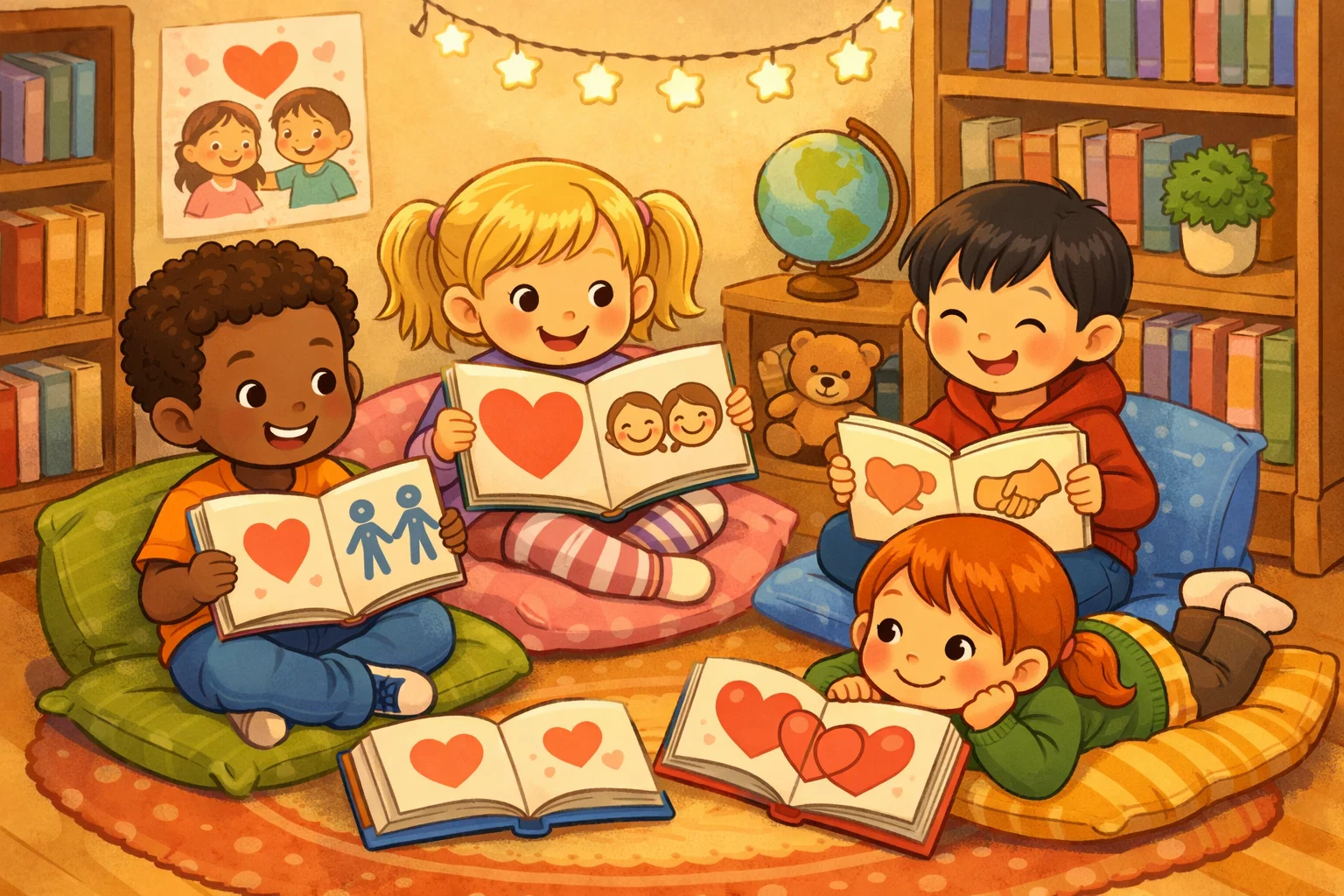
26. Friendship Picture Books
Age Range: 3–8 years
Supplies Needed: Curated children’s literature focused on positive peer relationships.
Steps:
- Read aloud a selected picture book that highlights inclusion, differences, or making amends after a conflict.
- Pause at critical plot moments where characters face a challenging social dilemma or exclusion scenario.
- Ask the children to analyze the characters’ body language and predict the emotional impact of their choices.
- Conclude the reading by having children connect the story’s lesson to a personal playground situation.
Friendship Skill Practiced: Narrative perspective-taking and identifying empathetic behavioral responses.
27. Write a Story Together
Age Range: 8–12 years
Supplies Needed: Lined paper, storytelling graphic organizers, pencils.
Steps:
- Pair two students together and ask them to co-create an original fictional character.
- Instruct the pair to write a structured short narrative where their character encounters a common friendship challenge.
- Have students alternate writing sentences or paragraphs so they practice integrating each other’s plot ideas.
- Ensure that the final resolution of their story shows a healthy, prosocial way to resolve conflict.
Friendship Skill Practiced: Coordinated composition, narrative compromise, and creative problem-solving.
28. Make a Video
Age Range: 9–12 years
Supplies Needed: Tablet or video recording device, simple script outline sheets.
Steps:
- Form small groups of 3 to 4 students and hand out a basic video production planning prompt.
- Have the group script a brief 60-second public service announcement demonstrating a key social skill.
- Assign clear production roles within the group: scriptwriter, actor, camera operator, and director.
- Record the scenario and screen the final videos for the entire class to reinforce positive behavior.
Friendship Skill Practiced: Media literacy, task division, and public speaking confidence.
29. Friendship Letter
Age Range: 7–11 years
Supplies Needed: Structured letter templates, envelopes, writing materials.
Steps:
- Provide students with the option to write to a new classmate, a long-term friend, or a peer from another class.
- Use a template that separates the letter into sections: a compliment, a shared memory, and a question.
- Direct the children to complete the letter independently using clear handwriting.
- Have the kids fold, seal, and place the finished letter inside a physical classroom mailbox for delivery.
Friendship Skill Practiced: Expressing internal thoughts in writing and strengthening intentional peer bonds.
30. Friendship Journals
Age Range: 8–12 years
Supplies Needed: Personal notebooks, daily whiteboard reflection prompts.
Steps:
- Establish a predictable 10-minute quiet journaling routine at the start or conclusion of the school day.
- Write a highly specific social prompt on the board, such as “Describe a time you noticed a peer showing empathy.”
- Instruct children to write at least four complete sentences describing their thoughts, feelings, and reactions.
- Keep journal contents private between the adult and child to build a safe space for honest reflection.
Friendship Skill Practiced: Intrapersonal emotional processing and self-directed social evaluation.
31. Friendship Want Ad
Age Range: 8–12 years
Supplies Needed: Mock newspaper template sheets, fine-tip drawing pens.
Steps:
- Show children traditional newspaper classified ads to explain the concept of a “want ad.”
- Ask the child to write a playful, personalized advertisement describing the ideal qualities of a great friend.
- Require the text to focus strictly on personality traits and core values rather than appearance, popularity, or possessions.
- Give students space to decorate the borders with symbols that reflect their unique hobbies and personal style.
Friendship Skill Practiced: Clarifying personal relationship standards and articulating values.
32. Wanted Poster: Great Friend Edition
Age Range: 6–10 years
Supplies Needed: Thick cardstock sheets, brown colored pencils, markers.
Steps:
- Distribute a template titled “WANTED: A Great Friend” styled like a historical poster.
- Have the child sketch an illustration of a peer demonstrating an act of kindness in the central box.
- Instruct the child to list four specific behavioral traits that make someone an ideal partner.
- Display the completed posters across the room walls to set high community expectations.
Friendship Skill Practiced: Identifying positive character traits and establishing healthy relationship standards.
33. Friendship Acrostic Poem
Age Range: 6–9 years
Supplies Needed: Pre-lined writing paper with vertical starter words.
Steps:
- Provide a worksheet where a core concept word like “FRIEND” or “KIND” is printed vertically down the margin.
- Instruct the child to write a complete phrase or sentence starting with each corresponding letter.
- Ensure each line describes an explicit action or behavior related to maintaining a healthy connection.
- Encourage the children to read their completed acrostic lines aloud during small group time.
Friendship Skill Practiced: Linguistic expression and reinforcing core relational concepts through poetry.
34. Friendship Poem Color Palette
Age Range: 8–12 years
Supplies Needed: Gradated hardware-store paint-chip cards, fine-tip permanent markers.
Steps:
- Provide each student with a multi-shaded paint-chip card representing a specific color spectrum.
- Ask the child to assign an emotional state or friendship memory to each gradient shade on the card.
- Instruct them to write a single line of poetry directly across each colored segment to build a short poem.
- Use the different shades to explain how friendships can include a wide range of feelings.
Friendship Skill Practiced: Abstract emotional mapping, metaphor use, and creative self-expression.
35. Friendship Quotes Activity
Age Range: 9–12 years
Supplies Needed: Printed list of famous prosocial quotes, drawing paper, markers.
Steps:
- Present a list of well-known quotes about cooperation, unity, and being dependable.
- Have each child select one quote that aligns with their personal values or experiences.
- Direct the child to write the quote clearly in the center of their page and sketch a real-world example underneath.
- Have them present their drawing to a partner, explaining how the words connect to everyday actions.
Friendship Skill Practiced: Interpreting meaningful quotes and connecting abstract ideas to everyday actions.
36. Friendship Adventure Story Pack
Age Range: 7–10 years
Supplies Needed: Printed short stories, comprehension worksheets, pencils.
Steps:
- Hand out a brief, engaging story detailing an adventure where two characters must cooperate to succeed.
- Have students read the text independently or in pairs, highlighting moments of teamwork.
- Instruct the children to complete the attached reading comprehension worksheet independently.
- The worksheet should prompt kids to identify the specific turning point where cooperation resolved the central dilemma.
Friendship Skill Practiced: Reading comprehension, analyzing situations, and recognizing the value of cooperation.
SEL Activities for Stronger Friendships
37. Things We Have in Common
Age Range: 5–10 years
Supplies Needed: Two-circle Venn diagram worksheets, colored pencils.
Steps:
- Pair two students who do not typically sit together or interact during open playtime.
- Give the pair a Venn diagram sheet and ask them to interview each other about their lives.
- Instruct them to write unique individual traits in the outer sections and shared traits in the overlapping center.
- Encourage them to find at least three meaningful similarities that are not immediately obvious.
Friendship Skill Practiced: Identifying shared experiences, cultivating curiosity, and reducing peer bias.
38. Facial Expression Emotion Exploration
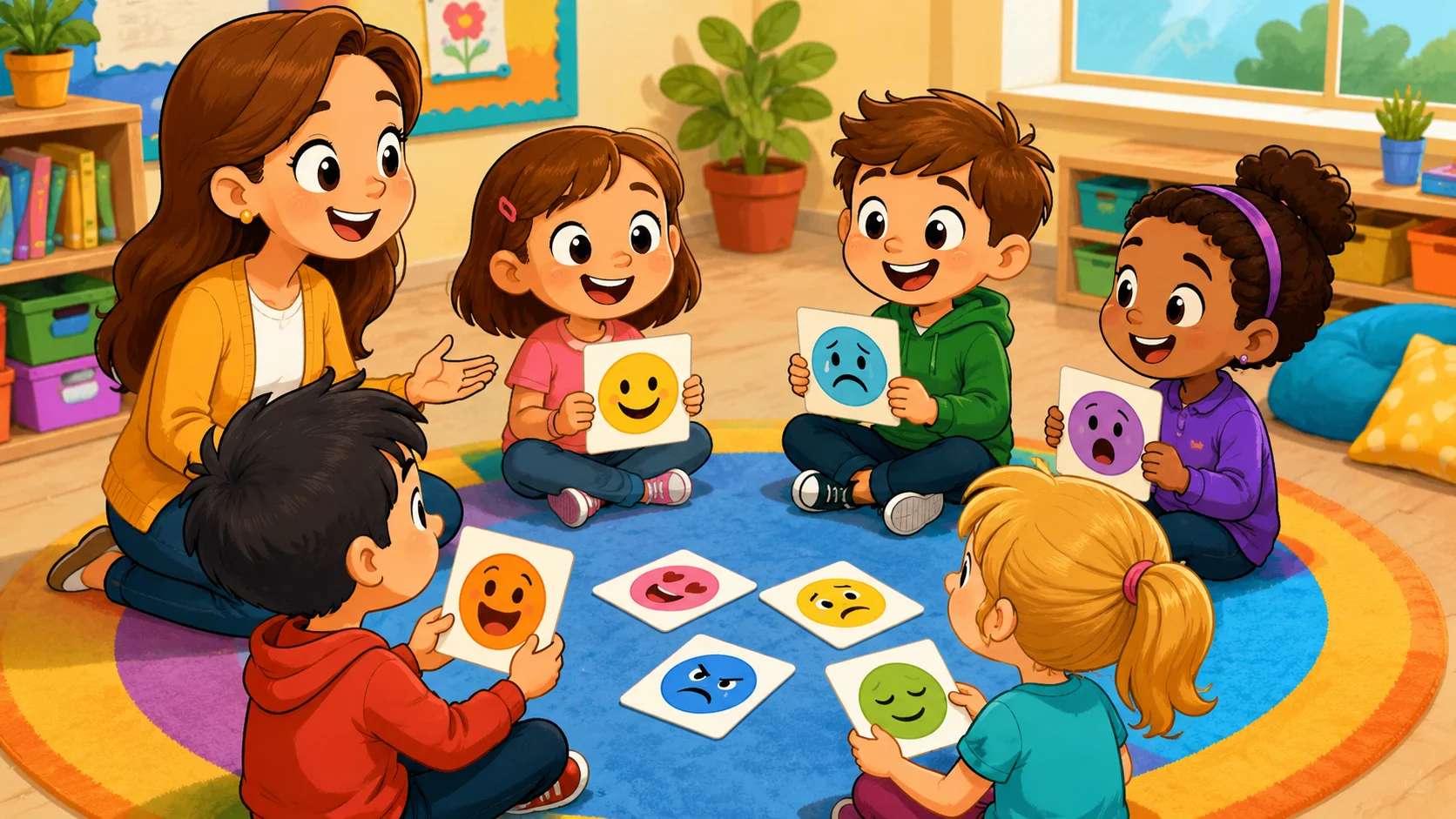
Age Range: 4–8 years
Supplies Needed: Handheld mirrors, printed emotion flashcards detailing facial features.
Steps:
- Hold up an emotion flashcard, such as “anxious” or “excited,” and describe the subtle facial shifts involved.
- Instruct the children to replicate that exact facial expression while looking into a small handheld mirror.
- Pair the kids and have them practice reading their partner’s face to identify the matching emotion card.
- Discuss specific, kind ways a friend can respond when they notice a peer showing those emotions.
Friendship Skill Practiced: Nonverbal emotional recognition, facial decoding accuracy, and empathetic responding.
39. Conversation Cards
Age Range: 6–12 years
Supplies Needed: Index cards containing balanced, open-ended discussion prompts.
Steps:
- Place a stack of custom question cards face down in the center of a small group table.
- Have students take turns drawing a card and reading the prompt aloud to their neighbor.
- The drawing student must listen quietly for 30 seconds while their partner answers the question fully.
- The listener then repeats the main points of their partner’s answer before drawing the next card.
Friendship Skill Practiced: Active listening habits, validation, and structured conversational turn-taking.
40. Conversation Cubes
Age Range: 5–10 years
Supplies Needed: Six-sided foam cubes with question prompts attached to each side.
Steps:
- Provide a small group with a foam conversation cube that has a social question on each side.
- Have the first student roll the cube onto the floor and read the top question aloud to the group.
- Every child in the circle must provide a brief answer to that question before the cube passes to the next roller.
- Teach children to ask a follow-up question after a peer speaks to show genuine interest.
Friendship Skill Practiced: Group dialogue management, mutual disclosure, and verbal inclusion.
41. Whole Body Listening
Age Range: 4–9 years
Supplies Needed: An illustrative poster detailing supportive listening posture options.
Steps:
- Gather the children to discuss how people show respect when listening to someone speak.
- Introduce flexible listening options that respect neurodiverse needs, focusing on attention rather than rigid stillness.
- Demonstrate how nodding, facing the speaker, and keeping a calm body help speakers feel heard.
- Practice these postures during a brief peer sharing session, then ask speakers how it felt to receive that focus.
Friendship Skill Practiced: Attentional focus, displaying respect, and adjusting behavior to support a peer.
42. Compliment Circle
Age Range: 5–11 years
Supplies Needed: A small stuffed animal or soft transition token.
Steps:
- Seat all participants in a closed circle on the rug, establishing a calm, focused environment.
- Hand the transition token to the first speaker, who must turn to the person on their right.
- The speaker delivers a specific compliment highlighting a character strength, such as “I appreciate how you shared your markers yesterday.”
- Pass the token clockwise around the circle until every child has both given and received a compliment.
Friendship Skill Practiced: Delivering targeted verbal praise and practicing accepting positive peer feedback.
43. Highs, Lows, Grows
Age Range: 7–12 years
Supplies Needed: None.
Steps:
- Integrate this structured reflection routine into regular small group or family mealtime discussions.
- Have each child share their “High” (a positive moment), their “Low” (a challenge), and their “Grow” (a social goal).
- Instruct the rest of the group to listen attentively without offering unsolicited advice or interruptions.
- Encourage peers to validate the speaker’s challenges by saying, “Thank you for sharing that with us.”
Friendship Skill Practiced: Emotional sharing, respectful listening, and group empathy.
44. Friendship Spotlight Game
Age Range: 6–10 years
Supplies Needed: A designated “Spotlight Chair” placed in the center of the room.
Steps:
- Select one child per session to sit in the central chair to be celebrated by the group.
- Give the surrounding peers 2 minutes to write down or sketch a strength they appreciate about that child.
- Read the anonymous positive submissions aloud, or invite students to share their thoughts directly with the child in the center.
- Present the collected notes to the spotlighted child as a physical reminder of their value to the group.
Friendship Skill Practiced: Building peer self-worth, creating community validation, and reinforcing prosocial behavior.
45. Empathy Map
Age Range: 8–12 years (KS2)
Supplies Needed: Four-quadrant empathy map worksheets labeled Think, Feel, Say, and Do.
Steps:
- Present a relatable scenario, such as a student sitting alone on the playground during afternoon recess.
- Distribute the empathy map worksheets and have the children fill out each quadrant based on that student’s perspective.
- Guide them to consider what the lonely student might think, feel, say, and do in that situation.
- Discuss concrete, kind steps a classmate could take to support someone in that position.
Friendship Skill Practiced: Advanced cognitive perspective-taking, emotional analysis, and proactive empathy.
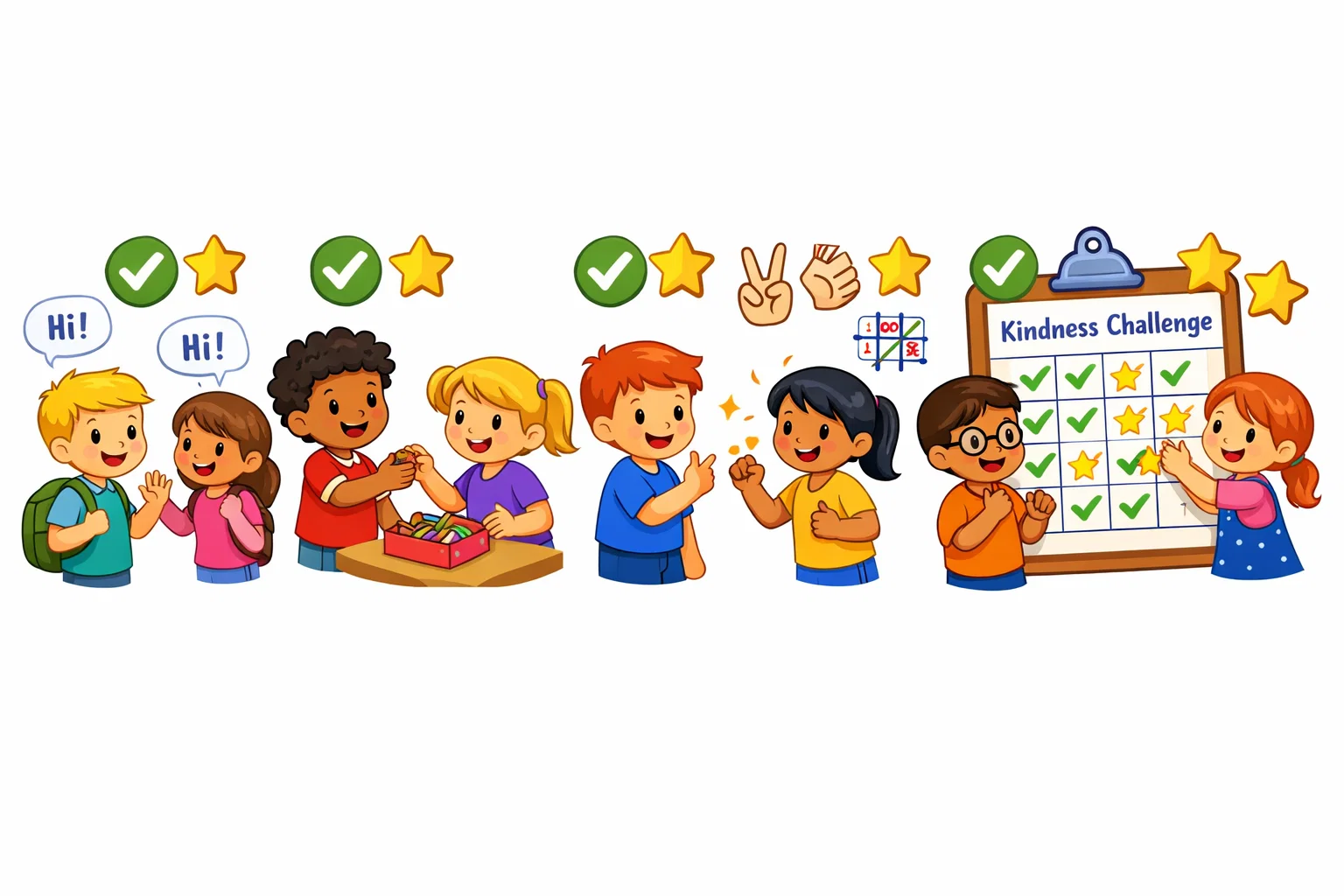
46. Kindness Challenge
Age Range: 5–12 years
Supplies Needed: Printed kindness challenge grids.
Steps:
- Hand out a challenge sheet listing simple daily actions, such as “Invite someone new to play” or “Help clean a mess.”
- Have the children check off one completed task box each day over a designated 10-day period.
- Require a brief parent or teacher signature next to each checked box to confirm the helpful behavior occurred.
- Gather the group at the end of the challenge to celebrate their collective contribution to a kinder community.
Friendship Skill Practiced: Developing proactive prosocial habits, consistency, and empathy.
47. Friendship Pledge
Age Range: 6–11 years
Supplies Needed: Large poster board, colored ink pads, wet wipes.
Steps:
- Facilitate a group brainstorming session to establish a shared set of rules for kindness and inclusion.
- Write the finalized group agreements onto a large poster board titled “Our Community Friendship Pledge.”
- Have each child dip their thumb into an ink pad and place a print onto the poster to show their commitment.
- Mount the signed pledge near the front whiteboard to serve as a daily behavior reference point.
Friendship Skill Practiced: Developing civic responsibility, consensus building, and accountability to a group.
48. New Friend Challenge
Age Range: 7–11 years
Supplies Needed: Small pocket challenge tracking cards, pencils.
Steps:
- Distribute challenge cards containing three explicit social goals designed to welcome unfamiliar peers.
- The goals should include learning a new peer’s name, asking an open-ended question, and inviting that peer to play.
- Give children three days to complete these goals naturally during unstructured recess or lunchtime periods.
- Have students turn in their completed cards along with a short paragraph describing what they learned about their peer.
Friendship Skill Practiced: Initiative, hospitality, breaking down social cliques, and introductory conversation.
49. Friendship Social Story
Age Range: 3–7 years
Supplies Needed: Short, personalized illustrated booklets.
Steps:
- Create a short social story booklet outlining step-by-step scripts for standard social interactions.
- Include explicit phrases and behavioral expectations for greetings, asking to share, or joining an ongoing game.
- Read the story one-on-one with children who find social situations stressful before they enter a group setting.
- Have the child practice the behavior immediately afterward through a brief, supported role-play exercise.
Friendship Skill Practiced: Navigating social situations, building predictability, and developing early intervention skills.
50. Invisible Rules of Friendship
Age Range: 7–12 years
Supplies Needed: Whiteboard markers, scenario discussion worksheets.
Steps:
- Explain that some social expectations are hidden or “invisible” rules that people assume everyone knows.
- List common examples on the board, such as respecting personal space, taking turns in a conversation, and recognizing when a joke becomes hurtful.
- Present short scenarios where a character accidentally breaks one of these unwritten social rules.
- Have the group analyze the situation calmly and rewrite the character’s behavior to be more supportive of others.
Friendship Skill Practiced: Social awareness, identifying subtle cues, and managing relational boundaries.
Communication, Cooperation, and Conflict Skills
51. Communication Lesson Plan
Objective: Students will define, practice, and reflect on active listening techniques during peer conversations.
Materials: Two paper cups connected by string, plus chalk for marking where students should stand.
Activity:
- Pair students and instruct them to stand 6 feet apart on chalk lines, holding the string taut between the cups.
- One student says a secret three-word phrase into one cup while the partner holds the other cup to their ear.
- The listening partner must repeat the phrase back to confirm accuracy before switching communication roles.
- Use the activity to discuss what helps or blocks clear communication.
Discussion Prompt: “What specific barrier made it difficult to interpret your partner’s message clearly?”
Reflection: Students complete an exit slip listing two physical signs that demonstrate they are paying full attention to a speaker.
52. Good Friend or Not Good Friend Task
Age Range: 4–8 years
Supplies Needed: Sorting bins labeled “helpful” and “hurtful,” plus custom behavior scenario cards.
Steps:
- Provide a pair of children with a deck of cards describing various helpful and hurtful friendship choices.
- Instruct the children to read each card together or evaluate the illustration side by side.
- Have them discuss and place helpful actions into the “helpful” bin and hurtful actions into the “hurtful” bin.
- If a disagreement occurs regarding a card’s placement, require the pair to negotiate a compromise before sorting it.
Friendship Skill Practiced: Recognizing helpful and hurtful behaviors, peer negotiation, and setting boundaries.
53. Would You Rather Communication Game
Age Range: 6–12 years
Supplies Needed: List of low-stakes preference prompts mixed with deeper friendship dilemmas.
Steps:
- Have the children stand in a central line, with the room divided into an “Option A” zone and an “Option B” zone.
- Read a prompt aloud, such as “Would you rather have a friend who is always funny or a friend who is a great listener?”
- Have the children physically move to the side of the room that corresponds with their personal choice.
- Pair students with opposing viewpoints and give them 1 minute to explain their choices to each other respectfully.
Friendship Skill Practiced: Articulating personal values, perspective-taking, and practicing respectful dialogue.
54. Healthy vs. Unhealthy Conflict Resolution
Age Range: 8–12 years (KS2)
Supplies Needed: Two-column sorting worksheets and scenario role-play scripts.
Steps:
- Distribute a two-column table worksheet labeled “Healthy Responses” and “Unhealthy Responses.”
- Present common conflict responses, such as using calm words, shouting, ignoring a peer, blaming others, and compromising.
- Have small groups categorize these behaviors and discuss why certain choices cause more relational harm.
- Have the groups act out an unhealthy conflict script, hit an imaginary “pause button,” and switch to a healthier resolution.
Friendship Skill Practiced: Understanding conflict patterns, practicing emotional self-control, and using structured problem-solving.
55. Apology Letter Practice
Age Range: 7–12 years
Supplies Needed: Scaffolded four-part apology writing templates, pencils.
Steps:
- Teach the four parts of a sincere apology: acknowledging the action, explaining how it affected the peer, offering to make things right, and committing to change.
- Provide a fill-in-the-blank writing template to guide children through this emotional process.
- Have students practice drafting responses to hypothetical scenarios, such as accidentally knocking over a classmate’s tower.
- Review the drafted letters to ensure they take clear accountability without using defensive language like “but.”
Friendship Skill Practiced: Managing personal accountability, building empathy, and repairing relationships proactively.
Tips for Success
Set Clear Kindness Rules
Before starting any friendship activity, adults must establish firm behavior boundaries to protect sensitive participants. Clearly state that teasing, mocking, or forcing children to share private personal stories is strictly prohibited. Emphasize that making social mistakes is a normal part of the learning process, and ensure that every participant receives an equal turn to speak and engage.
Model Positive Language
Children often need clear verbal examples to learn how to navigate social situations effectively. Provide visible sentence starters on a whiteboard or anchor chart to support them during challenging peer interactions:
- “May I please join this game?”
- “Let’s try that step again together.”
- “I felt upset when my tower was knocked down.”
- “Thank you for helping me clean up this mess.”
Pair Kids Thoughtfully
Avoid letting children choose their own partners exclusively, as this often leads to repeated exclusion for vulnerable individuals. Rotate partnerships frequently to balance distinct personality traits, mix different social circles, and expand comfort zones. Focus on creating cooperative pairs for specific tasks rather than forcing intense, long-term best-friend expectations.
Keep Activities Low Pressure
Recognize that children develop social competencies at very different rates. Provide alternative options for introverted or neurodiverse children by allowing observation time, using smaller groups, or offering nonverbal ways to participate. Lowering social pressure helps reduce anxiety and fosters a safer environment for eventual participation.
Use Reflection Questions
Conclude every activity session with a dedicated, structured group reflection period. Use a consistent question bank to help children connect their experience during the game to their real-world friendships:
- “What specific action helped your team stay calm during the challenge?”
- “How did you show your partner that you were listening to their ideas?”
- “What is one kind action you noticed someone else do today that you would like to try tomorrow?”
Review Progress Regularly
Adults should monitor group dynamics over time to see how these social-skill activities are working. Look for positive changes, such as increased inclusion during recess, independent problem-solving during minor disputes, and more frequent spontaneous acts of kindness. Repeat effective activities regularly, adjusting support levels as the children’s skills and independence grow.
FAQ About Friendship Activities for Kids
What are some fun friendship activities for kids?
Fun friendship activities for kids include making friendship bracelets, playing group games, reading books about friendship, creating a circle of friends display, and completing random acts of kindness challenges. The best games and activities are simple, age-appropriate, and give children a natural way to encourage kindness, sharing, listening, and teamwork.
Why are friendship activities important for a child’s emotional and social development?
Friendship is a skill, and children need safe opportunities to practice it. Friendship activities for children support a child’s emotional and social development by helping them build strong communication habits, solve problems, understand how their actions affect others, and develop strong social skills. They also help kids enjoy close friendships and feel more included in a group.
Can friendship activities work with just two kids?
Yes. Many friendship building activities work well with two kids, especially partner crafts, turn-taking games, conversation cards, shared storytelling, and activities to help with making a new friend. Working in pairs teaches kids to listen, compromise, take turns, and practice good problem-solving in a low-pressure setting.

Take a short quiz to find out what your everyday choices say about your parenting style
When your child is curious about something new, what’s your instinct?
Take a short quiz to find out what your everyday choices say about your parenting style
“Can I download this app?” What happens next?
Take a short quiz to find out what your everyday choices say about your parenting style
When it comes to rules at home, which sounds most like you?
Take a short quiz to find out what your everyday choices say about your parenting style
If you could give your child one life skill today, what would you pick?
Take a short quiz to find out what your everyday choices say about your parenting style
Your child gets to choose what to watch. What would your ideal setup look like?
Take a short quiz to find out what your everyday choices say about your parenting style
Pick your parenting superpower ✨



