
35 Activities for Teaching Shapes to Preschoolers

 Discover a Free Education Video App for Kids
Pastory uses AI to personalize educational video content based on your child’s interests and personality. Safe, engaging, and built for curious young minds. Sign up now to stay updated and enjoy early access with a free trial
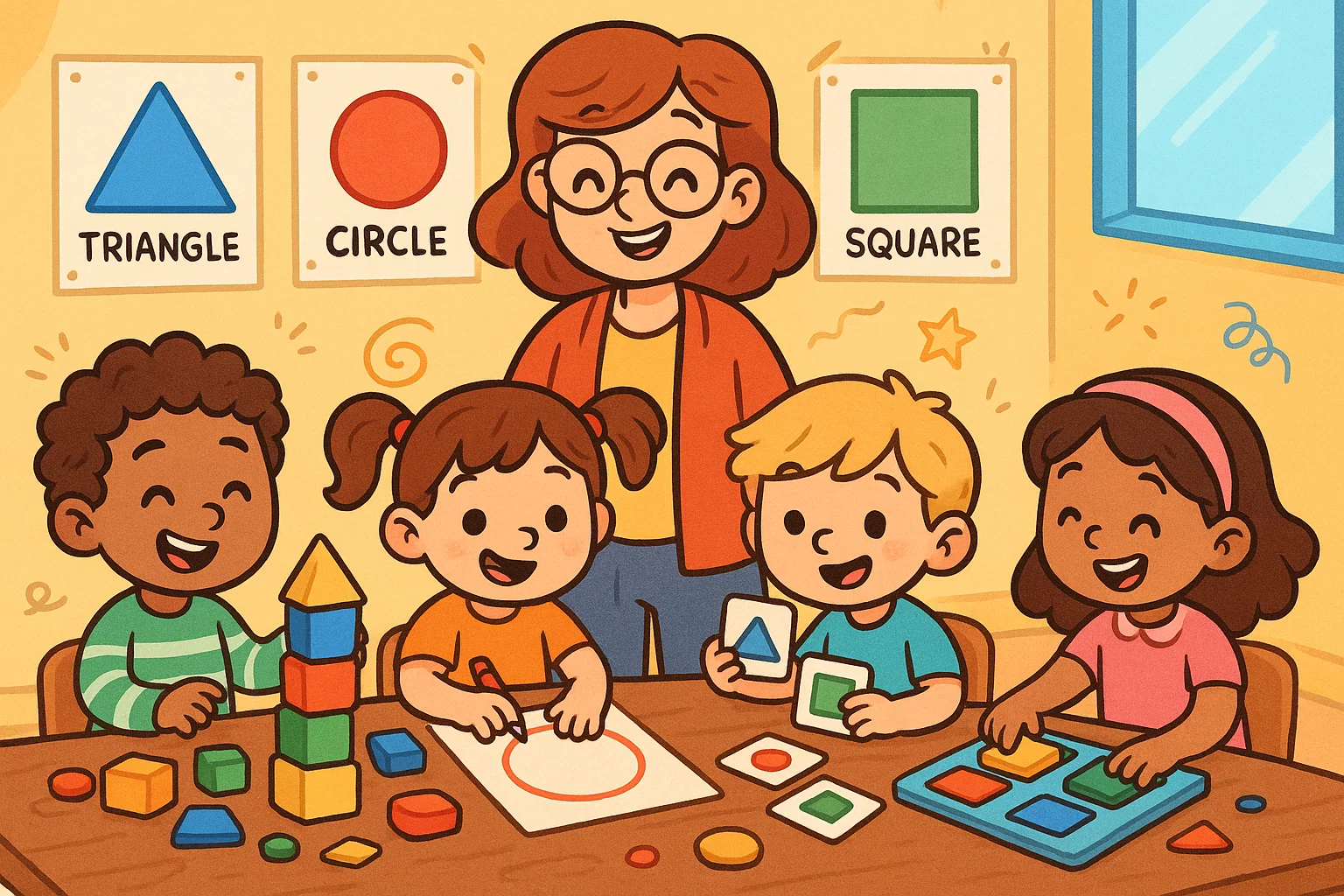
Finding the right activities for teaching shapes helps young children move from abstract ideas to hands-on understanding. This collection brings together 35 ideas for preschoolers and early learners, spanning sensory play, art projects, movement games, pretend play, and everyday real-life connections that make geometry feel natural and genuinely fun.
The article also covers foundational geometry concepts, 2D and 3D shapes, age-based adaptations, book recommendations, and practical tips for parents and educators. Whether you are planning a classroom lesson or a quick activity at home, these ideas are organized to help children recognize, name, sort, and build shapes with growing confidence.
Key Takeaways
- The article includes 35 activities for teaching shapes, covering sensory play, art, movement, pretend play, and real-life object exploration.
- Activities are designed for preschoolers and early learners and can be adapted by age for both home and classroom settings, including kindergarten and early elementary grades.
- Both 2D shapes and 3D solids are covered, along with geometry vocabulary and key attributes children should learn early.
- A dedicated section on 3D shape activities gives children hands-on ways to explore spheres, cubes, cylinders, and pyramids through building and games.
- Sensory, movement-based, and art-based sections extend learning beyond worksheets and keep young children engaged.
- Kindergarten and K–2 adaptations are included so teachers and parents can scale activities up for older early learners.
- Practical tips for parents and educators help make shape learning spontaneous, conversational, and consistently enjoyable.
Make Geometry Fun Through Play
The American Academy of Pediatrics (AAP) emphasizes the importance of play in early learning and development. When educators design preschool geometry activities as games, crafts, or movement challenges, children can explore geometric ideas in a low-pressure way. A playful geometry game creates a low-stress environment where children feel comfortable making mistakes, trying new ideas, and experimenting with spatial orientation.
Real Objects Make Geometry Easier to Recognize
Young learners need tangible reference points as they move from concrete experiences toward more abstract thinking. An effective way to introduce these concepts is to connect each one to a familiar real-world object, which helps anchor the concept in a child’s memory. Connecting flat drawings to real objects—such as recognizing that a wall clock is circular or that a tissue box is shaped like a rectangular prism—bridges the gap between early geometry and the physical world.
The Best Activities Combine Naming, Sorting, Building, and Moving
Children often learn best when physical movement is paired with thinking tasks. The most effective preschool activities invite toddlers and preschoolers to identify forms, sort items by attribute, build structures, and move through space. By combining gross motor movement with tactile exploration, these activities support memory, spatial awareness, and fine motor development.
Basic Geometry Concepts for Preschoolers
Before moving into multi-step building or craft projects, educators should establish basic vocabulary and clear geometry concepts. Preschool geometry instruction works best when it clearly separates flat 2D figures from solid 3D objects and builds children’s understanding step by step.
2D Shapes Children Should Know
Two-dimensional (2D) figures are flat forms with length and width but no depth. Early childhood curricula should initially prioritize four basic figures: circles, squares, triangles, and rectangles.
Once children can consistently identify these basic figures, educators can introduce additional forms with more complex features, including ovals, diamonds, pentagons, and hexagons. The table below outlines core 2D figures, their key attributes, and practical examples suitable for early childhood learning environments.
| 2D Figures | Key Attributes | Primary Instructional Example | Secondary Identification Feature |
| Circle | 1 continuous curved line; no corners | Wall clock, round coin | Symmetrical around its center |
| Square | 4 equal straight sides; 4 corners | Square floor tile, wooden block | All sides are equal in length |
| Triangle | 3 straight sides; 3 corners | Pizza slice, yield traffic sign | Angles can vary in size and sharpness |
| Rectangle | 4 straight sides; 4 corners | Classroom door, standard paper | Two long sides and two short sides; opposite sides are parallel |
| Oval | 1 continuous elongated curve; no corners | Chicken egg, racetrack footprint | Longer in one direction than the other |
| Diamond | 4 equal straight sides; 4 angled corners | Standard kite, playing card suit | Appears as a tilted square profile |
| Pentagon | 5 straight sides; 5 corners | Home plate in baseball, house outline | Combines a square-like base and a triangle-like roof |
| Hexagon | 6 straight sides; 6 corners | Honeycomb cell, standard hex nut | Creates interlocking honeycomb grids |
3D Solids Children Can Explore
Three-dimensional (3D) solids have length, width, and depth and take up space. Early childhood classrooms provide an ideal setting for hands-on geometry exploration with solid objects. Educators can introduce spheres with playground balls, cubes with dice, and cylinders with clean, empty soup cans.
Introducing cones with birthday party hats, rectangular prisms with cardboard shoe boxes, and pyramids with block-set pieces helps children discover how flat 2D faces can form 3D solids.
Geometric Attributes
Geometric attributes are the specific features that define a figure, such as sides, corners, curves, straight lines, faces, and edges. The National Council of Teachers of Mathematics (NCTM) emphasizes that young children should recognize, compare, sort, and analyze the attributes of two- and three-dimensional shapes.
Children learn to observe that a triangle always has three sides and three corners, whether it is a small red plastic piece or a giant green chalk drawing on the playground pavement.
Geometry Vocabulary for Kids
Using simple, precise mathematical language during play helps build a foundation for later analytical thinking. Adults can introduce simple words into daily conversations, encouraging children to use terms like side, corner, edge, face, flat, curved, and round.
During interactive block-building sessions, educators can prompt children to use action verbs such as slide, roll, stack, build, match, and sort to describe how different forms behave.
Why Early Geometry Matters
Visual recognition is a foundational skill that supports several areas of early childhood development. Understanding geometry supports visual processing, categorization, spatial reasoning, and early literacy.
Object Recognition
Early childhood development research indicates that children naturally categorize visual input to make sense of their surroundings. Hands-on practice can reinforce shape recognition and help children notice basic geometric features in everyday objects. A preschooler who can recognize shapes can more easily distinguish a rectangular street sign from a triangular yield sign, strengthening visual awareness and early visual literacy.
Spatial Reasoning and Problem-Solving
Spatial reasoning is the mental capacity to visualize, manipulate, and rotate spatial patterns and objects. Using tangrams, geometric puzzles, and building blocks encourages children to rotate and combine pieces to fit a specific outline or space. These spatial tasks help build mental-rotation skills, which research has linked to later mathematical and STEM-related learning.
Categorization Skills
Early math thinking relies heavily on a child’s ability to sort, classify, and organize information. Sorting and matching activities teach preschoolers to group objects by structural properties while ignoring features such as color, pattern, or texture. Learning to sort objects into groups based on the number of sides builds early logic and classification skills.
Counting and Pattern Skills
Geometric play offers a natural, hands-on path to early numeracy. When children engage with geometric materials, they naturally count physical attributes, such as tracking the four corners of a square or the three sides of a plastic triangle. Recognizing, repeating, and creating patterns with alternating pieces builds early patterning and sequencing skills.
Early Literacy Connections
Visual discrimination—the ability to notice subtle differences between visual symbols—is a vital prerequisite for learning to read. Written alphabet letters are essentially combinations of lines, curves, circles, and angles. For instance, a child who can distinguish a circle from an oval may more easily notice visual differences between letters such as “O” and “Q” or “b” and “d,” supporting early reading development.
Making Connections Before Geometry Activities
Before introducing formal lessons, adults can help children notice that geometry appears all around them and appear throughout daily routines.
Shapes All Around Home
The home environment offers many opportunities for practical geometry exploration because geometric forms are everywhere. Parents can point out geometry in everyday routines, identifying circular dinner plates, rectangular doors, square floor tiles, and triangular sandwich slices. Exploring the pantry reveals oval labels and cylindrical cans, helping children understand how geometric concepts appear in everyday household items.
Shapes in the Classroom
A structured early learning classroom offers many opportunities for children to identify forms and connect them with familiar classroom objects. Educators can highlight rectangular books, square tables, circular rugs, and triangular building blocks during free play. Pointing out geometric shapes on window frames, calendar cards, and student name tags helps children associate abstract geometric terms with their familiar school surroundings.
Shapes Outdoors
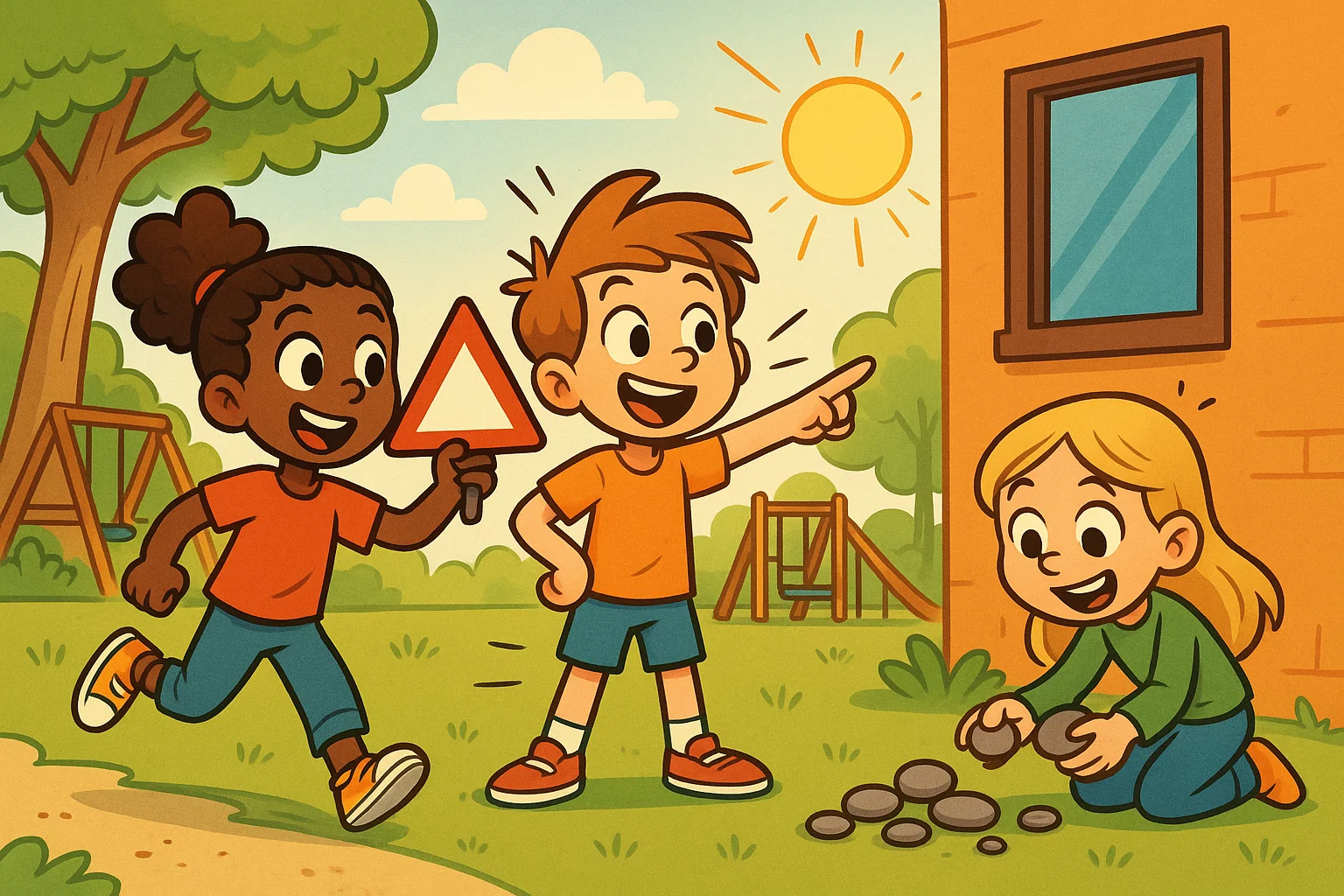
Outdoor exploration gives children a large, dynamic space for discovering geometry in the world around them. On walks or playground visits, children can spot circles in rolling bicycle wheels, triangles in fallen leaves, ovals in smooth river stones, and rectangles in building bricks. Drawing geometric forms with sidewalk chalk allows children to trace lines, create angles, and notice natural forms in flowers, tree bark patterns, and shifting shadows.
Setting the Stage for Geometry Learning
An intentional, organized learning space maximizes engagement and helps activities run smoothly.
Simple Geometry Learning Goal
Before starting an activity, educators should define a specific learning target. The instructional goal should focus on one key skill, such as naming figures, sorting by attributes, tracing lines, building 3D forms, or finding shapes in the environment. Setting a single, clear objective helps adults focus on one concept or one skill at a time, preventing toddlers and preschoolers from feeling overwhelmed by too many concepts at once.
Materials for Hands-On Practice
Hands-on activities require a variety of tactile, flexible materials that children can safely handle and reshape. Teachers should gather versatile supplies, including:
- Wooden blocks and interlocking LEGO bricks
- Flexible craft sticks and pipe cleaners
- Non-toxic play dough, geometry mats, and geometric cutters
- Bright geometry stickers and colored construction paper
- Sensory bin bases like dry rice or sand
- Common household items like toothpicks and healthy snacks
Always use age-appropriate materials, supervise young children closely, and avoid small objects or food items that may pose choking or allergy risks.
Age-Based Adaptation
Instructional tasks should match each child’s developmental stage. For toddlers, lessons should stay simple, focusing on matching identical 2D figures and sorting bright, high-contrast objects.
For older preschoolers, teachers can increase the challenge by introducing 3D solids, exploring attributes such as faces and edges, graphing simple data, and using more precise geometry vocabulary.
Literature in Math
Integrating picture books into early math lessons creates a warm, engaging transition from language arts to geometric concepts.
Geometry Books and Friendly Figure Characters
Using picture books with vibrant illustrations is an excellent way to introduce geometric ideas before hands-on play, and teachers can create simple figure characters as recurring story characters. Classic books such as Mouse Shapes by Ellen Stoll Walsh and The Shape of Me and Other Stuff by Dr. Seuss use engaging storytelling to highlight circles, squares, and triangles. These stories give children a helpful visual reference point before they begin matching and building forms on their own.
Geometry Story Time
During geometry story time, parents and teachers can turn reading from a passive activity into an interactive discussion. By pausing on a page, adults can ask children to point out hidden figures, trace outlines with their fingers, or count the sides of an illustrated object. This interactive reading style reinforces shape recognition and helps children connect story elements to basic geometry.
What Would a Figure Say?
To add a fun language twist to geometry, adults can ask children to imagine a figure’s personality and voice. Children can describe what a round circle might sound like as it rolls down a hill or what a pointy triangle might say when it bumps into a square block. This creative storytelling prompts preschoolers to describe figures using their own words, boosting both vocabulary and spatial awareness.
Make Geometry Learning Concrete
Moving geometry from flat pages to hands-on exploration helps children learn about geometry through touch, motion, and direct observation.
Touch and Trace Outlines
Tactile exploration helps children form a strong mental image of shape outlines. Educators can create tactile cards using rough sandpaper, smooth yarn, or raised play-dough outlines. Having children run their index fingers along these textured paths gives them direct physical feedback on how a circle curves smoothly without stopping, while a square has sharp, distinct corners.
Shape Building and Taking Apart
Deconstructing and rebuilding forms helps children understand exactly how figures are formed. Preschoolers can use craft sticks to build triangles, twist pipe cleaners into bright circles, or press toothpicks into play-dough balls to build sturdy cubes. Learning that they can cut or fold a large square into two smaller triangles gives children a practical look at how forms can connect and change.
Compare Shapes Side by Side
Placing different shapes next to each other helps children notice the details that define each shape. Teachers can pair a circle next to an oval, a square next to a rectangle, or a cube next to a flat square card.
Asking children to look closely and describe why a rectangle is different from a square teaches them to focus on key structural attributes rather than general appearances.
35 Hands-On Shape Activities for Kids (Preschool, Kindergarten, and Early Elementary)
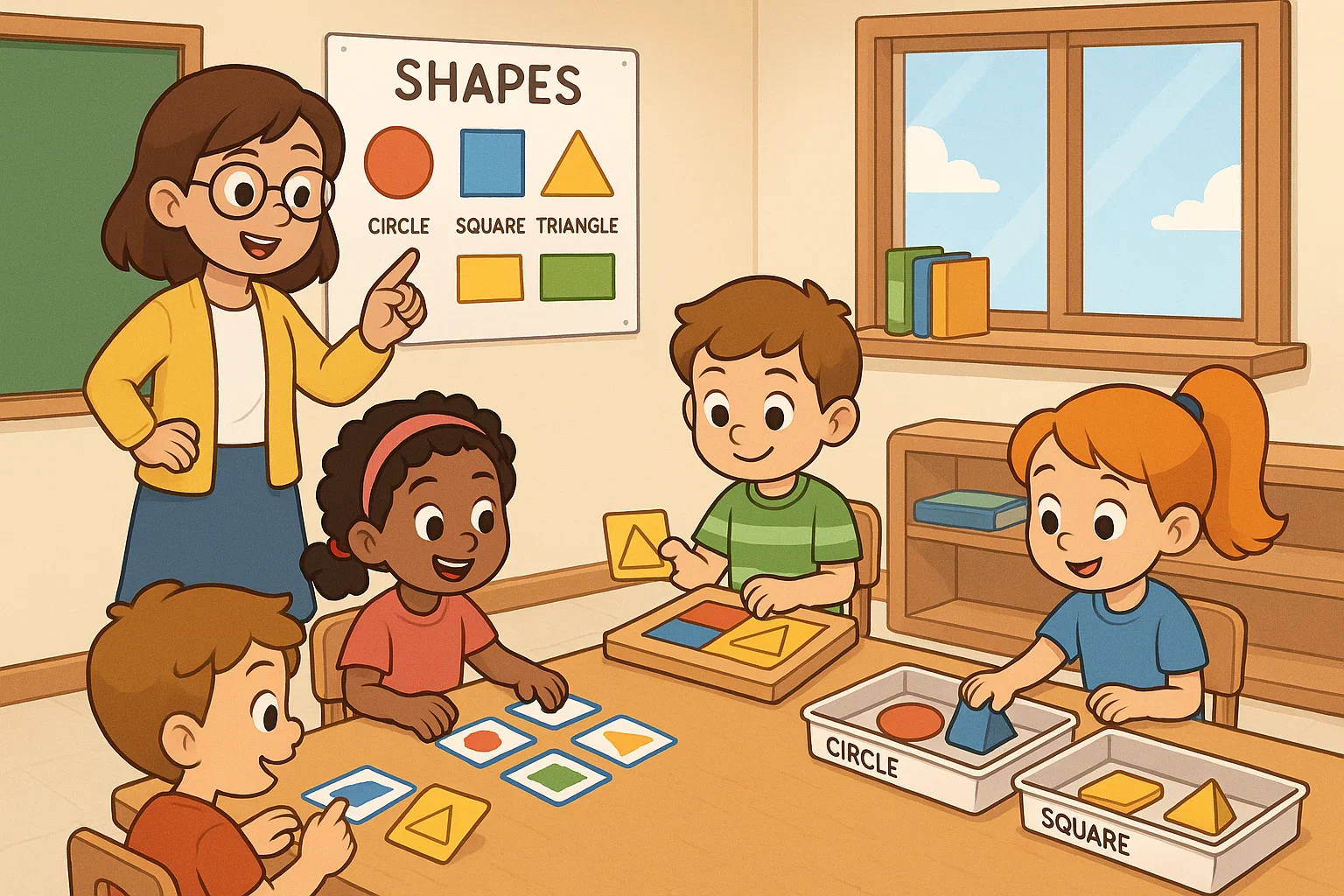
The following curated collection of engaging shape activities provides parents and educators with practical, play-based strategies to teach geometry effectively.
1. Start with a Geometry Anchor Chart
Create a large, colorful reference chart on butcher paper displaying the target geometric shapes. Write the official name clearly next to a bold drawing of each shape. Include a simple count of its sides and corners, along with drawings of familiar real-world items like a slice of cheese for a triangle or a clock for a circle.
2. Play a Shape Matching Game
Gather a mixed basket of common items like buttons, container lids, colorful plastic blocks, and foam cutouts. Provide children with sorting trays labeled with specific shapes. Ask children to examine each item, sort it into the correct tray, and ignore differences in color, texture, or size.
3. Play with Tangram Puzzles
Provide children with standard seven-piece wooden or plastic tangram sets. Guide them to arrange the triangles, square, and parallelogram to match silhouette templates of animals, houses, and people. This activity challenges children to rotate and combine smaller shapes to recreate a larger design.
4. Snack on Geometry
Turn snack time into a moment of fun and learning by serving a variety of foods in familiar shapes. Offer circular crackers, square cheese slices, triangular tortilla chips, rectangular graham crackers, and round cereal loops. Have children name each shape and count its corners before enjoying their edible shape snack.
5. Stamp with Geometric Prints
Set out shallow trays of washable paint and a variety of stamping tools, such as cut sponges, plastic blocks, bottle caps, and cardboard tubes. Show children how to dip the tools into the paint and press them onto paper. Encourage them to name each print and talk about how artists create patterns using shapes.
6. Go on a Shape Scavenger Hunt
Give children a simple clipboard and a checklist of target shapes, then lead them on a shape scavenger hunt through the classroom or home. Have them search for shapes in their everyday environment. Ask them to check off each item they find, such as a rectangular bookshelf or a circular doorknob, and record their discoveries as they go.
7. Try a Color-and-Shape Scavenger Hunt
Make the hunt more structured by giving children specific picture clues or matching cards. For example, give a child a card with a green triangle and challenge them to find an outdoor object that matches that exact shape and color. This targeted search helps kids identify shapes, compare details, and strengthen visual scanning skills.
8. Hop Along a Geometry Maze
Use painter’s tape or outdoor chalk to draw a large grid across the floor or playground pavement. Call out a specific shape name, such as “Triangle!” Ask children to find and jump onto the nearest matching shape as they move through the floor maze.
9. Build a Geometry Obstacle Course
Design a fun gross motor course that mixes physical movement with geometry recognition. Have children crawl through a circular tunnel, step carefully along the edges of a large taped square, hop between carpet triangles, and toss beanbags into a giant cardboard shape target. This active play connects spatial concepts with balance and movement.
10. Build a Shape Truck
Cut out the shapes children need, including colorful paper rectangles, circles, squares, and triangles. Challenge children to glue the pieces onto a sheet of cardstock to create a vehicle collage, such as a tractor or a delivery truck. As they work, ask them to name the pieces they used for the wheels, cab, and cargo bed.
11. Stretch Shapes on Geoboards
Give children sturdy plastic geoboards and a basket of colorful rubber bands. Show them how to stretch the bands across the pins to create clear triangles, squares, and rectangles. This hands-on activity provides excellent fine motor practice while showing how changing the bands can transform one shape into another.
12. Drive on Geometric Roads
Create large floor roads by taping lines in the shape of giant circles, triangles, and rectangles across the rug. Hand children toy cars and invite them to drive along these geometric tracks. Driving the cars along straight edges and around smooth curves helps children feel the outline of each shape.
13. Find Geometry in Nature
Take children outside to explore geometry in the natural world. Help them search for circular flower centers, triangle-shaped leaves, oval river stones, and spiral snail shells. This outdoor search encourages children to see geometric patterns in nature and the environment around them.
14. Build Craft Stick Shapes
Provide children with a bundle of wooden craft sticks and small drops of washable glue or hook-and-loop dots. Show them how to line up three sticks to make a triangle, four sticks for a square, or six sticks to form a hexagon. This simple activity for preschoolers helps children understand how straight sides can form closed shapes.
15. Blow 3D Geometry Bubbles
Help children twist flexible pipe cleaners or plastic straws into sturdy 3D frames, like a cube or a pyramid. Dip these structural frames into a shallow tray of bubble solution. When children lift the frames and blow, they can observe how the thin bubble film stretches across the frame and forms interesting surfaces.
16. Prep Shape Pizza
Cut out a large brown paper circle to serve as a pizza crust, along with red paper circles for sauce and yellow paper strips for cheese. Provide various toppings cut into shapes, such as square ham pieces and triangular pieces of pepperoni. Have children assemble their paper pizza while discussing the toppings and how familiar food can make learning shapes memorable.
17. Try Shape Play Dough with Toothpicks
Give children small balls of non-toxic play dough and a box of sturdy wooden toothpicks. Show them how to use the play-dough balls as corner joints and the toothpicks as straight sides. This tactile building task allows preschoolers to construct flat 2D shapes and then build upward into 3D cubes and pyramids.
18. Outline Shapes with Stickers
Draw large, bold outlines of target shapes on sheets of cardstock. Hand children sheets of colorful stickers and instruct them to peel and place the stickers directly along the drawn lines. This steady tracking activity reinforces shape outlines while strengthening fine motor control and hand-eye coordination.
19. Lace Geometric Cards
Create durable lacing cards by cutting thick cardboard into various geometric shapes and punching clean holes along the borders. Give children colorful yarn with taped tips and show them how to weave the yarn through the holes. This sewing activity keeps children focused on each shape’s perimeter and corners.
20. Make Geometry with LEGO Bricks
Challenge children to use standard interlocking LEGO bricks to build geometric outlines or solid structures on a baseplate. Ask them to build a square wall, a long rectangular tower, or a stepped triangular pyramid. This block play turns shape building into a practical exercise in spatial planning and fine motor adjustments.
21. Categorize Shapes by Attributes
Set up an advanced sorting station where children sort blocks based on specific geometric attributes rather than simple names. Have them separate shapes into groups that can roll versus those that slide, or flat 2D cards versus solid 3D blocks. This analytical sort deepens their understanding of structural characteristics.
22. Play Shape Bingo and Graph Finds
After children complete a shape hunt or a quick round of shape bingo, have them bring their checklists to a central table. Guide them to count the total number found for each category and fill in a simple bar graph using colorful square stickers. This task introduces early data collection, counting, and basic graphing concepts.
23. Create a Shape Monster
Provide an assortment of precut paper shapes in various sizes and colors. Invite children to design an imaginative monster by gluing a large rectangle for the body, triangles for sharp teeth, circles for eyes, and diamonds for horns. This creative art project gives children plenty of engaging shape practice as they experiment freely with paper pieces.
24. Feed the Geometry Monster
Decorate three or four empty shoe boxes to look like friendly monsters, cutting a distinct geometric mouth into each one, such as a circle, square, or triangle mouth. Give children cards or plastic objects in various shapes. Challenge them to “feed” each object into the monster box with the matching geometric mouth, turning classification into a fun way to learn.
25. Sift Through Rice for Hidden Shapes
Fill a large sensory bin with dry white rice or clean sand, and bury a variety of colorful plastic or foam shapes inside. Give children scoops, cups, and small sifters. Invite them to dig through the bin, find the hidden shapes, name each discovery, and sort them into matching trays nearby.
26. Craft an Ice Cream Cone
Cut out brown paper triangles to look like waffle cones, along with colorful paper circles for ice cream scoops, red ovals for cherries, and tiny rectangles for sprinkles. Have children build their own custom ice cream cone by stacking the pieces, reinforcing geometry terms through a fun, familiar theme.
27. Piece Together Geometry Puzzles
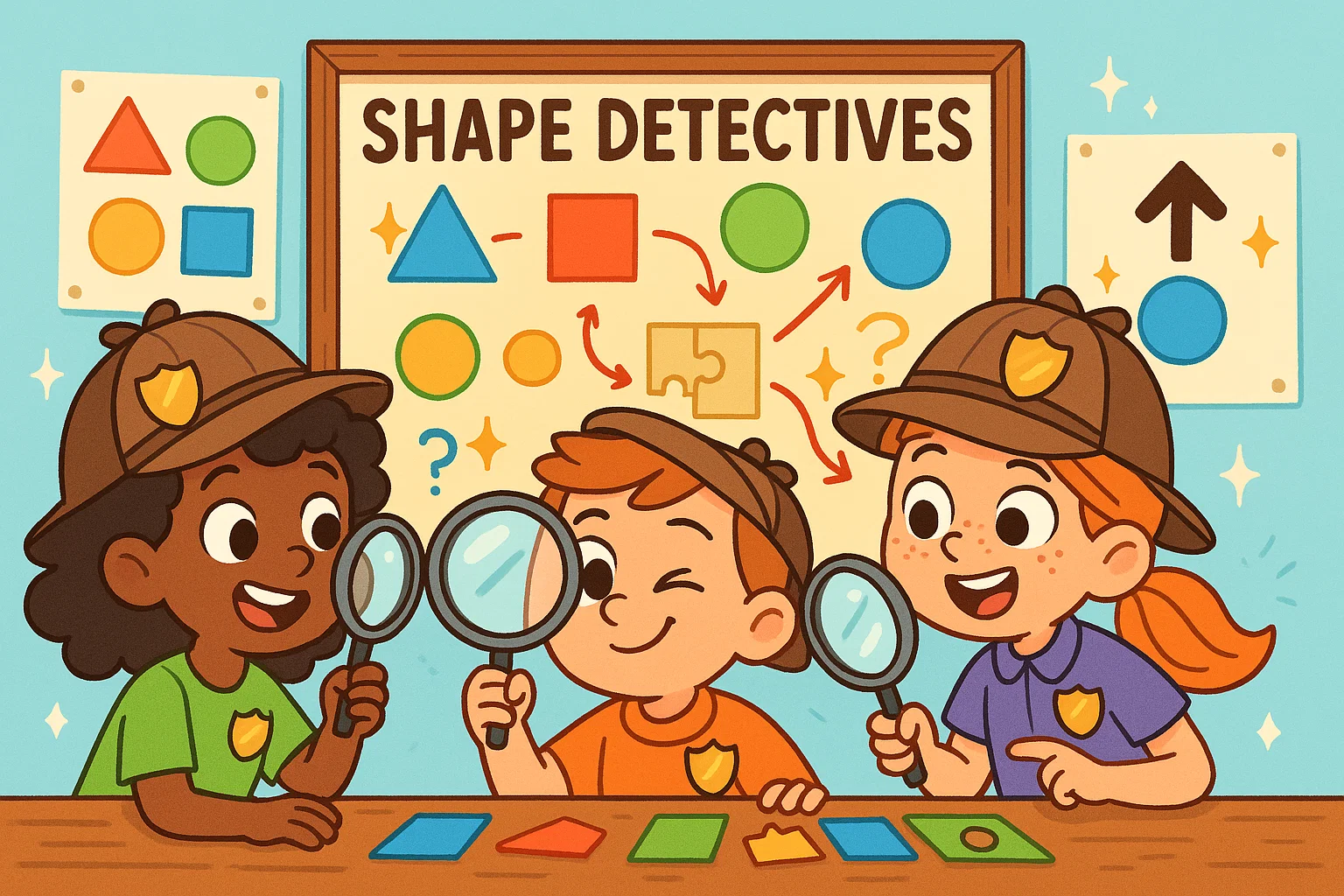
Provide children with high-quality wooden shape puzzles, tangram challenge cards, or homemade puzzles made by cutting old calendar pictures into geometric pieces. Solving these puzzles encourages children to mentally rotate and physically adjust the pieces, building spatial awareness and problem-solving skills.
28. Make Shape Cookies
Roll out a batch of cookie dough and give children a variety of geometric cookie cutters. Have them press out circles, squares, triangles, rectangles, stars, and hearts. Before baking, guide them to compare the sides and sizes of the cookies. Enjoying the warm cookies creates a memorable connection between math and daily life.
29. Create a Paper Geometry Cityscape
Provide a large sheet of black construction paper along with various precut brightly colored geometric shapes. Show children how to layer tall rectangles for skyscrapers, squares for windows, triangles for roofs, and circles for yellow streetlights. This project helps children see shapes as building blocks for streets, windows, roofs, and city designs.
30. Paint Kandinsky Concentric Circles
Show children a Kandinsky-inspired artwork featuring concentric circles. Give them watercolor paints and heavy paper, and guide them to paint a grid of squares, then paint smaller and smaller circles nested inside each one. This activity combines art history with size comparison.
31. Make an Overlapping Shape Art Activity
Have children use white crayons or painter’s tape to create overlapping squares, triangles, and circles on thick paper. Instruct them to paint over the entire sheet with watercolor paints. When the paint dries, guide them to look closely at the new spaces created where the original shapes intersect.
32. Build Geometric Scenes
Provide an open-ended selection of cut-out shapes and challenge children to build a complete scene, such as an underwater ocean view or a deep space landscape. A child might use an oval for a rocket body and triangles for fins. This activity helps children see how complex pictures and objects can be built from simple shapes.
33. Create Geometry Collage Art
Set out a basket of mixed materials, including old magazine cutouts, patterned fabric scraps, colored foam sheets, and textured corrugated cardboard cut into various shapes. Allow children to freely select and glue these pieces onto cardstock, creating an open-ended collage that celebrates diverse shapes and textures.
34. Make Giant Geometry Art
Spread a long roll of white butcher paper across the floor and draw large geometric shapes using thick black markers. Invite children to walk carefully along the borders, fill the shapes with colorful stamps, or arrange plastic blocks inside the lines. This large-scale play supports gross motor development and visual tracking.
35. Make Spaghetti Shapes
Cook a batch of spaghetti noodles and let them cool, or use pieces of colorful yarn or string. Place the flexible strands on plastic trays and show children how to curve and bend them to form circles, ovals, and rectangles. This sensory activity helps children explore lines, curves, and borders.
Sensory Shape Activities
Sensory play offers calming, engaging ways for children to explore shapes through touch and sight.
Tactile Shape Matching
Texture-based activities provide children with distinct tactile feedback that helps them remember geometric boundaries. Educators can set up a tactile matching station featuring shapes cut from rough sandpaper, soft felt, smooth plastic, bumpy corrugated cardboard, and shiny metallic foil.
Matching a rough sandpaper triangle to a smooth plastic triangle helps children focus on shape attributes rather than color or texture.
Rainbow Rock Geometry
Gather smooth, flat river stones and paint bright geometric shapes onto their surfaces using outdoor acrylic paint. Alternatively, children can arrange unpainted stones into large circles, triangles, or rectangles directly on the grass. This calming activity combines natural outdoor textures with pattern-making and helps children create geometric paths with simple, real-world materials.
Hook-and-Loop Geometry
Construct a durable, reusable sorting board by attaching strips of hook-and-loop tape to a sturdy felt display board. Cut out a matching set of colorful foam shapes with hook-and-loop backing. Preschoolers can independently sort, match, and stack these pieces at a quiet learning station, enjoying the satisfying pull of the hook-and-loop pieces as they rearrange the shapes.
Movement-Based Shape Activities
Kinesthetic learning helps preschoolers explore spatial concepts through gross motor movement, balance, and physical coordination.
Geometry Yoga
Children can use their bodies to form physical shapes during group movement sessions. Guide them to stretch their arms wide to form a circle, bend at the waist to create a triangle, or work with a partner to make a long rectangle with their bodies. This active play connects balance and body awareness with geometry vocabulary.
Move with a Ball
Set up large cardboard boxes decorated with clear geometric targets across the playground. Give children lightweight playground balls and ask them to roll, bounce, or toss a ball into a specific target, such as the square bin. Combining physical coordination with quick shape identification keeps children active while reinforcing geometry skills.
Shape Balloon Fun
Inflate a collection of colorful latex-free balloons and draw clear geometric shapes on them with a dark marker. Toss the balloons into the air and challenge children to keep them afloat by tapping them toward matching targets drawn on the floor. This fast-paced game builds visual tracking, physical agility, and quick shape recognition.
Art-Based Shape Activities
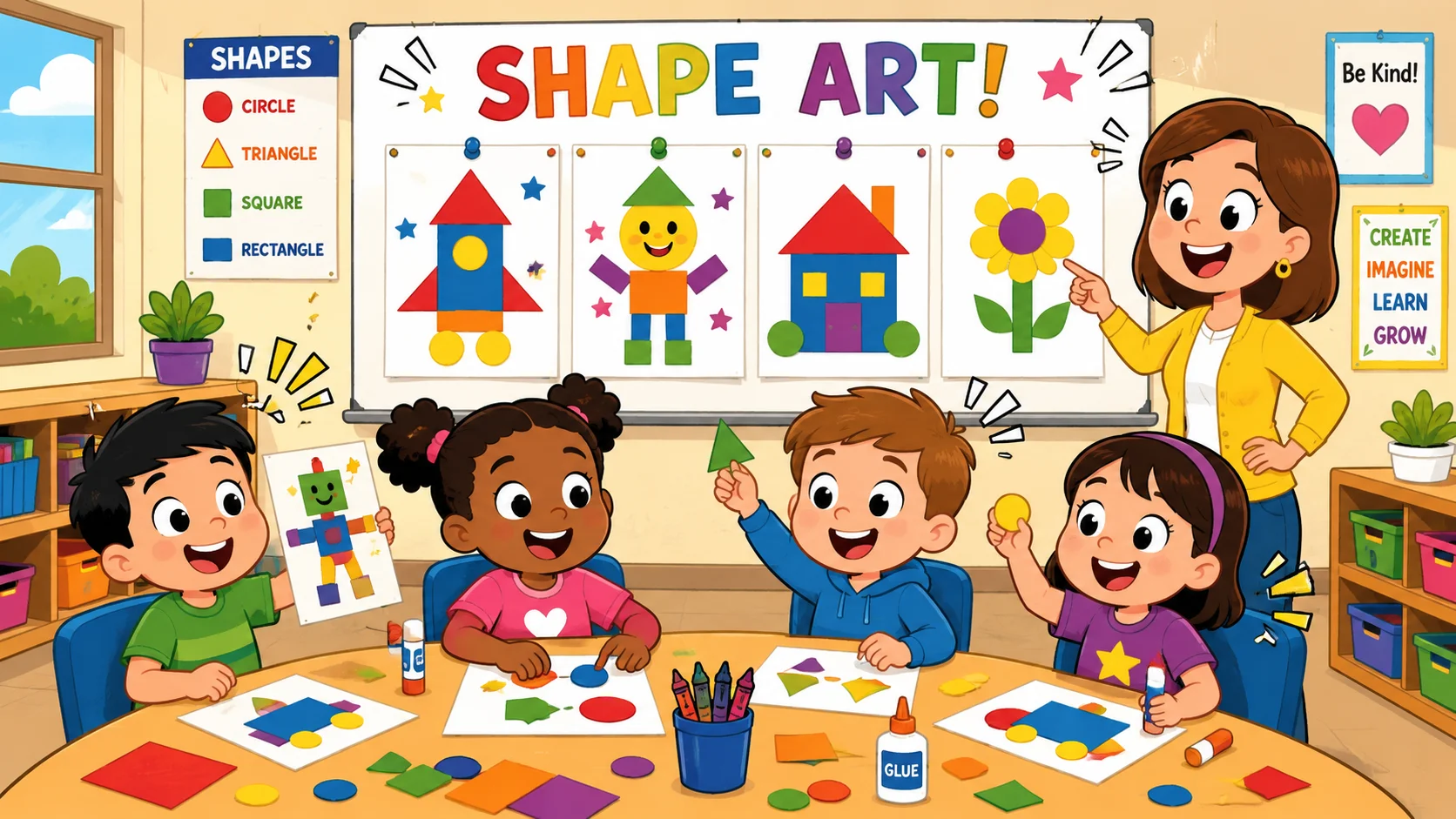
Art projects provide an expressive, open-ended outlet for children to explore how many shapes combine to create patterns and images.
Sponge Painting with Geometric Prints
Cut standard household sponges into distinct geometric shapes like circles, triangles, and rectangles. Provide shallow plates of washable tempera paint and large sheets of heavy paper. As children dip the sponges and print them across the page, they can observe the clear geometric textures and practice naming each shape they print.
Block Painting
Invite children to dip standard wooden or plastic building blocks directly into trays of washable paint and press them onto paper. Children can discover that a solid 3D triangular prism prints a flat 2D triangle, while a cylinder block leaves a circular print. This art project provides a clear visual link between 2D faces and 3D solids.
Geometry Sorting Suncatchers
Cut out a large geometric frame from dark cardstock and seal it with a sheet of clear contact paper. Provide a tray of colorful translucent tissue paper pieces.
Have children press the tissue pieces onto the sticky paper, sorting them by color or shape. Hanging the finished suncatcher in a sunny window creates a beautiful display of glowing geometric patterns.
Shape Silhouette Prints for Elementary Students
This project works especially well for kindergarten through third grade. Give students a sheet of heavy white paper and ask them to arrange geometric foam or cardboard cutouts across the page, then trace around each one with a pencil. Students paint inside each traced outline with a contrasting watercolor wash, let it dry, and then outline the edges with a black marker. The finished prints make a strong classroom display and open a conversation about how artists use geometric forms as the foundation for more complex compositions.
Torn-Paper Geometric Mosaic
Torn-paper mosaics are a low-prep art lesson that suits kindergarten through early elementary classrooms. Have students tear colored construction paper into small irregular pieces, then arrange and glue them inside large geometric outlines drawn on cardstock — filling a triangle with warm colors, a circle with cool colors, and a rectangle with a pattern of their choice. This project reinforces shape recognition, color theory, and fine motor control at the same time, making it a practical choice for art lessons that connect math and creative expression.
Pretend Play Shape Activities
Imaginative play allows children to apply their geometry knowledge to creative stories, roles, and adventures.
Geometry Treasure Map
Design a simple treasure map filled with geometric landmarks, such as “Triangle Mountain” or “Square Rug Island.” Hand children a cardboard telescope and guide them to follow the shape clues to find a hidden basket of toys. This adventure game builds early map-reading and spatial-navigation skills.
Geometry Monster Game
In this imaginative group game, one child puts on a playful “Geometry Monster” crown and calls out a shape name, such as “Circle!” The other children must quickly find and stand on a circle taped to the floor before the monster gently tags them in a safe, age-appropriate way. This active game combines dramatic play with fast visual scanning and shape identification.
Geometry Cooking Adventure
Set up a pretend-play kitchen with plastic play-dough knives, rolling pins, and geometric cutters. Invite children to act as bakers and prepare geometric recipes, such as rolling out a square pizza or baking circle-shaped cookies. This imaginative play allows preschoolers to practice geometry terms while acting out familiar routines.
Shape Activities Using Real-Life Objects
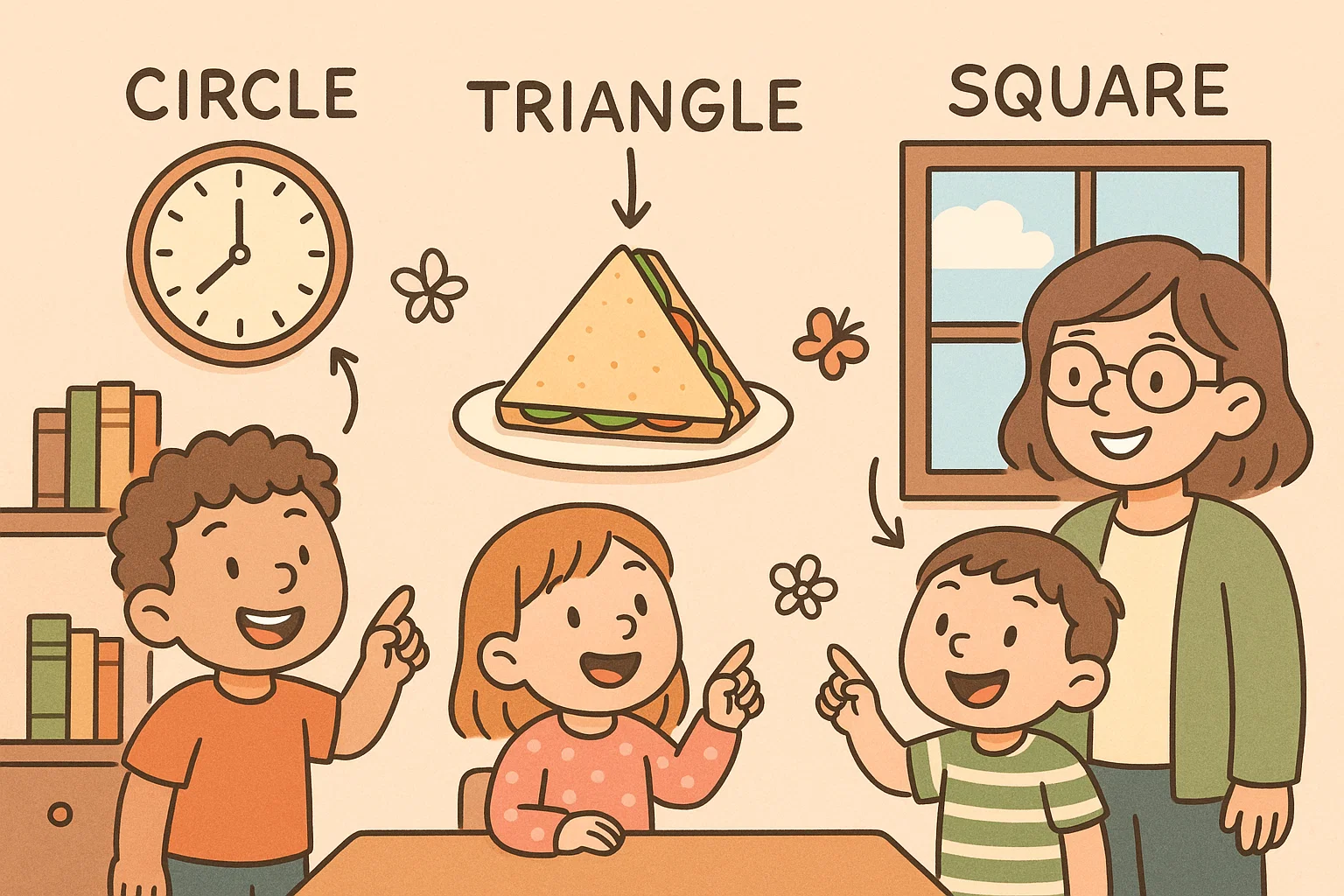
Using common, everyday items for geometry practice shows children that shapes in daily routines are a natural part of the world around them.
Home Object Sorting
Parents can set up a low-prep sorting game using safe, common household items. Gather everyday objects like plastic storage lids, small cardboard boxes, books, round drink coasters, and cloth napkins. Have children sort these household items into matching baskets, showing how everyday objects connect directly to shape learning at home.
Classroom Object Match
Give children a small stack of geometry cards and challenge them to find matching items around the classroom. A child can place a rectangle card next to a book or a circle card on a clock, then explain to the group why the match works. This interactive matching task builds confidence and encourages clear mathematical communication.
Outdoor Geometry Search
Turn outdoor play into a fun shape search on sidewalks, playgrounds, and in park gardens. Guide children to spot rectangles in brick walls, circles in playground steering wheels, triangles in caution signs, and cylinders in support posts. This outdoor walk helps children realize that geometry is part of the architecture and design of the wider world.
Tips for Parents and Educators
Guiding young children through early geometry works best when adults keep activities positive, encouraging, and responsive to each child’s needs.
Embrace Spontaneity and Fun
The most memorable learning moments often happen naturally during daily routines rather than during structured lessons. Adults can casually point out shapes during walks, family meals, grocery store trips, or cleanup time, reminding children that shapes around them are worth noticing. Noticing that a stop sign is an octagon keeps geometry fresh, relevant, and fun for young minds.
Encourage Shape-Making
Provide children with regular opportunities to build and create shapes using a variety of creative methods. Invite them to form shapes using their own bodies, arrange fallen sticks in the yard, stack wooden blocks, or draw lines in shaving cream.
Giving children the freedom to create shapes with different materials builds spatial confidence and encourages creative problem-solving.
Extend Conversation
When a child points out a shape, adults can ask open-ended questions to deepen the child’s understanding. Try prompting children with questions like:
- “What specific shape do you see there?”
- “How many straight sides can you count on that object?”
- “Can you find another shape nearby that matches this one?”
These gentle prompts encourage children to analyze attributes and practice using geometric vocabulary.
Keep Practice Short
Toddlers and preschoolers usually learn best through short, playful interactions rather than long, repetitive drills. Keep shape activities brief, engaging, and lighthearted, switching to a new activity when a child shows signs of fatigue.
Short, positive sessions protect a child’s natural curiosity and build a lasting love for learning.
3D Shape Activities for Preschoolers and Kindergarteners
Three-dimensional shapes are all around children every day, and hands-on 3D activities help young learners move beyond flat pictures to understand how solid forms have faces, edges, and depth. The activities below are suitable for preschool through kindergarten and can be extended for early elementary students.
Build 3D Shapes with Marshmallows and Toothpicks
Give children mini marshmallows and sturdy toothpicks and challenge them to build a cube, a pyramid, or a rectangular prism. The marshmallows act as corner joints and the toothpicks form the edges, making the structure of each solid visible and tangible. As children build, count the edges and corners together and compare how a cube differs from a pyramid. Always supervise closely and check for allergy considerations before using food materials.
3D Shape Sorting Game
Collect a set of everyday 3D objects — a ball (sphere), a soup can (cylinder), a tissue box (rectangular prism), a party hat (cone), and a die (cube). Label four or five baskets or trays with the name and a simple drawing of each solid. Have children pick up each object, feel its faces and edges, name the solid, and place it in the correct basket. For kindergarteners, extend the game by asking which solids can roll, which can stack, and which can do both.
How to Make 3D Shapes from Nets
A net is a flat pattern that folds up into a 3D solid — a great hands-on discovery for kindergarten and early elementary students. Print or draw simple nets for a cube and a rectangular prism on cardstock. Have children cut along the outer edges, fold along the inner lines, and tape the tabs together to form the solid. Seeing a flat sheet transform into a box helps children understand the relationship between 2D faces and 3D forms, and it directly answers the common question of how to make 3D shapes at home or in the classroom.
3D Shape Hunt Indoors and Outdoors
Give children a simple checklist with pictures of a sphere, cube, cylinder, cone, and rectangular prism. Send them on a hunt through the classroom, home, or playground to find one real object that matches each solid. A basketball matches a sphere, a paper towel roll matches a cylinder, and a cereal box matches a rectangular prism. Recording their finds on the checklist adds an early data-collection element and makes the activity easy to discuss as a group afterward.
Shape Activities for Kindergarten and Early Elementary
Many of the 35 activities above work beautifully for preschoolers, but kindergarten and early elementary students are ready for a bit more challenge. The ideas below adapt core shape concepts for K–2 learners, connecting geometry to early math standards and creative projects that keep older children engaged.
Geometry Journals for Kindergarten
Give each child a small blank notebook to use as a geometry journal. Each day, students draw one shape, label it, write or dictate one fact about it (such as “A triangle has 3 sides”), and sketch a real-world object that matches. Over a week, the journal becomes a personal reference book that children can revisit and share with families. This routine builds geometry vocabulary and early writing skills at the same time.
Shape Attribute Sorting for First and Second Grade
First and second graders can sort shapes by multiple attributes at once — number of sides, number of corners, presence of right angles, or whether sides are equal. Set up a Venn diagram on the floor using two hula hoops and give students a set of shape cards. Ask them to sort by two rules simultaneously, such as “four sides” and “all sides equal,” and discuss which shapes belong in the overlapping section. This analytical task builds early logic skills and connects directly to first-grade math standards.
Shape Art Projects for Third Grade
Third graders can explore how geometric shapes combine to create art in the style of abstract artists. Challenge students to create a composition using only triangles, rectangles, and circles cut from colored paper, then write two or three sentences describing the shapes they used and why they arranged them that way. This project connects math, art, and writing — making it a practical choice for cross-curricular lessons and a strong option for easy third-grade art projects that still carry meaningful learning goals.
Frequently Asked Questions About Learning Shapes Activities
How Do You Teach Shapes in Preschool?
Preschool shape instruction is most effective when it uses hands-on, play-based methods rather than relying only on worksheets or flashcards. Teachers can introduce geometry through picture books, shape matching games, tactile sorting trays, and active hunts. Combining physical movement with real-world objects helps children build a strong, lasting understanding of geometric concepts.
What Shape Concepts Should Preschoolers Know?
Preschoolers should focus on naming, matching, and sorting basic 2D shapes like circles, squares, triangles, and rectangles. As they grow more confident, they can explore more complex shapes such as ovals, diamonds, and hexagons, along with basic 3D solids such as spheres and cubes. Learning to count sides and corners helps them understand the key attributes that define each shape.
How Do You Make Shapes Interesting?
You can make learning shapes fun by weaving recognition practice into a variety of engaging, multisensory activities. Try serving shaped snacks, setting up sensory bins filled with hidden blocks, designing active floor mazes, or planning outdoor treasure hunts. Connecting geometric concepts to art projects and imaginative play keeps lessons fresh and interesting for young learners.
Which Shapes Should Kids Learn First?
Children usually start by learning four basic shapes: the circle, square, triangle, and rectangle. These shapes have distinct structural differences that make them easy for toddlers and preschoolers to tell apart. Once a child can easily identify these core shapes, educators can introduce more complex forms such as ovals, diamonds, stars, hearts, and basic 3D solids.
How Can Parents Practice Shapes at Home?
Parents can easily practice geometry at home by pointing out shapes during everyday family routines. Look for circles on dinner plates, rectangles on doors, and squares on floor tiles during meals or cleanup. Reading geometry books together, drawing outlines with sidewalk chalk, or sorting household items like container lids makes geometry a natural, stress-free part of family life.

Take a short quiz to find out what your everyday choices say about your parenting style
When your child is curious about something new, what’s your instinct?
Take a short quiz to find out what your everyday choices say about your parenting style
“Can I download this app?” What happens next?
Take a short quiz to find out what your everyday choices say about your parenting style
When it comes to rules at home, which sounds most like you?
Take a short quiz to find out what your everyday choices say about your parenting style
If you could give your child one life skill today, what would you pick?
Take a short quiz to find out what your everyday choices say about your parenting style
Your child gets to choose what to watch. What would your ideal setup look like?
Take a short quiz to find out what your everyday choices say about your parenting style
Pick your parenting superpower ✨



