5 Topics of Simple Science Questions and Answers for Kids

 Discover a Free Education Video App for Kids
Pastory uses AI to personalize educational video content based on your child’s interests and personality. Safe, engaging, and built for curious young minds. Sign up now to stay updated and enjoy early access with a free trial
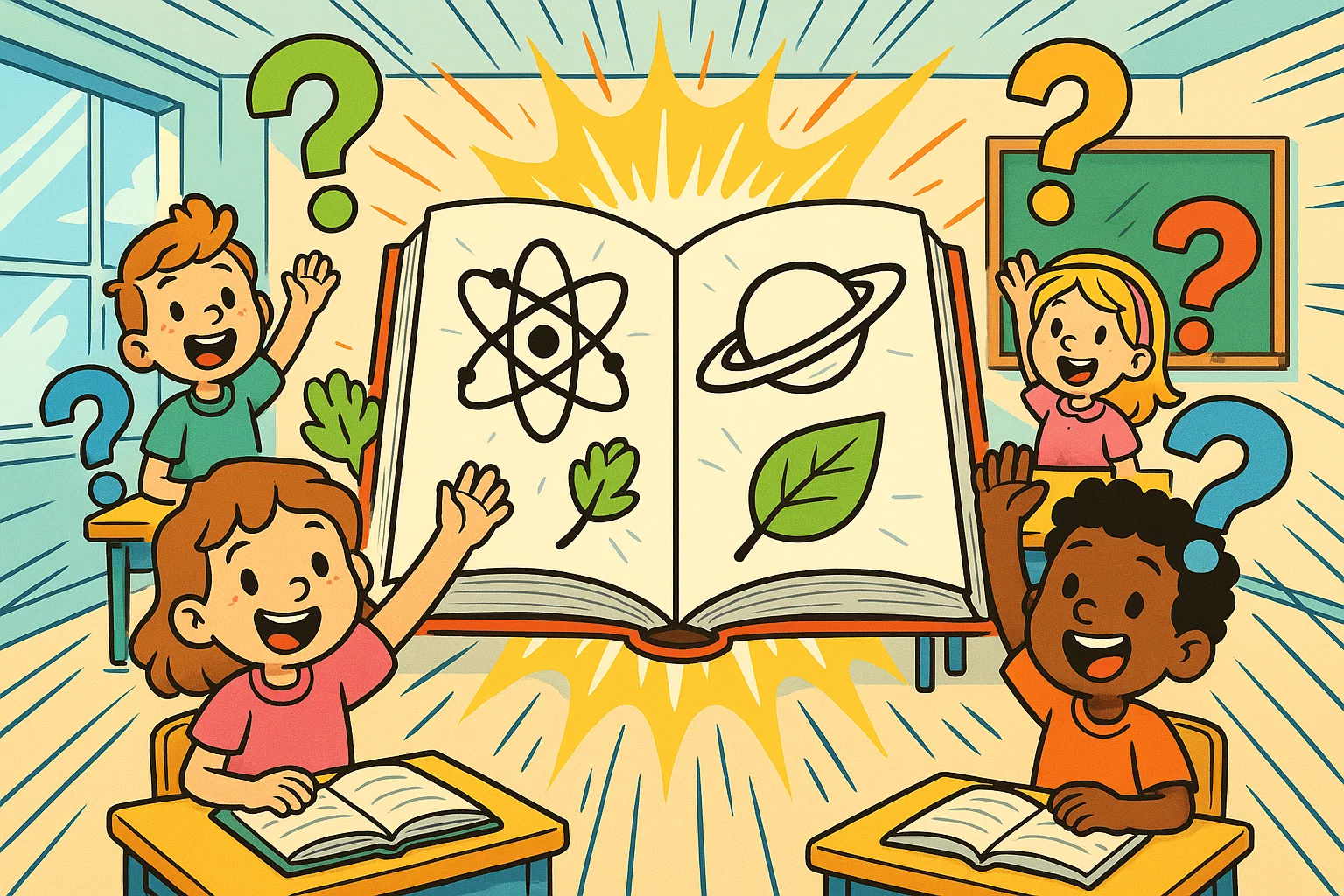
Simple science questions and answers give kids a clear, confidence-building way to explore the world around them. This article covers easy questions across biology, chemistry, astronomy, earth science, and physics, organized by topic and difficulty level to suit learners from preschool through middle school.
Whether you need a quick home quiz, a classroom activity, or a fun review session, every question here is age-appropriate and paired with a straightforward answer that makes science feel accessible and enjoyable for young learners.
Key Takeaways
- The article organizes simple science questions and answers across five core subjects: biology, chemistry, astronomy, earth science, and physics.
- Questions are grouped by topic and difficulty level, covering preschool through middle school.
- Each subject includes focused subtopics such as the human body, planets, weather, and motion.
- Practical tips help make science quizzes more engaging through games, visual aids, and student-created questions.
- A resources section links science questions to cross-curricular learning and educational tools.
Fun science quiz for kids
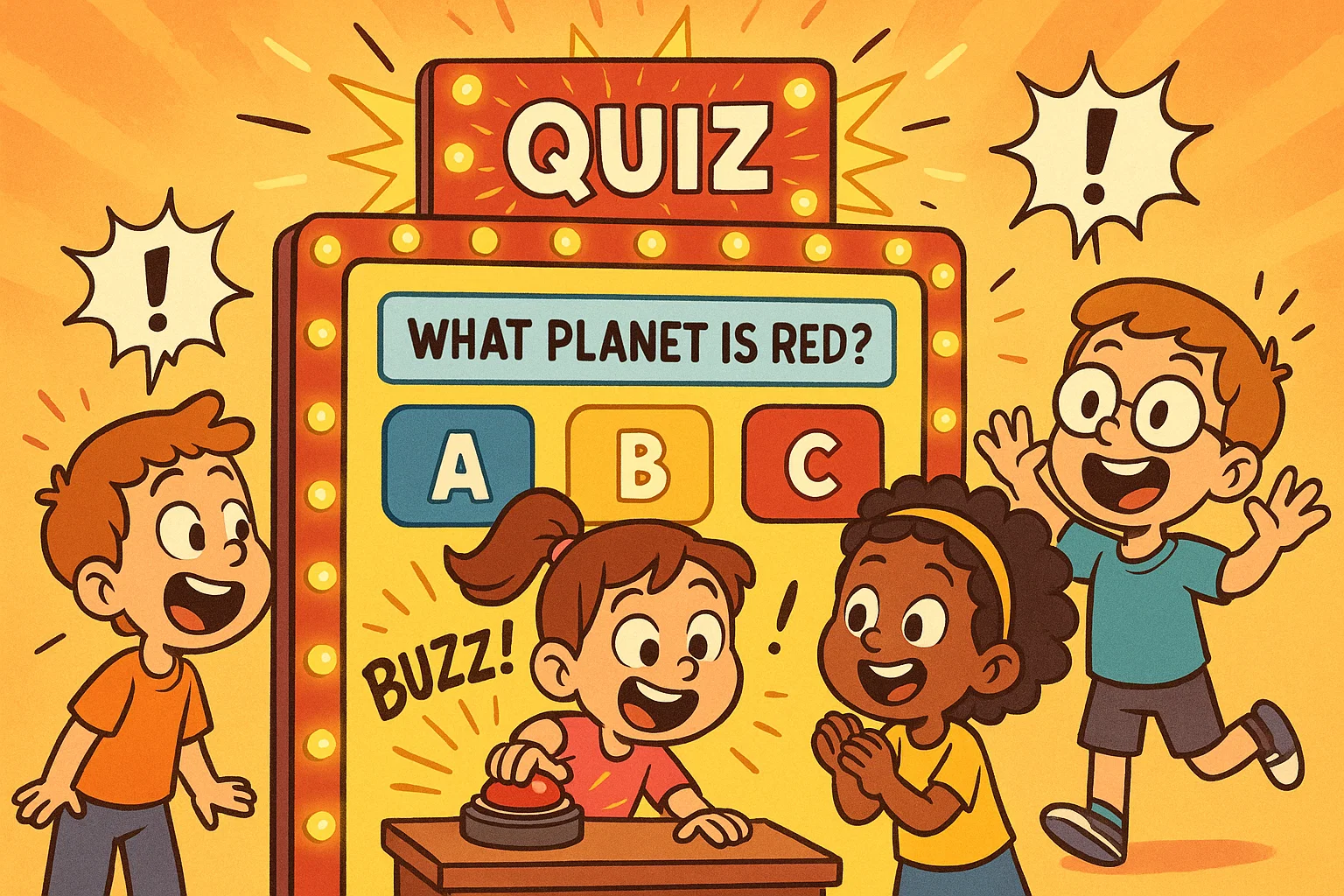
A well-designed science quiz transforms complex concepts into bite-sized, digestible information. Science trivia helps break down barriers by presenting scientific concepts as exciting puzzles to solve rather than intimidating subjects.
Studies in cognitive psychology show that students who engage in regular low-stakes quizzing—an example of retrieval practice—can retain up to 50% more information than those who only review content. When children engage with fun questions about nature, they develop critical thinking skills while exploring topics from the human body to our solar system.
Why science quizzes are great for learning
Science trivia questions for kids offer multiple benefits:
- Memory enhancement – Active participation creates stronger neural pathways
- Problem-solving development – Children process information and make connections
- Immediate feedback – Quiz answers provide instant understanding
- Confidence building – Success with easier questions builds academic self-esteem
How to use science questions at home and in school
Successful implementation strategies:
Classroom applications
- Warm-up activities before lessons
- Transition tools between subjects
- Comprehensive review sessions
Home learning opportunities
- Car ride discussions about photosynthesis
- Dinner conversations about chemical symbols
- Bedtime questions about space and planets
Interactive approaches
- Encourage predictions before revealing answers
- Draw diagrams to illustrate concepts
- Conduct simple experiments demonstrating principles
Best topics for simple science questions
The most effective topics connect to children’s daily experiences:
- Human body – How many bones we have, heart function, senses
- Space science – Planets like Jupiter and Venus, black holes
- Biology – Why leaves change color, animal adaptations, photosynthesis
- Chemistry – Carbon dioxide, water states, everyday reactions
Easy biology questions for kids 🌱
Biology offers endless opportunities for engaging young minds through observable, interactive concepts.
Human body questions
Popular questions about our bodies:
Q: How many bones does an adult human have? A: An adult human has 206 bones, but babies start with about 270 that fuse together.
Q: Which organ filters waste from the blood? A: The kidneys remove waste from the blood, cleaning about 50 gallons daily.
Q: What’s the largest organ in the human body? A: The skin, covering about 20 square feet in adults.
Animal and plant life questions
Nature-focused questions:
Q: What’s the largest animal on Earth? A: The blue whale, reaching lengths of 100 feet.
Q: How do plants make food? A: Through photosynthesis, using sunlight, water, and carbon dioxide.
Q: Which shark is the largest? A: The whale shark, but it only eats tiny plankton.
Easy chemistry questions for kids
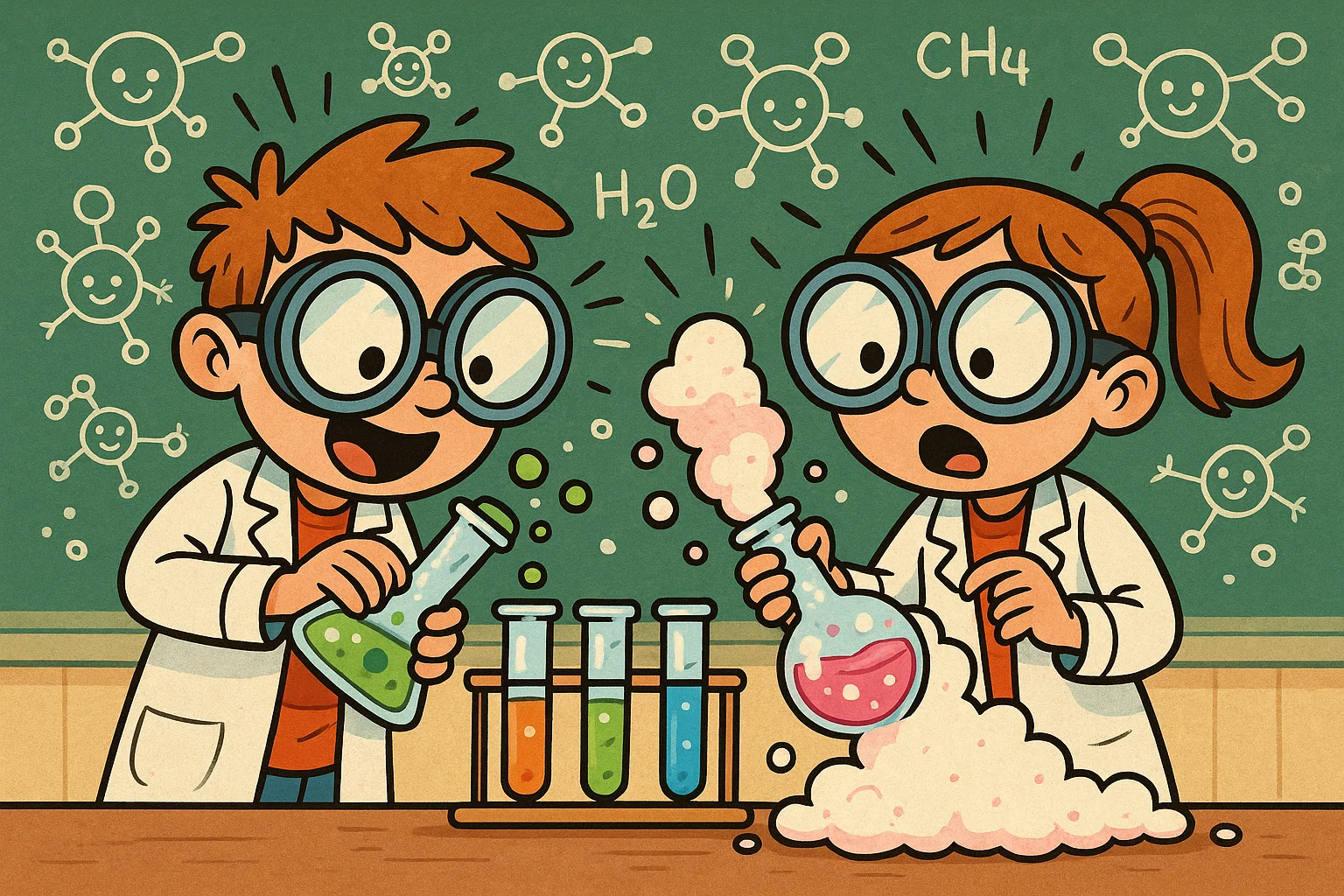
Chemistry is everywhere – in cooking, cleaning, and even breathing. Understanding basic chemical symbols and reactions helps children recognize science in daily life.
Questions about elements and symbols
Essential chemistry concepts:
- Water formula: H₂O (two hydrogen, one oxygen)
- Carbon dioxide: CO₂, what we exhale and plants need
- Gold symbol: Au, from Latin “aurum”
- Air composition: 78% nitrogen, 21% oxygen
Chemistry in everyday life
Real-world applications:
- Baking soda + vinegar = carbon dioxide bubbles
- Bread rising = yeast producing gas bubbles
- Soap cleaning = molecules grabbing dirt and oil
- Water boiling = liquid changing to gas at 212°F (100°C)
Easy astronomy questions for kids 🌟
Astronomy captures imagination like few subjects can. From our local solar system to distant galaxies, space science offers endless wonder.
Questions about planets
Solar system fundamentals:
Q: Which planet in our solar system is closest to the Sun? A: Mercury completes its orbit in just 88 Earth days.
Q: Why is Venus called Earth’s twin? A: Similar size but much hotter due to the thick atmosphere.
Q: What makes Jupiter special? A: Largest planet with a red spot storm bigger than Earth.
Q: Which planet has beautiful rings? A: Saturn has spectacular rings made of ice and rock particles.
Questions about stars and space
Key astronomy concepts:
- The Sun is actually a star producing light through nuclear fusion
- Venus is often the brightest object in the night sky
- Our galaxy, the Milky Way, contains billions of stars
- Black holes have gravitational pull so strong nothing escapes
Easy earth science questions for kids 🌍
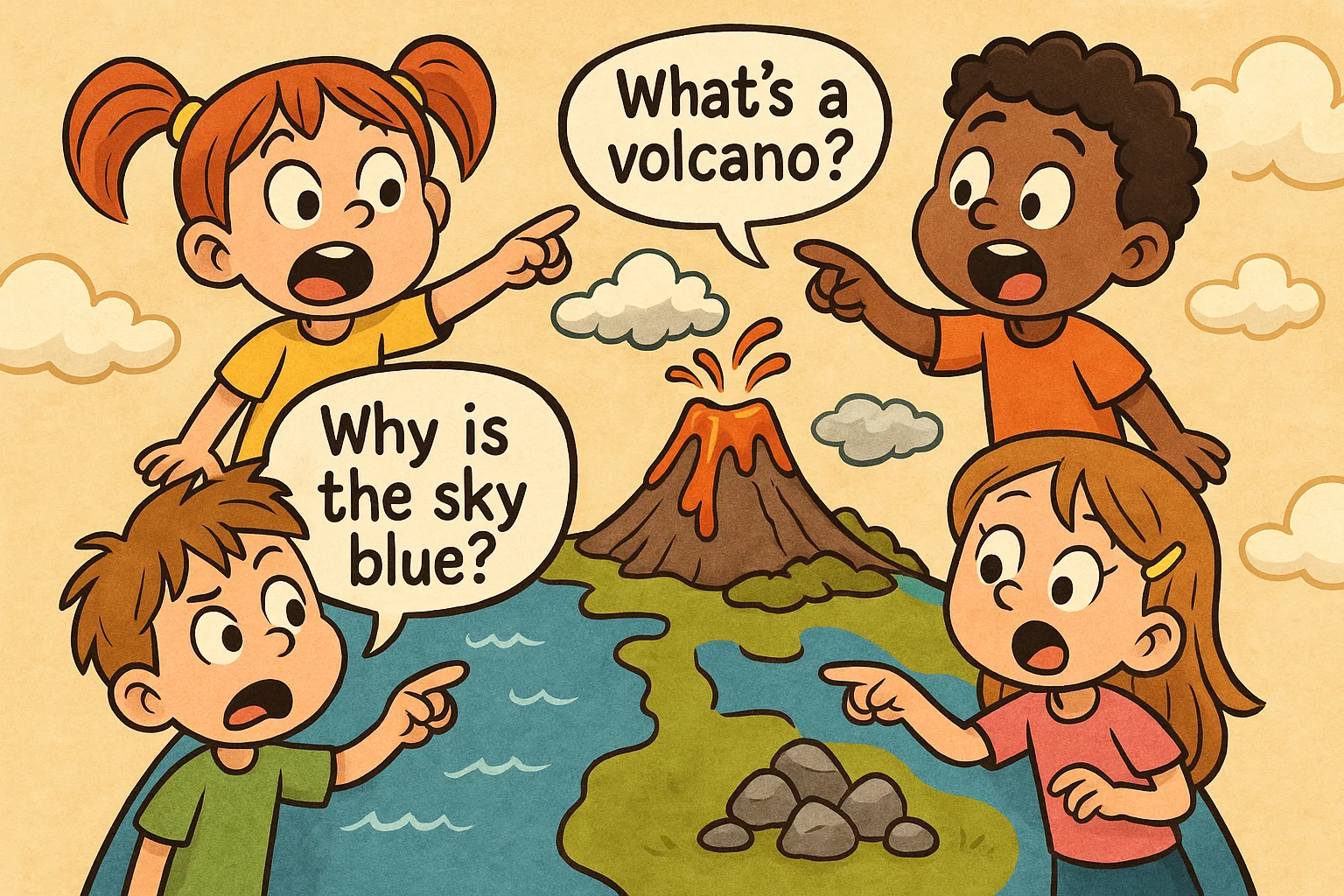
Earth science helps children understand weather, rocks, and natural processes in the world around them.
Weather and atmosphere
Atmospheric science basics:
- Earth’s atmosphere: 78% nitrogen, 21% oxygen
- Ozone layer protects from harmful space radiation
- Clouds form when water vapor condenses around particles
- Rain occurs when water droplets become too heavy for clouds
Rocks and geology
Understanding Earth’s structure:
Q: What is a volcano? A: An opening in Earth’s crust where molten rock escapes as lava.
Rock types:
- Igneous – formed from cooled magma
- Sedimentary – compressed layers over time
- Metamorphic – changed by heat and pressure
Easy physics questions for kids
Physics explores laws of motion and energy governing our universe. Isaac Newton‘s discoveries provide excellent starting points.
Questions about motion and gravity
Newton’s contributions:
- Laws of motion explain how objects move and interact
- Gravity pulls objects toward each other
- Air resistance opposes motion through air
- All objects fall at the same rate in a vacuum.
Energy and everyday physics
Energy and everyday physics Examples in daily life:
Q: Why do we see lightning before thunder? A: Light travels much faster than sound (186,000 miles/second vs 1,125 feet/second).
Energy types:
- Potential energy – stored (ball held high)
- Kinetic energy – motion (rolling ball)
- Electrical energy – moving electrons
Science questions by difficulty level
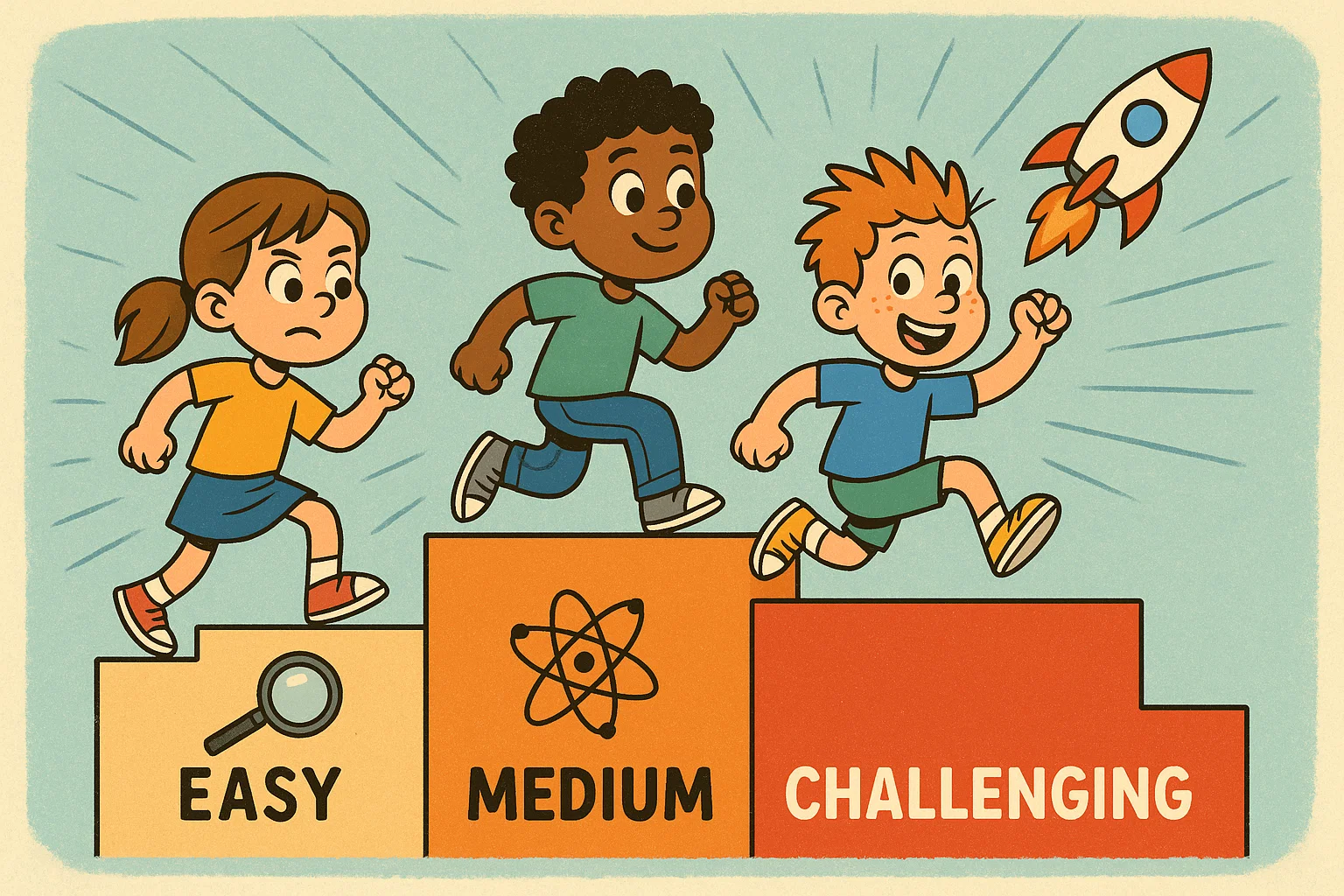
Preschool and kindergarten science questions
Simple observation-based questions:
- Spiders have 8 legs (insects have 6)
- Mixing red and yellow makes orange
- Plants need sunlight, water, air, nutrients
Elementary school science questions
More complex reasoning:
- Seasons occur due to Earth’s tilt and orbit
- Tooth enamel is hardest substance in human body
- Birds fly using hollow bones and wing shape
Middle school science questions
Advanced concepts:
- Tides caused by Moon’s gravitational pull
- Vaccines train immune system against diseases
- Photosynthesis produces oxygen we breathe
How to make science quizzes fun for kids
Use games and competitions
Engaging formats:
- Team competitions with point systems
- Science trivia tournaments with prizes
- Flashcard rapid-fire rounds
- Science-themed escape rooms
Include visual aids and experiments
Hands-on approaches:
- Microscopes for examining everyday objects
- Volcano demonstrations with baking soda
- Nature walks for real-world observations
- Models and diagrams for complex concepts
Encourage kids to create their own questions
Student-generated learning:
- Children formulate questions about favorite topics
- Interview family members about science knowledge
- Develop questions based on personal interests (sharks, space, cooking)
Related quizzes and educational resources 📖
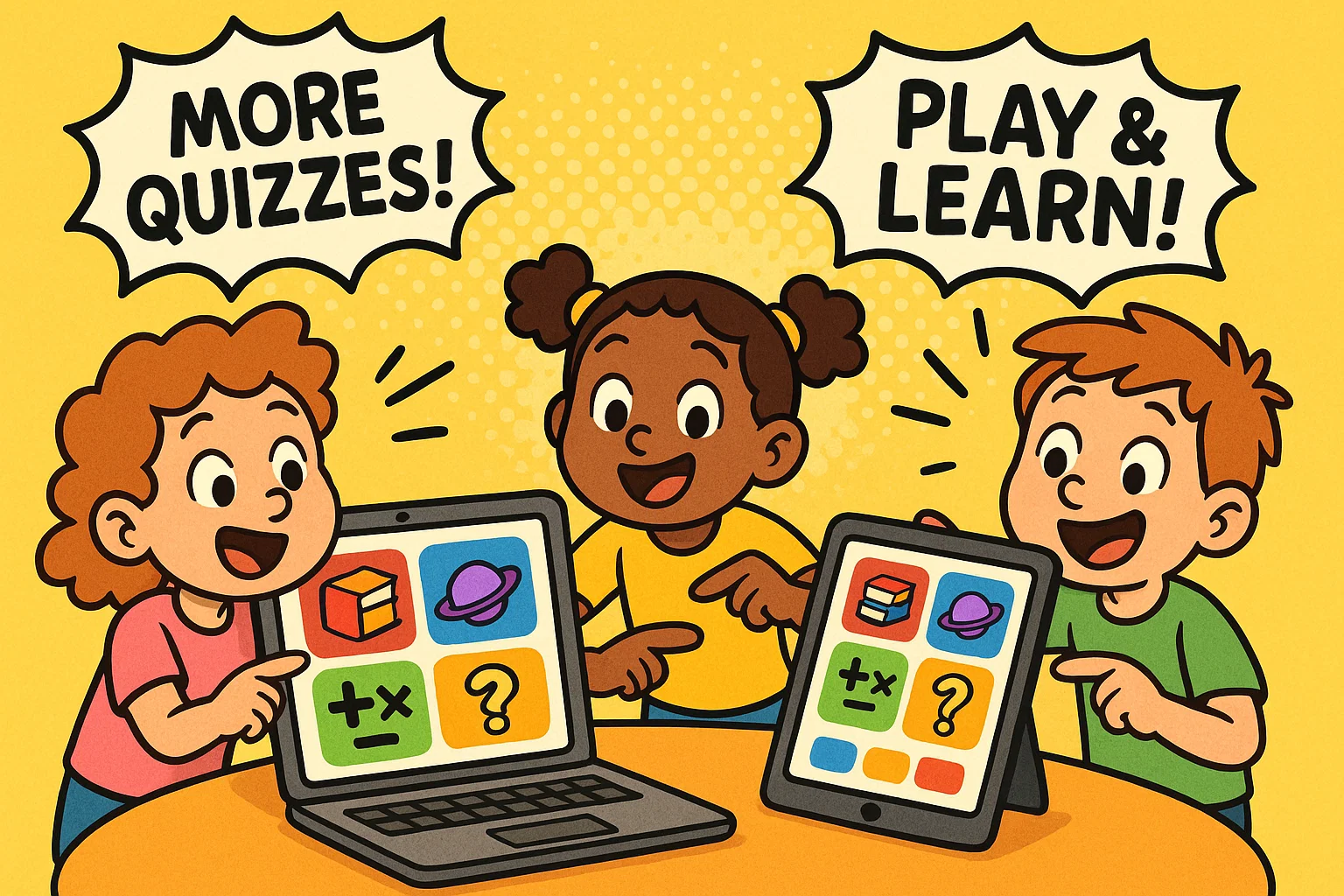
Educational website categories
| Website Type | Benefits | Age Range |
| Science Museums | Virtual tours, interactive exhibits | KS1 and up |
| Educational Games | Gamified learning | Elementary |
| Experiment Sites | Hands-on instructions | All ages |
| Free science platforms | Simulations, activities | Primary schools |
Cross-curricular connections
Complementary subjects:
- History trivia – Scientific discoveries and inventors
- Math trivia – Quantitative reasoning for science
- Geography trivia – Earth sciences and location effects
Quality resources such as Twinkl provide comprehensive science lessons with supporting materials for teachers, teaching assistants, and parents. These platforms expand their knowledge beyond single quiz sessions while maintaining that crucial element that helps make science fun.
The key to success lies in variety – using multiple approaches to engage young learners while fostering curiosity about the world around us. Whether through quizzes, conversations, or experiments, we can encourage critical thinking while building scientific literacy for life.
Take a short quiz to find out what your everyday choices say about your parenting style
When your child is curious about something new, what’s your instinct?
Take a short quiz to find out what your everyday choices say about your parenting style
“Can I download this app?” What happens next?
Take a short quiz to find out what your everyday choices say about your parenting style
When it comes to rules at home, which sounds most like you?
Take a short quiz to find out what your everyday choices say about your parenting style
If you could give your child one life skill today, what would you pick?
Take a short quiz to find out what your everyday choices say about your parenting style
Your child gets to choose what to watch. What would your ideal setup look like?
Take a short quiz to find out what your everyday choices say about your parenting style
Pick your parenting superpower ✨