Best Board Games for 5-Year-Olds: First Strategy and Family Picks

 Discover a Free Education Video App for Kids
Pastory uses AI to personalize educational video content based on your child’s interests and personality. Safe, engaging, and built for curious young minds. Sign up now to stay updated and enjoy early access with a free trial
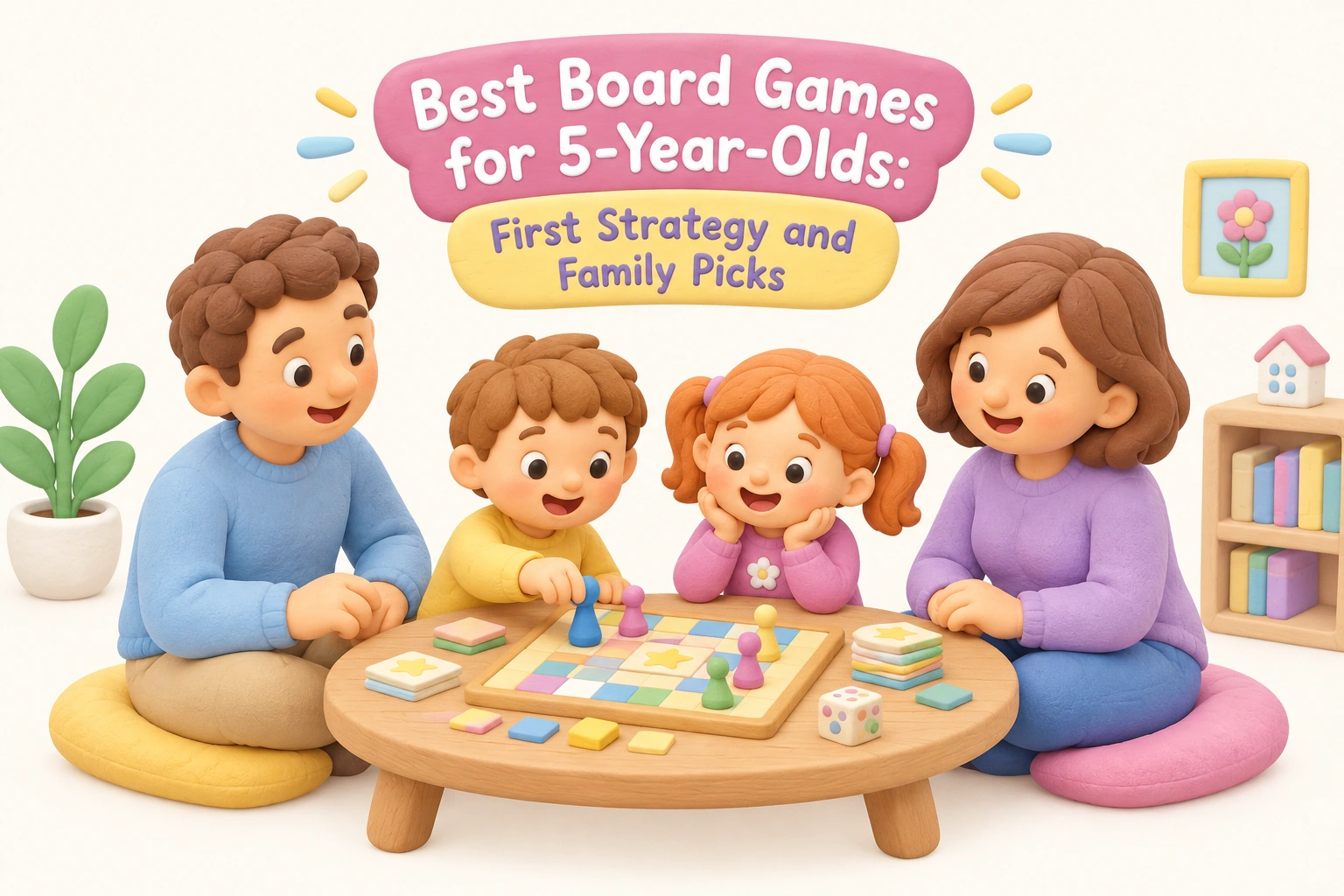
Choosing board games for 5-year-olds involves more than picking something colorful off a shelf. At this age, children are developing working memory, early deductive reasoning, and the emotional tools to handle winning and losing — and the right game can support all of these at once. This guide covers the best cooperative, strategy, and family games suited to five-year-olds, explains what developmental skills each type supports, and helps you decide which games are worth adding to your family game night rotation.
Key Takeaways
- Five-year-olds are developmentally ready for simple rules, cooperative gameplay, and early strategy — not just luck-based games like Candy Land.
- Cooperative games are an excellent starting point because they reduce the emotional pressure of winning and losing while building teamwork and communication skills.
- First strategy games such as Dragomino and My First Carcassonne introduce tile placement and planning without requiring reading or complex rules.
- Look for games with short playtimes (10–20 minutes), chunky wooden pieces or durable components, and scalable difficulty that grows with your child.
- Board games at this age may support executive function, fine motor skills, school readiness, and emotional regulation — though outcomes vary by child and context.
What 5-Year-Olds Are Developmentally Ready For
At age five, children are typically in a transitional developmental window. Their attention span supports focused play of roughly 10 to 20 minutes, they are beginning to understand that other people have different knowledge and perspectives (an emerging theory of mind), and they can follow multi-step instructions when presented clearly. Most five-year-olds are at a pre-reading stage, so games that rely on text create unnecessary barriers. What they can engage with meaningfully includes color recognition, simple counting, pattern recognition, and basic cause-and-effect reasoning.
Research published in peer-reviewed developmental literature suggests that structured tabletop play may support visuospatial memory and early numeracy skills, though the strength of these effects depends on the game type, how often it is played, and whether a caregiver is involved. Board games also offer something screens rarely replicate: the physical experience of handling chunky wooden pieces, rolling dice, and sitting face-to-face with another person — all of which contribute to fine motor skills and social development simultaneously.
Executive function — the cluster of cognitive skills that includes planning, impulse control, and flexible thinking — is actively developing at age five. Games that ask a child to wait their turn, remember a rule, or think one step ahead provide low-stakes practice for these skills in a context that feels like play rather than instruction.
Cooperative vs. Competitive Games: Which Should You Start With?
The cooperative vs. competitive distinction matters more at age five than at almost any other stage. In a cooperative game, all players work together toward a shared goal — either everyone wins or everyone loses together. This structure removes the sting of individual defeat, which is particularly valuable for children who are still developing emotional regulation and may struggle with handling losing gracefully.
Competitive games are not off-limits for five-year-olds, but they work best when introduced gradually and paired with explicit conversations about good sportsmanship. A child who has experienced the collaborative satisfaction of a cooperative game is often better prepared emotionally to handle the outcome of a competitive one. Think of cooperative gameplay as a bridge: it builds the social and emotional vocabulary — taking turns, communicating strategy, managing frustration — that makes competitive play more enjoyable for everyone at the table.
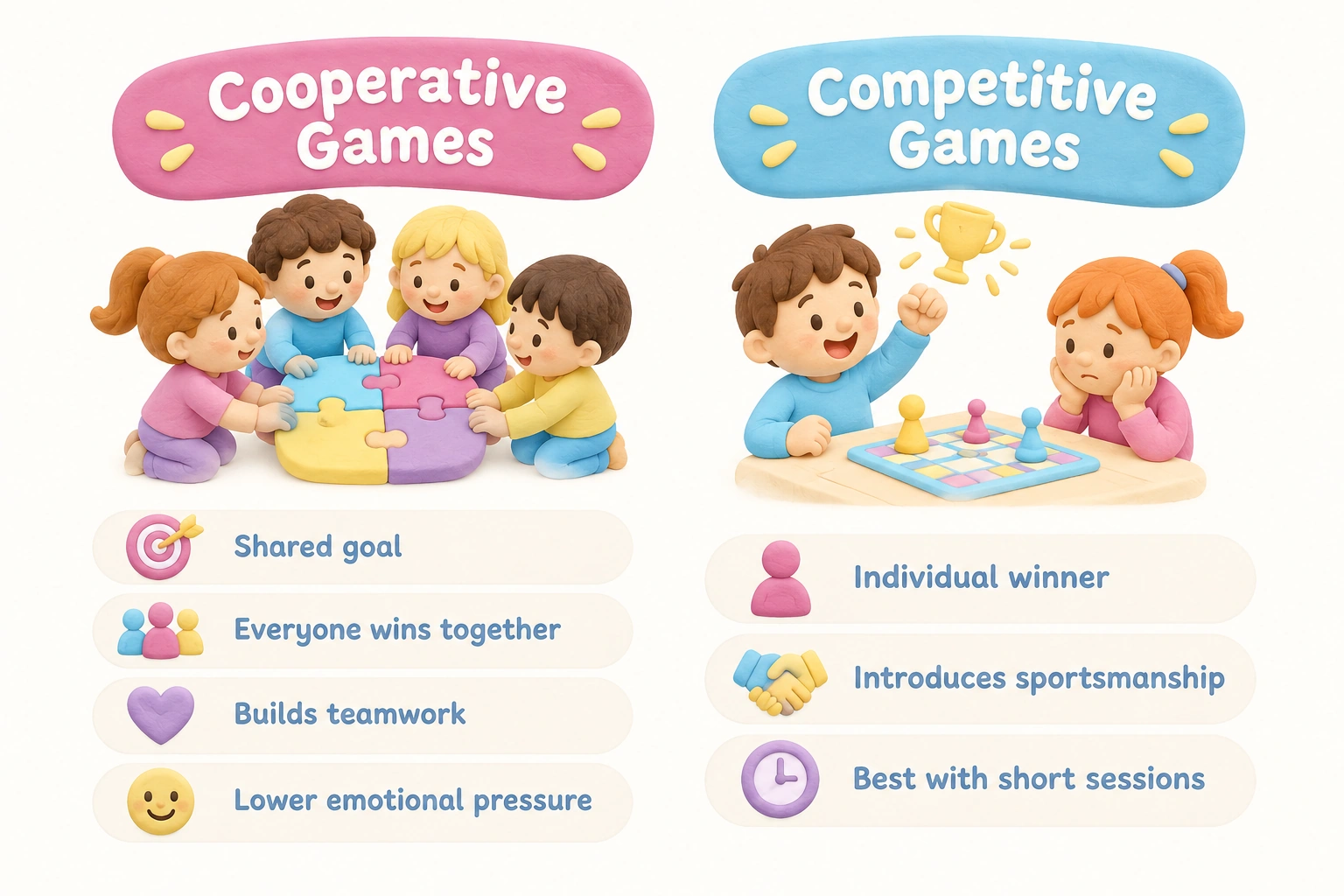
For mixed-age households where a five-year-old plays alongside older siblings or adults, cooperative games also level the playing field naturally. No one is at a structural disadvantage when the whole group is working toward the same outcome.
Best Cooperative Board Games for 5-Year-Olds
Cooperative games are the most recommended starting point for this age group, and several titles stand out consistently for their age-appropriate mechanics and genuine replay value.
Outfoxed! (Peaceable Kingdom)
Outfoxed! is the most widely cited cooperative game for five-year-olds, and for good reason. Players work together to identify which fox stole a pot pie before the thief escapes. The game introduces simple deductive reasoning — players roll dice to reveal clues and eliminate suspects — without requiring any reading. The mechanics are intuitive enough for a five-year-old to grasp within a few minutes, and the shared decision-making keeps everyone engaged. Peaceable Kingdom, the publisher, specializes in cooperative games designed specifically for young children, and the component quality reflects that focus.
Hoot Owl Hoot! (Peaceable Kingdom)
Hoot Owl Hoot! is a color-matching cooperative game in which players guide owls back to their nest before sunrise. It features three difficulty levels, making it one of the clearest examples of scalable difficulty available for this age group. The simplest level is accessible to children as young as four, while the harder settings remain genuinely challenging for five- and six-year-olds. The game requires no reading, plays in around 15 minutes, and supports color recognition and turn-taking in a low-pressure format.
First Orchard (HABA)
First Orchard is often the very first board game recommended for children aged two and up, but it remains engaging at five because of its cooperative structure and the satisfying physicality of placing chunky wooden fruit pieces into a basket. HABA is a German toy and game manufacturer with a strong reputation for quality components and thoughtful age-appropriate design. First Orchard has won multiple awards and is a reliable choice for families introducing cooperative gameplay for the first time.
Race to the Treasure! (Peaceable Kingdom)
Race to the Treasure! asks players to build a path to a treasure chest before an ogre arrives. It introduces basic spatial reasoning and path-planning in a cooperative format, and the modular tile-drawing mechanic gives each game a different layout, which supports replay value over many sessions.
First Strategy Games for 5-Year-Olds
Moving beyond pure luck and cooperation, first strategy games ask children to make meaningful choices that affect the outcome. This is a significant developmental step: the child must consider options, anticipate consequences, and adapt their plan. The games below are specifically designed to make this transition accessible for five-year-olds.
Dragomino (Blue Orange Games)
Dragomino is the most frequently recommended first strategy game for this age group and won the Kinderspiel des Jahres — the German Children’s Game of the Year award — which is widely regarded as the most credible quality signal in children’s tabletop gaming. Players draft domino-style tiles to build their own island and hatch dragon eggs by matching terrain types. The tile placement mechanic is simple enough for a five-year-old to understand immediately, but the drafting decisions introduce genuine strategic thinking: which tile do I take, and where does it fit best? The game plays in about 15 minutes, requires no reading, and scales naturally as children develop more sophisticated planning skills.
My First Carcassonne (Hans im Glück)
My First Carcassonne is a simplified version of the classic Carcassonne tile-placement game, redesigned specifically for young children. Players draw and place tiles to build roads and try to complete paths that include their colored figures. The mechanics introduce spatial reasoning and basic planning without any text, and the familiar Carcassonne artwork gives the game a warm, illustrated quality that appeals to this age group. It is one of the clearest examples of a game that grows with your child: children who start with My First Carcassonne often transition naturally to the full Carcassonne game at ages seven or eight.
Ticket to Ride: First Journey
Ticket to Ride: First Journey is the official children’s version of the popular Ticket to Ride series. Players collect colored train cards and claim routes across a simplified map. The game introduces hand management and route planning at a level appropriate for five- and six-year-olds, and the familiar train theme tends to have broad appeal. It plays in 15 to 30 minutes and supports color recognition, counting, and early strategic thinking. For families who enjoy the original Ticket to Ride, this version creates a natural shared game night experience across different ages.
Sequence for Kids
Sequence for Kids uses a card-and-board matching mechanic to introduce pattern recognition and simple planning. Players match cards in their hand to animals on the board and try to create a sequence of four in a row. The game is competitive but low-stakes, plays quickly, and is a useful stepping stone between purely luck-based games and more complex strategy titles.
Dexterity and Memory Games Worth Considering
Not every five-year-old is ready to engage with strategic planning, and not every game session needs to be a cognitive workout. Dexterity games and memory games serve different but equally valid developmental purposes.
Rhino Hero (HABA)
Rhino Hero is a card-stacking dexterity game in which players build a tower and move a heavy wooden rhino figure to the top. It directly supports fine motor skills and hand-eye coordination, and the physical tension of the tower makes it genuinely exciting for children and adults alike. The game plays in about 5 to 15 minutes and works well as a warm-up or wind-down activity around a longer game night.
Sneaky Snacky Squirrel (Educational Insights)
Sneaky Snacky Squirrel uses a squirrel-shaped spinner and a squeezable acorn grabber tool to develop fine motor skills and color matching. The dexterity element — squeezing the tool to pick up small acorns — is engaging for five-year-olds and provides a different kind of physical challenge from card or tile games. It is a competitive game but plays quickly enough that losing does not feel significant.
Dragon’s Breath (HABA)
Dragon’s Breath is a visually striking game in which players remove rings from a dragon’s ice column to collect colored gems. It combines dexterity, color recognition, and a small element of prediction, and the component quality — including the chunky wooden pieces and the satisfying gem-collection mechanic — makes it a frequent gift recommendation. It plays in about 15 minutes and suits mixed-age households well.
How to Choose: A Practical Buying Guide
With dozens of options available, a few clear criteria help narrow the field quickly. The following checklist reflects the most important factors for five-year-olds specifically.
- No reading required: At age five, most children are at a pre-reading stage. Games that rely on text cards or written instructions create frustration rather than engagement. Look for games that use colors, symbols, images, or physical components to communicate all necessary information.
- Short playtime: A five-year-old’s attention span typically supports 10 to 20 minutes of focused play. Games that run longer than 30 minutes often result in disengagement or meltdowns before the game concludes.
- Durable components: Chunky wooden pieces, thick cardboard tiles, and sturdy boards hold up to repeated play and are easier for small hands to manipulate. HABA and Peaceable Kingdom are two brands consistently praised for component quality.
- Scalable difficulty: Games with multiple difficulty levels or rule variations extend the useful life of the game significantly. Hoot Owl Hoot’s three difficulty settings and Azul Kids’ simple and advanced board sides are good examples of this design approach.
- Cooperative or gently competitive: For children who are still developing emotional regulation, cooperative games reduce the pressure of individual outcomes. If choosing a competitive game, look for short play sessions and simple mechanics that keep the focus on fun rather than winning.
- Player count flexibility: Games that work well with two to four players are the most versatile for family use, accommodating a parent-child pair as easily as a full family group.
Games That Grow With Your Child
One of the most practical considerations for parents is whether a game will remain engaging as a child develops. Several titles are specifically designed with scalable difficulty or natural progression paths that extend their usefulness well beyond age five.
Hoot Owl Hoot offers three distinct difficulty levels, meaning the same box can serve a child from age four through age seven or eight. Dragomino introduces tile placement mechanics that directly prepare children for more complex strategy games later. My First Carcassonne creates a natural bridge to the full Carcassonne game. Azul Kids features a simpler board on one side and a more complex scoring system on the reverse, allowing the game to grow with your child’s developing strategic thinking. For families who want long-term value from a single purchase, prioritizing games with this kind of built-in progression is a sound approach.
Helping Children Handle Winning and Losing
Handling losing is one of the most common challenges parents face when introducing competitive board games to five-year-olds. At this age, children are still developing the emotional regulation skills needed to manage disappointment, and a lost game can quickly derail an otherwise enjoyable evening. A few practical strategies can make the transition smoother.
Starting with cooperative games before introducing competitive ones gives children a positive association with board games generally, and builds the social vocabulary — communicating, taking turns, managing frustration — that makes competitive play more manageable. When competitive games are introduced, choosing titles with short play sessions means that a loss is over quickly and a new game can begin. Framing the experience around participation rather than outcome — commenting on good decisions rather than final scores — helps children develop good sportsmanship gradually rather than expecting it immediately. It is also worth acknowledging that some children are temperamentally more sensitive to losing than others, and that this is a normal part of development rather than a problem to be solved.
Board Games as a Screen-Time Alternative
Board games offer a meaningful alternative to screen-based entertainment, particularly for families looking to balance digital and non-digital activities. Unlike passive screen consumption, board games require active participation, face-to-face interaction, and physical engagement with components. They also create a shared family experience that is difficult to replicate through individual screen use.
This does not mean board games are a replacement for all screen time, or that digital games have no developmental value. Rather, regular family game night sessions — even once or twice a week — can provide a consistent context for the kinds of social, cognitive, and emotional skills that five-year-olds are actively developing. The physical nature of board games, including the handling of chunky wooden pieces, the rolling of dice, and the face-to-face negotiation of cooperative gameplay, engages developmental domains that screen-based play does not always reach.
Quick Game Comparison Table
The table below summarizes the key characteristics of the most recommended board games for five-year-olds to help with side-by-side decision-making.
| Game | Type | Players | Playtime | Reading Required | Key Skill |
|---|---|---|---|---|---|
| Outfoxed! | Cooperative | 2–4 | 20 min | No | Deductive reasoning |
| Hoot Owl Hoot! | Cooperative | 2–4 | 15 min | No | Color matching, turn-taking |
| First Orchard | Cooperative | 1–4 | 10 min | No | Fine motor, cooperation |
| Dragomino | First strategy | 2–4 | 15 min | No | Tile placement, planning |
| My First Carcassonne | First strategy | 2–4 | 20 min | No | Spatial reasoning |
| Ticket to Ride: First Journey | Strategy | 2–4 | 15–30 min | No | Route planning, color matching |
| Rhino Hero | Dexterity | 2–5 | 5–15 min | No | Fine motor, hand-eye coordination |
| Dragon’s Breath | Dexterity/luck | 2–4 | 15 min | No | Color recognition, prediction |
| Race to the Treasure! | Cooperative | 2–4 | 20 min | No | Path planning, spatial reasoning |
| Sequence for Kids | Competitive | 2–4 | 20 min | No | Pattern recognition, planning |
Frequently Asked Questions
Are cooperative games better than competitive games for 5-year-olds?
Cooperative games are generally a better starting point because they reduce the emotional pressure of individual outcomes and help children build the social skills — turn-taking, communication, shared decision-making — that make competitive play more enjoyable later. Competitive games are appropriate for five-year-olds when the rules are simple, the playtime is short, and the focus is on participation rather than winning.
How long should a board game session be for a 5-year-old?
Most five-year-olds can sustain focused attention for 10 to 20 minutes. Games that fit within this window are the most likely to end positively. If a game runs longer, consider stopping at a natural pause point rather than pushing through to the end, particularly with children who are new to tabletop play.
What is the best first board game for a 5-year-old?
Outfoxed! and Hoot Owl Hoot! are the most consistently recommended first games for this age group because they are cooperative, require no reading, play in under 20 minutes, and introduce simple but genuine decision-making. For families ready to try a first strategy game, Dragomino is the most widely praised option and has won the Kinderspiel des Jahres award.
Can a 5-year-old play a board game alone?
Most board games designed for five-year-olds require at least two players. However, some cooperative games — including First Orchard and Hoot Owl Hoot! — can be played solo by having the child manage all player roles. This is not the intended experience, but it can work for short independent play sessions. Puzzle-style games and single-player logic games such as Rush Hour Jr. are better suited to solo play at this age.
Do board games help with school readiness?
Board games may support several skills associated with school readiness, including counting, color and number recognition, turn-taking, listening to instructions, and managing frustration. The connection between board game play and academic outcomes is supported by some research, particularly for numeracy and visuospatial skills, though the strength of these effects varies and depends on the type of game and how it is played. Board games are best understood as one useful tool among many rather than a direct academic intervention.
What does HABA mean, and why is it recommended so often?
HABA is a German toy and game manufacturer founded in 1938 and known for high-quality wooden toys and children’s games. HABA games are frequently recommended because of their durable components — including chunky wooden pieces that are easy for small hands to handle — thoughtful age-appropriate design, and consistent track record of award recognition. The brand is particularly well regarded for games aimed at children aged two to seven.
What are good board games for mixed-age families?
Games that work well across ages in mixed-age households include Outfoxed!, Rhino Hero, Dragon’s Breath, and Ticket to Ride: First Journey. Cooperative games are particularly effective in this context because older players and adults can participate meaningfully without dominating, and the shared goal keeps everyone invested regardless of age or experience level.
Which Board Games Are Worth Starting With for Your Family?
The best board games for 5-year-olds are those that match your child’s current developmental stage, fit within a realistic attention span, and create a positive experience around the table — whether that means a cooperative adventure or a gentle first taste of strategy. For most families, starting with one cooperative game (Outfoxed! or Hoot Owl Hoot! are reliable choices) and one first strategy game (Dragomino is the strongest option at this age) covers the most important ground without overwhelming a new player.
If your child is particularly sensitive to losing, lean toward cooperative gameplay for the first several months and introduce competitive games gradually, using short-session titles like Sequence for Kids as a bridge. If your child is already comfortable with turn-taking and simple rules, Dragomino or My First Carcassonne may be the right entry point into more meaningful strategic thinking.
For gift-buying purposes, games in the $20 to $35 range — including Outfoxed!, Hoot Owl Hoot!, and Dragomino — offer the best combination of quality, developmental value, and replay value. HABA titles such as First Orchard and Dragon’s Breath are worth the slightly higher price point for their component quality and longevity. Whatever you choose, the most important factor is simply playing together: the developmental benefits of board games at this age are most reliably realized when a caregiver is present, engaged, and making the experience enjoyable.

Take a short quiz to find out what your everyday choices say about your parenting style
When your child is curious about something new, what’s your instinct?
Take a short quiz to find out what your everyday choices say about your parenting style
“Can I download this app?” What happens next?
Take a short quiz to find out what your everyday choices say about your parenting style
When it comes to rules at home, which sounds most like you?
Take a short quiz to find out what your everyday choices say about your parenting style
If you could give your child one life skill today, what would you pick?
Take a short quiz to find out what your everyday choices say about your parenting style
Your child gets to choose what to watch. What would your ideal setup look like?
Take a short quiz to find out what your everyday choices say about your parenting style
Pick your parenting superpower ✨