Best Board Games for 6-Year-Olds: Cooperation and Simple Strategy

 Discover a Free Education Video App for Kids
Pastory uses AI to personalize educational video content based on your child’s interests and personality. Safe, engaging, and built for curious young minds. Sign up now to stay updated and enjoy early access with a free trial
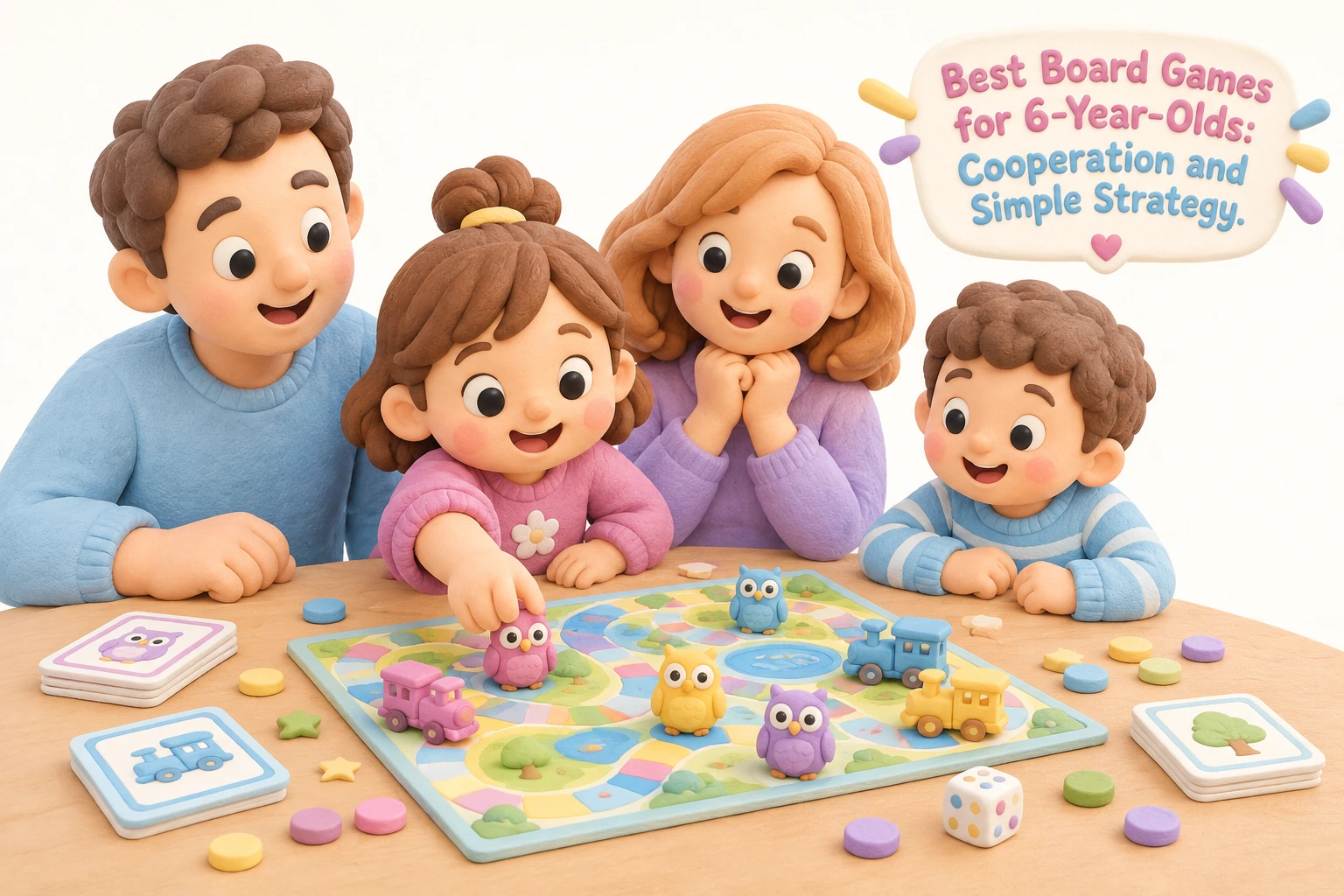
Choosing the right board games for 6-year-olds means finding that sweet spot between genuinely engaging and developmentally appropriate — games that hold a child’s attention for 15 to 30 minutes, require no reading, and build real skills without frustrating young players. At six, children are entering a stage where they can follow multi-step rules, understand winning and losing, and begin planning one or two moves ahead. This guide covers the best cooperative and simple strategy games for this age, explains what makes each one a good developmental fit, and helps parents sequence their child’s gaming journey from first co-op experiences through to more challenging picks.
Key Takeaways
- Six-year-olds are cognitively ready for short rule sets, turn-taking, and basic planning — making this an ideal age to introduce both cooperative and simple strategy games.
- Cooperative board games for 6-year-olds are especially valuable for children who struggle with losing, as players work together to win or lose as a team rather than competing against each other.
- Most games suited to this age require no reading, have play times of 15–30 minutes, and use color-coded or picture-based components.
- Starting with cooperative games and gradually introducing simple strategy games is a natural progression that builds good sportsmanship and critical thinking over time.
- Mixed-age siblings can often share the same games, particularly cooperative titles designed for players aged 5 and up.
What a 6-Year-Old Is Developmentally Ready For
Understanding what a 6-year-old can realistically manage helps parents choose games that challenge without overwhelming. At this stage, most children have developed enough working memory to hold a short set of rules in mind while playing. They can take turns with patience, understand that actions have consequences within a game, and begin to think one or two steps ahead — the foundation of simple strategy. Inhibitory control, the ability to wait and not act impulsively, is still developing, which is why games with clear, structured turns work better than free-form or fast-reaction formats.
Emotionally, six-year-olds are beginning to understand fairness and can experience genuine frustration when they lose. This is a normal part of development, not a character flaw. Cooperative games ease children into the social experience of gaming precisely because there is no single loser — the group either succeeds or fails together. This shared outcome reduces the sore loser dynamic that can derail family game night and gives children a chance to practice emotional regulation in a lower-stakes context. Once a child is comfortable with cooperative play, introducing age-appropriate competitive games becomes much smoother.
Attention span is a practical constraint worth respecting. Most 6-year-olds can sustain focused engagement for roughly 15 to 30 minutes, which is why the games recommended here fall within that window. Games that run longer tend to work better at age 7 or 8, when sustained concentration improves noticeably.
Best Cooperative Board Games for 6-Year-Olds
Cooperative games are those in which players work together to win or lose as a team, rather than competing against one another. For children just entering the world of board games, this format removes the anxiety of direct competition and encourages communication, turn-taking, and shared problem-solving. The following titles are among the most consistently recommended for this age group.
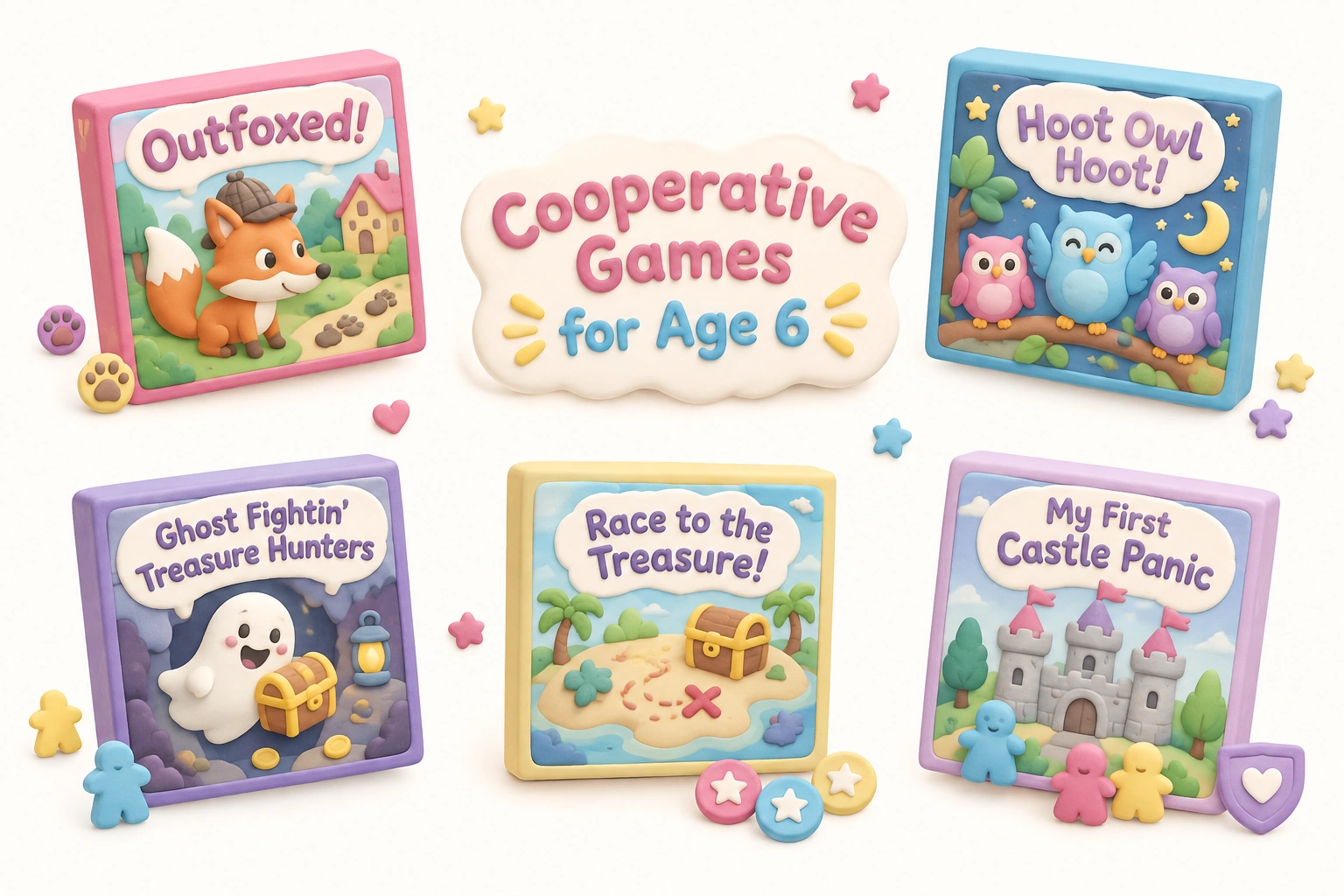
Outfoxed! (Gamewright)
Outfoxed! is widely regarded as one of the best entry-level cooperative games for children aged 5 and up. Players work together as a team of detective chickens trying to identify which fox stole a pot pie before the culprit escapes. The game uses a clever evidence scanner mechanic — a physical decoder device that reveals clues — which makes deductive reasoning feel tactile and exciting rather than abstract. Children practice process-of-elimination thinking without needing to read a single word. Play time is typically 20 minutes, and the game supports two to four players. Published by Gamewright, Outfoxed! has strong replay value because the guilty fox changes with every game.
Hoot Owl Hoot! (Peaceable Kingdom)
Hoot Owl Hoot! is a color-matching cooperative card game from Peaceable Kingdom in which players guide owls back to their nest before sunrise. The rules are simple enough for children as young as 4, making it an excellent choice for mixed-age siblings playing together. Players must coordinate their card choices to move owls efficiently, which introduces basic planning and teamwork without any reading requirement. The game plays in around 15 minutes and accommodates two to four players. Its gentle pace and clear visual design make it a reliable first cooperative game for families new to the format.
Ghost Fightin’ Treasure Hunters (HABA)
Published by HABA, Ghost Fightin’ Treasure Hunters challenges players to collect jewels from a haunted house while fighting off ghosts before the house becomes too haunted to escape. The game introduces slightly more complexity than Hoot Owl Hoot! — players must decide together which threats to address each turn — making it a natural next step once simpler co-op games feel comfortable. It supports two to four players and plays in around 30 minutes. The component quality is high, with chunky, durable pieces well suited to younger hands.
Race to the Treasure! (Peaceable Kingdom)
Race to the Treasure! is a tile-laying cooperative game in which players build a path to a treasure chest before an ogre arrives. Tile-laying, as a mechanic, means players draw and place path tiles to create a connected route — a format that supports spatial reasoning and planning in a very visual, hands-on way. The game is quick (around 20 minutes), requires no reading, and works for two to four players aged 5 and up. It is another strong Peaceable Kingdom title that works well for families with children of different ages.
My First Castle Panic (Fireside Games)
My First Castle Panic is a simplified version of the popular Castle Panic game, designed specifically for younger players. Players cooperate to defend a castle from approaching monsters by playing color-coded cards. The game introduces the concept of hand management — deciding which card to play and when — in a format accessible to 6-year-olds. It plays in 20 to 30 minutes and supports one to four players. The cooperative structure means that more experienced players can guide younger ones without the game feeling unfair.
A Note on the “Dominant Player” Problem
One challenge that can arise in cooperative games is that a more confident or older player begins directing everyone else’s moves, effectively reducing the game to a solo experience for the others. To prevent this, consider assigning each player a specific role or responsibility at the start of the game — for example, one child manages a particular game element while another handles a different one. House rules that require each player to announce their intended move before others comment can also help. The goal is to keep every player genuinely engaged in the decision-making, not just watching.
Best Simple Strategy Board Games for 6-Year-Olds
Simple strategy games introduce children to planning, spatial awareness, and the experience of competing fairly. At six, children are ready for games that require thinking one or two moves ahead, as long as the rules remain clear and the play time stays manageable. These games build critical thinking and problem-solving skills while also teaching good sportsmanship in a competitive context.
Ticket to Ride: First Journey (Days of Wonder)
Ticket to Ride: First Journey is the child-friendly version of the classic route-building game. Players collect colored train cards and use them to claim routes between cities on a map, completing destination tickets to score points. The route-building mechanic — connecting two locations by placing train pieces along a path — is intuitive and visually satisfying. The rules are significantly simpler than the adult version, and no reading is required beyond recognizing city names on a map (which can be supported by a parent). Play time is around 15 to 30 minutes for two to four players. This game is frequently cited as the best introduction to strategy gaming for children in this age range.
Kingdomino / Dragomino
Kingdomino is a tile-laying game in which players build a kingdom by connecting domino-style landscape tiles. Dragomino is the child-friendly version, replacing kingdoms with islands and adding a dragon-egg discovery mechanic. Both games develop spatial reasoning and simple planning as children decide where each tile fits best. Dragomino is specifically designed for ages 5 and up, plays in around 15 minutes, and supports two to four players. The format is accessible, visually appealing, and has strong replay value because the tile draw is different every game.
Blokus
Blokus is a spatial strategy game in which players take turns placing geometric pieces on a grid, with the rule that each new piece must touch a corner — but not a side — of the player’s existing pieces. This constraint makes the game a genuine exercise in spatial reasoning and forward planning. It supports two to four players and plays in 20 to 30 minutes. While the rules are simple to explain, the strategic depth grows naturally as children become more experienced, giving Blokus strong longevity as a family game.
Sleeping Queens
Sleeping Queens is a card game in which players use action cards to wake sleeping queens while protecting their own. It involves basic arithmetic and simple strategic decisions about which cards to play and when. The game is fast-paced, plays in 20 minutes, and supports two to five players. It is a good bridge between purely luck-based card games and games that require genuine decision-making, making it a useful step in a child’s gaming progression.
Sequence for Kids
Sequence for Kids is a simplified version of Sequence designed for players aged 3 to 6. Players match cards to images on the board and place chips to create sequences of four. The game introduces pattern recognition and basic planning in a format that is entirely picture-based, with no reading required. It plays in around 20 minutes and supports two to four players. It works particularly well as a transitional game for children moving from purely luck-based games toward more strategic formats.
Quick Reference: Game Comparison Table
| Game | Type | Players | Play Time | Reading Required | Key Skill |
|---|---|---|---|---|---|
| Outfoxed! | Cooperative | 2–4 | ~20 min | No | Deductive reasoning |
| Hoot Owl Hoot! | Cooperative | 2–4 | ~15 min | No | Color matching, teamwork |
| Ghost Fightin’ Treasure Hunters | Cooperative | 2–4 | ~30 min | No | Planning, cooperation |
| Race to the Treasure! | Cooperative | 2–4 | ~20 min | No | Spatial reasoning, path-building |
| My First Castle Panic | Cooperative | 1–4 | 20–30 min | No | Hand management, teamwork |
| Ticket to Ride: First Journey | Strategy | 2–4 | 15–30 min | Minimal | Route-building, planning |
| Dragomino | Strategy | 2–4 | ~15 min | No | Spatial reasoning |
| Blokus | Strategy | 2–4 | 20–30 min | No | Spatial strategy |
| Sleeping Queens | Strategy/Card | 2–5 | ~20 min | Minimal | Decision-making, arithmetic |
| Sequence for Kids | Strategy | 2–4 | ~20 min | No | Pattern recognition |
How to Choose a Board Game for a 6-Year-Old
The most useful buying criteria go beyond age labels on the box. A game that works well for one 6-year-old may frustrate another depending on temperament, prior gaming experience, and attention span. The following factors help narrow the choice.
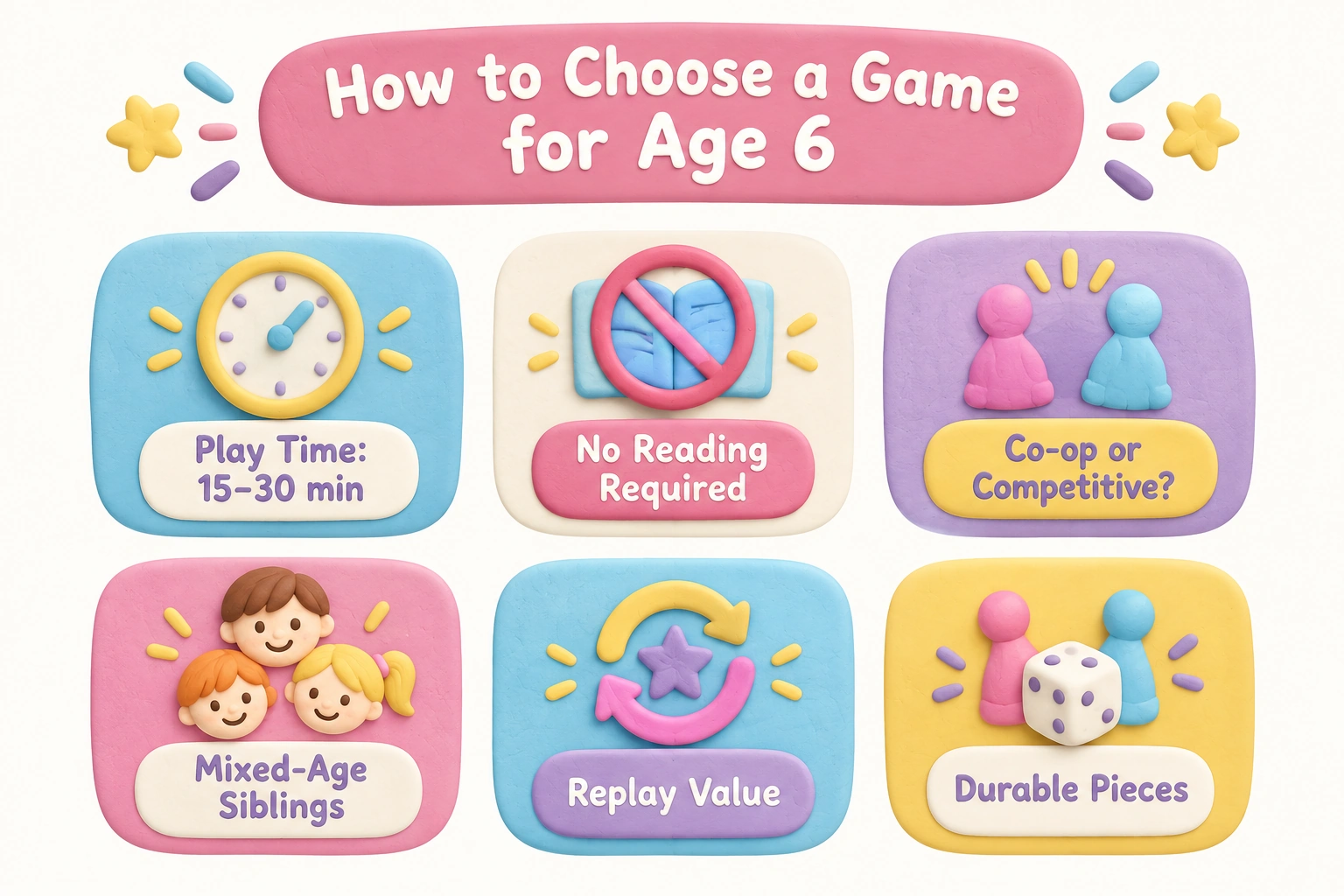
- Play time vs. attention span: Aim for games that finish in 15 to 30 minutes. Games that run longer are better saved for age 7 or 8.
- Reading level: Most games recommended for this age are entirely picture- or color-based. If a game requires reading, check whether a parent can comfortably support without taking over.
- Cooperative vs. competitive: If your child tends to become a sore loser or finds losing very distressing, start with cooperative games. Introduce competitive formats gradually once the child is comfortable with the social dynamics of gaming.
- Number of players: Consider who will actually play. Many of these games work for two players (parent and child) as well as larger groups, which matters for everyday use rather than just family game night.
- Mixed-age siblings: If a 4-year-old sibling will join, prioritize games with a lower age floor — Hoot Owl Hoot! and Race to the Treasure! both work well from age 4 or 5 upward.
- Replay value: Games with variable setups (different fox suspects in Outfoxed!, different tile draws in Dragomino) stay fresh longer than games with a fixed board state.
- Component quality: Chunky pieces, large cards, and durable materials matter for younger players. HABA games in particular are known for high-quality components designed for small hands.
Budget Guide for Gift-Buyers
Board games for this age range span a wide price range. As a general guide: simpler card-based games such as Hoot Owl Hoot! and Sleeping Queens typically fall under $20, making them accessible gifts. Mid-range games including Outfoxed!, Race to the Treasure!, Dragomino, and Sequence for Kids generally fall between $20 and $35. More component-heavy games such as Ghost Fightin’ Treasure Hunters, Blokus, and Ticket to Ride: First Journey typically sit in the $30 to $50 range. Price does not reliably predict developmental value — some of the most effective games for this age are among the least expensive.
Games for Children with Shorter Attention Spans
For children who find it difficult to sustain focus for a full 20 to 30 minutes — including some children with ADHD or sensory sensitivities — the best choices are games that can be completed in 10 to 15 minutes and have very clear, visual turn structures. Hoot Owl Hoot! and Dragomino are particularly well suited here, as both have short play times, simple visual mechanics, and a clear end condition that keeps the game moving. Cooperative formats also tend to work better for children who struggle with the emotional weight of losing, since the shared outcome reduces individual pressure. If a game consistently runs too long, it is entirely reasonable to agree on a shorter version — for example, playing until one team scores a set number of points rather than completing the full game.
A Progression Path: From First Games to What Comes Next
One gap in most board game guides is a clear graduation path — a sense of where to go once a child has mastered the games recommended for their current age. For 6-year-olds who have become comfortable with cooperative games, the natural next step is introducing simple competitive strategy games such as Ticket to Ride: First Journey or Blokus. From there, children aged 7 to 8 are typically ready for games with slightly more complex rule sets and longer play times.
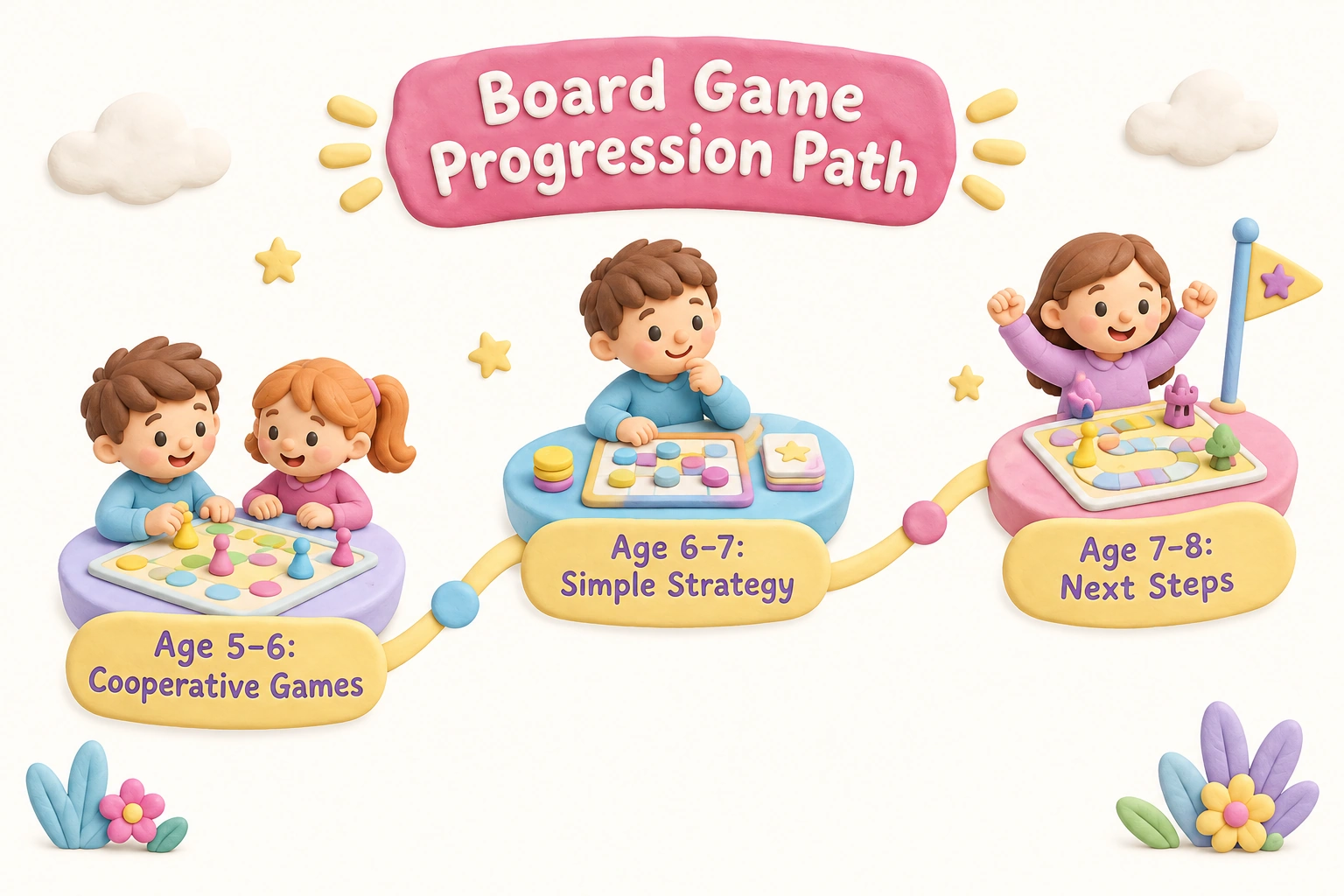
Good next-step games for children who have outgrown the 6-year-old picks include the full version of Ticket to Ride (with parental support), Carcassonne (a tile-laying game with more strategic depth), Catan Junior (a resource-management game that introduces trading), and King of Tokyo (a dice-rolling strategy game with push-your-luck decisions). These games introduce mechanics such as resource management, trading, and multi-turn planning that become accessible as working memory and inhibitory control continue to develop through middle childhood.
A Brief Glossary of Game Mechanics for Non-Gamer Parents
Game descriptions often use terminology that is unfamiliar to parents who did not grow up playing modern board games. A few quick definitions: tile-laying means players draw and place physical tiles to build a shared or individual map or path — it is a hands-on, spatial activity. Deduction means using clues to eliminate possibilities and identify a hidden answer, as in Outfoxed!. Push-your-luck means deciding whether to accept a current result or risk losing it by trying again — a mechanic that teaches risk assessment. Route-building means connecting locations on a map by claiming paths, as in Ticket to Ride: First Journey. Hand management means deciding which cards to play and when, balancing short-term and longer-term goals. Understanding these terms makes it easier to evaluate whether a game’s mechanics match your child’s current developmental stage.
Developmental Benefits of Board Games at Age Six
Board games at this age offer a range of developmental benefits that extend well beyond entertainment. Cooperative games in particular support social communication, emotional regulation, and the ability to consider another person’s perspective — skills that are actively developing during the early primary years. Competitive strategy games, when introduced at the right time, build tolerance for uncertainty, the ability to recover from setbacks, and an understanding of cause and effect within a rule-governed system.
Executive function skills — including working memory, cognitive flexibility, and inhibitory control — are exercised naturally during board game play. A child who must remember the rules, adapt their plan when an opponent takes a route they wanted, and wait patiently for their turn is practicing all three of these skills simultaneously. Research in early childhood development consistently identifies play-based activities that involve rule-following and social interaction as meaningful contexts for executive function development, though individual outcomes vary considerably depending on the child’s age, temperament, and the quality of adult involvement during play.
It is worth noting that board games are not a substitute for unstructured play, physical activity, or caregiver interaction — they are one valuable component of a balanced play environment. The developmental benefits are most likely to be realized when games are played with engaged adults or peers who model good sportsmanship, support problem-solving, and keep the experience enjoyable rather than pressured.
Frequently Asked Questions
Can 6-year-olds play strategy games?
Yes, with the right game. Six-year-olds can manage simple strategy games that require planning one or two moves ahead, as long as the rules are clear and the play time is short. Games like Ticket to Ride: First Journey and Dragomino are specifically designed to make strategy accessible at this age without overwhelming younger players.
What is the best first cooperative game for a 6-year-old?
Hoot Owl Hoot! from Peaceable Kingdom is frequently recommended as the best starting point because the rules are very simple, no reading is required, and the play time is short. Outfoxed! is a strong second choice for children who are ready for a slightly more complex deduction mechanic.
How do I handle a sore loser during game night?
Starting with cooperative games removes the single-loser dynamic entirely, which can significantly reduce frustration. When introducing competitive games, keep the focus on the experience rather than the outcome — celebrate good moves, not just wins. Naming emotions calmly and modeling gracious losing yourself are among the most effective strategies at this age.
Do these games require reading?
Most of the games recommended here require no reading at all. A few, such as Ticket to Ride: First Journey, involve city names on a map that a parent can easily support. The table in this article includes a reading-required column to help parents identify the most accessible options.
Which games work for mixed-age siblings?
Hoot Owl Hoot!, Race to the Treasure!, and Dragomino all work well from age 4 or 5 upward, making them good choices when a younger sibling wants to join. Cooperative formats are generally more inclusive for mixed-age groups because more experienced players can support younger ones without the game becoming unfair.
How long should a board game session be for a 6-year-old?
Most 6-year-olds can sustain focused engagement for 15 to 30 minutes. Games that fall within this window are the most practical choice. If a child loses interest before a game ends, it is fine to agree on a stopping point — the goal is a positive experience, not completing every game to its conclusion.
Are classic games like Candy Land and Chutes and Ladders still worth playing?
These games have value as introductions to turn-taking and the basic concept of a board game, but they rely entirely on luck with no meaningful decisions for the player. For a 6-year-old who is ready for more engagement, the games in this guide offer significantly more developmental value and tend to hold children’s interest for longer.
Which Board Games Are the Right Fit for Your 6-Year-Old?
The best board games for 6-year-olds are those that match the child’s current developmental stage, temperament, and gaming experience — not simply the ones with the highest ratings or the most recommendations. For a child who is new to board games or finds losing difficult, starting with cooperative board games for 6-year-olds such as Outfoxed! or Hoot Owl Hoot! provides a low-pressure entry point that builds confidence and positive associations with game play. For a child who is already comfortable with the social dynamics of gaming, simple strategy games like Ticket to Ride: First Journey or Blokus offer genuine intellectual challenge within an age-appropriate structure.
The progression from cooperative to competitive, and from simple to more complex, does not need to follow a rigid timeline. Some children are ready to move quickly; others benefit from spending longer with cooperative formats. Paying attention to how your child responds — whether they are engaged, frustrated, bored, or excited — is the most reliable guide. Family game night works best when it feels like a shared pleasure rather than a developmental exercise, and the games in this guide are genuinely enjoyable for adults and children alike. If you are unsure where to start, Outfoxed! and Hoot Owl Hoot! are consistently the most recommended first purchases for this age group, and either makes an excellent gift for a child turning six.

Take a short quiz to find out what your everyday choices say about your parenting style
When your child is curious about something new, what’s your instinct?
Take a short quiz to find out what your everyday choices say about your parenting style
“Can I download this app?” What happens next?
Take a short quiz to find out what your everyday choices say about your parenting style
When it comes to rules at home, which sounds most like you?
Take a short quiz to find out what your everyday choices say about your parenting style
If you could give your child one life skill today, what would you pick?
Take a short quiz to find out what your everyday choices say about your parenting style
Your child gets to choose what to watch. What would your ideal setup look like?
Take a short quiz to find out what your everyday choices say about your parenting style
Pick your parenting superpower ✨