Best Board Games for 7-Year-Olds: Beginner Strategy Picks

 Discover a Free Education Video App for Kids
Pastory uses AI to personalize educational video content based on your child’s interests and personality. Safe, engaging, and built for curious young minds. Sign up now to stay updated and enjoy early access with a free trial
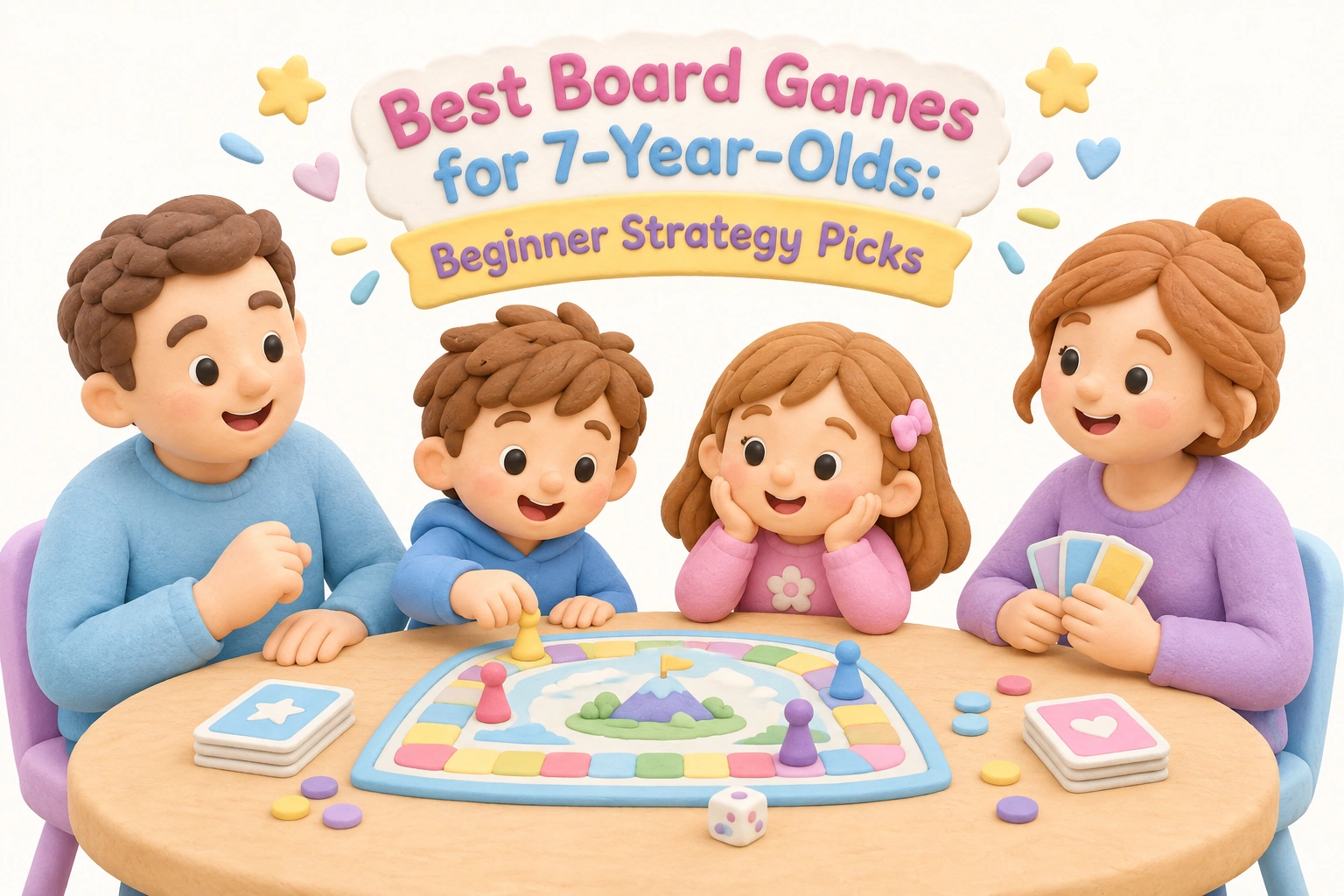
Seven is a genuinely exciting age for board games. Children at this stage are developing the cognitive tools that make strategy meaningful — they can hold a goal across several turns, begin to anticipate an opponent’s moves, and tolerate the tension of not knowing the outcome. The challenge for parents and gift-buyers is finding games that offer real strategic depth without overwhelming a child who is still building patience and planning skills. This guide focuses specifically on beginner strategy games: titles that introduce genuine decision-making while keeping rules accessible and playtime matched to a 7-year-old’s attention span.
Key Takeaways
- Seven-year-olds are cognitively ready for multi-step planning, making this an ideal age to introduce beginner strategy games with simple rules but meaningful choices.
- The best picks balance luck and skill so that less experienced players stay engaged without feeling outmatched.
- A strategy difficulty ladder — from spatial puzzles to resource management — helps children build confidence before moving to more complex games.
- Cooperative games offer a lower-pressure entry point for children who find losing difficult, while competitive games support healthy sportsmanship when introduced thoughtfully.
- Screen-free play through board games may support critical thinking skills, spatial reasoning, working memory, and social development simultaneously.
What Makes a Game a Beginner Strategy Game?
Not every game marketed as “educational” or “for ages 7+” involves genuine strategy. A beginner strategy game has a specific profile: it presents the player with meaningful choices where different decisions lead to different outcomes, but the rules are simple enough to learn in one sitting. Pure luck games — where the dice or spinner entirely determine the result — do not qualify, because the child has no real agency. Pure skill games with complex rule sets can frustrate a 7-year-old before the strategic thinking even begins. The sweet spot is a game with a luck and skill balance that keeps outcomes uncertain while rewarding thoughtful play.
A useful test: after a few plays, does the child start saying things like “next time I’ll try doing this differently” or “I should have blocked you earlier”? That kind of reflection is the hallmark of a genuine strategy experience, and it is exactly the cognitive habit that beginner strategy games are designed to cultivate. Games that prompt this kind of thinking — even in simple form — are doing developmental work that goes well beyond entertainment.
What 7-Year-Olds Can Cognitively Handle
Understanding what is developmentally realistic at age 7 helps narrow the field considerably. Around this age, most children move into what developmental psychologists describe as the concrete operational stage, meaning they can think logically about objects and events they can see and manipulate. In practical game terms, this means a 7-year-old can typically track a goal across multiple turns, understand cause-and-effect relationships within a game system, and begin to consider what another player might do next. Working memory — the ability to hold information in mind while using it — is also expanding, which is why games requiring players to remember a few rules or track a small number of variables become manageable.
Attention span is a real constraint, however. Most 7-year-olds engage best with games lasting between 15 and 30 minutes. Games that run longer can be introduced in stages or with simplified rules, but a playtime mismatch is one of the most common reasons a promising game ends up on a shelf. Emotional readiness also matters: competitive strategy games introduce the experience of losing due to a decision rather than just bad luck, which can feel more personal. This is worth acknowledging when introducing a new game, not as a reason to avoid competition, but as an opportunity to talk about good sportsmanship in a low-stakes setting.
The Strategy Difficulty Ladder: A Progression Path
One of the most useful things a parent can do is think of strategy games as a progression rather than a single category. Moving through levels of complexity builds confidence and prevents the frustration that comes from jumping too far too fast. The three-level framework below is a practical guide, not a rigid system — individual children vary considerably in readiness.
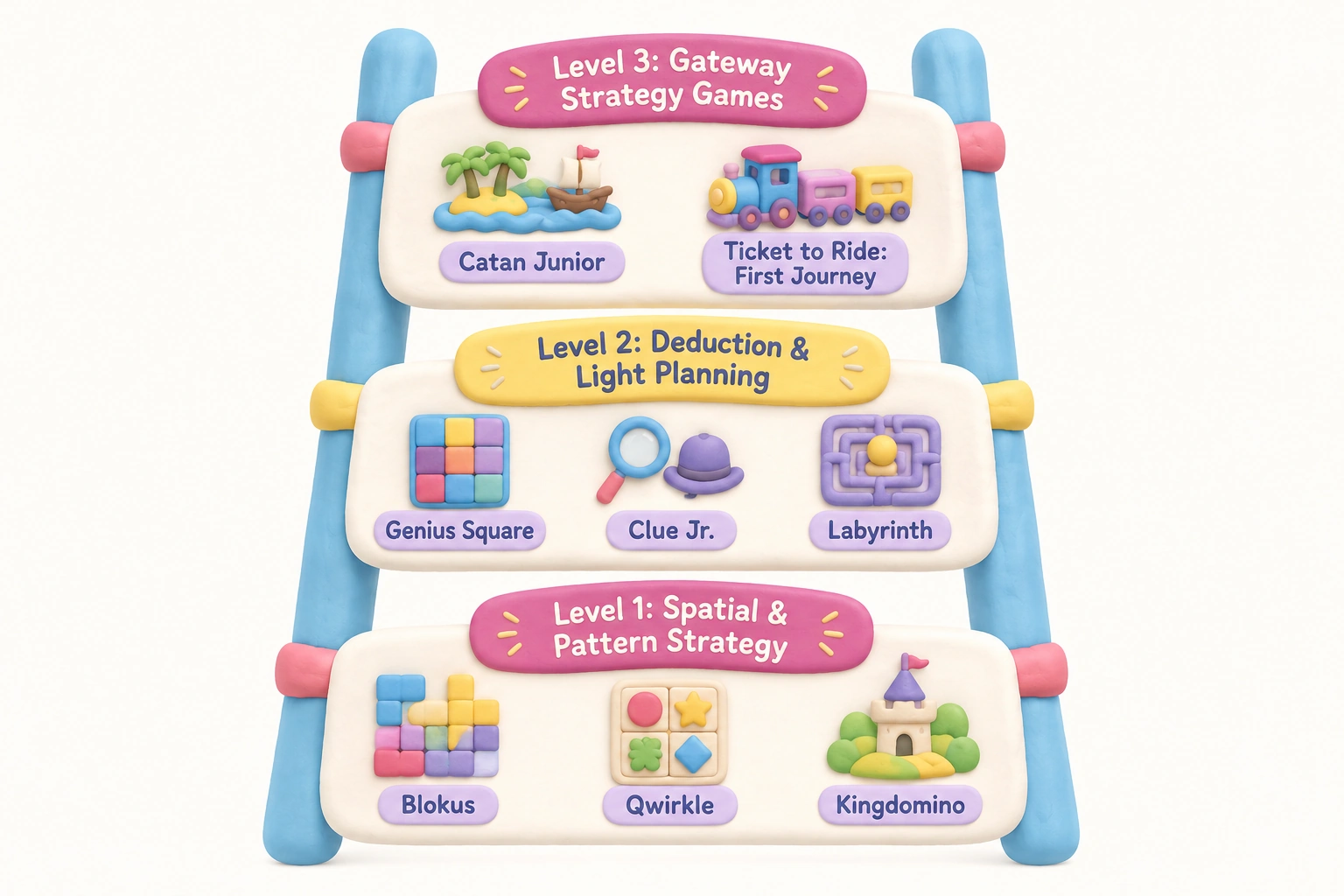
Level 1: Spatial and Pattern Strategy
These games ask players to think about placement, shape, and pattern rather than managing resources or predicting opponent behavior. The strategic thinking is visual and immediate, which makes it highly accessible. Blokus is the classic example: players take turns placing geometric pieces on a grid, trying to claim as much space as possible while blocking others. The rules fit on a single card, but the spatial reasoning required deepens with every game. Qwirkle works similarly, using color and shape matching to build lines on a shared board. Both games develop pattern recognition and spatial awareness without requiring reading or complex rule tracking. Kingdomino adds a light territory-building element — players draft domino-style tiles to build a kingdom — and introduces the idea that each choice affects future options, a foundational strategic concept.
Level 2: Deduction and Light Planning
At this level, games ask players to gather information, eliminate possibilities, and make decisions based on incomplete knowledge. Genius Square is an excellent entry point: players roll dice to determine which squares are blocked, then race to fill the remaining grid with shaped pieces. It builds deductive reasoning and problem-solving in a fast, satisfying format. Clue Jr. introduces the deduction mechanic in a narrative setting, asking players to eliminate suspects and locations — a gentler version of the classic that is well-matched to a 7-year-old’s reading level and attention span. Labyrinth by Ravensburger uses a shifting maze board where players must plan routes while anticipating how other players will change the board — a genuine multi-step planning challenge wrapped in an age-appropriate theme.
Level 3: Gateway Strategy Games
Gateway games are the bridge between beginner-friendly titles and the deeper strategy games that older children and adults enjoy. They introduce mechanics like resource management, route-building, or area control in simplified form. Catan Junior is the most widely recommended gateway game for this age: players collect resources, build ships and hideouts, and trade with a market — all core mechanics of the full Settlers of Catan, but with a pirate theme and streamlined rules that work well for ages 6 and up. Ticket to Ride: First Journey is another strong pick, asking players to collect colored train cards and complete routes across a map. Both games introduce the concept of resource management and planning ahead without overwhelming a new player. Children who enjoy these titles are genuinely ready to explore the full versions of these games within a year or two, making them excellent long-term investments.
Cooperative Strategy Games: A Lower-Pressure Entry Point
Cooperative board games — where all players work together against the game itself rather than against each other — deserve a dedicated mention for 7-year-olds. The cooperative vs. competitive distinction matters developmentally: cooperative games remove the sting of losing to a sibling or parent, which can make the strategic thinking feel safer to explore. Forbidden Island is a well-designed cooperative strategy game where players take on different roles and must coordinate to collect treasures before the island sinks. It introduces role specialization, shared planning, and the concept that different players have different strengths — all valuable social and cognitive experiences. Zombie Kidz Evolution is a legacy-style cooperative game that grows in complexity over multiple sessions, which means it genuinely grows with your child as their strategic thinking develops.
Cooperative games also provide a natural context for discussing strategy out loud. When players are on the same team, they talk through options, weigh trade-offs, and explain their reasoning — which is arguably more cognitively rich than silent competitive play. For children who are still developing emotional regulation around winning and losing, starting with cooperative games and gradually introducing competitive ones is a practical and developmentally sound approach.
Head-to-Head: Catan Junior vs. Ticket to Ride: First Journey
These two titles are the most frequently recommended first gateway strategy games for 7-year-olds, and parents often ask which to choose. Both are excellent, but they suit slightly different children and family contexts.
| Feature | Catan Junior | Ticket to Ride: First Journey |
|---|---|---|
| Core mechanic | Resource collection and trading | Route-building and card collection |
| Player count | 2–4 players | 2–4 players |
| Typical playtime | 30–60 minutes | 15–30 minutes |
| Reading required | Minimal (icons used) | Minimal (color-coded cards) |
| Key skill | Resource management, trading | Planning ahead, route optimization |
| Luck and skill balance | Moderate luck (dice), meaningful choices | Moderate luck (card draw), strong planning element |
| Grows into | Settlers of Catan (full version) | Ticket to Ride (full version) |
| Best for | Children who enjoy trading and negotiation | Children with shorter attention spans; map-lovers |
If a child has a shorter attention span or is new to strategy games entirely, Ticket to Ride: First Journey is the more accessible starting point. Catan Junior rewards children who enjoy the social element of trading and can sustain engagement for a longer session. Both titles have strong replayability, meaning they remain engaging across dozens of plays rather than feeling solved after a few sessions.
Card-Based Strategy Games Worth Considering
Not every strategy game requires a board. Card-based strategy games are often more portable, quicker to set up, and easier to store — practical advantages for families with limited space. Sushi Go! is a drafting game where players pass hands of cards and try to collect the best combinations — a simple rules with strategic depth format that works well for 7-year-olds who can read basic card names. Dragonwood combines card collection with dice rolling to defeat fantasy creatures, introducing the idea of risk assessment: do you strike now with what you have, or wait to build a stronger hand? This kind of probability thinking is an early form of the risk management reasoning that underpins more complex strategy games. Both titles fit comfortably in a bag, making them good options for travel or family visits.
How to Introduce a Strategy Game to a Reluctant Child
Some children resist new games, particularly if they have had frustrating experiences with games that felt too hard or too long. A few practical approaches can make the introduction smoother. First, start with a shorter, visually engaging game rather than the most strategically rich option — success and enjoyment in the first session matter more than depth. Second, play the first game cooperatively even if the game is competitive: explore the rules together without keeping score, so the child understands the mechanics before the stakes feel real. Third, narrate your own thinking out loud during play: “I’m going to place my piece here because it blocks two of your routes” models strategic reasoning in a natural, non-instructional way. Finally, keep early sessions short and end on a positive note, even if the game is not finished — a child who associates a game with fun is far more likely to want to play again.
Handling losing is a related challenge. When a 7-year-old loses a strategy game, the experience can feel more personal than losing a luck-based game, because they may sense that a different decision could have changed the outcome. Acknowledging this directly — “that was a tough game, what do you think you might try differently next time?” — reframes losing as information rather than failure. This kind of reflection is also where much of the cognitive benefit of strategy games actually lives.
Games That Grow With Your Child
One of the most practical considerations for parents is longevity. A game that a 7-year-old outgrows within six months represents poor value; a game that remains engaging at age 9, 10, or beyond is a much better investment. Several of the titles mentioned in this guide have strong longevity. Blokus remains genuinely competitive for adults. Forbidden Island scales in difficulty through its adjustable flood level. Catan Junior and Ticket to Ride: First Journey serve as explicit stepping stones to their full adult versions. Zombie Kidz Evolution uses a legacy mechanic — unlocking new content over multiple sessions — that keeps the game fresh for months.
Abstract strategy games like Blokus and Qwirkle also have the advantage of growing with the child’s skill rather than their age: a more experienced player simply plays better, rather than needing a more complex game. This makes them particularly good choices for mixed-age family groups where a 7-year-old and a 12-year-old might play together without either feeling bored or overwhelmed.
Independent Play and Two-Player Options
Parents sometimes need games that children can play without adult involvement — with a sibling, a friend, or even solo. Most of the games in this guide work well as two-player games, though some are better suited to it than others. Blokus has a specific two-player variant. Genius Square is designed as a race between two players and works particularly well in that format. Ticket to Ride: First Journey plays smoothly with two players. For solo play, puzzle-style strategy games like Rush Hour — where a child must slide vehicles to free a target car from a traffic jam — offer genuine strategic challenge without requiring a second player. Rush Hour develops deductive reasoning and multi-step planning in a self-contained format that a 7-year-old can engage with independently.
Buying Checklist: Choosing the Right Game
Before purchasing, it helps to run through a short set of practical questions matched to the specific child and family context.
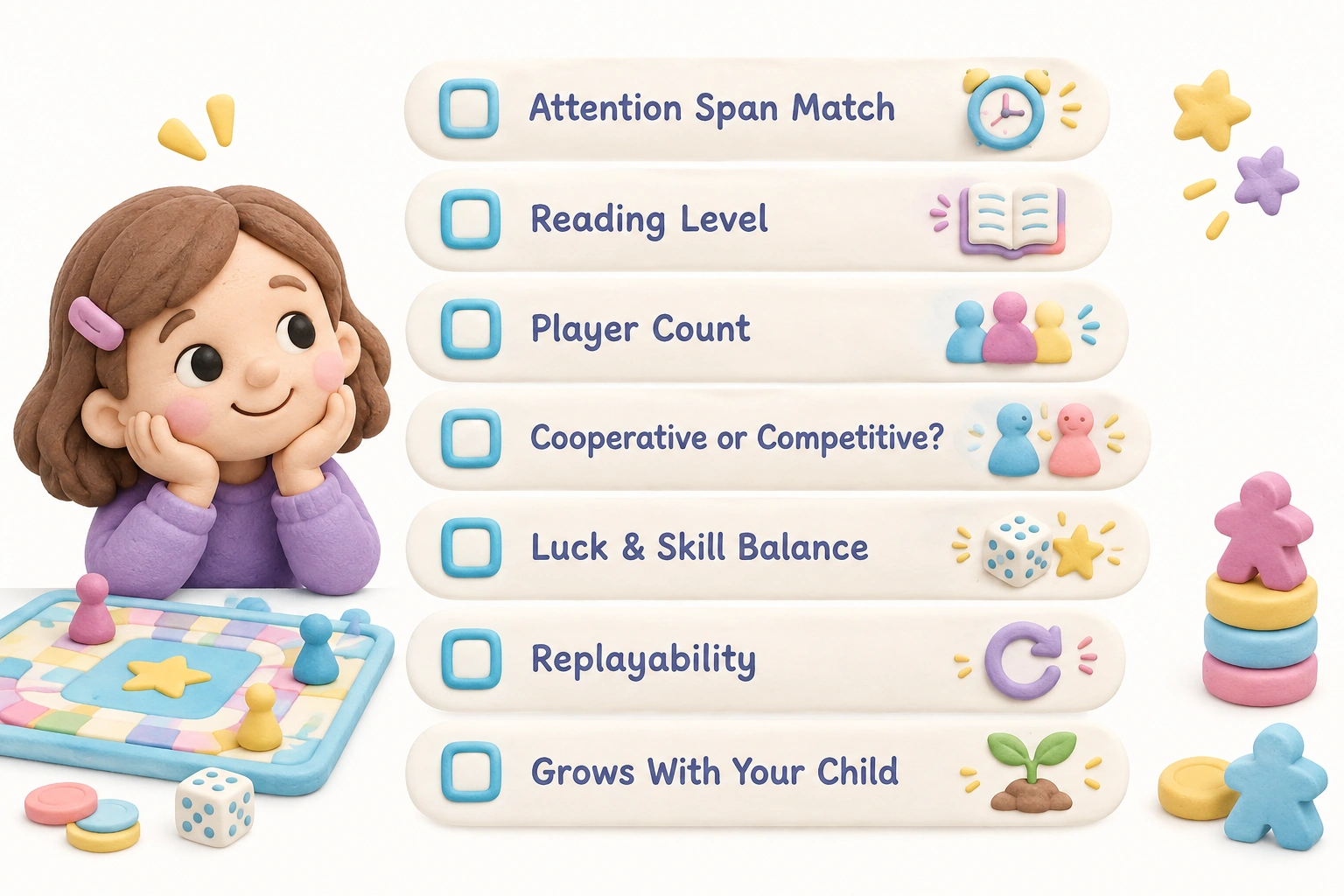
- Attention span match: Is the typical playtime between 15 and 30 minutes, or does the game allow for shorter sessions?
- Reading level: Does the game rely on text, or does it use icons, colors, and images that a 7-year-old can navigate independently?
- Player count: Does the game work well with the number of people who will typically play — two siblings, a family of four, or a larger group?
- Cooperative or competitive: Is the child emotionally ready for competitive play, or would a cooperative game be a better starting point?
- Luck and skill balance: Does the game include enough luck to keep outcomes uncertain, while still rewarding thoughtful decisions?
- Replayability: Will the game feel different across multiple plays, or will it feel solved quickly?
- Grows with your child: Will the game remain engaging as the child’s strategic thinking develops over the next two to three years?
Developmental Benefits of Strategy Board Games
The developmental case for strategy board games at age 7 is reasonably well-supported, though it is worth being precise about what the evidence does and does not show. Regular engagement with strategy games may support critical thinking skills, spatial reasoning, and working memory — cognitive domains that are actively developing during middle childhood. The turn-based structure of board games also provides natural practice in inhibitory control: waiting for your turn, resisting the impulse to act immediately, and thinking before moving are all forms of self-regulation that matter beyond the game table.
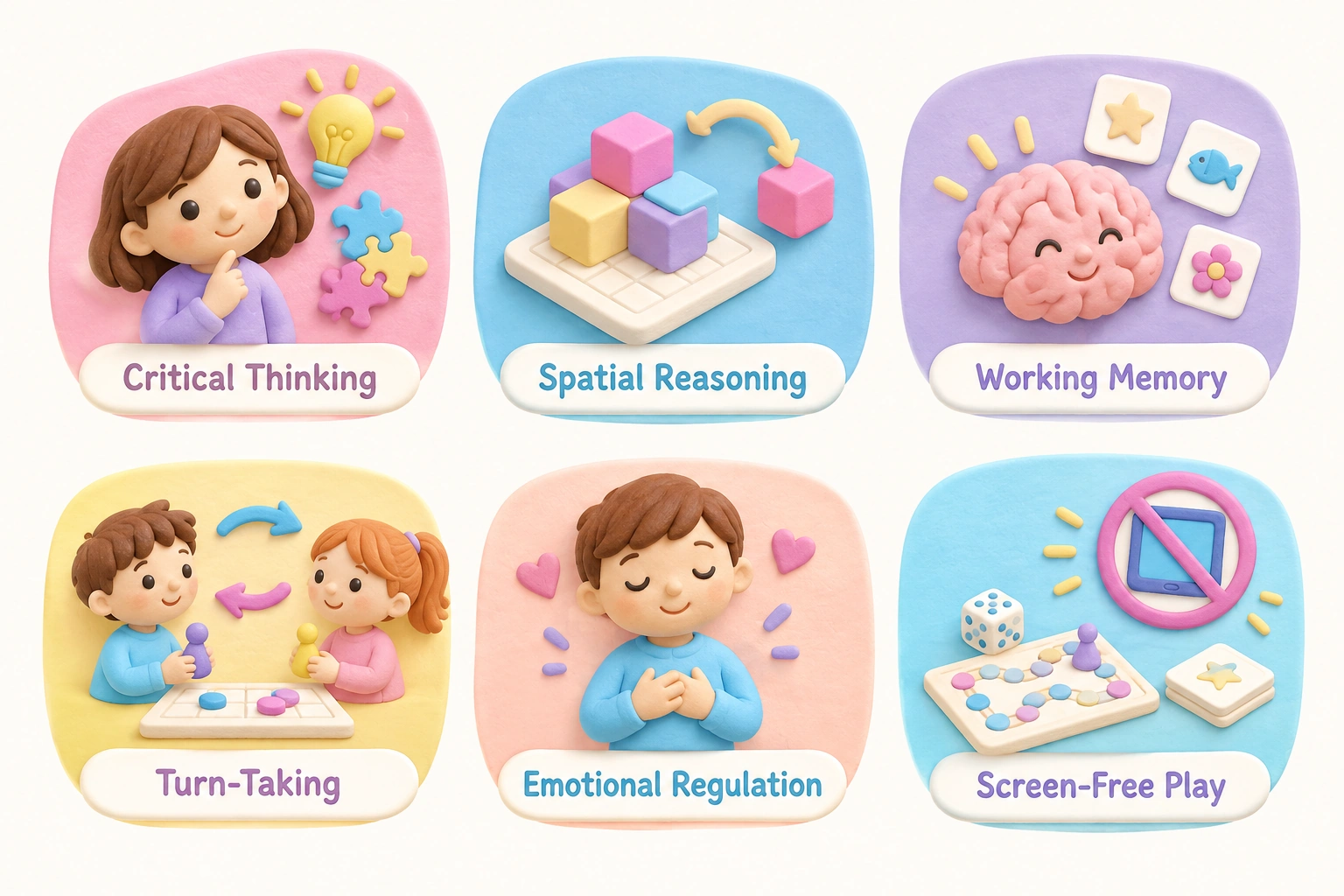
Social development is another meaningful dimension. Board games create structured opportunities for turn-taking, communication, negotiation (in trading games), and managing the emotional experience of competition. These are not trivial skills — they are the same interpersonal capacities that children use in classroom group work, friendships, and eventually professional settings. Screen-free play through board games also provides a counterbalance to passive digital consumption, offering an interactive, social, and cognitively demanding alternative that does not carry the concerns associated with unstructured screen time. That said, board games are not a developmental intervention, and outcomes vary considerably by child, family context, and how games are introduced and played.
Frequently Asked Questions
What is the difference between a strategy game and a luck-based game for kids?
A strategy game gives the player meaningful choices where different decisions lead to different outcomes. A luck-based game — like Snakes and Ladders — is determined almost entirely by dice or spinners, leaving the player with little real agency. Most good beginner strategy games for 7-year-olds include some luck to keep outcomes uncertain, but reward players who think ahead. The key question is: does the child’s decision-making actually affect the result?
How long should a board game session be for a 7-year-old?
Most 7-year-olds engage best with games lasting between 15 and 30 minutes. Longer games can work if the child is particularly engaged, but a playtime mismatch is one of the most common reasons games are abandoned. When introducing a new game, it is often worth playing a shorter practice round before committing to a full session.
Should I start with a cooperative or competitive game?
Either can work, but cooperative games are often a gentler entry point for children who are still developing emotional regulation around winning and losing. Competitive games are valuable too — they build sportsmanship and resilience — but introducing them after a child has some positive game experience tends to go more smoothly.
Can a 7-year-old play strategy games independently or with a sibling without adult help?
Many of the games in this guide work well between two children without adult involvement, particularly after the rules have been learned together. Two-player games like Blokus, Genius Square, and Ticket to Ride: First Journey are well-suited to sibling play. Solo puzzle games like Rush Hour offer independent strategic challenge without requiring a second player.
At what age can children move from beginner strategy games to more complex ones?
This varies considerably by child. Many 7-year-olds who have played gateway games like Catan Junior or Ticket to Ride: First Journey for six months to a year are ready to try the full adult versions by age 8 or 9. The best indicator is not age but engagement: if a child is consistently winning beginner games and asking for more challenge, it is a good sign they are ready to move up the strategy ladder.
Do board games actually help with school skills?
Board games may support cognitive skills that overlap with school learning — including working memory, pattern recognition, deductive reasoning, and early numeracy — but they are not a substitute for direct instruction. The benefit is more likely to come from the general cognitive engagement and social practice that games provide rather than from direct skill transfer. Outcomes vary by child and by how games are played.
Which Strategy Game Is the Right Starting Point for Your Child?
The best beginner strategy game for a 7-year-old is the one that matches their current attention span, emotional readiness, and interest — not necessarily the one with the most developmental credentials. For a child who is new to strategy games entirely, a Level 1 spatial game like Blokus or Qwirkle offers an accessible and genuinely engaging entry point. For a child who has some game experience and can sustain a 30-minute session, a gateway game like Catan Junior or Ticket to Ride: First Journey introduces the resource management and planning mechanics that underpin more complex strategy games. For a child who finds competitive play stressful, a cooperative game like Forbidden Island provides the strategic thinking without the interpersonal pressure.
The strategy difficulty ladder is a useful frame, but it is not a prescription. Some children will skip levels; others will return to simpler games even after mastering more complex ones. What matters most is that the game creates genuine engagement, prompts real decision-making, and leaves the child wanting to play again. A game that achieves those three things — regardless of where it sits on any developmental framework — is doing exactly what a good board game should do. Starting with one well-chosen title and building from there is a more effective approach than buying a large collection at once. The goal is a child who associates strategic thinking with enjoyment, because that association is what makes the cognitive benefits sustainable over time.

Take a short quiz to find out what your everyday choices say about your parenting style
When your child is curious about something new, what’s your instinct?
Take a short quiz to find out what your everyday choices say about your parenting style
“Can I download this app?” What happens next?
Take a short quiz to find out what your everyday choices say about your parenting style
When it comes to rules at home, which sounds most like you?
Take a short quiz to find out what your everyday choices say about your parenting style
If you could give your child one life skill today, what would you pick?
Take a short quiz to find out what your everyday choices say about your parenting style
Your child gets to choose what to watch. What would your ideal setup look like?
Take a short quiz to find out what your everyday choices say about your parenting style
Pick your parenting superpower ✨