Best Board Games for 8-Year-Olds: Teamwork and Challenge

 Discover a Free Education Video App for Kids
Pastory uses AI to personalize educational video content based on your child’s interests and personality. Safe, engaging, and built for curious young minds. Sign up now to stay updated and enjoy early access with a free trial
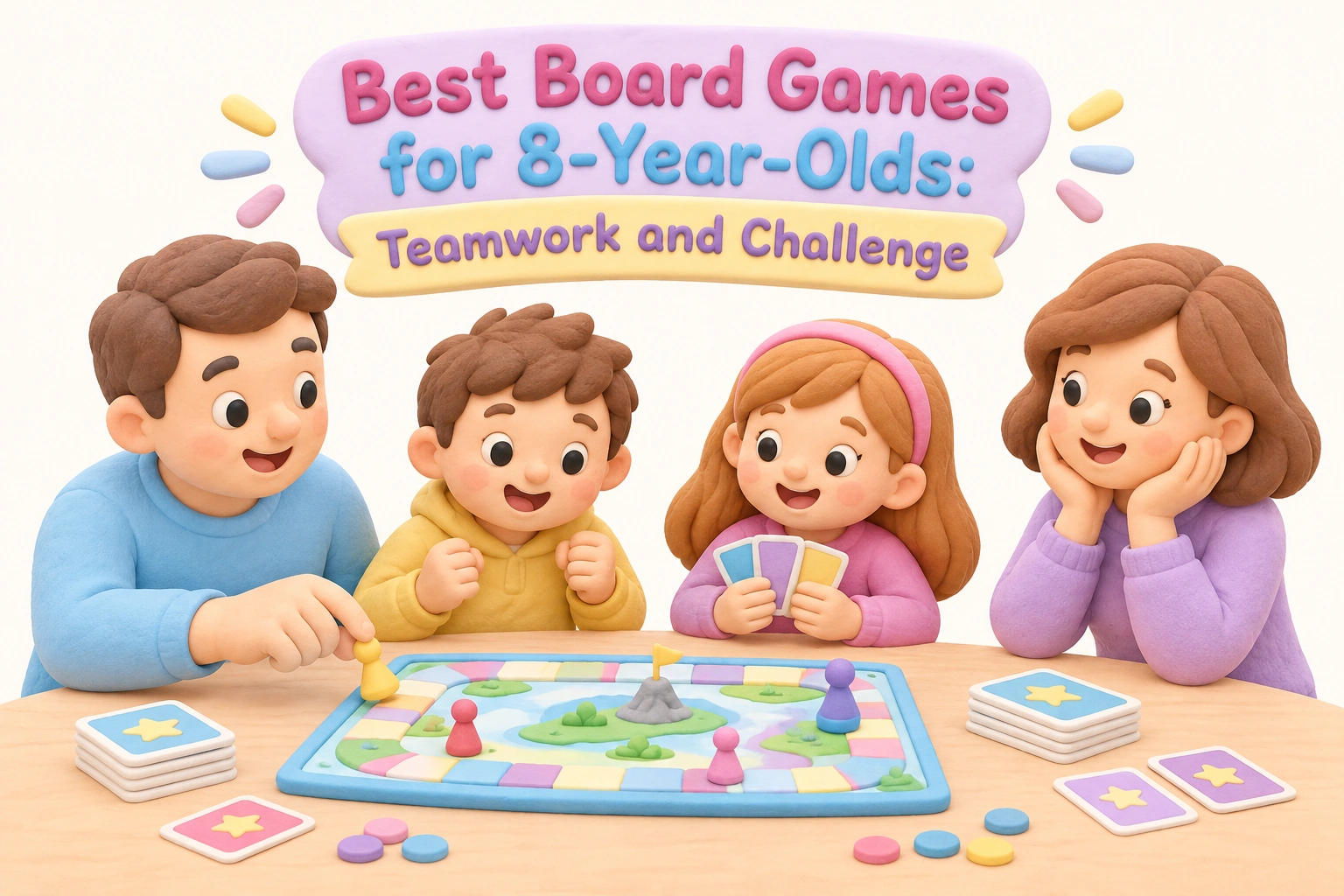
Eight-year-olds sit at a particularly rewarding stage for board games: they can follow multi-step rules, sustain attention through a full game, and begin to think strategically about consequences a few moves ahead. Whether you are looking for a cooperative board game that brings the family together or a strategy game that stretches a child’s critical thinking, the right choice at this age can support meaningful cognitive and social-emotional development — and make family game night something children genuinely look forward to.
Key Takeaways
- Cooperative board games, where all players win or lose together, are especially well-suited to ages 8 and up because they build teamwork and communication without the sting of direct competition.
- Strategy games at this age may support critical thinking, deductive reasoning, and planning skills, though outcomes vary by child and depend on how engaged caregivers are during play.
- Age ratings on boxes are guidelines, not guarantees — a child’s reading level, prior game experience, and temperament matter more than the number printed on the box.
- Scalable difficulty, replayability, and a manageable play time are the most practical features to look for when choosing a game for an 8-year-old.
- Board games offer a screen-free environment for practising social-emotional skills such as turn-taking, losing gracefully, and adapting when a plan is not working.
Why Board Games Matter at Age Eight
Around age eight, children enter a phase of cognitive development that psychologists often describe as the concrete operational stage. They can hold multiple pieces of information in mind simultaneously, understand cause and effect more reliably, and begin to appreciate another player’s perspective. These emerging abilities make board games far more than entertainment: they provide a structured, low-stakes environment in which children can practise strategic thinking, negotiate with teammates, and manage the emotional experience of uncertainty and loss.
Research in developmental psychology consistently links play-based activities that involve rules, social interaction, and problem-solving to gains in executive function — the cluster of mental skills that includes planning, flexible thinking, and impulse control. Board games, particularly cooperative ones, naturally exercise these capacities. When a child must decide whether to use a resource now or save it for later, or must listen to a teammate’s suggestion before acting, they are practising exactly the kind of regulated, goal-directed thinking that supports broader learning.
There is also a meaningful social-emotional skills dimension. Learning to lose without melting down, analysing what went wrong after a failed round, and celebrating a teammate’s contribution rather than seeking individual glory are all emotional regulation skills. Board games provide a repeatable, low-stakes context in which children can practise these responses with caregiver support nearby — something that screens and solo digital play rarely replicate.
Cooperative vs. Competitive: Choosing the Right Dynamic
One of the most important decisions when selecting board games for 8-year-olds is whether to choose a cooperative board game, a competitive game, or something in between. Each structure offers different developmental opportunities and suits different family situations.
A fully cooperative board game uses an all-win or all-lose structure: every player works together against the game itself rather than against each other. This format eliminates the disappointment of being singled out as the loser and naturally encourages communication, shared planning, and teamwork. Games like Forbidden Island, Ghost Fightin’ Treasure Hunters, and Outfoxed! are well-regarded examples that work well for ages 8 and up. The cooperative format is particularly valuable for reluctant board gamers — children who have had negative experiences with losing — because the emotional stakes feel shared rather than personal.
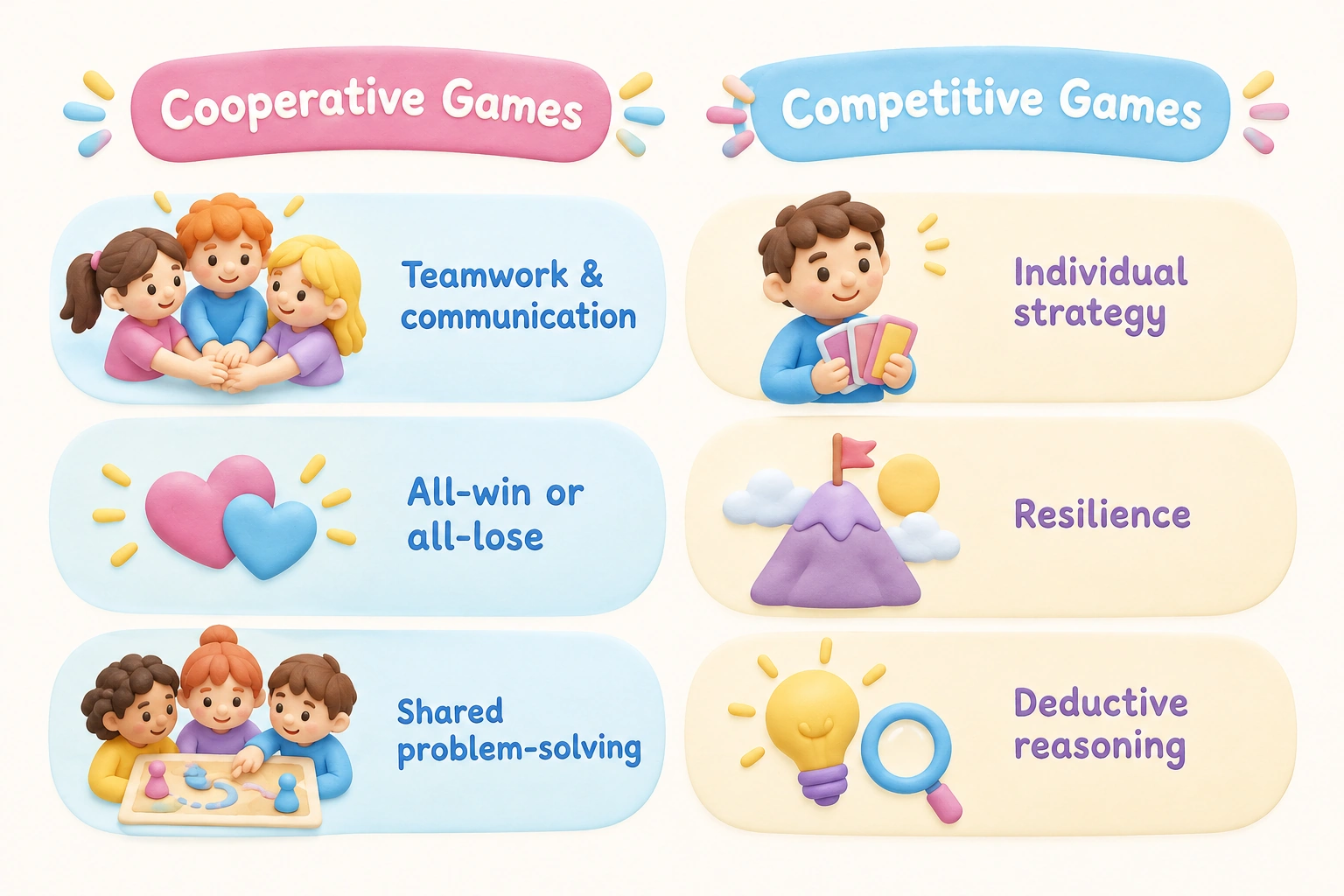
Competitive games, by contrast, introduce the healthy challenge of individual strategy and the experience of winning and losing directly. Games such as Kingdomino, Blokus, Ticket to Ride: First Journey, and Carcassonne ask players to think independently, read opponents’ moves, and adapt their plans. These games can build deductive reasoning and spatial reasoning effectively, but they require a child who can manage the emotional experience of being outplayed without significant distress.
A third category — semi-cooperative or team-vs-team games — sits between the two. Some games include a hidden traitor or one-vs-all mechanic. These are generally better suited to children with more game experience and stronger emotional regulation, as the social complexity can feel overwhelming for an 8-year-old encountering the format for the first time.
The Alpha Player Problem in Cooperative Games
One challenge that parents rarely read about before buying a cooperative board game is the so-called alpha player problem. In a fully cooperative game, it is possible for one confident or experienced player — often an older sibling, parent, or simply the most assertive child — to effectively direct everyone else’s moves. When this happens, the other players become passive participants rather than active decision-makers, which undermines the teamwork and critical thinking benefits the game is meant to provide.
There are practical ways to manage this. Some games are specifically designed to prevent it: 5-Minute Dungeon uses real-time card play that is too fast for any single player to control, and The Mind requires silent coordination that makes individual dominance structurally impossible. For games that are more vulnerable to the alpha player dynamic, caregivers can introduce a house rule that each player must propose their own action before the group discusses it, or that no player may tell another player what to do — only share information. Framing this as part of the game’s challenge, rather than a correction, tends to work well with 8-year-olds.
Best Cooperative Board Games for 8-Year-Olds
The following games are widely recommended for children ages 8 and up based on their mechanics, accessibility, and developmental fit. Play time estimates reflect real-world sessions with an 8-year-old, including setup and a brief rules explanation, which typically adds 10–15 minutes beyond the box estimate.
Forbidden Island
Forbidden Island is a gateway game for cooperative play that introduces tile placement, resource management, and collective decision-making. Players work together to collect treasures before the island sinks beneath them. It features scalable difficulty — four named difficulty levels from Novice to Legendary — making it easy to start gently with an 8-year-old and increase the challenge as confidence grows. Player count is 2–4, and a typical session runs 30–45 minutes. No reading is required beyond card names, which are simple. Replayability is high because the modular board creates a different island layout each game.
Ghost Fightin’ Treasure Hunters
This game is a strong choice for younger 8-year-olds or those new to cooperative play. Players collect jewels and fight ghosts together before the haunted house fills up. The theme is engaging without being frightening, the rules are genuinely easy to learn, and the all-win or all-lose outcome keeps the emotional stakes shared. Player count is 2–4, and play time is typically 30 minutes. It requires no reading, which makes it accessible for children who are still developing fluency.
Outfoxed!
Outfoxed! is a cooperative deduction game in which players work together to identify which fox stole a pot pie before the culprit escapes. It introduces deductive reasoning in a structured, child-friendly format and is genuinely engaging for adults playing alongside children. The game plays in around 20 minutes, supports 2–4 players, and requires no reading. It functions well as a gateway game for children who enjoy mystery or puzzle-style thinking.
Castle Panic
Castle Panic is a cooperative tower-defence game in which players defend a castle against waves of monsters. It introduces slightly more complex strategic thinking than the games above — players must manage hand cards, trade resources, and prioritise threats — making it a good step up for 8-year-olds who have already played simpler cooperative games. Player count is 1–6, play time is 45–60 minutes, and some card reading is required, though the vocabulary is straightforward.
5-Minute Dungeon
This real-time card game requires players to defeat dungeon bosses together within a five-minute timer. The time pressure naturally prevents any single player from dominating decisions, which makes it one of the most effective games for genuinely practising teamwork under pressure. It is fast, loud, and exciting — well-suited to children who find slower games difficult to sustain. Player count is 2–5. Because rounds are so short, it also works well as a birthday party game.
Best Strategy Board Games for 8-Year-Olds
Strategy games for this age group work best when the rules are easy to learn but the decisions remain interesting across multiple plays — the classic easy to learn, hard to master quality that keeps both children and adults engaged at the same table.
Kingdomino
Kingdomino is a tile-placement game in which players build kingdoms by selecting and placing domino-style tiles. It introduces spatial reasoning and forward planning in a format that takes around 15–20 minutes to play. The rules can be explained in under five minutes, and the game scales well from 2–4 players. It is an excellent transition game for children moving from simple family games toward more complex strategy titles.
Blokus
Blokus is a spatial reasoning game in which players place coloured pieces on a grid, each piece touching only the corners of their own previous pieces. It is competitive, visually intuitive, and requires no reading. The game develops pattern recognition and geometric thinking in a format that is accessible to children and adults alike. Player count is 2–4, and play time is typically 20–30 minutes. Replayability is very high because no two games unfold identically.
Ticket to Ride: First Journey
This is the child-friendly version of the popular Ticket to Ride series. Players collect train cards and claim routes across a map to complete destination tickets. It introduces route planning, resource collection, and mild competitive strategy in a format designed specifically for ages 6 and up, making it genuinely accessible to most 8-year-olds. Play time is around 30 minutes, and it supports 2–4 players. It functions well as a transition game toward the full adult version of Ticket to Ride.
Carcassonne
Carcassonne is a tile-placement and area-control game in which players build a medieval landscape and score points by completing cities, roads, and fields. It is slightly more complex than the games above and works best with 8-year-olds who already have some board game experience. The game rewards strategic thinking and observation, and its modular tile system gives it excellent replayability. Player count is 2–5, and play time is typically 35–45 minutes.
Scalable Difficulty and House Rules: Making Games Work for Your Child
Many of the best board games for 8-year-olds include built-in scalable difficulty settings, but parents can also adjust games informally to match a child’s current level. For cooperative games like Forbidden Island or Pandemic Hot Zone, starting on the easiest difficulty setting is strongly recommended for first-time players aged 6–8. This allows children to learn the mechanics and experience the satisfaction of winning before the challenge is increased.
For competitive games, house rules can level the playing field when an 8-year-old is playing with older siblings or adults. Common adjustments include giving the youngest player an extra starting resource, allowing the child to take back one move per game, or playing with open hands for the first few rounds while everyone learns. These modifications preserve the game’s structure while reducing the frustration that can make a child reluctant to play again.
Realistic play time is worth considering before purchase. Box estimates are typically optimistic. With an 8-year-old, add 10–15 minutes for setup and rules explanation, and expect occasional pauses for questions or disagreements. A game listed as 30 minutes will often run 40–50 minutes in practice. This is not a problem — it is simply useful to know before committing to a game on a school night.
Mixing Age Groups: Games That Work Across Generations
One underappreciated quality in a board game for an 8-year-old is how well it works when the player count includes younger siblings, grandparents, or adults who are not regular gamers. Games that are genuinely fun for a wide age range tend to get played more often, which increases the developmental benefit simply through repetition.
Sequence is a card-and-board game that has been played comfortably by 8-year-olds and adults in their seventies at the same table, because the rules are simple but the decisions remain interesting. Qwirkle similarly requires no reading and rewards pattern recognition in a way that is accessible to young children and satisfying for adults. Dixit uses illustrated cards and creative storytelling, making it one of the most genuinely cross-generational games available — it rewards imagination rather than prior game knowledge, which levels the playing field between children and adults.
When selecting a game for mixed-age groups, prioritise low reading requirements, short play time, and mechanics that reward different types of thinking rather than a single dominant strategy. This prevents older players from having a structural advantage that makes the game feel unfair to the 8-year-old.
Board Games as a Screen-Free Alternative
For many families, the appeal of board games is partly about what they replace. Children aged 8 are often spending significant time with screens — for entertainment, communication, and increasingly for learning — and parents looking for screen-free activities that are genuinely engaging rather than merely educational in a dutiful sense will find that well-chosen board games meet that need effectively.
Unlike passive screen consumption, board games require active participation: players must make decisions, communicate, respond to other players, and manage their emotional reactions in real time. Unlike many educational apps, board games do not adapt to keep a child engaged through algorithmic reward loops — the engagement must come from the game itself and from the social experience of playing with others. This distinction matters developmentally, because it places the child in a more active, self-directed role.
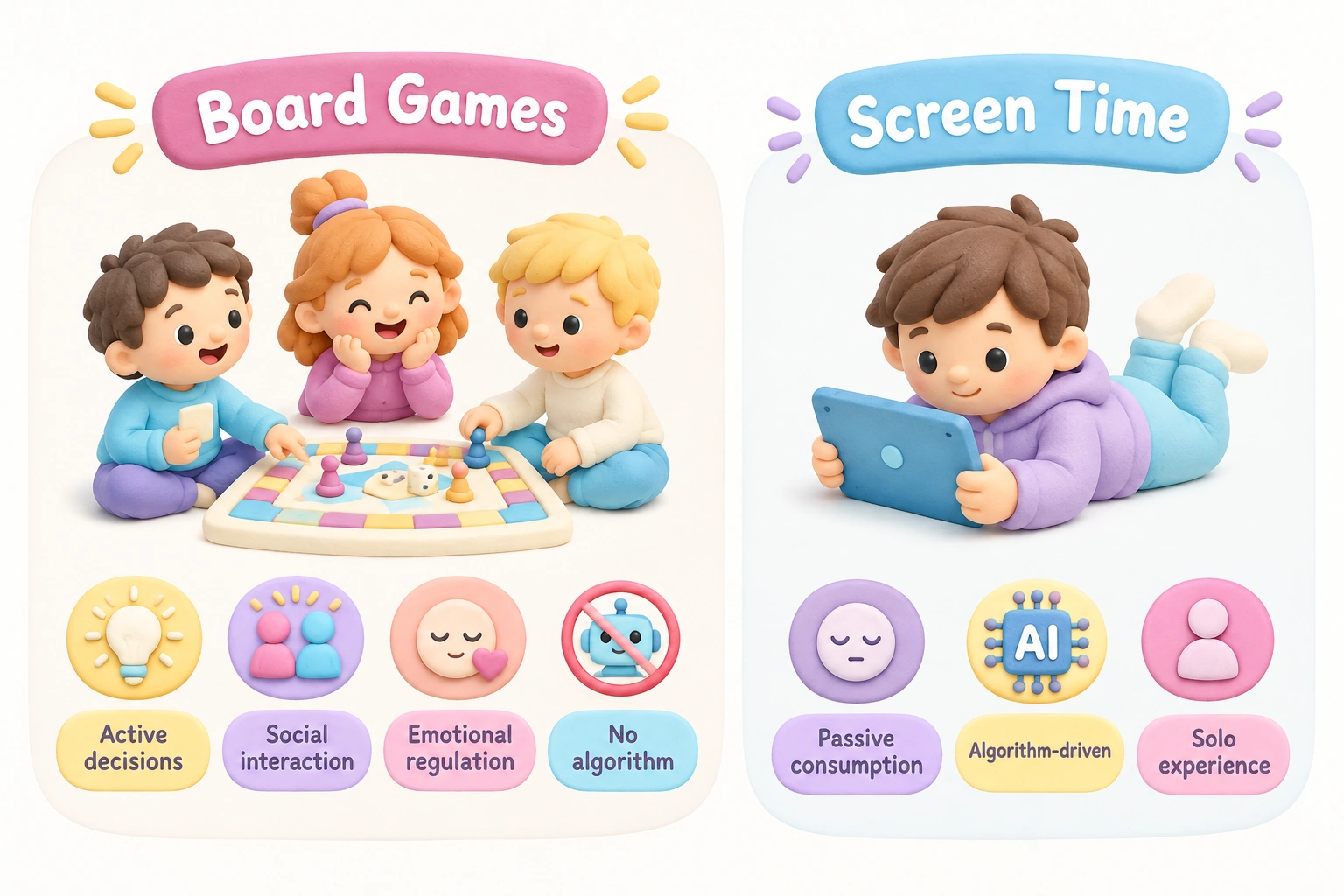
The social interaction dimension is particularly significant. Board games create natural opportunities for conversation, negotiation, and shared problem-solving that are difficult to replicate in digital environments. For families who want to reduce screen time without simply removing it, establishing a regular family game night around a rotating selection of cooperative and strategy games is a practical and evidence-consistent approach.
How to Choose the Right Game: A Practical Framework
Before purchasing a board game for an 8-year-old, it helps to work through a short set of practical questions rather than relying solely on age ratings or online rankings.
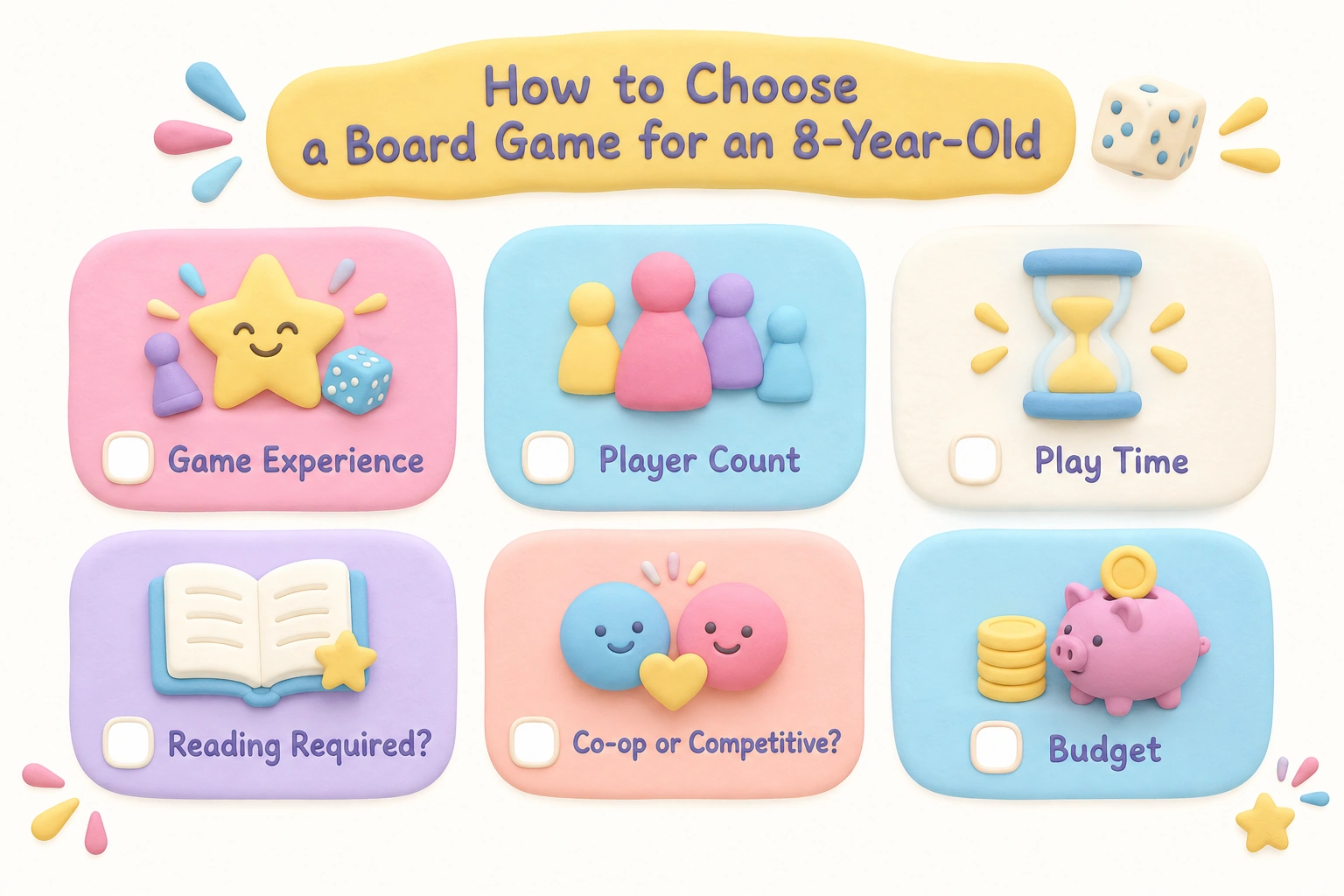
- What is the child’s game experience? A child new to board games will benefit from a gateway game with simple rules. An experienced player may be ready for more complex mechanics.
- What is the player count? Check whether the game works well at the number of players you actually have. Some games are significantly better at specific player counts.
- How long is the realistic play time? Consider when you will typically play — after school, on weekends, at parties — and choose a play time that fits.
- Is reading required? If the child is still developing reading fluency, prioritise games with no reading required or minimal text.
- Does the child prefer cooperation or competition? Some children find cooperative games more enjoyable; others are motivated by individual challenge. Both are valid.
- What is the budget? Many excellent games for 8-year-olds are available for under £20–£25. More complex games with higher replayability often justify a higher price point as a birthday gift for 8-year-olds or a holiday present.
- Will adults enjoy it too? Games that adults find genuinely engaging get played more often, which benefits the child more than a game that parents tolerate.
Frequently Asked Questions
What is the best cooperative board game for an 8-year-old who has never played one before?
Outfoxed! and Ghost Fightin’ Treasure Hunters are both strong starting points. Both require no reading, play in under 30 minutes, and use an all-win or all-lose structure that makes the cooperative dynamic immediately clear. Forbidden Island is a good next step once a child is comfortable with the cooperative format.
At what age can children start playing cooperative board games?
Many cooperative games are designed for ages 5 and up, but the ability to genuinely participate in shared strategy — rather than simply following instructions — typically develops more reliably around age 7–8. Age ratings are guidelines; a child’s temperament, attention span, and prior game experience matter more than the number on the box.
Can 8-year-olds play adult board games?
Some adult games are accessible to experienced 8-year-olds, particularly those with straightforward mechanics like Carcassonne or the full version of Ticket to Ride. Games rated 10 and up generally involve longer rulebooks, more complex decisions, or reading-heavy components that benefit from a parent reading aloud and playing alongside the child. The child’s individual readiness is a better guide than the age rating alone.
Are cooperative board games better than competitive ones for teaching social skills?
Cooperative and competitive games develop different but complementary social-emotional skills. Cooperative games are particularly effective for practising communication, shared decision-making, and managing collective failure. Competitive games build resilience, individual strategic thinking, and the ability to lose gracefully. A mix of both formats over time is likely more beneficial than exclusively choosing one type.
What makes a board game good for a birthday party with 8-year-olds?
For a party setting, prioritise games with a higher player count, a short play time (under 30 minutes), simple rules that can be explained quickly, and a format that keeps all players active rather than waiting for their turn. 5-Minute Dungeon, Outfoxed!, and Sushi Go Party are frequently recommended for this context.
How do I stop one child from taking over a cooperative game?
Introduce a house rule that each player must propose their own action before the group discusses it, and that no player may directly tell another player what move to make — they can only share information. Some games, like 5-Minute Dungeon and The Mind, are structurally designed to prevent this problem. Framing the rule as part of the game’s challenge rather than a correction tends to be more effective with children this age.
Which Board Game Is the Right Fit for Your 8-Year-Old?
The best board game for an 8-year-old is ultimately the one that gets played repeatedly — and that means finding a game that matches the child’s temperament, the family’s available time, and the social context in which it will be used. A cooperative board game like Forbidden Island or Outfoxed! is a reliable starting point for most families, particularly if the goal is to build teamwork and make family game night feel genuinely collaborative. Strategy games like Kingdomino or Blokus are excellent choices for children who enjoy individual challenge and spatial thinking.
Whatever game you choose, the developmental benefits — critical thinking, social-emotional skills, deductive reasoning, and the ability to adapt when a plan is not working — are most likely to emerge when caregivers play alongside children rather than simply setting up the game and stepping away. The conversation that happens around the table, the shared problem-solving, and the modelling of how to respond to setbacks are as valuable as the game mechanics themselves. Starting with one well-chosen gateway game and building a small collection over time is a more sustainable approach than purchasing many games at once, and it gives each game the repeated play it needs to deliver its full developmental value.

Take a short quiz to find out what your everyday choices say about your parenting style
When your child is curious about something new, what’s your instinct?
Take a short quiz to find out what your everyday choices say about your parenting style
“Can I download this app?” What happens next?
Take a short quiz to find out what your everyday choices say about your parenting style
When it comes to rules at home, which sounds most like you?
Take a short quiz to find out what your everyday choices say about your parenting style
If you could give your child one life skill today, what would you pick?
Take a short quiz to find out what your everyday choices say about your parenting style
Your child gets to choose what to watch. What would your ideal setup look like?
Take a short quiz to find out what your everyday choices say about your parenting style
Pick your parenting superpower ✨