30+ Climate Change Projects for Kids: Activities by Theme

 Discover a Free Education Video App for Kids
Pastory uses AI to personalize educational video content based on your child’s interests and personality. Safe, engaging, and built for curious young minds. Sign up now to stay updated and enjoy early access with a free trial

Climate change projects for kids make a complex global topic approachable, giving children real ways to explore, experiment, and take action. This collection brings together more than 30 hands-on ideas organized by theme — from greenhouse effect experiments and renewable energy builds to nature-based activities, games, and classroom lesson packs.
Whether you are a teacher planning a unit or a parent looking for meaningful projects at home, the ideas here are grouped to help you find the right fit quickly. The goal is to build genuine understanding, spark curiosity, and help children feel confident that their actions matter.
Key Takeaways
- This article covers 30+ climate change projects for kids organized across science, art, nature, games, and community action themes.
- Activities include greenhouse effect experiments, ice melt simulations, renewable energy model building, and carbon footprint challenges.
- Games and interactive activities — including board games, carbon cycle games, and digital simulations — make climate learning engaging for different ages.
- Nature-based projects such as tree-planting campaigns and school garden activities connect kids to climate action outdoors.
- Teaching resources, printable worksheets, and grade-based lesson packs are included to support classroom use.
Climate Change Timeline Activities

Historical Climate Events Visualization
To help kids grasp the “long view” of our planet, have them create a visual timeline. Use a long roll of paper to map out major shifts like the Ice Ages and the Medieval Warm Period. Students will learn that while the Earth’s temperature has always fluctuated, the current rate of global warming is occurring much faster than many past natural changes. Use blue tones for cooling periods and red for warming to make weather and climate trends more visually clear.
Human Impact Milestones
This activity focuses on how human activities have accelerated changes. Students create markers for the Industrial Revolution, the first use of coal and oil, and the rise of the automobile. By visualizing the correlation between industrial growth and rising carbon dioxide levels, young learners begin to see the “why” behind the climate crisis.
Classroom Timeline Projects
In a school setting, a collaborative wall display works best. Assign different groups to research specific environmental agreements, such as the Paris Agreement, or the founding of the World Wildlife Fund (WWF). This approach encourages teamwork and provides a permanent visual reminder of our global journey toward climate action.
Carbon Footprint Activities
Carbon Footprint Calculating Games
A carbon footprint activity doesn’t have to involve complex math. For younger kids, use “carbon footprints” cut out of paper. Assign “points” for daily actions: taking a long shower, leaving lights on, or frequent meat consumption. The larger the pile of paper feet, the larger the carbon footprint. It’s a fantastic way to engage them in ways to reduce their impact.
Classroom Carbon Reduction Challenges
Turn climate action into a friendly competition. Create a scheme of work where classrooms compete to see who can produce the least waste or use the least electricity over a month. This provides students with a sense of collective responsibility.
Home Carbon Habits Tracking
Provide a worksheet or digital tracker for kids to use at home. They can check off boxes for using public transport, turning off the tap while brushing teeth, or practicing recycling. This helps children become more aware of everyday environmental choices.
| Activity | Impact Level | Difficulty |
| Meatless Mondays | High | Easy |
| Walking to School | Medium | Medium |
| Unplugging Devices | Low | Very Easy |
Weather and Climate Activities

Weather Tracking Experiments
It is essential to teach the difference between weather and climate. Have kids keep a daily log of temperature and precipitation. After a month, compare their observations with long-term climate averages using age-appropriate online resources. This helps them see that “weather” is what happens today, while “climate” is the long-term pattern.
Weather Detective Games
Provide clues about different regions (e.g., “I have high humidity and frequent rainfall”) and have kids guess the climate zone. This activity helps students differentiate between tropical, arid, and polar climates and builds a foundation for understanding how weather patterns are shifting globally.
Extreme Weather Case Studies for Kids
Discussing heatwaves, floods, and droughts must be done sensitively. Use maps to show where these events occur and explain how global warming makes them more frequent. Focus on how communities affected by climate change are innovating to stay safe.
Greenhouse Effect Experiments
Mini Greenhouse Model Building
This hands-on lesson is a classic for a reason. Have students use two glass jars with thermometers inside. Wrap one in a plastic bag (the greenhouse) and leave the other open. Place both in the sun. They will see the trapped air gets much hotter, illustrating a simplified model of the greenhouse effect.
Edible Greenhouse Gas Models
Using marshmallows or clay, have kids build molecules of carbon dioxide (CO2) and methane (CH4). Explain that these gases act like a “blanket” around the Earth. This way to introduce chemistry makes the invisible gas molecules tangible.
Heat Trapping Demonstrations
Compare how different surfaces (soil, water, ice) absorb heat. This leads to discussions about climate change regarding the “albedo effect”—where dark oceans absorb more heat than white ice, further accelerating global warming.
Ice Melt and Sea Level Activities
Melting Ice Cap Simulations
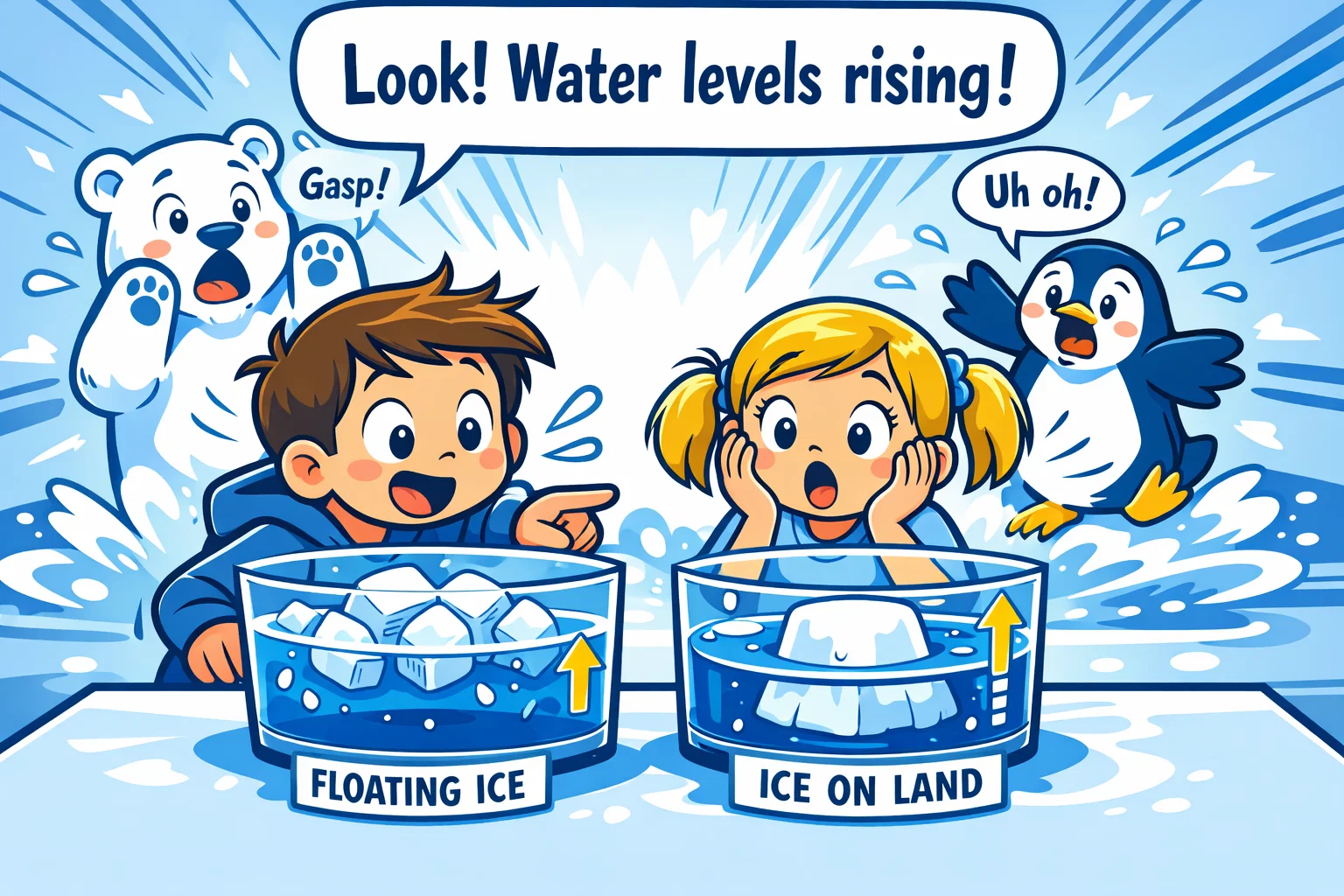
Students learn a crucial distinction here: melting sea ice (like in the Arctic) has a smaller impact on sea level rise than melting land ice (like glaciers in Antarctica). Use a container of water with ice cubes on a “land” rock and ice cubes floating in the “sea” to demonstrate this.
Sea Level Rise Demonstrations
Using a map of a coastal city, use blue clay or water to show which areas are affected by global warming and rising tides. This activity includes a writing activity where kids brainstorm how to protect these cities.
Wildlife Impact Activities
Many conservation organizations provide teaching resources on how ice loss impacts polar bears and seals. Use storytelling to explain how the impact of climate change disrupts the food chain, affecting both humans and animals.
Renewable Energy Projects
Renewable Energy Model Building
Get their hands dirty by building a simple wind turbine from cardstock and a thumbtack, or a solar oven from a pizza box. These hands-on lessons demonstrate alternative ways energy can be generated.
Clean Energy Transition Activities
Create a sorting game where kids categorize energy sources into “Renewable” (Sun, Wind, Water) and “Non-renewable” (Coal, Gas, Oil). This helps them understand climate change solutions.
Hydrogen and Nuclear Energy Comics
For older kids, use writing tasks to create comics about “Future Energy Heroes.” This is a creative way to help them explore complex topics like hydrogen fuel cells or nuclear energy through a narrative lens.
Art and Creativity Climate Activities

Climate Change Artwork Projects
Climate education shouldn’t just be about data; it’s about emotion. Students create collages using recycled materials to express their feelings about the planet. This fantastic climate change art can be displayed in school hallways to raise awareness about climate change.
Climate Fiction Story Writing
Invite children to write a story set in the year 2050 where the climate crisis has been solved. What does the city look like? How do people get around? This fosters a positive climate solutions focus.
Climate Heroes and Activism Art
Have kids design posters for a local climate action rally. This invites children to see themselves as part of a global movement, boosting their confidence and critical thinking skills.
Games and Interactive Climate Activities
Climate Change Board Games
Design a “Snakes and Ladders” style game where “Ladders” are actions like planting trees and “Snakes” are actions like wasting energy. This is a fun way to engage young learners.
Carbon Cycle Games
In this movement-based game, kids pretend to be carbon dioxide molecules moving from the atmosphere to plants, then to animals, and back again. It’s a great way to teach the carbon cycle.
Digital Climate Games and Simulations
Use reputable online simulations, such as those from NASA or National Geographic, which allow students to learn how changing variables like forest cover can impact the environment.
Nature-Based Climate Activities
Tree-Planting Campaigns
Nothing beats the hands-on experience of planting trees. It teaches kids about carbon dioxide absorption and provides a long-term project they can nurture.
School Garden and Growing Projects
A school garden is a living laboratory. Students will learn how shifting weather patterns affect food security and the importance of biodiversity.
Forest and Outdoor Field Activities
Take a “Biodiversity Walk.” Use a worksheet to tally different species of insects, birds, and plants. Explain that a healthy, diverse ecosystem is more resilient to the effects of climate change.
Waste Reduction and Sustainability Activities
Compost Creation Projects
Building a compost bin helps kids understand the carbon cycle and decomposition. It also reduces methane emissions from landfills, making it a direct climate action.
Upcycling Workshops
Teach kids to reuse items. An old t-shirt can become a tote bag; a plastic bottle can become a planter. This activity to help them value resources is a cornerstone of climate education.
Plastic and Pollution Trapping Experiments
Place “sticky traps” (index cards with petroleum jelly) in different areas to catch air particulates. This demonstrates how human activities like driving or factory work impact the environment.
Community and Action-Based Activities
Local Climate Surveys
Have kids interview elders about how the weather patterns have changed over the decades. This provides students with a local perspective on a global issue.
Eco-Friendly Transport Campaigns
Encourage using public transport, biking, or walking. Students create a “Green Map” of the neighborhood showing the safest routes for walking to school.
Letters to Leaders Projects
Teaching kids that their voice matters is vital. Help them write a letter to the mayor or a local representative asking for more renewable energy or better recycling programs.
Media and Research Activities
Climate Change News Bulletins
Have kids act as “Climate Reporters.” They can film a short video update on climate solutions or write a newsletter for parents. This integrates writing tasks with information gathering and analysis.
Climate Change Documentary Projects
Watch a kid-friendly documentary and follow it with discussions about climate change. Use a worksheet to help them identify the “Problem,” “Evidence,” and “Solution” presented.
Virtual Field Trips and Sea Level Tours
Use Google Earth to take a virtual tour of a melting glacier. Seeing the impact on climate change visually is often more powerful than reading about it in a textbook.
Teaching Resources and Lesson Packs
Printable Climate Worksheets
Good teaching resources should include printable climate worksheets that cover everything from the greenhouse effect to biodiversity. These serve as a great way to assess what students will learn.
Climate Change Activity Packs
Integrate climate change into every subject—math (calculating emissions), English (writing prompts), and Science (experiments). Bundled packs make it easier for teachers to provide a cohesive scheme of work.
Grade-Based Climate Activities
- Kindergarten: Focus on loving nature and simple recycling.
- Primary: Introduce the greenhouse effect and carbon footprint.
- Middle School: Explore renewable energy physics and climate science policy.
Climate Action Mindset for Kids
Positive Climate Solutions Focus
Focusing only on negative outcomes can sometimes lead to disengagement. We must emphasize climate solutions to keep kids motivated.
Managing Climate Anxiety in Kids
It is okay for kids to feel “eco-anxiety.” It is helpful to acknowledge children’s feelings while guiding them toward practical actions. Small wins—like a successful recycling drive—build emotional resilience.
Everyday Climate Action Habits
Finally, make climate action a habit. Whether it’s reuse of water bottles or choosing to walk, these small steps support long-term environmental well-being for generations to come.

Take a short quiz to find out what your everyday choices say about your parenting style
When your child is curious about something new, what’s your instinct?
Take a short quiz to find out what your everyday choices say about your parenting style
“Can I download this app?” What happens next?
Take a short quiz to find out what your everyday choices say about your parenting style
When it comes to rules at home, which sounds most like you?
Take a short quiz to find out what your everyday choices say about your parenting style
If you could give your child one life skill today, what would you pick?
Take a short quiz to find out what your everyday choices say about your parenting style
Your child gets to choose what to watch. What would your ideal setup look like?
Take a short quiz to find out what your everyday choices say about your parenting style
Pick your parenting superpower ✨