What Children Learn in Year 7 in the UK: Understanding the Key Stage 3 National Curriculum

 Discover a Free Education Video App for Kids
Pastory uses AI to personalize educational video content based on your child’s interests and personality. Safe, engaging, and built for curious young minds. Sign up now to stay updated and enjoy early access with a free trial
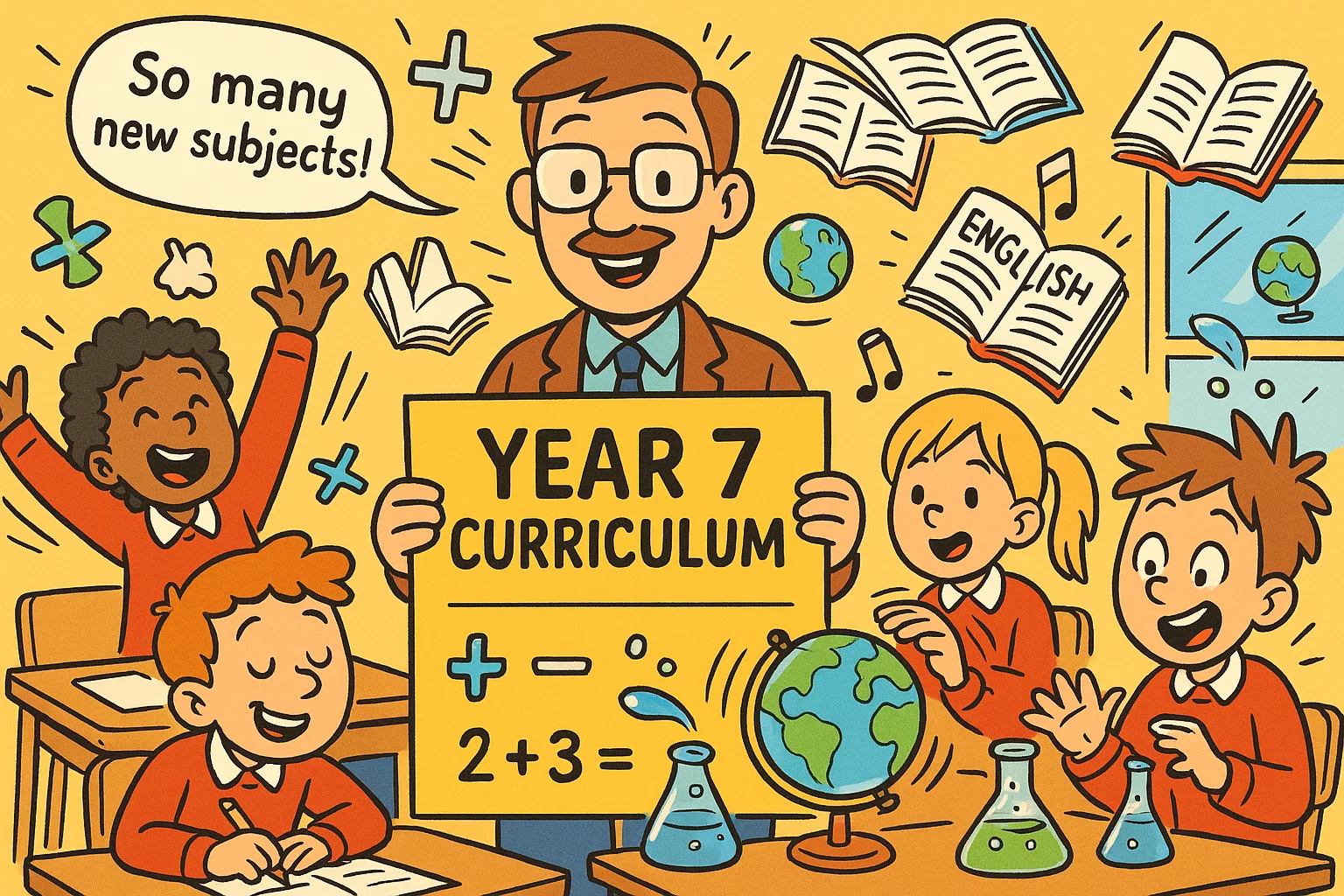
Year 7 marks the beginning of secondary school education for pupils in England, who are typically aged 11 to 12. As the first year of Key Stage 3 (KS3), it serves as a bridge between Year 6 in primary school and the more subject-based structure of secondary education. In this guide, we help parents navigate the UK education system by exploring the core and foundation subjects that make up the curriculum, changes in assessment, the development of essential academic skills, and practical ways for parents to support their children during this transition.
Year 7 in UK: Age, Key Stage, School Context
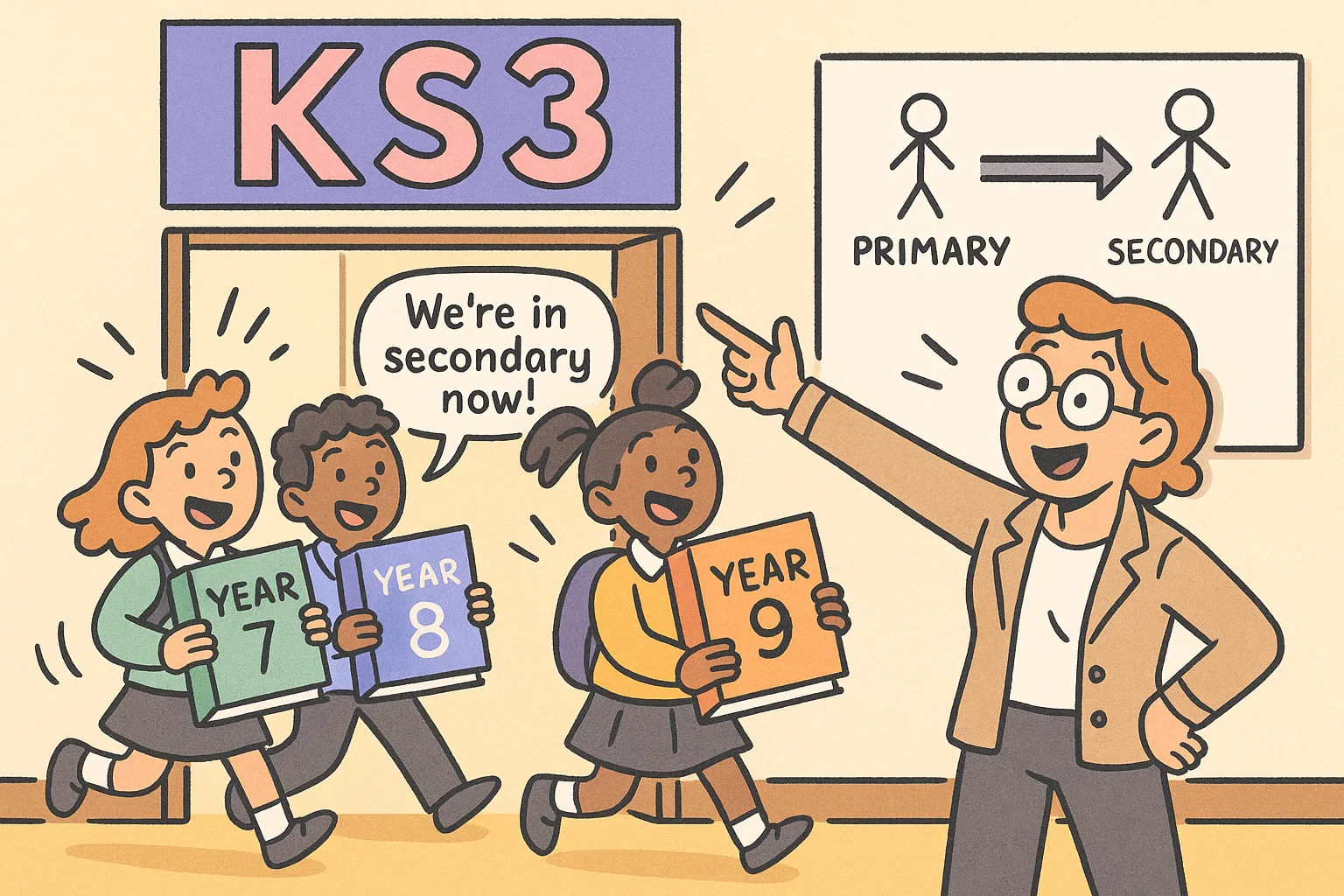
Understanding the structural position of Year 7 is essential for parents navigating the transition from primary to secondary school. This year’s group represents a significant shift in pedagogical approach and student responsibility within the UK school system.
Age Range and Year Group Match
The UK education system defines Year 7 as the academic year in which students are aged 11 to 12. While some international systems refer to the seventh year of schooling as “7th Grade,” the British “Year 7” is specifically designated as the first year of full-time secondary education following the completion of Year 6 at the end of primary school.
KS3 Position
Year 7 is the opening stage of Key Stage 3 (KS3), which encompasses Years 7, 8, and 9. This stage is a critical period in the national curriculum where students move from the generalist classroom model of primary education into a subject-specific structure, preparing them for the more intensive Key Stage 4 (Years 10 and 11) and the eventual GCSE qualifications.
Move from Primary to Secondary
The transition from primary to secondary school brings changes in both the school environment and the level of organisation expected from pupils. Students move from junior school into a more structured model of secondary school education, where they interact with multiple subject specialists, navigating different classrooms, and managing a more complex timetable.
What the National Curriculum Covers in Key Stage 3
In England, the Key Stage 3 national curriculum provides a broad and balanced framework that builds on pupils’ progress in Key Stage 2. Local-authority-maintained schools must follow it, while academies and independent schools have more flexibility.
Core Subjects
The core of the Year 7 curriculum consists of English, maths and science. These subjects underpin literacy, numeracy and scientific understanding across the wider curriculum.
Foundation Subjects
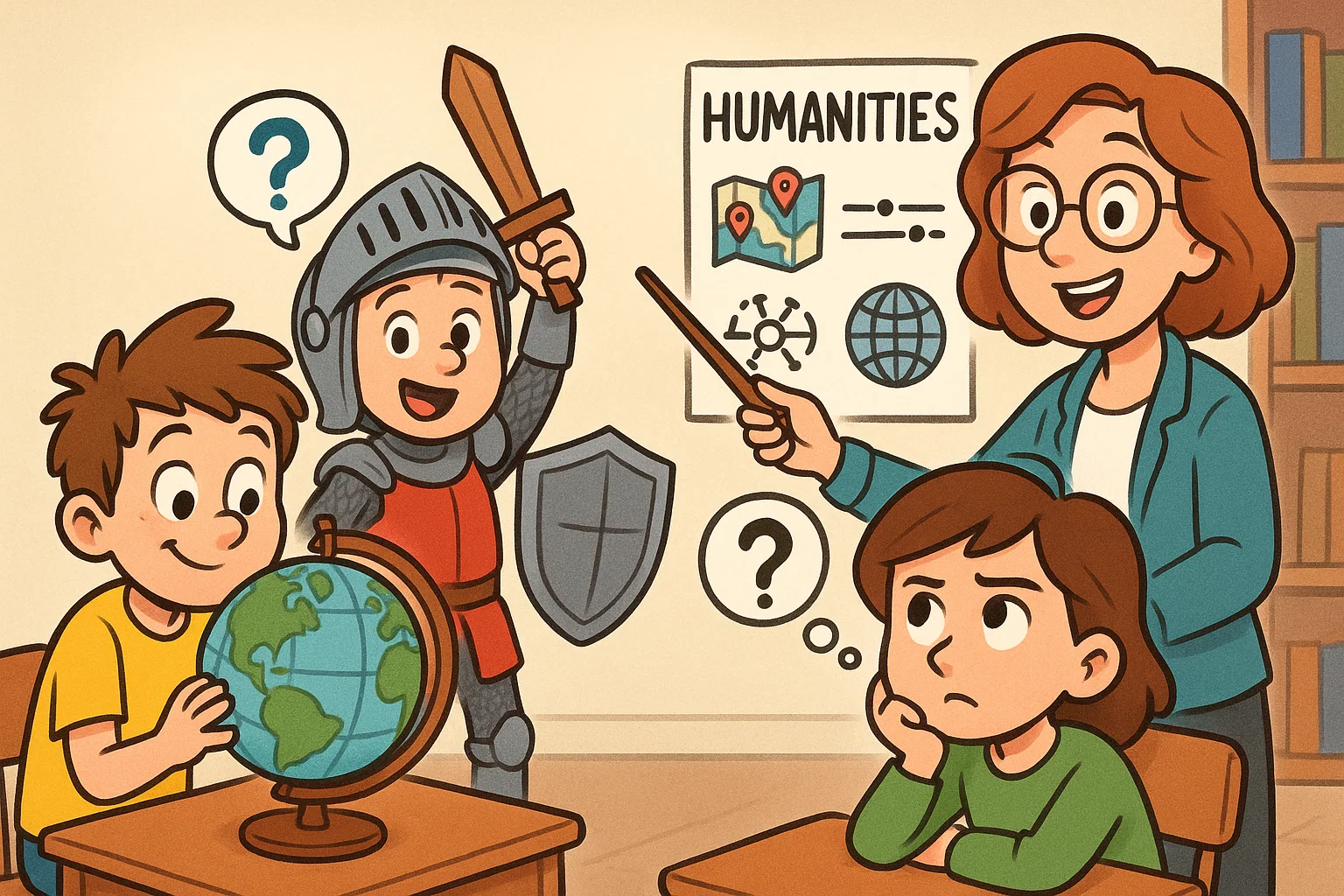
Beyond the core, pupils in England also study history, geography, modern foreign languages, design and technology, art and design, music, physical education, citizenship and computing.
- History and Geography: To develop an understanding of human and physical landscapes and past events.
- Computing: To build digital literacy and basic coding proficiency.
- Design and Technology: To foster creative problem-solving through practical making.
- Art and Design, Music, and Physical Education (PE): To encourage physical development and creative expression.
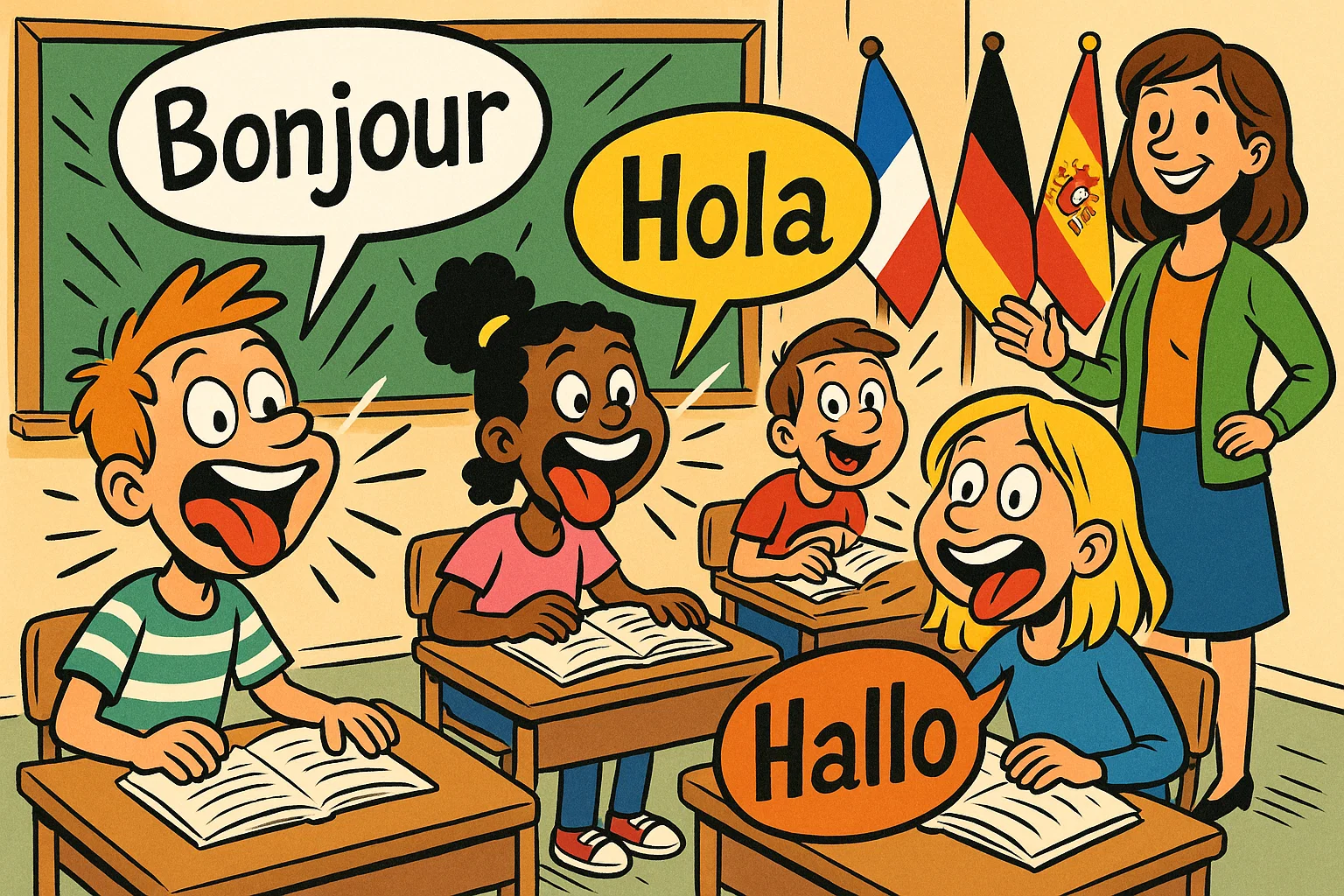
- Modern Foreign Languages: To begin the process of linguistic acquisition.
Relationships, Sex and Health Education, and RE
Schools must also provide religious education (RE), along with relationships, sex and health education. These subjects support pupils’ understanding of belief systems, personal wellbeing, healthy relationships and responsible decision-making.
Typical Year 7 School Day in England
A typical day in Year 7 provides a structured environment that encourages increasing student autonomy. Understanding this routine helps children feel more prepared for the secondary school experience.
Lessons, Form Time, and Moving Between Classrooms
Pupils typically follow a timetable of lessons lasting around 50 to 60 minutes and move between specialist classrooms. The day often begins with a “form time” or “tutor period,” where a designated form tutor monitors attendance, provides pastoral support, and delivers daily notices.
Homework, Planner, and Organisation
Organisation becomes much more important in Year 7. Students use a school planner or digital management system to track homework assignments, deadlines, and extracurricular commitments, fostering essential habits of independent learning and accountability.
Breaks, Lunch, and Clubs
The social aspect of the school day is vital for student wellbeing. Breaks and lunch allow pupils to socialise, while after-school clubs give them opportunities to pursue interests such as sport, drama, debating or STEM.
What Academic Skills Matter in Year 7
Success in Year 7 depends on the mastery of transferable academic skills that underpin the entire secondary curriculum.
- Reading Comprehension and Analysis: Students must transition from simple decoding to identifying nuanced arguments, writer techniques, and evidence within longer, more complex texts.
- Maths Fluency and Problem-Solving: The focus shifts from arithmetic to applying logic to multi-step problems and algebraic expressions.
- Scientific Enquiry and Curiosity: Students are encouraged to develop skills in making predictions, recording observations, and interpreting data during practical experiments.
- Written Communication: Clear, structured writing is essential across all subjects, not just in English, for articulating ideas in history, geography, and science.
- Independent Learning and Organisation: The ability to prepare for lessons, manage materials, and complete tasks without constant supervision is a hallmark of a successful Year 7 student.
English in Year 7
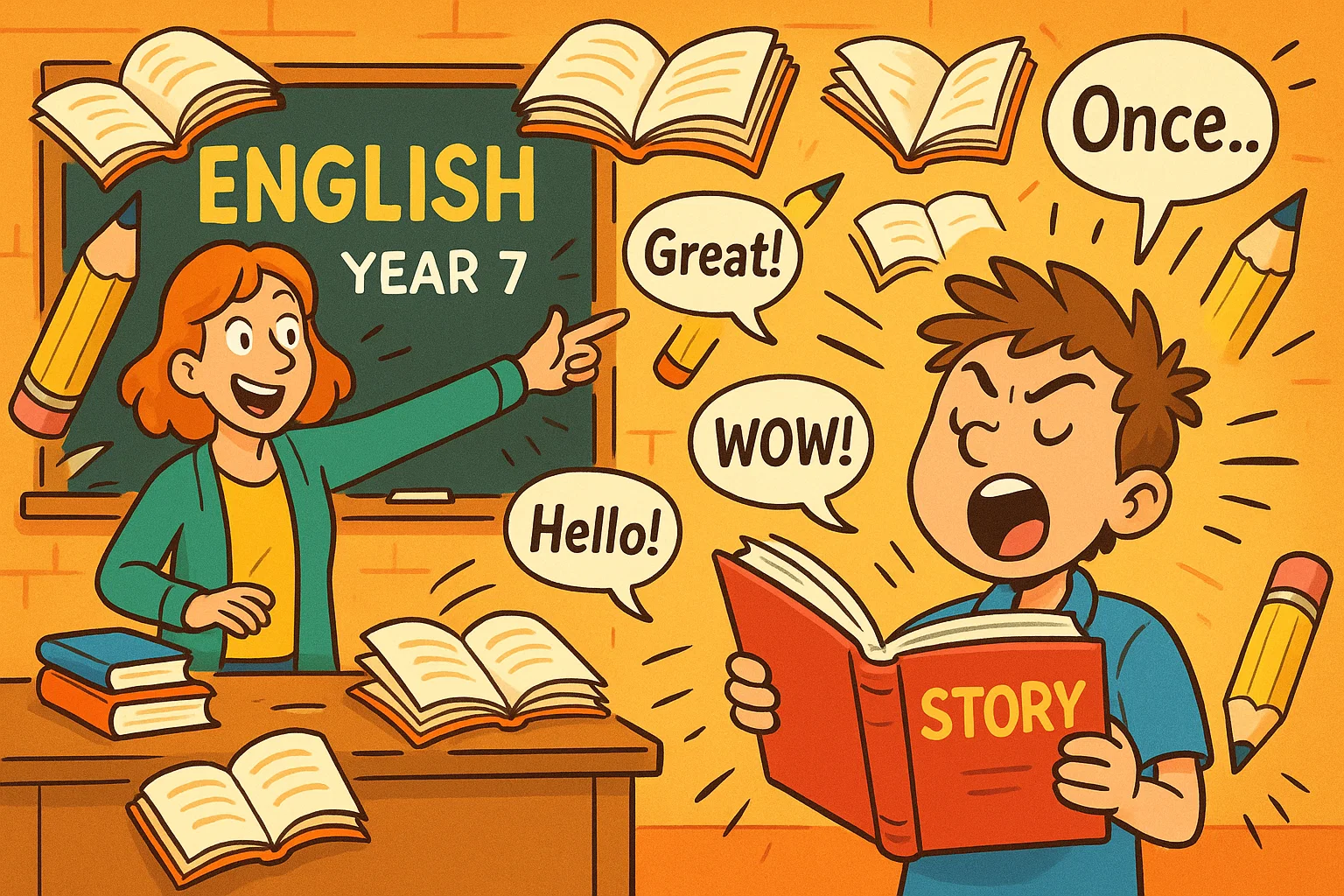
The Year 7 English curriculum focuses on developing pupils’ engagement with language and literature and preparing them for the demands of secondary English.
Reading Fiction and Non-Fiction
Pupils analyse a wider range of texts, including classic and contemporary fiction as well as non-fiction articles, speeches and essays. This helps them compare themes, understand authorial tone, and evaluate the effectiveness of different writing styles.
Writing for Different Purposes
The curriculum expects students to write in various formats, including narrative, descriptive, argumentative, and explanatory pieces. Emphasis is placed on developing coherent arguments, using sophisticated vocabulary, and maintaining consistent tone and purpose.
Grammar, Vocabulary, and Speaking
Precision in language is a primary objective. Students refine their use of grammar and punctuation, expand their academic vocabulary, and practice formal speaking through presentations and structured classroom debates.
Year 7 Maths Curriculum
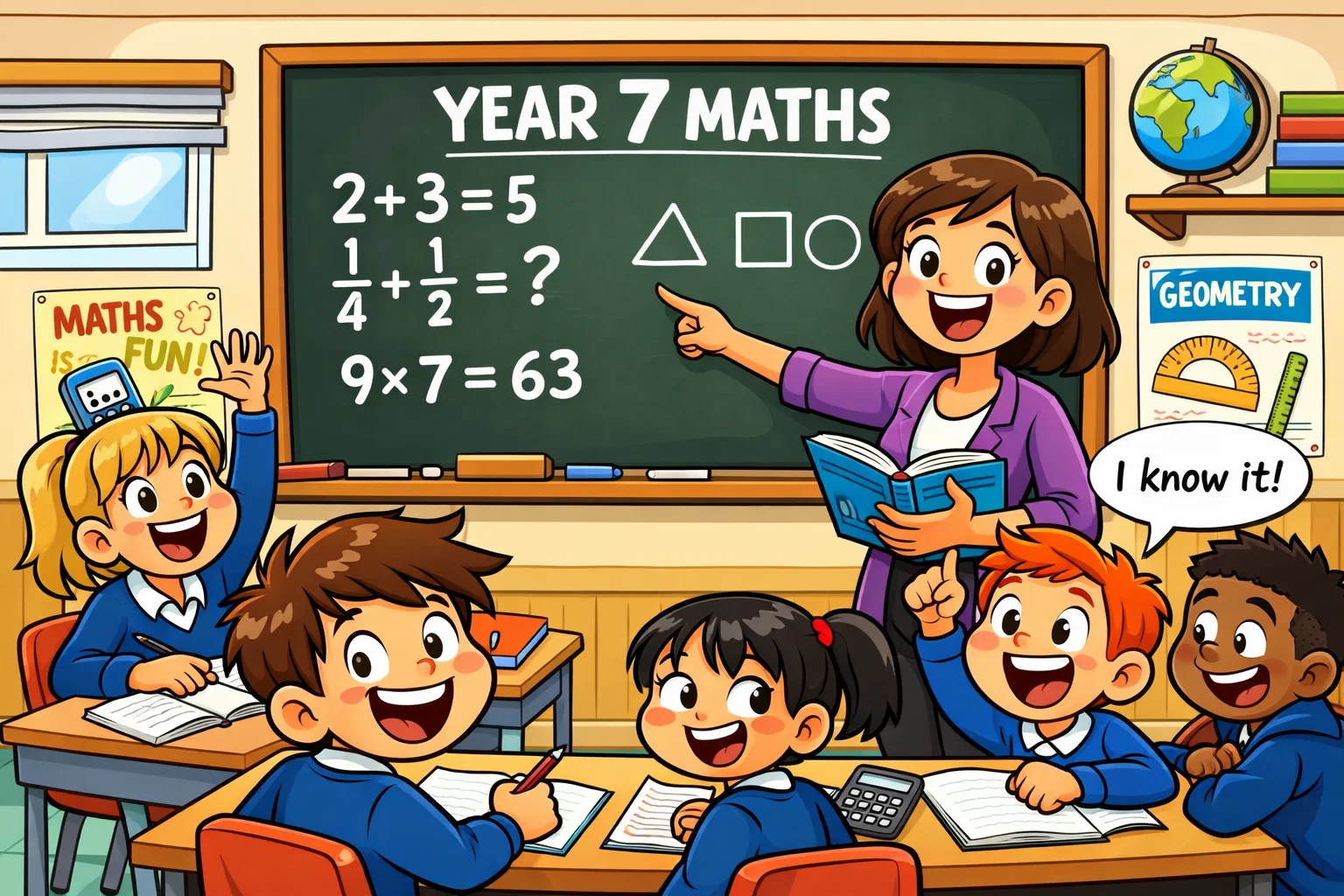
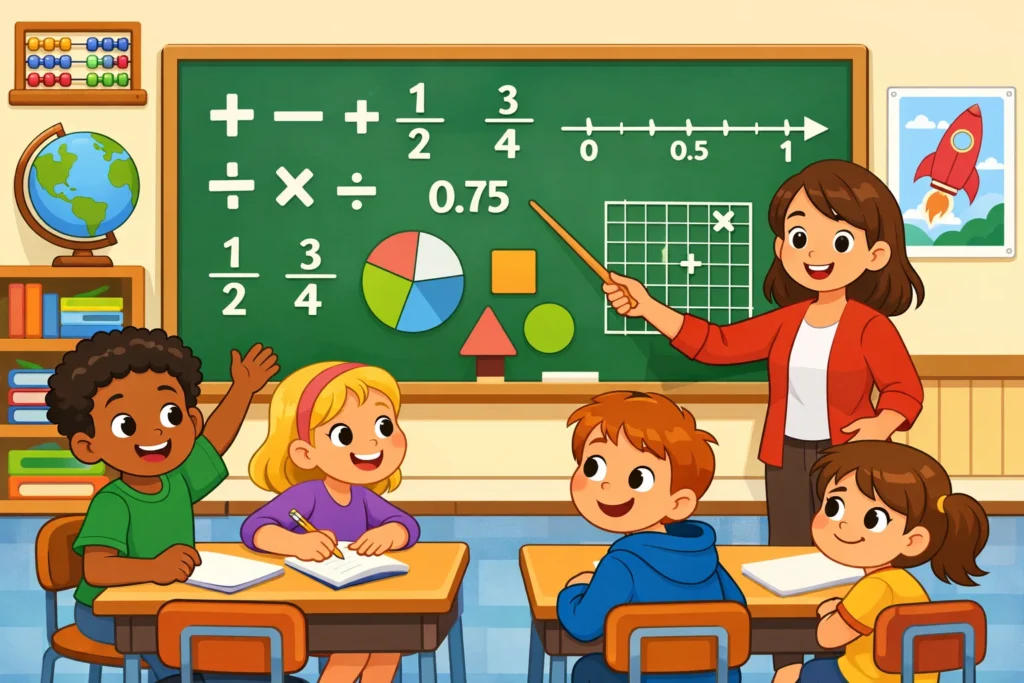
The Year 7 maths curriculum is designed to move students from primary-level numeracy to the abstract thinking required for GCSE-level study.
| Mathematical Area | Key Topics Covered |
| Number | Negative numbers, place value, HCF/LCM, fractions, decimals, and percentages. |
| Algebra | Expressions, linear equations, sequences, and pattern recognition. |
| Ratio & Proportion | Scaling, map scales, and unit rates of change. |
| Geometry | Angles, 2D/3D shapes, coordinates, and area/perimeter calculations. |
| Probability & Statistics | Data collection, charts, mean/median/mode, and basic probability language. |
Science in Year 7
Science in Year 7 introduces pupils to biology, chemistry and physics topics while maintaining a strong emphasis on ‘working scientifically’.
Biology, Chemistry, and Physics Topics
- Biology: Explores cells, life processes, human anatomy, and ecosystems.
- Chemistry: Investigates the particle model, properties of materials, atoms, and basic chemical reactions.
- Physics: Focuses on forces, energy transfer, light, sound, and motion.
Practical Work and Laboratory Skills
Students engage in frequent experiments where they learn to identify variables, follow safety protocols, and accurately record results. These activities are designed to build scientific curiosity and the technical ability to translate observations into logical conclusions.
How Children Are Assessed in Year 7
Assessment in Year 7 is fundamentally different from the high-stakes testing environment of primary school.
No National Exams in Year 7
In England, there are no national tests at the end of Year 7. Schools instead rely on internal assessment to track individual progress.
Teacher Assessments and Topic Tests
Schools rely on regular teacher assessments, including end-of-topic tests, quizzes, and ongoing homework monitoring. Teachers use this feedback to provide targeted support and to inform parents about student achievement during regular reporting cycles.
How to Prepare for Year 7
Preparation for Year 7 is most effective when it is gradual and focused on both academic confidence and organizational habits.
- Talk to Primary Teachers: Use the final weeks of Year 6 to discuss strengths and areas for improvement with the current primary teacher.
- Consolidate Year 6 Knowledge: Ensure that basics like fractions, times tables, and reading fluency are secure, as these form the baseline for the KS3 curriculum.
- Build Homework and Routine Skills: Encourage the child to take responsibility for packing their own school bag and using a planner, which helps transition from passive to independent learning.
Understanding the Transition
The move from primary to secondary school is a significant milestone in a child’s development. By fostering independence, maintaining a balanced approach to learning, and prioritizing social and emotional well-being, parents can ensure that the Year 7 experience is both rewarding and successful. Supporting a child’s curiosity during this time will serve them well as they progress through the secondary school years and beyond.
FAQs

Take a short quiz to find out what your everyday choices say about your parenting style
When your child is curious about something new, what’s your instinct?
Take a short quiz to find out what your everyday choices say about your parenting style
“Can I download this app?” What happens next?
Take a short quiz to find out what your everyday choices say about your parenting style
When it comes to rules at home, which sounds most like you?
Take a short quiz to find out what your everyday choices say about your parenting style
If you could give your child one life skill today, what would you pick?
Take a short quiz to find out what your everyday choices say about your parenting style
Your child gets to choose what to watch. What would your ideal setup look like?
Take a short quiz to find out what your everyday choices say about your parenting style
Pick your parenting superpower ✨