17 Fun Letter H Activities for Preschoolers

 Discover a Free Education Video App for Kids
Pastory uses AI to personalize educational video content based on your child’s interests and personality. Safe, engaging, and built for curious young minds. Sign up now to stay updated and enjoy early access with a free trial
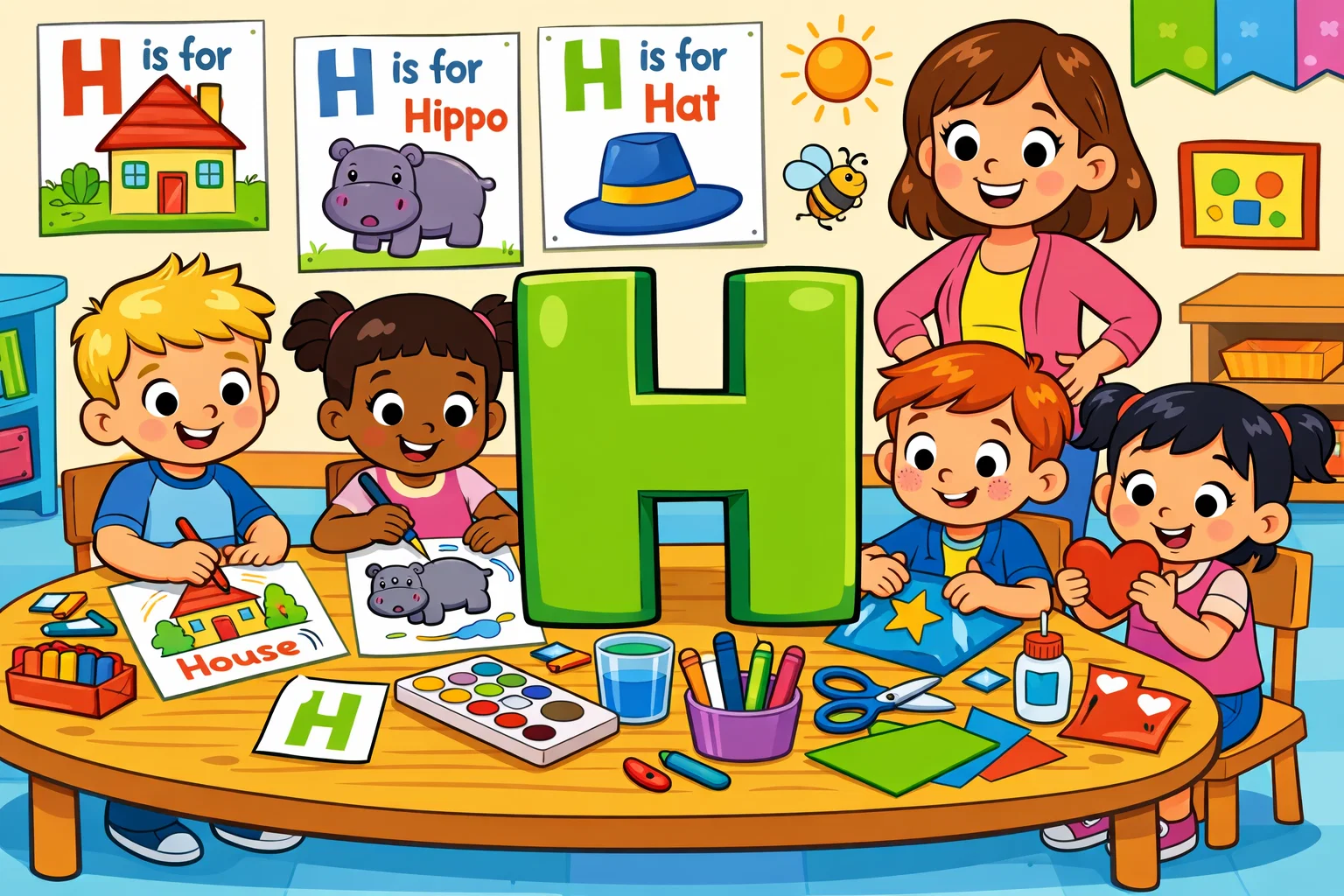
Introducing the letter H to preschoolers marks an exciting milestone in early literacy. The /h/ sound is light and airy, and many young children find it easier to imitate than more forceful sounds such as /b/ or /p/. Multi-sensory approaches that combine letter recognition, beginning sounds, and fine motor practice can help build a strong reading foundation.
By integrating crafts, printable worksheets, sensory play, and movement-based games, educators can make alphabet learning feel playful rather than like a chore. Whether you are looking for a free letter H worksheet or a creative handprint craft, these activities are designed to engage preschoolers at different developmental stages. This guide offers a wide range of hands-on ways to practice uppercase H and lowercase h.
1. H Coloring and Identification
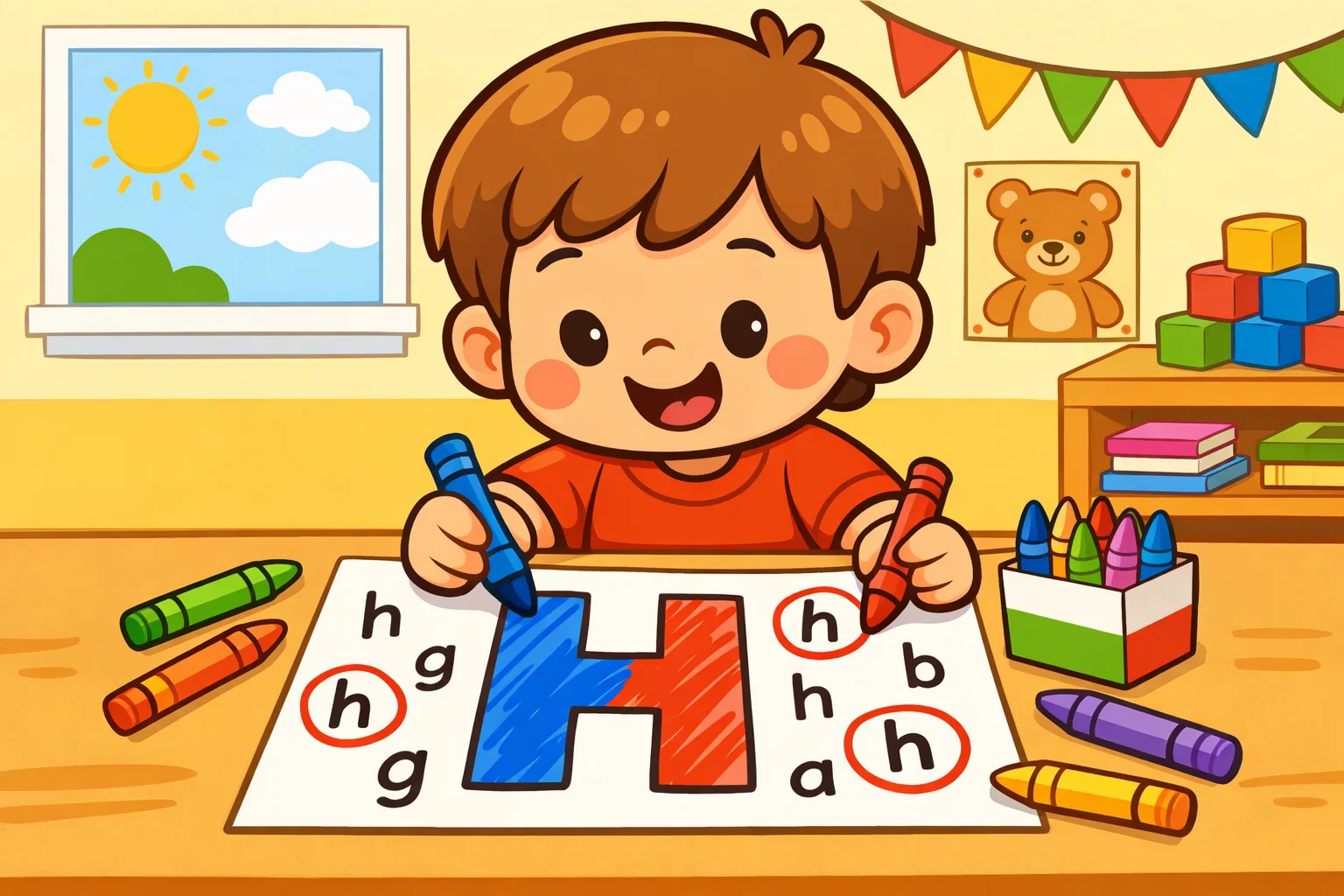
Letter H coloring is a simple, effective way to introduce letter recognition. For many preschoolers, an early step in literacy is learning to notice the distinct shape of a letter among other letters and symbols. Using a large-format H template helps children focus on the structural differences between uppercase H and lowercase h.
Skills This Activity Builds
The coloring and identification process reinforces visual discrimination, which is the ability to perceive differences between similar shapes. It also develops pencil control and fine motor skills as children navigate the boundaries of the form. This activity builds early alphabet confidence by providing a low-pressure environment for letter recognition.
How To Set Up
To begin, provide a printable featuring a large, hollow H. Instruct the child to color the letter while you model its sound. Enhance the task by adding a “search and find” section at the bottom of the worksheet and asking the child to identify and circle all instances of H and h hidden among other letters.
Tips for Preschool Groups
- Learning Centers: Laminated sheets with dry-erase markers allow multiple children to practice throughout the day.
- One-on-One: Use sticker rewards for each H correctly identified to boost motivation.
- Small Groups: Have children compare their color choices to encourage social interaction and discussion about the target symbol.
2. Identify and Find H
Letter recognition involves more than just seeing a symbol in isolation; it requires the child to pick it out from a crowded field. Preschool and kindergarten readiness often includes being able to distinguish H from similar-looking letters. Identifying it in various contexts – such as on a printable, a wall, or within a grid – helps reinforce letter recognition.
Uppercase H and Lowercase h Practice
It is helpful to introduce uppercase H and lowercase h together so children can compare them from the start. While the uppercase H consists of two vertical lines and a horizontal bridge, the lowercase h features a tall “neck” and a hump. Activities for preschoolers should highlight these specific geometric differences to ensure the child can identify both versions in different fonts.
H Hunt Variations
- Worksheet Grid: Use a letter h worksheet where children use a marker to “dot” the target form.
- Room Scavenger Hunt: Hide printable letter h cards around the classroom for children to find.
- Magnet Board: Ask the child to pull all uppercase H and lowercase h letters from a magnetic board.
- Book Search: Give the child a magnifying glass to find H in a favorite picture book.
Mistakes Preschoolers Make
Common errors include confusing lowercase h with lowercase n or forgetting the crossbar in uppercase H. Gentle correction and repeated exposure to letter shapes and formation usually help resolve these mix-ups over time.
3. Match Uppercase H and Lowercase h
Letter matching is a foundational step toward reading, as it teaches children that different symbols can represent the same sound. Matching activities help bridge the gap between seeing the uppercase letter and recognizing its lowercase counterpart.
Why Matching Matters
Being able to match uppercase H and lowercase h supports later handwriting and reading development. Early literacy research suggests that fluent recognition of upper- and lowercase pairs supports later reading progress. This skill ensures that the child understands the alphabet as a cohesive system of symbols.
Printable Card Game Idea
Create a free printable memory game where one card features an uppercase H and the other a lowercase h. Turn the cards face down and ask the child to flip them over to find a match. This adds an element of creativity and memory training to the literacy lesson.
No-Prep Version
If you do not have access to a printer, write several uppercase H and lowercase h letters on plastic bottle caps or sticky notes. Mix them up on a table and ask the children to find the matching pairs and place them together.
4. Spot H in a Rhyme
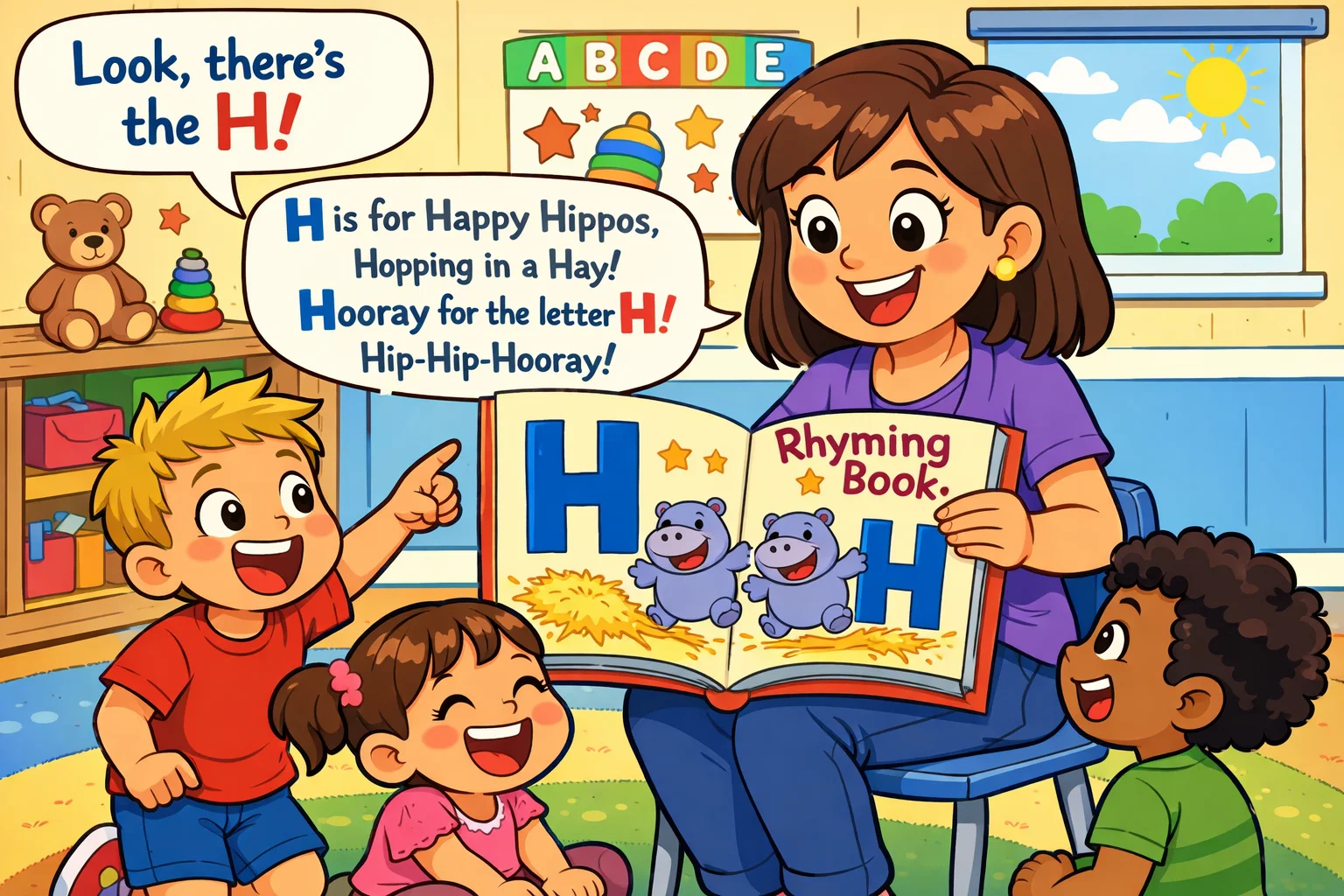
Integrating H into a nursery rhyme or short poem provides essential linguistic context. This activity expands the focus from visual letter recognition to auditory awareness and beginning sounds.
Best Rhymes for H
“Humpty Dumpty” is a classic choice for letter H practice. Other effective options include “Hickory Dickory Dock” or “If You’re Happy and You Know It.” You can also pause to emphasize familiar H words such as hop, hat, head, and hands.
How To Turn Reading Into Sound Search
While reading the text aloud, have the child follow along with their finger. Every time you reach a word that starts with H, have the child perform an action, such as a hop or a clap. This kind of movement helps reinforce the /h/ sound through action.
Extension With Sound Practice
After the rhyme, focus on vocabulary. Ask the child to name other objects that begin with the letter H, such as a hippopotamus, house, or heart. This reinforces the beginning sounds and expands their verbal repertoire.
5. Animal H Maze
A letter H maze is an engaging worksheet format that can also support fine motor development. Mazes require spatial reasoning and the ability to plan a path, which are critical cognitive milestones.
Why Mazes Work for Preschool
Mazes can reinforce left-to-right tracking, visual attention, and pencil control. They also require sustained pencil control, helping to prepare the hand for future handwriting tasks.
H Path Ideas
Design a printable where a horse needs to find its way to a house by following only the H symbols along the correct path. This forces the child to identify the target symbol while ignoring “distractor” characters.
Easy and Hard Versions
| Age Group | Complexity Level | Features |
| 3-Year-Olds | Easy | Large symbols, wide paths, few dead ends. |
| 4-Year-Olds | Medium | Mix of uppercase and lowercase, more turns. |
| 5-Year-Olds | Advanced | Small symbols, complex path, includes H-word pictures. |
6. H Is for Handprint
The handprint craft is a staple of preschool art because it is personal, tactile, and visually striking. This letter craft transforms a child’s own anatomy into a symbol of literacy, making H unforgettable.
Materials Needed
- Non-toxic washable paint (bright colors)
- Construction paper or a letter h template
- Paintbrushes or sponges
- Wet wipes for quick cleanup
How To Make a Hand Print H Craft
Paint the child’s hands and have them press two vertical handprints side by side on the paper. Once dry, help the child draw a horizontal line connecting the two “stems” to form an uppercase H. Alternatively, use one handprint as the “hump” for a lowercase h.
Learning Talk During Craft
While the child is painting, engage them with vocabulary-rich dialogue. Say, “H says /h/, like in hand,” or “You are using your hand to make H!” This verbal reinforcement connects the physical fine motor action to the alphabet sound.
7. H Tissue Painting
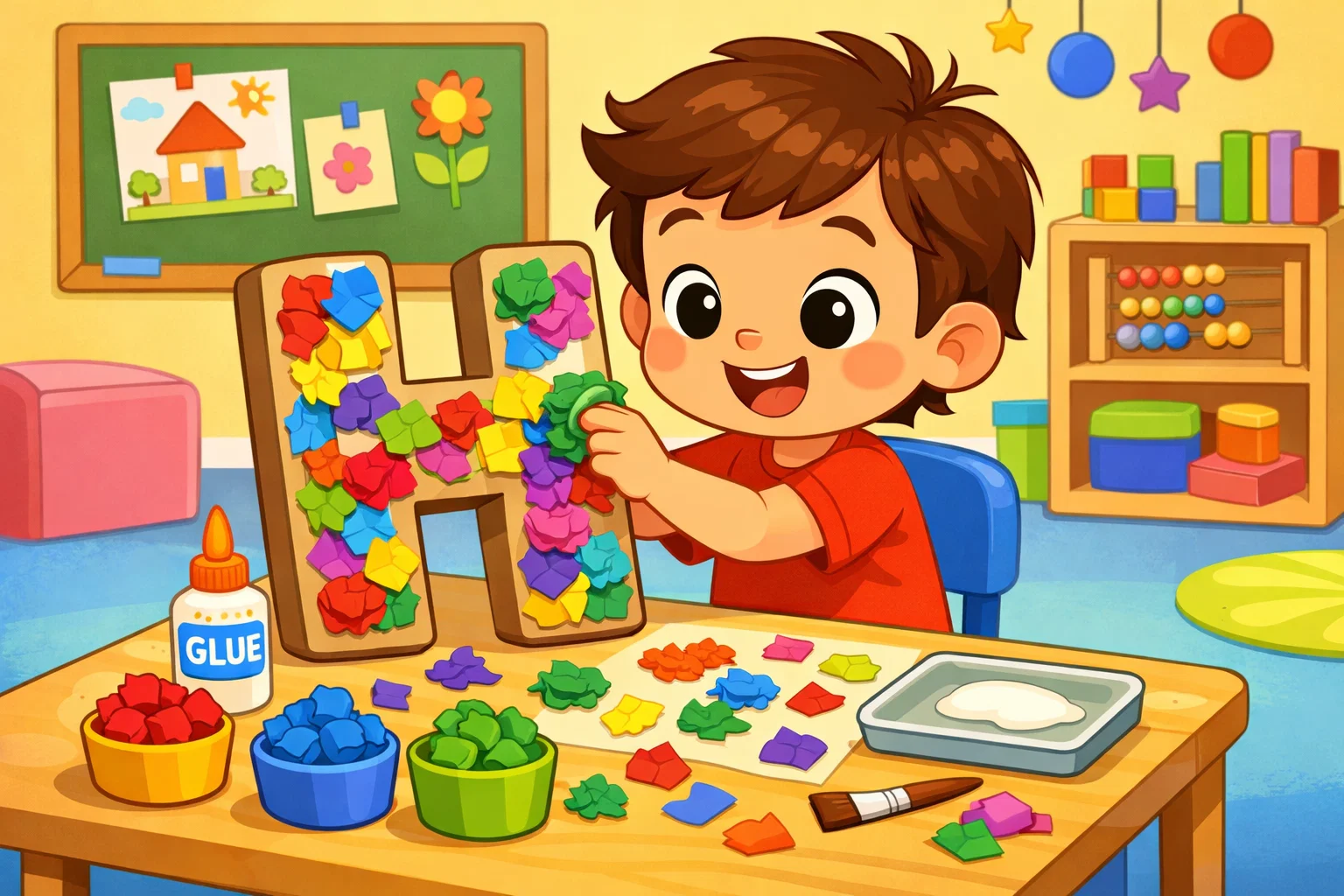
Tissue paper painting is a unique art activity that combines sensory play with letter recognition. It is particularly effective for children who enjoy textures and visual blending.
Simple Setup
Provide a large printable letter H on heavy cardstock. Cut small squares of colorful tissue paper and provide a small bowl of water or diluted glue.
How To Turn Painting Into Practice
Instruct the child to dip the tissue paper lightly in water and lay it over the H. As the paper dries, the pigment bleeds onto the cardstock, leaving a vibrant, multicolored result. This process encourages the child to stay within the lines of the formation, practicing fine motor skills without a pencil.
Cleanup and Low-Mess Tips
To minimize mess, use a tray to contain the water and paper scraps. Have a dedicated drying area for letter H projects to prevent color transfer to furniture.
8. H Is for Heart Matching
The word heart starts with H, and the shape is easy for preschoolers to recognize, making it a perfect tool for matching activities.
Heart Matching Cards
Create pairs of hearts. On one card, write uppercase H, and on the matching card, write lowercase h. You can also match H to a picture of a hippo or a horse. This reinforces letter recognition through visual association.
Valentine Theme Option
While this is a great year-round activity, it is especially popular in February. Using a heart theme can turn a seasonal activity into a meaningful literacy lesson.
Fine Motor Add-On
Increase the fine motor challenge by having children use clothespins to clip the matching hearts together. Using clothespins also strengthens the pincer grasp, which supports the hand control needed for handwriting.
9. H Is for House Craft
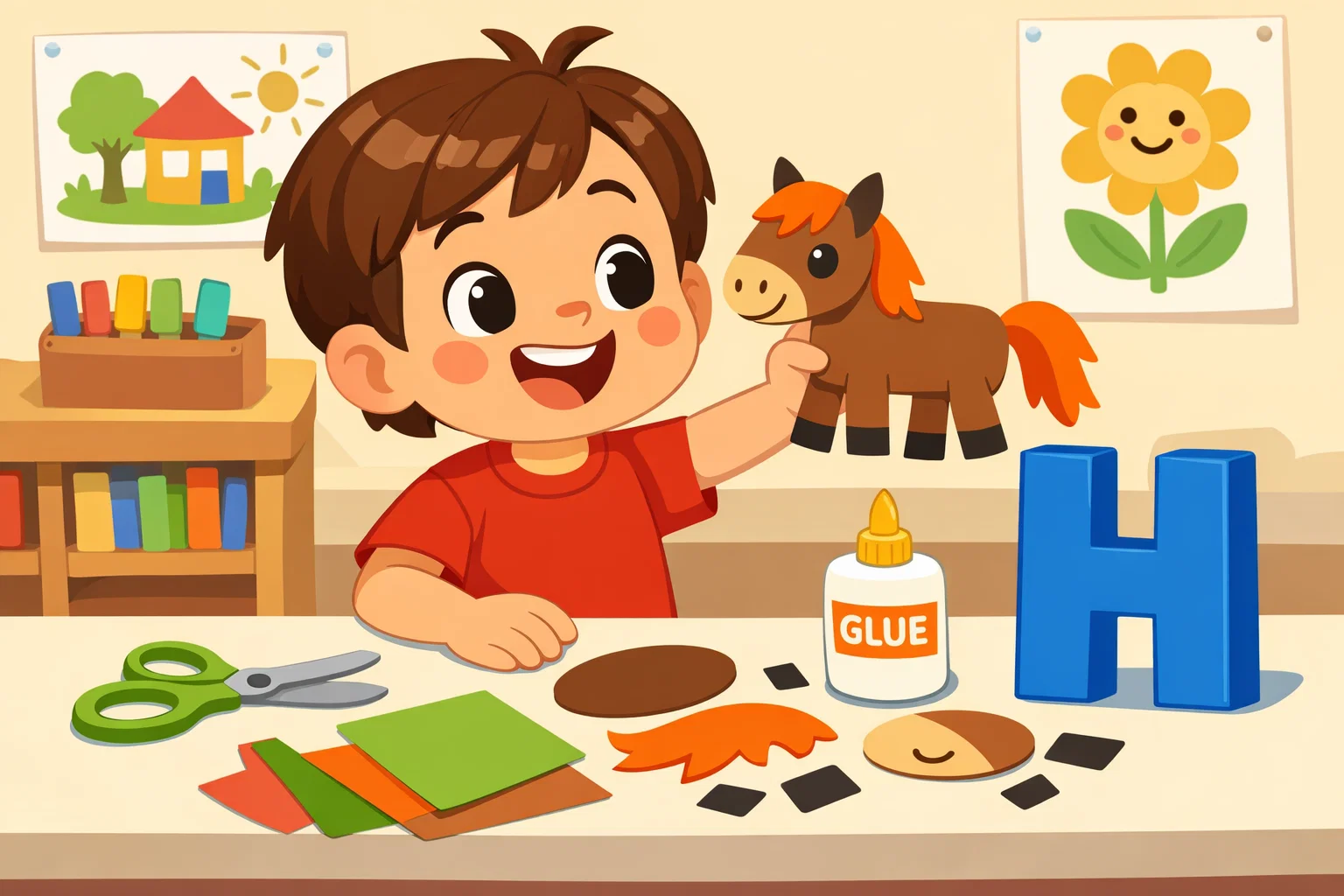
House is one of the most common and recognizable H words for preschoolers. Building a “House H” helps children understand how shapes combine to create symbols.
House Shape Craft
Use a large uppercase H as the frame of the house. Add a triangular roof on top and a small square door in the middle. This simple letter craft shows that letters can be built from familiar geometric shapes.
House Vocabulary to Add
During the activity, introduce new words such as:
- Home
- High (roof)
- Hallway
- Hearth
Classroom Display Idea
Create a “Neighborhood of H” on the classroom wall. Displaying the houses made by preschoolers fosters a sense of pride and community while keeping the alphabet visible for daily letter recognition.
10. H Is for Horse Craft
A horse theme appeals to many preschoolers and works well with movement-based play. A horse-themed letter craft is an excellent way to practice scissor skills and letter formation.
Easy Horse Template
Provide a printable letter h template. Have the child cut out the shape and add a “mane” made of yarn and a “tail” made of paper strips. Using glue to attach these items builds fine motor skills.
Talk About Horse Sound and Word Start
Encourage the child to make the “neigh” sound and then the /h/ sound. “The horse says neigh, but horse starts with /h/.” This distinction helps children understand the difference between an animal sound and a beginning sound in literacy.
Pretend Play Extension
Once the craft is finished, have the child gallop around the room like a horse. This physical activity breaks up the “sitting time” of alphabet worksheets and keeps the child engaged.
11. H Is for Hippo Craft
The hippopotamus is a favorite among little ones because of its large size and funny name. A hippo craft works well for teaching letter H because the word begins clearly with the /h/ sound.
Build Hippo Step by Step
- Print a large lowercase h.
- Add two small circles for ears at the top of the “neck.”
- Add a large oval at the bottom for the snout.
- Paste on googly eyes or draw them with a marker.
Best Questions to Ask Preschoolers
- “Does hippo start with the same sound as hat?”
- “What color should we make our hippo?”
- “Can you find H on the hippo’s body?”
Pair With Hippo Worksheet or Maze
After completing the craft, provide a letter h maze where the hippo is trying to find a snack. This creates a thematic unit that reinforces the alphabet through multiple formats.
12. H Bubble Painting
Bubble painting is a high-engagement art activity that provides a unique sensory experience. It is an excellent alternative to traditional letter h coloring pages.
Why Preschoolers Love Bubble Painting
The “pop” of the bubbles and the unpredictable patterns create an emotional reward. Because bubble painting feels playful and surprising, it can help children stay engaged and remember the activity more easily.
Safe Materials and Setup
Mix dish soap, water, and tempera paint in a bowl. Have the child blow through a straw to create bubbles under close supervision, making sure they blow out rather than suck in. Gently place a letter h template over the bubbles to transfer the print.
Turn Art Into Review
Once the bubble-printed paper is dry, have the child trace H over the colorful circles. This combines creativity with tracing practice, making alphabet review fun.
13. H Pipe Cleaner Craft
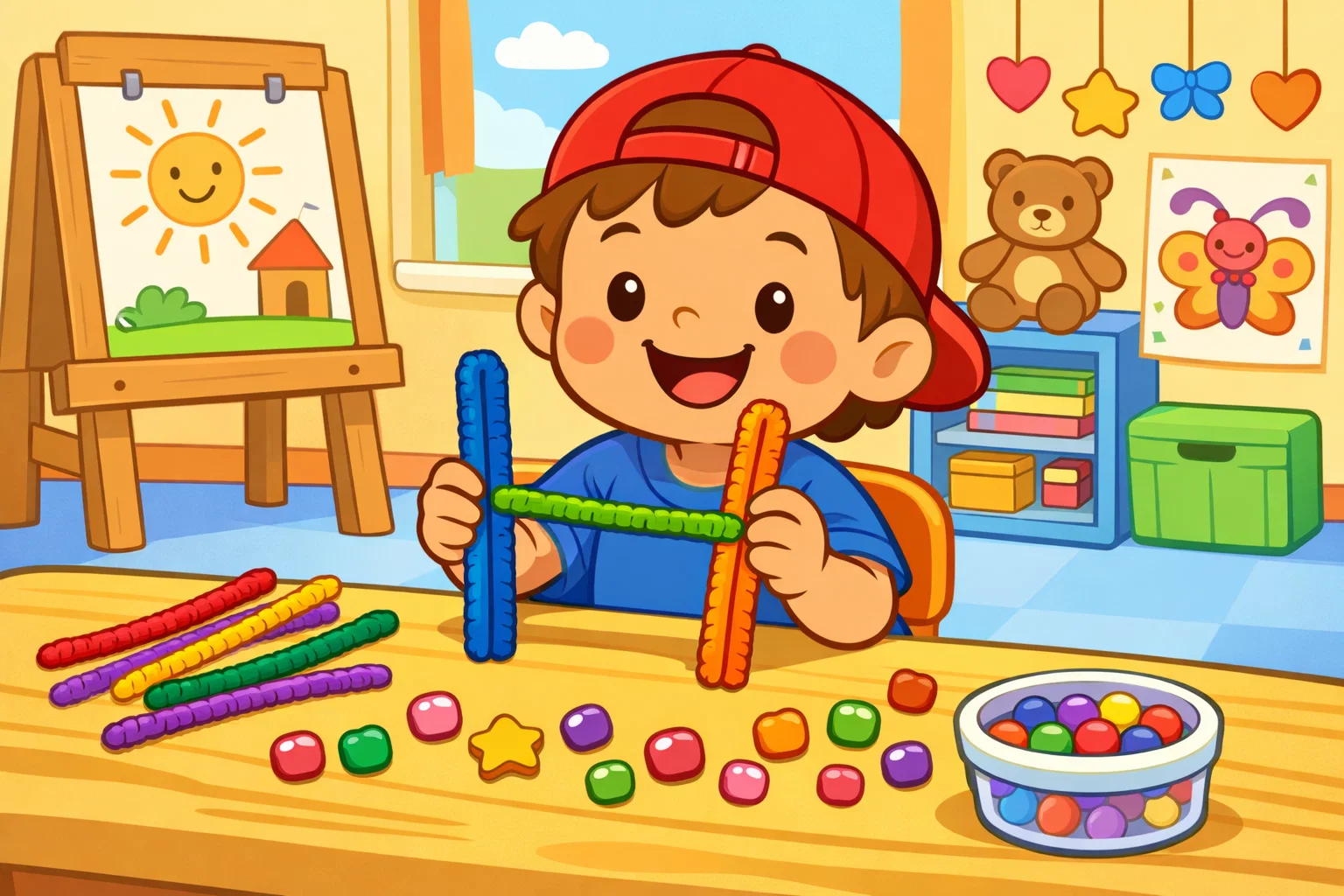
For a hands-on approach to letter formation, nothing beats the flexibility of pipe cleaners. This activity allows children to feel the structure of the letter shape.
Build H With Pipe Cleaners
Give the child three pipe cleaners. Show them how to place two vertically and one horizontally to create an uppercase H. For the lowercase h, show them how to bend one pipe cleaner into a “hump” and attach it to a straight one.
Fine Motor Benefits
Bending and twisting pipe cleaners requires significant hand strength. This helps build the hand strength needed for handwriting in kindergarten.
Add Beads or Buttons
For an added challenge, have the child thread beads onto the pipe cleaner before forming H. This adds a counting and sorting element to the literacy task.
14. H Is for Holes Punch Activity
Using a hole punch is a great way to build fine motor skills and strengthen the same hand muscles used for scissors.
Hole Punch H
Draw a large H on a piece of cardstock. Instruct the child to use a hole punch to follow the lines of the letter. This creates a “connect the dots” effect that is highly satisfying for little ones.
Materials Needed
- Handheld hole puncher
- Heavy-duty paper or cardstock
- Brightly colored marker
- A tray to catch the paper dots
Low-Prep Adaptation
If you do not have a hole punch, use sticker dots or a marker to place dots along the path of the H. Even a dot marker (bingo dauber) works perfectly for this letter identification task.
15. H Tracing and Handwriting Activity
Once a child is comfortable with letter recognition, they can move on to letter h tracing. This is a critical transition from observing to producing alphabet forms independently.
Tracing Uppercase H
Explain that the uppercase H is built in three steps:
- One big line down.
- Another big line down next to it.
- A small bridge across the middle.
Tracing Lowercase h
The lowercase h is often trickier. Teach it as “Start at the top, dive down, and bounce over.” Using playdough to form the shape before using a pencil can help a child visualize the “bounce.”
Move From Tracing to Independent Writing
Gradually reduce the number of dotted lines on the letter h worksheet. Start with full letter tracing, then move to a single starting dot, and finally encourage the child to print the character independently.
16. H Cut and Paste Worksheet
A cut-and-paste activity gives preschoolers practice with several skills at once. It combines sorting, logic, and fine motor coordination.
Sort Pictures That Start With H
Provide a worksheet with various images. Ask the child to identify and cut out only the objects that begin with the letter H.
- Hat (Yes)
- Apple (No)
- Helicopter (Yes)
- Hen (Yes)
H vs Non-H Picture Sort
Use a T-chart format where the child pastes pictures of H words on one side and non-H words on the other. This sharpens beginning sound awareness and letter recognition.
Cut and Paste Tips for Preschool
- Use safety scissors with blunt tips.
- Provide a “glue sponge” or glue stick to keep the mess manageable.
- Pre-cut the images into squares for younger preschoolers to make the scissor skills task easier.
17. H Sensory Bin and Playdough Invitation
Sensory play is essential for deep learning. A sensory bin allows children to explore H through touch and discovery.
H Sensory Bin Fillers
Fill a bin with dried beans, rice, or shredded paper. Hide alphabet magnets, printable letter h cards, and small H-themed objects like toy horses, plastic hearts, or a miniature house.
Make H With Playdough
A playdough invitation involves giving the child a lump of dough and a letter h template. They can “roll snakes” to form the shape or use letter H cookie cutters. This kind of tactile letter practice can make letter formation easier to understand.
Questions to Ask During Sensory Play
- “Can you find the lowercase h hiding in the rice?”
- “How does the playdough feel when you make H?”
- “What other H words can we find in our bin?”
H Words for Preschool
Building a robust vocabulary is a key part of early literacy. Focus on simple, concrete nouns that a child can easily visualize or hold.
Easy H Words
| Word | Category | Association |
| Hat | Clothing | Wear it on your head |
| Hen | Animal | Lays eggs |
| House | Building | Where we live |
| Hippo | Animal | Big and gray |
| Heart | Shape | Red and sweet |
| Hand | Body Part | Five fingers |
How To Teach H Words Through Pictures
Use printable picture cards. Show the picture, say the word, and emphasize the /h/ sound. This visual-auditory connection is one of the most effective ways to support preschool and kindergarten instruction.
Beginning Sound Practice
Play a game of “I Spy” using only letter h words. “I spy something on your body that starts with H…” (Hand, Head, Hair). This encourages children to listen for the sound in their everyday environment.
H Books for Preschool
Reading aloud is one of the most effective ways to foster a love of letters and books. When choosing books for H, look for titles that use the sound and symbol frequently and clearly.
What Makes a Good H Read-Aloud
The best books feature repetitive text and clear illustrations. Books like Hooray for Hat! by Brian Won or Old Hat, New Hat by Stan and Jan Berenstain work well because they include repeated H words and strong visual cues.
How To Read With a Focus on H
While reading, point to H on the page. Ask the child to “catch” the /h/ sound by raising their hand every time they hear a word that begins with the /h/ sound. This keeps them active and focused on the literacy goal.
Follow-Up Activities After Story Time
After the book, have a quick discussion. Ask the child to draw their favorite H-word from the story. This combines comprehension with creativity and fine motor practice.
Conclusion
The best letter h activities for preschool are those that blend play with purpose. By using a combination of crafts, worksheets, sensory play, and tracing practice, you can help children develop a strong and lasting understanding of the alphabet. You don’t need to do all 17 activities in one day; instead, choose 3–5 different formats and repeat them throughout the week to solidify letter recognition and beginning sounds.
Frequently Asked Questions (FAQs)
What are the best letter h activities for preschool?
The most effective activities include letter h coloring, handprint crafts, letter h tracing, and sensory bins. A mix of “sit-down” worksheets and “get-up” movement games provides the best balance for preschoolers.
How do you teach letter h to preschoolers?
Start by introducing the shape and the sound /h/. Use a letter h template for visual recognition, model the sound clearly, and then use printables and crafts to reinforce the concept through repetition and play.
What are some easy H words for preschoolers?
Common and easy letter h words include hat, hen, house, hand, hippo, horse, heart, and hop.
What are easy letter h crafts for preschoolers?
Simple and popular options include the handprint H, the house craft using geometric shapes, and building symbols out of pipe cleaners or playdough.
Are worksheets enough for letter h practice?
While a letter h worksheet is a valuable tool for letter identification and fine motor skills, it should be part of a larger, multi-sensory curriculum. Combining printables with crafts, movement, and sensory play yields the best educational outcomes.
Take a short quiz to find out what your everyday choices say about your parenting style
When your child is curious about something new, what’s your instinct?
Take a short quiz to find out what your everyday choices say about your parenting style
“Can I download this app?” What happens next?
Take a short quiz to find out what your everyday choices say about your parenting style
When it comes to rules at home, which sounds most like you?
Take a short quiz to find out what your everyday choices say about your parenting style
If you could give your child one life skill today, what would you pick?
Take a short quiz to find out what your everyday choices say about your parenting style
Your child gets to choose what to watch. What would your ideal setup look like?
Take a short quiz to find out what your everyday choices say about your parenting style
Pick your parenting superpower ✨