What Are Vowels for Kids: Definition, Examples, Types and Easy Learning Guide

 Discover a Free Education Video App for Kids
Pastory uses AI to personalize educational video content based on your child’s interests and personality. Safe, engaging, and built for curious young minds. Sign up now to stay updated and enjoy early access with a free trial
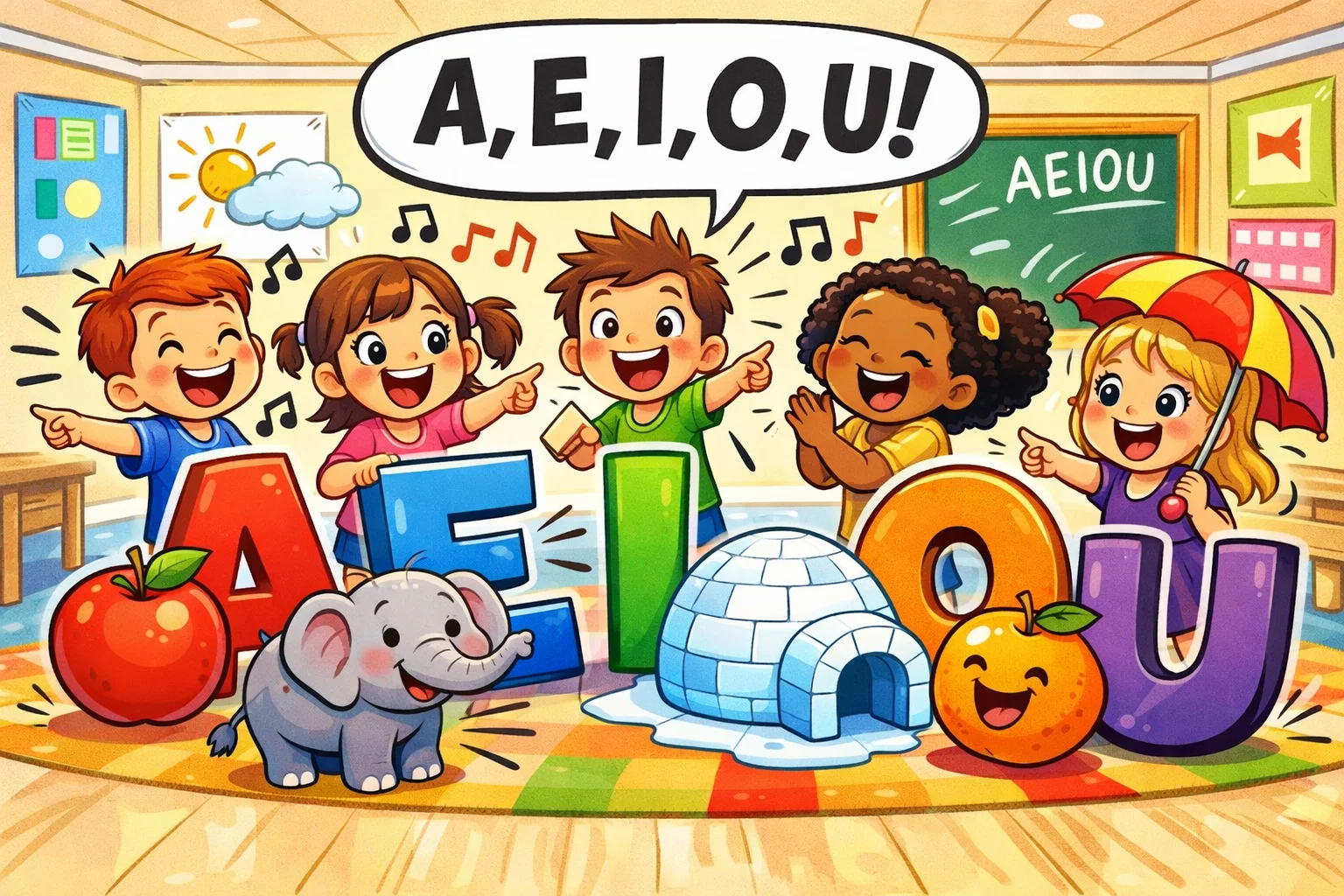
Every word a child learns to read contains at least one vowel. Before kids can decode sentences or write their own stories, they need to understand these essential letters — what they are, how they sound, and why they matter.
This guide breaks down A, E, I, O, and U in simple, clear terms for parents, teachers, and early learners, covering everything from the basic five letters to long vowel sounds, vowel teams, and practical teaching strategies.
What Are Vowels: Simple Definition for Kids
Vowels are letters that make open sounds — pronunciations produced when air flows freely through the mouth without being blocked by the lips, teeth, or tongue. In the English language, the five main vowels are A, E, I, O, and U. Every word in English contains at least one of these letters, making them essential building blocks of reading and speaking.
Think of these letters as the “heart” of every word. Without them, words simply cannot be spoken aloud. When a child learns to identify these letters, they gain one of the most important tools in early literacy.
Examples of Vowels in Words
These five letters appear in nearly every short word a young learner encounters first:
- A — cat, hat, bag
- E — bed, red, leg
- I — pig, sit, big
- O — dog, hot, box
- U — sun, cup, bus
In each of these examples, the vowel sits in the middle and creates the core sound. Helping children highlight or circle the letter in short words is a simple, effective way to build recognition early.
Why Vowels Are Important in Words
Without vowels, words lose their sound and meaning. Try reading “c-t” or “d-g” — without the central letter, they are incomplete. These letters are what make words pronounceable and give them their distinct sounds. Research in early literacy consistently shows that phonemic awareness is one of the strongest predictors of reading success in young children.
What Are the 5 Vowels
The English alphabet has 26 letters, and five of them are vowels: A, E, I, O, U. Each one can make more than one sound depending on where it appears in a word and how it is used. Understanding each letter individually helps children build confidence before tackling more complex patterns.
Here is your improved version with clear, expanded examples and richer explanations for SEO and readability:
Letter A
The letter A makes two primary sounds. The short A sounds like the “a” in cat, bag, map, apple, and hat. The long A says its own name, as in cake, rain, play, name, and train.
A simple rule: when A appears alone between consonants in a short word, it usually makes the short sound. For example, in cat, man, and cap, the A is short. When there is a silent “e” at the end or vowel teams like “ai” or “ay,” the A often becomes long, as in cake, tail, and day.
Letter E
Short E sounds like “eh,” heard in bed, red, net, pen, and hen. Long E makes the “ee” sound, as in feet, tree, me, see, and green.
Children often confuse short E with short I, so practicing minimal pairs — like bed/bid, pen/pin, and men/min — helps sharpen their listening skills. Long E can also appear in different spelling patterns such as ee (tree), ea (eat), and e (me).
Letter I
Short I sounds like “ih,” as in pig, sit, flip, milk, and fish. Long I says its name, as in bike, time, kite, line, and five.
A helpful tip for kids: if there is a silent E at the end of a word, the I usually takes on its long pronunciation (the “magic E” rule). For example, compare kit → kite and pin → pine to see how the sound changes.
Letter O
Short O makes a round, open “oh” sound, heard in dog, hot, clock, box, and frog. Long O appears in words like bone, go, coat, home, and snow.
The long O is one of the easier sounds for children to recognize because it sounds exactly like the letter name. It can also appear in vowel teams such as oa (boat), ow (snow), and o-e (home).
Letter U
Short U sounds like “uh,” as in sun, cup, jump, bus, and duck. Long U says its name, as in cube, mule, tune, use, and music.
In some words, long U sounds more like “oo,” especially after certain letters, as in blue, rule, and true. Because of this variation, children may need extra practice recognizing when U says “you” (cube) and when it says “oo” (rule).
Vowels Versus Consonants
Understanding the difference between vowels and consonants helps children make sense of how the English language is structured. Together, these two types of letters form every word — but they play very different roles.
What Are Consonants
Consonants are all the letters in the alphabet that are not vowels. That means B, C, D, F, G, H, J, K, L, M, N, P, Q, R, S, T, V, W, X, Y (sometimes), and Z are consonants. Their sounds are produced when the airflow is partially or fully blocked by the lips, teeth, or tongue — for example, the “b” in bat or the “s” in sit.
Unlike A, E, I, O, and U, these letters cannot usually form a word on their own and need to be combined with other letters to create complete words. For example, in dog, sun, and pen, consonants work together with A, E, I, O, or U to build clear sounds and meaning. Learning these letters helps children understand how words are formed and improves both reading and speaking skills.
Key Differences Between Vowels and Consonants
| Feature | Vowels | Consonants |
| Airflow | Open, unobstructed | Blocked or restricted |
| Letters | A, E, I, O, U | All other letters |
| Role in syllables | Forms the core sound | Surrounds the vowel |
| Can stand alone | Yes (e.g., “I,” “a”) | Rarely |
Easy Way for Kids to Tell Them Apart
A simple trick children can use: say the letter out loud and feel whether your mouth stays open or closes at some point. Vowels keep the mouth open and produce a smooth, flowing sound. Consonants involve some kind of stop or restriction. Another easy rule: if a letter is not A, E, I, O, or U — it is a consonant.
Why Are Vowels Special
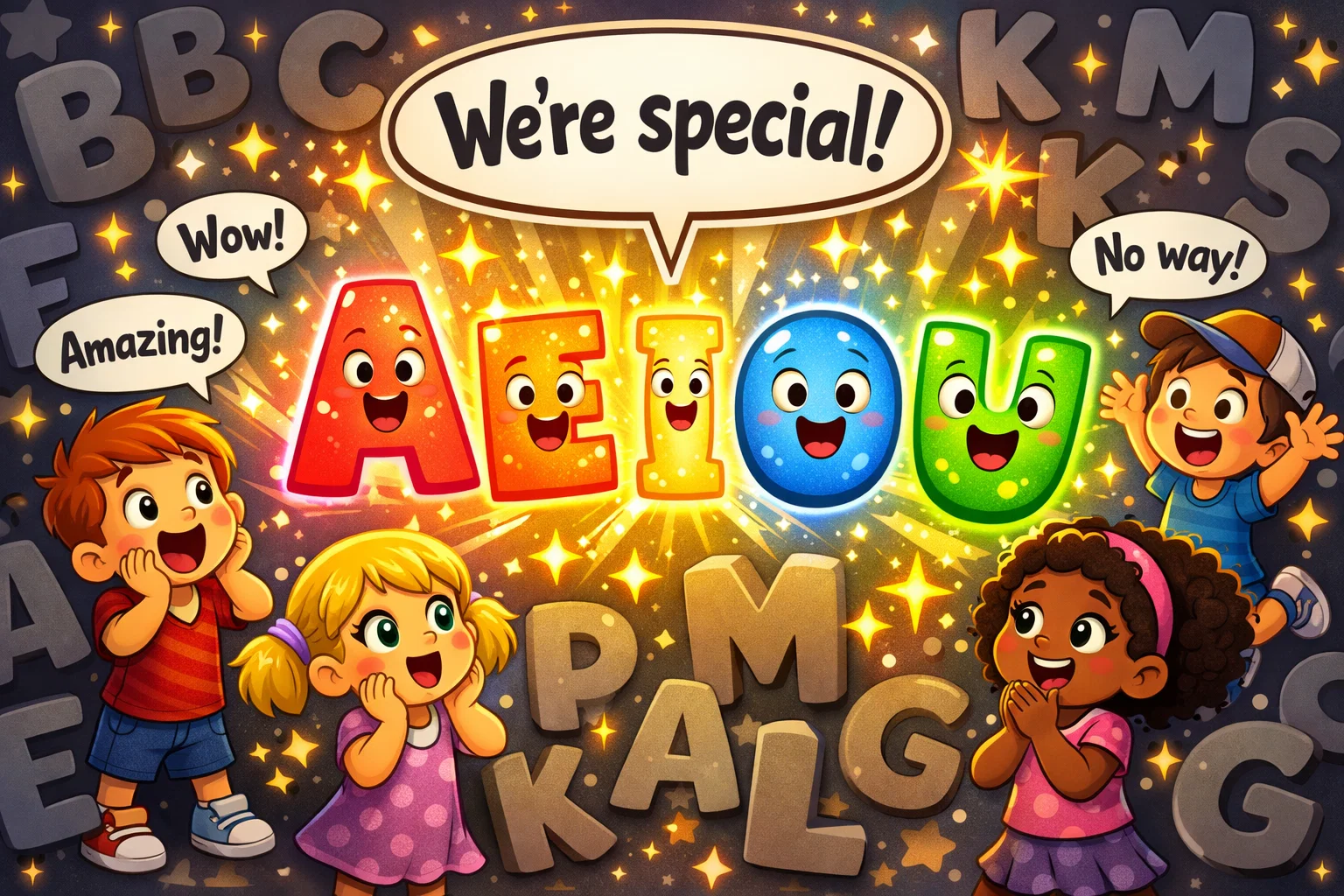
Every syllable in every English word contains exactly one vowel sound, which means these letters literally hold language together. Without these sounds, words would be difficult or even impossible to pronounce.
For example, if you remove them from cat, bed, or dog, the words become ct, bd, and dg, which are hard to read and say. These sounds act like the “voice” of a word, helping it flow smoothly and making speech clear and understandable for listeners.
Role in Reading and Speaking
A single vowel controls how a whole word sounds when spoken aloud. Changing just that one letter changes the meaning — hit becomes hot, pin becomes pan. Early readers rely on these letter sounds to decode unfamiliar words, making recognition a core phonics skill.
According to the National Reading Panel, systematic phonics instruction — which includes teaching these letter sounds explicitly — significantly improves reading accuracy in young children.
How Vowels Build Words
Almost every English word needs at least one vowel to be readable. Short CVC words (consonant-vowel-consonant), such as cat, bed, and hop, are the first building blocks children learn because they follow a simple, predictable pattern. They train early readers to identify the central letter and blend the sounds together.
Importance for Early Learning
Vowels are typically among the first letter sounds taught in phonics programs because they are so foundational. Children who can identify and produce these sounds are better equipped to decode new words independently. Early literacy experts recommend introducing these letters names and pronunciations by age 4 to 5, with structured practice continuing through early elementary school.
Short Versus Long Vowels
One of the most important distinctions in early phonics is the difference between short and long vowels. Both types appear constantly in everyday reading, so children benefit from learning them side by side.
What Are Short Vowels
Short vowels make a clipped, quick sound. They appear most often in CVC words:
- Short A: cat, map, fan
- Short E: bed, net, leg
- Short I: pig, sit, fin
- Short O: dog, hot, fox
- Short U: sun, cup, bug
These pronunciations are typically introduced first in phonics instruction because they follow consistent, predictable patterns.
What Are Long Vowels
Long vowels “say their name” — the pronunciation matches the letter name itself. These words often include a silent E at the end or a vowel team in the middle:
- Long A: cake, rain, play
- Long E: feet, tree, me
- Long I: bike, kite, pie
- Long O: bone, road, go
- Long U: cube, mule, blue
Differences Between Short and Long Vowels
| Feature | Short Vowels | Long Vowels |
| Sound | Clipped, quick | Full letter name |
| Common pattern | CVC (cat, bed) | CVCe or vowel team (cake, feet) |
| Introduced when | Early phonics | After short vowels |
| Example | sit, hop, beg | kite, boat, see |
Vowel Teams
A vowel team is when two letters appear together in a word and combine to make a single sound. A common classroom saying is: “When two vowels go walking, the first one does the talking.” This means the first letter usually takes on its long pronunciation while the second stays silent.
Common Vowel Team Examples
Some of the most frequently encountered vowel teams include:
- ai — rain, train, snail
- ea — eat, beach, dream
- oa — boat, coat, road
- ee — feet, tree, see
- ou — out, cloud, shout
Vowel teams produce sounds that neither letter makes alone. For example, the “ou” in cloud makes a completely different sound from either O or U on their own. Teaching these combinations after children are comfortable with individual letter sounds allows for a smooth, logical progression in phonics instruction.
Easy Practice Words
Short word lists help children practice vowel teams in a low-pressure way:
- sail, mail, tail (ai team)
- seal, meal, real (ea team)
- goat, soap, toad (oa team)
The Schwa
The schwa is the most common vowel sound in the English language, yet it is rarely taught by name in early phonics. It sounds like a relaxed “uh” and appears in unstressed syllables.
What Is the Schwa Sound
The schwa is produced when a vowel in an unstressed syllable is reduced to a neutral “uh” pronunciation. It can be spelled with any of the five letters, which is what makes it tricky for young learners. The phonetic symbol for schwa is ə.
You can hear this sound in banana, sofa, about, and lemon, where one part of the word is said more softly than the others. This happens because English naturally stresses certain syllables, while others become weaker and less clear. Helping children notice this pattern can improve both their pronunciation and listening skills, especially when they begin reading longer words.
Examples of Schwa Words
These examples show how this relaxed sound can appear at the beginning, middle, or end of words, especially in parts that are not stressed when speaking.
- banana — the first and last A both say “uh”
- sofa — the final A is a schwa
- about — the initial A is a schwa
- lemon — the second syllable uses a schwa
- pencil — the second syllable reads like “uh”
- teacher — the ending “-er” has a soft “uh”
- problem — the second syllable is reduced to “uh”
- support — the first syllable begins with a soft “uh”
- family — the middle syllable is often pronounced like “uh”
Why Schwa Is Important
Understanding the schwa helps children make sense of why some words are not spelled the way they sound. It supports more accurate spelling and more natural spoken English as children move into fluent reading and writing.
R-Controlled Vowels
When a vowel is followed by the letter R, the R changes how the letter is pronounced. These are called r-controlled vowels, and they do not follow standard rules.
What Are R-Controlled Sounds
R-controlled vowels produce a blended sound where the letter and R merge together. The most common r-controlled combinations are AR, ER, IR, OR, and UR. These patterns appear frequently in everyday words, making them essential to teach once children are comfortable with basic sounds.
Common R-Controlled Words:
- AR: car, star, farm
- ER: fern, her, verb
- IR: bird, stir, girl
- OR: fork, corn, storm
- UR: turn, burn, fur
Tips to Recognize Them
Encourage children to listen for the “growl” in r-controlled words — the R blends with the vowel and gives it a rougher quality. Sorting activities, where kids group these words by spelling pattern, are an effective way to build recognition.
What About Y as a Vowel
The letter Y is unique in the English language because it can function as either a consonant or a vowel depending on where it appears in a word.
When Y Is a Vowel
Y acts as a vowel when it appears in the middle or at the end of a word. In these positions, it makes a vowel-like sound:
- At the end of a two-syllable word: happy, funny, baby (like long E)
- In a single-syllable word: gym, myth, fly (like long I)
Y takes on the role of carrying the sound, allowing the word to be pronounced clearly. Without Y in words like myth or fly, the word would not have a complete, pronounceable sound.
When Y Is a Consonant
Y acts as a consonant at the beginning of a word, where it produces the “yuh” sound:
- yes, yellow, yard, yell
In this position, Y works more like other consonants such as B or D, helping to start the word rather than forming the main sound of the syllable. You can hear how the sound begins with a quick glide in yes or yard, which is different from the longer, smoother sounds it makes at the end or in the middle of words.
Easy Rule for Kids
A simple rule children can remember: if Y starts the word, it is a consonant; if Y is in the middle or at the end, it is a vowel. This covers the majority of words they will encounter in early reading.
How Vowel Sounds Change
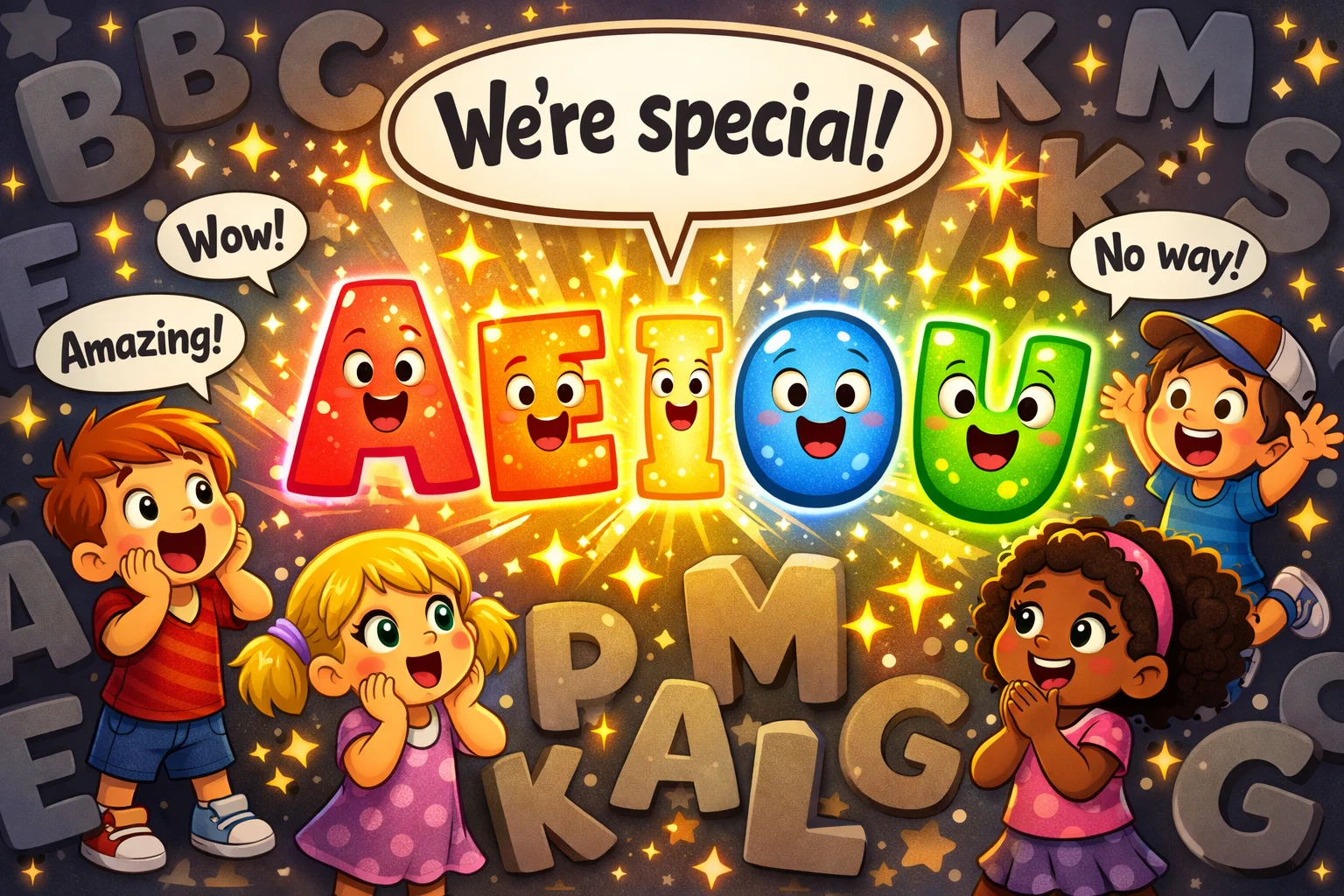
These letters can produce different sounds depending on the word structure around it. Understanding this helps children become more confident, adaptable readers.
Patterns like silent “e,” letter pairs, and surrounding consonants all influence how a sound is spoken. For example, compare cap → cape, hop → hope, and rid → ride—a small change in spelling creates a noticeable shift in pronunciation. Recognizing these patterns helps children predict how new words might sound.
Pronunciation Variations
A single vowel letter can produce multiple distinct pronunciations. The letter A, for example, makes a short sound in cat, a long sound in cake, and a different quality entirely in call or car. Exposure to many examples helps children internalize these patterns naturally.
It’s helpful for kids to group words by sound, such as cat, map, bat versus cake, lake, make, so they can hear the difference clearly. Listening activities, reading aloud, and repeating similar word sets can strengthen their ability to recognize and use these sound changes correctly.
Influence on Meaning
Swapping one vowel for another can completely change a word’s meaning. Bit and bite, hop and hope, cut and cute — in each pair, that one-letter shift transforms not just the pronunciation but the entire word. This is a powerful concept for early readers to explore through word sorting and comparison activities.
Practicing with word pairs helps children see how small spelling changes affect meaning. Activities like matching games or reading simple sentences (e.g., “The bit is small” vs “Take a bite”) allow kids to connect sound, spelling, and meaning in a fun and memorable way.
Syllables and Vowel Sounds
Every syllable contains exactly one vowel sound. This means that counting these sounds in a word is one of the most reliable ways to count syllables. Ba-na-na has three syllables because it has three distinct vowel sounds. Teaching children to clap syllables while identifying the key letter in each one reinforces both phonemic awareness and reading fluency.
How to Teach Vowels to Kids
Teaching vowels effectively means moving from recognition to application in a gradual, structured way. The goal is not memorization alone, but genuine understanding of how these letters work inside words.
Step-by-Step Guide
- Introduce letter names — Begin with A, E, I, O, U using alphabet songs, charts, and flashcards. Help children recognize the five letters by sight before focusing on pronunciation.
- Teach short letter sounds — Use CVC words and hands-on sorting activities to connect each letter with its short sound.
- Practice with word families — Use patterns like -at, -et, -ig, -og, -ug to help children see how changing the middle letter changes the word.
- Introduce long letter sounds — Teach the magic E rule and common vowel teams once the short sounds are solid.
- Move to reading and application — Encourage children to read simple decodable books that feature the patterns they have learned.
Differentiation Activities
Engaging activities make learning these letters stick:
- Sorting games — Sort picture cards by sound into labeled columns
- Word building with tiles — Use letter tiles to swap the middle letter and create new words
- Bingo — Call out words and have children mark the matching letter sound
How Parents Can Support Learning at Home
Parents play a powerful role in reinforcing vowel learning outside the classroom. The good news is that practice does not require worksheets or formal lessons — it fits naturally into everyday life.
Simple ways to support learning at home include:
- Read aloud daily — Point out vowel sounds in familiar picture books and ask your child to identify them
- Play “I Spy” with letter sounds — “I spy something with a short A sound” turns phonics awareness into a game
- Use everyday conversations — When cooking, driving, or shopping, ask children to name the vowel sound in a word they see or hear
- Celebrate progress — Building confidence is just as important as building skills; praise effort and recognition, not just correct answers
Children who practice these letter sounds regularly in a low-stress, playful environment tend to develop stronger phonics skills and greater reading fluency over time.
Frequently Asked Questions
What are vowels for kids?
Vowels are the letters A, E, I, O, and U. They make open sounds that form the core of every syllable and word in English. Every word needs at least one of these letters to be readable and pronounceable.
How many vowels are there in English?
There are 5 vowel letters in English: A, E, I, O, and U. However, these five letters produce more than 15 distinct sounds, including short and long vowels, teams, and the schwa.
What is the difference between short and long vowels?
Short vowels make a quick, clipped sound (as in cat, bed, pig). Long ones say the letter name (as in cake, feet, bike). Short sounds appear most often in CVC words; long vowels often appear with a silent E or in team combinations.
Why are vowels important for reading?
These letters are the sound center of every syllable. Children who can identify and produce them are able to decode unfamiliar words, read with greater fluency, and develop stronger spelling skills. Recognition of these letters is a core component of phonics instruction and early literacy development.
Are there words without vowels?
Most English words contain at least one vowel. A small number of words, like rhythm and myth, use Y as the vowel sound instead of a traditional letter. These are exceptions rather than the rule.
How do you explain vowels to kindergarteners?
Keep it simple: “Vowels are the letters A, E, I, O, and U — special letters that help make the sounds in words.” Use songs, colorful charts, and short CVC words to make the idea concrete and memorable.
What vowels should kids learn first?
Most phonics programs recommend starting with short vowels in CVC words, beginning with short A and short I, as these appear most frequently in early reading texts. Once children are comfortable with them, introduce long ones and then more complex patterns like vowel teams.
Take a short quiz to find out what your everyday choices say about your parenting style
When your child is curious about something new, what’s your instinct?
Take a short quiz to find out what your everyday choices say about your parenting style
“Can I download this app?” What happens next?
Take a short quiz to find out what your everyday choices say about your parenting style
When it comes to rules at home, which sounds most like you?
Take a short quiz to find out what your everyday choices say about your parenting style
If you could give your child one life skill today, what would you pick?
Take a short quiz to find out what your everyday choices say about your parenting style
Your child gets to choose what to watch. What would your ideal setup look like?
Take a short quiz to find out what your everyday choices say about your parenting style
Pick your parenting superpower ✨