120 Best & Frequently Used Verbs List for Kids A–Z

 Discover a Free Education Video App for Kids
Pastory uses AI to personalize educational video content based on your child’s interests and personality. Safe, engaging, and built for curious young minds. Sign up now to stay updated and enjoy early access with a free trial
In the journey of child development, the ability to express movement and states of being is a critical milestone. These linguistic building blocks enable young learners to describe everything from a fast dash on the playground to a quiet moment of reflection. Mastering these terms is essential for building a solid foundation in literacy, allowing children to connect subjects with meaningful activities in their daily lives.
This guide includes a list of 120 verbs for kids, child-friendly meanings, and simple example sentences. It also includes themed collections, fun ways to teach verbs, and practical tips to make learning enjoyable for both parents and educators.
What Are Verbs?
A verb is a word that shows an action, a state, or an occurrence. Essentially, they are “happening” words. While a noun names a person, place, or thing, a verb tells us what the subject does, feels, or is.
Meaning for Young Learners
To keep it simple, a verb is a word that tells us what is going on. For example, words like run, eat, and sleep tell us what someone is doing.
How to Spot Action in Sentences
To help kids spot verbs in a sentence, ask: “What is the person, animal, or thing doing, feeling, or being?”
- The cat naps on the rug.
- I kick the soccer ball.
- The sun shines brightly.
Daily Talk and Writing
Children use verbs all day at home, in class, and during play. From school assignments to retelling a favorite story, verbs help children communicate clearly. The richer this vocabulary, the more precisely a child can express their needs.
120 Best & Frequently Used Verbs List for Kids A–Z
This comprehensive verb list is curated to provide a rich vocabulary for young learners. Each entry is designed to be simple and clear.
A–F
- Add: To put together. (I add blocks to my tower.)
- Answer: To give a response. (I answer the teacher.)
- Ask: To request information or help. (I ask for a glass of water.)
- Bake: To cook in an oven. (We bake yummy muffins.)
- Bark: To make the sound a dog makes. (The dog barks at the cat.)
- Bathe: To take a bath. (I bathe every evening.)
- Be: To exist or to have a certain role or identity. (I want to be a doctor.)
- Bend: To curve. (I bend down to tie my shoe.)
- Bite: To use teeth. (I bite the crunchy carrot.)
- Blow: To move air. (I blow out the candles.)
- Bounce: To spring back. (I bounce the basketball.)
- Bring: To carry here. (Please bring your backpack.)
- Brush: To clean with a tool. (I brush my hair.)
- Build: To create. (I build a sandcastle.)
- Buy: To get with money. (We buy fresh apples.)
- Call: To speak to someone on the phone or call out to them. (I call my grandma.)
- Carry: To hold and move. (I carry the groceries.)
- Catch: To grab from the air. (I catch the ball.)
- Chase: To run after. (The dog chases the ball.)
- Clap: To hit your hands together. (We clap along to the music.)
- Clean: To remove dirt. (I clean my messy room.)
- Climb: To go up. (I climb the jungle gym.)
- Close: To shut. (I close the window.)
- Color: To use crayons. (I color the sky blue.)
- Come: To move toward. (Please come home.)
- Cook: To prepare food. (Mom cooks dinner.)
- Count: To say numbers. (I count to twenty.)
- Cry: To shed tears. (Babies cry when tired.)
- Cut: To divide something with scissors, a knife, or another sharp tool. (I cut out a paper star.)
- Dance: To move to music. (We dance at the party.)
G–L
- Dig: To move dirt. (I dig for treasure.)
- Do: To perform. (I do my homework.)
- Draw: To make a picture. (I draw a pretty house.)
- Dream: To see images while asleep. (I dream of space.)
- Drink: To swallow liquid. (I drink orange juice.)
- Drive: To operate a vehicle. (Dad drives the car.)
- Drop: To let fall. (Don’t drop the egg!)
- Eat: To take in food. (I eat my lunch.)
- Explain: To make clear. (I explain the rules.)
- Fall: To drop down. (Leaves fall in autumn.)
- Feed: To give food. (I feed the hungry cat.)
- Feel: To experience an emotion or physical sensation. (I feel excited today.)
- Find: To discover. (I find my missing sock.)
- Fly: To move through the air. (The plane flies high.)
- Fold: To bend cloth. (I fold my pajamas.)
- Follow: To go after. (I follow the teacher.)
- Get: To receive. (I get a gold star.)
- Giggle: To laugh in a silly or excited way. (We giggle during the movie.)
- Give: To hand over. (I give my friend a toy.)
- Go: To move away. (I go to the park.)
- Grow: To get bigger. (The flowers grow in spring.)
- Guess: To answer without knowing for sure. (I guess the number.)
- Have: To own. (I have a new bike.)
- Hear: To notice a sound with your ears. (I hear the bell ring.)
- Help: To assist. (I help set the table.)
- Hide: To go unseen. (I hide behind the tree.)
- Hit: To strike. (I hit the drum.)
- Hold: To have in hand. (I hold the baby’s hand.)
- Hop: To jump on one foot. (I hop across the yard.)
- Hug: To hold close. (I hug my mom.)
M–R
- Hurry: To move fast. (We hurry to the bus.)
- Jump: To spring up. (I jump into the leaves.)
- Keep: To stay with. (I keep my favorite toy.)
- Kick: To hit something with your foot. (I kick the soccer ball.)
- Kiss: To touch with lips. (I kiss my pet.)
- Kneel: To go down onto your knees. (I kneel to look at the bug.)
- Knock: To hit a door. (I knock on the door.)
- Know: To understand or have information about something. (I know how to count.)
- Laugh: To show joy. (We laugh at the clown.)
- Learn: To get knowledge. (I learn how to swim.)
- Leave: To go away. (We leave the school.)
- Lick: To touch with tongue. (I lick my ice cream.)
- Like: To enjoy. (I like strawberries.)
- Listen: To pay attention to sound. (I listen to the story.)
- Look: To direct your eyes toward something. (I look at the map.)
- Love: To care for. (I love my puppy.)
- Make: To create. (I make a paper boat.)
- March: To walk steady. (We march in the parade.)
- Mix: To combine. (I mix the flour and eggs.)
- Mop: To clean a floor with a mop. (I mop the kitchen floor.)
- Move: To change place. (Don’t move during the photo.)
- Nap: To sleep a bit. (The baby naps at noon.)
- Nod: To move your head up and down. (I nod yes.)
- Open: To make something no longer closed. (I open the gift box.)
- Paint: To use colors. (I paint a rainbow.)
- Pick: To choose or pluck something. (I pick a yellow flower.)
- Play: To have fun. (We play tag.)
- Pull: To move toward you. (I pull the wagon.)
- Push: To move away. (I push the swing.)
- Put: To place. (I put my shoes away.)
S–Z
- Read: To look at words. (I read before bed.)
- Ride: To travel on or in something. (I ride my scooter.)
- Run: To move fast. (I run to the fence.)
- Say: To speak. (I say please and thank you.)
- See: To notice something with your eyes. (I see a ladybug.)
- Sell: To give for money. (We sell lemonade.)
- Send: To make something go to another person or place. (I send a letter.)
- Shake: To move back and forth. (I shake the rattle.)
- Share: To give part of. (I share my crayons.)
- Shout: To speak loudly. (I shout for joy!)
- Show: To let someone see. (I show my drawing.)
- Sing: To make musical sounds. (I sing a happy song.)
- Sit: To rest on a seat. (I sit on the chair.)
- Sleep: To rest at night. (I sleep in my warm bed.)
- Smile: To make a happy expression with your face. (I smile for the photo.)
- Spell: To say letters of a word. (I can spell my name.)
- Stand: To be on your feet. (I stand in line.)
- Stop: To finish moving. (The car stops at the light.)
- Swim: To move in water. (I swim in the pool.)
- Take: To grab or carry. (I take my umbrella.)
- Talk: To use your voice. (We talk about school.)
- Tell: To say something to someone. (I tell a story.)
- Think: To use your mind. (I think of a great idea.)
- Throw: To send through the air. (I throw the ball.)
- Touch: To make contact with something. (I touch the soft fur.)
- Wait: To stay until a time. (I wait for my turn.)
- Walk: To move by putting one foot in front of the other. (I walk to the park.)
- Wash: To clean with water. (I wash my dirty hands.)
- Watch: To look at something. (I watch a movie.)
- Write: To make letters. (I write a letter.)
Action Verbs List for Kids
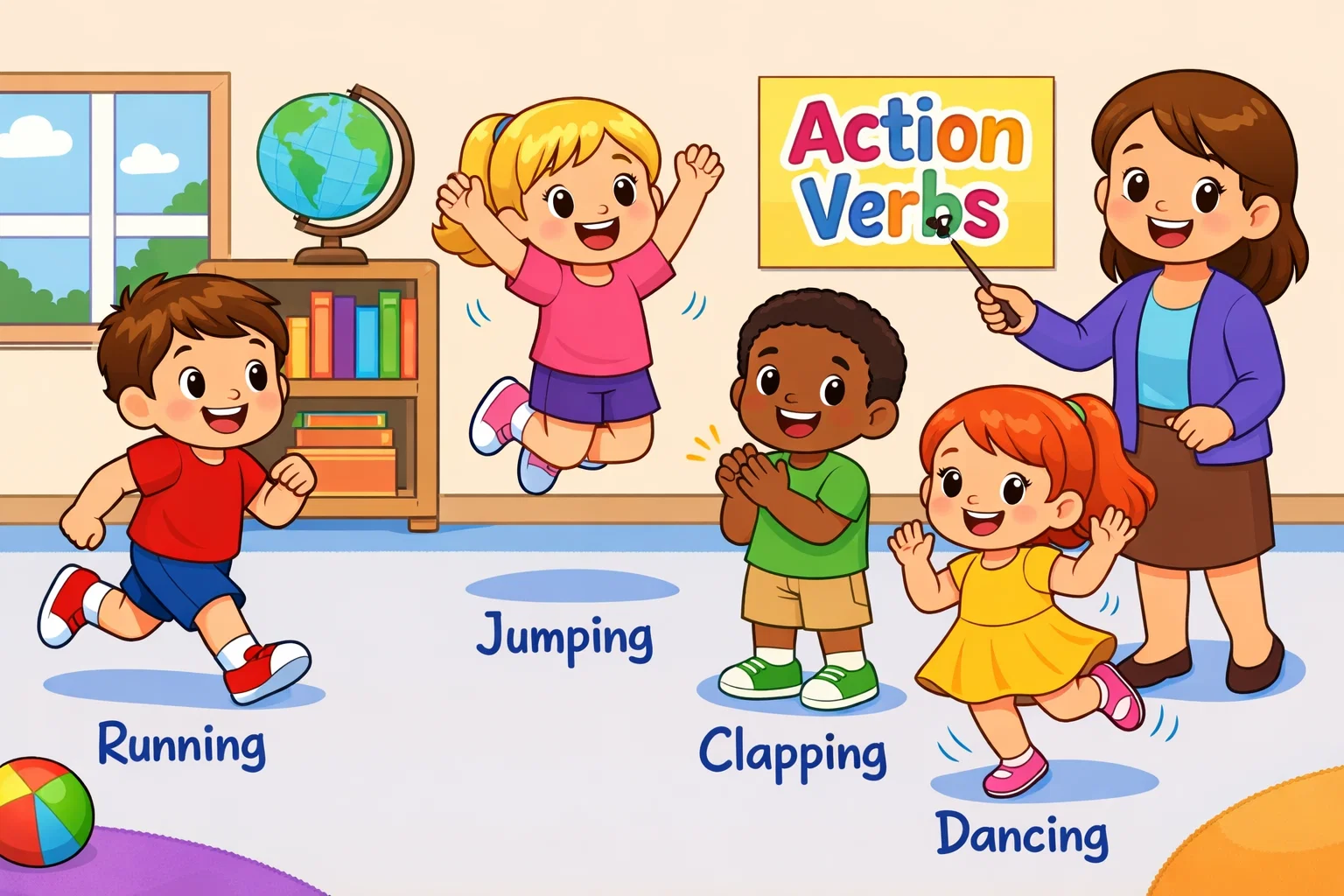
Action verbs are the words that bring language to life. This categorized list helps children connect verbs to the world around them.
At School
In the classroom, language skills grow as kids interact with their surroundings.
- Write: I write my name on the worksheet.
- Cut: I cut along the dotted lines.
- Color: We color our drawings together.
At Home
Daily chores and routines are a great way to help kids learn useful verbs.
- Wash: I wash my face in the morning.
- Cook: Dad cooks our dinner every night.
- Fold: I fold my clean socks.
Outside and Playground
Play gives kids many chances to learn verbs through movement and exploration.
- Climb: I climb the ladder to the slide.
- Swing: We swing high into the air.
- Throw: I throw the ball to my dog.
Daily Routine Verbs for Kids
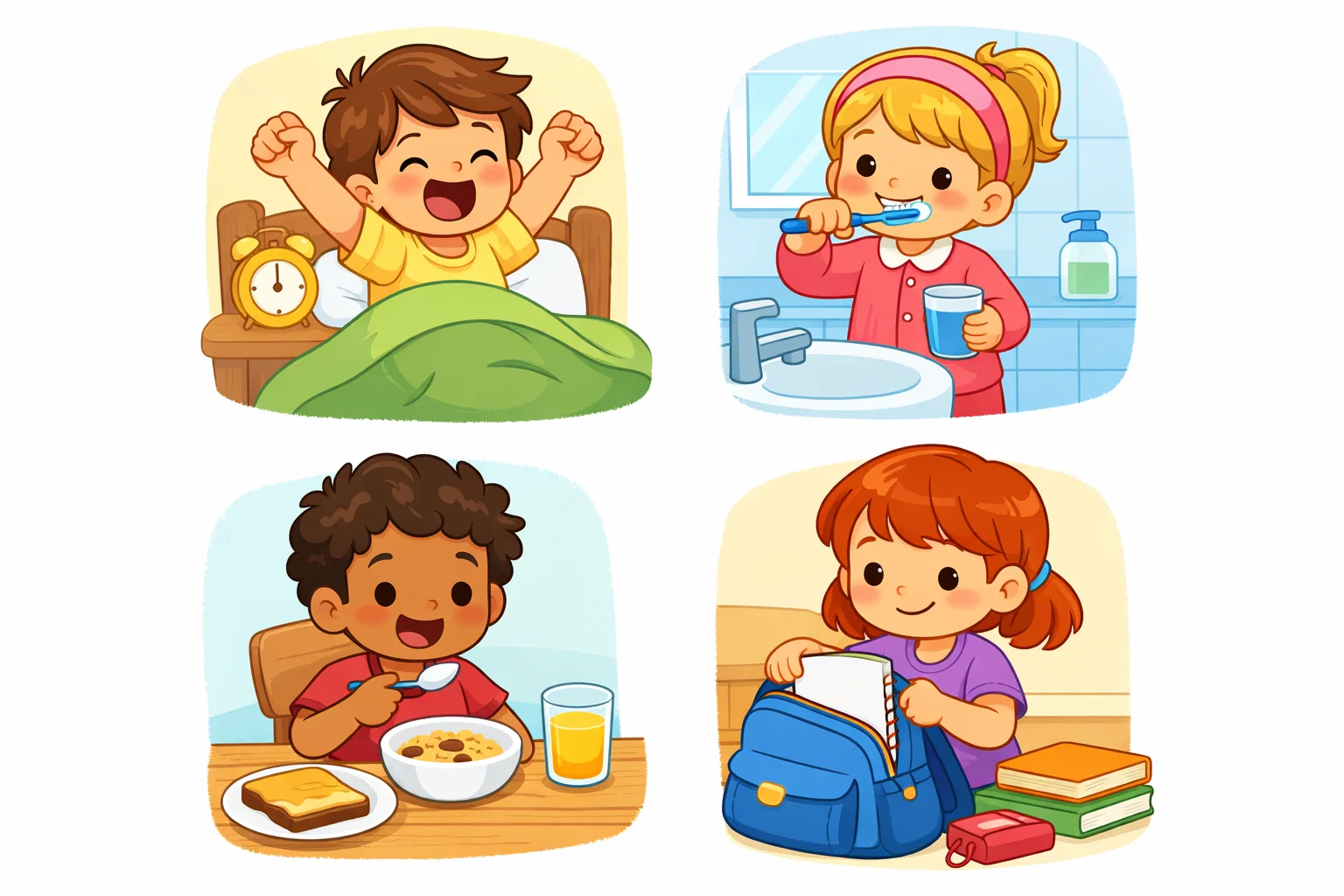
Teaching verbs through a daily schedule helps children understand both word meaning and the order of everyday tasks.
Morning Routine Verbs
- Wake up: I wake up when the sun rises.
- Brush: I brush my teeth thoroughly.
- Dress: I get dressed for the day.
- Pack: I pack my school supplies.
School Day Verbs
- Learn: We learn about the planets.
- Share: I share my toys during recess.
- Answer: I answer when the teacher calls.
Evening Routine Verbs
- Bathe: I bathe with warm water.
- Relax: We relax by reading a story.
- Sleep: I sleep in my cozy bed.
Body Movement Verbs for Kids
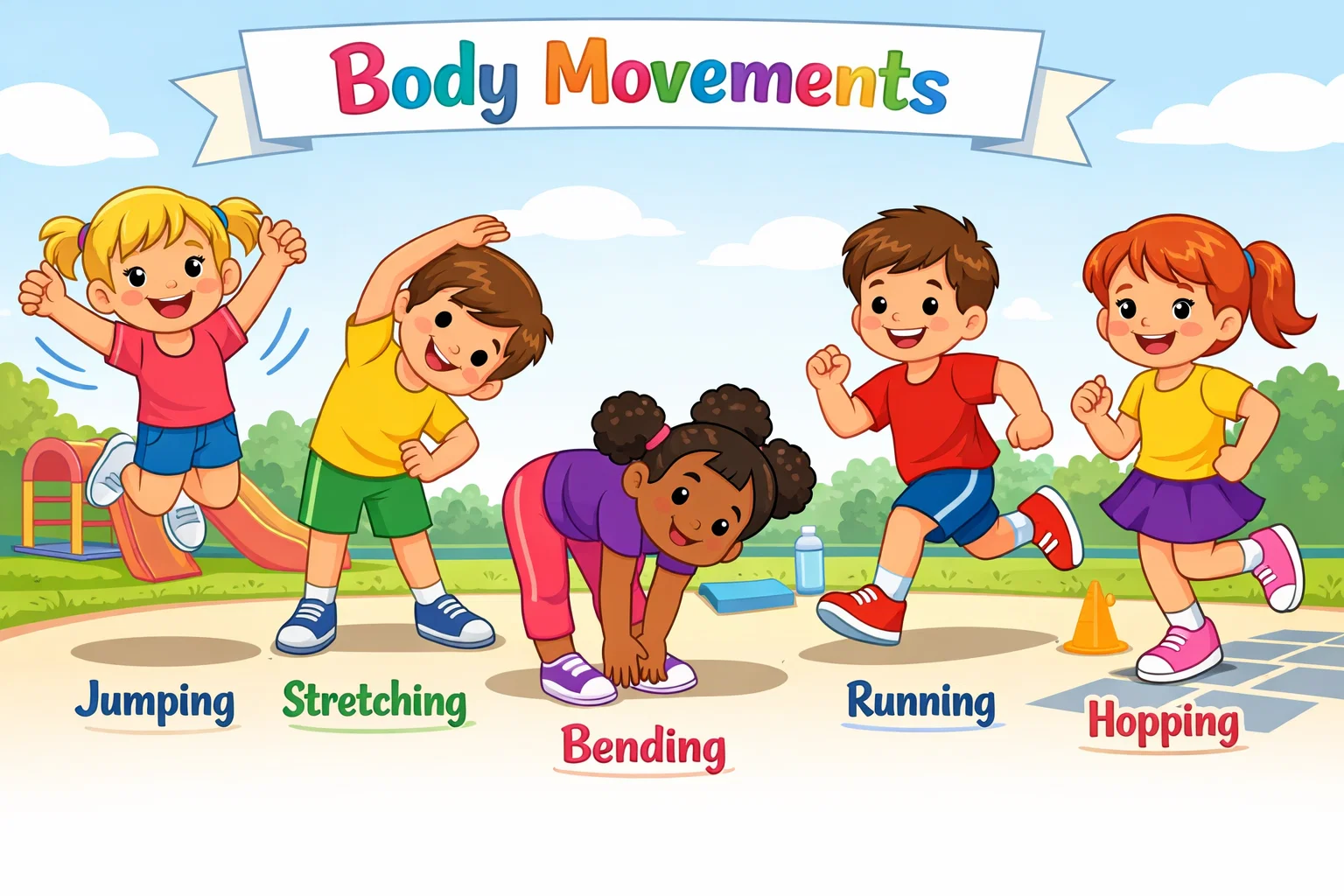
Physical movement helps kids learn because it connects each verb to an action they can feel and remember.
Jumping and Running Verbs
- Hop: To jump on one foot like a bunny.
- Skip: To move with a happy, light rhythm.
- Race: To run as fast as possible to the finish.
Balance and Stretch Verbs
- Bend: To move part of your body so it is no longer straight.
- Stretch: To make your body or limbs as long as possible.
- Balance: To stay steady without falling. (I balance on one foot.)
Sports and Dance Verbs
- Kick: To hit something with your foot. (I kick the soccer ball.)
- Spin: To turn around quickly in a circle.
- Dance: Move your body in time with the music.
Verbs by Age Group and Grade Level
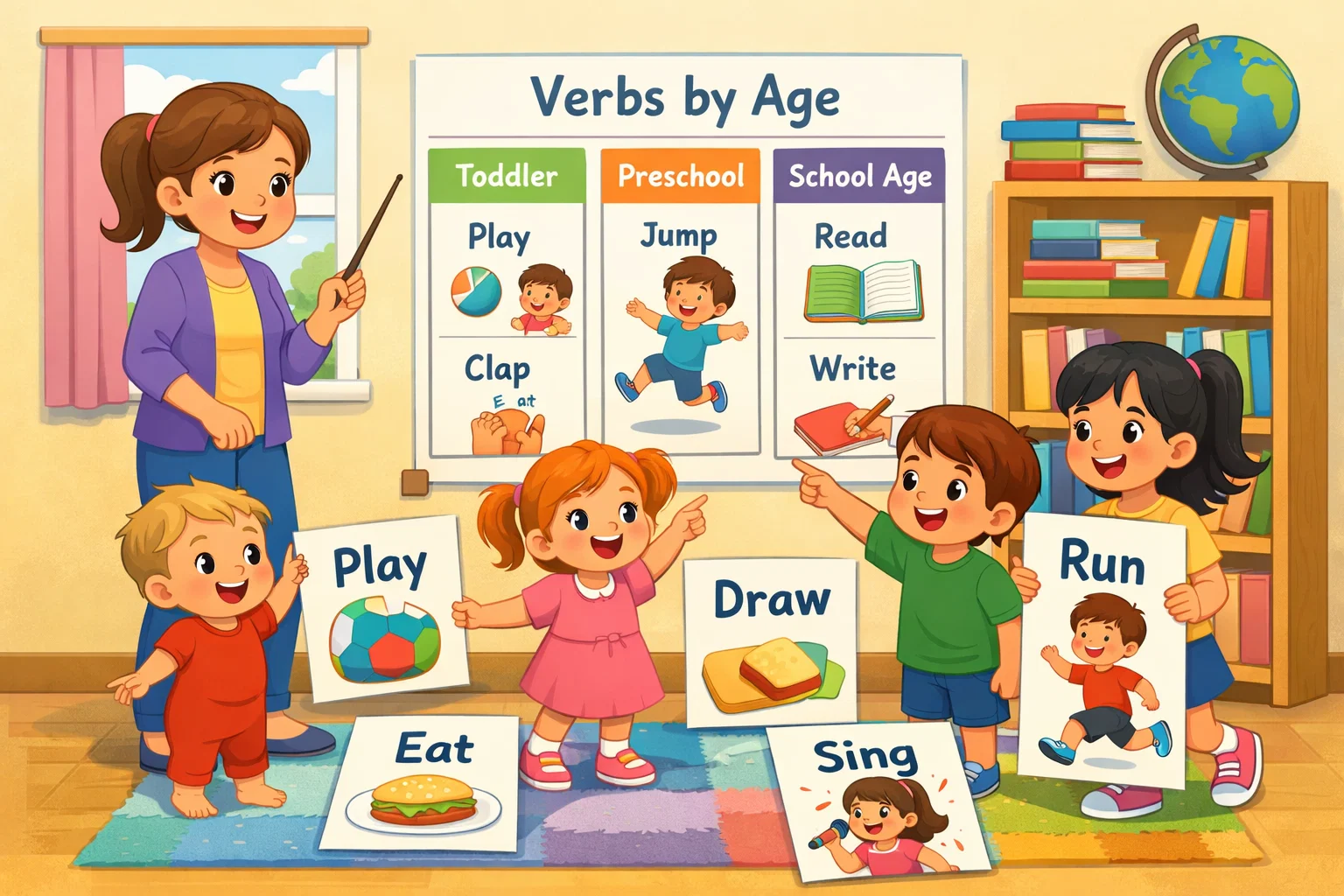
Helping kids learn the right vocabulary at the right time is key to their ongoing development.
| Age/Grade | Developmental Focus | Key Terms |
| Ages 2–3 | High-use physical activities | Go, Sit, Eat, Up |
| Ages 3–4 | Social and creative activities | Share, Sing, Help, Draw |
| Ages 4+ | Expression and logic | Build, Decide, Explain |
| Grades 2–4 | Academic writing and reading | Describe, Compare, Solve |
| Grades 5–6 | Abstract concepts and organization | Notice, Discover, Organize |
Irregular Verbs for Kids
Irregular verbs are tricky because they do not follow the standard “-ed” past tense rule. To help kids learn these, repetition in context is the best strategy.
Most Used Irregular Verbs
Common forms like go/went, eat/ate, see/saw, come/came, and give/gave appear in nearly every storybook.
Present and Past Pairs
- Go / Went: Today I go. Yesterday I went.
- Eat / Ate: I eat an apple. I ate an apple.
- See / Saw: I see a cat. I saw a cat.
Easy Practice Ideas
Use word cards to match the present tense with its past partner. Simple drills or fill-in-the-blank sentences make this process feel less like work and more like a puzzle.
Phrasal Verbs for Kids
Phrasal verbs are made of a verb plus a small word, such as sit down or pick up.
Daily Life Phrasal Verbs
- Wake up: To stop sleeping and open your eyes.
- Put on: To wear a piece of clothing.
- Take off: To remove an item of clothing.
Classroom Phrasal Verbs
- Line up: To stand in a straight row behind others.
- Pick up: To lift an object from the floor.
- Turn on: To start a light or electronic device.
Why These Words Matter for Development
Verbs help children move from naming things to expressing complete ideas and telling stories. A strong verb vocabulary can support reading comprehension and help children express ideas more clearly.
Role in Speaking Skills
These specific words help kids say exactly what they want, need, feel, or do during their daily routines. As children learn verbs, they move from one-word requests like “Apple” to complete thoughts like “I want an apple.” This can reduce frustration and make communication easier.
Role in Reading Skills
A solid understanding of verbs helps children follow the sequence in stories, adhere to classroom instructions, and succeed in literacy tasks. When kids understand the difference between “the boy walked” and “the boy raced,” they can picture the action more clearly and understand the story better.
Role in Writing Skills
Strong verbs describe actions more vividly, making a child’s writing clearer and more lively. Instead of a weak sentence like “He went to the store,” a child might use a different verb to say “He dashed to the store,” creating a much stronger mental image for the reader.
When Kids Start Using Motion Words
Many children begin using simple action verbs between 12 and 18 months of age. As they grow, they move from simple verbs like “go” and “eat” to a wider range of words that include feelings, thoughts, and more specific actions.
Types of Verbs for Kids
Understanding the different types of verbs helps students construct grammatically correct sentences. While grammar can feel complex, focusing first on action, helping, and linking verbs provides a practical foundation for language learning.
| Category | Function | Examples |
| Action Verbs | Shows physical or mental effort | Jump, Think, Throw |
| Helping Verbs | Supports the main activity | Is, Can, Will |
| Linking Verbs | Connects subject to a state | Am, Are, Was |
| Irregular Verbs | Changes spelling in the past | Go/Went, Eat/Ate |
Action Terms
Action verbs show what the subject of a sentence is doing. Examples like jump, play, read, and clap are usually the first new verbs a child masters because they can be easily visualized and mimicked in real life.
Helping Words
A helping verb (also called an auxiliary verb) works with the main verb to show time, possibility, or emphasis. In the phrase “is running,” the first word acts as the helper to show the movement is happening right now.
Linking Terms
Linking verbs do not show a physical movement; instead, they connect the subject with more information or describe a state. Common examples include is, am, are, and was, which define who or what someone is.
Tense and Timing
The tense tells us when something happened: in the past, the present, or the future.
- Present: I play (Now)
- Past: I played (Before)
- Future: I will play (Later)
Regular and Irregular Forms
Most verbs in English add -ed in the past tense, as in walk → walked. Irregular verbs change differently, as in go → went, so they need extra practice.
How to Teach Verbs to Kids
To make learning verbs successful, educators suggest fun and interactive methods. One of the best ways to help kids learn is to use verbs in everyday contexts.
Make Learning Interactive
Make learning a full-body experience. Movement and role-play help children remember a verb by connecting it to an action.
Use Visuals and Movement
Verb cards with bright pictures help children connect the word to the action it describes.
Use Real-Life Examples
Teach during meals (eat, drink), chores (wash, clean), and play (jump, throw) to show how language applies to the real world.
Fun Activities to Teach Verbs
Action Charades
- Goal: Guess the action word.
- Setup: One child acts out a term from our list of action verbs while others guess. No speaking allowed!
Verb Game
Hide pictures or objects around the room and have children match each one to the correct verb card.
Verb Time Machine
Use one verb in the present, past, and future. Kids can jump “forward” for the future and “backward” for the past.
Challenges When Teaching Motion Words
Help kids understand that making mistakes is a normal part of expanding their vocabulary.
Low Motivation
If kids lose interest, switch to a verb toss game or charades to keep the energy level high.
Mixed Ages and Levels
Use simpler words for toddlers and richer, more descriptive terms like “discover” for older kids.
Confidence Building
Praise and small wins help kids use new verbs more frequently without fear of being wrong.
Final Takeaways
Learning verbs is an important step in building a child’s communication skills. By providing a rich list of verbs and using fun activities, you help children become more confident and expressive speakers.
Key Points Recap
Verbs are one of the most important parts of a sentence. Using themed collections and alphabetical lists helps kids organize their learning about verbs in a logical way.
Next Practice Steps
Start with a small group of 10–15 common terms. Once the child is comfortable, gradually introduce more complex words by theme or grade level.
Frequently Asked Questions
What Are Easy Verbs for Kindergarten?
Beginner words include run, jump, eat, sit, read, draw, and play. These are the most recognizable and easy to demonstrate physically.
How Many Types of Verbs Are There?
For children, the three most important categories are action verbs, helping verbs, and linking verbs. These cover most school-level grammar needs.
How Can Kids Learn New Verbs Faster?
A combination of visuals, repetition, and physical movement is the most effective way to accelerate vocabulary growth.
How Can Parents Keep Practice Fun?
Use games and activities such as charades, ball tosses, and sentence-building challenges to keep practice light and enjoyable.
Take a short quiz to find out what your everyday choices say about your parenting style
When your child is curious about something new, what’s your instinct?
Take a short quiz to find out what your everyday choices say about your parenting style
“Can I download this app?” What happens next?
Take a short quiz to find out what your everyday choices say about your parenting style
When it comes to rules at home, which sounds most like you?
Take a short quiz to find out what your everyday choices say about your parenting style
If you could give your child one life skill today, what would you pick?
Take a short quiz to find out what your everyday choices say about your parenting style
Your child gets to choose what to watch. What would your ideal setup look like?
Take a short quiz to find out what your everyday choices say about your parenting style
Pick your parenting superpower ✨