Fun Team Building Activities For Kids

 Discover a Free Education Video App for Kids
Pastory uses AI to personalize educational video content based on your child’s interests and personality. Safe, engaging, and built for curious young minds. Sign up now to stay updated and enjoy early access with a free trial
Effective team-building activities are more than just a break from academic work; they can support social-emotional learning and help children practice collaboration. For teachers, parents, camp counselors, and coaches, having a varied set of games makes it easier to turn almost any setting – from a rainy-day classroom to a playground – into an active, cooperative space. This guide offers team-building activities for kids grouped by age, setting, and skill focus, ranging from no-equipment icebreakers to STEM-style challenges.
The list includes options for different settings, including lower-conflict activities for more sensitive groups and higher-energy outdoor games for active sessions. By using these games thoughtfully, educators can create structured opportunities for teamwork that children can carry into everyday social situations.
Benefits of Team Building Games for Children
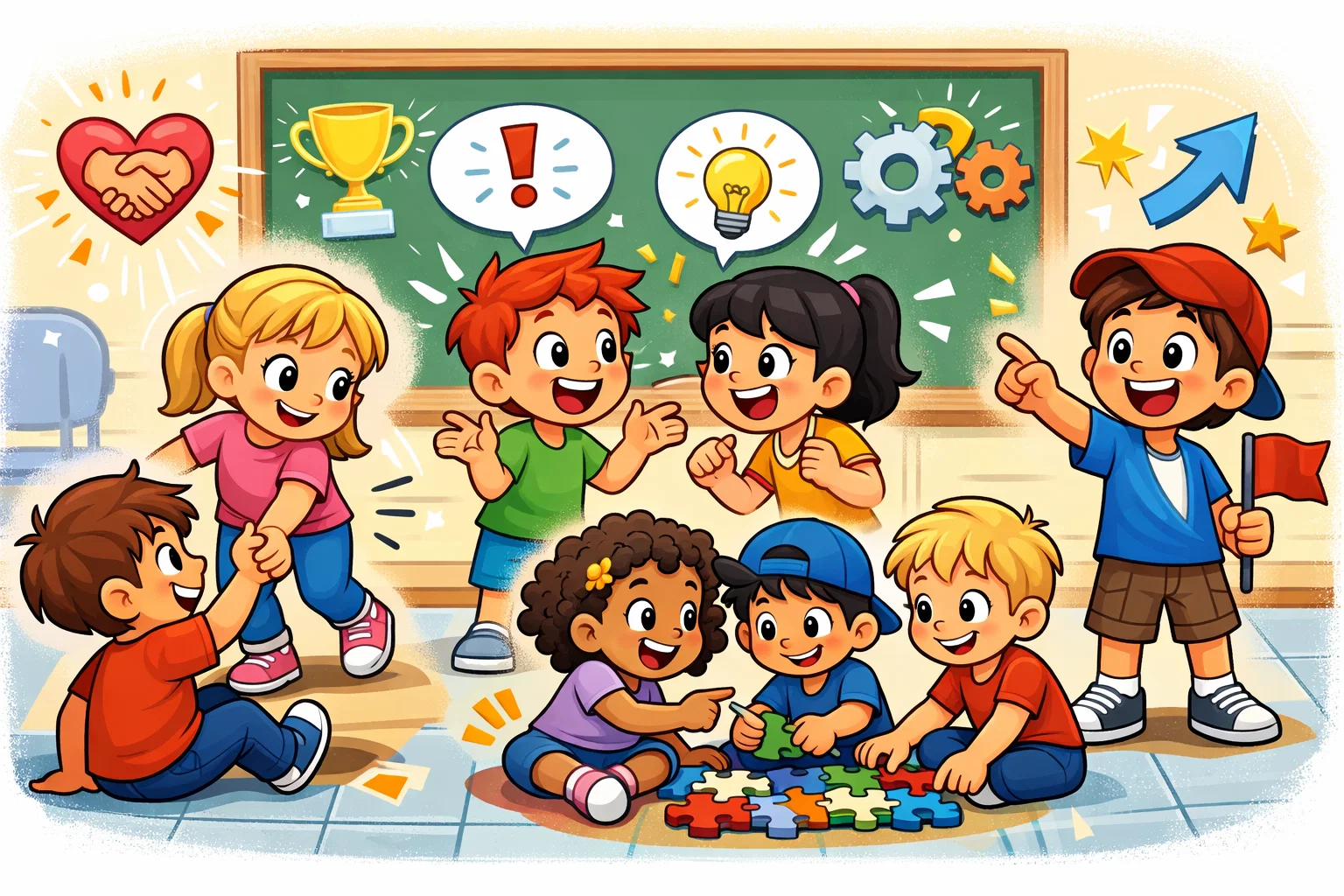
Using team-building activities regularly can support children’s social and communication skills over time. AAP guidance broadly supports play-based experiences as beneficial for children’s social, emotional, and executive-function development, but this claim should be phrased more cautiously. When children learn to work as part of a team, they may feel more included and more comfortable participating in class.
Communication and Listening Skills
One of the main benefits of team building is that it helps children practice verbal and nonverbal communication. In a fun way, team-building activities require a team member to articulate ideas clearly while practicing active listening. For example, in tasks where students must follow a peer’s directions, they learn that teamwork and communication are reciprocal processes. These activities can help children practice negotiating, taking turns, and giving constructive feedback to peers.
Problem-Solving and Critical Thinking
Many team building exercises function as “social laboratories” where kids need to navigate constraints to reach a goal. When students work together to figure out a complex task, such as a teamwork game involving physical puzzles, they apply logic and test hypotheses. This process helps children see that mistakes can be useful for learning and trying again. Collaborative problem-solving encourages older children to notice how their group works and adjust their strategy based on different teammates’ strengths.
Cooperation, Trust, and Peer Bonds
Teamwork and cooperation are essential for building a cohesive community, especially in new or diverse groups. Cooperative games shift the focus from individual performance to a shared group goal, which can help children work with classmates outside their usual social circles. By participating in a well-designed team-building session, kids learn to rely on one another, which can strengthen peer relationships. This sense of teamwork can help reduce exclusion and make more children feel valued within the group.
Confidence, Leadership, and Conflict Resolution
A well-designed activity teaches kids how to lead and follow with equal grace. Team-building games for kids provide a safe space for shy students to help lead a small group or for dominant personalities to learn the value of a supportive role. When conflicts arise—which they inevitably do during fun team-building activities—the presence of a facilitator helps kids to improve communication and resolve disputes through compromise rather than confrontation. These experiences build teamwork skills that empower children to handle real-life social friction effectively.
How to Choose and Run Team Building Games for Children
Selecting the right team building games requires a strategic approach to ensure the activity aligns with the group’s current needs. An activity for children that is too difficult can lead to frustration, while one that is too easy may fail to engage kids of all ages. Practitioners should evaluate the specific intent of the session before choosing a first team challenge.
Choose Goal: Icebreaker, Cooperation, Strategy, or Movement
Before you ask students to participate, identify the core objective. If the goal is to lower social barriers, an icebreaker is a good place to start. If the group already knows one another, a strategy- or problem-solving-focused team-building activity is more appropriate. High-energy “movement” games are ideal for a fun team building session on the playground, whereas “cooperation” tasks are better for indoor team building where space is limited.
Match Game to Age Group and Group Size
The development stage should guide how complex the games are.
- Preschool (3–5): Focus on simple teamwork on the playground with rhythmic movements and immediate rewards.
- Early Elementary (6–8): Use playground games that involve repetition and clear, singular goals.
- Late Elementary (9–12): Introduce team-building activities that involve role-play, planning, and multi-step problem-solving.
For large groups, use relays or scavenger-style activities so you can divide students into manageable teams of four to six.
Check Space, Materials, and Safety Rules
Logistics are a critical part of a successful team-building session. Indoor team building activities must prioritize noise control and floor safety, often requiring a “no-running” rule. Conversely, outdoor team building activities allow for expansive movement but require clear boundaries. Before the activity begins, check for trip hazards and ensure all materials—such as a set of blocks or balls—are age-appropriate and sanitized.
Add Quick Reflection After Each Game
To maximize the benefits of team building activities, always conclude with a 2-minute “debrief.” This shift from play to reflection helps children internalize the lesson. Ask questions like:
- “What was the hardest part of working as a team member?”
- “How did you work together to figure out the solution?”
- “What is one thing the first team did differently that worked?”
This practice ensures the team building skills are identified and reinforced for future use.
Get to Know You Team Building Activities for Kids
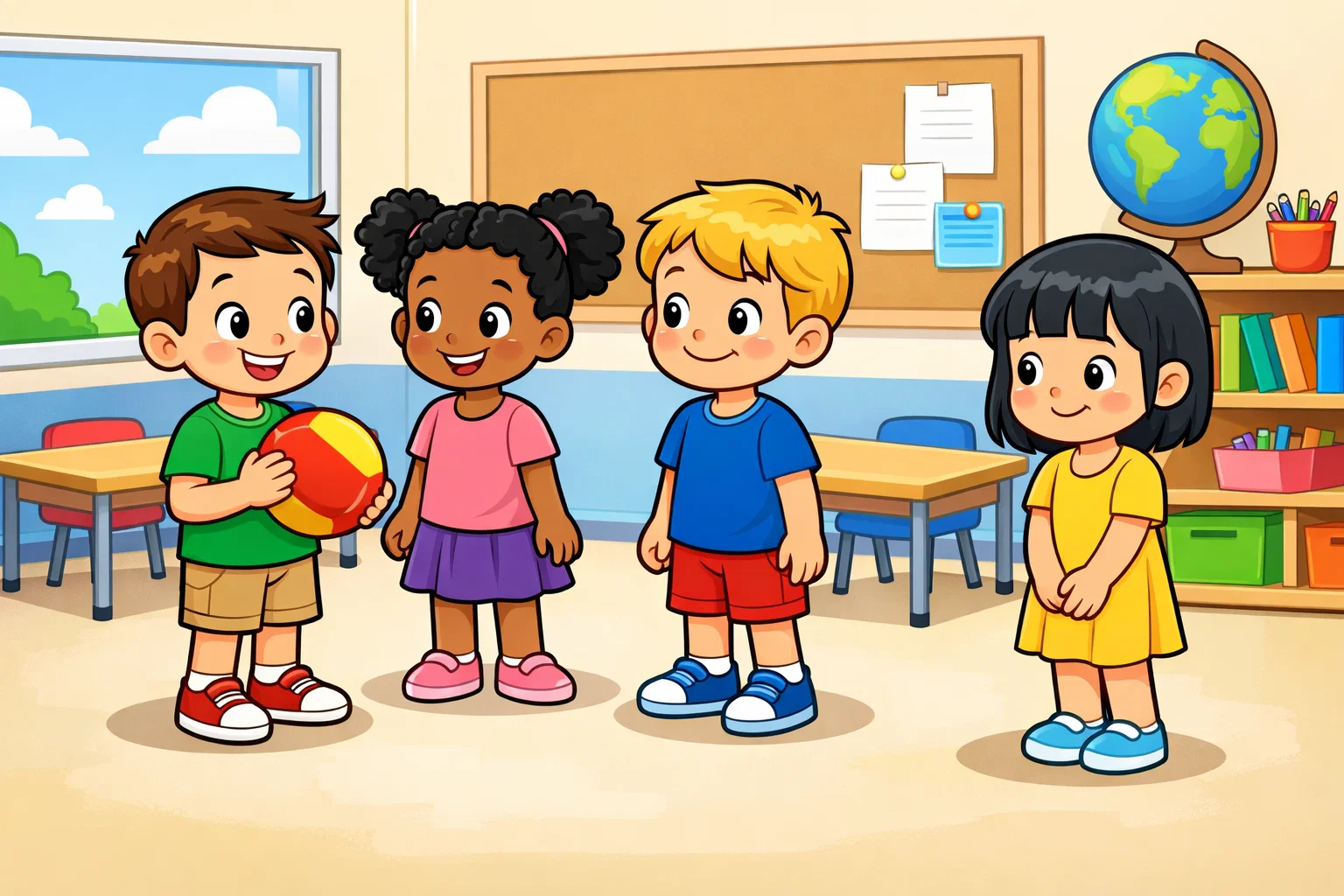
These team-building activities are designed for the first week of school or new camp sessions. They aim to help children feel comfortable with one another more quickly through lighthearted interaction.
Birthday Line-Up
The Birthday Line-Up is a classic team challenge that requires kids to arrange themselves in chronological order of their birthdays without speaking.
- Goal: Improve non-verbal communication skills.
- Format: Kids stand in a line and use hand signals to indicate their birth month and day.
- Ideal for: Kids of all ages (9+ for the silent version; younger children can use whispered voices).
- Development: Teaches patience and the ability to work together to figure out a sequence without a formal leader.
Human Bingo
In Human Bingo, students working in small groups or as a whole class are given a grid of traits (e.g., ‘Has a cat,’ ‘Speaks two languages’).
- Goal: Identify different kids’ interests and find commonalities.
- Format: Kids play by circulating around the room, finding peers who fit the descriptions, and asking them to sign a square.
- Adaptation: For shy children, provide “partner bingo” where two kids work together to find others.
- Value: A fun way for kids to discover shared experiences, forming a foundation for teamwork.
Common Denominator
Common Denominator tasks a small group of kids to find three non-obvious things they all have in common (e.g., “We all have a younger brother”).
- Goal: Foster team building among diverse participants.
- Format: Split kids into groups of 4; they have 5 minutes to interview each other.
- Outcome: Once they find their “denominator,” they present it to the class in a fun way.
- Benefit: Encourages kids to work together to find hidden social bridges.
Story Chain
The Story Chain is a creative activity for kids that builds listening skills and collective imagination.
- Goal: Enhance focus and cooperation.
- Format: One child starts a story with one sentence, and each following child adds a sentence that fits what came before.
- Constraint: Students must listen intently, as they cannot repeat what has already been said.
- Impact: This activity teaches kids that every team member’s contribution is vital to the final narrative.
Mingle Groups
Mingle Groups is a rapid-fire icebreaker in which kids quickly form small groups based on fun criteria.
- Goal: High-energy interaction and quick communication.
- Format: The leader shouts a category (e.g., “Favorite fruit!”), and kids must quickly form groups with others who share their choice.
- Purpose: It works well as an indoor warm-up because it keeps children mixing with different classmates.
Indoor Activities
When limited to a classroom or gym, indoor team building focuses on coordination, physical proximity, and shared mental models.
| Activity Name | Primary Skill | Materials Needed | Time Limit |
| Human Knot | Problem-Solving | None | 10 Minutes |
| Hula Hoop Pass | Coordination | Hula Hoop | 5 Minutes |
| Cup Stacking | Engineering | Plastic Cups | 15 Minutes |
| Back-to-Back Drawing | Communication | Paper/Pens | 10 Minutes |
Human Knot
The Human Knot is a team building game for kids that emphasizes physical teamwork and communication.
- How to play: Kids stand in a tight circle and grab the hands of two different people across from them.
- The Challenge: They must untangle themselves into a circle without letting go.
- Safe Version: For younger children, instruct kids to hold a short piece of string between them instead of hands to allow more movement.
- Note: This can be a useful trust-building activity, but some children may prefer a low-contact variation.
Hula Hoop Pass
In the Hula Hoop Pass, a group of kids stands in a circle holding hands.
- Action: One child starts with a hula hoop on their arm, and the group must pass the hoop all the way around the circle without letting go of hands.
- Value: It teaches kids the importance of rhythm, coordination, and cooperation.
- Variation: Add a second hoop moving in the opposite direction to increase the challenge for older kids.
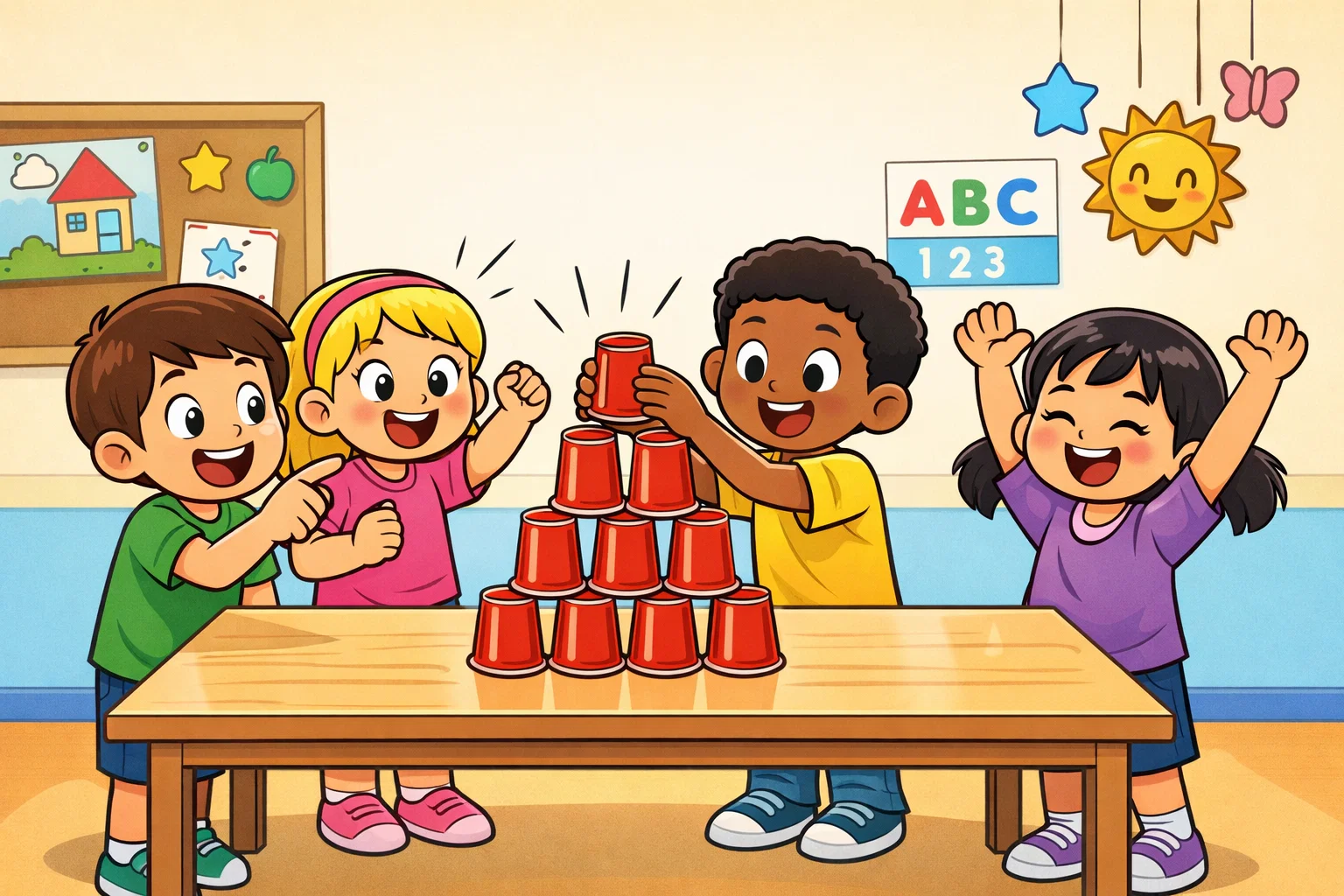
Cup Stacking Challenge
This building activity uses simple plastic cups to foster engineering-based teamwork.
- Goal: Give each team a set of 20 cups; they must build the tallest possible structure in 3 minutes.
- Roles: Assign a “Builder” and a “Strategist” to help students understand role distribution.
- Result: Kids will learn that stability requires a solid foundation and collaborative precision.
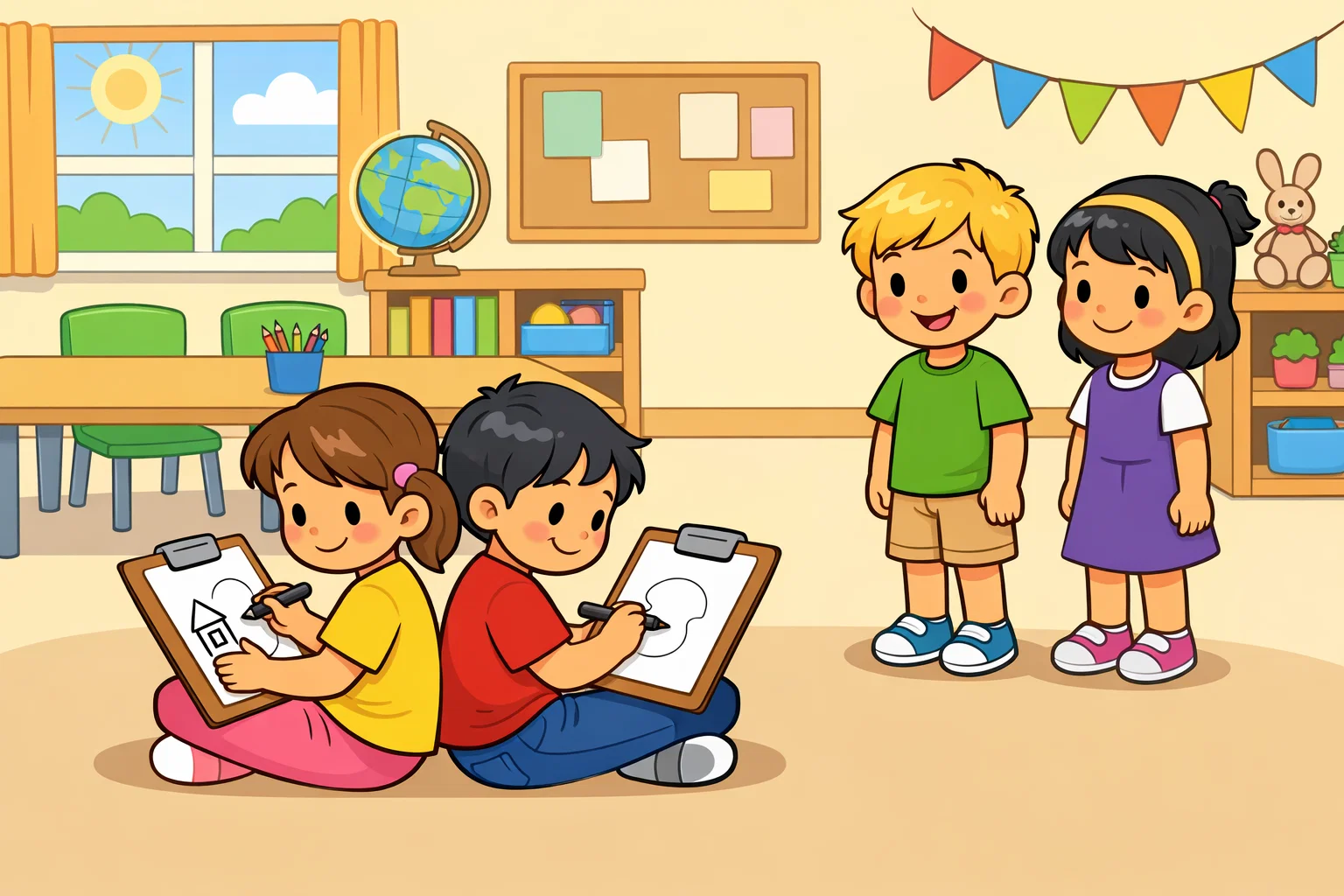
Back-to-Back Drawing
This is a premier activity for kids to improve precision in language.
- Format: Two kids sit back-to-back. One has a picture, the other has a blank paper and a pen.
- Action: The first child describes the picture using only shapes and positions, and the second child tries to replicate it.
- Benefit: It helps kids realize how easily information can be misinterpreted and highlights the need for clear communication skills.
Hidden Structures
Hidden Structures is an indoor team-building game that focuses on observation, memory, and communication.
- Setup: A small structure is hidden behind a screen. Split kids into “Viewers” and “Builders.”
- Action: Viewers look at the structure for 10 seconds and then give kids in the building group verbal instructions on how to replicate it.
- Skill: This teaches kids the difference between seeing a solution and communicating it to others who haven’t seen it.
Outdoor Activities
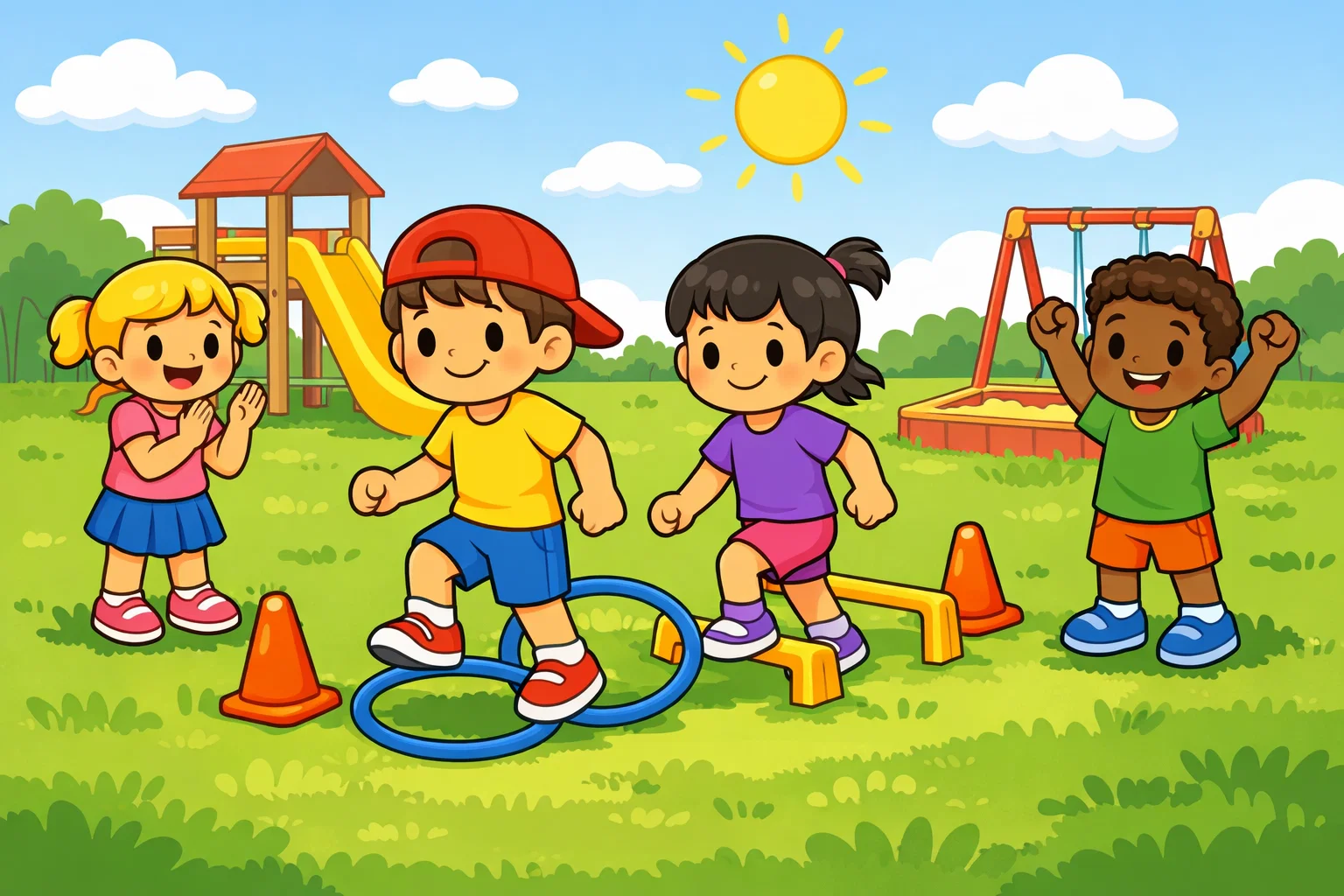
Outdoor team building activities leverage space and energy to build camaraderie through physical challenges.
Group Jump Rope
Group Jump Rope is a rhythmic outdoor team building activity that requires perfect synchronization.
- Format: Two adults or older kids swing a long rope.
- The Task: One by one, the kids get into the rope until they are jumping together.
- Goal: The first team to reach 10 collective jumps without a trip wins a point.
- Impact: This playground game promotes the idea that the team’s success depends on every team member’s timing.
Playground Obstacle Course
Creating a Playground Obstacle Course allows kids to work together to navigate physical hurdles.
- Setup: Use existing equipment like slides and tunnels. Divide students into small teams.
- Constraint: One team member must be “escorted” (e.g., holding a ball between their backs) throughout the course.
- Safety: Make sure children play on soft surfaces such as mulch or rubber mats.
- Outcome: It is a fun way to practice coordination, communication, and shared responsibility.
Team Scavenger Hunt
A Scavenger Hunt is highly effective for large outdoor team building activities.
- Task: Give each team a set of clues that ask them to spot natural features (for example, ‘a yellow leaf’ or ‘a smooth stone’) without collecting them.
- Constraint: Kids must stay together at all times; they cannot split up to find items individually.
- Value: This activity for kids encourages group decision-making and collective scouting.
Over Under Relay
The Over Under Relay is a classic team race that is great for team energy.
- Format: Kids line up in rows. The first child passes a ball over their head to the person behind them.
- Action: The second child passes it under their legs. This “over-under” pattern continues to the end.
- Benefit: It is a fun team-building exercise that emphasizes speed and physical coordination without requiring complex equipment.
Blindfolded Toss
Blindfolded Toss is a trust-based outdoor team-building game.
- Setup: One child is blindfolded and holds a soft beanbag. Their team member stands several feet away.
- Action: The sighted children use calm verbal directions to help the blindfolded child toss the bag into a hoop.
- Skill: This teaches kids to provide precise, calm instructions under pressure.
Problem-Solving Activities
These teamwork challenges focus on critical thinking, planning, and coordination.
Marshmallow Tower Challenge
This is a staple building activity for STEM-focused learning.
- Materials: 20 sticks of dry spaghetti, one yard of tape, and one marshmallow.
- Goal: Build the tallest free-standing structure that supports the marshmallow on top.
- Process: Students must brainstorm, prototype, and test their structures within a 15-minute window.
- Lesson: Kids learn that the most successful teams spend more time testing and less time arguing.
Egg Drop Challenge
The Egg Drop Challenge is a high-stakes teamwork game.
- Task: Give kids a variety of materials (straws, tape, bubble wrap). They must build a vessel to protect a raw egg from a 5-foot drop.
- Format: Divide students into two or more teams and see whose design works best.
- Insight: This activity teaches kids about structural integrity and shared responsibility for a “fragile” goal.
Flip Tarp Challenge
Flip Tarp is a spatial problem-solving task.
- Action: A group of kids stands on a small tarp. Without stepping off the tarp, they must work together to flip it over completely.
- Communication: Kids line up and move in unison to create enough space to fold and flip the fabric.
- Outcome: It requires intense teamwork and cooperation and often a designated leader to coordinate the moves.
Body Spellers
In Body Spellers, kids are divided into two teams and given a word to ‘spell’ using their bodies on the ground.
- Execution: If the word is “TEAM,” four kids must lie down and form the shapes of the letters.
- Constraint: They have 30 seconds to coordinate their positions.
- Benefit: A fun way for kids to use spatial reasoning and physical teamwork.
Human Alphabet
Similar to Body Spellers, the Human Alphabet asks the entire group of kids to form a single letter.
- Challenge: Instruct kids to form an “S” or an “M” together.
- Skill: This helps students visualize how their individual body contributes to a larger, recognizable shape.
- Context: This is a fantastic indoor team building activity for a classroom brain break.
Circle Games That Build Community
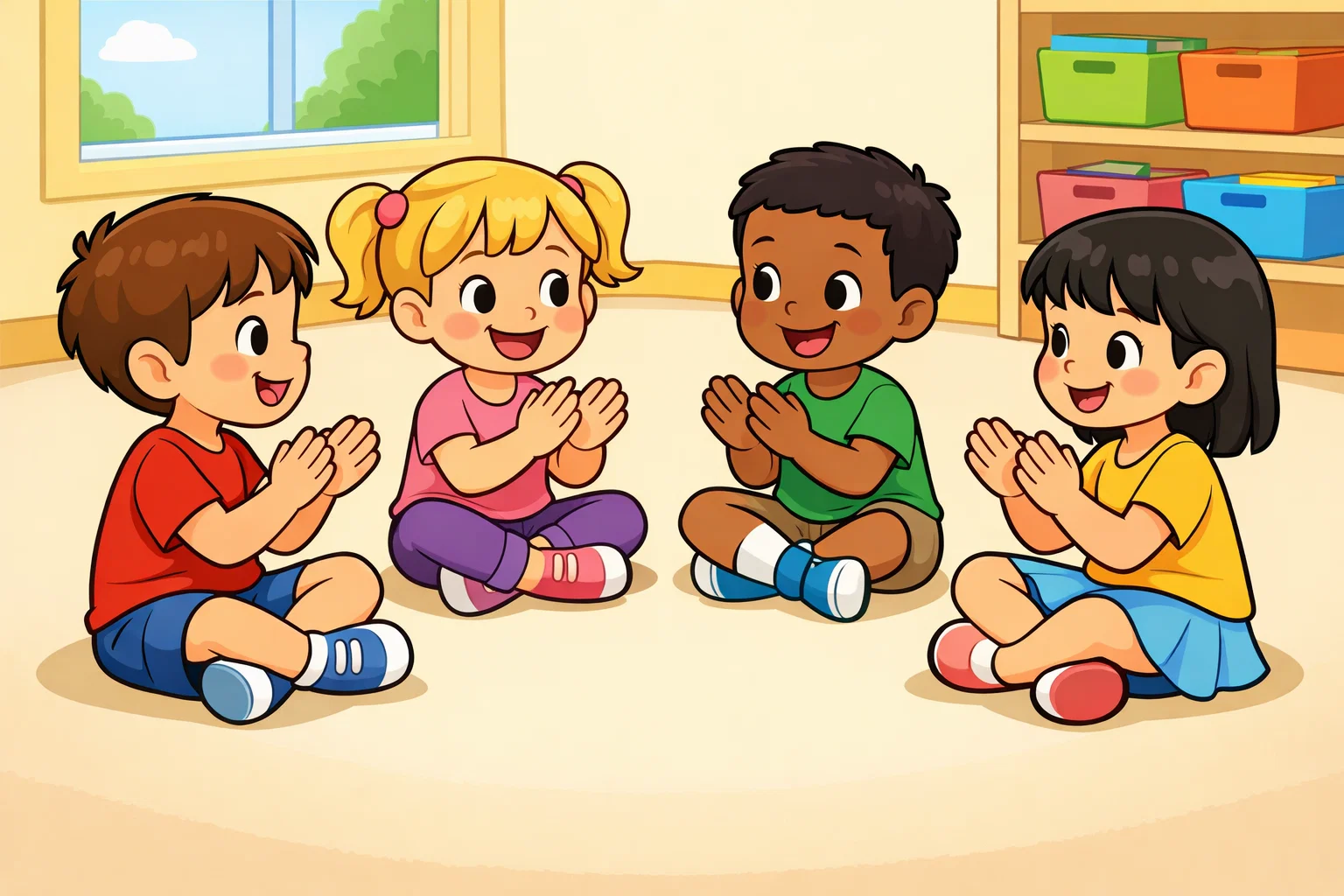
Circle games are designed to sync the group’s energy and improve focus.
Zip, Zap, Boing
This fast-paced activity for kids requires intense concentration.
- Action: Kids stand in a circle. They “pass” an imaginary spark around by pointing and saying “Zip.” They can change direction with “Zap” or skip someone with “Boing.”
- Value: It is a fun team building game that improves reaction time and group awareness.
- Impact: It teaches kids to stay engaged even when they aren’t the primary focus.
Hot Seat
Hot Seat is a team-building game for kids that can be adapted for any subject.
- Format: One child sits in the ‘hot seat’ with a word on the board behind them, while their teammates give clues without saying the word.
- Outcome: This activity teaches kids to think about how others process information.
- Goal: The first team to come up with the correct answer wins.
Bumpity-Ump-Bump-Bump
This is a fast-paced name game that is great for team bonding.
- Action: A leader points to a child and says “Left!” The child must name the person to their left before the leader says “Bumpity-Ump-Bump-Bump.”
- Purpose: It’s a fun way for kids to learn names quickly and stay alert within the group.
- Ages: Excellent for kids of all ages in the first week of a program.
Applause, Please
Applause, Please is a game of collective rhythm and observation.
- Action: The group tries to clap in perfect unison without a conductor.
- Challenge: Can the group of kids maintain the same tempo for 30 seconds?
- Insight: This helps kids feel the “pulse” of the group, fostering a sense of social synchrony.
Creative and STEM Games for Children
STEM-based team building activities for students integrate scientific concepts with social skills.
| STEM Activity | Key Concept | Team Goal |
| Paper Chain | Efficiency | Longest chain with limited paper. |
| No-Hands Drawing | Coordination | Draw a house using strings tied to one pen. |
| Straw Balance | Physics | Balance a platform using only 10 straws. |
| Build as a Team | Architecture | Create a replica using modular blocks. |
Paper Chain Challenge
This building activity focuses on process optimization.
- Task: Divide the kids into two teams. They have 2 minutes to make the longest paper chain using a fixed amount of paper and tape.
- Lesson: Kids work together to set up a simple assembly line, showing how dividing roles can increase output.
Build as a Team
In Build as a Team, the kids line up and are given a task to create a “futuristic city” using building blocks.
- Constraint: Each team member can only place one block at a time before going to the back of the line.
- Focus: This teaches kids to adapt to the changes made by their peers, building upon a collective vision rather than a solo plan.
Classroom Team Building Games for Children
Teachers often need team building activities for students that integrate with the curriculum or classroom management.
Classroom Scavenger Hunt
A Classroom Scavenger Hunt helps kids to get to know their learning environment.
- Tasks: “Find where the extra pencils are kept” or “Locate the science corner.”
- Teamwork: Students in small groups must complete the list together.
- Benefit: This helps students feel more comfortable and responsible for their shared space.
Quiz Show
A Quiz Show format is a fun team-building way to review a lesson.
- Setup: Divide students into two teams. They must huddle and agree on a final answer before speaking.
- Value: It encourages teamwork and cooperation over individual competition, as the group must reach a consensus.
Bingo
Team Bingo uses educational concepts (math facts, vocabulary) on the cards.
- Mechanism: To mark a square, the kids must find a peer who can explain or solve the concept in that square.
- Focus: It teaches kids to view their classmates as resources for learning.
Team Building Games for Children by Age Group
Preschool (Ages 3–5)
For the youngest learners, activities help develop basic social cues.
- Selection: Focus on playground games like “Follow the Leader” or “Duck, Duck, Goose” (Team Version).
- Criteria: Keep instructions to 2 steps and rounds under 5 minutes. Kids need immediate positive reinforcement.
Ages 6–8
At this age, children are still learning how to handle both winning and losing with good sportsmanship.
- Selection: Use outdoor team building activities like relays or “Simon Says” (Team Version).
- Criteria: Focus on fun team building where the “win” is a group high-five.
Ages 9–12
Older kids thrive on complexity and “missions.”
- Selection: Team building exercises like the “Escape Room: Classroom Edition” or “Egg Drop.”
- Criteria: Give them autonomy to work together to figure out roles like “Timekeeper” or “Materials Manager.”
Activities Without Equipment
No-equipment team-building games are vital for transitions, bus rides, or spontaneous breaks.
- Numbers Game: The group tries to count to 20. Only one person can say a number at a time. If two kids speak at once, the group starts over at 1.
- Storybook: Each child adds three words to a story. It requires everyone to listen so the plot remains coherent.
- Categories: A fun team building game where the group must name 10 items in a category (e.g., “Types of dinosaurs”) without repeating what another team member said.
Tips for Making Team Building Games Successful
To help these activities run smoothly, follow these practical strategies:
- Keep Teamwork Above Competition: Whenever possible, frame the goal as “beating the clock” or “reaching a group target” rather than beating another team. This reduces friction and helps kids focus on support.
- Keep Rules Short and Visible: Children follow directions more easily when they know exactly what to do. Use a “3-Rule Max” approach and demonstrate the activity once before starting.
- Give Every Child a Clear Role: To prevent 1–2 children from dominating, give each team specific roles (e.g., Encourager, Scribe, Runner).
- Adapt for Shy Children: Allow kids to play in pairs or provide a “consultant” role for those who aren’t ready for a high-intensity physical spot.
Adding team-building activities to daily routines can be a valuable way to support children’s social development. By providing structured and enjoyable team-building opportunities, adults can help children learn more than academic content—they also practice cooperation, communication, and connection.
FAQ
Which team building games work for preschool children?
For preschool-aged children, the best team building activities focus on rhythmic cooperation and simple imitation. Simple imitation games or rhythm-based circle activities are often a good fit for preschool-aged children. These activities help develop basic motor skills and social awareness without the pressure of complex rules or competitive scoring.
Which team building games work without equipment?
Several team-building games for kids require zero materials. “The Numbers Game” (counting to 20 collectively), “Categories,” and “Human Alphabet” are excellent low-prep options. These are perfect for outdoor team-building transitions or when you need a quick “brain break” in the classroom.
How long should the games last?
Duration should scale with age. Preschoolers engage best in 5–10 minute bursts. Elementary students (ages 6–10) can often handle 15–20 minutes, while older kids may enjoy longer challenges if the activity is varied and well paced. Always end the activity for kids while they are still having fun to leave a positive impression.
How can I stop fights during the games?
To minimize conflict, use cooperative games that have a shared group goal rather than a “winner takes all” format. Instruct kids on how to use ‘I-statements,’ and if tension rises, pause the game and help the group reset before continuing. If tensions rise, pause the fun team-building and conduct a quick 1-minute reflection on the team’s progress.
Which team building games build critical thinking?
Marshmallow Towers, Egg Drops, and Hidden Structures are premier choices for developing high-level problem-solving skills. These activities help children practice analytical thinking by asking teams to plan, test, and revise their work together.

Take a short quiz to find out what your everyday choices say about your parenting style
When your child is curious about something new, what’s your instinct?
Take a short quiz to find out what your everyday choices say about your parenting style
“Can I download this app?” What happens next?
Take a short quiz to find out what your everyday choices say about your parenting style
When it comes to rules at home, which sounds most like you?
Take a short quiz to find out what your everyday choices say about your parenting style
If you could give your child one life skill today, what would you pick?
Take a short quiz to find out what your everyday choices say about your parenting style
Your child gets to choose what to watch. What would your ideal setup look like?
Take a short quiz to find out what your everyday choices say about your parenting style
Pick your parenting superpower ✨