Understanding Synonyms: Definition and Examples for Kids

 Discover a Free Education Video App for Kids
Pastory uses AI to personalize educational video content based on your child’s interests and personality. Safe, engaging, and built for curious young minds. Sign up now to stay updated and enjoy early access with a free trial
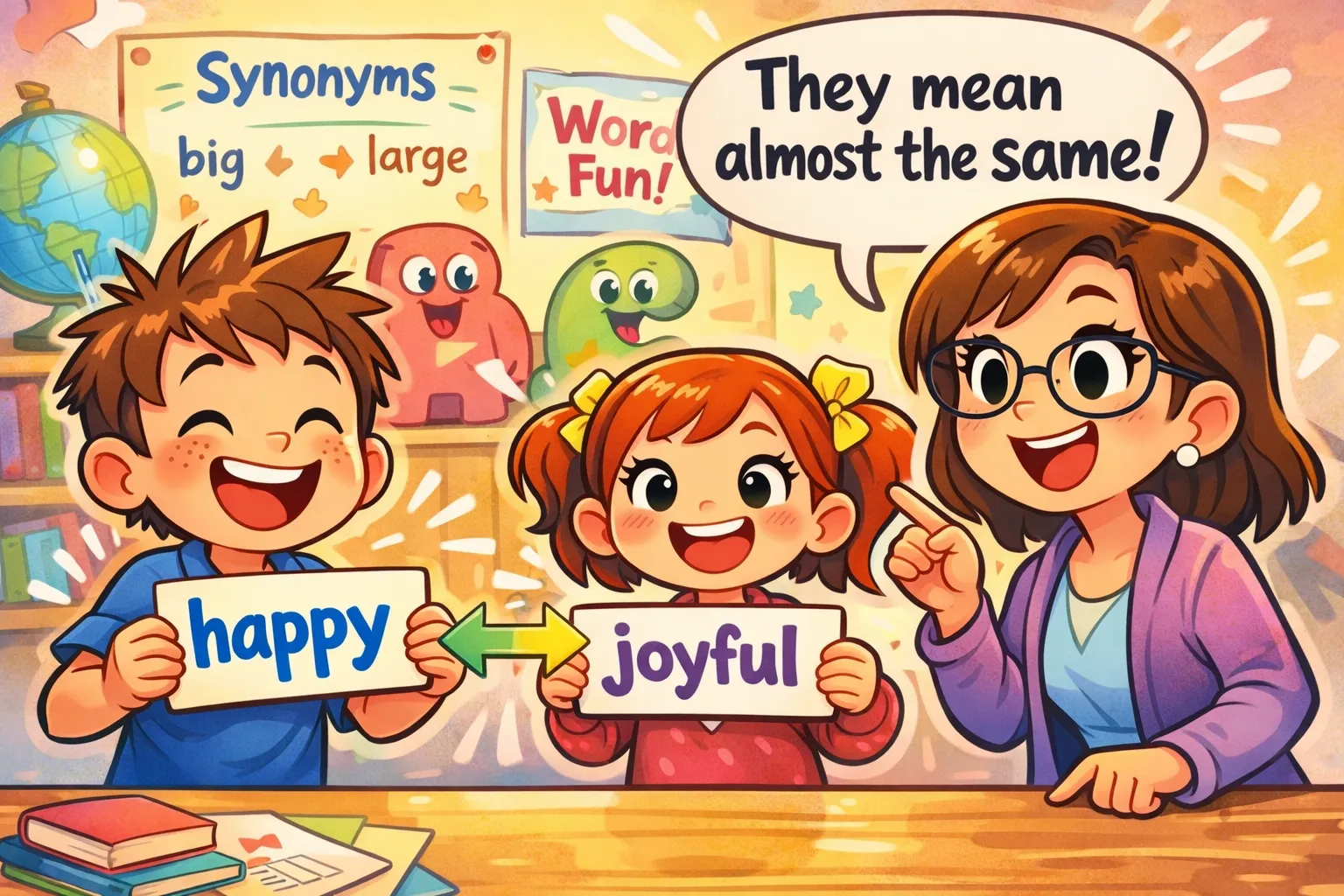
A synonym is a term that has almost the same meaning as another word. Children who learn the synonym definition and examples quickly discover that language offers many ways to express one idea.
For example, “big” and “large” describe size in a similar way. Another easy pair is “happy” and “joyful,” which both show a positive feeling. These simple pairs help kids understand how language works in a fun and flexible way.
Synonym Meaning and Simple Definition
Synonyms are two (or more) words that mean almost the same thing. For example, “small” and “tiny” both describe something little in size. This flexibility makes communication more creative and enjoyable.
Why Words Can Have Similar Meanings
Language develops over time, so many expressions end up with nearly the same meaning. Different cultures and historical influences create multiple ways to describe one idea. Linguists explain that this diversity helps speakers express emotions and details more precisely. Two different words can share history but develop slightly different feelings, or connotation.
Synonyms in Everyday Language
Children already use synonyms in everyday conversation. A child might say “I feel glad” instead of “I feel happy.” Parents and teachers often observe that children naturally pick up similar expressions while talking with friends or listening to stories. This behavior supports early language development.
Synonyms are an essential part of growing your vocabulary. Without them, talking would feel boring and repetitive.
Synonym Examples for Kids
Clear examples make learning easier and more memorable. When you see examples of synonyms in action, you understand how to replace one word with another.
10 Basic Synonym Examples
Here are some easy examples from the same part of speech. That means adjective with adjective, noun with noun, or adverb with adverb. These examples appear in stories, cartoons, and everyday conversations:
- Big – large
- Small – tiny
- Fast – quick
- Smart – clever
- Happy – glad
- Pretty – beautiful
- Run – dash
- Look – observe
- Child – kid
- Home – house
Sentence Examples
Synonyms work best when used in full sentences.
Original: “The cat is small.” (adjective) Changed: “The cat is tiny.” (adjective)
Original: “He runs fast.” (adverb) Changed: “He runs quickly.” (adverb)
Both sentences communicate the same idea. Studies in early education suggest that using examples in sentences improves comprehension and memory. Using synonyms effectively means checking that the new word fits the sentence structure.
Types of Synonyms
Each type helps children understand language more deeply. Learning these types supports better word choice in writing and speaking.
- Absolute synonyms are words that mean exactly the same thing in all situations. These cases are rare. One example is “sofa” and “couch,” which often describe the same object. Another is “drink” and “beverage”. They can be swapped interchangeably without any change in meaning.
- Partial synonyms are expressions that are similar but not always interchangeable. For example, “cold” and “chilly” both describe low temperature, but “chilly” often suggests a milder feeling. Understanding this difference helps children use language more precisely.
- Near synonyms are the most common type. These expressions have similar meanings but slightly different shades. For instance, “walk” and “stroll” both describe movement, but “stroll” suggests a relaxed pace.
Synonym vs Antonym Differences
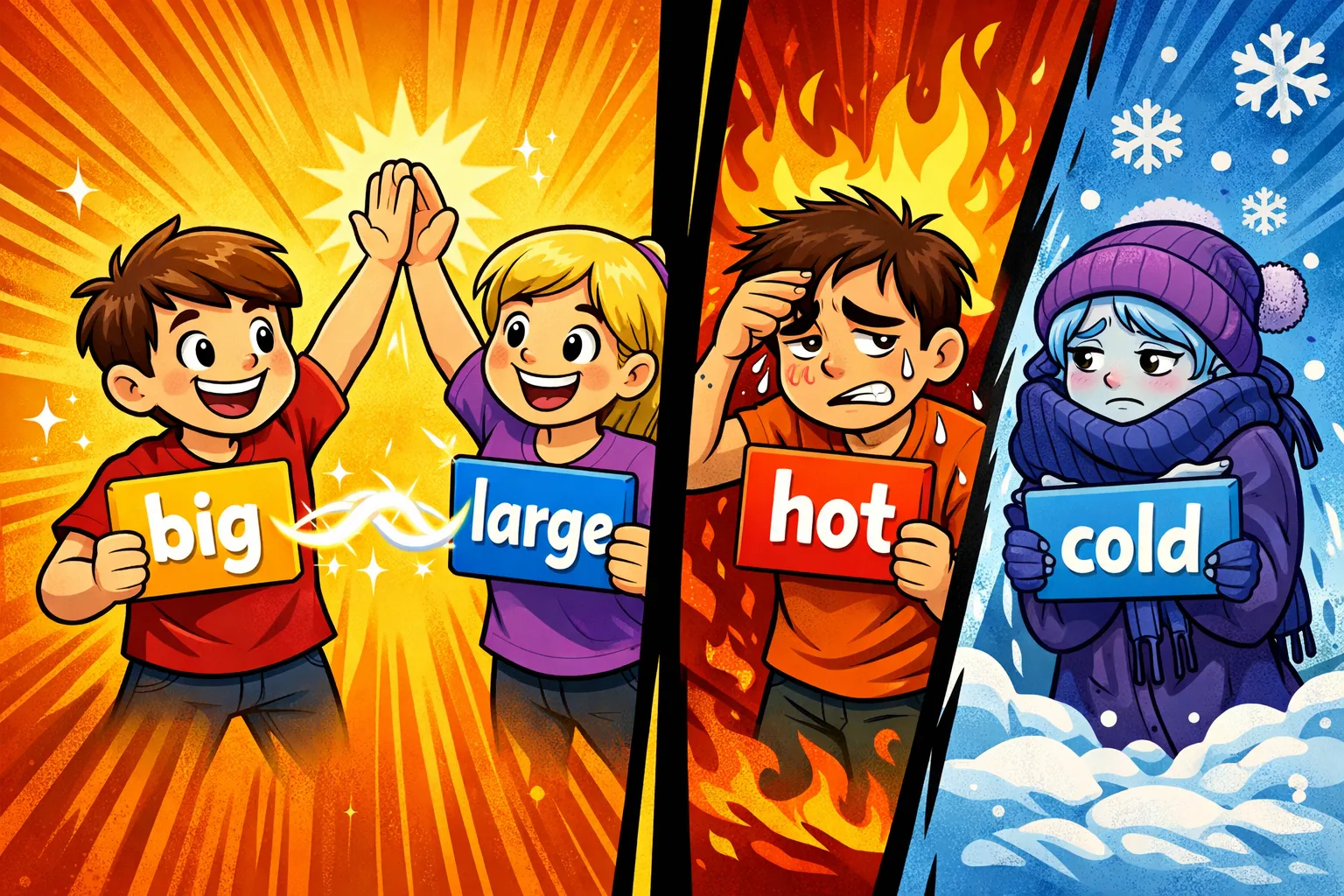
Antonyms are words with opposite meanings such as “hot” and “cold,” or “big” and “small.” Research in cognitive development shows that learning opposites helps children categorize information more effectively.
Synonyms and Antonyms Side by Side
Here is a simple comparison:
| Term | Synonym | Antonym |
| Happy | Joyful | Sad |
| Big | Large | Small |
| Fast | Quick | Slow |
This table shows how similar meanings differ from opposite meanings.
Why Use Synonyms in Writing and Speaking
Synonyms are important in writing because they make language more interesting and reduce repetition.
Make Sentences More Interesting
Example:
Before: “The movie was good. The ending was good.” After: “The movie was exciting. The ending was amazing.”
Using varied vocabulary makes writing more engaging. Similar expressions also help you avoid saying the same thing again and again. Without them, every sentence would sound flat.
Improve Your Writing
Improve your writing by choosing the best term among several options. Instead of always saying “nice,” you can pick “kind,” “friendly,” or “pleasant.” Different words bring different flavors.
Avoid Repeating Same Word
Using different words keeps the reader interested. Instead of repeating “said,” children can use “whispered,” “shouted,” or “explained.” This approach makes storytelling more vivid and expressive.
How to Find Synonyms Easily
Children can find similar expressions using simple tools and daily habits. These methods make learning easy and enjoyable.
Using a Thesaurus
A thesaurus is a tool that lists expressions with similar meanings. It is similar to a dictionary but focuses on alternatives. Children can quickly find options and expand vocabulary. A thesaurus helps you find words with the same meaning in seconds.
Using Dictionaries and Apps
Modern dictionaries and apps often include synonym sections. Research in educational technology suggests that interactive tools improve vocabulary learning outcomes. Some apps let you type one word and get ten similar expressions that can be used in sentences.
Learning Through Reading
Reading books naturally introduces new words. Authors often use varied vocabulary to keep stories interesting. This exposure helps children learn without effort. When you meet two or more words that feel similar, you have found synonyms.
List of Common Synonyms for Kids
Everyday Words:
- Good – great, excellent (adjectives)
- Bad – poor, terrible (adjectives)
- Nice – kind, friendly (adjectives)
These common words appear frequently in daily communication.
Emotions:
- Happy – joyful, cheerful (adjectives)
- Sad – unhappy, gloomy (adjectives)
- Angry – mad, furious (adjectives)
Emotion-related vocabulary helps children express feelings clearly, supporting emotional intelligence.
Action Words:
- Run – sprint, jog (verbs)
- Jump – leap, hop (verbs)
- Talk – speak, chat (verbs)
These verb alternatives make descriptions more dynamic.
Describing Things:
- Big – large, huge (adjectives)
- Small – tiny, little (adjectives)
- Beautiful – pretty, lovely (adjectives)
These words help children describe objects and people more clearly.
School & Learning:
- Smart – clever, bright (adjectives)
- Easy – simple, basic (adjectives)
- Hard – difficult, tough (adjectives)
These terms are useful for talking about schoolwork and learning experiences.
Time & Frequency:
- Fast – quick, rapid (adjectives)
- Slow – unhurried, sluggish (adjectives)
- Always – forever, constantly (adverbs)
These words help describe how often or how quickly something happens.
Places & Positions:
- Near – close, nearby (adjectives)
- Far – distant, remote (adjectives)
- Above – over, on top (prepositions/adverbs)
These words help children explain where things are located.
Food & Taste:
- Tasty – delicious, yummy (adjectives)
- Sweet – sugary, honeyed (adjectives)
- Sour – tangy, sharp (adjectives)
Food-related vocabulary makes it easier to describe flavors and preferences.
Fun Activities to Practice Synonyms
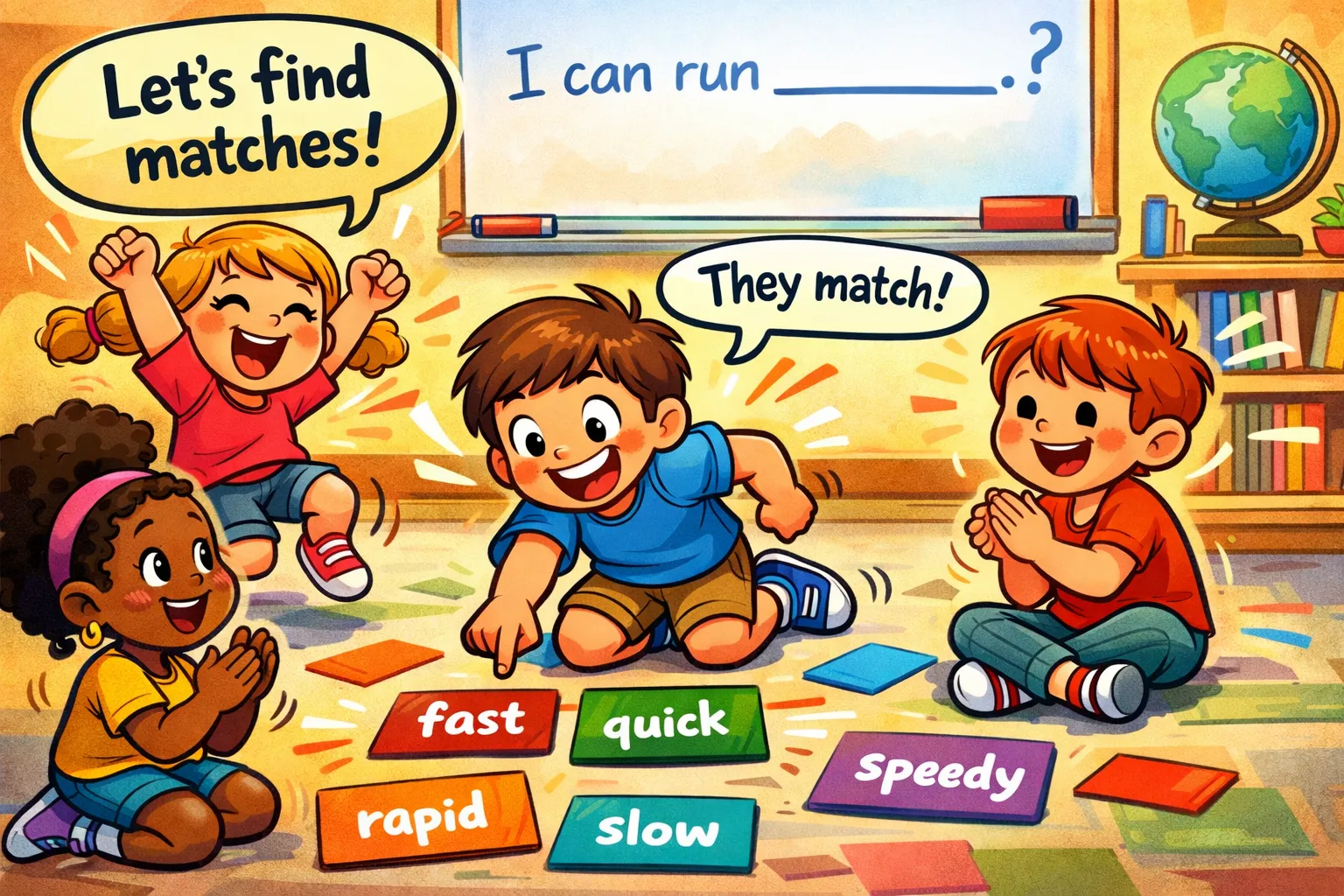
Interactive activities help children remember concepts more effectively.
Matching Games
Children match pairs with similar meanings. This activity reinforces understanding through play. Studies show that game-based learning improves retention significantly.
Fill in the Blank Exercises
Example: “The clever fox was very _____ (smart).” Children choose a suitable alternative and test their understanding.
Word Hunt
Children look for similar expressions in books or conversations. This activity encourages observation and strengthens vocabulary skills.
Important Language Notes: Homonyms and Homographs
Sometimes different words sound the same but have different meanings. This is called homonymy. A homonym is a word that sounds like another word but means something else. For example, “bat” (animal) and “bat” (sports equipment) are homonyms.
Homographs are words that are spelled the same but have different meanings and sometimes different pronunciations, like “lead” (to guide) and “lead” (the metal). Learning about this helps you avoid confusion.
Conclusion
Learning the synonym definition and examples helps children develop strong language skills. Regular practice through reading, games, and conversation supports long-term vocabulary growth.
Synonyms make communication colorful and fun. So go ahead—find new words, play with words, and enjoy the richness of English!
Frequently Asked Questions
What is synonym and antonym?
A synonym has a similar meaning, while an antonym has an opposite meaning. For example, “warm” is similar to “hot,” but opposite to “cold.” These word relationships help us better understand language and improve vocabulary.
What is a synonym example for kids?
A simple example is “big” and “large.” Another is “fast” and “quick.” These pairs share a similar meaning and can often be used in place of each other in sentences.
What are 5 examples of synonyms?
Here are 5 clear examples:
- Small – tiny
- Happy – joyful
- Run – sprint
- Beautiful – pretty
- Smart – clever
Each pair shows how different words can express nearly the same idea.
How to explain synonyms to kids?
Tell them: synonyms allow you to say the same thing in many ways. Explain that it is a term with a similar meaning. Use simple examples and let children practice replacing words in sentences to make learning more fun and interactive.
Take a short quiz to find out what your everyday choices say about your parenting style
When your child is curious about something new, what’s your instinct?
Take a short quiz to find out what your everyday choices say about your parenting style
“Can I download this app?” What happens next?
Take a short quiz to find out what your everyday choices say about your parenting style
When it comes to rules at home, which sounds most like you?
Take a short quiz to find out what your everyday choices say about your parenting style
If you could give your child one life skill today, what would you pick?
Take a short quiz to find out what your everyday choices say about your parenting style
Your child gets to choose what to watch. What would your ideal setup look like?
Take a short quiz to find out what your everyday choices say about your parenting style
Pick your parenting superpower ✨