35 Best 5th Grade STEM Activities for the Classroom and Home (Quick Prep)

 Discover a Free Education Video App for Kids
Pastory uses AI to personalize educational video content based on your child’s interests and personality. Safe, engaging, and built for curious young minds. Sign up now to stay updated and enjoy early access with a free trial
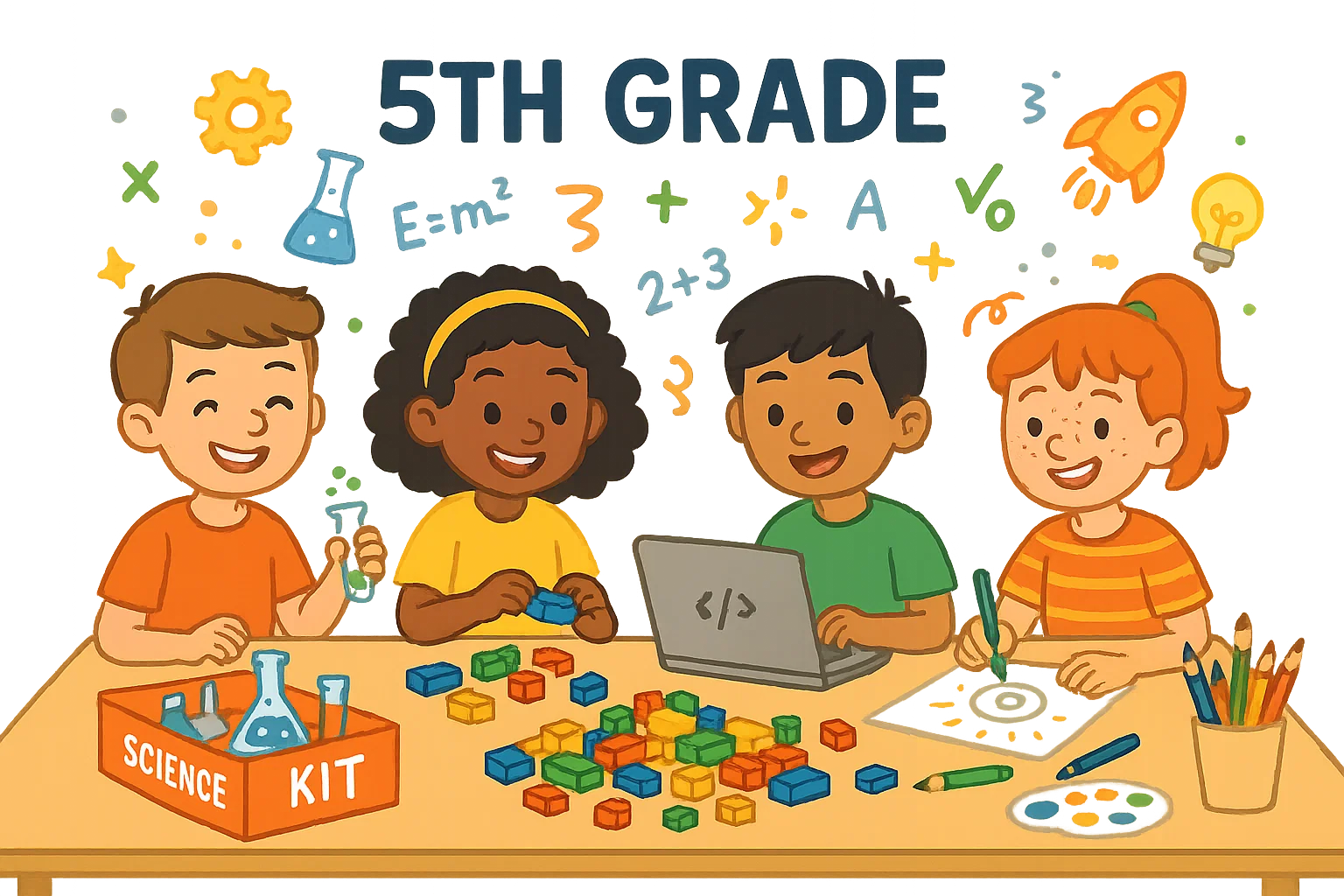
Engaging 5th grade students in meaningful learning requires a blend of hands-on discovery and structured inquiry. 5th grade STEM activities provide this balance by allowing young scientists to move beyond basic concepts into complex problem-solving. This collection of easy STEM activities is designed for educators and parents who need lesson plans that work in the classroom or at home. With quick-prep options and minimal materials, these projects turn any space into a place for hands-on STEM exploration.
Why 5th Grade STEM Activities Work

These STEM activities serve as an important bridge between curiosity and systematic scientific inquiry. At this stage, fifth graders are ready to engage with the engineering design process, which involves defining a problem, brainstorming solutions, testing ideas, and refining prototypes. Research and classroom practice suggest that regular hands-on inquiry helps upper-elementary students retain complex science concepts more effectively than passive learning does.
Critical Thinking and Problem Solving Gains
STEM activities teach children to approach challenges through the lens of trial and error rather than guessing. When students design and build a structure, they must evaluate variables, identify structural weaknesses, and draw conclusions based on objective performance data. This iterative process of testing and adjusting builds resilience and demonstrates that failure is simply a data point in the educational journey.
Hands-On Learning for Upper Elementary
Hands-on learning is a highly effective pedagogical approach for upper elementary students, as it aligns with their developmental need for physical interaction with abstract concepts. By using recycled materials to solve real-world engineering challenges, children transition from passive observers to active creators. This tactile approach significantly increases engagement, helping students stay focused on both the experiment and the underlying science concepts for longer periods.
Real-World Skills and Teamwork
Teamwork is an essential component of STEM education, mirroring the collaborative nature of modern professional environments. Through STEM projects, children practice communication, time management, and listening to different perspectives. Successfully completing a set of STEM challenges requires students to negotiate ideas, fostering social-emotional growth alongside technical learning.
Core STEM Disciplines for 5th Graders
Effective STEM learning integrates four distinct disciplines to provide a holistic view of how the world functions. By blending these areas, educators help children see the interconnected nature of science, technology, engineering, and math.
| Discipline | Focus Area | 5th Grade Application |
| Science | Observations | Testing hypotheses through simple science and data collection. |
| Technology | Digital Literacy | Utilizing digital tools to track progress or simulate results. |
| Engineering | Design | Using the engineering design process to create prototypes. |
| Math | Measurement | Calculating ratios, averages, and physical dimensions. |
Science Skills Through Testing and Observation
Science-focused STEM activities allow students to explore cause and effect by manipulating variables in a controlled environment. Whether studying potential and kinetic energy or the properties of matter, these tasks encourage children to make predictions and verify them with evidence.
Technology Skills Through Digital Tools and Coding
In fifth grade, technology extends beyond screens to include logical thinking, digital problem-solving, and the effective use of tools. Students use digital tools to enter data, simulate outcomes, or create media that document their engineering projects, strengthening their ability to analyze information.
Engineering Skills Through Design and Revision
Engineering challenges provide a structured framework where fifth graders apply creativity to solve a specific problem. By working within constraints – such as limited materials or a time limit – children learn to innovate within boundaries, a key habit in engineering.
Math Skills Through Measurement and Data
STEM activities provide a practical context for math, moving students beyond worksheets and into real-world applications. Students use rulers, stopwatches, and scales to measure outcomes, then organize the data into tables or graphs to compare how well different designs work.
Science 5th Grade STEM Activities

Water Cycle in Bag Model
This simple science activity allows students to visualize evaporation, condensation, and precipitation. By sealing water in a plastic bag with a marker-drawn cycle on the exterior and taping it to a sunny window, children observe the water cycle in real-time. This project supports the understanding of energy transfer and states of matter.
Cookie Chemistry Lab
The Cookie Chemistry Lab treats baking as a controlled science experiment. Students compare two cookie recipes or vary one factor – such as the amount of baking soda or the temperature of the butter – to observe changes in texture and height. Recording these results in a data table helps children understand how chemistry affects the final product.
Slime Polymer Test
Students test the elasticity and bounce of various slime formulations using basic household items like glue, starch, or borax alternatives. By measuring how far a piece of slime stretches or how high it bounces, children learn about polymer chains. Always ensure safe handling of materials and use a designated cleanup area.
Bubble Solution Formula Challenge
This challenge asks students to create the most durable bubble solution by adjusting ratios of water, dish detergent, and glycerin. Success is measured by bubble diameter and lifetime before popping. Students use problem-solving skills to refine their formulas after initial tests fail.
Ice Insulation Test
Students design containers using various household materials to keep an ice cube from melting. By timing how long the ice remains solid, they collect data on heat transfer and material thermal properties. This activity emphasizes the importance of prediction and controlled variable testing.
Desalination Mini Lab
In this project, students build a solar still to purify salt water. This experiment demonstrates the principles of evaporation and condensation, providing a clear, hands-on look at how to address water scarcity using natural energy sources.
Technology 5th Grade STEM Activities

Magnet Maze Bottle Challenge
Students place a metal object inside a plastic bottle and use an external magnet to navigate it through a taped-on maze. This task develops motor control and understanding of magnetic fields. This is a simple, low-prep activity that works well in upper-elementary classrooms.
Scratch Maze Game Build
Using the Scratch platform, students design a virtual maze game where a character must reach a goal. This project introduces basic coding logic, such as conditional statements and coordinate mapping. It is a powerful way to integrate technology with logical problem-solving.
Stop Motion Chain Reaction Project
Children build a Rube Goldberg-style chain reaction and use a camera to create a stop-motion animation of the event. This integrates storytelling, sequence planning, and digital media creation. It teaches students how to break down complex movements into manageable frames.
Toy Car Motion Without Touch
Students must invent three ways to move a toy car across a distance without touching it, such as using a ramp, a balloon, or a string pulley. This activity helps students explore how force, friction, and acceleration affect motion.
Digital Weather Tracker Project
Students create a shared digital log to record temperature, wind speed, and precipitation over two weeks. Using these data points, they create charts to identify trends. This project connects science observation with digital data management.
Engineering 5th Grade STEM Activities
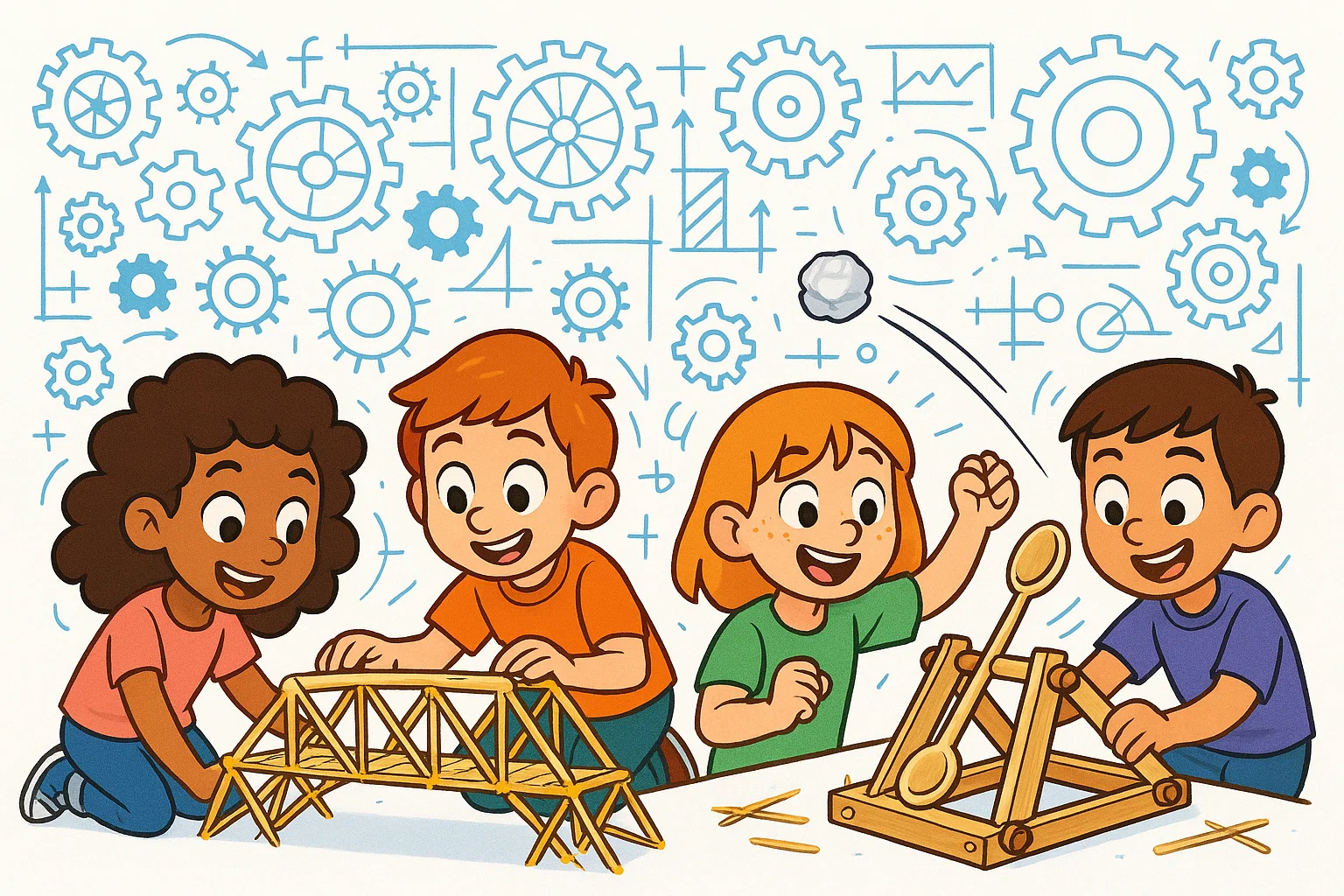
Floating Raft Penny Challenge
Using only plastic straws, masking tape, and string, students must build a raft that supports the maximum number of pennies. The engineering design process here requires students to consider buoyancy and weight distribution. It is one of the best STEM challenges for testing structural limits.
Toothpick Gumdrop Tower Build
This classic project challenges students to build the tallest tower using only toothpicks and gumdrops. It teaches the importance of triangular bracing for stability. Students must frequently think outside the box to overcome gravity and center-of-balance issues.
Craft Stick Catapult Build
Using wood craft sticks, rubber bands, and a plastic spoon, students engineer a device to launch projectiles. Testing for target accuracy and distance allows for multiple rounds of redesign, which is essential for mastering the engineering cycle.
Clothespin Weight Support Structure
Students construct a frame capable of supporting a heavy book. This project helps children discover why triangles and trusses provide superior strength compared to squares. It is an excellent way to introduce architectural engineering principles to fifth graders.
Index Card Book Support Tower
With only index cards and tape, students must build a structure that holds a textbook. This challenge forces students to experiment with folding, rolling, and column shapes to create vertical support. It demonstrates how geometry influences structural integrity.
Marble Roller Coaster Build
Using cardboard tubes, plates, and tape, students design a track for a marble. The goal is to create a path that allows for consistent speed and successful navigation of turns. This project is a fantastic introduction to potential and kinetic energy.
Straw Bridge Load Test
Students construct a bridge from drinking straws and masking tape to span a specific gap. After building, they test the structure by adding weight until it collapses. Redesigning after the first test is the most important part of this engineering challenge.
Geodesic Dome Build
Students use straws and pipe cleaners to create a geodesic dome. This project connects geometry with structural engineering, showing how distributed load makes a dome one of the strongest shapes in construction.
Math 5th Grade STEM Activities
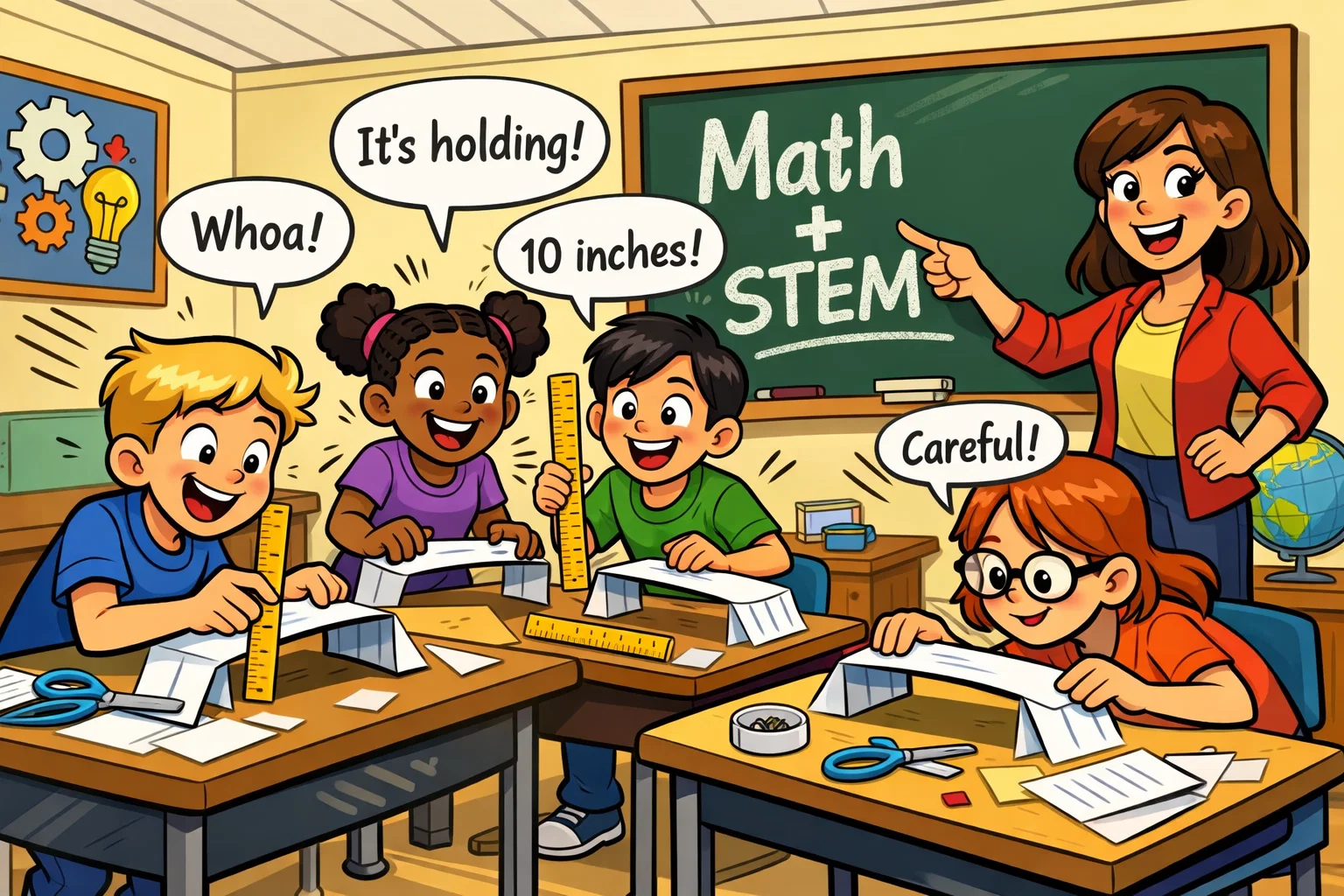
Paper Airplane Cargo Test
Students design a paper airplane capable of flying a set distance while carrying a “cargo” of paper clips. By calculating the weight-to-distance ratio, students apply math in a meaningful way. This activity is perfect for teaching students to compare data and iterate designs.
Paper Clip Chain Length Challenge
In this speed challenge, teams compete to create the longest paper clip chain within a time limit or test the weight capacity of different chain patterns. Students count, measure, and calculate averages to determine the most effective design.
100 Cup Tower Time Trial
Students work in teams to build a 100-cup tower as quickly as possible. This requires precise planning and organization. Recording the time taken for each attempt allows students to analyze their process improvements.
Domino Chain Reaction Name Build
Students arrange dominoes to spell their names, focusing on spacing and angles. This teaches planning, geometry, and the necessity of precision. It is a great example of fun and engaging math application.
Zip Line Water Carrier Test
Students build a carriage to transport a cup of water down a zip line. Success is measured by how much water remains in the cup. This activity can involve measuring volume, distance, and slope, providing a concrete example of applied mathematics.
Quick 5th Grade STEM Challenges
- Paper Cup Water-Hold Challenge: Ask students to fold a single sheet of paper into a cup that can hold water for one minute.
- Pringles Ring Balance Challenge: Create a freestanding ring of potato chips using only balance and geometry, with no adhesive.
- Newspaper Rain Shield Design: Build a shield from newspaper that keeps a doll or small object dry during a simulated rainstorm.
- Newspaper Shoe Design: Construct a wearable shoe from paper and tape that survives a short walk test.
- Grocery Bag Jump Rope Build: Weave plastic bags into a durable rope and test it for durability as a jump rope.
- Marshmallow Tower Sprint: Build the highest stable structure in under 10 minutes.
STEAM Extensions for 5th Grade

Musical Instrument Sound Design
Create instruments using rubber bands and straws, then measure the resulting pitch. This connects physics (vibration) with music theory.
House With Two Rooms Build
Plan and build a miniature house using craft sticks. This exercise emphasizes layout planning and scale.
Custom Paper Clip Design
Students invent a new paper clip shape. They must prove its function by holding a specific number of sheets, combining design aesthetics with structural engineering.
Cardboard Building Blocks Design
Cut cardboard into uniform shapes to create custom building blocks. This activity helps students compare how different shapes perform when stacked.
Solar Oven Snack Test
Build a solar oven using a box and foil. This simple project explores heat capture and sustainable energy solutions.
Materials, Prep, Safety for 5th Grade STEM Activities
Low-Cost Supply List
Keeping a STEM bin stocked with essential items ensures you are always ready for a science activity. Key materials include:
- Drinking straws and masking tape
- Wood craft sticks and rubber bands
- Paper clips and index cards
- Cardboard tubes and recycled boxes
- Marbles and balloons
Classroom Setup and Group Roles
Organize students into groups of 3–4 with assigned roles:
- Builder: Assembles the prototype.
- Tester: Conducts performance trials.
- Recorder: Tracks data and measurements.
- Presenter: Explains the design logic.
Safety Rules and Cleanup Routine
Establish clear expectations for scissors, small parts, and liquids. Keep a designated “cleanup bin” to ensure the classroom remains organized, and always protect surfaces when using adhesives or water.
Tips for Running 5th Grade STEM Activities
- Plan Short Time Blocks: Divide lessons into 15-minute segments for the introduction, build, test, and reflection.
- Use a Reusable STEM Bin: Keep supplies organized in one bin to minimize prep time.
- Keep Instructions Simple: Give students a clear goal and two constraints to encourage creativity.
- Choose Open-Ended Challenges: Avoid “correct” answers to foster unique problem-solving.
- Focus on Revision and Retest: The learning occurs during the redesign phase, not the first attempt.
- Add Themes, Team Roles, and Friendly Competition: Seasonal themes or team leaderboards can help sustain student interest.
FAQ About 5th Grade STEM Activities
What makes 5th grade STEM activities effective?
5th grade STEM activities are effective because they combine hands-on engagement with the engineering design process, requiring students to test, measure, and refine their ideas rather than simply following a recipe.
How can parents run STEM activities at home?
Parents can facilitate STEM learning at home by using low-cost kitchen supplies, setting a clear time limit, and asking guiding questions that prompt the child to consider how to improve their design after an initial test.
What supplies work for low-prep STEM projects?
The most versatile supplies include drinking straws and masking tape, wood craft sticks, rubber bands, cardboard tubes, and standard paper clips. These items allow for dozens of different engineering projects.
How long should each STEM activity take?
Quick STEM challenges typically take 15–45 minutes, while more complex engineering projects that require multiple redesign cycles may take 45–90 minutes to fully explore.
How can teachers connect STEM with standards?
Teachers can connect these activities to curriculum standards by focusing on measurable skills such as using units, representing data in graphs, and applying concepts related to forces, energy, or ecosystems within each task.
Take a short quiz to find out what your everyday choices say about your parenting style
When your child is curious about something new, what’s your instinct?
Take a short quiz to find out what your everyday choices say about your parenting style
“Can I download this app?” What happens next?
Take a short quiz to find out what your everyday choices say about your parenting style
When it comes to rules at home, which sounds most like you?
Take a short quiz to find out what your everyday choices say about your parenting style
If you could give your child one life skill today, what would you pick?
Take a short quiz to find out what your everyday choices say about your parenting style
Your child gets to choose what to watch. What would your ideal setup look like?
Take a short quiz to find out what your everyday choices say about your parenting style
Pick your parenting superpower ✨