300 English Sight Words for Class 1: The Ultimate Guide to Reading Fluency

 Discover a Free Education Video App for Kids
Pastory uses AI to personalize educational video content based on your child’s interests and personality. Safe, engaging, and built for curious young minds. Sign up now to stay updated and enjoy early access with a free trial
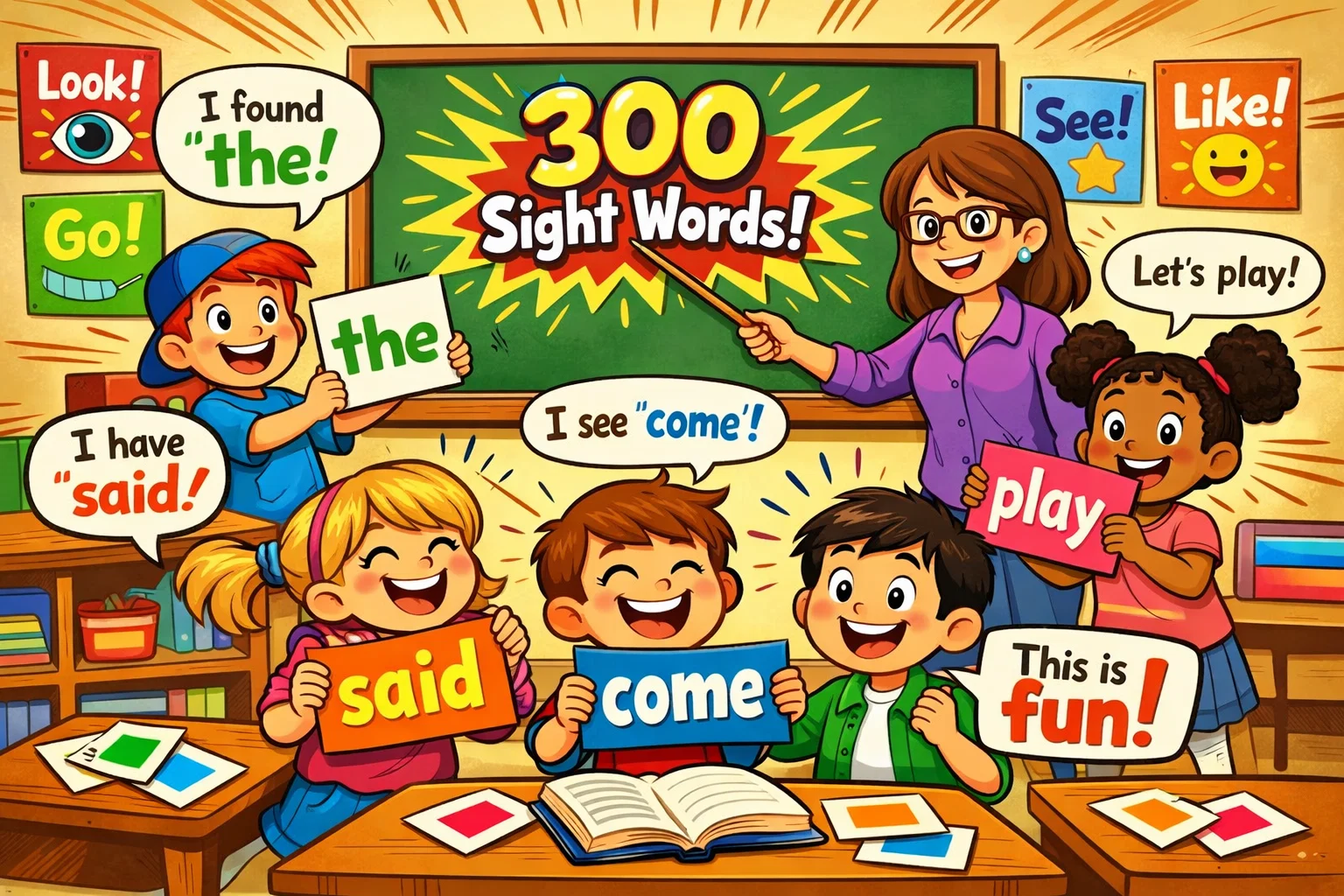
Mastering reading in the early years is a pivotal milestone for every student. This comprehensive guide offers a curated list of 300 high-frequency words for first-grade learners. By focusing on common sight words and Dolch lists, parents and educators can help children transition from hesitant decoders to fluent readers. Below, you will find categorized word lists, practical games and example sentences to help your first grader build word recognition and reading fluency.
What Are Sight Words
Sight words are high-frequency words that appear so often in English that fluent readers recognize them instantly without needing to sound them out. These words include both phonetically regular examples (such as ‘and’) and irregular ones (such as ‘the’ and ‘said’) that do not follow standard spelling patterns. For first-grade students, mastering these words is essential because they make up a large share of the words children encounter in books and classroom materials.
Sight Words Meaning for Class 1
In Grade 1, word recognition refers to a child’s ability to identify a word quickly and accurately on sight. These common words act as the ‘glue’ that holds sentences together, allowing children to focus on new vocabulary without stopping to decode every word. Early automatic word recognition is strongly associated with later reading fluency and comprehension.
High-Frequency Words vs Phonics Words
While phonics teaches children to map sounds to letters, high-frequency words are taught because they appear often in written text. Some high-frequency words are ‘rule-breakers’ (such as ‘was’ and ‘of’), so they can be difficult to decode using phonics alone. For example, a child might use phonics to read “cat,” but they should learn common terms like “the” or “is” through practice and repetition to ensure they don’t get stuck on the most common items.
Why Instant Recognition Matters in Grade 1
Instant word recognition reduces cognitive load, allowing first-grade students to focus more on comprehension than on decoding. When a student identifies 1st grade terms immediately, they can read with better prosody (expression) and speed. Automatic word recognition supports smoother reading, stronger comprehension, and greater confidence during reading practice.
300 Most Common Sight Words for Class 1
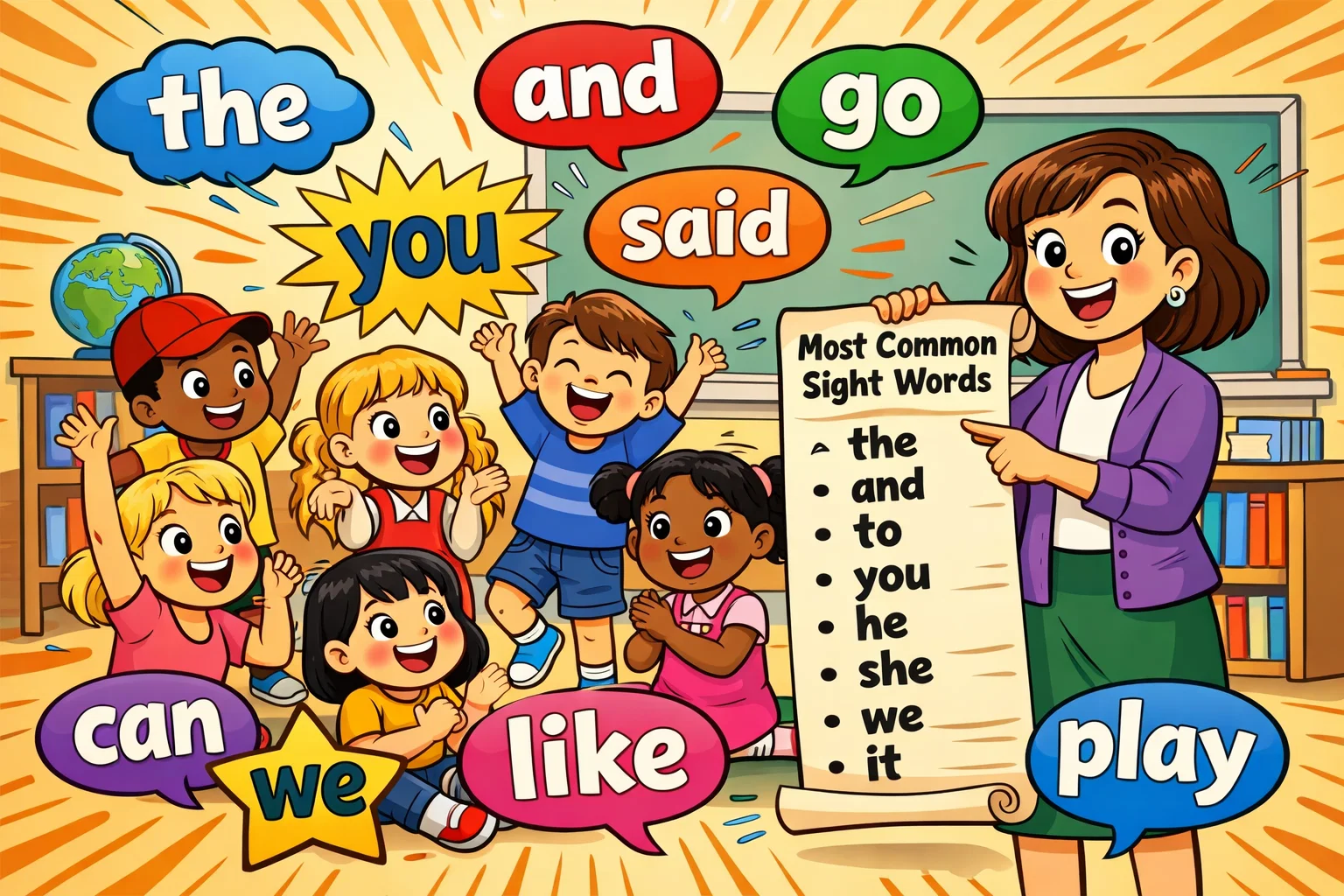
Below is a structured master list of 300 terms, broken into manageable blocks of 50. Use these for games, flash cards, or practice worksheets.
Sight Words 1–50
the, of, and, a, to, in, is, you, that, it, he, was, for, on, are, as, with, his, they, I, at, be, this, have, from, or, one, had, by, words, but, not, what, all, were, we, when, your, can, said, there, use, an, each, which, she, do, how, their, if
Sight Words 51–100
will, up, other, about, out, many, then, them, these, so, some, her, would, make, like, him, into, time, has, look, two, more, write, go, see, number, no, way, could, people, my, than, first, water, been, called, who, am, its, now, find, long, down, day, did, get, come, made, may, part
Sight Words 101–150
over, new, sound, take, only, little, work, know, place, years, live, me, back, give, most, very, after, things, our, just, name, good, sentence, man, think, say, great, where, help, through, much, before, line, right, too, mean, old, any, same, tell, boy, follow, came, want, show, also, around, farm, three, small
Sight Words 151–200
set, put, end, does, another, well, large, must, big, even, such, because, turn, here, why, ask, went, men, read, need, land, different, home, us, move, try, kind, hand, picture, again, change, off, play, spell, air, away, animal, house, point, page, letter, mother, answer, found, study, still, learn, should, America, world
Sight Words 201–250
high, every, near, add, food, between, own, below, country, plant, last, school, father, keep, tree, never, start, city, earth, eyes, light, thought, head, under, story, saw, left, don’t, few, while, along, might, close, something, seem, next, hard, open, example, begin, life, always, those, both, paper, together, got, group, often, run
Sight Words 251–300
important, until, children, side, feet, car, mile, night, walk, white, sea, began, grow, took, river, four, carry, state, once, book, hear, stop, without, second, late, miss, idea, enough, eat, face, watch, far, Indian, real, almost, let, above, girl, sometimes, mountains, cut, young, talk, soon, list, song, being, leave, family, it’s
Sight Words Sentences
Applying new terms in context is the best way to ensure comprehension. These sentences use common vocabulary for first graders to build reading stamina.
10 Easy Sentences for Early Practice
- The cat is on the mat.
- I see a big red ball.
- He had a little dog.
- We like to play here.
- Can you go with me?
- It is a sunny day.
- She said no to the toy.
- Look at that blue bird.
- They are at the park.
- One for you and one for me.
10 Home Sentences
- My mother is in the house.
- Please put your shoes away.
- We eat food at the table.
- I help my father at home.
- Do you want to play a game?
- The water is in the cup.
- Wash your hands before you eat.
- It is time to go to sleep.
- Look at the picture on the wall.
- Can I have another apple?
10 School Sentences
- My teacher is very good.
- Write your name on the paper.
- Read the book at your desk.
- We go to school every day.
- Use a pencil to draw a line.
- The boys and girls are in class.
- Please tell me the answer.
- Look at the text on the page.
- We learn to read and write.
- Sit in your chair for the story.
10 Mixed Sentences for Reading Aloud
- Many people live in the big city.
- Which way did the animal go?
- I think it is going to rain today.
- There are three trees near the river.
- He came back after the long walk.
- Follow the path through the woods.
- Small things can be very important.
- How many words can you read now?
- I found a secret place in the garden.
- Always try to do your best work.
Why Sight Words Matter for Class 1
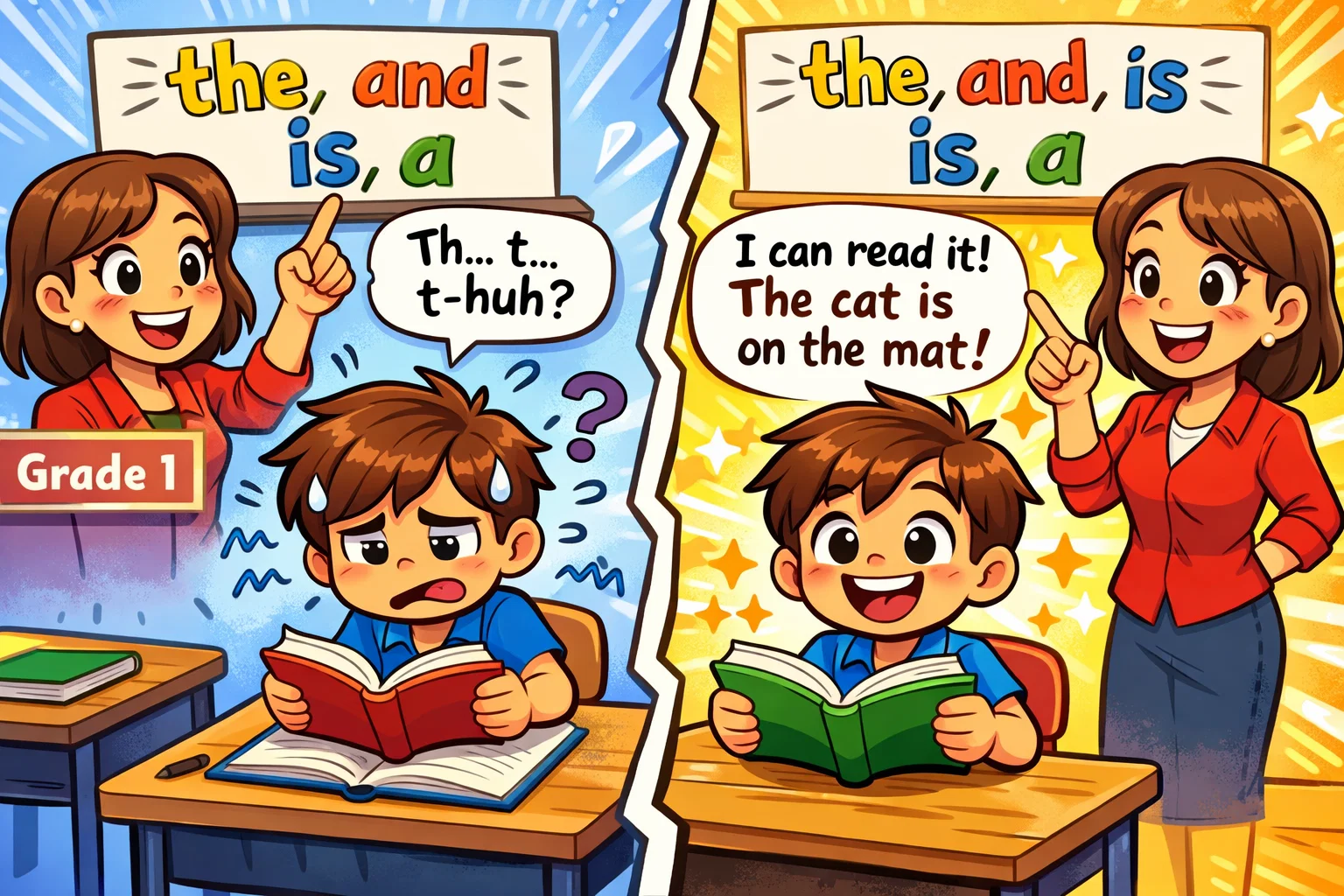
Teaching these terms to first graders provides the foundational scaffolding necessary for all future literacy tasks. In first grade, children begin moving from letter-sound knowledge to more fluent reading, and high-frequency words play an important role in that transition. By focusing on a comprehensive list, educators help students bridge the gap between simple phonemic awareness and complex reading skills.
Reading Speed Growth
A child’s reading speed increases significantly when they no longer have to pause for common items in first grade texts. As children become familiar with common sight words, their reading rate often improves because they spend less time sounding out familiar words. This growth in speed is vital for meeting end of first grade literacy benchmarks.
Sentence Building Skills
Common words such as ‘the,’ ‘is,’ ‘and,’ and ‘with’ are essential building blocks in simple sentences. Without a solid grasp of these words, a child may struggle to connect ideas and understand how sentences work. Mastering these common entries allows 1st graders to move from reading isolated units to understanding the flow and logic of full sentences.
Writing Confidence Growth
When first-grade students can spell high-frequency words from memory, their writing confidence grows. Instead of struggling to spell “because” or “there,” the child can focus on the creative aspect of their story. Regular practice can support longer and more detailed writing in the classroom.
Everyday Reading Success
These items appear everywhere, from children’s books to street signs and practice worksheets. By helping a child learn these terms, you are giving them the tools to navigate their environment independently. This kind of everyday success creates a positive feedback loop: the child feels more confident tackling harder texts because common words already feel familiar.
How Many Sight Words Should Class 1 Students Know
The number of new terms a child should master varies by curriculum, but there are generally accepted milestones for 1st grade. Some programs focus on a core set of around 100 words, while others use an extended bank of up to 300 high-frequency words for extra practice.
100-Word Starting Point
Many first-grade programs begin with a core set drawn from the most common Dolch or Fry words. These entries cover the vast majority of “starter” readers and provide a solid foundation for kindergarten graduates entering grade 1. Mastery of this initial bank typically occurs by the middle of the school year.
200-Word Year Goal
By the end of first grade, many educators aim for students to recognize at least 200 high-frequency items. This expanded list often includes more complex and irregular words that appear in leveled readers. Achieving this goal suggests the child is on track for reading fluency.
300-Word Extended Practice Bank
For confident first-grade readers, an extended list of 300 high-frequency words can provide valuable extra practice. This extended bank can include more challenging words such as ‘together,’ ‘mountain,’ and ‘example’ to broaden vocabulary and build reading stamina. Using a free printable list of 300 items allows for differentiated learning at home or in the classroom.
Signs Child Is Ready for Next 50 Words
| Indicator | Description |
| Instant Identification | Child names the entry in < 2 seconds without hesitation. |
| Contextual Accuracy | Child reads the term correctly within a sentence, not just on flash cards. |
| Spelling Mastery | Child can write the item from memory during practice. |
| Low Error Rate | Child maintains over 95% accuracy on current worksheets. |
Types of Sight Words for Class 1
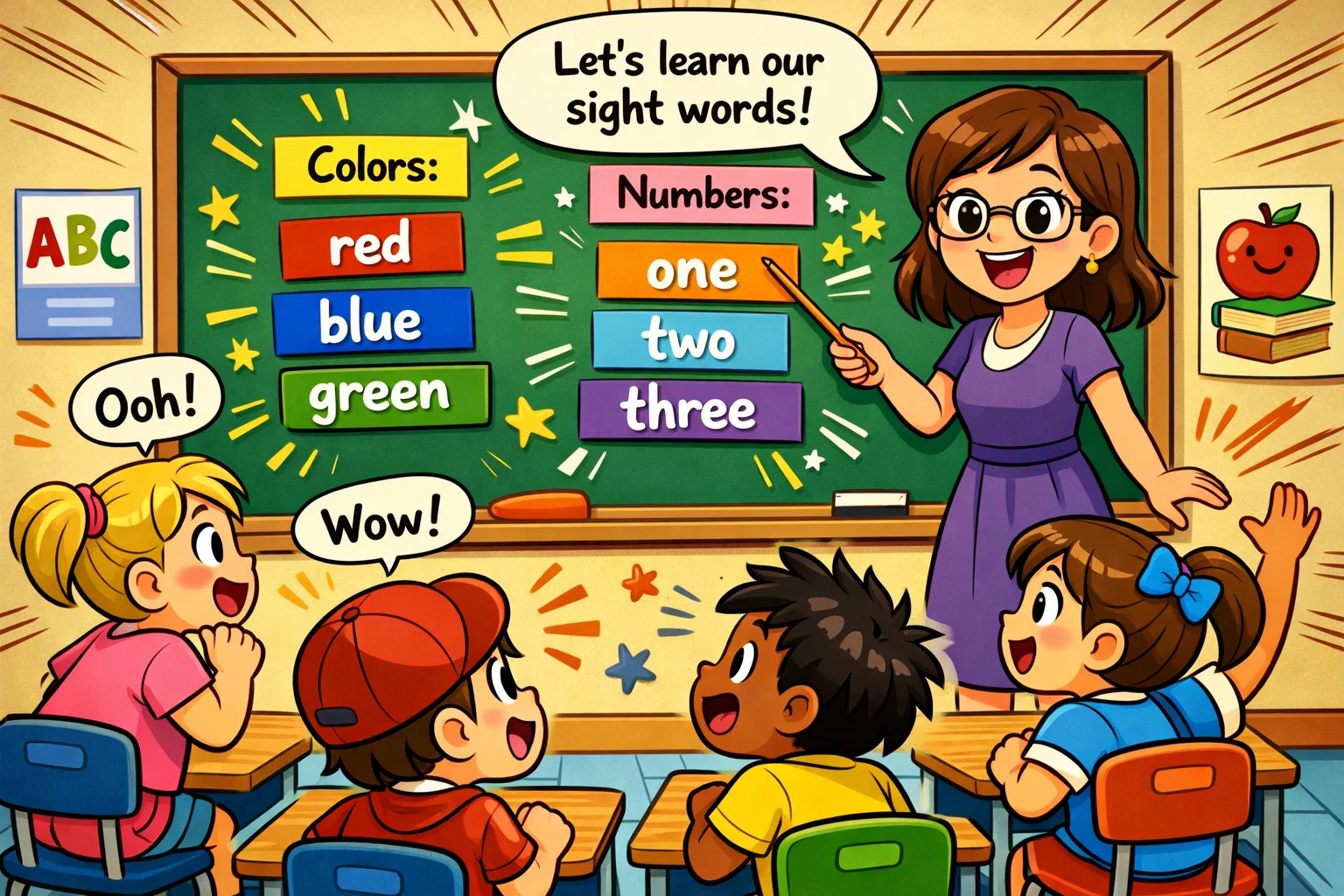
Not all lists are created equal; different collections serve different pedagogical purposes. Understanding the origins of these banks – such as those by Edward Fry or Edward Dolch – helps in choosing the right practice items for your student.
Dolch Sight Words
The Dolch collection, created by Edward Dolch, contains 220 “service words” that should be learned by sight. These items are categorized by grade level, from kindergarten to third grade. The Dolch words were selected from children’s literature and are still widely used in early reading instruction.
Fry Sight Words
The Fry list, developed by Edward Fry, is a more modern and expansive set totaling 1,000 entries. The first 100 Fry items represent approximately 50% of any written material in the English language. Some educators also use the Fry list because it is based on a broader range of texts.
Top Written Words
Beyond formal sight-word lists, children also benefit from learning common words they see in everyday print. This includes common entries like “exit,” “stop,” “push,” and “pull.” Incorporating these into learning sessions helps children connect their reading skills to real-world applications.
Overlap Across Lists
There is significant overlap across lists, with terms like “the,” “of,” “and,” and “to” appearing at the top of both the Dolch and Fry rankings. Because these common items are so universal, it is highly efficient to teach them first. Most kindergarten and first-grade word lists focus on this high-overlap core to make learning more efficient for children.
Sight Words Games and Activities
To make learning fun, incorporate high-frequency word practice into daily play. Interactive games reduce the stress of being tested and help children develop a natural love of reading.
Sight Words Bingo
Bingo is a classic classroom staple. Create a grid with first-grade sight words instead of numbers.
- How to play: An adult calls out a word, and the child covers it with a counter, such as a bean or a coin.
- Outcome: This builds rapid recognition and auditory processing.
Memory Match
Use two sets of flashcards with 10-15 new words. Lay them face down.
- How to play: The child flips two cards. If the cards match and the child can read the word, the child keeps the pair.
- Outcome: This improves visual memory and practice consistency.
Stick Notes Game
Write common terms on sticky notes and place them on objects around the house.
- How to play: To “use” an object (like the fridge or the door), the child must identify the term stuck to it.
- Outcome: Connects high-frequency vocabulary to the child’s physical environment.
Word Hunt
Hide flash cards or printable slips around the room.
- How to play: Give the child a list of 5 items to find. As they find each one, they must read it and use it in a sentence.
- Outcome: Encourages active movement while focusing on mastering the list.
Roll Read Race
Create a sheet with six columns, each labeled with a number from 1 to 6. Fill the columns with grade level vocabulary.
- How to play: The child rolls a die and reads the first entry in the corresponding column.
- Outcome: Gamifies recognition and adds an element of speed.
Read and Act
This is perfect for items like “jump,” “run,” “sit,” “clap,” and “dance.”
- How to play: Show the child a flash card. They must read the term and then perform the action.
- Outcome: Uses kinesthetic learning to reinforce the meaning of high-frequency vocabulary.
How to Teach Sight Words Step by Step
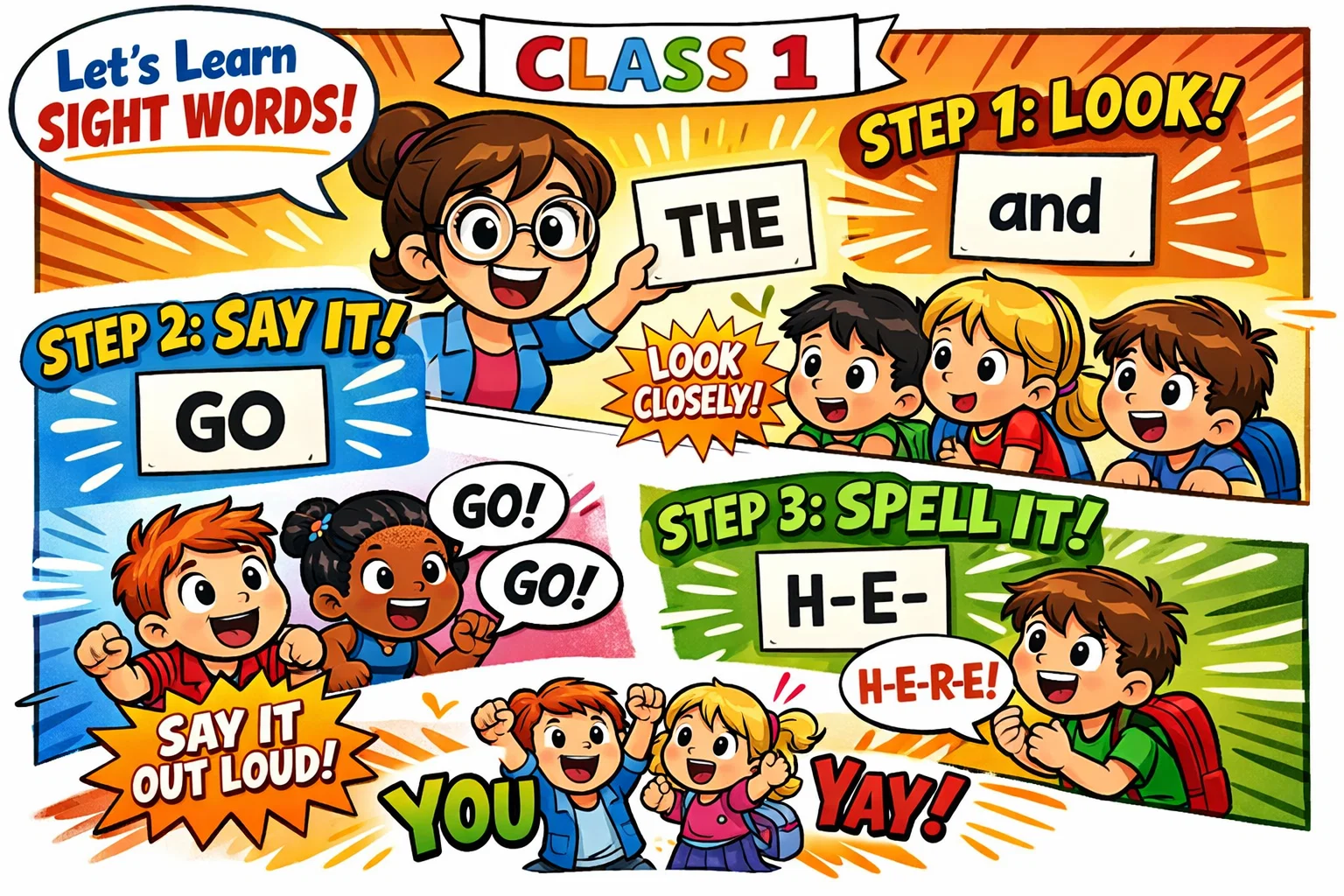
Teaching 1st graders requires a structured approach that moves from simple exposure to total mastery. Using a consistent teaching routine prevents the child from feeling overwhelmed.
Four-Step Learning Routine
- See and Say: Show the word and say it clearly. Have the child repeat it three times.
- Spell and Trace: Have the child spell the word aloud while tracing the letters on a worksheet or in the air.
- Write and Check: Ask the child to write the word from memory, then compare it with the flashcards.
- Use in Context: Encourage the child to create a simple sentence using the entry to ensure comprehension.
Daily 10-Minute Practice Plan
Consistency is more effective than duration. Children can make steady progress in just 10 minutes a day.
- Minutes 1-3: Review 10 “old” terms the child already knows.
- Minutes 4-7: Introduce 3-5 new items.
- Minutes 8-10: Play a quick game or read a short passage containing the new entries.
Weekly Review Method
At the end of the week, gather all the items practiced and do a “speed round.” If the child hesitates on a term, keep it in the “active” pile for next week. Some words remain difficult simply because children have not reviewed them often enough to store them in long-term memory.
Mistakes to Avoid
- Too Many Entries: Don’t introduce more than 5 items at a time; it leads to cognitive fatigue.
- Skipping Phonics: Sight-word practice should supplement, not replace, systematic phonics instruction.
- Lack of Context: Never teach entries only in isolation; always point them out in children’s books.
- Ignoring Frustration: If the child is tired, stop. Make learning fun to keep their interest high.
Expanding the Vocabulary: Beyond the 300
Once a child feels confident with an extended bank of high-frequency words, you can gradually introduce more advanced vocabulary from longer or more complex texts. This gradual progression helps children continue building fluency and vocabulary. Research suggests that the “Matthew Effect” in reading – where the rich get richer – applies here: the more common terms a child knows, the easier it is for them to acquire new vocabulary from context.
The Role of Technology in Learning
While flash cards and printable worksheets are vital, digital tools can also support 1st grade learners. Well-designed educational apps can provide games that adapt to a child’s pace. However, it is best to balance screen time with hands-on activities such as Word Hunt or Memory Match. This multimodal approach can improve engagement and support long-term retention.
Summary of Fluency Mastery
| Feature | Description |
| Target Group | First grade students and advanced kindergarten learners. |
| Core Lists | Dolch and Fry high-frequency collections. |
| Primary Goal | Instant recognition within 2 seconds. |
| Key Tools | Flash cards, worksheets, and interactive games. |
| Benchmark | 300 items by the end of first grade for advanced learners. |
By using this collection and following a structured practice routine, you provide your first-grade student with the essential building blocks for a lifetime of literacy. Successful reading development starts with these common words, turning each learning experience into a small victory.
Frequently Asked Questions (FAQ)
What is the difference between high frequency words and sight words?
While these terms are often used interchangeably, there is a subtle pedagogical difference. High-frequency words are words that appear very often in English, such as ‘the,’ ‘and,’ and ‘it.’ Sight words, on the other hand, are specifically those that students should be able to identify instantly without decoding. This set of sight words often includes words like “was” or “said,” which are irregular words because they do not follow standard phonics rules. Mastering sight words of both types is essential for building early reading confidence.
How many first-grade sight words should my child learn each week?
For most first graders, a manageable goal is to introduce five to ten words per week, depending on the child’s pace. Attempting to tackle a lot of sight words at once can be overwhelming and may lead to a decrease in word recognition accuracy. Instead, focus on short, consistent sight word sessions lasting about 10 minutes. During these sessions, you can use sight words worksheets and word practice games to reinforce memory. By the end of first grade, this steady pace can help children master a solid core of sight words.
Why do some children find that certain sight words are difficult to remember?
It is common for students to struggle with words in the English language that have similar shapes or sounds, such as ‘where’ and ‘were.’ Additionally, irregular words that cannot be sounded out phonetically require more visual repetition. To help with sight word recognition, educators suggest using multi-sensory techniques. For example, you can call out a sight word and have the child trace it in sand or write it with “rainbow colors.” This brings both sight and touch into the learning process, which can make new sight words easier to remember.
Should I use the Dolch list or the Fry list for practice reading?
Both the Dolch sight word list and the Fry list are excellent resources for reading development. The Dolch words focus on “service words” found in classic children’s literature, while the Fry list is more modern and expansive. If your child is just starting, beginning with the top 100 sight words from either list is a great strategy. Using words from these established lists helps ensure that your child is learning useful, high-frequency vocabulary for Grade 1 and beyond.

Take a short quiz to find out what your everyday choices say about your parenting style
When your child is curious about something new, what’s your instinct?
Take a short quiz to find out what your everyday choices say about your parenting style
“Can I download this app?” What happens next?
Take a short quiz to find out what your everyday choices say about your parenting style
When it comes to rules at home, which sounds most like you?
Take a short quiz to find out what your everyday choices say about your parenting style
If you could give your child one life skill today, what would you pick?
Take a short quiz to find out what your everyday choices say about your parenting style
Your child gets to choose what to watch. What would your ideal setup look like?
Take a short quiz to find out what your everyday choices say about your parenting style
Pick your parenting superpower ✨