
101 Riddles for 10 Year Olds With Answers

 Discover a Free Education Video App for Kids
Pastory uses AI to personalize educational video content based on your child’s interests and personality. Safe, engaging, and built for curious young minds. Sign up now to stay updated and enjoy early access with a free trial
Finding the perfect balance of challenge and entertainment for a ten-year-old can be a rewarding endeavor. At this developmental stage, children are transitioning into more complex logical reasoning and often appreciate humor that relies on wordplay or double meanings. This collection of riddles for 10-year-olds offers a wide range of brain teasers designed to challenge kids and provide hours of family fun.
Whether you are looking for fun riddles to liven up a car ride or easy, tricky riddles for a classroom icebreaker, this guide covers a wide range of topics and situations. We have categorized these challenges by difficulty, school subjects (like math and science), and popular themes such as animals and holidays. Each section is organized to help parents and educators quickly find the kinds of riddles they need.
What Are Riddles for 10-Year-Olds?
At its core, a riddle is a short puzzle that uses descriptive clues, metaphors, or wordplay to lead the solver toward a specific answer. For ten-year-olds, riddles help bridge the gap between more literal thinking and the flexible reasoning skills they continue developing in later elementary school. These puzzles often present a “problem” that requires the child to look at an object or situation from a completely new perspective.
Why Kids Love Riddles
Children aged 10 are in a “sweet spot” for puzzle-solving because they have gained enough life experience to understand cultural references but still possess a high level of curiosity. The “aha!” moment – the instant they realize the hidden logic behind a tricky question – feels rewarding and encourages them to keep learning. Riddles also offer a competitive but low-stakes environment where they can demonstrate their cleverness to peers or adults.
Why This Difficulty Level Works for 10-Year-Olds
The ideal level of difficulty for a ten-year-old involves multi-step logic. While younger children might struggle with abstract concepts, ten-year-olds can successfully navigate riddles that involve:
- Double meanings: Words like “leaves” (from a tree vs. departing).
- Homophones: Words that sound the same but have different meanings (e.g., “stair” and “stare”).
- Lateral thinking: Solving a problem by using an indirect and creative approach.
Home and School Use Cases
Riddles are versatile tools for both environments. In the classroom, teachers use them as “brain breaks” to reset focus between heavy subjects. At home, they serve as excellent screen-free entertainment during dinner, long commutes, or rainy days. Because they require no special equipment, they are an easy activity to use almost anywhere.
Ground Rules for Solving Riddles
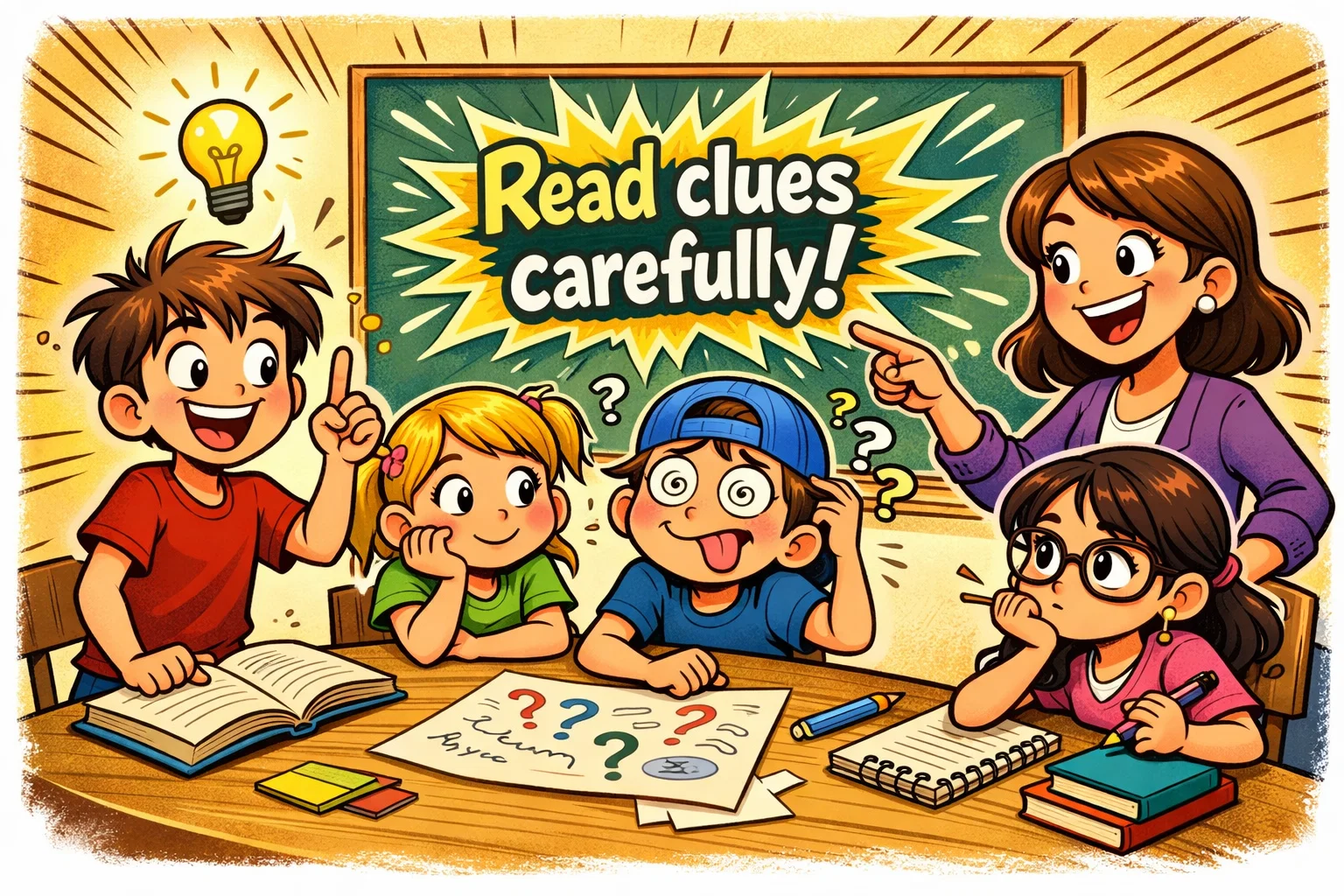
Before diving into the list, it is helpful to set some “ground rules.” These strategies help children manage frustration and improve their success rate when tackling brain teasers for kids.
Read Every Clue Slowly
Riddles are often designed to mislead the listener by emphasizing unimportant details. Encourage the child to listen for the specific question at the end. Often, the answer is hidden in the first sentence, and the rest of the text is simply “filler” to distract the brain.
Look for Double Meanings
Many tricky riddles rely on words that have more than one definition. If a riddle mentions a “bank,” it might not be talking about money; it could be the edge of a river. Learning to identify these linguistic traps is a key part of developing high-level literacy and reading comprehension skills.
Guess Before Checking Answers
It can be tempting to scroll directly to the solution, but the cognitive benefit comes from the struggle. Encourage kids to make at least three guesses before revealing the answer. This persistence can help build resilience and confidence when kids face difficult tasks.
Use Team Play for More Fun
Solving puzzles in groups encourages collaboration. You can assign points for the correct answer or for the funniest “wrong” guess. Collaborative play reduces the pressure of being “wrong” and transforms a mental exercise into a social bonding experience.
101 Fun Riddles for 10 Year Olds
This section contains the main collection of puzzles. We have organized them into clear categories to make them easier to browse.
Easy Riddles for 10 Year Olds
These are perfect for building confidence. They use common objects and clear descriptions.
- I have a bed but never sleep, and I have a mouth but never speak. What am I? (A river.)
- I have many keys but can’t open a single lock. What am I? (A piano.)
- What has a thumb and four fingers but isn’t alive? (A glove.)
- What has to be broken before you can use it? (An egg.)
- What goes up but never comes down? (Your age.)
- What has one eye but cannot see? (A needle.)
- What is full of holes but still holds water? (A sponge.)
- What building has the most stories? (A library.)
- What has legs but cannot walk? (A table.)
- What is easy to get into but hard to get out of? (Trouble.)
Funny Riddles for 10 Year Olds
These focus on puns and “dad jokes” that 10-year-olds find hilarious.
- What do you call a bear with no teeth? (A gummy bear.)
- What has a neck but no head? (A bottle.)
- Why did the student eat his homework? (Because the teacher said it was a piece of cake.)
- What kind of tree can you carry in your hand? (A palm tree.)
- What do you call a pile of kittens? (A meow-ntain.)
- Why can’t a bicycle stand up on its own? (Because it is two-tired.)
- What did the zero say to the eight? (“Nice belt!”)
- Which bank never has any money? (A river bank.)
- What kind of dog does a magician have? (A Labracadabrador.)
- What did one ocean say to the other ocean? (Nothing, they just waved.)
Tricky Riddles for 10 Year Olds
These require the child to think about “who” or “what” is actually performing the action.
- Mary has four daughters, and each of her daughters has a brother. How many children does Mary have? (Five — four daughters and one brother they all share.)
- You’re in a one-story house where everything is yellow. The walls are yellow, the doors are yellow, and all the furniture is yellow. What color are the stairs? (There are no stairs — it’s a one-story house.)
- If you’re running a race and you pass the person in second place, what place did you finish? (Second place.)
- I am light as a feather, yet the strongest man cannot hold me for much more than a minute. What am I? (Breath.)
- What comes once in a minute, twice in a moment, but never in a thousand years? (The letter “M”.)
- A man is driving a black car. His lights are off, and the moon is not out. A black cat crosses the street, and the man stops. How did he see it? (It was daytime.)
- What is so fragile that saying its name breaks it? (Silence.)
- What can travel around the world while staying in a corner? (A stamp.)
- The more of this there is, the less you see. What is it? (Darkness.)
- What has a head and a tail but no body? (A coin.)
Hard Riddles for 10 Year Olds
These riddles are a bit more challenging and encourage careful thinking.
- I follow you all day long, but when the sun goes down, I disappear. What am I? (Your shadow.)
- What can you catch but not throw? (A cold.)
- I have cities, but no houses. I have mountains, but no trees. I have water, but no fish. What am I? (A map.)
- What belongs to you, but everyone else uses it more than you do? (Your name.)
- I am tall when I am young, and I am short when I am old. What am I? (A candle.)
- What has a face and two hands but no arms or legs? (A clock.)
- What gets wetter the more it dries? (A towel.)
- If you have me, you want to share me. If you share me, you haven’t got me. What am I? (A secret.)
- What can run but never walks, has a mouth but never talks, has a head but never weeps, and has a bed but never sleeps? (A river.)
- I start with T, end with T, and I have T in me. What am I? (A teapot.)
Short Riddles With Quick Answers
Use these for quick rounds to keep kids engaged.
- What gets bigger the more you take away? (A hole.)
- What has words but never speaks? (A book.)
- What has a neck but no head? (A shirt.)
- What goes up and down but doesn’t move? (A staircase.)
- What can you break without touching it? (A promise.)
- What has no beginning, no end, and no sides? (A circle.)
- What has many teeth but cannot bite? (A comb.)
- What is always in front of you but can’t be seen? (The future.)
- What has 13 hearts but no other organs? (A deck of cards.)
- What stays where it is when it goes? (A road.)
School Riddles for 10 Year Olds
Incorporating riddles into the school day can make educational concepts more approachable. These are categorized by grade level and classroom situation.
Back to School Riddles
- I have graphite inside, but I’m not heavy; I help you write all day. What am I? (A pencil.)
- I have two hands and a face, and I tell you when it’s time to leave this place. What am I? (The school clock.)
- I have many leaves but no roots; I have a spine but no bones. What am I? (A textbook.)
- I am a box that holds your lunch, keeping your snacks ready to munch. What am I? (A lunchbox.)
4th Grade Riddles
At age 9–10, many 4th graders are strengthening basic logic and vocabulary skills.
- What has four legs like a dog but can’t run or bark? (A chair.)
- I am both a fruit and a color. What am I? (An orange.)
5th Grade Riddles
As they approach age 11, 5th graders enjoy more sophisticated wordplay.
- I come once every four years and add an extra day to February. What am I? (A leap year.)
- I am a word of five letters; remove the first and I am the same. (Alone.)
Classroom Riddles for Teachers
Teachers can use these to manage transitions or as a “ticket out the door.”
- Beginning of lesson: What has many keys but can’t open doors? (A keyboard.)
- Math Transition: I am an odd number. Take away a letter and I become even. (Seven — S-even.)
- End of day: What is always coming but never arrives? (Tomorrow.)
Math Riddles for 10 Year Olds
Mathematics doesn’t have to be limited to worksheets. Math riddles for kids help bridge the gap between calculation and logic.
Number Riddles
- What number stays the same no matter what number you multiply it by? (Zero.)
- I am a three-digit number. My tens digit is five more than my ones digit. My hundreds digit is eight less than my tens digit. What number am I? (194.)
- How many times can you subtract 10 from 100? (Once — because after that, you are subtracting from 90.)
Shape and Pattern Riddles
- I have no beginning, middle, or end. I am not a square or a triangle. What am I? (A circle.)
- I have three sides and three corners, but I am not a slice of pizza. What am I? (A triangle.)
Logic Math Riddles
- A man has 10 cows. All but 9 die. How many does he have left? (9.)
- If there are three apples and you take away two, how many apples do you have? (Two — the ones you took.)
Word Problem Style Riddles
- A grandfather, two fathers, and two sons went to a movie. They only bought three tickets. How is this possible? (There were only three people: a grandfather, a father, and a son.)
Science Riddles for 10 Year Olds
Science riddles are a great way to get kids interested in the natural world and how things work.
Nature Science Riddles
- I can fly but have no wings. I can cry but have no eyes. What am I? (A cloud.)
- I fall from the sky, I am cold, and I melt in your hand. What am I? (Snow.)
- I am a gas people need to breathe to stay alive. What am I? (Oxygen.)
Space and Planet Riddles
- I am the only planet that is not named after a god. What am I? (Earth.)
- I am a huge ball of hot gas and plasma that Earth moves around. What am I? (The Sun.)
Human Body Riddles
- I am the pump of your body, but I don’t use electricity. What am I? (The heart.)
- I have two windows to the world, but if I close them, you see nothing. What am I? (Eyes.)
English Riddles for 10 Year Olds
These riddles focus on vocabulary, spelling, and the intricacies of the English language.
Vocabulary Riddles
- What word is spelled incorrectly in every dictionary? (Incorrectly.)
- What is the longest word in the dictionary? (Smiles — because there is a “mile” between the two S’s.)
Spelling Riddles
- Which letter of the alphabet has the most water? (The “C”.)
- What starts with “P”, ends with “E”, and has thousands of letters? (A post office.)
Wordplay Riddles
- Forward I am heavy, but backward I am not. What am I? (The word “ton”.)
- What kind of room has no doors or windows? (A mushroom.)
Animal Riddles for 10 Year Olds
Animals are a universally loved topic. These range from farm favorites to exotic predators.
Farm Animal Riddles
- I give you milk and I say “Moo.” (A cow.)
- I have feathers and I wake you up in the morning. (A rooster.)
Wild Animal Riddles
- People call me the king of the jungle, but I usually live in the savannah. What am I? (A lion.)
- I have a long neck to reach the trees. (A giraffe.)
Ocean Animal Riddles
- I have eight arms and I can spray ink. (An octopus.)
- I am the largest mammal in the sea. (A blue whale.)
Food Riddles for 10 Year Olds
Food riddles are excellent for mealtime conversations.
- Fruit: I am a bird, a fruit, and the nickname for a person from New Zealand. What am I? (A kiwi.)
- Vegetable: I have many eyes but cannot see. (Potato.)
- Sweet: I am a cold treat on a stick. (Popsicle.)
- Kitchen Tool: I tell you how hot food is, but I never take a bite. What am I? (A thermometer.)
Family Riddles for 10 Year Olds
These riddles celebrate the relationships and items found within a home.
Sibling Riddles
- Two brothers are born at the same time to the same mother, but they are not twins. How? (They are part of triplets.)
Parent and Grandparent Riddles
- I am your father’s father. Who am I? (Your grandfather.)
Home Life Riddles
- I have a frame but no picture, and I have a mattress but no blanket. What am I? (A bed.)
Holiday Riddles for 10 Year Olds
Holiday themes provide seasonal excitement and help build traditions.
Halloween Riddles
- I am a house you enter but never want to stay in. (A haunted house.)
- I am a round orange pumpkin that people carve faces into at Halloween. What am I? (A pumpkin.)
Christmas and December Riddles
- I have a red nose and I lead a sleigh. (Rudolph.)
- You hang me by the chimney and hope I am full of treats. (A stocking.)
Summer Riddles
- I am the giant yellow ball that gives you a tan. (The sun.)
- I am a sandy place where the land meets the ocean. What am I? (A beach.)
Benefits of Riddles for 10 Year Olds
Integrating riddles into a child’s routine provides more than just entertainment. According to Jean Piaget’s theory of cognitive development, many children between about ages 7 and 11 begin to use more logical “concrete operational” thinking.
Vocabulary Growth
Riddles introduce children to new words and context-dependent meanings. By engaging with double meanings, children learn that language is flexible. This can support vocabulary growth and reading comprehension, especially when children talk through multiple meanings and explain their answers.
Logic and Problem Solving Skills
Solving a brain teaser requires “executive function,” the mental process that allows us to plan, focus attention, and juggle multiple tasks. Riddles encourage kids to look for patterns, test possibilities, and rule out weak answers.
Confidence and Social Play
When a child successfully solves a “hard” riddle, they experience a boost in self-efficacy. Sharing riddles with friends can also build social skills, because kids learn to read the clues clearly and reveal the answer at the right moment.
Screen-Free Fun
In an era of high digital consumption, riddles provide an alternative that requires zero battery life. The American Academy of Pediatrics encourages families to build healthy media habits and create a Family Media Plan; riddles are a simple screen-free activity that supports conversation and focused thinking.
How Kids Can Create Their Own Riddles
Creating a riddle is a higher-level cognitive task than simply solving one. It requires synthesis and creative writing. Use the following steps to help a child write their first puzzle.
Step 1: Start With the Answer
Choose a simple object, like a “pencil” or a “cat.” It is much easier to work backward from a known solution than to try and invent a mystery from scratch.
Step 2: Brainstorm Clues
List 5–7 attributes of the object. For a pencil, you might list:
- Yellow
- Has an eraser
- Contains graphite
- Gets shorter as you use it
- Used for homework
Step 3: Think Like the Answer
Use personification. Instead of saying “A pencil is yellow,” say “I wear a yellow coat.” This adds a layer of mystery and makes the riddle more engaging.
Step 4: Twist the Sentence
Look for a “hook.” For example: “I have a pink hat that I use to fix my mistakes.” This uses a common object (eraser) but describes it in an unusual way (a hat).
Step 5: Write the Final Riddle
Combine the best clues into 2–4 lines.
Example:
I wear a yellow coat and have a pink hat.
The more I work, the shorter I get.
I help you with your math, but I never say a word.
What am I? (A pencil.)

Take a short quiz to find out what your everyday choices say about your parenting style
When your child is curious about something new, what’s your instinct?
Take a short quiz to find out what your everyday choices say about your parenting style
“Can I download this app?” What happens next?
Take a short quiz to find out what your everyday choices say about your parenting style
When it comes to rules at home, which sounds most like you?
Take a short quiz to find out what your everyday choices say about your parenting style
If you could give your child one life skill today, what would you pick?
Take a short quiz to find out what your everyday choices say about your parenting style
Your child gets to choose what to watch. What would your ideal setup look like?
Take a short quiz to find out what your everyday choices say about your parenting style
Pick your parenting superpower ✨



