Best Quick Math Games for Five-Minute Learning Breaks

 Discover a Free Education Video App for Kids
Pastory uses AI to personalize educational video content based on your child’s interests and personality. Safe, engaging, and built for curious young minds. Sign up now to stay updated and enjoy early access with a free trial
A five-minute learning break can do more than simply pause a lesson — it can help children consolidate what they have just learned, reduce math anxiety, and return to focused work with renewed attention. Quick math games are one of the most practical tools available to parents and teachers for filling those short windows productively, whether during a classroom transition, a homework session, or a quiet moment between activities. This article explains why brief, game-based math practice works, then provides a curated set of ready-to-use games organized by format and use case, along with guidance on choosing the right type for different learners.
Key Takeaways
- Short, game-based math practice can support fact fluency and number sense without requiring long preparation or specialist materials.
- The spacing effect — revisiting skills in brief, repeated sessions — is a well-supported learning mechanism that five-minute breaks are well suited to exploit.
- Different game formats (verbal, card, dice, movement, digital) suit different learning styles and classroom or home contexts; no single format works best for every child.
- Cooperative games may be a better fit than competitive ones for children who experience math anxiety or who tend to disengage under pressure.
- Digital math games can be a useful option, but the quality and structure of the tool matters; free browser games that require no account sign-up are widely available and low-risk for short sessions.
Why Five-Minute Math Breaks Actually Work
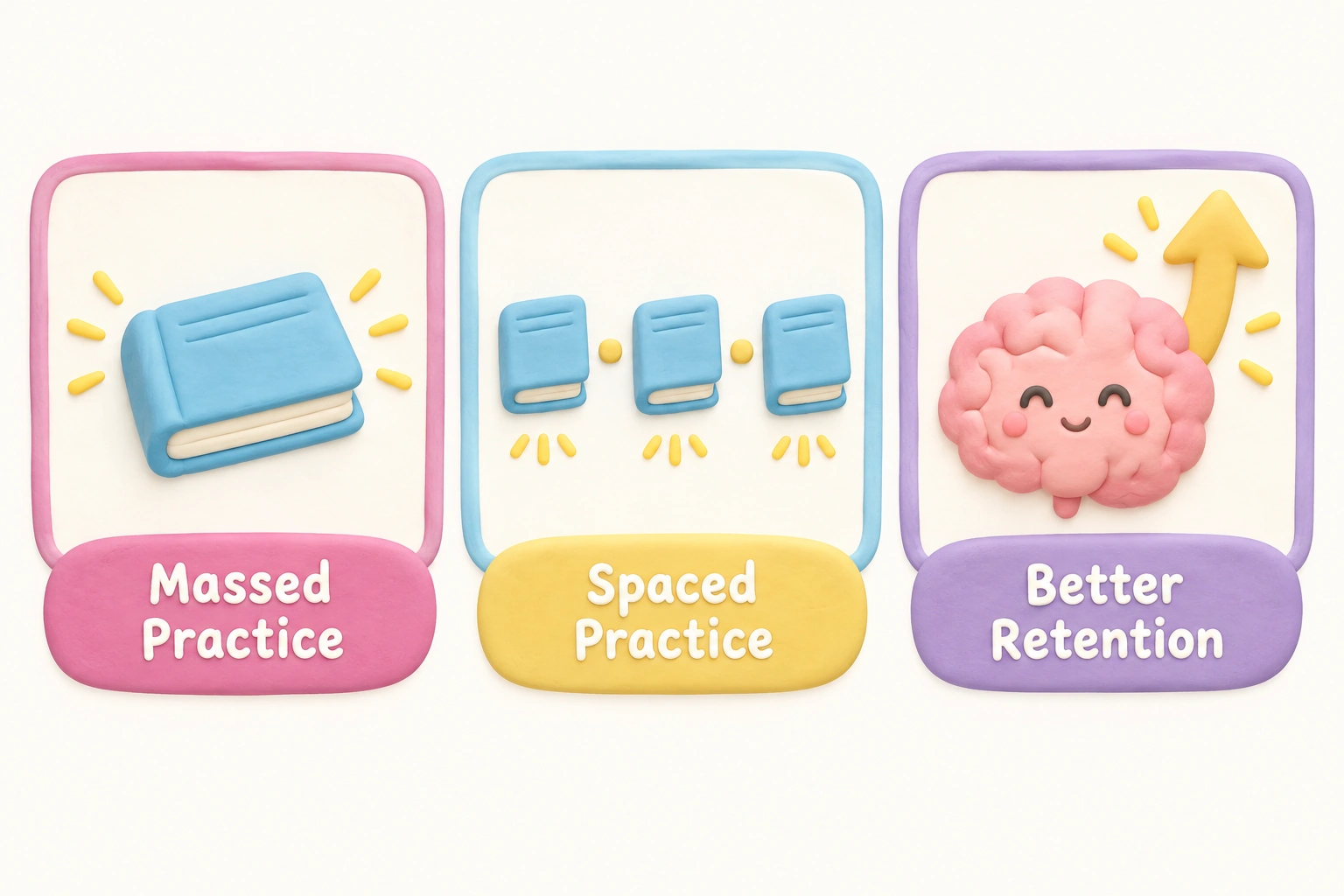
The case for short, structured math breaks is grounded in cognitive science rather than convenience. Research on the spacing effect — the finding that distributing practice across multiple short sessions produces stronger long-term retention than a single extended block — suggests that brief, repeated encounters with math facts may help children move those facts into long-term memory more reliably than massed drill alone. Neuroscientist Mary Helen Immordino-Yang at the University of Southern California has used neuroimaging to show that the brain continues processing and consolidating learning during periods of mental rest and low-stakes engagement, which is precisely what a well-designed five-minute learning break provides.
Beyond memory consolidation, short breaks serve an attention-restoration function. Children’s working memory capacity is limited, and sustained cognitive effort depletes it. Switching briefly to a playful math warm-up activity gives the prefrontal cortex a partial reset while keeping the child’s mind oriented toward numbers. Research cited by Edutopia on brain break effectiveness suggests that even brief pauses between learning blocks can help children focus more effectively when they return to direct instruction. For children who experience math anxiety, the low-stakes, game-like format of a quick math activity can also reduce the stress response that interferes with mathematical reasoning, making the subject feel more approachable over time.
No-Prep Verbal Games: Zero Materials Required
No-prep math games are the most accessible option for both classroom transitions and home learning breaks because they require nothing beyond the children themselves and a few seconds of setup. These whole-class games work well as a bell ringer at the start of a math block or as a math transition game between subjects.
Buzz
Players count aloud around the group, replacing every multiple of a chosen number (for example, 5) with the word “Buzz.” A child who says the number instead of “Buzz” sits down, and the last player standing wins. Buzz builds skip counting and multiplication awareness naturally, and the difficulty scales easily by changing the target number. It fits comfortably within three to four minutes for a group of up to thirty children. For younger learners in the early primary years, using multiples of 2 or 5 keeps the game accessible; older children in middle childhood can use multiples of 7 or 9 for a genuine mental math challenge.
Stand Up / Sit Down
The teacher or parent calls out a math fact or number property (“Stand up if your answer is greater than 20”), and children respond physically. This active math movement format doubles as a movement break, which is particularly useful when children have been seated for an extended period. It requires no materials, takes under two minutes, and can target any skill from basic addition to place value or estimation.
Around the World
Two children stand side by side while the teacher presents a rapid-fire math fact. The first child to answer correctly moves on to challenge the next player. Around the World is a classic whole-class game that builds fact fluency through repetition and mild competitive pressure. It is worth noting that this format suits children who respond well to competition; for children who find competitive formats stressful, the cooperative alternatives described later in this article may be a better choice.
Card and Dice Games: Low-Prep, High Engagement
A standard deck of playing cards and a pair of dice open up a wide range of low-prep classroom games and home math activities. These formats are particularly well suited to partner or small-group play, making them useful for early finisher activities or paired practice during a math block.
Math War
Each player flips two cards simultaneously and multiplies (or adds) the values. The player with the higher product keeps all four cards. Math War is a straightforward card game that reinforces multiplication facts or addition fluency depending on the age group, requires no explanation beyond the first round, and can run for exactly as long as needed — making it ideal for a five-minute learning break. Face cards can be assigned values (Jack = 11, Queen = 12, King = 0) to extend the range of facts practiced.
Dice Race
Each player rolls two dice and performs the target operation (addition, subtraction, or multiplication) as quickly as possible, recording the answer. After ten rolls, players compare totals. The Dice Race format supports mental math fluency and can be differentiated easily: younger children add the two dice values, while older children multiply them or work with three dice for multi-step calculations. The game takes approximately four minutes and requires only dice and a scrap of paper.
Make It Ten (Partner Card Game)
Players spread a set of number cards face up and take turns finding pairs that sum to ten (or another target number). Make It Ten builds number bonds and number sense in a cooperative rather than competitive format, which research on math anxiety suggests may be more effective for children who tend to shut down under competitive pressure. This game is particularly well suited to preschool-age and early primary children who are developing foundational addition concepts.
Movement-Based Math Games: Active Learning Breaks
Active math movement games combine physical activity with mathematical thinking, addressing two needs simultaneously: the child’s need for movement and the teacher’s or parent’s goal of maintaining math engagement. These formats are especially effective as a brain break during long learning sessions.
Number Line Jump
A number line is taped or drawn on the floor (or imagined in an open space). The teacher calls out an addition or subtraction problem, and children physically jump to the correct position on the line. Number Line Jump supports number sense and mental arithmetic in a kinesthetic format that is particularly accessible for children in the toddler-to-early-primary range who are still developing abstract number concepts. The physical movement reinforces the mental model of numbers as positions in space.
Math Simon Says
A variation of the classic game, Math Simon Says replaces simple actions with math-conditional instructions: “Simon says take three steps forward if 6 × 4 equals 24.” Children must evaluate the math statement before deciding whether to act, which adds a layer of cognitive engagement to the movement break. This format works well for children in the early primary and middle childhood years and can target any skill from basic facts to geometry vocabulary.
Groups
Children move freely around the space until the teacher calls a number. Children must quickly form groups of exactly that size. Groups can be made more mathematically demanding by calling instructions such as “Form a group equal to 3 squared” or “Form a group that is half of 14.” This active math movement game takes under three minutes, requires no materials, and builds quick thinking alongside basic number operations.
Digital and Online Math Games: Choosing Wisely
Digital math games can be a practical option for five-minute learning breaks, particularly when children are already working on a device or when a teacher needs a self-running activity for early finishers. However, the quality and structure of the tool matters considerably. Passive or purely entertainment-focused games offer little mathematical benefit, while well-designed interactive tools can reinforce fact fluency and number sense effectively in short sessions.
For classroom or home use without account creation, several free browser-based options are worth knowing. FreeCasual.games Quick Math is a 60-second browser game that presents rapid-fire arithmetic problems with no sign-up required, making it a genuinely low-friction free online math game for short sessions. Kill5Minutes offers a collection of no-account browser math games calibrated to fill exactly the kind of short window described in this article. These tools are appropriate for children in the early primary through middle childhood range and can be used independently once a child understands the format.
Platforms such as Prodigy, Blooket, and Kahoot offer more structured digital math warm-up experiences with grade-level filters and adaptive difficulty, though most require account creation and are better suited to planned classroom use than spontaneous five-minute breaks. When selecting any digital math game, parents and teachers should look for tools that require active problem-solving rather than passive watching, provide immediate feedback, and allow the session to end cleanly at the five-minute mark without leaving children mid-engagement in a way that causes frustration.
Organizing Games by Use Case: When to Use Each Format
Most articles about quick math games organize their lists by game type, but teachers and parents often think in terms of when they need an activity rather than what category it falls into. The table below maps the games described in this article to four common use cases, along with the prep level and a suggested grade band.
| Use Case | Recommended Games | Prep Level | Grade Band |
|---|---|---|---|
| Pre-lesson math warm-up / bell ringer | Buzz, Stand Up/Sit Down, Around the World | Zero | K–8 |
| Transition filler between subjects | Math Simon Says, Groups, Number Line Jump | Zero | K–5 |
| Post-lesson consolidation | Math War, Dice Race, Make It Ten | Low | K–6 |
| Early finisher / independent activity | FreeCasual Quick Math, Kill5Minutes, Dice Race | Zero–Low | 2–8 |
| Home learning break / homework session | Make It Ten, Math War, Number Line Jump | Low | K–6 |
Competitive vs. Cooperative: Choosing the Right Format for Your Child
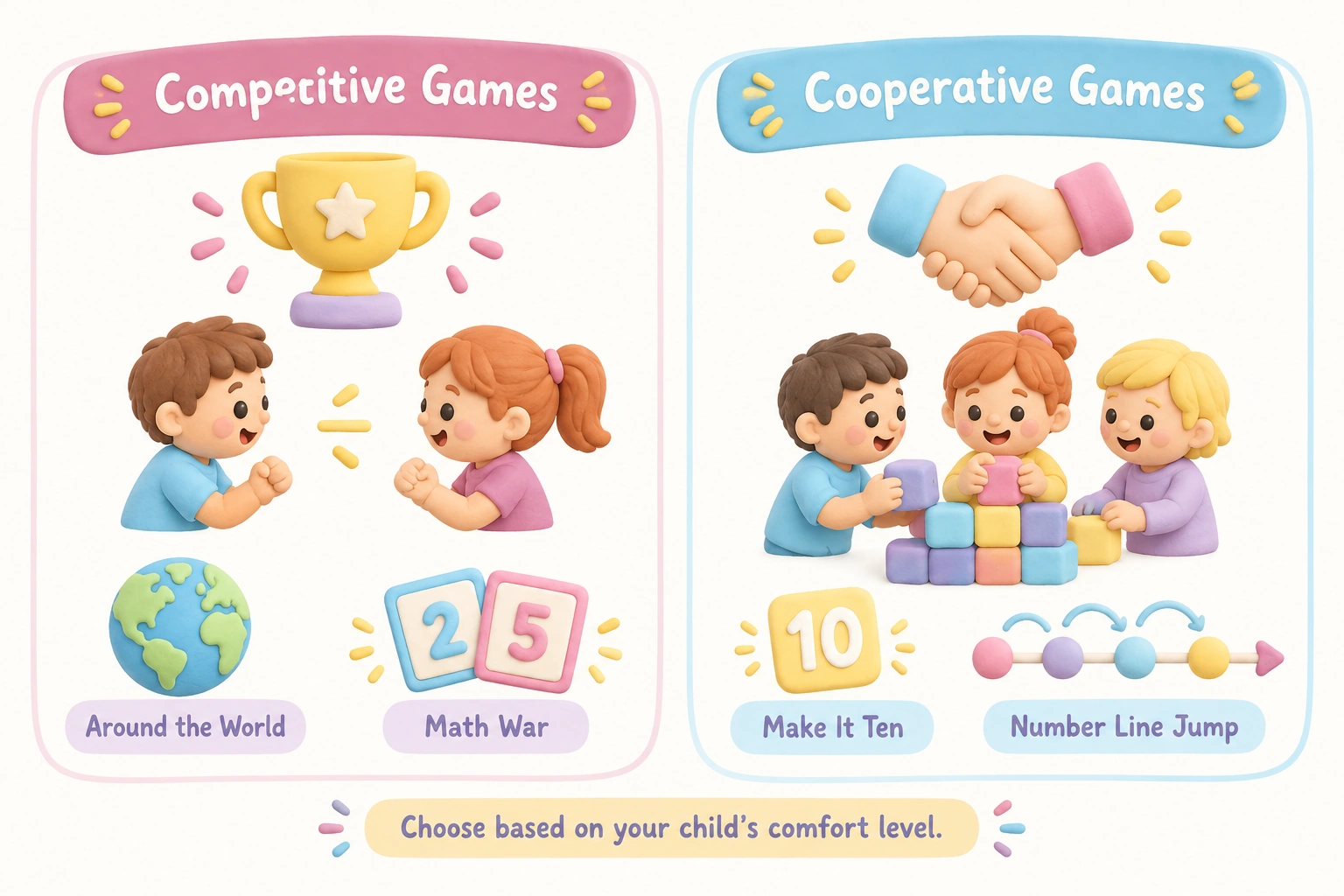
One dimension that is rarely addressed in game lists is the distinction between competitive and cooperative formats, yet it has a meaningful impact on whether a game supports or undermines a child’s relationship with mathematics. Competitive quick math games — Around the World, Math War, Dice Race — work well for children who are motivated by mild challenge and who have sufficient fact fluency to participate without feeling exposed. For these children, the competitive element adds energy and engagement to what might otherwise feel like routine drill.
Cooperative games or collaborative puzzles, by contrast, work better for children who experience math anxiety or who tend to disengage when they feel they might lose in front of peers. Make It Ten, Number Line Jump, and group-based movement games all allow children to contribute at their own level without a single winner or loser. Research on math anxiety consistently finds that the emotional context of math practice — whether it feels safe or threatening — influences how well children encode and retrieve mathematical information. Parents and teachers who notice a child becoming withdrawn or distressed during competitive math games should consider switching to a cooperative format before concluding that the child simply dislikes math.
Adapting Quick Math Games for Home Use
Most of the games described in this article were originally designed for classroom settings, but they adapt readily to home learning breaks with minor adjustments. A parent working through a homework session with one child can use the card and dice games in a two-player format, turning a brief break into a shared activity rather than a solo drill. Number Line Jump works in a hallway or living room with a strip of masking tape. Buzz can be played in the car during a short journey, requiring no materials at all.
For home use, the key principle is keeping the session genuinely short — five minutes or fewer — so that the break functions as a cognitive reset rather than an extension of the learning session. Setting a visible timer helps children understand that the game has a defined endpoint, which reduces resistance to returning to focused work afterward. Parents do not need to act as teachers during these breaks; participating as a fellow player, including making deliberate occasional errors, can reduce the evaluative pressure that some children associate with math practice at home.
Grade-Level Quick Reference
The games in this article span a wide age range, but matching the format and difficulty to the child’s developmental stage is important for maintaining engagement and genuine learning benefit. The following overview provides a starting point; individual children may be ready for more or less challenge depending on their current skill level.
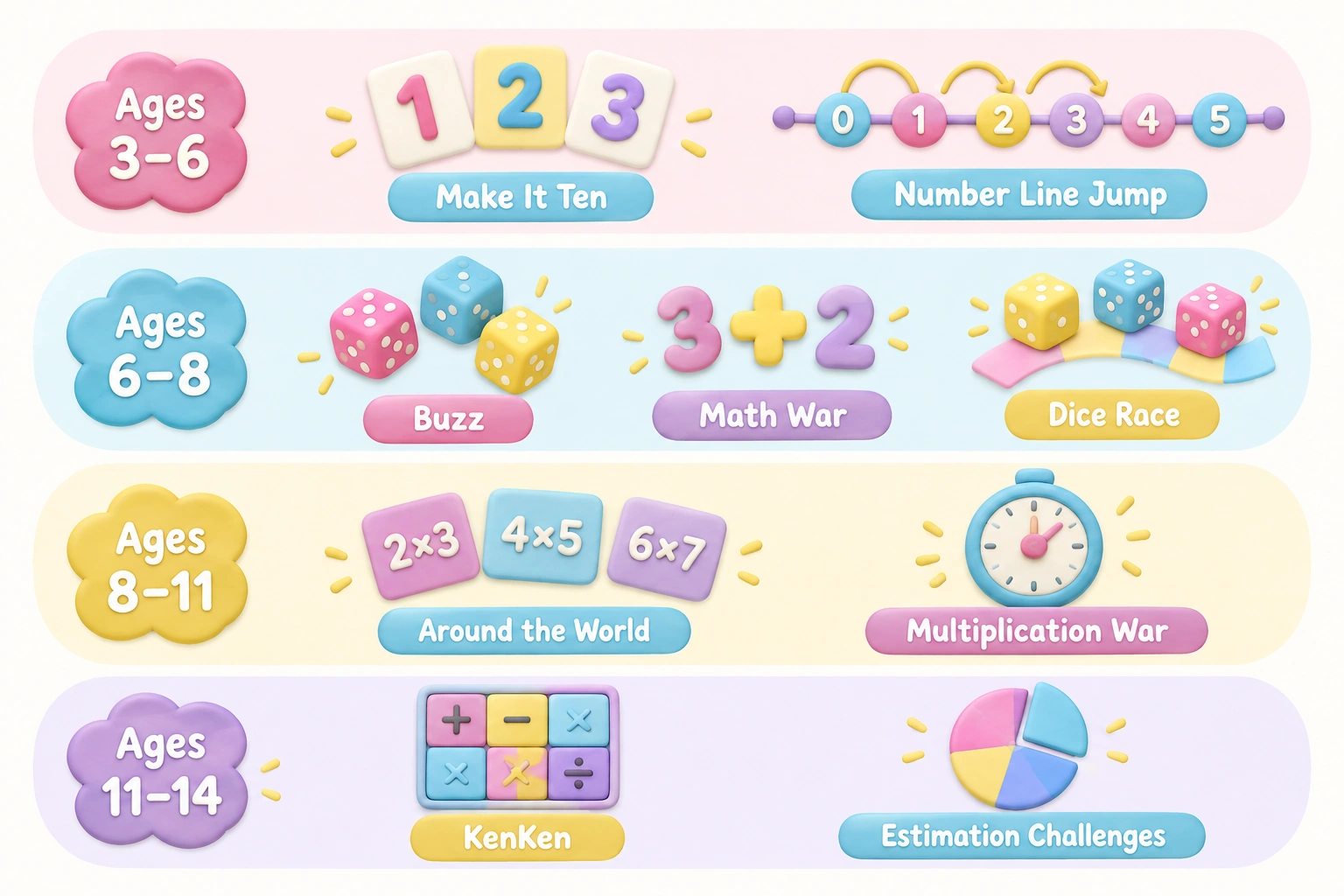
- Preschool and Kindergarten (ages 3–6): Make It Ten (with small numbers), Number Line Jump, Stand Up/Sit Down with simple counting prompts, Clap and Count.
- Early Primary (ages 6–8): Buzz (multiples of 2, 5, 10), Math War (addition), Dice Race (addition and subtraction), Math Simon Says, Groups.
- Middle Primary (ages 8–11): Buzz (multiples of 6, 7, 8, 9), Math War (multiplication), Dice Race (multiplication), Around the World, FreeCasual Quick Math.
- Middle School (ages 11–14): Buzz (composite rules), Dice Race (multi-step operations), Blooket or Kahoot math sets, estimation challenges, KenKen puzzles.
What Makes a Quick Math Game Genuinely Effective
Not every activity labeled a “math game” delivers meaningful learning in a five-minute window. The most effective quick math games share several characteristics that are worth checking before introducing a new activity. First, the game should require active mathematical thinking rather than passive observation — children should be generating answers, not watching someone else solve problems. Second, the feedback loop should be immediate: children learn more from a game where they find out quickly whether their answer was correct than from one where errors go unaddressed. Third, the game should be simple enough to explain in under sixty seconds, so that setup time does not consume the available break.
Games that build fact fluency and mental math fluency are particularly valuable in short formats because automaticity with basic facts frees up working memory for more complex problem-solving later. A child who must laboriously calculate 7 × 8 cannot simultaneously attend to the structure of a multi-step word problem. Brief, repeated practice through game formats — the spacing effect in action — is one of the most practical ways to build that automaticity without resorting to rote drill that many children find demotivating.
Frequently Asked Questions
How long should a math brain break actually last?
Most of the games described here are designed for three to five minutes. Going beyond five minutes risks turning the break into an additional learning session rather than a genuine cognitive reset. Setting a timer before starting helps maintain the boundary, particularly for children who become highly engaged and resist stopping.
Are these games suitable for children with math anxiety?
Many of them are, provided the format is chosen carefully. Cooperative and movement-based games tend to be lower-stakes than competitive verbal games and are generally a better starting point for children who find math stressful. Gradually introducing mild competitive elements once a child feels more confident can help build resilience without triggering avoidance.
Do digital math games count as screen time?
Yes, and this is worth factoring into a child’s overall daily screen time. For short, structured sessions of five minutes or fewer, the interactive and educational nature of a well-chosen digital math game means the screen time is purposeful rather than passive. The American Academy of Pediatrics encourages parents to consider content quality and context alongside raw duration when evaluating screen time for school-age children.
Can these games replace formal math instruction?
No. Quick math games are designed to supplement and reinforce skills that have already been introduced through direct instruction, not to introduce new concepts. They are most effective when the skills being practiced are already partially familiar to the child, allowing the game format to build fluency and confidence rather than create confusion.
What if my child finds all competitive math games stressful?
This is more common than many parents and teachers realize, and it is a meaningful signal rather than a character flaw. Switching entirely to cooperative formats — Make It Ten, Number Line Jump, collaborative estimation challenges — while maintaining a playful tone is a reasonable response. If math anxiety appears to be significantly affecting a child’s willingness to engage with mathematics more broadly, consulting a teacher or educational psychologist may be helpful.
How do I know if a free online math game is appropriate for my child?
Look for games that present clear math problems, give immediate feedback, do not require personal information or account creation for basic use, and can be exited cleanly at any point. Avoid games that use manipulative engagement mechanics — such as reward loops designed to extend session length — since these work against the five-minute break format and may make it harder for children to stop when the break is over.
Finding the Right Quick Math Game for Your Child or Classroom
The best quick math game for any given child or group is the one that fits the available time, matches the current skill level, and feels genuinely engaging rather than like disguised drill. No single format works for every learner: a competitive verbal game that energizes one child may discourage another, and a digital tool that works well for an independent early finisher may not suit a whole-class transition moment. Starting with no-prep verbal games and low-prep card or dice games gives parents and teachers a flexible foundation that requires no investment and can be adjusted immediately based on how children respond.
The science behind short learning breaks is encouraging, but it is worth keeping realistic expectations. Five-minute math games are most effective as a consistent habit — brief, repeated practice over weeks and months — rather than as a one-off intervention. Children who play a quick math game several times a week as part of a regular routine are more likely to show gradual improvements in fact fluency and number sense than those who encounter the same games sporadically. The goal is not a dramatic transformation in any single session, but a steady, low-pressure accumulation of mathematical confidence that makes the subject feel more familiar and less threatening over time.

Take a short quiz to find out what your everyday choices say about your parenting style
When your child is curious about something new, what’s your instinct?
Take a short quiz to find out what your everyday choices say about your parenting style
“Can I download this app?” What happens next?
Take a short quiz to find out what your everyday choices say about your parenting style
When it comes to rules at home, which sounds most like you?
Take a short quiz to find out what your everyday choices say about your parenting style
If you could give your child one life skill today, what would you pick?
Take a short quiz to find out what your everyday choices say about your parenting style
Your child gets to choose what to watch. What would your ideal setup look like?
Take a short quiz to find out what your everyday choices say about your parenting style
Pick your parenting superpower ✨