12 Best Math Games to Play in the Classroom

 Discover a Free Education Video App for Kids
Pastory uses AI to personalize educational video content based on your child’s interests and personality. Safe, engaging, and built for curious young minds. Sign up now to stay updated and enjoy early access with a free trial
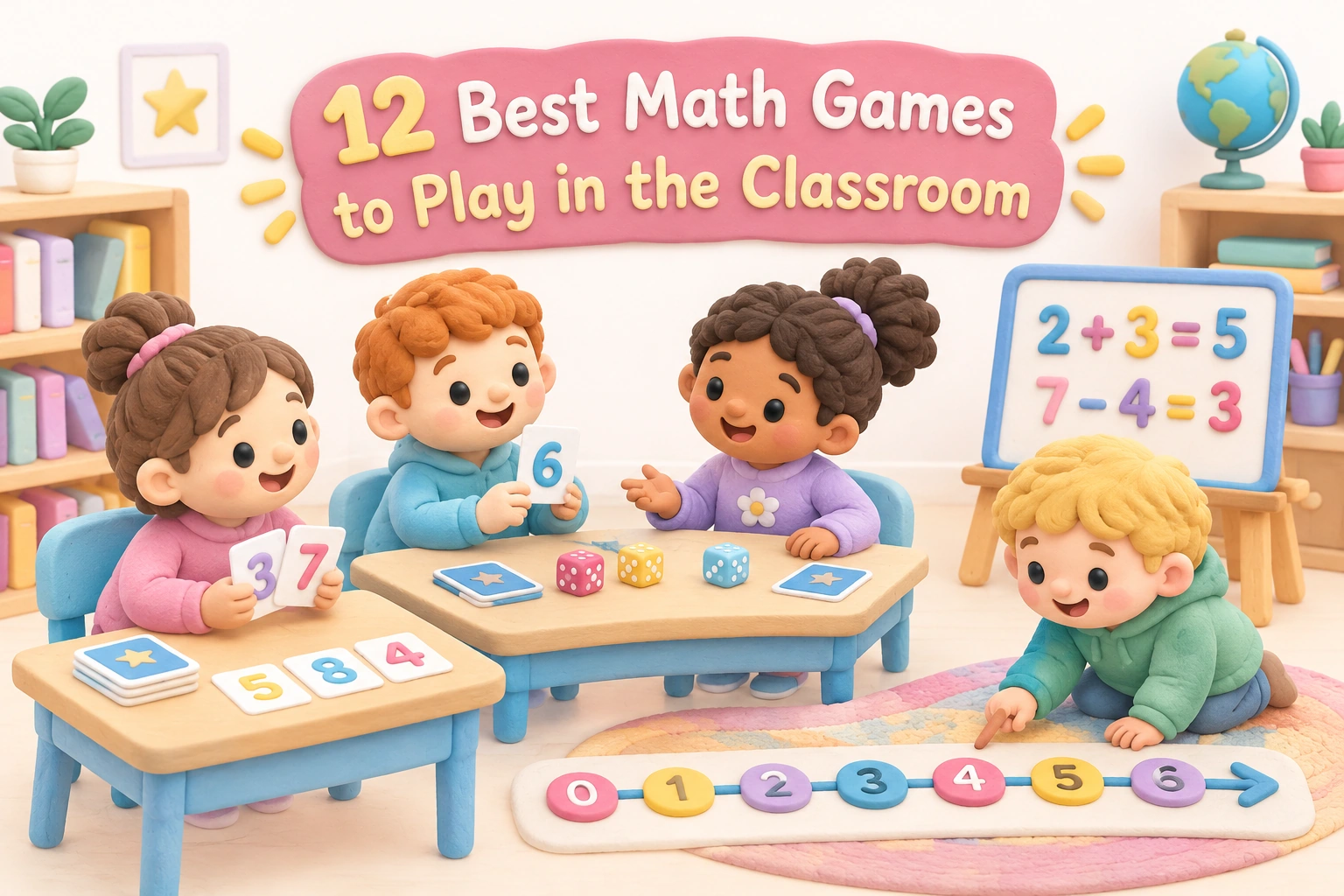
Finding fun math games to play in the classroom can transform a routine lesson into an experience students genuinely look forward to. Research published in peer-reviewed mathematics education journals suggests that game-based learning lessons produce significantly higher on-task time compared with traditional instruction, and that non-digital games in particular may help reduce math anxiety by lowering the stakes around getting an answer wrong. This article presents 12 carefully selected classroom math games, each with grade-level guidance, a clear how-to-play summary, prep requirements, and differentiation tips so teachers can adapt each game for mixed-ability groups.
Key Takeaways
- Game-based learning can support math fact fluency, number sense, and mental math skills across all elementary and middle school grade levels.
- Most of the games below require minimal prep or no prep at all — many need only a deck of cards, dice, or a whiteboard.
- Whole-class math games, partner games, and small-group formats each serve different instructional purposes; matching the format to your goal matters.
- Differentiation is possible in every game on this list — small rule changes can make the same game accessible for struggling learners and challenging for advanced students.
- A brief FAQ at the end addresses common teacher questions about noise management, review use, and no-materials options.
Why Math Games Belong in Every Classroom
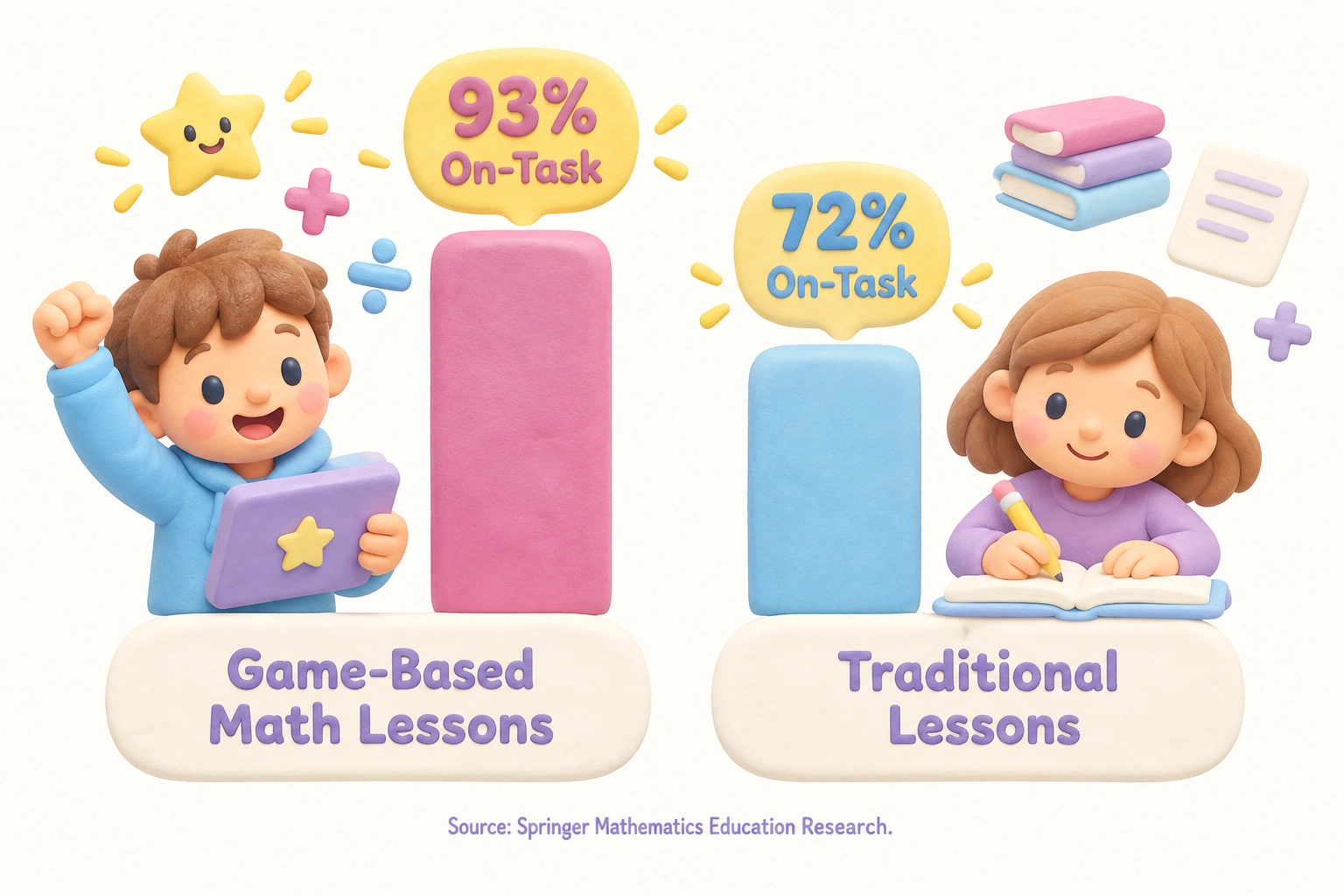
Game-based learning is not simply a reward activity. When students play a well-designed math game, they practice skills repeatedly in a low-pressure context, receive immediate feedback from the game outcome, and often explain their reasoning to a partner — all of which are recognized features of effective math instruction. A study published in a Springer mathematics education journal found that students were on task approximately 93% of the time during game-based math lessons, compared with roughly 72% during non-game lessons. That gap in engagement has real implications for how much practice students accumulate over a school year.
Games also address math anxiety in a way that drills rarely do. When a student loses a round of Math War, the social consequence is minimal and the next round begins immediately. This low-stakes repetition allows students who feel anxious about timed tests to build math fact fluency without the pressure that formal assessments create. Research from Frontiers in Education highlights that collaborative and competitive game formats both show positive effects on student engagement, though collaborative formats may be particularly beneficial for students who experience high math anxiety.
How to Choose the Right Game for Your Class
Before selecting a game, consider three practical factors: the skill you want to reinforce, the time available, and the group size. A five-minute math warm-up at the start of a lesson calls for a different game than a twenty-minute math center activity or an end-of-unit review game. The table below provides a quick-reference overview of all twelve games covered in this article.
| Game | Grade Band | Prep Level | Group Size | Primary Skill | Best For |
|---|---|---|---|---|---|
| Math War | K–5 | Zero prep | Pairs | Fact fluency / comparison | Math centers, early finishers |
| Buzz | 2–6 | Zero prep | Whole class | Multiplication / multiples | Warm-up, brain break |
| Math Bingo | K–5 | Minimal prep | Whole class | Any operation | Review game, indoor recess |
| Around the World | 1–5 | Zero prep | Whole class | Fact fluency | Warm-up, fast review |
| Trashketball | 3–8 | Minimal prep | Whole class / teams | Any skill | End-of-unit review |
| Number Line Jump | K–3 | Minimal prep | Whole class / small group | Number sense, addition | Active learning, movement |
| Math Tic-Tac-Toe | 2–6 | Minimal prep | Pairs | Any operation | Math centers, early finishers |
| Dice Race | K–4 | Zero prep | Pairs / small group | Addition, multiplication | Math centers, warm-up |
| Math Scavenger Hunt | 3–8 | Moderate prep | Small groups | Mixed skills | Review game, active learning |
| Math Jeopardy | 4–8 | Moderate prep | Whole class / teams | Mixed skills | End-of-unit review |
| Escape Room Challenge | 5–8 | Moderate prep | Small groups | Problem-solving, mixed | End-of-unit review, enrichment |
| Sum Swat | K–3 | Minimal prep | Pairs / small group | Addition fluency | Warm-up, math centers |
The 12 Best Math Games to Play in the Classroom
1. Math War (Grades K–5) — Zero Prep
Math War is one of the most reliable no-prep math games a teacher can keep in their toolkit. Each pair of students needs only a standard deck of cards with face cards removed. Both players flip two cards simultaneously and either add, subtract, or multiply them depending on the skill being practiced. The player with the higher result wins all four cards. The player who collects the most cards wins the round.
How to play: Divide students into pairs. Each pair splits a deck evenly. On a count of three, both players flip two cards and call out their answer. The player with the higher total takes all four cards. If answers are equal, players flip two more cards — the higher result wins the pile. Play continues for a set time limit rather than until one player runs out of cards, which keeps the game moving.
Differentiation tip: For K–1 students, use only cards 1–5 and practice simple addition. For grades 4–5, keep face cards in and assign values (Jack = 11, Queen = 12, King = 13) to practice multiplication with larger numbers. Fraction War is a natural extension: students flip two cards and form a fraction, then compare which fraction is greater.
2. Buzz (Grades 2–6) — Zero Prep
Buzz is a whole-class math game that builds multiplication fluency and an understanding of multiples with no materials whatsoever. Students stand in a circle and count aloud in sequence. Whenever a student reaches a multiple of the chosen number — say, 3 — they say “Buzz” instead of the number. A student who says the number instead of “Buzz” sits down. The last student standing wins.
How to play: Choose a target number (start with 3 or 5 for grades 2–3, use 7 or 9 for grades 4–6). Students count around the circle starting from 1. Any multiple of the target number must be replaced with “Buzz.” For an added challenge, use two target numbers simultaneously — students say “Buzz” for multiples of the first number and “Fizz” for multiples of the second, and “FizzBuzz” when a number is a multiple of both.
Differentiation tip: Allow struggling students to keep a multiplication chart visible. For advanced students, extend the sequence past 100 or introduce the FizzBuzz variation immediately.
3. Math Bingo (Grades K–5) — Minimal Prep
Math Bingo adapts the classic game into a flexible review game that works for almost any math concept. Teachers call out equations rather than numbers, and students cover the answer on their bingo card. Free printable bingo cards are widely available online, or students can create their own cards in about five minutes, which itself reinforces number sense.
How to play: Each student receives or creates a 5×5 bingo card filled with answers relevant to the skill being reviewed. The teacher calls out a problem (e.g., “7 times 8”). Students solve it mentally and cover the answer if it appears on their card. Standard bingo rules apply — first to complete a row, column, or diagonal calls “Bingo” and reads back their answers to verify.
Differentiation tip: Create two sets of cards — one with simpler answer ranges for students who need support, and one with more complex answers for students working above grade level. Both sets can be used in the same whole-class game.
4. Around the World (Grades 1–5) — Zero Prep
Around the World is a classic whole-class math game that targets math fact fluency through rapid-fire oral practice. One student stands beside a seated classmate. The teacher shows a flashcard or calls out a problem. The first of the two students to answer correctly moves on to challenge the next seated student. The goal is to travel all the way around the class.
How to play: One student stands next to a classmate. The teacher presents a fact (addition, subtraction, or multiplication). The first student to call out the correct answer moves to the next desk. If the seated student answers first, they stand and the standing student sits. Continue until one student has traveled around the entire class or time runs out.
Differentiation tip: To reduce anxiety for students who struggle with speed, allow a three-second think time before answers are accepted. You can also group students by ability for a few rounds so that no student is consistently eliminated in the first few seconds.
5. Trashketball (Grades 3–8) — Minimal Prep
Trashketball combines active learning with math review in a format that works particularly well for grades 3–8. Teams answer math problems on whiteboards or paper. A correct answer earns the team a chance to shoot a crumpled paper ball into a recycling bin from a designated distance. Teams earn one point for a correct answer and a bonus point for a successful shot.
How to play: Divide the class into three or four teams. Post a math problem on the board. All teams work simultaneously and hold up their whiteboards when ready. Teams with correct answers earn one point and send a representative to attempt the shot. Vary the shooting distance by difficulty — harder problems earn a closer shot. Rotate the shooter within each team so every student participates.
Differentiation tip: Assign different problem difficulties to different teams, or allow teams to choose between an easier problem worth one point and a harder problem worth two points before attempting the shot.
6. Number Line Jump (Grades K–3) — Minimal Prep
Number Line Jump is a movement-based game that builds number sense and early addition and subtraction skills by having students physically move along a large floor number line. This active learning format is especially effective for kinesthetic learners in the early primary years and works well as a math warm-up or brain break.
How to play: Create a large number line on the floor using tape or paper cards (0–20 for K–1, 0–100 for grades 2–3). One student stands on a starting number. The teacher calls out an addition or subtraction problem. The student jumps forward or backward the correct number of spaces and lands on the answer. The class confirms or corrects. Rotate students frequently to keep everyone engaged.
Differentiation tip: For kindergarten, use a 0–10 number line and focus on counting on. For grade 3, extend to a 0–1000 number line marked in hundreds and practice skip-counting by tens or hundreds.
7. Math Tic-Tac-Toe (Grades 2–6) — Minimal Prep
Math Tic-Tac-Toe replaces the standard grid with a set of math problems. Students must answer a problem correctly before they can place their X or O in that square. This partner game works well in math centers or as an early-finisher activity and can be adapted to virtually any math concept.
How to play: Prepare a 3×3 grid where each square contains a math problem. Students take turns choosing a square, solving the problem, and placing their mark if correct. If a student answers incorrectly, the square remains open. The first player to get three in a row wins. Grids can be reused across multiple rounds by simply erasing marks.
Differentiation tip: Create multiple grid versions at different difficulty levels and allow students to choose their grid. This approach lets you differentiate instruction without drawing attention to ability differences.
8. Dice Race (Grades K–4) — Zero Prep
Dice Race is one of the simplest no-prep math games for building addition and multiplication fluency. Each pair of students needs two dice. Students roll, perform the required operation, and record the answer. The first student to reach a target total wins the round. The game is endlessly repeatable and requires no preparation beyond having dice available.
How to play: Each student rolls two dice and adds (or multiplies) the numbers shown. They record their answer on a tally sheet or mini whiteboard. The first student to accumulate a target score — say, 50 for addition or 200 for multiplication — wins. For a whole-class variation, students race to fill a 100-square grid by coloring in the number of squares equal to each roll’s product.
Differentiation tip: Use ten-sided dice for grades 3–4 to practice multiplication facts up to 10×10. For kindergarten, use one die and practice counting and subitizing before introducing addition.
9. Math Scavenger Hunt (Grades 3–8) — Moderate Prep
A Math Scavenger Hunt turns the classroom or hallway into an active problem-solving environment. Task cards are posted around the room, each containing a math problem whose answer leads to the next card. Small groups work together to solve each problem and find the next clue, making this an effective collaborative review game that also builds critical thinking.
How to play: Prepare 8–12 task cards, each with a problem and a location clue embedded in the answer (e.g., “If your answer is 24, go to the bookshelf”). Post cards around the room. Groups start at different cards to avoid crowding. Each group records their answers on a recording sheet. The first group to complete all cards and return to the starting point wins.
Differentiation tip: Create two sets of task cards at different difficulty levels and assign them by group. Both sets can run simultaneously in the same classroom without students noticing the difference.
10. Math Jeopardy (Grades 4–8) — Moderate Prep
Math Jeopardy is a highly effective end-of-unit review game for upper elementary and middle school students. Organized into categories by skill or topic, it allows teachers to cover a wide range of math concepts in a single engaging session. Free digital templates are available through tools like Google Slides, making setup faster than it once was.
How to play: Create a board with four or five categories (e.g., Fractions, Place Value, Geometry, Algebra) and four point values per category (100–400). Divide the class into three or four teams. Teams take turns selecting a category and point value. The teacher reads the clue; the team confers briefly and gives an answer. Correct answers earn points; incorrect answers may allow other teams to steal. The team with the most points at the end wins.
Differentiation tip: Assign lower-point questions to students who need additional support and higher-point questions to students who are ready for a challenge. This keeps all students contributing meaningfully to their team.
11. Escape Room Challenge (Grades 5–8) — Moderate Prep
A classroom math escape room is one of the most immersive problem-solving experiences available for middle school students. Small groups work through a series of interconnected math puzzles — often involving fractions, decimals, algebra, or geometry — to “unlock” a final answer within a set time limit. The format builds both mathematical reasoning and collaborative skills.
How to play: Prepare four to six puzzle stations, each requiring students to solve a math problem to obtain a code or clue. Puzzles should connect sequentially so that the answer to one unlocks the next. Groups of three to four students work simultaneously. A time limit of 20–30 minutes creates appropriate urgency. Free and low-cost escape room templates designed for math classrooms are available from several educational resource platforms.
Differentiation tip: Include one optional “hint envelope” at each station that groups can open if they are stuck. This prevents frustration without removing the challenge for groups that do not need help.
12. Sum Swat (Grades K–3) — Minimal Prep
Sum Swat — sometimes called the Fly Swatter Game — is an energetic partner game that builds addition fluency in early primary students. Two students stand at a whiteboard or poster covered with numbers. The teacher calls out an addition problem, and the first student to swat the correct answer wins the point. The physical element makes this game particularly effective as a math warm-up or brain break.
How to play: Write 15–20 numbers on the board in a scattered arrangement. Two students each hold a fly swatter (or a rolled-up piece of paper). The teacher calls out a sum (e.g., “4 plus 7”). The first student to swat the number 11 earns a point. After five rounds, two new students take a turn. The rest of the class solves the problems on mini whiteboards to stay engaged.
Differentiation tip: For kindergarten, call out the number directly and have students identify it on the board to practice number recognition. For grade 3, call out multiplication facts instead of addition problems.
Digital vs. Non-Digital Math Games: A Practical Note
Digital tools such as Kahoot and Quizizz offer genuine advantages for certain review scenarios — instant scoring, easy differentiation through question sets, and the ability to review results afterward. However, non-digital games offer something digital platforms cannot easily replicate: physical interaction, verbal reasoning, and the social experience of playing alongside a classmate. Research from Frontiers in Education suggests that hands-on game formats may be particularly effective at reducing math anxiety because they remove the screen-mediated pressure of a countdown timer and allow students to self-pace within a round.
A practical approach is to use digital tools for whole-class review when speed and immediate data are priorities, and to reserve non-digital games for math centers, partner work, and any context where student conversation and collaborative problem-solving are the instructional goal. Neither format is universally superior; the best choice depends on the skill being practiced, the available technology, and the needs of the specific group of students.
Classroom Management Tips for Math Games
Introducing a new game takes time, but the investment pays off quickly once students know the routine. Teach each game’s rules during a low-stakes session before using it for actual skill practice. Establish a clear signal — a raised hand, a bell, or a countdown — that students recognize as the cue to pause the game and listen. This transition signal is especially important for active learning games like Number Line Jump or Trashketball, where noise levels can rise quickly.
To keep all students engaged during whole-class games, require every student to solve each problem independently on a mini whiteboard before the answer is revealed. This prevents the common pattern where fast finishers dominate while other students disengage. For partner and small-group games, assign roles — solver, checker, recorder — and rotate them each round so that no single student carries the cognitive load for the entire group.
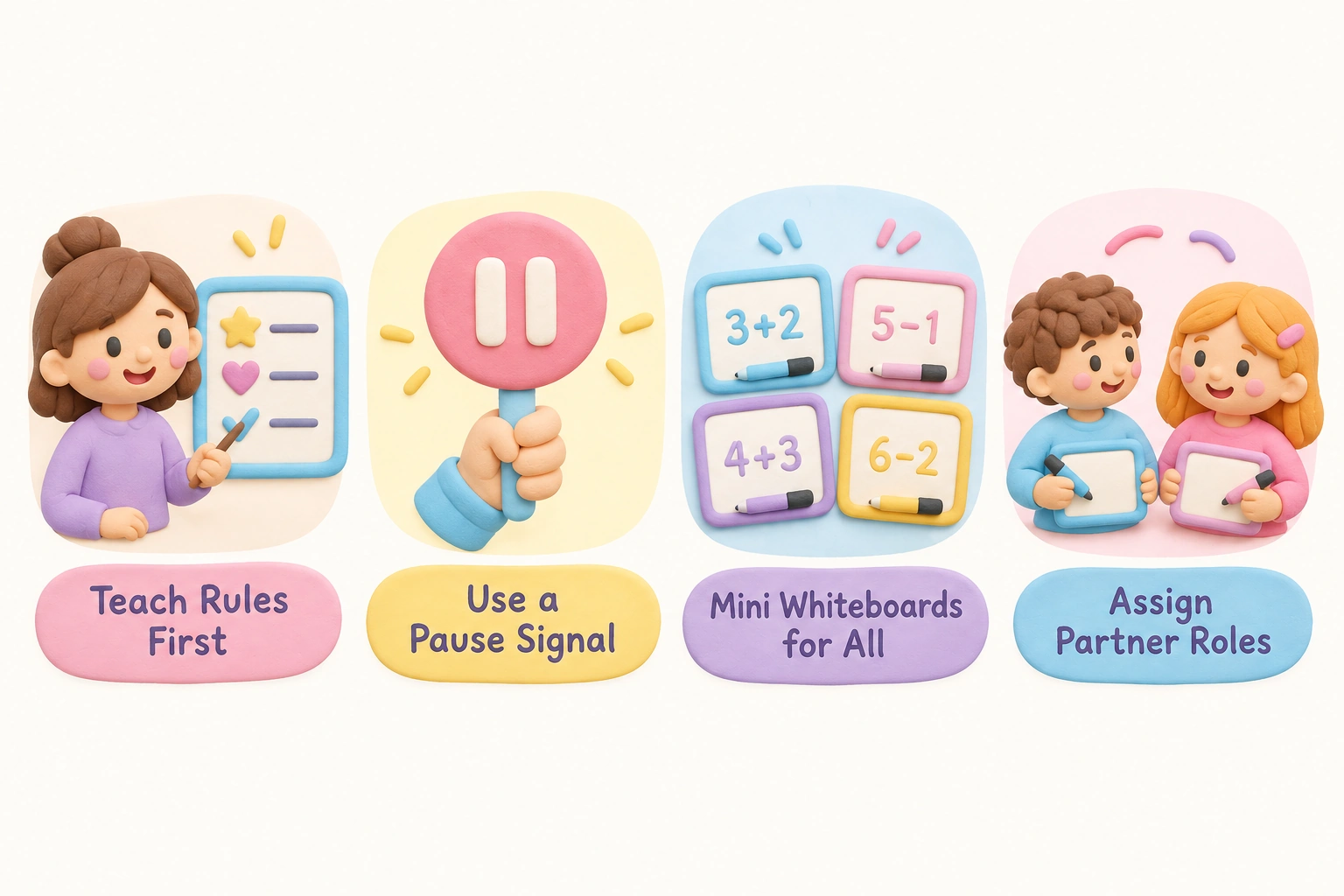
Noise is a natural part of game-based learning and is generally a sign of engagement rather than a management problem. Setting a clear expectation — “partner voices only” or “team voices only” — before the game begins is usually sufficient. If noise becomes disruptive, a brief pause and reset is more effective than stopping the game entirely, which can deflate student motivation.
Frequently Asked Questions
What math games require absolutely no materials?
Buzz, Around the World, and a verbal version of Dice Race (where students call out imaginary dice rolls) all require zero materials. These are ideal for unexpected gaps in the schedule, outdoor learning, or any situation where classroom supplies are unavailable.
How do I manage noise during math games?
Establish a noise-level expectation before the game begins — “partner voices” for pair games, “team voices” for group games. Use a consistent signal such as a raised hand or a countdown to pause the class when needed. Brief, predictable pauses are more effective than stopping the game entirely.
Can these games be used for test review?
Yes. Math Jeopardy, Trashketball, Math Bingo, and the Math Scavenger Hunt are particularly well-suited to end-of-unit or pre-test review because they can cover a wide range of math concepts in a single session. Math War and Dice Race are better suited to fluency practice than broad concept review.
Which games work best for middle school students?
Trashketball, Math Jeopardy, the Escape Room Challenge, and a more complex version of Math Scavenger Hunt are all well-received by grades 6–8 students. These formats allow for problem-solving and critical thinking at a level that feels age-appropriate rather than elementary.
How long should a math game session last?
Five to ten minutes works well for warm-up games like Buzz, Around the World, and Sum Swat. Partner and small-group games used in math centers typically run 15–20 minutes. Review games like Math Jeopardy or the Escape Room Challenge can fill a full 30–45 minute period. Matching the game length to the available time prevents rushed endings that can frustrate students.
How can I differentiate instruction within the same game?
Most games on this list can be differentiated by changing the numbers used, the operation required, or the complexity of the problems. For example, in Math War, younger or struggling students use cards 1–5 with addition, while advanced students use the full deck with multiplication. In Math Bingo, two card sets at different difficulty levels can run simultaneously in the same whole-class game.
Choosing the Right Math Games for Your Classroom
The twelve games in this article cover the full range of classroom contexts — from a two-minute math warm-up to a forty-minute end-of-unit review game — and span grade levels from kindergarten through middle school. No single game will suit every class or every lesson, but building a small repertoire of three to five games that your students know well is more effective than introducing a new game every week. Familiarity with the rules allows students to focus their cognitive energy on the math rather than the mechanics of the game.
If you are new to game-based learning, start with the zero-prep options: Math War, Buzz, and Around the World require nothing beyond what is already in your classroom and can be introduced in under five minutes. Once students are comfortable with those formats, gradually introduce games with slightly more structure, such as Math Bingo or Trashketball. Over time, the investment in teaching game routines pays dividends in student engagement, math fact fluency, and — perhaps most importantly — a classroom culture where students associate mathematics with curiosity and enjoyment rather than anxiety.

Take a short quiz to find out what your everyday choices say about your parenting style
When your child is curious about something new, what’s your instinct?
Take a short quiz to find out what your everyday choices say about your parenting style
“Can I download this app?” What happens next?
Take a short quiz to find out what your everyday choices say about your parenting style
When it comes to rules at home, which sounds most like you?
Take a short quiz to find out what your everyday choices say about your parenting style
If you could give your child one life skill today, what would you pick?
Take a short quiz to find out what your everyday choices say about your parenting style
Your child gets to choose what to watch. What would your ideal setup look like?
Take a short quiz to find out what your everyday choices say about your parenting style
Pick your parenting superpower ✨