Parts of a Sentence for Kids: Simple Guide with Examples and Activities

 Discover a Free Education Video App for Kids
Pastory uses AI to personalize educational video content based on your child’s interests and personality. Safe, engaging, and built for curious young minds. Sign up now to stay updated and enjoy early access with a free trial
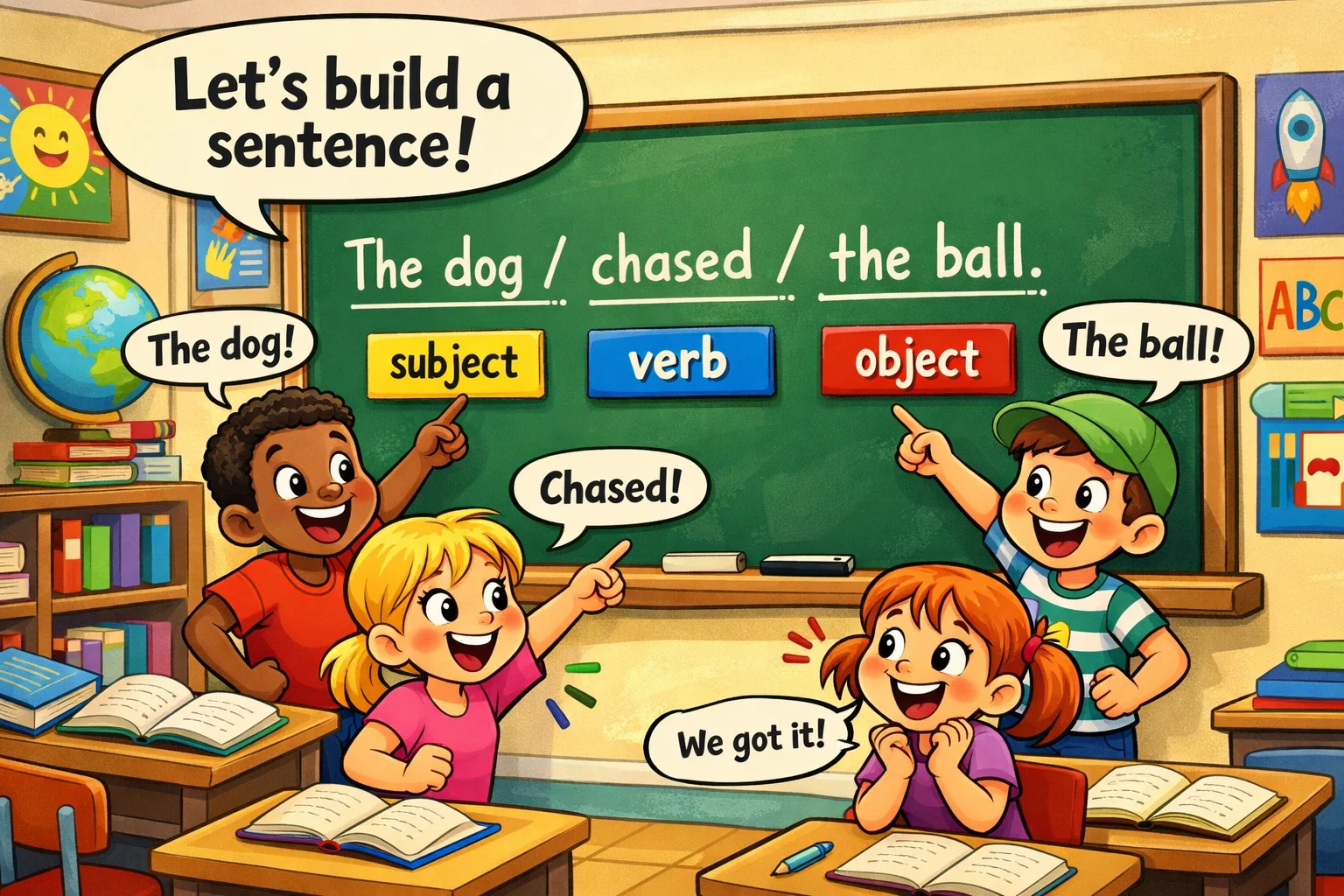
Learning how sentences work is one of the most important steps in a child’s literacy journey. This guide walks parents and teachers through everything from the basic building blocks of a sentence to fun, hands-on activities that make grammar genuinely enjoyable. You’ll find clear explanations of subjects, predicates, phrases, clauses, and sentence structure, along with a step-by-step guide and practical teaching strategies.
Simple Sentence Definition for Kids
A sentence is a group of words that works together to express a complete thought. Every sentence starts with a capital letter and ends with a punctuation mark — a full stop, a question mark, or an exclamation mark. For example, “The dog runs fast” is a complete statement because it tells us who (the dog) and what happens (runs fast).
They are the basic building blocks of all written and spoken communication. When kids understand what makes a sentence complete, they gain a foundational skill that supports everything from reading comprehension to creative writing.
Sentence vs. Sentence Fragment
A sentence fragment is an incomplete thought — it’s missing either a subject, a predicate, or both. Understanding the difference helps students identify errors in their own writing.
| Complete Sentence | Sentence Fragment |
| The cat sat on the mat. | Sat on the mat. |
| Maya loves painting. | Loves painting. |
| Birds sing in the morning. | In the morning. |
The fragment “Sat on the mat” leaves the reader asking: who sat? A complete phrase always answers that question.
Four Types of Sentences
Sentences do different jobs depending on what a writer or speaker wants to communicate.
| Type | Purpose | Example |
| Declarative | Makes a statement | The sun rises in the east. |
| Interrogative | Asks a question | Where is my backpack? |
| Imperative | Gives a command | Please close the door. |
| Exclamatory | Expresses strong feeling | What a wonderful surprise! |
Basic Parts of a Sentence
Before exploring advanced constructions, children need a clear understanding of the two core components every phrase contains: a subject and a predicate. These two parts work together to create meaning.
Subject Explained
The subject is who or what a statement is about. It is usually a noun or pronoun — a person, place, animal, or thing. In the phrase “The little girl laughed,” the subject is the little girl. In “Birds fly south in winter,” the subject is birds.
A helpful tip for students: ask “Who or what is this sentence about?” The answer is almost always the subject.
Predicate Explained
The predicate tells us what the subject does or is. It always contains a verb — an action word or a linking word. In “The little girl laughed,” the predicate is laughed. In “The sky looks cloudy today,” the predicate is looks cloudy today.
The simple predicate is the main verb on its own, while the complete predicate includes the verb and all the words connected to it.
Subject and Predicate Together
When a subject and predicate are joined, they form a complete phrase that expresses a complete thought. Think of the subject as the “who” and the predicate as the “what happens.”
- Subject + Predicate: Tom / kicked the ball.
- Subject + Predicate: The old house / stood at the end of the lane.
- Subject + Predicate: She / smiled and waved.
Step-by-Step Guide to Identifying Sentence Parts
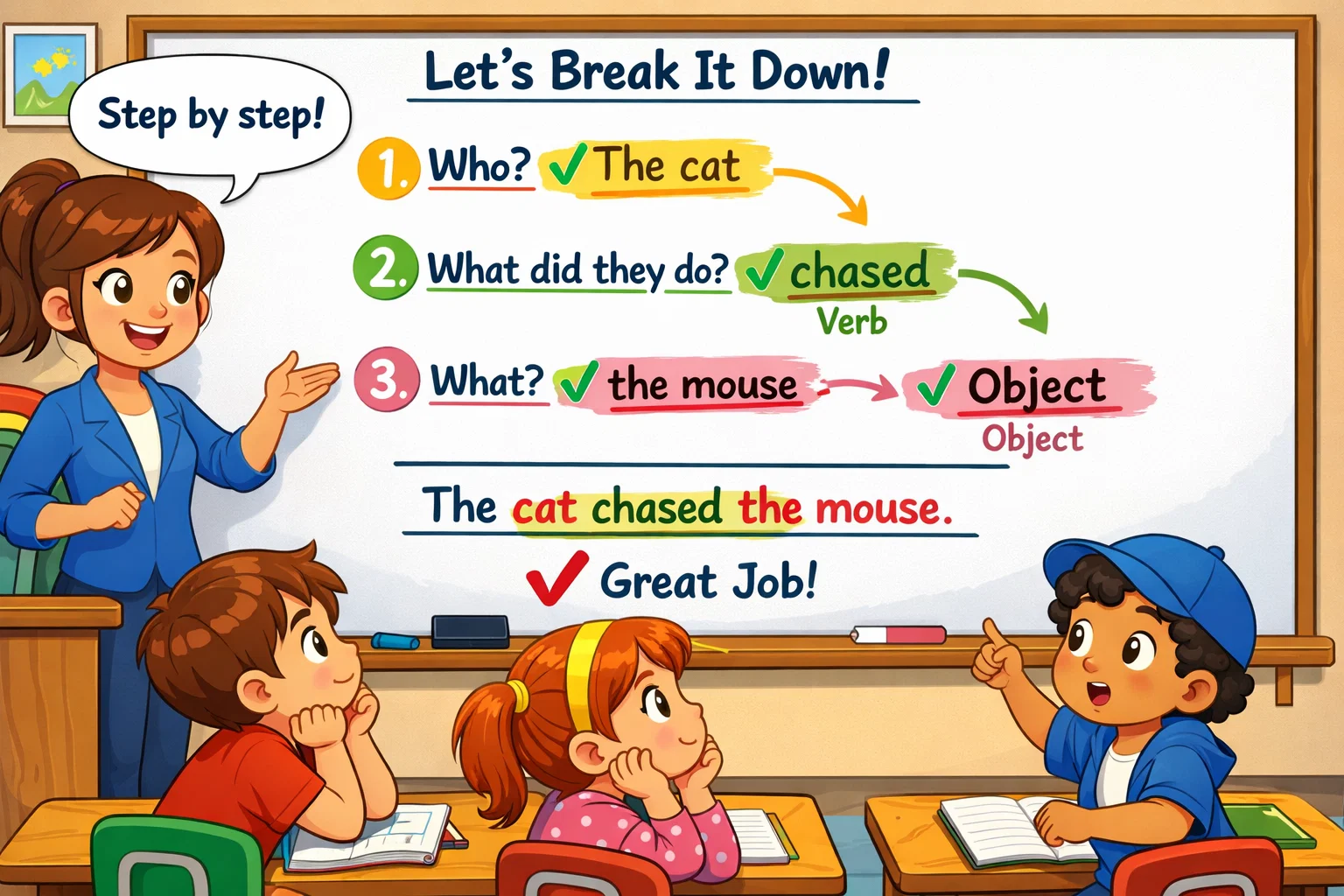
This step-by-step guide helps students identify the different parts of a sentence in a logical, manageable way. Working through each step gives learners a reliable method they can apply to any phrase they read or write.
Step 1: Find the Subject and Predicate
Start by asking two questions: “Who or what is this sentence about?” (subject) and “What does the subject do or what happens?” (predicate). In the phrase “The children played in the park,” the children is the subject and played in the park is the predicate.
Encourage students to underline the subject once and the predicate twice. This visual habit helps them see the two core parts of every complete statement.
Step 2: Add Complements
A complement is a word or group of words that completes the meaning of the predicate. The most common complements are:
- Direct object — receives the action of the verb (“She kicked the ball.”)
- Indirect object — shows to whom or for whom the action is done (“He gave his sister a gift.”)
- Subject complement — describes or renames the subject after a linking verb (“The soup smells delicious.”)
Step 3: Identify Phrases
A phrase is a group of words that adds information to a statement but does not contain both a subject and a verb. Prepositional phrases are especially common: “under the table,” “beside the river,” “after school.” These add additional information about time, place, or manner.
Ask students: “Does this group of words have its own subject and verb?” If not, it’s a phrase.
Step 4: Spot Direct Address Words
Sometimes a sentence includes a name used to address someone directly — this is called a vocative or direct address. It is separated from the rest of the phrase by a comma. Examples include “Mom, can I go outside?” and “Listen carefully, class.” These words are not part of the subject or predicate — they simply identify who is being spoken to.
Phrases and Clauses
Understanding the difference between phrases and clauses is an important step in developing more sophisticated sentence writing skills. Both are groups of words, but they work very differently.
What Is a Phrase?
A phrase is a group of words that functions as a single unit but does not contain both a subject and a verb. Phrases add detail and color to a phrase. Common types include noun phrases (“the big red bus”), verb phrases (“had been running”), and prepositional phrases (“on top of the hill”).
What Is a Clause?
A clause is a group of words that contains both a subject and a verb. A main clause (also called an independent clause) expresses a complete thought and can stand alone as a sentence. A subordinate clause (dependent clause) contains a subject and verb but relies on the main clause to make full sense — for example, “because it was raining.”
Difference Between Phrase and Clause
| Feature | Phrase | Clause |
| Contains a subject? | No | Yes |
| Contains a verb? | Not always | Yes |
| Expresses complete thought? | No | Main clause: yes / Subordinate: no |
| Example | “in the morning” | “when the bell rang” |
Different Sentence Structures for Kids
As children grow as writers, they learn to vary their sentence structure to make their writing more interesting and precise. There are several key patterns to introduce gradually.
Simple Sentences
A simple sentence contains one independent clause — one subject and one predicate. It expresses one complete idea. For example: “The dog barked.” Simple statements are clear and direct, making them a great starting point for young writers.
Compound Sentences
A compound sentence joins two independent clauses using a coordinating conjunction such as and, but, so, or or. The two main clauses are equal in importance. Example: “I wanted to go outside, but it was raining.” Compound statements help children connect related ideas smoothly.
Complex Sentences
A complex sentence contains one main clause and at least one subordinate clause, joined by a subordinating conjunction such as because, although, when, or if. Example: “She practiced every day because she wanted to improve.” Complex statements allow children to show cause-and-effect and other relationships between ideas.
Four Core Patterns
| Pattern | Structure | Example |
| Subject–Verb | S + V | Birds fly. |
| Subject–Verb–Object | S + V + O | Sam ate the apple. |
| Subject–Verb–Complement | S + V + C | She is a teacher. |
| Subject–Verb–Indirect Object–Direct Object | S + V + IO + DO | He gave his friend a book. |
How to Teach Parts of a Sentence to Kids
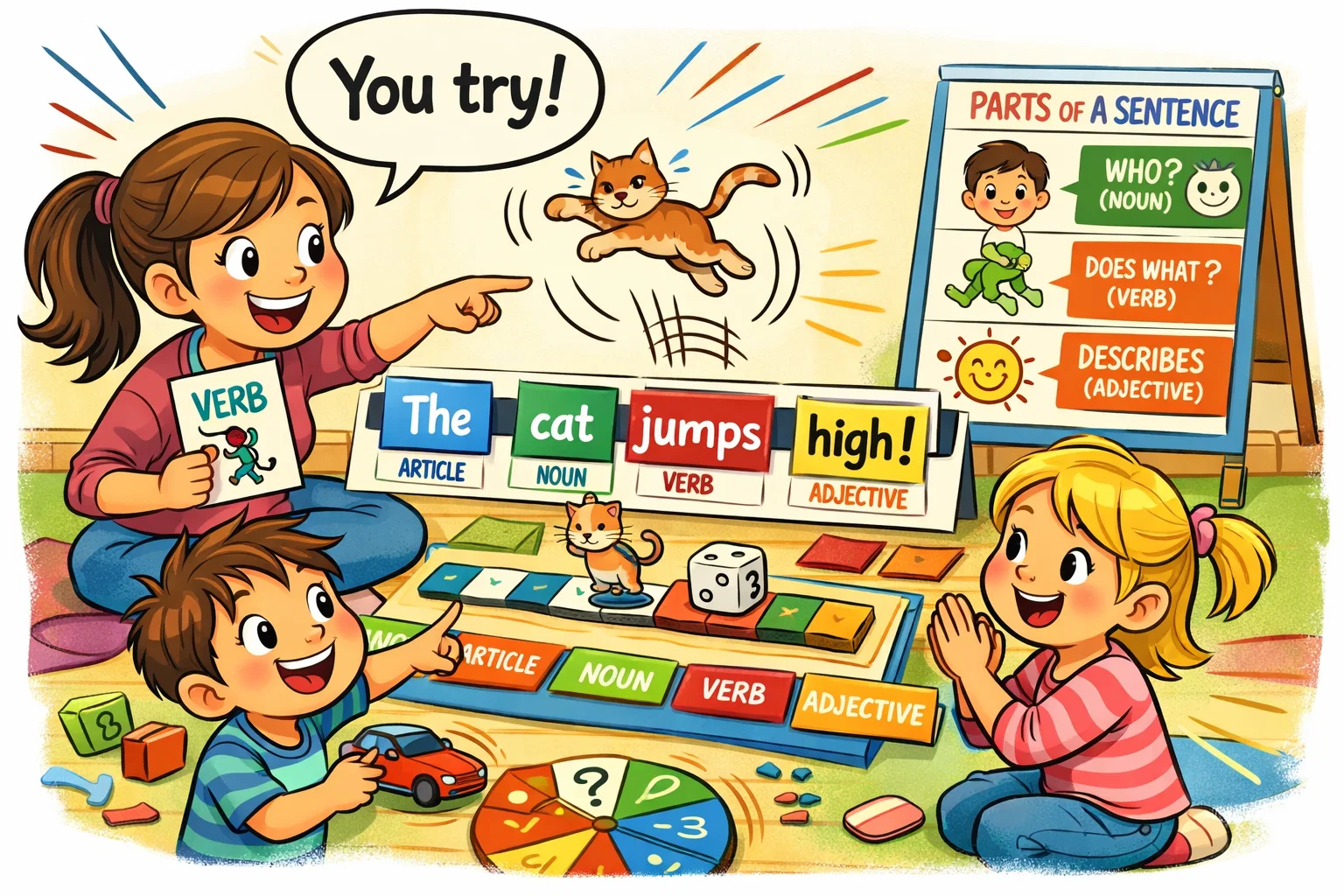
Effective grammar teaching starts with clear, concrete instruction and builds gradually toward more abstract concepts. These strategies work well for both classroom teachers and parents supporting learning at home.
Start with Parts of Speech
Before introducing sentence structure, help students identify individual word types: nouns, verbs, adjectives, and adverbs. Understanding that a noun names a thing and a verb shows action gives children the vocabulary they need to discuss sentences meaningfully. Start with simple, one-syllable examples before moving to longer words.
Use Sentence Expansion Techniques
Begin with a bare-bones phrase like “The dog ran” and ask students to add information: Where did the dog run? What kind of dog? How did it run? This technique, sometimes called “sentence stretching,” helps students see how a phrase can grow while still maintaining a subject and predicate at its core.
Practice with Writing Frames
Writing frames are structured templates that guide children through sentence construction. For example: “____ [subject] ____ [verb] ____ [where/when].” Use these worksheets regularly to build confidence before moving to open-ended writing tasks. Writing frames are especially helpful for students who find blank-page writing overwhelming.
Build Vocabulary Gradually
A wide vocabulary gives children more options when constructing phrases. Introduce new nouns, action verbs, adjectives, and adverbs regularly, and encourage students to use them in their own sentences. Word walls, vocabulary journals, and word-of-the-day routines all support this process steadily over time.
Fun Activities to Practice Sentence Parts
Hands-on, playful activities are among the most effective ways to help students understand grammar. The following activities are ready-to-use and easy to adapt for different ages and ability levels.
Sentence Building Games
Write individual words on cards and ask children to arrange them into a complete phrase. You can also include “silly” combinations to spark laughter and discussion — “The elephant baked a cake” still has a subject and predicate! This activity helps students identify how word order affects meaning.
Fill in the Missing Parts
Create worksheets where sentences are missing their subject or predicate, and students fill in the gap. For example: “____ ran across the playground” or “The cat ____.” This format directly targets the core parts of a phrase in a focused, low-pressure way.
Color Coding Sentence Parts
Ask students to use different colors to highlight different elements:
- Red for the subject
- Blue for the predicate/verb
- Green for objects or complements
- Yellow for phrases
Color coding makes grammar visual and memorable, helping students identify patterns across many different phrases quickly.
Speaking and Listening Activities
Oral grammar practice is just as valuable as written work. Try these:
- Ask a child to say a complete sentence aloud, then identify the subject and predicate together
- Play “sentence relay” — one child says a subject, another adds a predicate
- Read sentences aloud and clap when the verb is heard
Common Mistakes Kids Make with Sentences
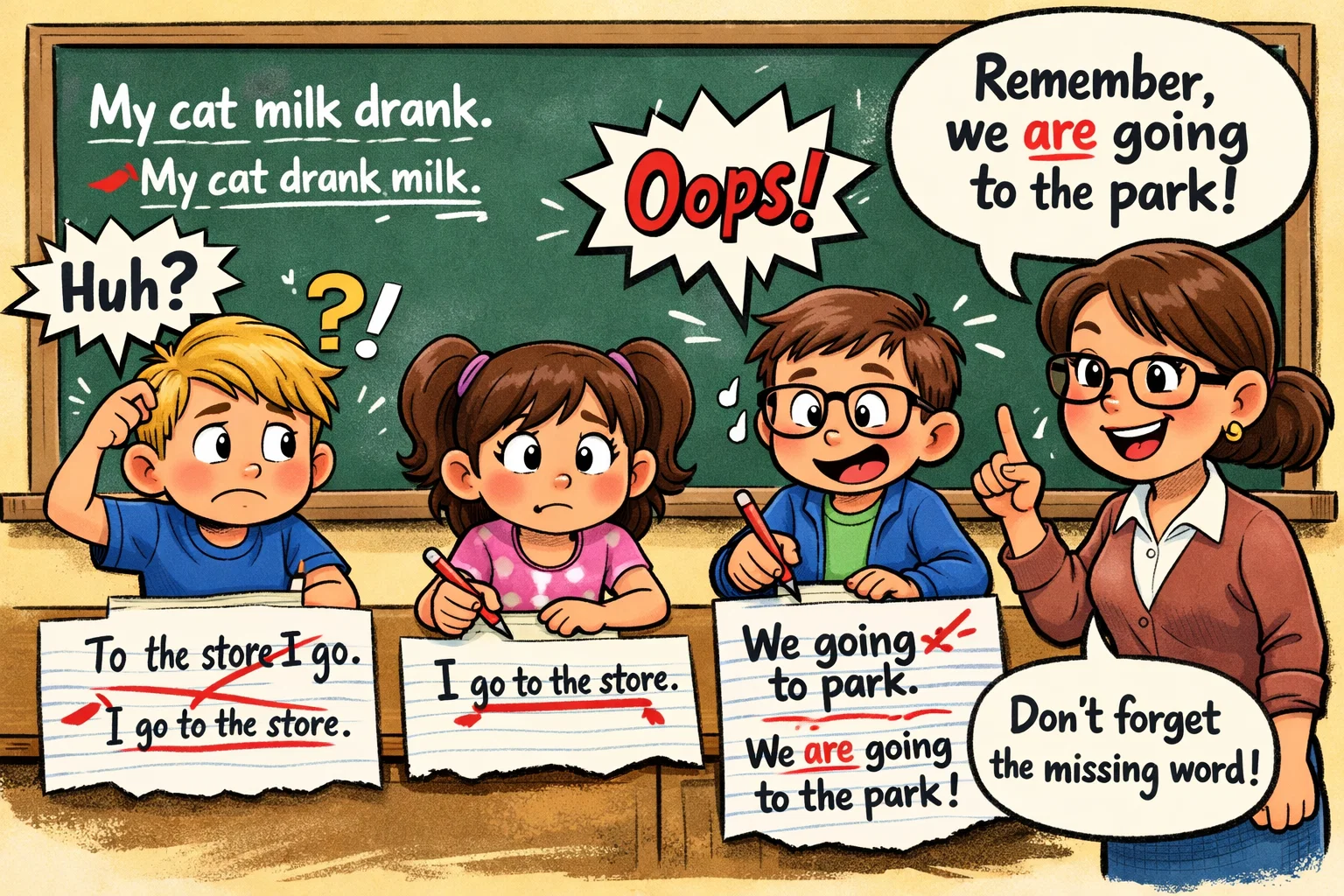
Understanding common errors helps parents and teachers provide targeted support. These grammatical mistakes are typical in early writers and can be corrected gently with practice.
Missing Subject or Predicate
The most frequent error is writing a sentence fragment — a group of words that is missing a subject, a predicate, or both. “Running down the street” and “The big, fluffy cat” are both fragments because neither expresses a complete thought. Teaching children to ask “Who does this? What happens?” helps them self-check.
Run-On Sentences
A run-on sentence occurs when two or more independent clauses are joined without proper punctuation or conjunctions. For example: “I went to the park it was fun we played football.” The fix is simple — teach children to use a full stop, a comma with a conjunction, or a semicolon to separate ideas.
Confusing Phrases and Clauses
Many students assume that any group of words with a verb is a clause. However, a phrase may contain a verb form (like “running fast”) without having a proper subject. Reinforce the rule: a clause needs both a subject and a verb to count as one.
Simple Summary of Sentence Parts
Here is a quick recap of the key concepts covered in this guide:
- Subject — who or what the phrase is about (usually a noun)
- Predicate — what the subject does or is (always contains a verb)
- Complement — a word or phrase that completes the predicate’s meaning (direct object, indirect object, subject complement)
- Phrase — a group of words without a complete subject-verb pair
- Clause — a group of words with both a subject and a verb; can be main or subordinate
- Simple structure — one main clause
- Compound structure — two main clauses joined by a coordinating conjunction
- Complex structure — a main clause and a subordinate clause joined by a subordinating conjunction
Understanding parts of a sentence gives children the tools to express their ideas with clarity and confidence. When parents and teachers introduce these concepts step by step — starting with subjects and predicates, then expanding into clauses and sentence patterns — children build a grammar foundation that supports their writing and reading for years to come. Keep lessons short, keep them varied, and celebrate every step of progress along the way.
Frequently Asked Questions
How to explain sentence parts in simple words?
A sentence has two main jobs: to name something (the subject) and to say something about it (the predicate). Think of it like a news headline — “Dog bites man” names who and says what happened. Every complete phrase does exactly that.
How to teach sentence structure to struggling learners?
For students who find sentence construction difficult, return to concrete, physical materials. Use word cards they can move around, speak phrases aloud before writing them, and use simple writing frames. Reduce the complexity of vocabulary so the focus stays on structure, not spelling. Consistent, short daily practice tends to produce better results than occasional long sessions.
How to check if a child understands sentence parts?
Use a mix of assessment methods:
- Ask the child to underline the subject and circle the verb in a written statement
- Read a statement aloud and ask them to identify who it is about
- Give them a sentence fragment and ask: “Is this a complete sentence? What’s missing?”
- Use short quizzes with a mix of complete statements and fragments to sort
How can kids practice building correct sentences?
Kids can practice by reading simple texts, playing word games, and writing short ideas every day. Activities like rearranging mixed-up words or completing missing parts are also helpful. Regular practice makes it easier to form clear and correct ideas.
How can kids spot mistakes in their writing?
Kids can read their writing out loud to hear if something sounds wrong or confusing. Checking for missing words or unclear ideas also helps improve clarity. Practice and feedback from adults make it easier to notice and fix errors.

Take a short quiz to find out what your everyday choices say about your parenting style
When your child is curious about something new, what’s your instinct?
Take a short quiz to find out what your everyday choices say about your parenting style
“Can I download this app?” What happens next?
Take a short quiz to find out what your everyday choices say about your parenting style
When it comes to rules at home, which sounds most like you?
Take a short quiz to find out what your everyday choices say about your parenting style
If you could give your child one life skill today, what would you pick?
Take a short quiz to find out what your everyday choices say about your parenting style
Your child gets to choose what to watch. What would your ideal setup look like?
Take a short quiz to find out what your everyday choices say about your parenting style
Pick your parenting superpower ✨