Mind-Blowing Math Facts: 26 True Mathematical Facts That Feel Impossible

 Discover a Free Education Video App for Kids
Pastory uses AI to personalize educational video content based on your child’s interests and personality. Safe, engaging, and built for curious young minds. Sign up now to stay updated and enjoy early access with a free trial
Mathematics is often perceived as a rigid collection of schoolroom formulas and dusty equations, but the world of mathematics is actually a landscape of infinite wonder, paradoxes, and “glitches in the matrix.” Whether you are looking for amazing math facts to share with friends or seeking to spark a child’s curiosity, the following insights move beyond simple arithmetic into the realm of the truly mind-blowing. In this guide, we explore several domains of mathematics, from numerical curiosities and enormous numbers to probability, infinity, and topology.
Quick Mind Blowing Math Facts
Before diving into complex branches of mathematics like calculus or complex analysis, it is helpful to observe how simple numbers can behave in ways that feel scripted. These fun math facts serve as an immediate entry point into the elegance of the number system, requiring no advanced degree to appreciate.
111,111,111 × 111,111,111 Creates Mirror Pattern
The calculation of 111,111,111² results in a perfect numerical palindrome: 12,345,678,987,654,321.
This mathematical phenomenon occurs because the digit alignment during multiplication builds a symmetrical sum. You can observe similar “mirror” patterns with smaller sequences, such as 11 × 11 = 121 and 111 × 111 = 12,321.
Forty Keeps Letters In Alphabetical Order
The word “Forty” is the only number in the English language whose letters appear in strict alphabetical order (F-O-R-T-Y).
Conversely, the number “One” features letters in exact reverse alphabetical order (O-N-E). This linguistic coincidence highlights how even our naming conventions for mathematical entities occasionally follow a hidden, non-mathematical logic.
Word Four Has Four Letters
The word “four” is the only English number name whose number of letters matches the value it represents. It is a neat linguistic curiosity that many children notice when they first learn to count.
Twelve Plus One Rearranges Into Eleven Plus Two
The phrase “twelve plus one” is a perfect anagram of “eleven plus two,” and both phrases contain 13 letters. Beyond the literal sum being 13, the exact rearrangement of letters demonstrates a rare symmetry between language and algebraic values.
Number Tricks That Look Fake
Some mathematical facts seem like magic tricks, but they follow straightforward rules from arithmetic and algebra. These examples allow anyone to use math to produce results that feel rigged, even though they are universal constants in mathematics.
Kaprekar’s Constant Pulls Four-Digit Numbers Toward 6174
The Kaprekar Constant, or 6174, acts as a numerical “black hole” for any four-digit number (provided not all digits are the same).
- Choose any 4-digit number (e.g., 1234).
- Arrange digits in descending (4321) and ascending (1234) order.
- Subtract the smaller from the larger (4321 – 1234 = 3087).
- Repeat the process with the result.
Within at most seven iterations, you will always reach 6174, which then cycles back to itself (7641 – 1467 = 6174).
10! Seconds Equals Six Weeks
The factorial of 10, written as 10! (10 × 9 × 8 × … × 1), is exactly equal to the number of seconds in 42 days, or six weeks.
While 10! equals 3,628,800, the product of 60 (sec) × 60 (min) × 24 (hours) × 7 (days) × 6 (weeks) yields the same value. This fact connects a seemingly abstract factorial to a familiar unit of human time.
Pizza Volume Joke Still Uses Real Formula
If you approximate a pizza as a cylinder with radius z and height a, its volume is πz²a – spelled “pizza.”
The volume of a cylinder is defined by the equation V = πr²h. By substituting z for r and a for h, the mathematical result becomes “pizza.” While used as a joke, it correctly applies the geometry of two-dimensional circles extended into three dimensions.
First Seven Prime Squares Sum To 666
The sum of the squares of the first seven prime numbers (2² + 3² + 5² + 7² + 11² + 13² + 17²) is 666.
A prime number is a natural number greater than 1 that has no positive divisor other than 1 and itself. The fact that the first seven of these fundamental building blocks sum to such a culturally significant number is a statistical coincidence that often surprises students.
Fractions Of Seven Repeat Same Digits In Shifted Order
When you write the fractions of sevenths as decimals, a striking rotating pattern appears in the digits.
| Fraction | Decimal Result (Repeating) |
| 1/7 | 0.142857… |
| 2/7 | 0.285714… |
| 3/7 | 0.428571… |
The sequence 142857 always remains intact; it simply changes its starting digit based on the numerator, making these fractions appear “alive” or cyclical.
Probability And Combinatorics That Break Intuition
Probability is one of the branches of mathematics that most frequently contradicts human “gut feeling.” Because our brains are wired for linear progression, we struggle to grasp exponential possibilities or the likelihood of rare matches.
Birthday Match Happens With 23 People
In a room of just 23 people, there is about a 50.7% chance that at least two people share a birthday, assuming birthdays are uniformly distributed and leap days are ignored.
This interesting maths fact is known as the Birthday Paradox. It feels wrong because we think about our own birthday, but math accounts for every possible pair in the room. With 23 people, there are 253 possible pairs to check, which quickly drives the probability upward.
52 Cards Create Near-Infinite Possibilities
The number of ways to arrange a standard deck of 52 playing cards is 52!, a finite number so large it defies description.
52! is approximately 8.06 × 10⁶⁷. For context, if you were to rearrange a deck every second since the Big Bang, you wouldn’t have made even a fraction of a percent of progress toward seeing every combination.
Proper Card Shuffle Likely Creates Never-Seen Order
Whenever you thoroughly shuffle a deck of cards, you are likely holding a sequence of cards that has never existed in the history of the universe.
Given that 52! is vastly larger than the total number of atoms on Earth, the statistical probability of two random shuffles matching is effectively zero. Every “fair” shuffle is a unique mathematical event.
Rubik’s Cube Holds Astronomical Count
A standard 3×3 Rubik’s Cube has 43,252,003,274,489,856,000 possible permutations.
Despite this enormous complexity, any configuration can be solved in 20 moves or fewer. This shows that even a huge search space can have a surprisingly short optimal solution.
5040 Has 60 Divisors
The number 5040 is a “highly composite number,” meaning it has more divisor options than any number smaller than it.
Plato singled out 5040 because it is divisible by every whole number from 1 to 12 except 11, which made it useful for dividing citizens, land, and administrative units.
X% Of Y Equals Y% Of X
This is a cool fact that makes mental math effortless: Percentages are reversible.
For example, if you need to find 8% of 50, it might be hard to calculate. But 50% of 8 is simply 4. Therefore, 8% of 50 is also 4. This algebraic property (a/100 × b = b/100 × a) is a “life hack” that blows your mind when you realize how much time it saves.
Infinity And Equality That Trigger Debate
Some mathematical constants and proofs are so counterintuitive they lead to heated debates, even though they are settled theorems in the world of mathematics.
0.999… Equals 1
In mathematical terms, the repeating decimal 0.999… is exactly equal to 1; there is no “infinitesimal” gap between them.
A simple proof: If x = 0.999…, then 10x = 9.999…. Subtracting the first equation from the second gives 9x = 9, which means x = 1. This proves that in our number system, some values can be represented in more than one way.
Fibonacci Sequence Hides Inside 1/89
The reciprocal 1/89 is linked to the Fibonacci sequence through a generating-function identity. In base 10, 1/89 = 0.011235955…, and the early digits reflect Fibonacci numbers placed at increasing decimal positions, with carrying appearing later. It is a beautiful equation that links division to one of nature’s most famous patterns.
1 + 2 + 3 + 4 + … Connects To -1/12
In a very specific, advanced context (Ramanujan Summation), the sum of all natural numbers is associated with the value -1/12.
While this is not a “sum” in the traditional sense you would use in a grocery store, this result is used in calculus and string theory. It warns us that mathematics can behave differently when we move from finite sets to infinite series.
Numbers That Outrun Imagination
As we move toward the edge of mathematical research, we encounter numbers so large that the physical universe cannot even contain their digits. These mind-blowing values push the limits of what a mathematician can even conceptualize.
Dedekind Numbers Grow At Double Exponential Speed
Dedekind numbers arise in logic and the study of monotone Boolean functions, and they grow extremely quickly. The ninth Dedekind number was computed in 2023, and it has 42 digits. The jump from the 8th to the 9th number required supercomputers and months of processing, illustrating how some mathematical sequences “outrun” our current hardware.
TREE(3) Leaves Huge Numbers Behind
TREE(3) is a number that arises from a problem in graph theory. It is so large that it makes “googolplex” look like zero.
TREE(3) is so large that ordinary benchmarks such as a googol or even a googolplex are nowhere near it. The point of the example is not literal physical storage, but how quickly some finite mathematical quantities outgrow our intuition. It is a finite number, but one that exists purely in the mathematical ether.
Patterns Hidden In Nature And Data
Math isn’t just on paper; it is the “source code” for the natural world. From geometric patterns to prime numbers, the universe appears to be built on these mathematical constants.
Random Data Prefers Digit 1
Benford’s Law suggests that in many real-life sets of numerical data, the number 1 appears as the leading digit about 30% of the time.
This pattern appears in many naturally occurring datasets. Auditors and investigators sometimes use Benford’s Law as a screening tool for anomalies, but deviations from it are not proof of fraud on their own.
Prime Numbers Form Spirals
When prime numbers are plotted in an Ulam spiral, they form striking diagonal patterns rather than a literal spiral made of primes.
This geometric phenomenon suggests a deep, underlying structure to primes that we still don’t fully understand. Even the most “chaotic” numbers in mathematics seem to crave order.
Fibonacci Sequence Appears In Nature
Fibonacci numbers often appear in plant patterns such as sunflower heads and pinecones.
These arrangements are often modeled as efficient packing patterns that can help with space use and light exposure. It is a functional application of mathematical constants that evolved naturally over millions of years.
Geometry And Topology That Feels Impossible
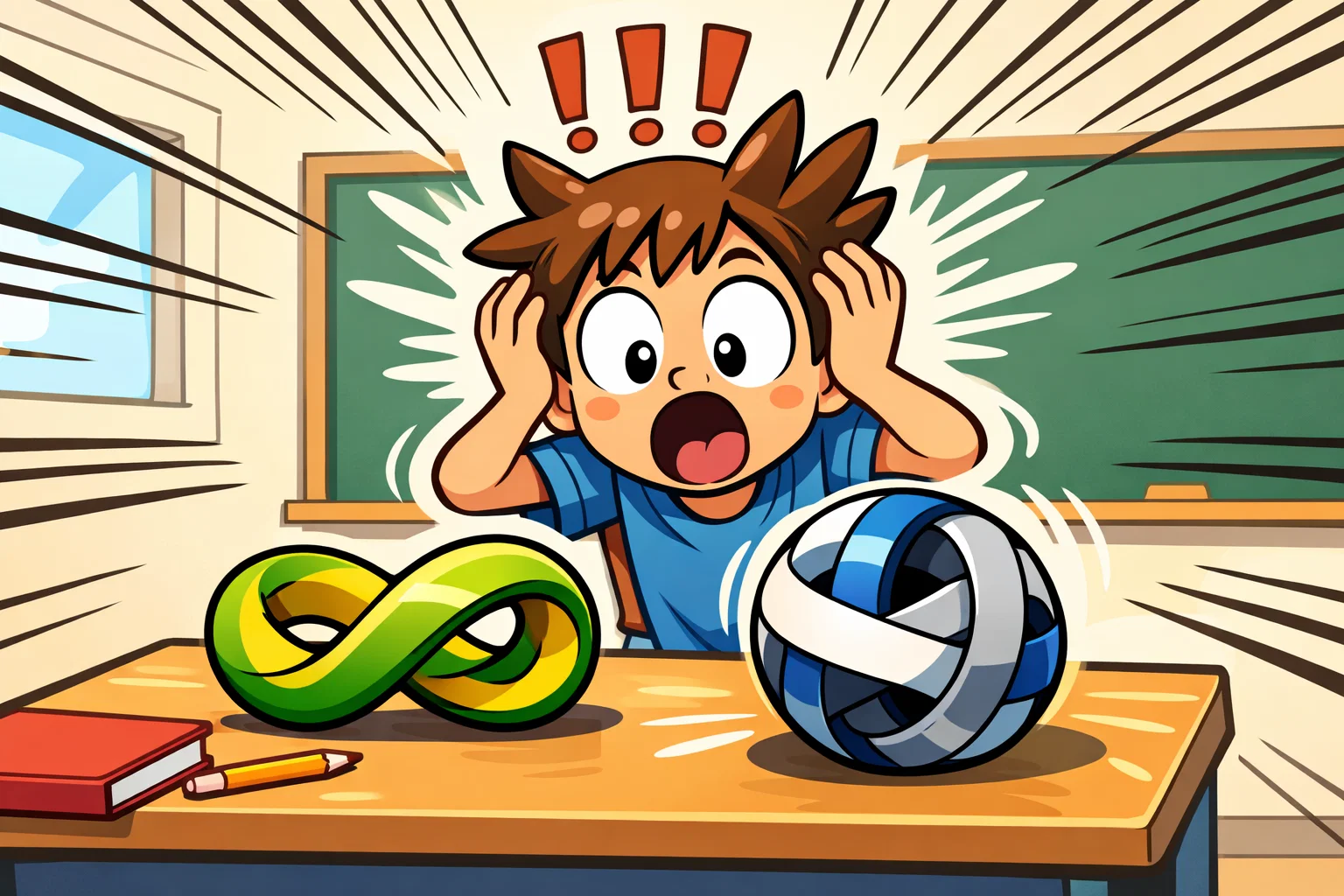
Topology is the study of geometric properties that remain unchanged even when a shape is twisted or stretched. It provides some of the most interesting math facts because it ignores our physical intuition of “solid” objects.
Sphere Can Turn Inside Out
In topology, it is mathematically possible to turn a sphere inside out without tearing or creasing it (Smale’s Paradox).
While a physical ball would rip, mathematical surfaces can pass through themselves. Sphere eversion is a classic result in differential topology and a vivid example of how counterintuitive smooth surfaces can be.
Two Opposite Points Share Same Weather
The Borsuk–Ulam theorem implies that, under standard continuity assumptions, there are at least two antipodal points on Earth with the same temperature and barometric pressure.
Because temperature is a continuous function across a two-dimensional sphere (the Earth), mathematically, there must be “antipodal” points where these values match perfectly.
Banach-Tarski Paradox Turns One Ball Into Two Balls
In abstract set-theoretic geometry, the Banach–Tarski paradox shows that a ball in 3D Euclidean space can be partitioned into finitely many non-ordinary sets and reassembled into two copies of the original.
It relies on the “Axiom of Choice” and only works in abstract mathematical space. In the real world, matter is made of atoms, but in the world of mathematics, space is infinitely divisible, allowing for this “infinite doubling.”
By understanding these mathematical facts, we see that math is not just a tool for calculation, but a language that describes the very fabric of reality – no matter how mind-blowing or “impossible” that reality may seem.
FAQ: Mind Blowing Math Facts
What Are Some Mind Blowing Facts About Mathematics?
Mathematics includes facts like 0.999… = 1, the Birthday Paradox (23 people for a 50% match), and the fact that a proper card shuffle creates a sequence never seen before in human history.
What Is the Most Interesting Mind-Blowing Math Fact for Beginners?
The most accessible fact is often 10! seconds equals exactly 6 weeks. It bridges the gap between scary-looking factorial notation and the everyday way we measure time, making the math feel “real.”
Why Does 0.999... Equal 1?
It equals 1 because there is no finite number you can place between 0.999… and 1. In our number system, any two distinct numbers must have a third number between them. Since nothing fits between 0.999… and 1, they must be the same value.
Why Do 23 People Create 50% Birthday Match Chance?
The probability is high because you aren’t comparing one person to 22 others; you are looking at all possible pairs. With 23 people, there are (23 × 22) / 2 = 253 different pairs. Each pair is a new chance for a match.
What Is a Favorite “Cursed” Math Fact?
A popular “cursed” fact is the Hairy Ball Theorem, which says you cannot comb a hairy sphere flat without leaving at least one cowlick. In an idealized model of Earth’s atmosphere, it implies that there is always at least one point where the horizontal wind speed is zero.
What Math Fact Can Surprise Kids Fast?
Show them the 111,111,111 mirror pattern or the Kaprekar Constant (6174). These are “hands-on” facts where they can use a calculator and see the “magic” happen immediately, which builds confidence and interest in mathematical exploration.

Take a short quiz to find out what your everyday choices say about your parenting style
When your child is curious about something new, what’s your instinct?
Take a short quiz to find out what your everyday choices say about your parenting style
“Can I download this app?” What happens next?
Take a short quiz to find out what your everyday choices say about your parenting style
When it comes to rules at home, which sounds most like you?
Take a short quiz to find out what your everyday choices say about your parenting style
If you could give your child one life skill today, what would you pick?
Take a short quiz to find out what your everyday choices say about your parenting style
Your child gets to choose what to watch. What would your ideal setup look like?
Take a short quiz to find out what your everyday choices say about your parenting style
Pick your parenting superpower ✨