
70 Metaphor and Simile Examples for Kids, with Definitions

 Discover a Free Education Video App for Kids
Pastory uses AI to personalize educational video content based on your child’s interests and personality. Safe, engaging, and built for curious young minds. Sign up now to stay updated and enjoy early access with a free trial
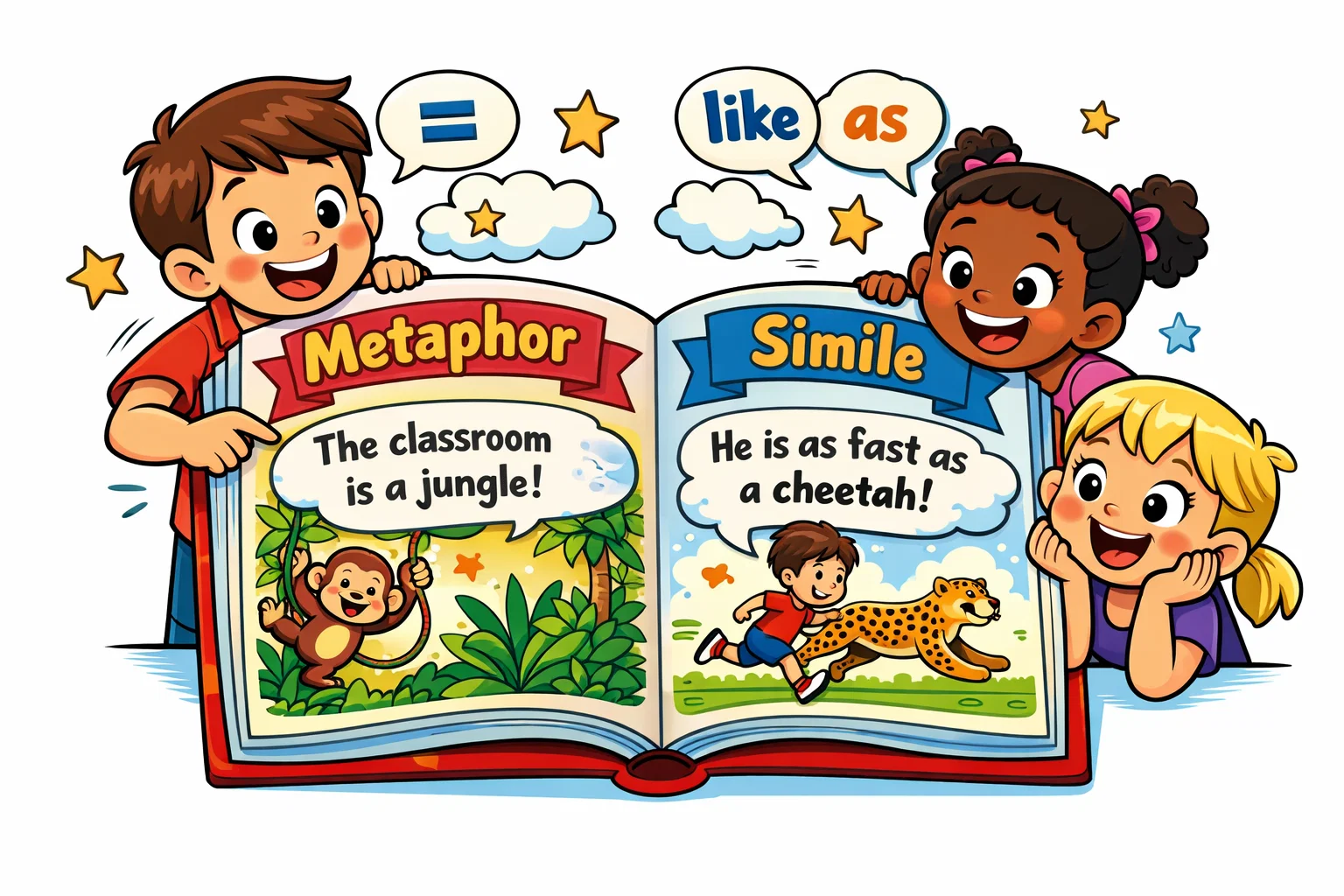
Whether you are a parent looking to boost your child’s creative writing, a teacher planning a literacy unit, or a homeschooler searching for clear English Language Arts (ELA) resources, you have found the ultimate guide. This comprehensive resource helps children master the art of figurative language through simple definitions, engaging activities, and a curated list of examples.
What Is a Metaphor for Kids?
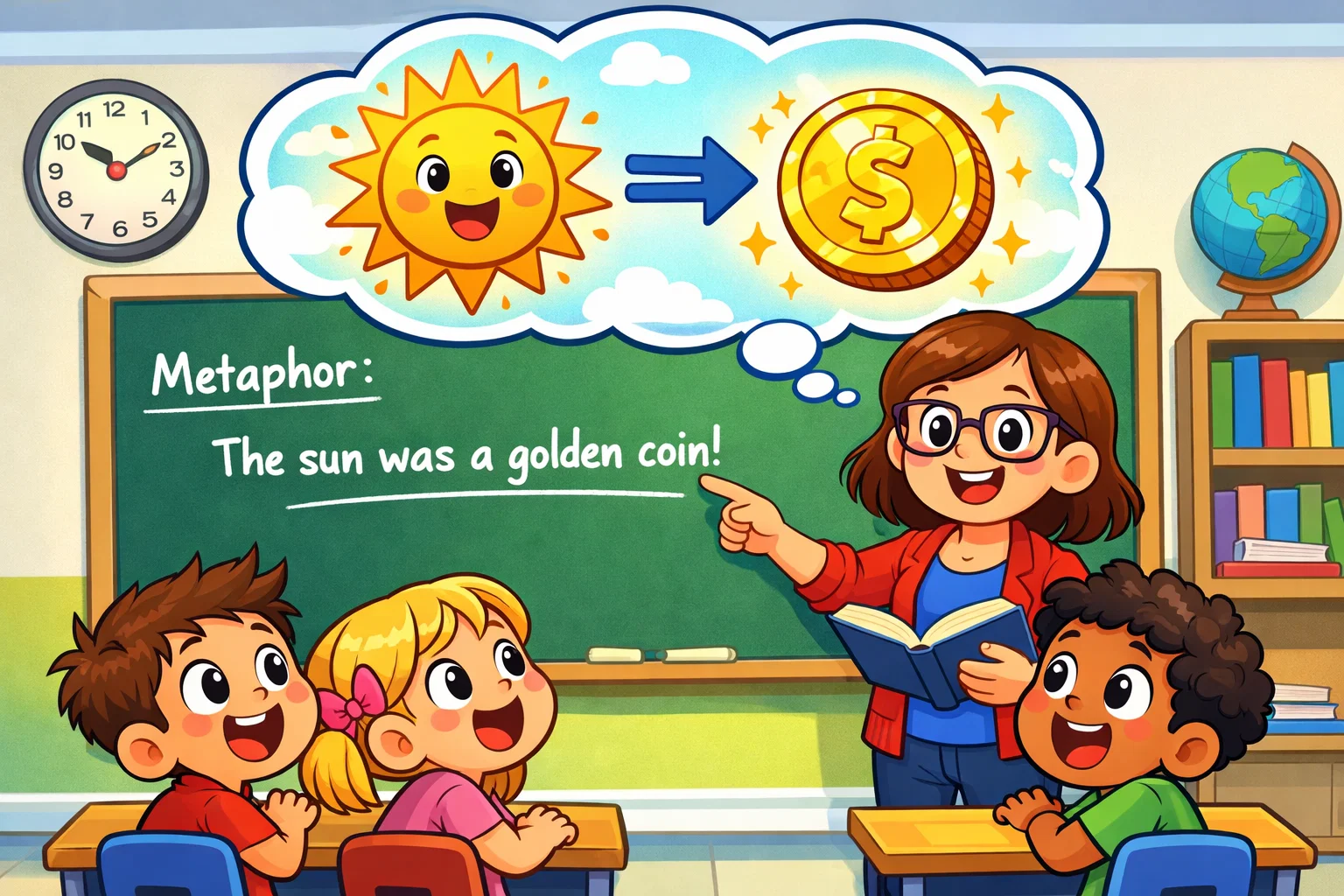
A metaphor is a creative way to describe something by saying it is something else. Instead of using plain words, we use this literary device to paint a vivid picture in the listener’s mind. For example, if a mother says, “My son is a monkey,” she doesn’t mean he has fur and a tail; she means he is excellent at climbing and full of energy. Metaphors help kids make connections between what they know and new ideas they are learning.
Metaphor Definition for Kids
A metaphor is a figure of speech in which one thing is described as another to highlight a shared quality.
- Formula: [Thing 1] + [is/are] + [Thing 2].
- Simple Example: “The snow is a white blanket.” (The snow and the blanket are both soft, white, and cover the ground).
How Metaphor Works in Simple Words
This creative tool works by taking a specific trait from one object and “carrying it over” to another. It ignores the literal meaning (what the words say exactly) and focuses on the figurative meaning – the mental image created.
- The Phrase: “The classroom was a zoo.”
- The Real Meaning: The room was very loud and chaotic.
- The Image in Mind: Students running around like wild animals.
Quick Metaphor Examples Kids Hear Every Day
Children encounter these word pictures in daily conversations without even realizing it. These common phrases help build an early understanding of non-literal language:
- “You are my sunshine”: You make me feel warm and happy.
- “Time is money”: Time is valuable and shouldn’t be wasted.
- “The wind was a howling wolf”: The wind made a loud, scary noise.
- “Life is a roller coaster”: Life has many ups and downs (good and bad times).
What Is a Simile for Kids?
A simile is a figure of speech used to compare two different things and show how they are alike. Unlike a metaphor, which says one thing is another, a simile uses the words ‘like’ or ‘as’ to connect the two ideas. This makes similes very easy for children to spot in books and poems because they follow a specific pattern.
Simile Definition for Kids
A simile is a comparison between two things using the words “like” or “as.” It is used to make a description more interesting or funny.
- Formula: [Thing 1] + [is as ___ as] + [Thing 2] OR [Thing 1] + [is like] + [Thing 2].
- Simple Example: “The water is as clear as glass.”
How Simile Works With Like and As
Similes rely on “signal words” to alert the reader that a comparison is happening. Because these signal words are easy to spot, similes are often easier for children to identify in stories and poems.
- The “Like” Bridge: “His feet are like blocks of ice.” (The feet are very cold).
- The “As” Bridge: “She is as brave as a lion.” (She has a lot of courage).
Quick Simile Examples Kids Hear Every Day
These phrases are common in school and play, making them perfect for initial practice:
- “Quiet as a mouse”: Being very still and making no noise.
- “Sweet as honey”: Someone who is very kind.
- “Slept like a log”: Sleeping very deeply without moving.
- “Strong as an ox”: Having a lot of physical power.
The Difference Between a Metaphor and a Simile
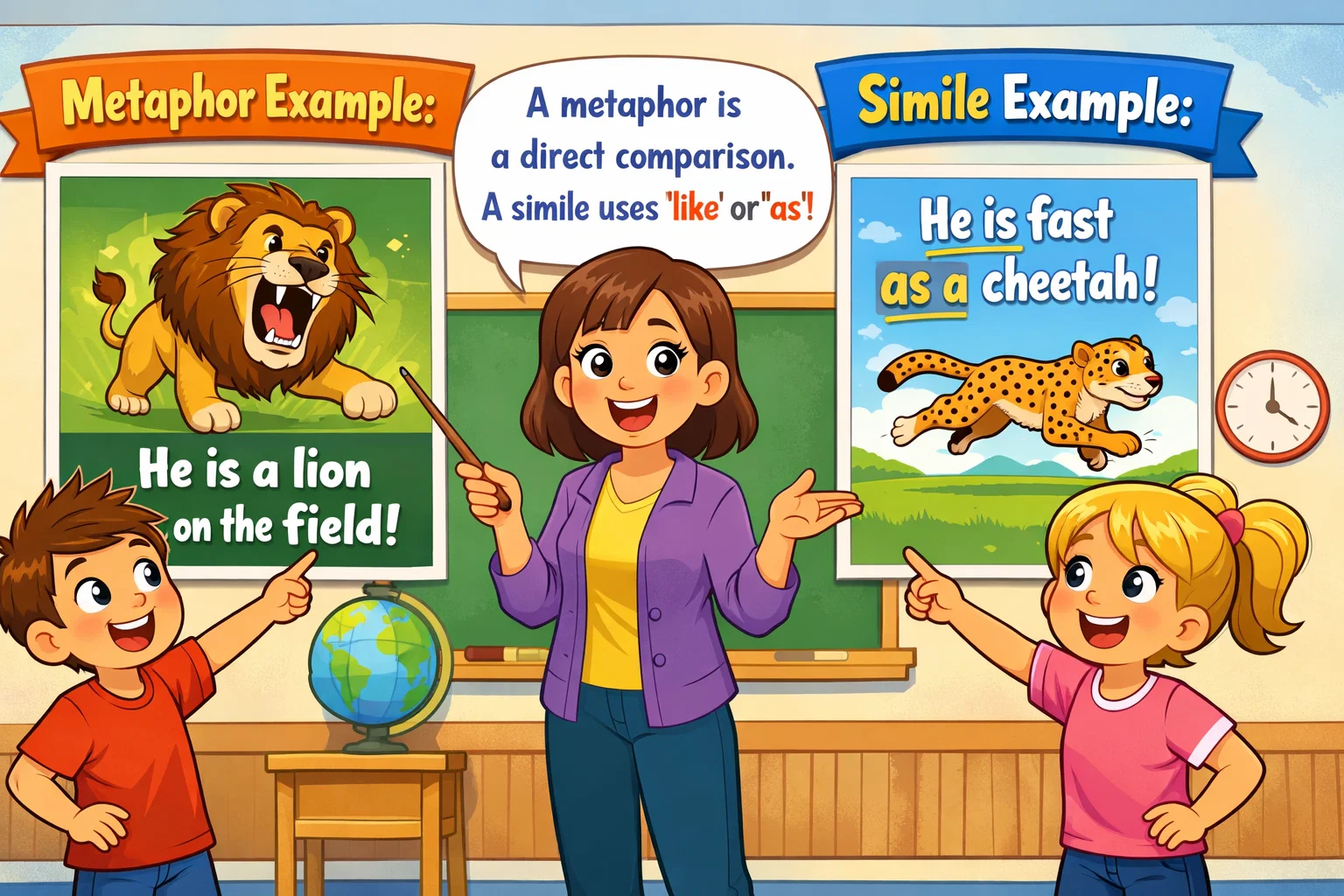
Understanding the difference between similes and metaphors is an important English Language Arts skill. While both are used to create a comparison between two things, the way they connect those things is what sets them apart.
Side-by-Side Difference Chart
| Feature | Metaphor | Simile |
| Form | Direct Statement (A is B) | Comparison (A is like B) |
| Signal Words | Is, Are, Was, Were | Like, As |
| Effect | Stronger, more immediate | Descriptive, observational |
| Sample | “The stars are diamonds.” | “The stars shine like diamonds.” |
How Kids Can Spot Each One
To help a child identify which literary device is being used, follow this three-step checklist:
- Check for ‘like’ or ‘as’: if the sentence uses these words to compare two things, it is a simile.
- Look for forms of ‘to be,’ such as ‘is,’ ‘are,’ ‘was,’ or ‘were’: if the sentence says one thing is another and it is not literally true, it is probably a metaphor.
- Find the Comparison: Ask, “What two things are being talked about?” (e.g., a person and a tiger).
Most Common Mix-Ups
Children often face three specific hurdles when learning these figures of speech:
- Literal vs. Figurative: A child might think “The cat is on the mat” is a special comparison. Explain that it must describe the cat as something it isn’t (e.g., “The cat is a fluffy cloud”).
- The “Like” Trap: Students may think any sentence with “like” is a simile. Example: “I like pizza” is NOT a simile because there is no comparison.
- The ‘It’s Not Literal’ Confusion: Some kids think a metaphor is ‘lying.’ Reassure them that it is simply a word picture, not a literal statement.
Parent Guide to Metaphors & Similes
Teaching children about metaphors and similes doesn’t have to be a formal lesson. Parents can weave these concepts into bedtime stories to support a child’s critical thinking and emotional awareness.
Best Age to Start
Many children begin to understand simple metaphors between the ages of 5 and 7, although they may take them literally at first.
- Ages 5–7: Stick to simple metaphors and similes involving animals and colors.
- Ages 8–10: Introduce writing metaphors in school journals and identifying them in chapter books.
- Ages 10+: Explore different types of metaphor, such as extended or implied versions.
Easy Way to Explain Hidden Meaning
To help your child learn more about metaphors, use the “Translation Game.” When you encounter a figurative phrase, ask them to translate it into “Plain English.”
- Example: When we say, “You are a couch potato,” we mean “You have been sitting on the sofa watching TV for a long time.”
Sharing and Discussing Examples Together
The most effective way to explain metaphors is through active discussion. Follow this simple script:
- Read the example: “The moon was a silver coin in the sky.”
- Ask for the image: “What do you see when I say that?”
- Discuss the link: “Why did the author pick a coin? Is the moon round? Is it shiny?”
- Create your own: “What else could the moon be? A slice of lemon? A fingernail?”
Why Metaphors & Similes Matter for Kids
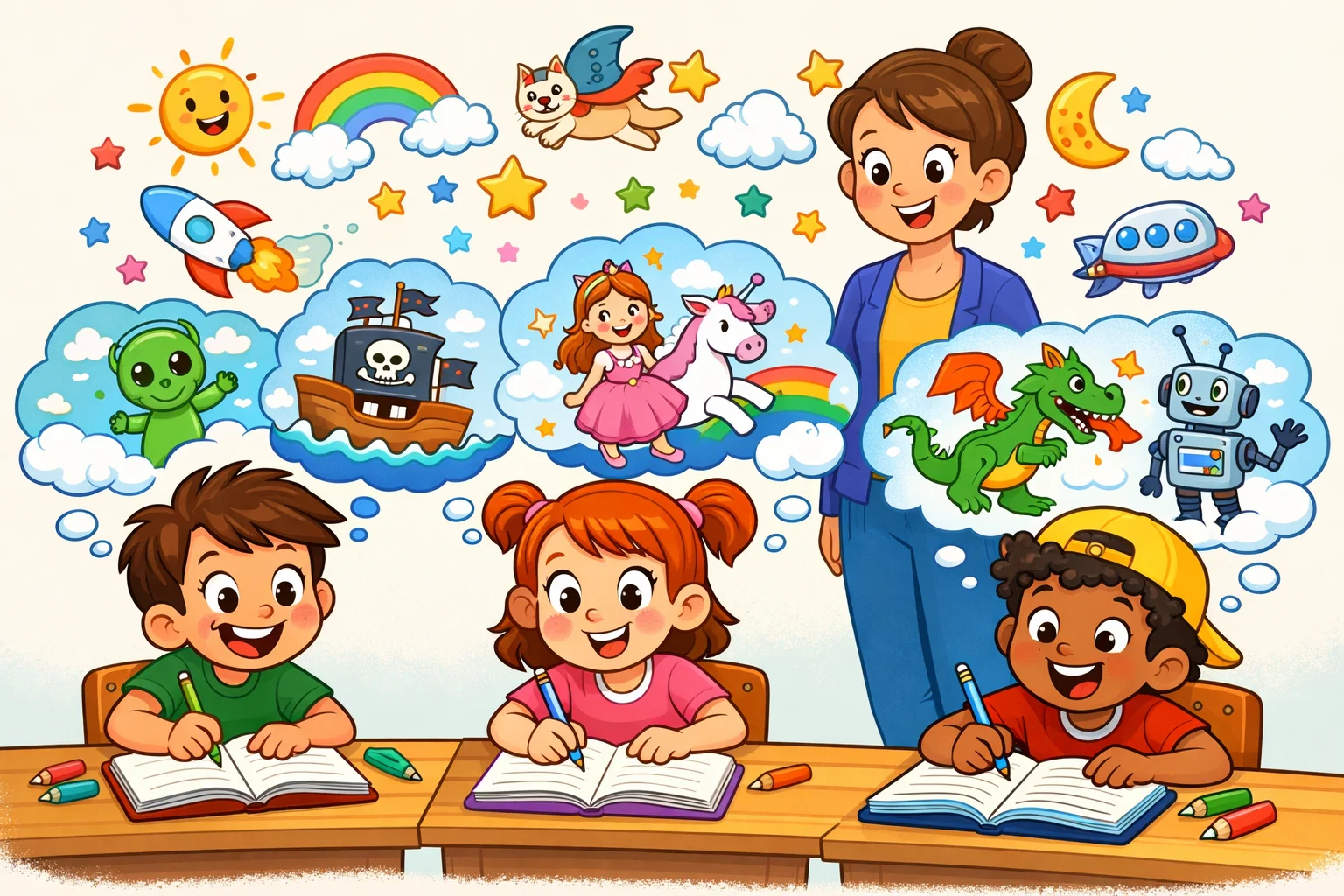
Using metaphors helps children become better writers and more empathetic communicators. These tools help children move beyond basic vocabulary and create vivid images in speech and writing.
Vocabulary Growth and Word Choice
When children use metaphors, they are encouraged to look for a more precise and vivid word rather than the easiest one.
- Plain Sentence: “The dog ran fast.”
- Vivid Sentence: “The dog was a lightning bolt across the yard.”
By choosing “lightning bolt,” the child learns to associate speed with energy and light.
Storytelling and Writing Skills
In creative writing, metaphors and similes help keep readers engaged.
- Before: “I was scared.”
- After: “My heart was a drumming woodpecker in my chest.”
The second version uses a comparison between two things – the heart and a woodpecker – to show the physical sensation of fear, which makes the story feel more vivid and real.
Emotion, Imagination, and Memory
For children, metaphors can act as ‘emotional handles.’ It is often easier for a child to say, ‘I feel like a wilted flower’ than to explain that they feel sad, tired, or left out. These images stick in the memory longer than literal descriptions, helping with classroom speaking and social-emotional learning.
Types of Metaphors for Kids
As children progress, they will encounter more complex versions of this literary device. Learning about these types can prevent confusion in English Language Arts lessons and assessments.
Implied Metaphors
An implied metaphor compares two things without mentioning one of them by name. It uses a verb or adjective associated with the second thing.
- Example: “The boss barked at his employees.” (The boss is being compared to a dog, but the word “dog” isn’t used).
Extended Metaphors
An extended metaphor is a comparison that continues through several sentences or even a whole poem.
- Example: “School is a garden. The teachers are the sun helping us grow. The books are the water for our minds. We are the little seeds turning into flowers.”
Mixed Metaphors
A mixed metaphor happens when someone combines two different images in a way that sounds silly.
- Example: ‘We’ll burn that bridge when we come to it.’ (This mixes ‘cross that bridge when we come to it’ and ‘burn your bridges.’).
Dead Metaphor
A dead metaphor is a phrase that has been used so much that people no longer see the image.
- Example: “The legs of the table.” (We don’t think of the table as having actual human legs anymore).
Visual Metaphors for Kids
Not all metaphors are used in text. Visual imagery can also represent ideas, which is a key part of media literacy for modern students.
What Visual Metaphors Show
A visual comparison uses an image to stand for something else.
- Example: A lightbulb appearing over a character’s head represents a “bright idea.”
- Example: A red heart on a card can symbolize love or affection.
How Pictures Build Meaning
By observing size, color, and symbols, children learn to “read” images. A giant, dark cloud over a character might visually represent sadness without using a single word. This supports critical thinking by asking the child to interpret clues.
Draw-and-Guess Practice
To practice this, have your child draw a “literal” version of a phrase (e.g., a boy who is actually a potato on a couch) and then discuss what the “figurative” meaning is. This helps bridge the gap between sight and language.
70 Metaphor & Simile Examples With Definitions for Kids
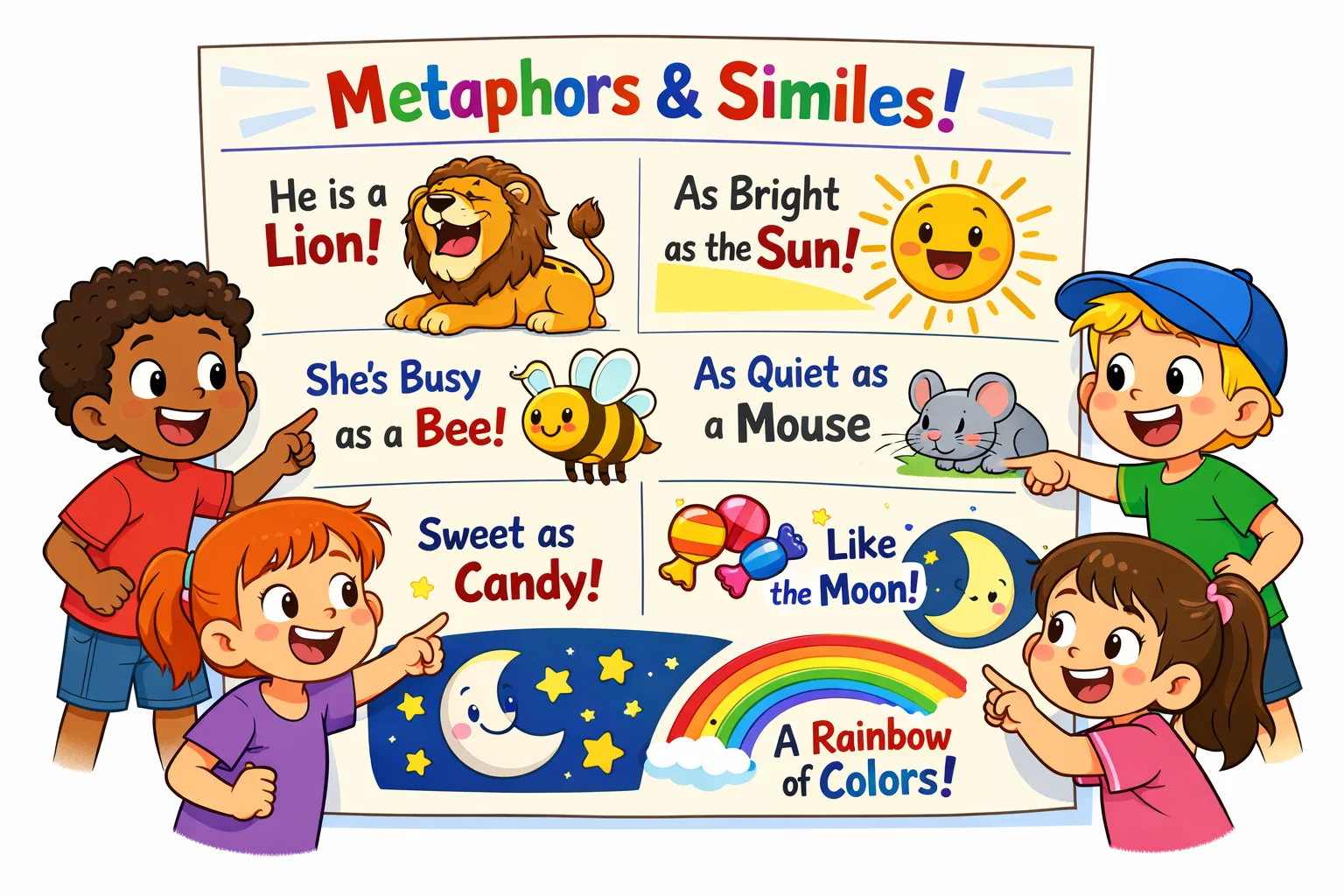
This list of metaphor and simile examples is organized by category to help you find the right fit for any lesson.
10 Everyday Life Examples
| Example | Type | Simple Definition | What It Means |
| Life is a journey. | Metaphor | Comparing life to a trip. | You will go many places and learn things. |
| As clean as a whistle. | Simile | Very clean. | There is no dirt or mess at all. |
| The alarm was a siren. | Metaphor | Comparing an alarm to an emergency siren. | The sound was very loud and urgent. |
| Like two peas in a pod. | Simile | Very similar. | Two people who are exactly alike. |
| The kitchen was an oven. | Metaphor | Comparing a kitchen to an oven. | The room was incredibly hot. |
| Hard as nails. | Simile | Very tough. | Someone who is very tough, resilient, or emotionally strong. |
| His home was a prison. | Metaphor | Comparing a house to a jail. | He felt stuck and couldn’t leave. |
| Fits like a glove. | Simile | Perfect size. | Something that fits exactly right. |
| The car was a lemon. | Metaphor | Comparing a car to sour fruit. | The car was broken and bad. |
| As light as a feather. | Simile | Not heavy at all. | Something that is very easy to carry. |
10 School Examples
- “My teacher is an encyclopedia.”: She knows everything.
- “The hallway was as busy as a beehive.”: Lots of kids moving around.
- “The test was a breeze.”: It was very easy.
- “He sat as still as a statue during the play.”: He didn’t move at all.
- “Books are keys to new worlds.”: Reading lets you imagine new places.
- “Her pencil was flying across the paper.”: She was writing very fast.
- “The classroom was like a library.”: It was very quiet.
- “Recess is the sunshine of my school day.”: It is the happiest and most exciting part of my day.
- “As sharp as a tack.”: Being very smart.
- “History is a window to the past.”: It helps us see what happened before.
10 Animal Examples
- “He is a social butterfly.”: He likes talking to everyone.
- “As blind as a bat.”: Not being able to see well.
- “She is a night owl.”: She likes to stay up late.
- “Eat like a bird.”: To eat very little.
- “The toddler is a little monkey.”: He loves to climb.
- “As slow as a snail.”: Moving at a very low speed.
- “He has the heart of a lion.”: He is very courageous.
- “Sly as a fox.”: Being very clever or sneaky.
- “The dog was a shadow.”: He followed his owner everywhere.
- “As happy as a clam.”: Being very content.
10 Nature & Weather Examples
- “The stars are sparkling jewels.”: They are bright and beautiful.
- “Cold as ice.”: Very, very chilly.
- “The sun is a golden ball.”: It is round and yellow.
- “Like a fish out of water.”: Feeling uncomfortable in a new place.
- “The wind was a whispering ghost.”: It made a soft, spooky sound.
- “Clear as day.”: Very easy to understand or see.
- “The grass is a green carpet.”: It is soft and covers the ground.
- “As white as snow.”: Very pure and bright white.
- “The thunder was a giant’s drum.”: It made a loud, booming noise.
- “The river is a winding snake.”: It curves back and forth.
10 Feeling & Emotion Examples
- “I’m feeling blue.”: I feel sad.
- “As mad as a hatter.”: Acting very eccentric or irrational.
- “He has a heart of stone.”: He is not very kind or emotional.
- “Like a kid in a candy store.”: Being very excited.
- “Anger is a fire.”: It can grow quickly and hurt people.
- “As proud as a peacock.”: Being very pleased with oneself.
- “She has butterflies in her stomach.”: She feels nervous.
- “Solid as a rock.”: Being very dependable.
- “Her smile was a ray of sunshine.”: It made everyone feel better.
- “As cool as a cucumber.”: Being very calm under pressure.
10 Family & Friendship Examples
- “My brother is a pest.”: He is very annoying.
- “Good friends are like stars.”: You don’t always see them, but they are there.
- “My mom is the glue of the family.”: She keeps everyone together.
- “As thick as thieves.”: Very close friends who share secrets.
- “Our team is a well-oiled machine.”: We work perfectly together.
- “Her smile sparkled like a diamond.”: It was bright, beautiful, and impossible to miss.
- “He is the black sheep of the family.”: He is different from the others.
- “Sweet as sugar.”: Very nice and kind.
- “Friends are the flowers in the garden of life.”: They make life beautiful.
- “Like two sides of the same coin.”: Different but connected.
10 Funny & Creative Examples
- “His brain is a computer.”: He processes information fast.
- “As hungry as a horse.”: Needing a lot of food.
- “The moon is a giant cheese.”: It looks round, pale yellow, and full of craters.
- “Dance like nobody is watching.”: To be free and silly.
- “My dad’s snoring is a chainsaw.”: It is very loud and raspy.
- “As funny as a clown.”: Making everyone laugh.
- “The clouds are marshmallows.”: They look soft and puffy.
- “Ugly as sin.”: Very unpleasant to look at.
- “The cat is a master ninja.”: She moves silently and hides well.
- “As tough as old boots.”: Very strong and durable.
How to Write Metaphors & Similes
Moving from identifying metaphors to writing them is a huge milestone. Use these steps to guide your child through the creative process.
Start With Familiar Objects
Begin with things the child sees every day. Use these templates to help them start:
- “My backpack is as heavy as a _______.”
- “The dog’s fur is a _______.”
- “The pizza smells like _______.”
Use Senses, Feelings, and Action
One purpose of metaphors and similes is to describe how something feels, sounds, looks, or moves.
- Touch: “The ice was a sharp needle.”
- Sound: “The rain danced like tap dancers on the roof.”
- Emotion: “Loneliness is a cold room.”
Turn Plain Sentences Into Vivid Lines
Practice “upgrading” sentences together. This is a fun alternative to a worksheet.
| Plain Sentence | Upgraded With Simile/Metaphor |
| The sun was hot. | The sun was a blazing furnace. |
| She ran fast. | She ran like a cheetah. |
| The soup was good. | The soup was a warm hug in a bowl. |
| He is smart. | He is as sharp as a razor. |
| It was loud. | The noise was a crashing wave. |
Help Kids Create Original Comparisons
Encourage children to avoid clichés. Ask them, “What else is brave?” Maybe a “soldier ant” or a “small candle in the wind”? These prompts help children create their own metaphors in ways that feel unique and personal.
Activities With Metaphors & Similes for Kids
Interactive play helps children make lasting connections with figurative language.
Activity 1: Metaphor Treasure Hunt
- Choose an object in the house (e.g., a toaster).
- Pick a quality (it gets hot).
- Compare it to something else (it is a small dragon in the kitchen).
- Write the idea on a sticky note and leave it on the object!
Activity 2: Simile Match Game
Create two sets of cards. One set has things to describe (car, cloud, puppy). The other has comparison images (a new coin, cotton, a race car). The child draws one from each and builds a simile, such as ‘The car is as shiny as a new coin.’
Activity 3: Draw Metaphor Scene
Have the child draw a literal picture of a metaphor or simile, such as ‘The stars are diamonds.’ Seeing the physical comparison helps them understand metaphors as visual tools.
Activity 4: Story Prompt Challenge
Give the child a short story starter: “I walked into the dark forest…” Challenge them to include at least one simile and one metaphor in the next few sentences.
Activity 5: Charades and Guessing Game
One person acts out a figurative phrase (like “quiet as a mouse”) without speaking. The others must guess the comparison and then explain what it means literally.
Reading Help With Metaphors & Similes
Using these tools during “read-aloud” time can transform a simple story into a deep learning experience.
Spotting Comparisons in Stories
As you read picture books, keep a “Figurative Language Checklist.” When you find a comparison, stop and check:
- Does it use “like” or “as”?
- Is it comparing two different things?
- What is the shared quality?
Talking About Meaning During Read-Aloud
Ask open-ended questions to build critical thinking:
- “What picture comes to mind when the author says the wind ‘whistled’?”
- “If the character’s heart is ‘made of gold,’ does that mean it’s metal, or that they are kind?”
Using Poems and Picture Books
You’ll often find these devices in poetry, where rhythm and imagery work together especially well. Poetry is an excellent starting point because it is short and every word matters. Books like Owl Moon by Jane Yolen are known for their beautiful imagery.
FAQ
What Age Is Best for First Practice?
Children as young as 5 can enjoy simple metaphors in picture books. Formal practice usually begins around 2nd or 3rd grade.
Are Similes Easier Than Metaphors?
Yes, usually. Because “like” and “as” act as clear clues, children find similes easier to identify. Once comfortable, you can introduce more direct imagery.
How Many Examples Should Kids Learn at Once?
Focus on 5–10 examples per session. Use a mix of both types to keep the distinction clear.
How Can Parents and Teachers Correct Mistakes?
If a child makes a mistake, ask them to describe the image they are trying to create. If the comparison doesn’t quite fit, suggest a different one and ask them to try again. This keeps their creativity flowing.

Take a short quiz to find out what your everyday choices say about your parenting style
When your child is curious about something new, what’s your instinct?
Take a short quiz to find out what your everyday choices say about your parenting style
“Can I download this app?” What happens next?
Take a short quiz to find out what your everyday choices say about your parenting style
When it comes to rules at home, which sounds most like you?
Take a short quiz to find out what your everyday choices say about your parenting style
If you could give your child one life skill today, what would you pick?
Take a short quiz to find out what your everyday choices say about your parenting style
Your child gets to choose what to watch. What would your ideal setup look like?
Take a short quiz to find out what your everyday choices say about your parenting style
Pick your parenting superpower ✨



