
Main Idea vs. Theme for Kids: Differences, Examples, Activities, and Questions

 Discover a Free Education Video App for Kids
Pastory uses AI to personalize educational video content based on your child’s interests and personality. Safe, engaging, and built for curious young minds. Sign up now to stay updated and enjoy early access with a free trial
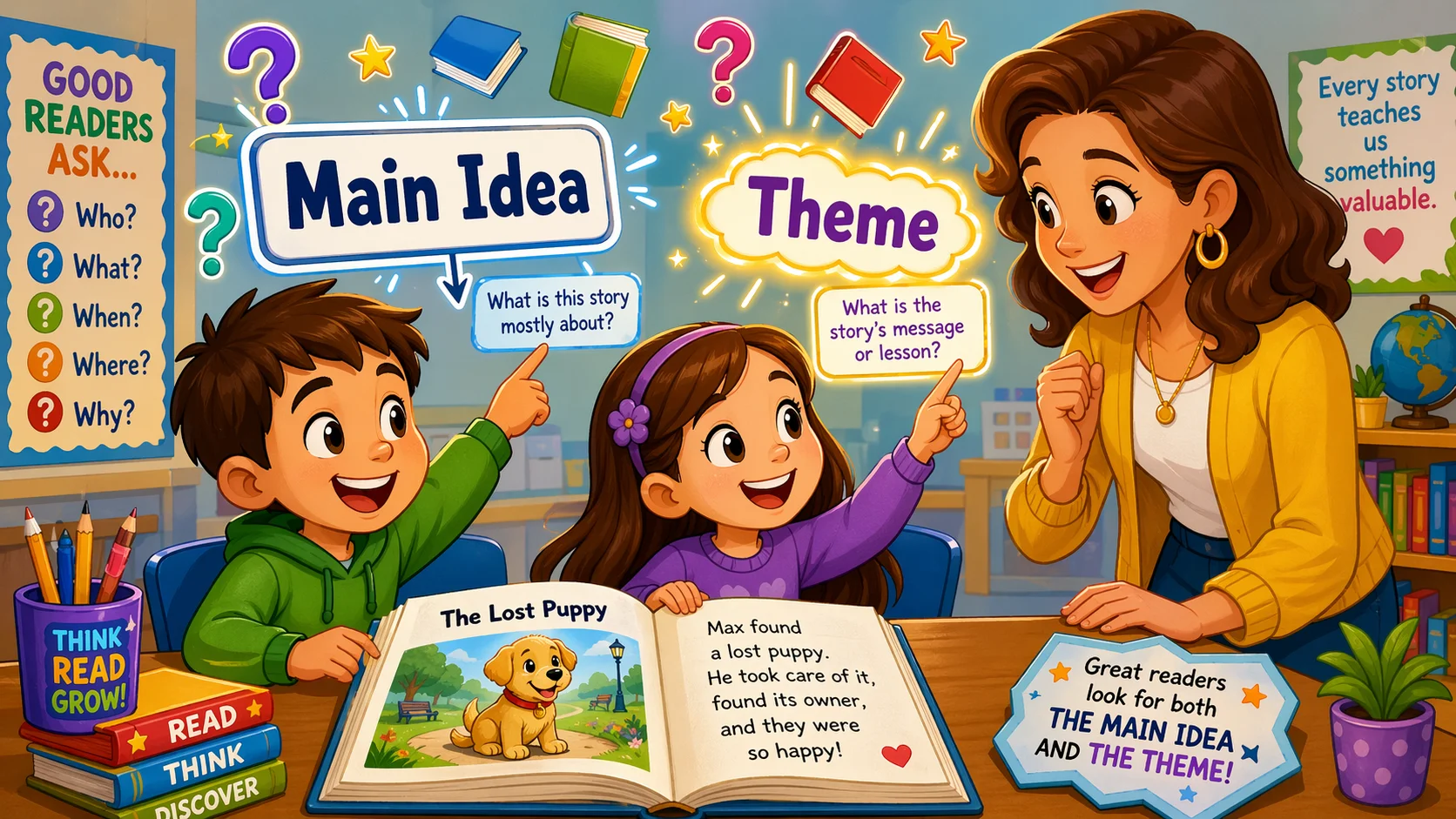
Distinguishing between the main idea and the theme of a story is a foundational milestone in literacy development. While these concepts are closely related, they serve distinct purposes in helping young readers comprehend and analyze text. Many students initially struggle with this distinction, often confusing specific plot details with the broader message the author intends to convey.
Teaching children the difference between a text’s central point and its deeper message transforms them from passive readers into active thinkers. This guide provides a comprehensive comparison, clear definitions, and practical examples from well-known stories. With clear questions, anchor charts, and engaging activities, parents and educators can help students master these reading comprehension skills with confidence. In the following sections, readers will find a clear breakdown of definitions, step-by-step instructions for identifying both elements, and ready-to-use practice exercises. Whether students are reading fiction or nonfiction, the goal is to move beyond guessing and toward using textual evidence to build deep understanding.
Why the Difference Matters for Kids
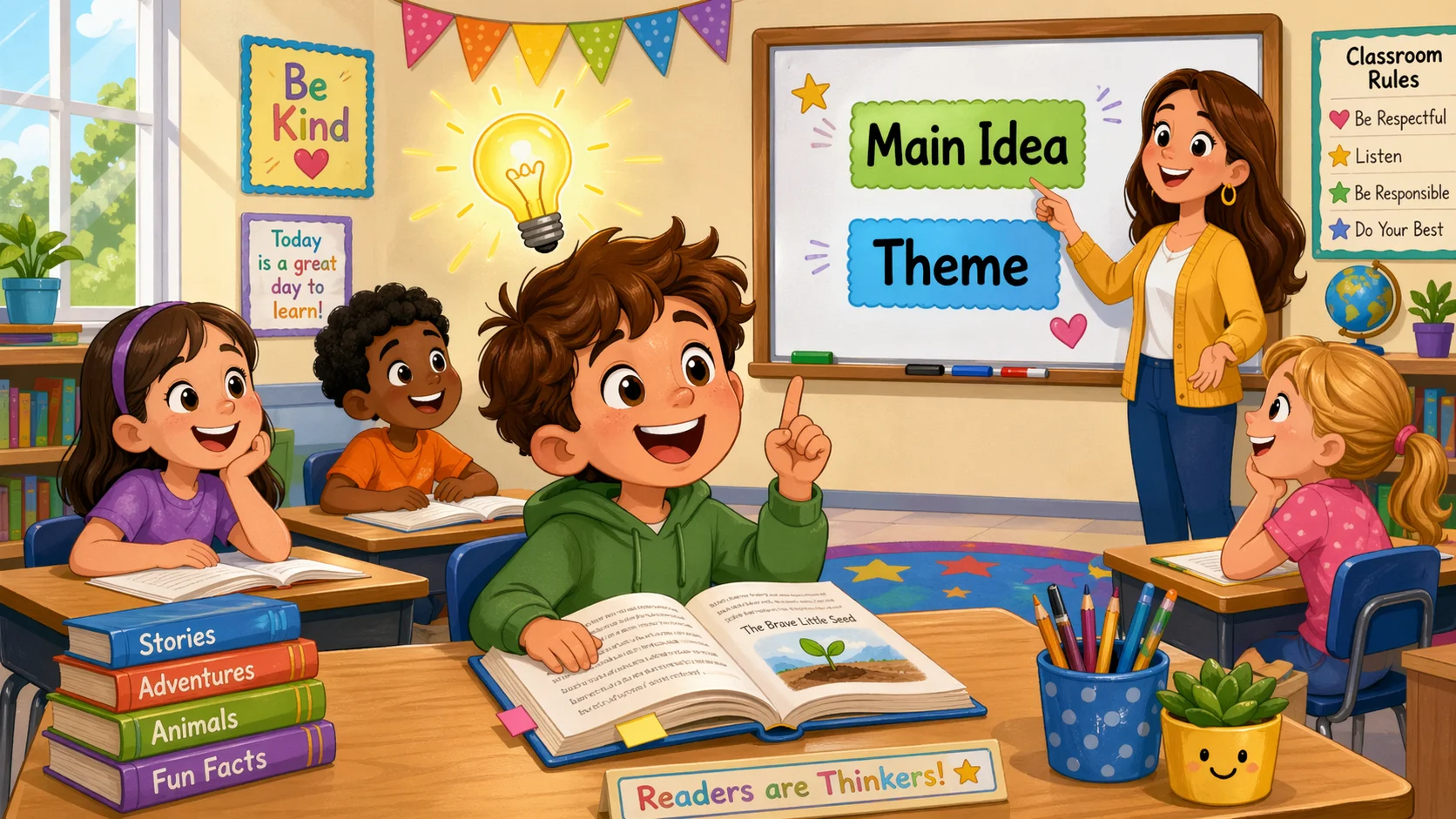
Understanding the difference between a story’s lesson and its main point allows children to categorize information more effectively during reading. Educational research suggests that metacognitive awareness – understanding how one makes sense of a text – can strengthen retention and critical thinking. When a child can separate “what happened” from “what it means,” they unlock a deeper level of literacy.
Reading Growth
Developing this skill directly impacts reading comprehension by providing a mental framework for organizing story elements. Research reviewed by the National Reading Panel suggests that explicit comprehension-strategy instruction can improve retention, understanding of new passages, and, in some cases, overall comprehension. As this skill develops, students move from simple decoding toward more thoughtful analysis of stories and other texts.
Test Success
A text’s main idea and theme are common targets in classroom assignments and standardized assessments. Standards such as the Common Core ask students to determine central ideas or themes and support their responses with textual evidence and key details. Familiarity with typical question formulations, such as “What is the primary message?” or “Summarize the main point,” reduces test anxiety and improves accuracy.
Confidence With Stories
Mastering these concepts builds academic confidence by giving students a reliable framework for discussion. Instead of feeling overwhelmed by a complex plot, a student with these skills can point to specific evidence from the text to justify their conclusions. This shift from guessing to evidence-based reasoning empowers students to participate more actively in classroom discussions and peer reviews.
Main Idea and Theme Basics
At their core, the main idea and theme answer two different questions: “What is the text mostly about?” and “What broader message or lesson does it communicate?” While the first stays rooted in the specific text, the second points to a broader message that extends beyond it.
Main Idea in One Sentence
The main idea is a concise statement that summarizes the most important point of a specific text. In nonfiction, it typically explains the central point the author wants the reader to understand about the topic. For example, in a text about honeybees, the main idea might be: “Honeybees play a vital role in our ecosystem by pollinating plants that grow our food.”
Theme as Message or Lesson
The theme is the deeper message or life lesson that the author wants the reader to take away. Unlike the main idea, it is broad and usually avoids specific character names or plot details. Common themes include “hard work pays off” or “kindness is its own reward,” which can apply to many different stories regardless of the setting.
Topic vs Main Idea
It is common for students to mix up theme and topic, or topic and main idea. A topic is a one- or two-word subject (e.g., “Friendship”), whereas the main idea is a complete thought about that topic.
- Topic: Friendship.
- Main Idea: Two friends work together to build a treehouse despite their differences.
Theme vs Moral
While a moral is a direct lesson or rule for behavior (e.g., “Slow and steady wins the race”), a theme is often a more nuanced observation about the human experience. In many upper elementary curricula, the terms are used interchangeably, but a theme can be descriptive rather than prescriptive. A story might explore “the complexity of growing up” without necessarily providing a single moral or rule.
Related Reading Terms
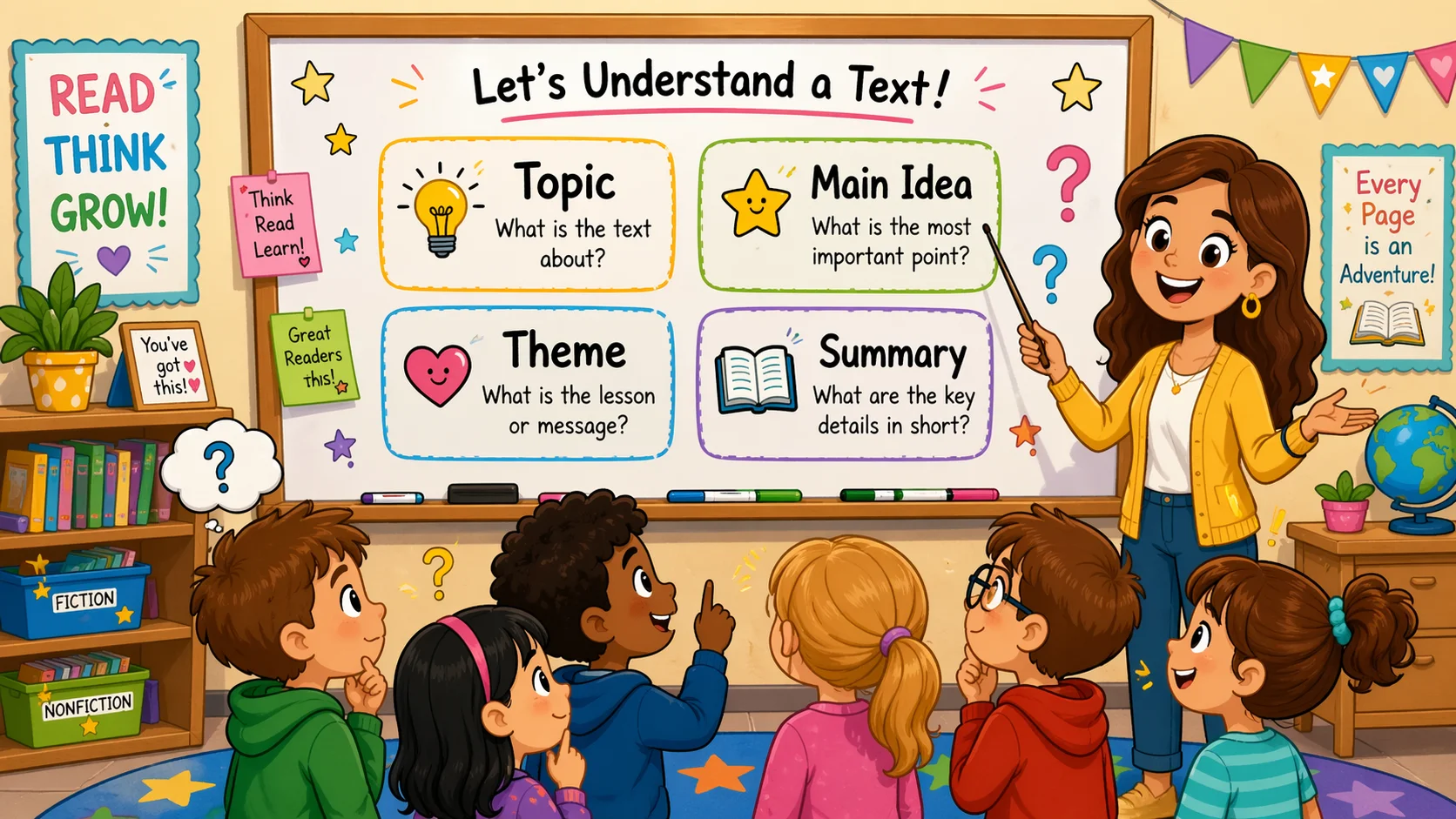
To fully understand the difference, students must also navigate several related terms used in literacy instruction. These terms are related, which can lead to confusion if they are not clearly defined.
Summary vs Main Idea
A summary is a brief retelling of the whole text or story, including its key points or events, while the main idea is the single most important point.
| Feature | Main Idea | Summary |
| Length | One sentence | A short paragraph |
| Focus | The central point | All key plot points |
| Scope | Narrow | Broad |
Central Point vs. Main Idea
The term central point is often used when discussing informational texts or nonfiction, whereas main idea is a general term applied to both fiction and nonfiction. In many classrooms, these two terms are used in similar ways and both ask students to identify the core focus of a text. Both ask readers to look at how details support the text’s central point.
Purpose vs Main Idea
The author’s purpose explains why the author wrote the piece (to persuade, inform, or entertain), while the main idea explains what the piece is actually about. For instance, an author may write to inform readers (purpose) that climate change is affecting polar bear habitats (main idea).
Topic vs Theme
A topic is the subject matter of the work (e.g., “Courage”), but the theme is the author’s specific statement about that subject. To move from a topic to a theme statement, a student must ask, “What is the author saying about courage?” A valid statement would be: “Courage is found in facing one’s fears to help others.”
Main Idea vs Theme: Key Differences
Understanding the structural differences between these two concepts helps students master reading comprehension. The table and sections below highlight how they function within a text.
Fiction vs Nonfiction
The main idea matters in both fiction and nonfiction because it helps readers track the text’s central focus, whether that focus is a sequence of events or a set of ideas. However, the theme is discussed most often in literature, such as novels, fairy tales, and short stories, although informational texts can also communicate broader messages. While some informational texts may have an underlying message, this concept is most often discussed in the context of characters and conflict.
Specific vs Broad
The main idea stays closely tied to the specific text and its events, ideas, or central information. Conversely, the theme is broad and universal, meaning it could apply to many different stories.
- Main Idea (Specific): A young boy learns to be honest after breaking a window.
- Theme (Broad): Honesty is the best policy.
Explicit vs Implied
In informational texts, the main idea is often stated explicitly in a topic sentence or introduced early in a paragraph or section. The theme is usually implied, requiring readers to use inferential thinking to look beyond the story and determine the message through character growth and resolutions.
One Answer vs More Than One Answer
A paragraph or short text usually has one main idea that anchors its supporting details. However, complex stories can contain multiple themes. For example, a story about a war might explore themes of both “the loss of innocence” and “the power of resilience.”
Main Idea Statement vs Theme Statement
Teaching students to use specific templates can improve the quality of their responses:
- Main Idea Template for Fiction: “[Character] does [Key Action] because [Reason/Goal].”
- Main Idea Template for Nonfiction: “This text explains that [Topic] [Key Point].”
- Theme Statement Template: “The author believes that [Universal Truth about Life].”
Questions to Find Main Idea and Theme
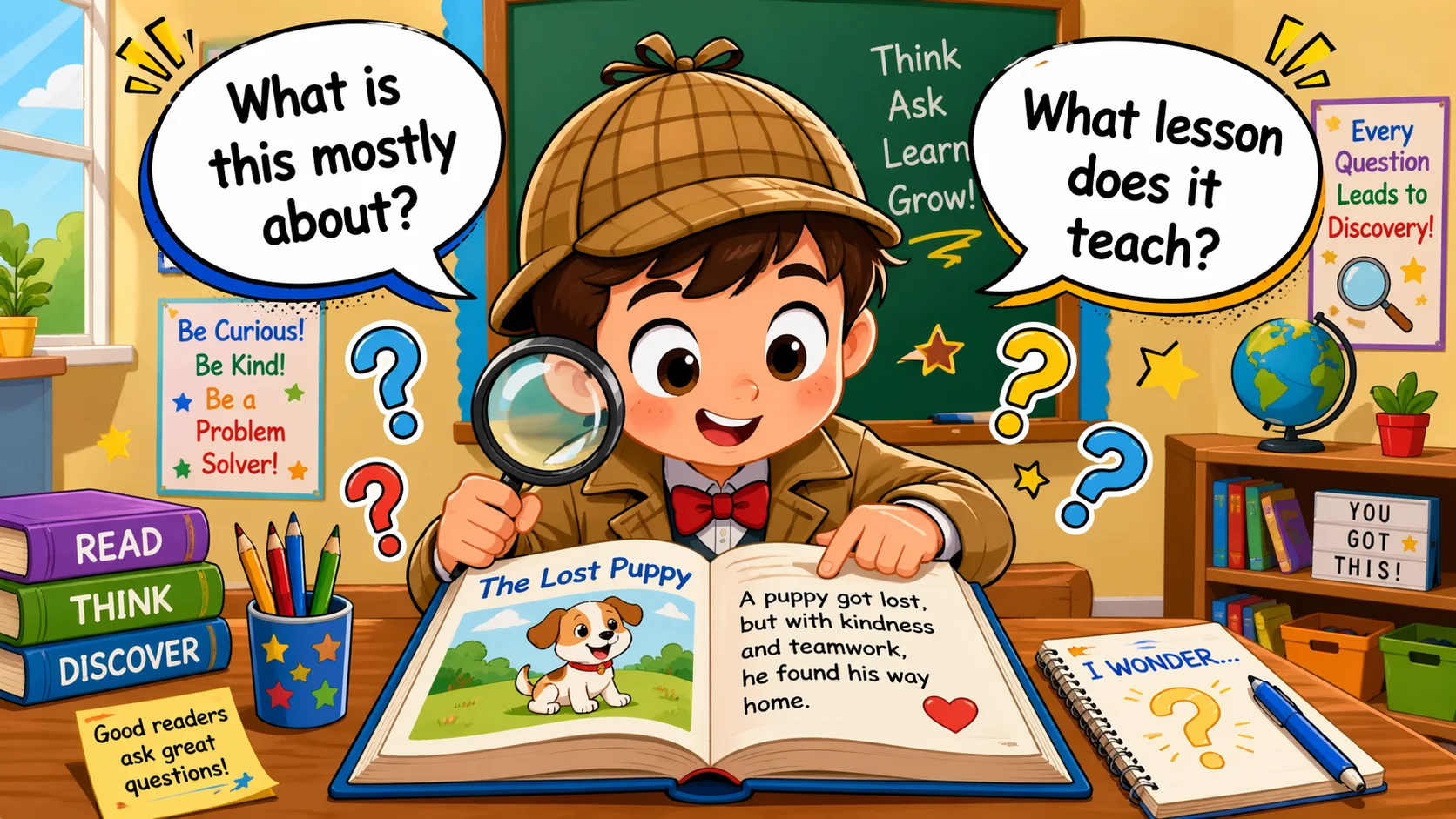
Asking the right questions is the most effective way to help students navigate a text. These prompts guide readers toward the most important parts of a story or informational text.
Questions to Find Main Idea
To identify the main idea, students should focus on the “who” and the “what” of the text:
- Who is the main character or what is the primary subject?
- What is the most important event or idea in the text?
- Which key details are repeated throughout the text?
- If I had to give this story a new title, what would it be?
Questions to Find Theme
To identify the underlying message, students must look for the “why” and the “lesson”:
- What did the main character learn by the end of the story?
- How did the characters change from the beginning to the end?
- What life lesson is the author trying to teach me?
- What message does the character’s choice send to the reader?
Before, During, and After Reading
- Before: “Based on the title and cover, what do I think the text will mostly be about?”
- During: “Are there any repeated details or words that keep appearing?”
- After: “What was the result of the main conflict, and what does that result show about life?”
How to Find Main Idea: Step-by-Step
Finding the main idea is a skill that takes practice. Following a consistent process helps students analyze information systematically.
- Identify Repeated Details: Look for words, objects, or ideas that appear multiple times. In nonfiction, these are often the facts that support the central point.
- Examine Title and Headings: Titles and subtitles often provide a direct clue to the main point of the text. In informational texts, headings act as roadmaps for each section’s main point.
- Locate the Topic Sentence: The topic sentence is often found near the beginning of a paragraph, though it may also appear later, and it summarizes the paragraph’s central point.
- Write a One-Sentence Main Idea: Combine the subject with the most important point into a single sentence. Avoid including specific details like dates or secondary character names.
How to Find Theme: Step-by-Step
Identifying a theme requires students to move from literal understanding to inferential thinking. It involves looking at patterns within the story’s structure.
- Analyze Character Choices and Feelings: How a character reacts to a problem often reveals the message. If a character chooses to be brave despite being afraid, the theme might relate to courage.
- Connect Problem, Change, and Lesson: Follow the arc of the characters as they face a conflict. A character’s change often points to the story’s lesson or message.
- Develop a Theme Statement: Start with a broad topic like “Honesty” and expand it into a complete thought.
- Verify the Statement: A strong theme statement does not use specific names and can be applied to other stories.
Main Idea vs Theme in Well-Known Stories
Using familiar stories is an excellent way to show students how these concepts differ in practice.
Aladdin
- Main Idea: A poor young man finds a magic lamp and uses a genie’s help to win the heart of a princess.
- Theme: Being true to oneself is more important than wealth or status.
Cinderella
- Main Idea: A mistreated girl attends a royal ball with the help of a fairy godmother and eventually marries a prince.
- Theme: Kindness and resilience are rewarded in the end.
The Lion and the Mouse
- Main Idea: A small mouse saves a powerful lion from a hunter’s trap after the lion previously spared the mouse’s life.
- Theme: No act of kindness is too small, and even the smallest friend can be helpful.
The Three Little Pigs
- Main Idea: Three pigs build houses from different materials, but only the pig who builds a sturdy brick house stays safe from the wolf.
- Theme: Hard work and careful planning lead to success and safety.
Examples and Practice Exercises for Kids
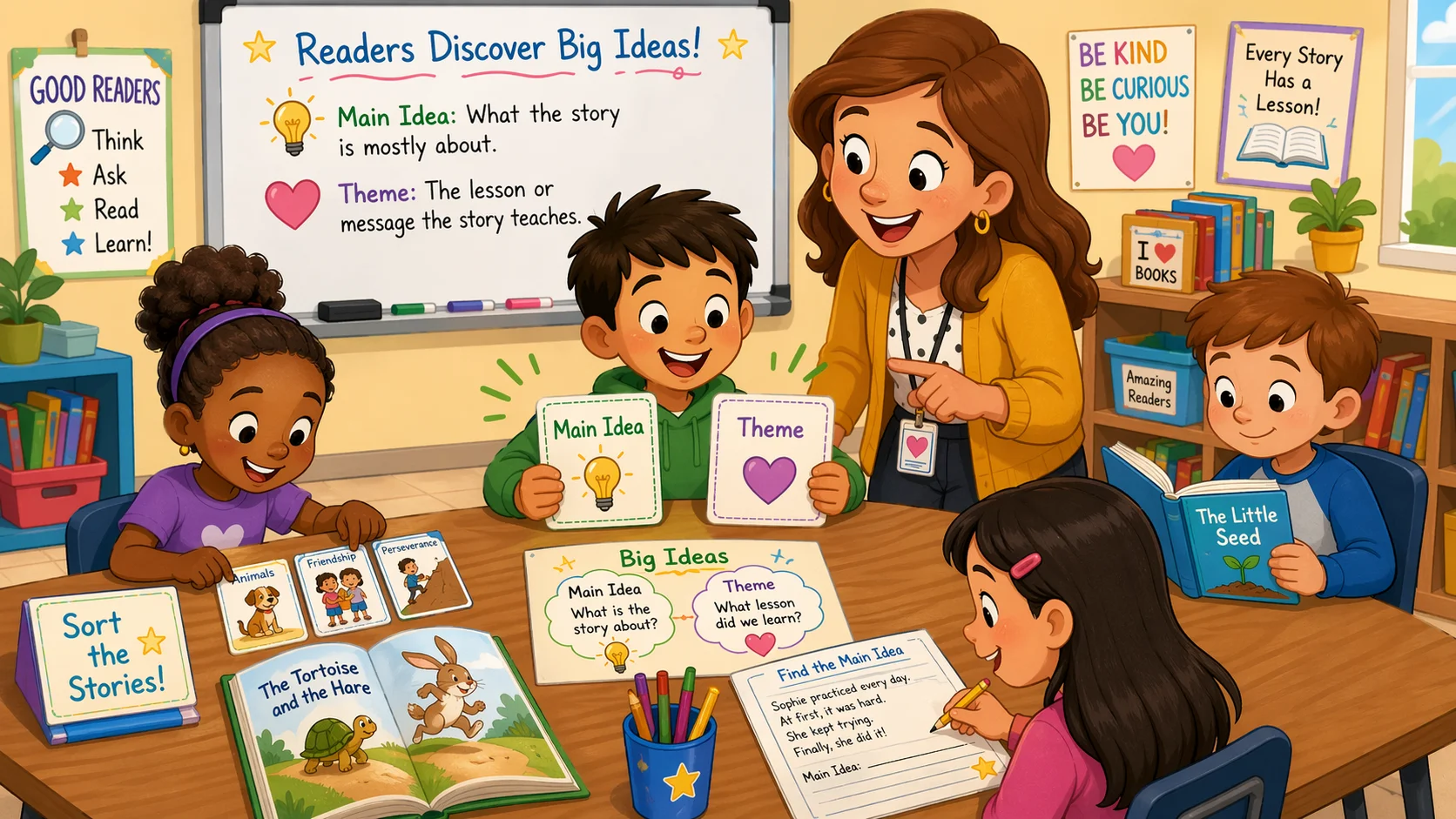
Active practice is essential for students to identify these elements independently. Below are exercises designed for upper elementary learners.
Short Passage Practice
Main Idea: Sarah worked hard to improve the appearance of her local park.
Match Statement to Category
Provide students with three statements and ask them to categorize them:
- “Love” (Topic)
- “Romeo and Juliet fall in love despite their families’ hatred.” (Main Idea)
- “Love can overcome even the deepest grudges.” (Theme)
Fix Weak Answers
Explain why “Friendship” is a weak theme. It is a synonym for a topic, not a complete thought. A better answer would be: “True friendship requires sacrifice.”
Activities to Teach Main Idea and Theme to Kids
Teachers can use a variety of activities and tools to make these abstract concepts more concrete for young learners.
- Main Idea Anchor Chart: Create a visual with two columns. On the left, list “Main Idea” (What happened, specific, one per story). On the right, list “Theme” (The lesson, broad, can be multiple).
- Sorting Game: Use task cards with sentences. Students sort the cards into “Main Idea” or “Theme” by deciding whether each sentence is text-specific or broad and transferable.
- Story Mapping: Use graphic organizers that link the “Problem” and “Solution” to the “Life Lesson.”
- Song Lyrics: Analyze the central point and message of a popular, kid-friendly song to show that these concepts exist in all forms of media.
Support Strategies for Different Learners
Every student learns at a different pace. Providing visual supports and sentence frames can help those who struggle with abstract reasoning.
- Sentence Frames: Provide starters like “The main idea of this text is…” and “The author wants us to learn that…”
- Small-Step Scaffolds: Begin with fairy tales where the moral is clear before moving to complex novels.
- Partner Talk: Let students discuss their ideas with a partner before writing them down. This builds confidence with stories and allows them to hear different perspectives.
Note: The American Academy of Pediatrics recommends interactive shared reading with children because it supports language, cognitive, and social-emotional development. This kind of interactive reading also supports the discussion and reflection skills children need when distinguishing between a story’s main idea and its theme.
Frequently Asked Questions
Is Central Idea the Same as Main Idea?
Yes, in most educational contexts, especially regarding informational texts, these terms are used interchangeably. They both refer to the primary point the author is making.
Is Theme the Same as Main Idea?
No. The main idea is what the story is about (specific to the plot), while the theme is the universal lesson or message (applicable to life).
Can a Story Have More Than One Theme?
Yes. Many complex stories have multiple themes. For example, Charlotte’s Web explores ideas related to both friendship and the cycle of life.
Is Theme Just a Moral?
While a moral is a direct lesson (often found in fables), a theme can be a broader observation about human nature or the world that doesn’t necessarily tell you “how to behave.”
What Is the Difference Between Topic and Theme?
A topic is the subject (e.g., “War”), while the theme is a full statement about that topic (e.g., “War has a lasting impact on those who survive it”).
What’s the Difference Between Theme and the Main Idea in a Story?
Students often ask about the difference between a story’s central point and its lesson. The simplest way to distinguish them is this: the main idea explains the story’s central focus, while the theme explains what the story suggests about life. This helps students understand the difference without confusing plot details with a broader message.
How Can I Help Students Find Important Information in a Passage?
To help students identify the most important parts of a passage, start by asking them to look for repeated ideas, important actions, and supporting details in the text. These details often support the main idea and make it easier to identify main points before trying to come up with a theme. This step-by-step approach helps students read more carefully and notice meaning beyond the surface.
Are There Printable Worksheets for Teaching Main Idea vs Theme?
Yes, many teachers use printable worksheets when teaching main idea vs theme because they give students a simple way to practice side by side. A good worksheet might ask students to compare a summary with a main idea statement, distinguish topic from theme, and answer a few guided prompts. These activities help students understand the skill more clearly and provide extra support for students who benefit from more structure.

Take a short quiz to find out what your everyday choices say about your parenting style
When your child is curious about something new, what’s your instinct?
Take a short quiz to find out what your everyday choices say about your parenting style
“Can I download this app?” What happens next?
Take a short quiz to find out what your everyday choices say about your parenting style
When it comes to rules at home, which sounds most like you?
Take a short quiz to find out what your everyday choices say about your parenting style
If you could give your child one life skill today, what would you pick?
Take a short quiz to find out what your everyday choices say about your parenting style
Your child gets to choose what to watch. What would your ideal setup look like?
Take a short quiz to find out what your everyday choices say about your parenting style
Pick your parenting superpower ✨



