Letter Q Activities for Preschoolers: 16 Fun Crafts and Games

 Discover a Free Education Video App for Kids
Pastory uses AI to personalize educational video content based on your child’s interests and personality. Safe, engaging, and built for curious young minds. Sign up now to stay updated and enjoy early access with a free trial
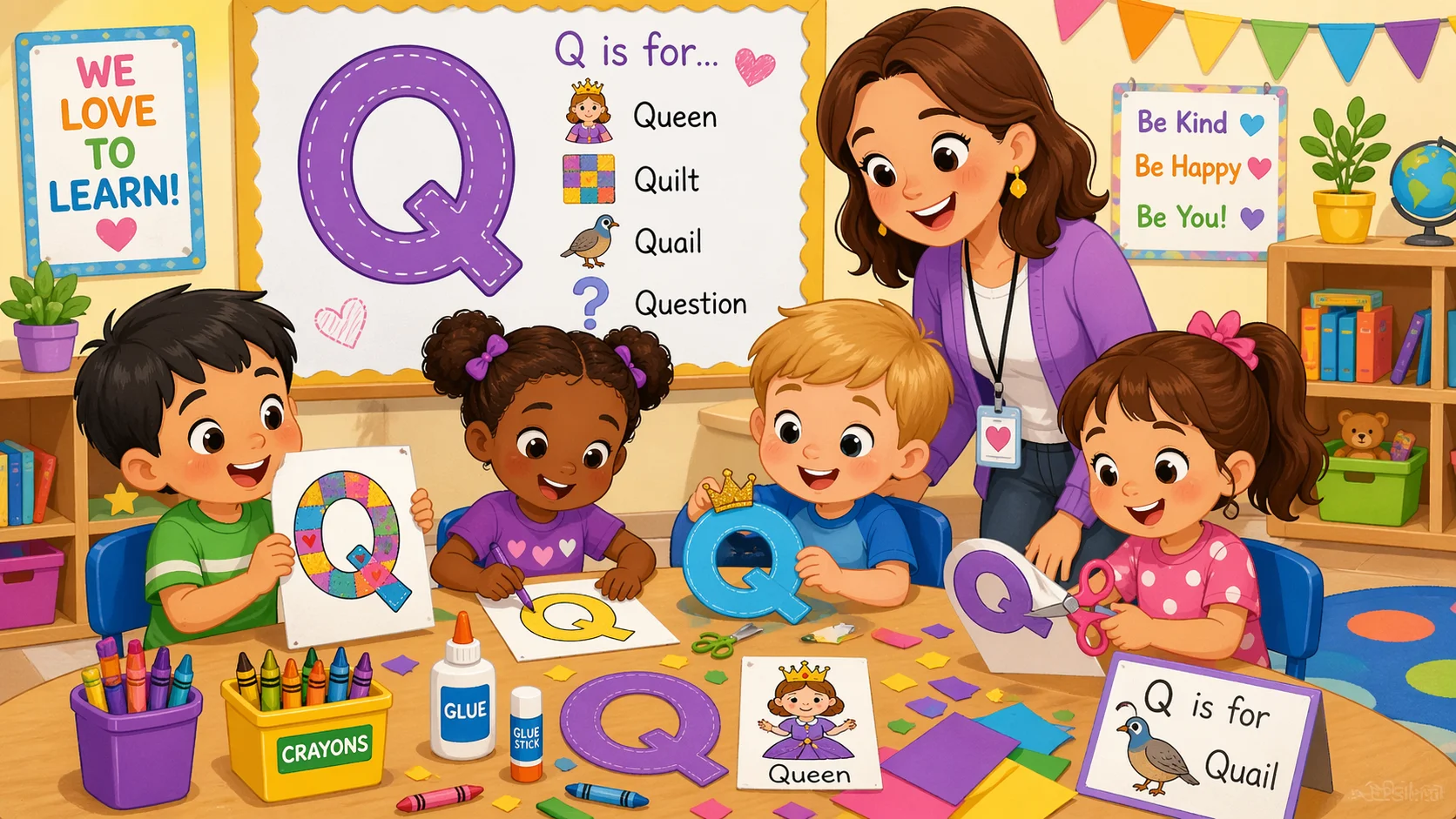
Teaching the letter Q can be a fun part of any letter-of-the-week routine. Although Q is not one of the most common letters in English, its distinct shape and the /kw/ sound it often represents with U can make it memorable for young children. With the right mix of crafts, movement, sensory play, and printables, preschoolers can build letter recognition, strengthen fine motor skills, and begin connecting the letter shape with its sound.
This guide includes playful alphabet activities designed to help children explore the letter Q in different ways. Some focus on visual discrimination, some support letter formation, and others build confidence with initial sounds. Together, they create a practical, engaging plan for preschool at home or in the classroom.
Quick Activity Guide
Use the options below to choose the best activity for your group, whether you need something low-prep, movement-based, or more focused on early writing.
Skills by Activity Type
| Activity Type | Primary Skill Focus | Recommended Setting |
| Creative Crafts | Fine motor skills, creativity | Home or Classroom |
| Sensory Play | Tactile learning, shape awareness | Sensory Table |
| Movement | Gross motor skills, recall | Gym or Outdoors |
| Printables | Visual scanning, early writing | Desk or Small Group |
Prep Time and Mess Level
- Low Prep / Low Mess: Search and Match, Quiet Game, Floor Hop
- Medium Prep / Creative Mess: Quilt Collage, Painting, Dot Marker Hunt
- High Prep / Sensory Setup: Quarter Sensory Bin, Playdough Formation
Best Picks for Ages 3, 4, and 5
- Age 3: Focus on simple art and sensory experiences, like finger painting or a quilt collage.
- Age 4: Introduce matching games, uppercase and lowercase letter recognition, and simple sorting.
- Age 5: Add tracing, early writing, and sound work with letter Q worksheets or other guided printables.
1. Q Is for Quack Craft
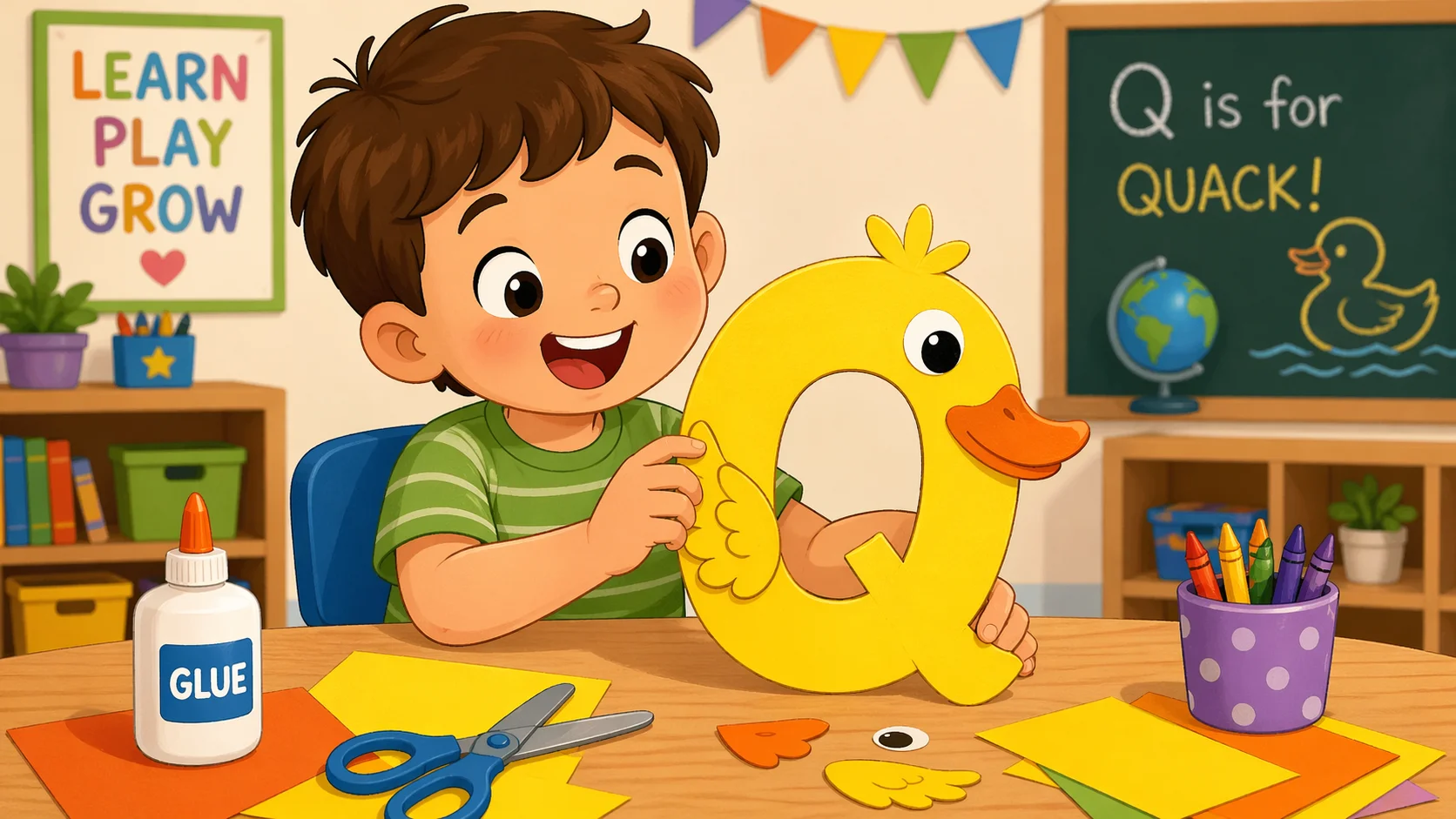
This duck-themed project is a classic letter Q craft for preschoolers. It helps children connect the shape of Q with the familiar /kw/ sound in “quack” and gives them a visual anchor for the lesson.
Materials
- Printable lowercase q template or simple q outline
- Yellow construction paper
- Orange paper for the beak
- Googly eyes
- Glue sticks and scissors
How to Run the Activity
- Give each child a printable q template. A lowercase letter q works especially well for this craft.
- Help children cut out the shape if needed.
- Add a googly eye and an orange triangle beak to turn the letter shape into a duck.
- As they work, invite them to say “quack” and repeat the /kw/ sound.
Skills Focus
This activity supports letter Q recognition, fine motor practice, and vocabulary development. It also gives children a strong sound-and-image connection they can remember later.
2. Creative Painting Exploration
Painting is an easy way to help children notice what makes Q different from other round letters and shapes. It is especially useful when introducing uppercase Q.
Materials
- Large blank uppercase Q outline on cardstock
- Washable paints and brushes or sponges
- Art smocks
- Optional: cotton swabs for dot painting
How to Run the Activity
- Place a large Q outline in front of the child.
- Let them paint the inside using brushes or sponges.
- Draw attention to the tail and talk about how it changes the shape.
- Use a different color for the tail to make the structure clearer.
Skills Focus
This activity builds visual memory, hand control, and awareness of the overall letter shape. It also helps children learn the letter name while they create.
3. Q Is for Quarter Sensory Bin
A sensory bin brings the letter Q into a tactile setting and gives children a reason to repeat the /kw/ sound while they explore.
Materials
- Sensory bin filled with rice, beans, or sand
- Plastic toy coins or real quarters with close adult supervision
- Alphabet cards, including Q and a few other letters
- Scoops and small cups
How to Run the Activity
- Hide quarters and Q cards in the filler.
- Invite children to search for Q cards and items whose names begin with the /kw/ sound, such as quarter.
- Each time they find a quarter, have them say the word aloud.
- Sort the coins into cups to add a simple math extension.
Skills Focus
This sensory activity supports sound practice, sorting, and vocabulary growth. It also helps reinforce recognition through repetition and touch.
4. Q Is for Queen Crown Craft
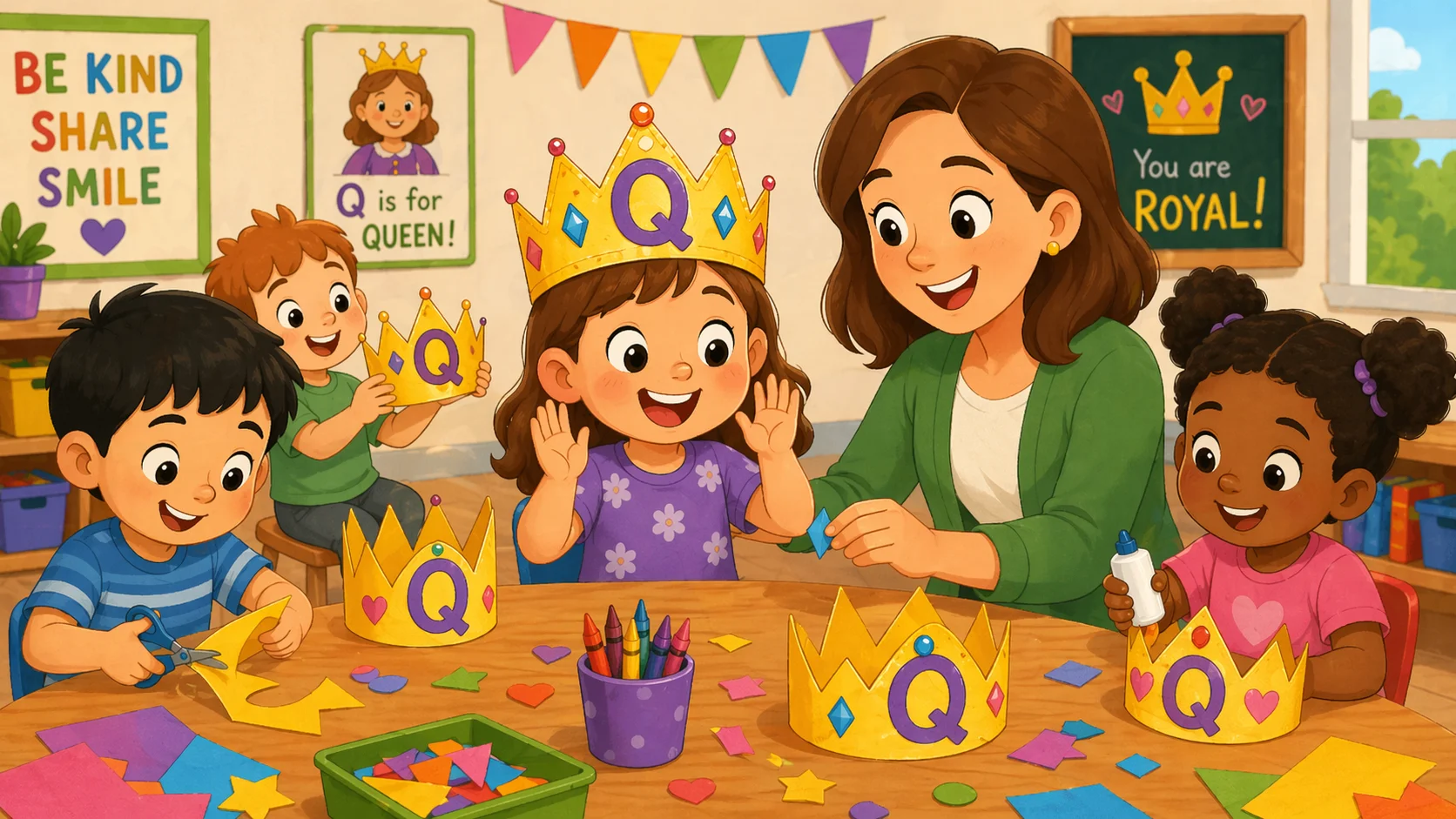
A crown craft is a natural fit for a classroom theme and works well during letter Q week.
Materials
- Crown template or strips of yellow paper
- Decorative gems, stickers, or glitter
- Glue and crayons
- Word card that says “Queen”
How to Run the Activity
- Give each child a paper crown base.
- Let them decorate it while you talk about the word “queen.”
- Add a large Q to the front.
- Wear the crowns for pretend play or group sharing.
Skills Focus
This project supports vocabulary, imagination, and oral language. It also fits nicely into Q show-and-tell ideas if children talk about their crowns or related words.
5. Q Tail Creation
This activity helps children understand one of the most important visual features of Q: the tail.
Materials
- Printable circles or paper plates
- Strips of paper or pipe cleaners
- Markers and glue
How to Run the Activity
- Show the child a circle and compare it to O.
- Explain that adding a tail turns O into Q.
- Have them attach a strip to the lower-right side.
- Repeat with different materials for variation.
Skills Focus
This activity is useful for visual discrimination and early letter formation. It helps children notice small structural differences that matter.
6. Q Is for Quiet Game
The Quiet Game is a low-prep activity that reinforces the /kw/ sound through a classroom routine.
Materials
- Cue card with Q
- Bell or timer
How to Run the Activity
- Tell children that when you hold up a Q card, everyone becomes quiet.
- Emphasize the /kw/ sound at the beginning of the word “quiet.”
- Whisper Q words like queen, quilt, and quick.
- Keep rounds short and playful.
Skills Focus
This activity strengthens listening skills, self-control, and sound awareness. It is a simple way to support letter learning without adding materials or mess.
7. Q Is for Quilt Collage
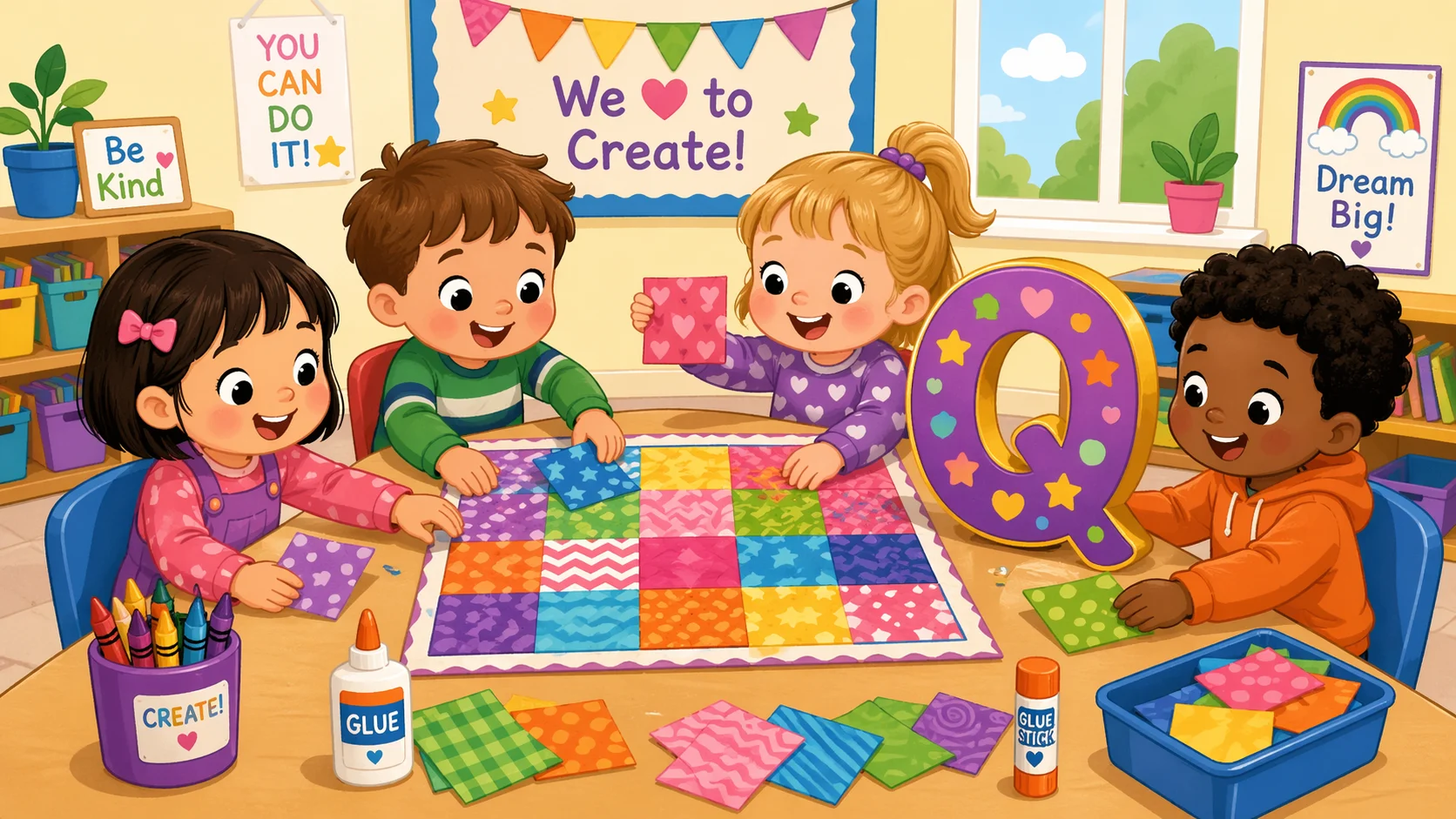
A quilt collage combines pattern work and art, making it a strong preschool activity for the letter Q.
Materials
- Letter Q outline or quilt square template
- Small patterned or colored paper squares
- Glue sticks
How to Run the Activity
- Give each child a Q outline or a square base.
- Invite them to glue small squares into a colorful pattern.
- Repeat the word quilt while they work.
- Combine the finished pieces into a class display.
Skills Focus
This collage supports fine motor development, visual organization, and vocabulary growth. It also offers a memorable real-world connection for Q.
8. Fine Motor Hole Punch Task
This activity is excellent for building the hand strength children need for future writing tasks.
Materials
- Cardstock with large Q and q outlines
- Child-safe hole punch
- Tray for paper confetti
How to Run the Activity
- Print or draw a large Q and q on thick paper.
- Show children how to punch along the lines.
- Work around the round part first, then the tail.
- Add yarn lacing afterward for an extra challenge.
Skills Focus
Hole punching supports grip strength, coordination, and control. These are all helpful foundations for controlled letter formation and early writing readiness.
9. Q Is for Quail Craft
“Quail” is a less common but useful word that begins with qu and expands vocabulary beyond the usual examples.
Materials
- Quail printable or bird outline
- Feathers or small paper dots
- Glue and crayons
How to Run the Activity
- Color the bird in natural shades.
- Add a small feather or paper strip for the quail’s head plume.
- Practice saying the word slowly together.
- Compare “quail” and “quack” as two words that begin with qu.
Skills Focus
This activity supports vocabulary, category building, and sound awareness. It is also a good way to vary your letter Q ideas across the week.
10. Dot Marker Letter Hunt
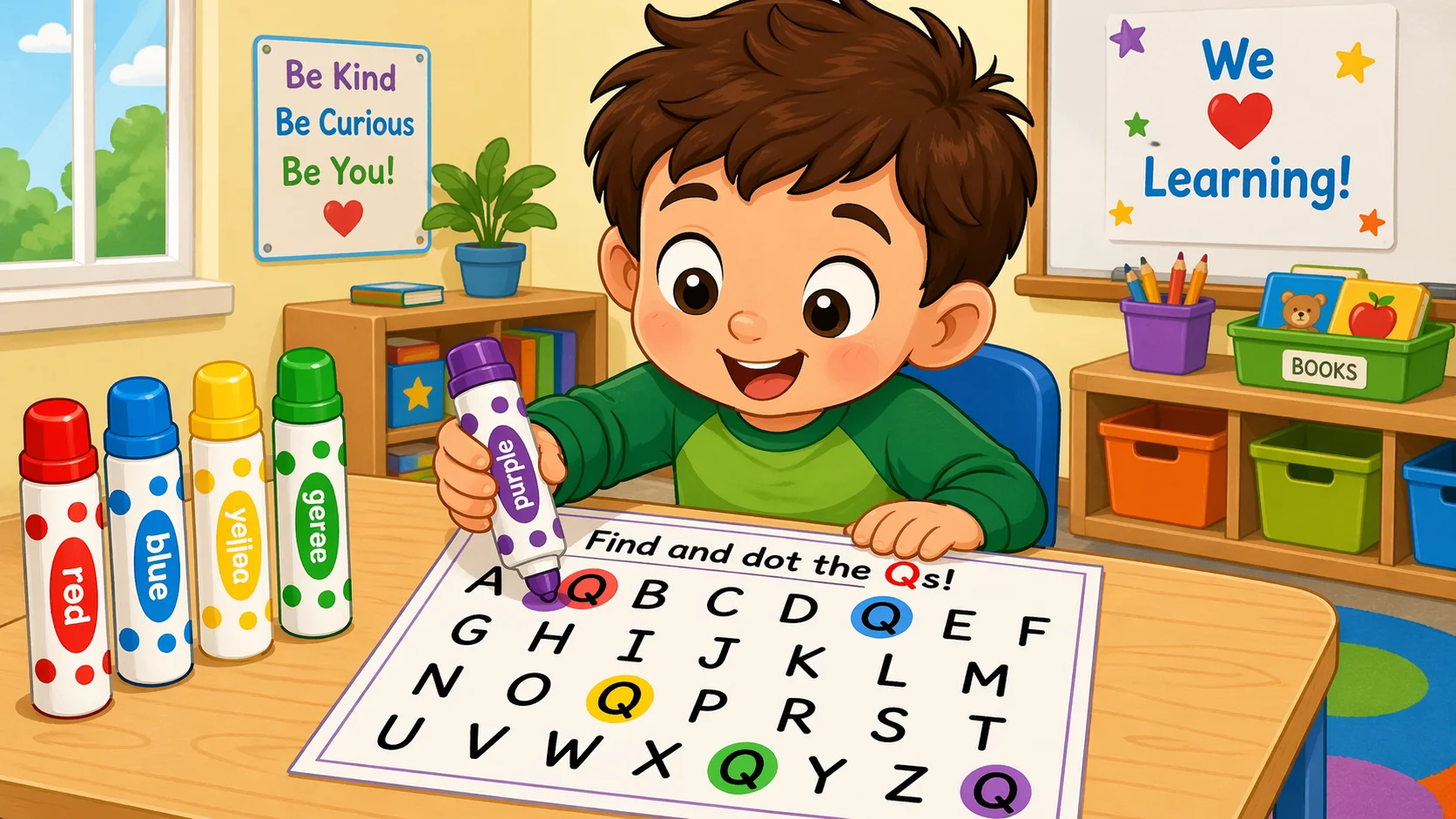
This printable game is one of the easiest ways to practice letter recognition in preschool.
Materials
- Printable grid with mixed letters and symbols
- Dot markers or bingo daubers
How to Run the Activity
- Ask children to find all the uppercase Qs and dot them in one color.
- Then ask them to find the lowercase q forms using another color.
- Count how many they found.
- Keep the page simple enough that scanning stays fun.
Skills Focus
This activity improves visual scanning and attention to detail. It also supports uppercase and lowercase letter recognition without forcing writing too early.
11. Search and Match Game
A matching game helps children decide which pictures belong with the letter Q.
Materials
| Component | Description |
| Symbol Cards | Flashcards with Q and q |
| Object Cards | Pictures of a queen, quilt, quail, and quarter |
| Match Mats | Boards for placing the correct pairs |
How to Run the Activity
- Spread picture cards face down.
- Have the child turn one over and name it.
- Decide whether the word begins with the /kw/ sound and the letters qu.
- Match it to the Q or q card and continue.
Skills Focus
Matching games build memory, sorting, and sound awareness. They are especially helpful for children learning to notice which words begin with the letter pattern being studied.
12. Playdough Formation
Playdough is one of the best preschool tools for hands-on letter building.
Materials
- Playdough
- Laminated mats or letter q worksheets
- Beads or sticks for the tail
How to Run the Activity
- Roll long “snakes” of dough.
- Curve one into the round body of Q.
- Add the tail with a smaller piece.
- Repeat with lowercase q and compare the two forms.
Skills Focus
This activity strengthens hands, supports shape memory, and makes letter formation feel playful instead of pressured.
13. Salt Tray Tracing
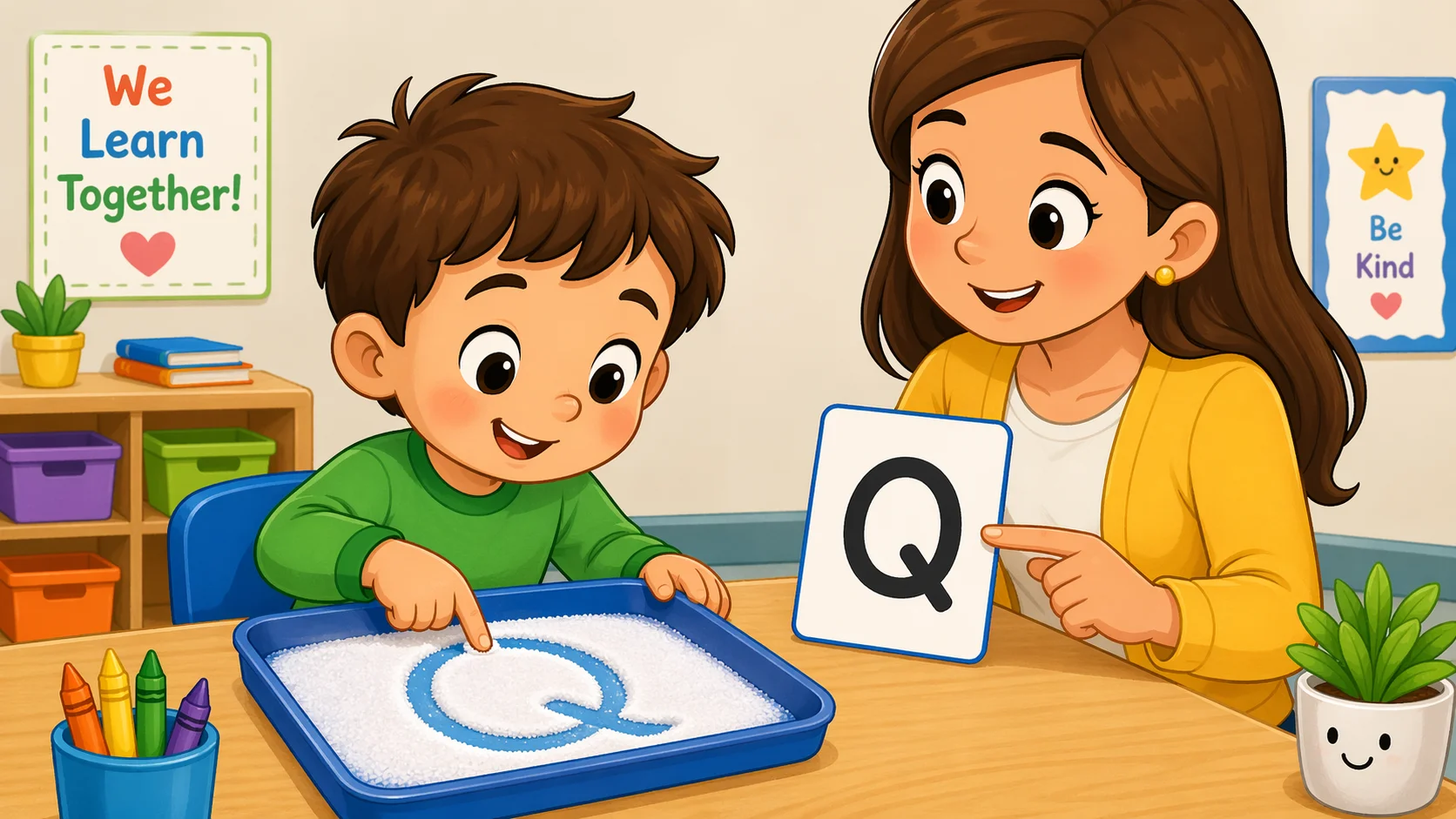
A salt tray is ideal for children who are ready to begin tracing but not yet ready for full pencil control.
Materials
- Shallow tray
- Salt, sand, or colored sugar
- Reference card showing Q and q
How to Run the Activity
- Let the child study the model card.
- Use one finger to draw Q or q in the tray.
- Shake gently to erase it.
- Repeat with both uppercase and lowercase forms.
Skills Focus
Salt trays support tactile memory, confidence, and early writing habits. They are especially useful when children are learning how to form the letter with the correct movement pattern.
14. Beginning Sound Sorting
This is one of the most effective preschool phonics activities for the letter Q.
Materials
- Two baskets or envelopes
- One labeled Q
- Picture cards with qu words and non-Q pictures
How to Run the Activity
- Choose a picture card.
- Say the word aloud.
- Put it in the Q basket if it belongs there.
- Review the final group together.
Skills Focus
This activity teaches initial sounds, listening, and sound sorting. It is simple, effective, and easy to repeat over several days.
15. Letter Q Floor Hop
This movement game is a fun way to bring Q practice off the page.
Materials
- Painter’s tape or paper cards
- Open floor space
- Music optional
How to Run the Activity
- Put Q and q cards on the floor in a path.
- Have children hop from one to the next.
- At each stop, say a word that begins with qu or make the /kw/ sound.
- Add freeze-and-hop music for variety.
Skills Focus
Floor Hop supports letter recall, gross motor coordination, and active participation. It is especially useful for high-energy preschoolers and keeps literacy work lively.
16. Q Snack Formation
An edible activity can be a fun way to end the week, as long as children are closely supervised.
Materials
- Pretzels for the tail
- Cucumber slices or apple rings for the circle
- Cheese sticks or other safe, age-appropriate snack pieces
How to Run the Activity
- Give each child a round snack and a straight snack.
- Ask them to arrange the pieces into the shape of a Q.
- Name the letter before eating.
- Count how many Q shapes they can make.
Skills Focus
This activity reinforces sequencing, shape awareness, and participation. It also adds a sensory component that many preschoolers enjoy.
Mastering the Q Sound with Songs and Chants
Understanding the /kw/ sound associated with qu is just as important as recognizing the letter shape. In English, Q is usually followed by U, and the pair qu often represents the /kw/ sound heard in words like “queen” and “quilt.”
The Q + U Connection
Preschoolers do not need a formal spelling lesson, but it helps to point out that Q and U often work together in simple words. This gives children a useful early pattern to notice in common words.
Song and Chant Ideas
- The Quacking Q: “The duck by the Q goes quack, quack, quack…”
- The Quiet Queen: Children tiptoe like a queen while staying quiet.
- Clap the Sound: Children clap only when they hear a word that begins with the /kw/ sound.
Expert Tips for Teaching Q
Start with the Uppercase Form
Many children notice uppercase Q first because the tail is easy to spot. Once children feel secure with uppercase Q, introduce lowercase q.
Connect to Real Life
Use objects children may already know, like a quarter or a quilt in a storybook. This makes learning more concrete.
Keep Practice Short and Playful
Preschoolers do better with short, active sessions than long drills. Rotating crafts, games, movement, and printables helps keep the lesson fresh.
Build Shape, Sound, and Name Together
Many children learn more easily when they see the shape, hear the sound, and say the letter name in the same lesson. This kind of repetition is simple but effective.
Conclusion
Teaching the letter Q does not need to feel difficult or forced. With a thoughtful mix of crafts, sensory play, movement, and printables, preschoolers can build confidence in letter recognition, sound awareness, and early writing skills in a natural way.
For a balanced week, try this combination:
- One Craft: Q Is for Quack
- One Sensory Task: Quarter Sensory Bin
- One Movement Game: Floor Hop
- One Printable: Dot Marker Letter Hunt
This mix keeps letter learning varied, practical, and fun.
Frequently Asked Questions
What are fun letter Q activities for preschoolers?
Some of the most popular options include a quacking duck craft, a queen crown, a quilt collage, a quarter sensory bin, and a movement game like Floor Hop.
How do you teach Q to preschoolers?
Start with the letter shape and the /kw/ sound, then move into playful practice. Crafts, matching games, sensory bins, and simple tracing all help reinforce learning.
Why does Q usually appear with U?
In English, Q and U are usually paired together, and the pair qu often represents the /kw/ sound. Teaching this as a simple pattern helps preschoolers remember it more easily.
What Q words work well for preschoolers?
Good examples include “queen,” “quack,” “quilt,” “quarter,” “quail,” “quiet,” and “quick.”
What letter Q printables work best?
Simple tracing pages, search-and-find pages, matching games, and beginner-friendly letter Q worksheets are usually the most effective.
How can I support both uppercase and lowercase practice?
Use matching cards, dot marker pages, and side-by-side comparison activities. Children often learn more easily when they can see both forms together in short, repeated practice.
How can I use these letter Q crafts and activities in a letter of the week plan?
These letter Q crafts and activities work well as part of a simple letter of the week plan. Choose one craft, one fine motor activity, one movement game, and one printable to reinforce the letter sound, shape, and beginning letter sounds throughout the week.
Do I need a free printable letter Q for these activities?
A free printable letter Q can make the activities easier to prepare, especially for tracing, coloring, dot marker pages, and fill-the-letter-Q crafts. A blank letter Q template is also useful for painting, collage work, and other hands-on activities.
What is a good fine motor activity for uppercase letter Q?
A hole punch task, playdough formation, or salt tray tracing can be a great fine motor activity for uppercase letter Q. These activities help children draw the letter Q, write the letter, and build control for proper letter formation.
Take a short quiz to find out what your everyday choices say about your parenting style
When your child is curious about something new, what’s your instinct?
Take a short quiz to find out what your everyday choices say about your parenting style
“Can I download this app?” What happens next?
Take a short quiz to find out what your everyday choices say about your parenting style
When it comes to rules at home, which sounds most like you?
Take a short quiz to find out what your everyday choices say about your parenting style
If you could give your child one life skill today, what would you pick?
Take a short quiz to find out what your everyday choices say about your parenting style
Your child gets to choose what to watch. What would your ideal setup look like?
Take a short quiz to find out what your everyday choices say about your parenting style
Pick your parenting superpower ✨