Letter G Activities for Kids: Games, Crafts, Worksheets and Learning Ideas

 Discover a Free Education Video App for Kids
Pastory uses AI to personalize educational video content based on your child’s interests and personality. Safe, engaging, and built for curious young minds. Sign up now to stay updated and enjoy early access with a free trial
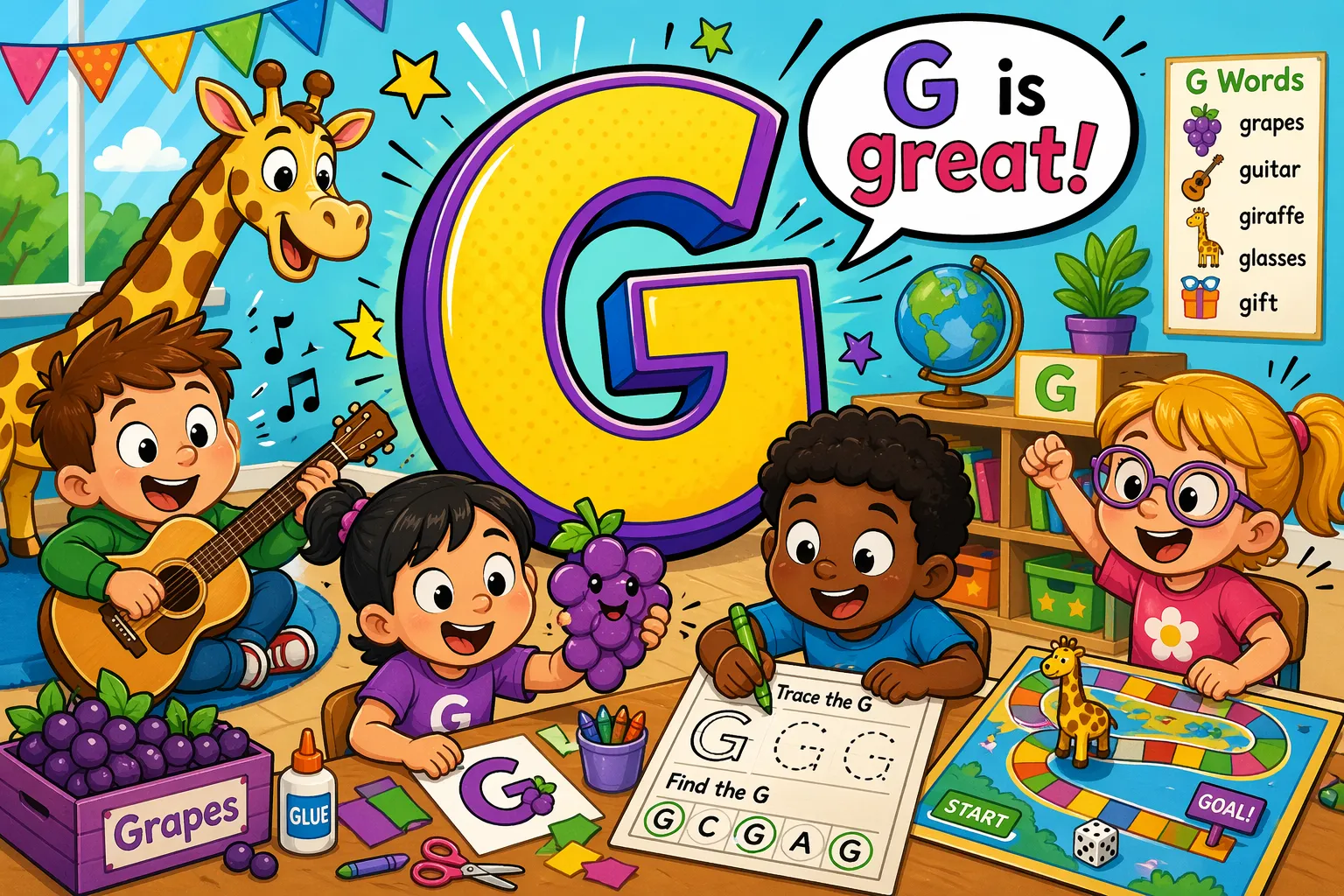
Learning the letter G is one of the early milestones in a child’s literacy journey. This guide covers a wide range of G activities for preschoolers and kindergarteners, from hands-on crafts and sensory play to printable worksheets and phonics games. Whether you’re a parent working with a toddler at home or an educator building a letter G lesson plan, you’ll find practical, age-appropriate ideas to make learning both effective and fun.
Letter G Vocabulary and Word Collection
Building vocabulary around the G gives children a meaningful context for learning the letter itself. When kids connect sounds to real words and images they already know, letter recognition becomes much easier to internalize.
Common Words That Start With G
Introducing G words works best when you start with familiar, concrete objects. Words like goat, grape, gift, grass, green, girl, and gold are easy to illustrate and remember. Begin with three to five words and gradually expand the list as confidence grows. Pointing to real objects or pictures while saying each word helps children form a strong connection between the letter, the sound, and the concept.
Picture and Word Matching Activities
Matching games that pair images with written G words are a highly effective tool for early literacy. Set out a group of picture cards — a goat, a guitar, a glass — alongside word cards, and ask children to find the pairs. This type of activity reinforces both letter recognition and early reading skills in a low-pressure, game-like format.
Beginning Sound Sorting Games
Sound sorting helps children tune in to the /g/ sound at the start of a word. Prepare a set of picture cards featuring objects that start with G and objects that don’t — then ask children to sort them into two groups. This builds phonemic awareness, which is one of the strongest predictors of early reading success.
Letter G Recognition and Identification Games
Before children can write or sound out the G, they need to be able to spot it reliably. Recognition activities train the eye to identify G among other letters — an important step toward fluent reading.
Circle the Letter G Worksheets
Printable worksheets that ask children to circle every letter G on a page are a simple but effective scanning exercise. These worksheets strengthen visual discrimination skills and help children distinguish G from similar-looking letters like C or O. Keep sessions short — five to ten minutes is enough for most preschoolers.
Spot Letter G in Rhymes and Stories
Reading aloud and asking children to raise their hand or tap the table every time they hear the /g/ sound turns a regular storytime into an active phonics lesson. Books with repetitive language and rhyme, like Green Eggs and Ham, are particularly good for this type of activity. It builds phonemic awareness naturally, without feeling like formal instruction.
G Search and Match Games
Interactive matching exercises — either on printed sheets or through educational apps — ask children to find and match uppercase G with lowercase g, or to connect G letters with pictures of G words. These activities reinforce both letter recognition and the understanding that uppercase G and lowercase g represent the same sound.
Find and Color G
Coloring activities serve a dual purpose: they develop fine motor skills while reinforcing early letter recognition and visual memory. When a child colors every G on a page, they practice sustained attention and careful observation at the same time.
- Printable letter G coloring pages come in many themes — animals (gorilla, giraffe, goose), food (grapes, gingerbread), and nature scenes. Choose themes that match your child’s current interests to maintain engagement.
- Dot marker and sticker fill activities ask children to fill in the outline of a letter G using dot markers or round stickers. The physical act of placing each dot builds hand-eye coordination and reinforces the shape through repetition.
- Color by letter G worksheets combine coloring with identification tasks, asking children to color only the spaces marked with a G. This adds a problem-solving element while keeping the activity hands-on and visually engaging.
Uppercase and Lowercase G Practice
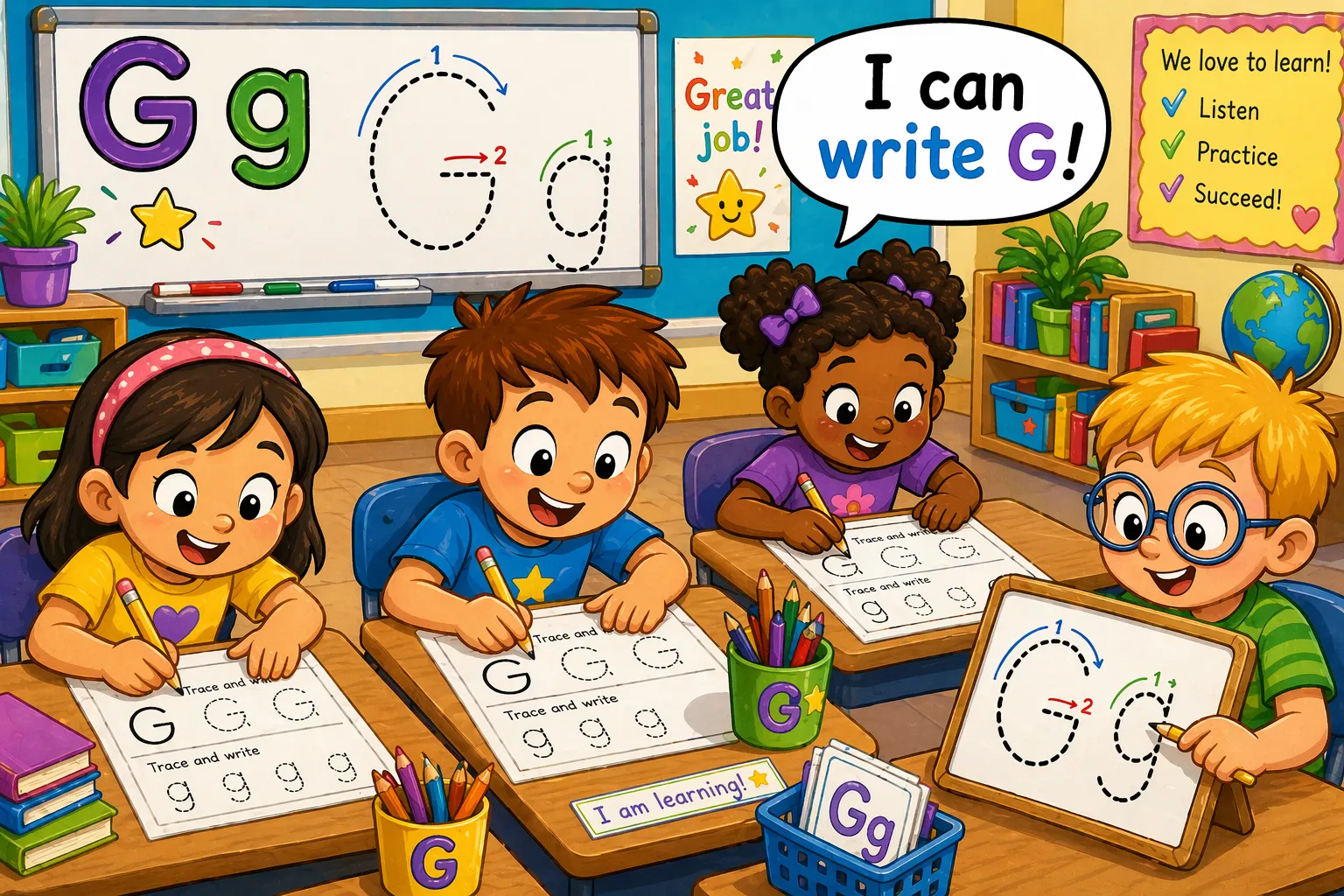
Understanding that uppercase G and lowercase g are the same letter in two different forms is a concept that takes time and practice. A mix of visual, tactile, and written activities helps children internalize both forms.
G Handwriting Practice Sheets
Tracing worksheets are the standard starting point for handwriting practice — and for good reason. Guided tracing gives children a motor memory for the letter before they attempt freehand writing. A well-designed handwriting sheet will progress from large, dotted outlines to smaller, unguided spaces, gradually building independence. Focus on the capital letter G and lowercase g separately before introducing them side by side.
Salt Tray and Sensory Tracing Methods
Filling a shallow tray with salt, sand, or rice and asking children to trace the letter G with their finger is a tactile learning technique that engages multiple senses at once. This method is particularly effective for children who struggle with pencil-based tasks, as it removes the pressure of “getting it right” on paper. The loose material also lets children erase and try again instantly, which encourages persistence.
Playdough and Tactile Letter Formation
Rolling playdough into long snakes and shaping them into the letter G is a hands-on craft activity that doubles as fine motor practice. Children can make the uppercase G and lowercase g side by side for comparison. Adding googly eyes to a playdough G to turn it into a funny creature is a popular variation that adds an element of fun and helps with memorization.
Letter G Games, Mazes and Interactive Activities
Play-based learning is especially important in preschool and kindergarten, where sustained attention is still developing. Games and movement activities keep children engaged while reinforcing letter G skills in a natural, low-pressure context.
- Animal-themed G mazes ask children to guide an animal — a goat, a gorilla — through a maze to reach a goal. These activities combine problem-solving with letter learning and are well-suited to children who are ready for a mild challenge.
- Treasure hunt games send children around the room (or garden) to find objects or cards that begin with the G. The physical movement involved helps anchor the learning experience in memory.
- Online letter G games offer gamified learning experiences through platforms like Starfall or PBS Kids, where children can interact with animated letter G. Short sessions of five to ten minutes can be a useful complement to hands-on activities, particularly for children who respond well to screen-based rewards.
Letter G Crafts and Art Projects
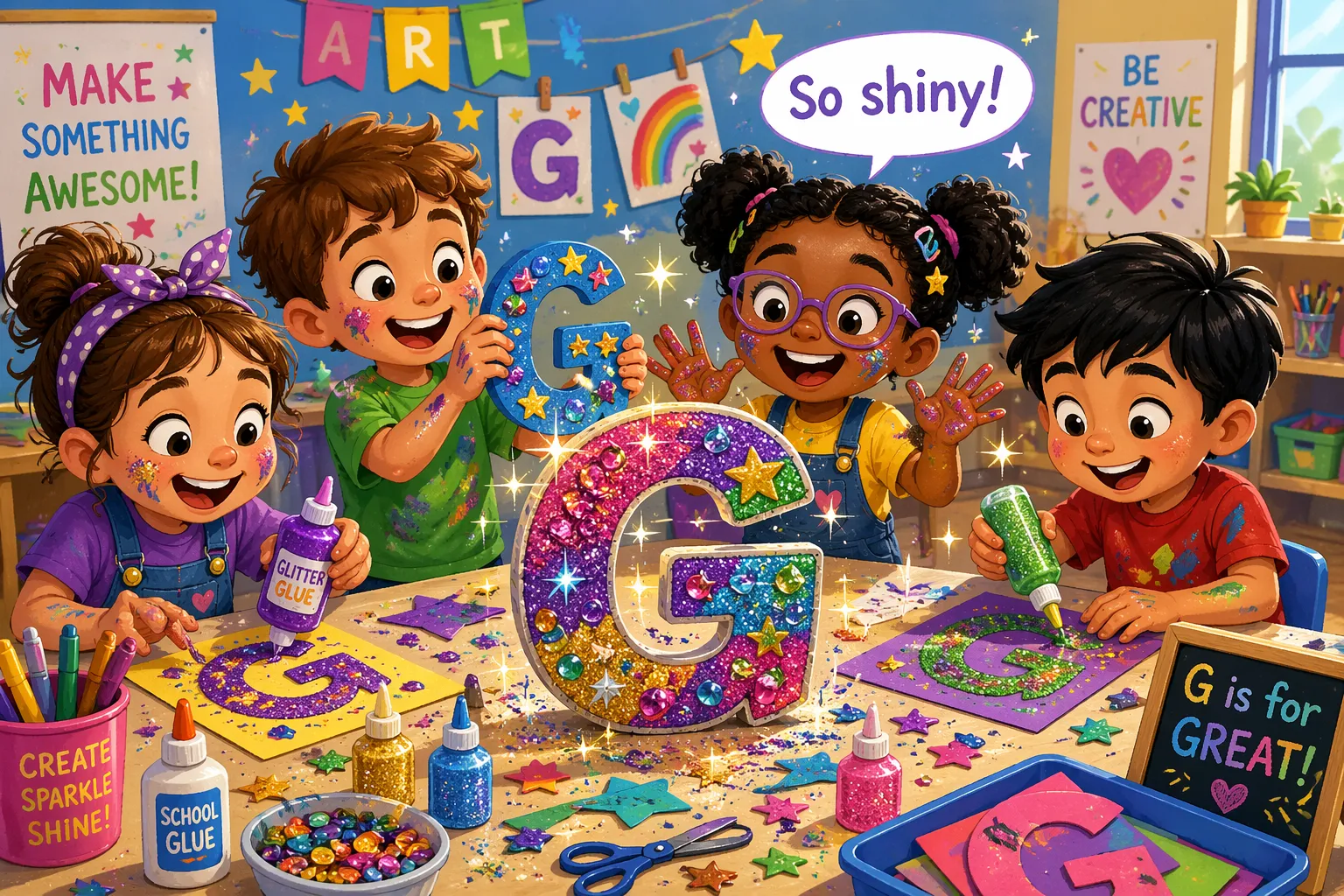
Craft activities build a lasting association between the sound and the words it represents. They also give children something tangible to be proud of — which builds confidence alongside early literacy skills.
G Is for Glitter Glue Craft
Tracing the G shape in glue and then covering it with glitter, sequins, or colored sand is a simple, visually rewarding activity that reinforces formation skills. The tactile element — feeling the raised outline — supports sensory learning and helps children remember the shape more effectively. Glitter glue or squeeze bottles make the process easier for small hands that are still developing control.
Additional variations include using salt over wet glue and painting it with watercolor, outlining with pom-poms, or decorating with small beads for extra texture.
G Is for Garden, Grapes and Green
Themed art projects built around familiar words help children remember vocabulary through creative association. Painting a bunch of grapes using fingerprints, creating a paper garden scene with flowers and grass, or making a collage from green magazine scraps all reinforce recognition while encouraging imagination.
More ideas include crafting a green frog with paper circles, building a mini garden using real soil and seeds, or creating a “green day” artwork using only shades of green. You can also introduce items like grass rubbings, leaf prints, or sponge painting to add variety.
Animal Crafts Like Giraffe and Goose
Animal-based projects are especially effective because children naturally connect with animals. A paper plate giraffe with painted spots, a cotton ball goose, or a paper bag gorilla are simple enough for preschoolers and kindergarteners to create with minimal help. These crafts can be paired with stories or songs to deepen engagement.
Other engaging options include making a goldfish using paper plates, crafting a grasshopper with folded paper, or designing a glowing firefly using yellow tissue paper and black cardstock. Displaying these creations at home or in the classroom creates a print-rich environment that reinforces learning over time.
Food-Themed Crafts and Edible Creations
Using food adds another layer of excitement and sensory exploration. Children can create shapes using grapes, assemble snacks like crackers and cheese into recognizable forms, or decorate cookies with green icing.
You can also try making gelatin cups (“green jelly”), building fruit skewers with grapes, or arranging vegetables like cucumbers and peas into fun designs. These activities combine creativity with taste, making the experience more memorable.
Sensory and Texture-Based Art Ideas
Hands-on, texture-rich activities help strengthen memory and engagement. Children can trace shapes in shaving cream, sand, or salt trays, or create textured art using fabric, foil, or natural materials like grass and leaves.
Other ideas include using gel bags for tracing, painting with sponges, or creating “mess-free” sensory bags filled with colored gel. These approaches are especially helpful for kinesthetic learners who benefit from movement and touch.
Recycled and DIY Craft Projects
Using everyday materials encourages creativity while teaching resourcefulness. Cardboard tubes can become giraffes, egg cartons can be turned into caterpillars or insects, and old magazines can be cut into themed collages.
You can also create gift boxes, decorate jars with green materials, or build simple toys like spinning wheels or puppets. These projects show children that learning can happen anywhere using simple, accessible supplies.
Letter G Sensory and Fine Motor Activities
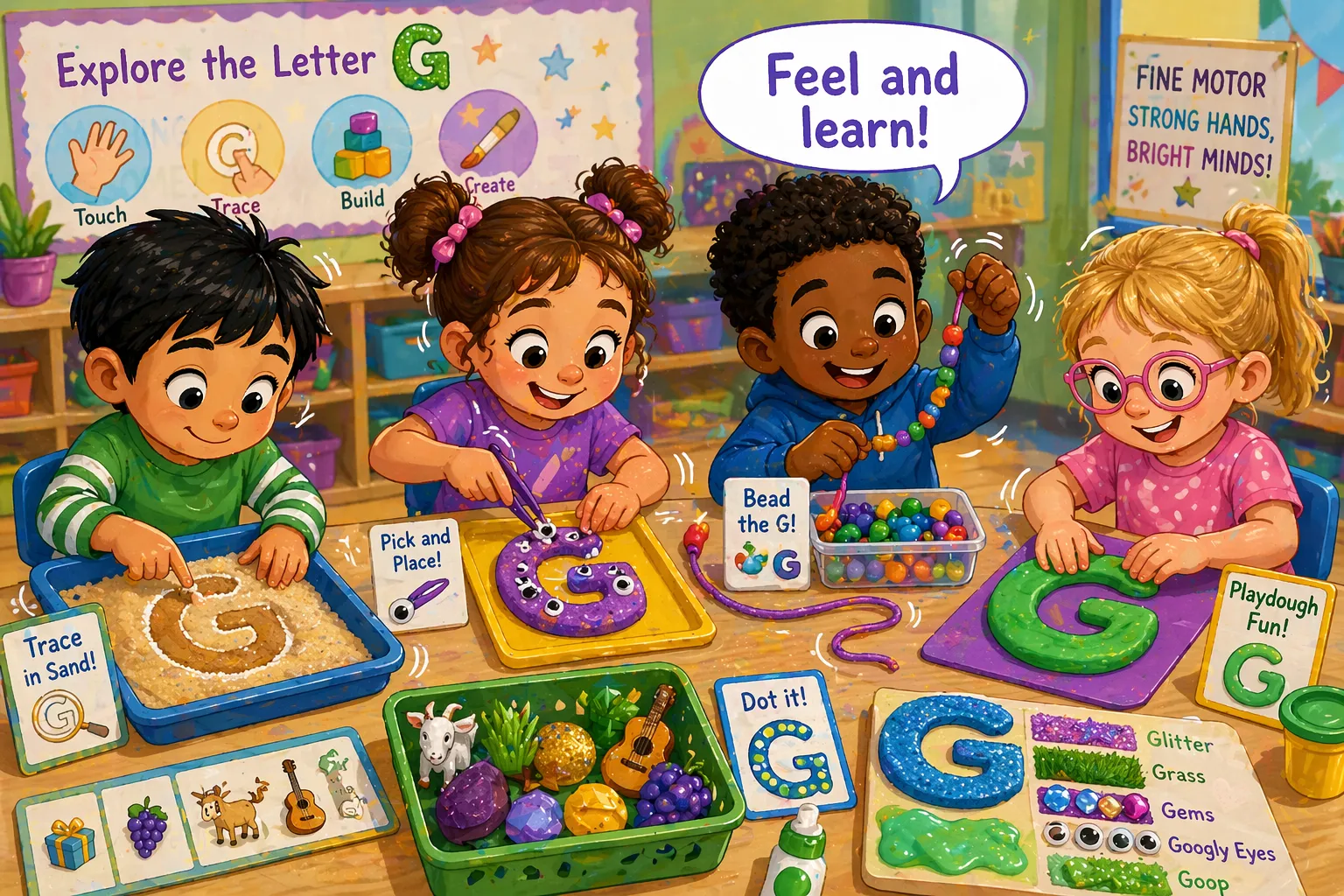
Sensory play supports letter learning in ways that worksheets alone cannot — it engages the whole body and creates multi-sensory memories that are easier to recall.
Gem Sensory Bin Exploration
Fill a bin with kinetic sand, dried rice, or water beads and hide plastic gems, letter tiles, or small objects beginning with G throughout. Children search for the items and name each one as they find it. This type of sensory play is particularly effective for toddlers and children who learn best through movement and touch.
Sticker Letter Fill and Collage Activities
Providing children with a large outline of the letter G and asking them to fill it with stickers, torn paper pieces, or collage materials strengthens hand coordination while reinforcing the visual shape. Sticker activities are especially accessible for younger children who find cutting and gluing challenging.
Floor Hop and Movement Games
Write large letters on the floor using masking tape or chalk, then call out words and ask children to hop to the correct letter. Physical movement combined with recognition creates a multi-sensory learning experience, and movement breaks have been shown to improve attention and on-task behavior in young children.
Letter G Reading and Phonics Activities
Phonics instruction gives children the tools to decode unfamiliar words independently. Letter G is a useful teaching point because it introduces the concept of a letter having more than one sound.
G Sound Practice and Phonics
The letter G makes two sounds in English: the hard G (as in goat, grape, green) and the soft G (as in giraffe, gem, giant). Teaching both sounds clearly — and helping children understand when each applies — builds stronger phonemic awareness than treating G as a single sound. Word grouping activities, where children sort hard-G and soft-G words into two lists, are an effective and engaging method.
Letter G Song and Video Resources
Songs and rhythmic chants are among the most powerful tools in early literacy because repetition and melody help children retain information. YouTube channels like Cocomelon, Jack Hartmann Kids Music Channel, and Super Simple Songs offer letter G songs that are free, short, and designed for preschool attention spans. Using the same song repeatedly across a week reinforces learning through consistent repetition.
Simple Reading Exercises with G Words
Once children are familiar with the letter G and its sounds, short reading tasks help bridge the gap between phonics and real reading. Prepare simple two- to four-word sentences using G words — The goat is big. Gus has a gift. — and ask children to read them aloud. This builds decoding confidence and connects phonics instruction to meaningful reading.
Tips for Teaching Letter G Successfully
Effective letter G instruction is less about any single activity and more about the combination of approaches you use over time.
- Focus on sound and pronunciation first. Children who understand the /g/ sound before they learn to write the letter develop stronger phonics skills. Avoid drilling letter names without connecting them to sounds.
- Combine multiple activity types. A mix of handwriting practice, sensory play, crafts, and games ensures that different learning styles are supported and that children stay engaged across a full week of letter G activities.
- Adapt activities by age level. Toddlers (ages 2–3) benefit most from sensory bins, large coloring pages, and simple object naming. Preschoolers (ages 3–5) can handle matching games, tracing, and basic crafts. Kindergarteners are ready for beginning sound sorting, handwriting sheets, and simple phonics reading tasks.
Weekly Letter G Activity Plan
A structured week keeps learning varied and progressive:
- Monday — Introduce G vocabulary with picture cards and a letter G song
- Tuesday — Tracing worksheets (uppercase G and lowercase g) and salt tray practice
- Wednesday — Letter G craft (giraffe or grape art project)
- Thursday — Sensory bin exploration and sticker fill activity
- Friday — Letter hunt game, story read-aloud, and simple G word reading
Teaching the letter G is most effective when it combines phonics, hands-on crafts, sensory play, and printable worksheets in a varied, consistent routine. Children build letter recognition, fine motor skills, and early literacy skills most reliably when learning feels like exploration rather than drill. Whether you’re working through a homeschool curriculum or planning kindergarten lesson activities, the key is to keep sessions short, playful, and connected to words and objects that children already find meaningful.
Frequently Asked Questions
What are fun letter G art projects for preschoolers?
Easy and engaging options include a paper plate giraffe, a fingerprint grape bunch, a glitter glue G tracing craft, and a torn-paper green collage. These crafts are low-prep, use basic materials, and help children form a lasting visual memory of both the letter and the G vocabulary words connected to it.
What are activities that start with G for kids?
Beyond literacy-focused tasks, activities that start with G include gardening (planting seeds), gallery walks (displaying artwork), guessing games, group sorting activities, and gross motor games like “Goose, Goose, Goat” (a variation on Duck, Duck, Goose). These reinforce the letter G sound in a natural, playful context.
What is the best way to teach letter G?
The most effective approach combines clear phonics instruction (teaching both the hard and soft G sounds), tactile and sensory activities, repetition through songs and games, and gradual progression from recognition to writing. Consistency matters more than any single method — short daily practice sessions across a week are more effective than one long lesson.
What are easy letter G activities for toddlers?
For toddlers, the best letter G activities are low-prep, safe, and sensory-focused. Object identification games (pointing to a grape, a goat picture, a green toy), large-format coloring pages, gem sensory bins, and simple dot marker activities all suit shorter attention spans and developing motor skills. Keep sessions to five minutes and prioritize exploration over accuracy.
How do you teach hard and soft G sounds?
The hard G sound (as in goat, grape, grass) is the more common of the two and is usually taught first. The soft G sound (as in giraffe, gem, giant) typically occurs before the letters E, I, or Y. Introduce both sounds using word grouping activities — sorting picture cards into hard-G and soft-G piles — and reinforce with repetitive reading of simple sentences featuring each sound.
What are indoor letter G games for preschoolers?
Indoor options include scavenger hunts (searching for objects beginning with G around the house), matching card games, floor-tape letter hop activities, playdough letter formation, and printable G mazes. These activities keep children active and focused without requiring outdoor space or elaborate materials.
Take a short quiz to find out what your everyday choices say about your parenting style
When your child is curious about something new, what’s your instinct?
Take a short quiz to find out what your everyday choices say about your parenting style
“Can I download this app?” What happens next?
Take a short quiz to find out what your everyday choices say about your parenting style
When it comes to rules at home, which sounds most like you?
Take a short quiz to find out what your everyday choices say about your parenting style
If you could give your child one life skill today, what would you pick?
Take a short quiz to find out what your everyday choices say about your parenting style
Your child gets to choose what to watch. What would your ideal setup look like?
Take a short quiz to find out what your everyday choices say about your parenting style
Pick your parenting superpower ✨