21 Letter B Activities for Preschool, Pre-K, and Kindergarten

 Discover a Free Education Video App for Kids
Pastory uses AI to personalize educational video content based on your child’s interests and personality. Safe, engaging, and built for curious young minds. Sign up now to stay updated and enjoy early access with a free trial
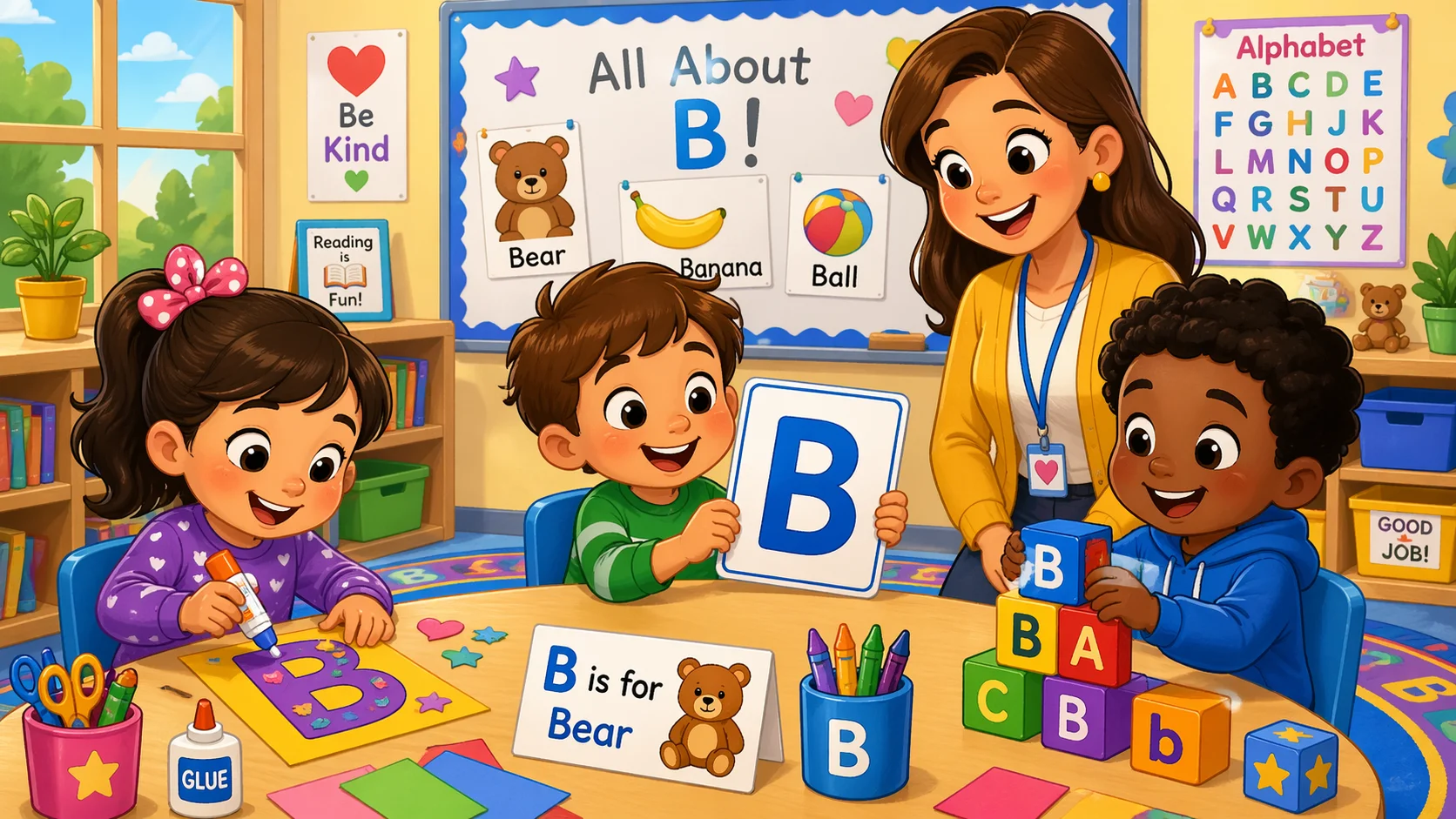
Teaching the alphabet is a foundational milestone in early childhood education. For young learners, the letter B is often one of the first consonants introduced because its sound is easy to produce and its shape is easy to recognize. This guide offers 21 engaging ways to build letter recognition, phonemic awareness, and fine motor skills through hands-on play and structured learning.
Why Letter B Activities Work for Preschool, Pre-K, and Kindergarten
Effective early literacy instruction requires a multi-sensory approach. This article brings together a variety of phonics-based exercises, sensory play ideas, and creative crafts. By engaging multiple senses, children are more likely to remember the beginning sound and the formation of both the uppercase and lowercase forms.
To support learning, many educators use a “letter of the week” approach, allowing children to explore one letter in depth before moving on. This approach can help prevent cognitive overload and build a strong foundation for future reading.
Skills Focus
Targeting specific developmental milestones is crucial at this age. These tasks build:
- Identification: Recognizing the visual shapes of uppercase B and lowercase b.
- Phonemic Awareness: Connecting the /b/ sound to objects that begin with that sound.
- Fine Motor Skills: Using markers, crayons, glue, and small materials to strengthen the hand muscles needed for writing.
- Visual Discrimination: Noticing the difference between similar-looking letters such as b, d, and p.
Age Fit
Tailoring the experience to the child’s developmental stage ensures engagement without frustration:
- Toddlers, Ages 2–3: Focus on sensory bins, gross motor skills, and hearing the sound in fun songs.
- Preschoolers, Ages 3–4: Try worksheets, dot-marker pages, and simple crafts, such as a paper-plate bumblebee.
- Pre-K and Kindergarten, Ages 4–6: Focus on tracing, early phonics, and simple problem-solving with math activity sheets.
How to Use This List
To create a balanced curriculum, select one task from each of these categories:
- Printable: Use a search-and-match page or another simple worksheet.
- Sensory: Set up a sensory bin with items that start with ‘B’.
- Creative: Complete a B craft or a process-art project.
- Movement: Play a game of balloon batting to reinforce the concept.
Letter Collage
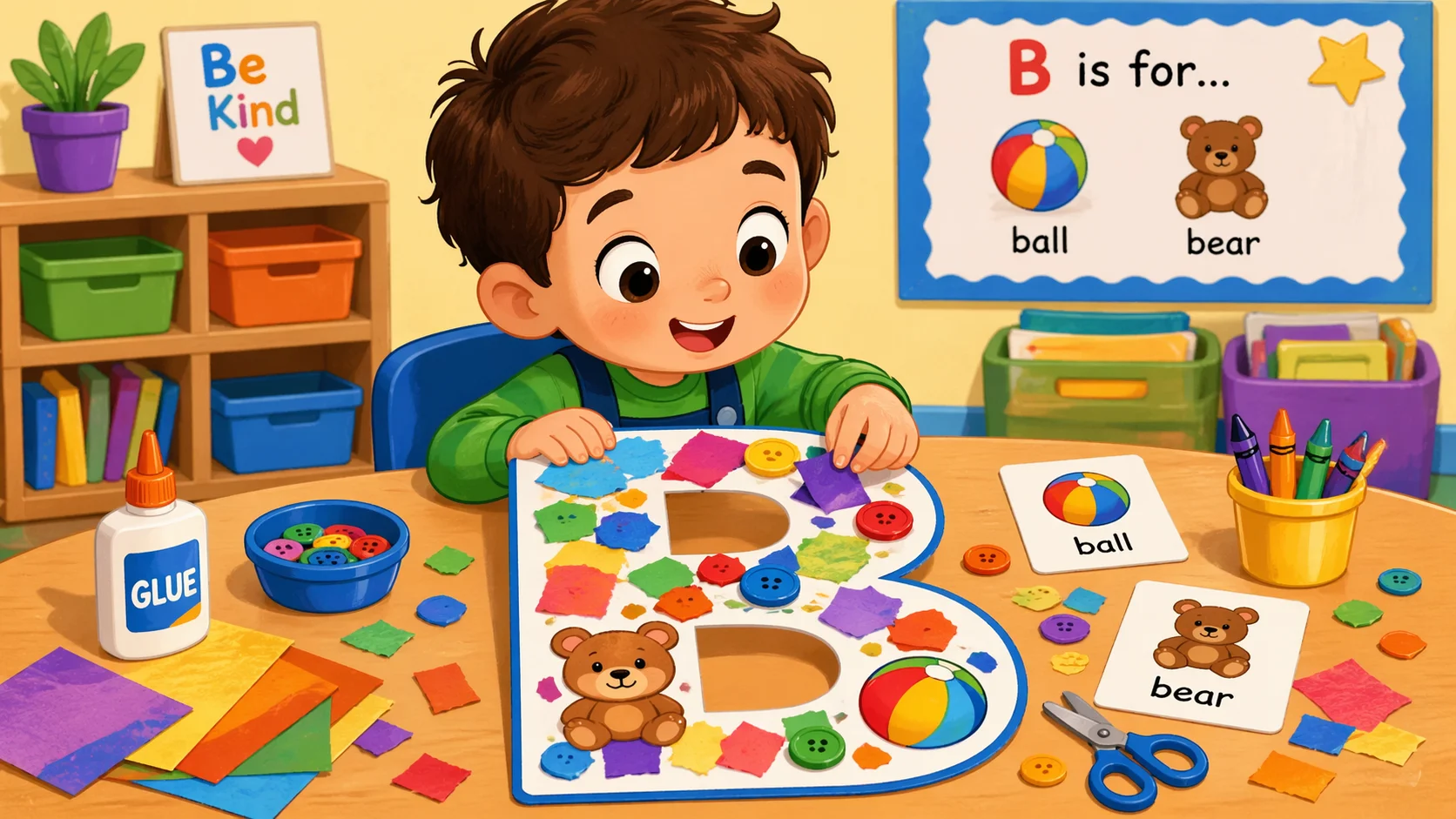
A letter collage is a classic hands-on activity that introduces the shape of a letter while building vocabulary.
Materials Needed
- Large ‘B’ template printed on construction paper.
- Glue sticks or liquid adhesive.
- Magazines, stickers, and buttons.
- Pictures of objects that begin with B (ball, bird, boat).
Set-Up
Print or draw a large uppercase B and lowercase b on a sheet of paper. Organize your materials in a tray so the child can easily see and sort through the different textures and images.
How to Do Activity
- Show the child the character and model the /b/ sound clearly.
- Have the child identify magazine pictures of objects that start with the /b/ sound.
- Apply glue to the outline.
- Stick the items onto the letter while repeating the name of each object, such as “B is for button.”
Do-A-Dot Letter Search
A dot-marker activity is a fun way to strengthen visual scanning and fine motor control in preschoolers.
Materials Needed
- Do-A-Dot markers (or round stickers).
- Free alphabet search printable.
- Crayons for coloring the border.
Set-Up
Print a worksheet that features a grid of various characters. Include a mix of uppercase and lowercase letters to support the child’s visual discrimination skills.
How to Do Activity
- Ask the child to find the uppercase B and mark it with a specific color.
- Switch colors and have the child find the lowercase b.
- Encourage the child to count how many they found at the end of the task.
Search and Match
This matching activity reinforces the connection between the printed letter and its beginning sound.
Materials Needed
- Cardstock letter cards.
- Picture cards (bear, bus, banana).
- A matching activity mat or a flat surface.
Set-Up
Lay out the uppercase and lowercase cards on one side of the table and the picture cards on the other. Ensure the images represent clear, simple phonics examples.
How to Do Activity
- The child picks a picture card and says the word aloud.
- The child then searches for a letter card that matches the beginning sound.
- Place the letter card and the corresponding picture card together to complete the pair.
Find and Cover
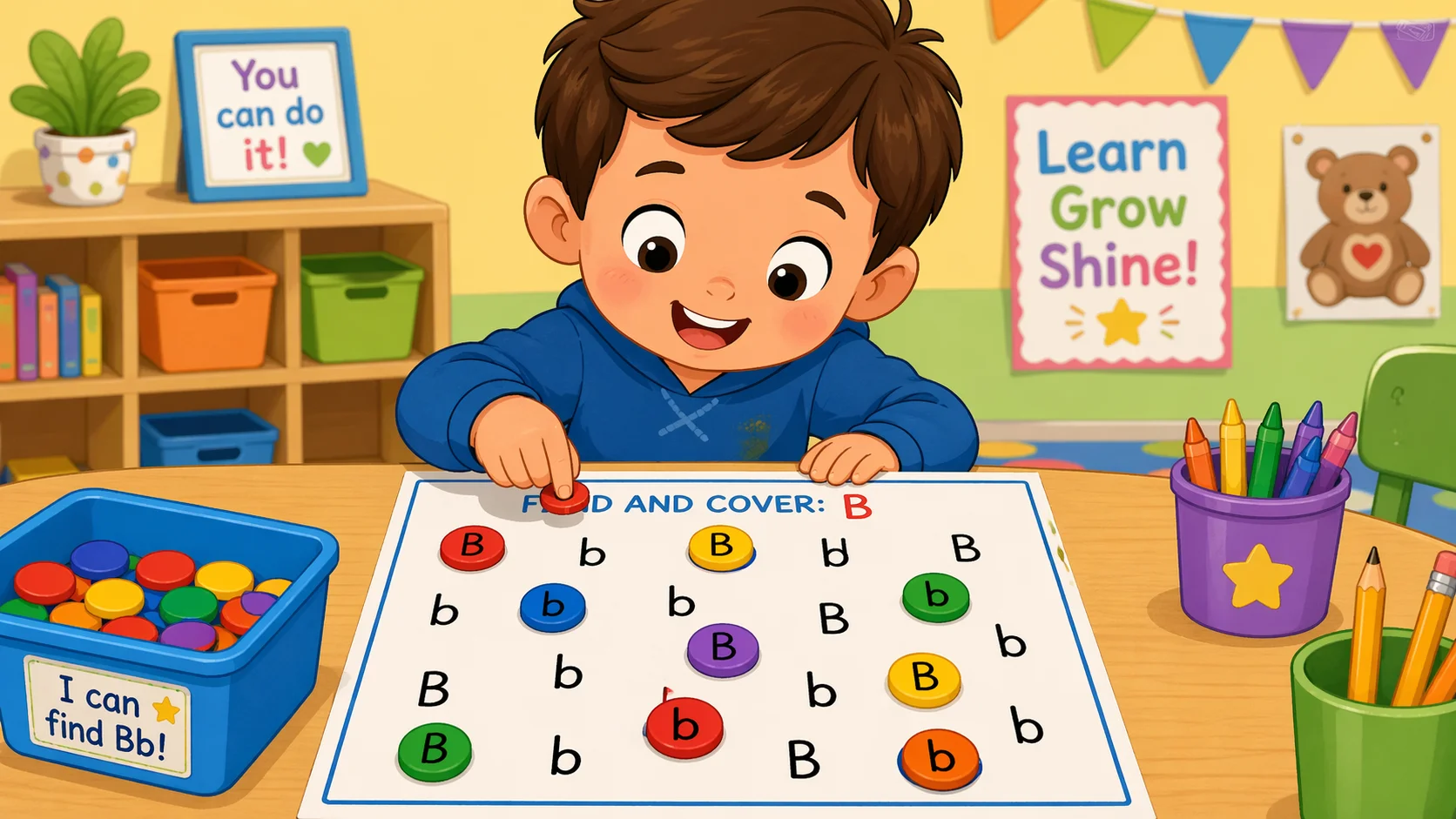
Using small manipulatives can make a simple worksheet feel like a game, which is ideal for toddlers and preschoolers.
Materials Needed
- Letter worksheets with a “hidden” layout.
- Small objects like mini erasers, buttons, or pom-poms.
Set-Up
Place the printable on a tray. Provide a small bowl of “covers” (the manipulatives).
How to Do Activity
- The child scans the page to find uppercase B and lowercase b.
- Every time they see a ‘B’ or ‘b’, they cover it with a small object.
- This pre-reading skill helps with tracking from left to right across a page.
Bear Collage
Connecting the lesson to Brown Bear, Brown Bear, What Do You See? by Bill Martin Jr. makes the activity memorable.
Materials Needed
- Brown construction paper.
- Googly eyes and a black marker.
- Glue and scissors.
Set-Up
Cut out a large uppercase B. Pre-cut two small circles for ears and a small oval for a snout.
How to Do Activity
- Explain that “B is for Bear.”
- The child glues the ears and snout onto the uppercase B.
- Add googly eyes and draw a mouth to turn the letter into a bear.
Salt Painting
Salt painting provides a sensory experience that makes letter formation visually engaging.
Materials Needed
- White glue in a squeeze bottle.
- Table salt.
- Watercolor paint and a brush.
- Cardstock.
Set-Up
Draw a large ‘B’ with the glue on the cardstock. Cover the wet adhesive with a thick layer of salt, then shake off the excess.
How to Do Activity
- Dip the brush into liquid watercolor paint.
- Touch the brush to the salt; the color will “travel” along the formation through capillary action.
- The child watches the process-art effect while practicing the /b/ sound.
Secret Symbols
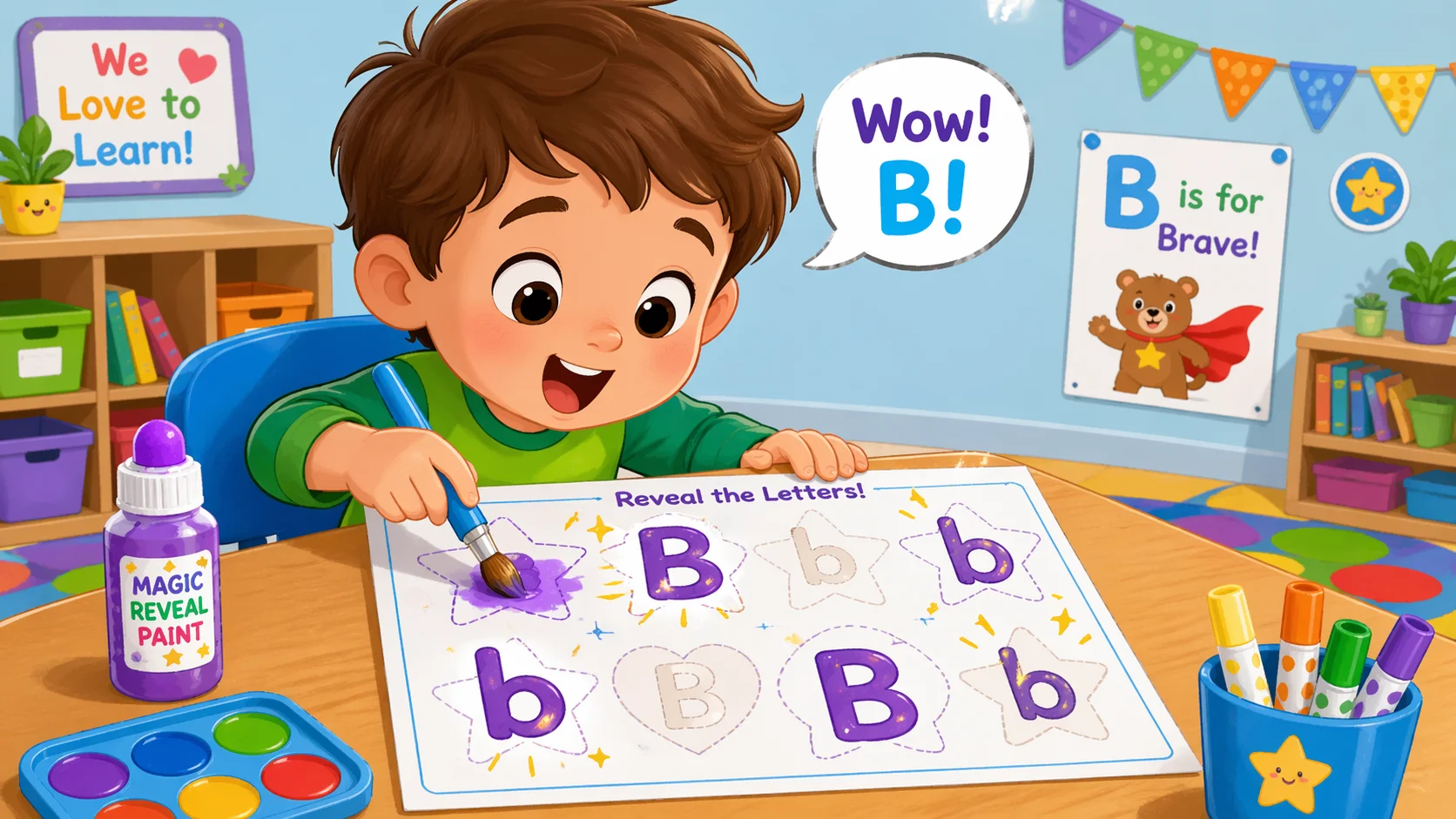
This activity adds a “magic” element to learning and sparks curiosity and problem-solving.
Materials Needed
- White crayon.
- White paper.
- Watercolor paints.
Set-Up
Before the child arrives, use the white crayon to draw several ‘B’s and ‘b’s on the white paper. They will be invisible initially.
How to Do Activity
- The child paints over the paper with watercolors.
- The wax from the crayon resists the paint, causing the hidden letters to “magically” appear.
- Have the child shout “B!” every time a new shape is revealed.
Beginning Sound Sort
This phonemic-awareness task helps children sort objects by their initial sounds.
Materials Needed
- Two baskets or bins.
- A collection of different animals or household items (some starting with B, some not).
Set-Up
Label one basket with a large ‘B’ and leave the other blank.
How to Do Activity
- The child picks an item (e.g., a ball).
- They say the word slowly: “B-b-ball.”
- If the word starts with the /b/ sound, the item goes in the B basket; if not, it goes in the “Other” basket.
Threading Fun
Threading is an excellent way to combine recognition with fine motor skills.
Materials Needed
- Cardboard cut into a B shape.
- Hole punch.
- Pipe cleaner or yarn.
Set-Up
Punch holes around the entire perimeter of the cardboard B.
How to Do Activity
- The child weaves the pipe cleaner or yarn through the holes.
- This mimics the path used in tracing and helps the child’s brain map the letter shape.
Sensory Bin
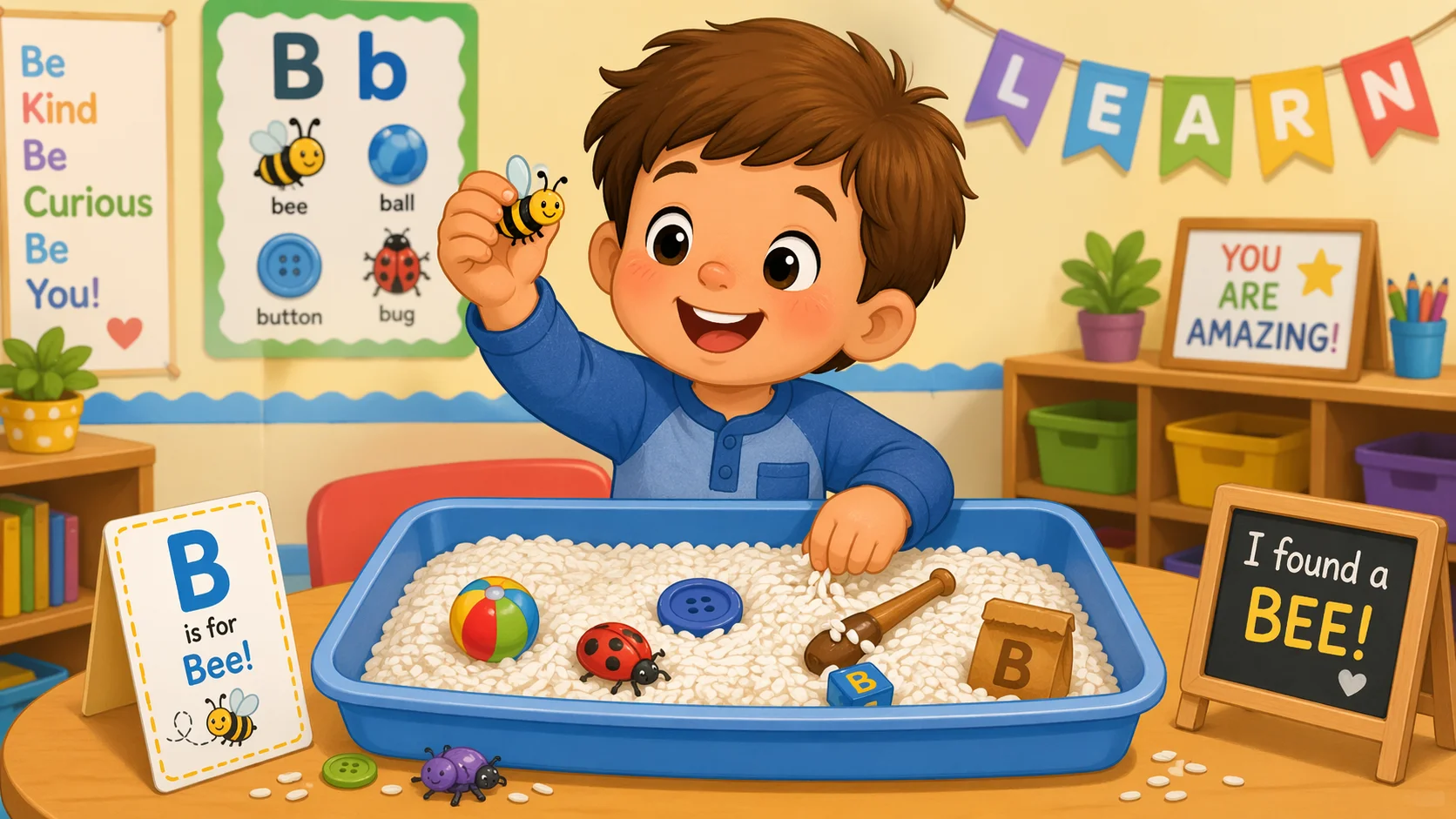
A sensory bin allows for open-ended exploration, vocabulary practice, and letter-sound recognition.
Materials Needed
- A plastic bin filled with dried black beans, rice, or another sensory filler.
- Bumblebee toys, blocks, bells, and buttons.
Set-Up
Hide the B-themed items inside the sensory filler.
How to Do Activity
- The child digs through the sensory play material to find “buried treasure.”
- As the child finds each object, they name it and identify its beginning sound.
Scavenger Hunt
Movement-based tasks are perfect for high-energy preschoolers.
Materials Needed
- A small basket.
- A free printable checklist with pictures of B-words.
Set-Up
Place several objects whose names start with B around the room at the child’s eye level.
How to Do Activity
- Give the child the checklist and the basket.
- They must find a book, a bottle, a blanket, and a box.
- Check off each item on the worksheet as they find it.
LEGO Building
Using blocks to build shapes supports spatial reasoning and fine motor development.
Materials Needed
- LEGO or Duplo blocks.
- A formation guide.
Set-Up
Place an uppercase B card on the table as a reference.
How to Do Activity
- The child uses the blocks to build a vertical line (the spine of the B).
- They then add two curves to complete the uppercase shape.
Stick Building
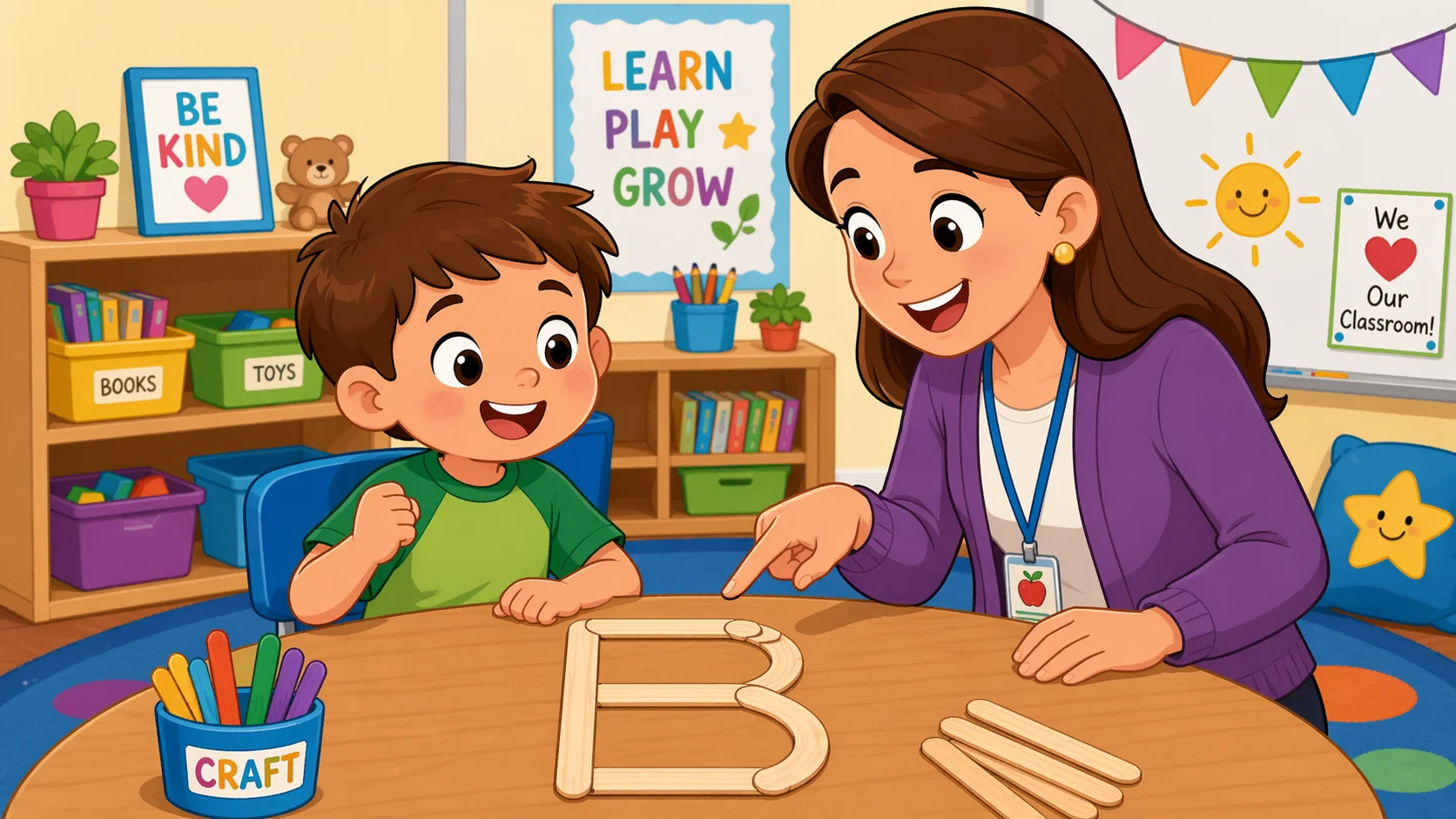
This is a low-prep activity that combines early math thinking with literacy practice.
Materials Needed
- Craft sticks.
- Play dough.
Set-Up
Provide a handful of sticks and a small tub of play dough.
How to Do Activity
- The child uses the sticks for the straight lines.
- They roll the play dough into “snakes” to create the curved parts of the lowercase ‘b’.
Sound Basket
Inspired by Montessori principles, this basket activity focuses on real-world connections.
Materials Needed
- A wicker basket.
- A bumblebee toy, banana, ball, brush, and bell.
Set-Up
Fill the basket with these items that start with the target sound.
How to Do Activity
- Sit with the child and pull one item out at a time.
- Emphasize the beginning sound: “/b/ /b/ /b/ bell.”
- Allow the child to hold and explore the texture of each object.
Sandpaper Tracing
Tactile tracing is a helpful way to teach letter formation.
Materials Needed
- Sandpaper.
- Cardstock and glue.
Set-Up
Cut the ‘B’ out of sandpaper and glue it to the cardstock.
How to Do Activity
- The child uses their index finger to trace the rough surface.
- Guide the child to follow the correct stroke order: down, around, and around.
Bubble Wrap Painting
This sensory art project provides a fun texture and immediate visual feedback.
Materials Needed
- Bubble wrap.
- Blue paint.
- A B outline.
Set-Up
Cut a small piece of bubble wrap and tape it to a wooden block or leave it flat.
How to Do Activity
- The child dips the bubble wrap into the paint.
- The child stamps it onto the template to create “bubbles” inside the B shape.
Button Collage
Using buttons is a great way to strengthen the small hand muscles used for writing.
Materials Needed
- Assorted buttons.
- Glue.
- Construction paper.
Set-Up
Draw a large ‘B’. Provide buttons in various sizes and colors.
How to Do Activity
- The child applies dots of glue along the lines of the letter.
- They pick up and place a button on each dot, practicing fine motor skills.
B Actions Game
Help children get their wiggles out with a game that pairs action words with the /b/ sound.
Materials Needed
- None.
Set-Up
Clear a space for movement.
How to Do Activity
- Call out an action word that starts with the letter B.
- The child must Bounce, Bend, Blink, or Balance.
- This connects the sound to movement and body awareness.
Balloon Batting
Gross motor skills are just as important as fine motor skills in early childhood development.
Materials Needed
- A balloon.
- A fly swatter or a rolled-up magazine (“bat”).
Set-Up
Blow up a balloon and mark it with a large ‘B’ using a marker.
How to Do Activity
- The child tries to keep the balloon in the air using the “bat.”
- Each time the child hits the balloon, they say a word that starts with the /b/ sound.
Phonics Sounds and Songs
Music is a powerful tool for pre-reading skills and memory.
Sound Practice
Model the sound by pressing your lips together and releasing a puff of air. Make sure the child is not adding an “uh” sound at the end: it should be /b/, not /buh/.
Song Ideas
Sing to the tune of “The Wheels on the Bus”:
“The letter B says /b/, /b/, /b/…”
“Big Brown Bear, /b/, /b/, /b/…”
Home and Classroom Use
Use these songs during storytime or as transition songs during cleanup.
Storytime with Books
Reading builds vocabulary and helps children become familiar with letters in print.
Book Picks
- Brown Bear, Brown Bear, What Do You See? by Bill Martin Jr.
- The Berenstain Bears series.
- Bumblebee, Bumblebee, Do You Know Me?
Talk Prompts
- “Can you find the lowercase ‘b’ on this page?”
- “What animal did we see that begins with the letter B?”
Follow-Up Activities
After reading, have the child draw their favorite B character with crayons.
Healthy Snacks and Foods
Themed snacks can reinforce learning through taste, smell, and conversation.
Snack Ideas
| Food Item | Preparation |
| Banana | Sliced into rounds |
| Blueberries | Served fresh |
| Bagel | With cream cheese |
| Broccoli | “Little trees” with dip |
Allergy-Friendly Swaps
If a child has a fruit allergy, offer alternatives such as breadsticks, beans, or another approved classroom snack. Always check school allergy policies before serving food.
Talk Prompts During Snack Time
Ask questions such as, “Is this banana crunchy or soft?” and “What sound does the word blueberry start with?”
Benefits of These Activities
These structured play activities support development in several important areas:
Cognitive Skills
Sorting, matching, and searching tasks improve categorization and problem-solving. When a child decides whether a picture of a dog belongs in the B group, they are using early reasoning and categorization skills. The American Academy of Pediatrics emphasizes the importance of play for healthy development, including skills related to self-regulation, planning, and problem-solving.
Language Skills
Repeated exposure to the /b/ sound helps build phonemic awareness – the ability to hear and work with individual sounds in words. Phonemic awareness is one of the strongest predictors of later reading success. By naming objects that start with the sound, children also expand their expressive vocabulary.
Motor Skills
Fine motor tasks such as tracing, gluing, and threading help prepare children’s hands for handwriting. Gross motor activities like balloon batting improve coordination and spatial awareness. Regular physical activity in early childhood can support focus, coordination, and overall learning readiness.
Emotional and Social Growth
Completing a B craft or participating in a group game can build confidence and social skills. Children practice following multi-step directions and taking pride in their finished projects. In a classroom setting, these tasks encourage turn-taking and cooperative play.
Creativity and Exploration
Process art and sensory bins allow for open-ended exploration. Because there is no “wrong” way to explore a sensory bin, this type of activity can reduce performance pressure and foster a love of learning.
Independence and Problem-Solving
As children become familiar with these routines, they learn to work independently. Choosing between a blue crayon and a yellow crayon, or deciding which blocks to use for building, fosters a sense of autonomy.
Final Thoughts and Conclusion
Teaching the alphabet should be a joyful, varied experience. This list includes printable, sensory, phonics, craft, movement, and book-based ideas to ensure every child finds a way to connect with the material. By choosing two or three of these letter B activities each week and rotating the formats, you can provide a strong foundation that goes beyond simple letter recognition.
Frequently Asked Questions
What Activities Start with B for Kids?
Popular options include blowing bubbles, building with blocks, baking, going on a bug hunt, making a bear collage, and balloon batting.
What Are the Best Letter B Activities for Preschool?
For younger children, do-a-dot searches and sensory bins are especially effective because they provide hands-on, tactile feedback.
How Can You Use These Ideas at Home?
You can build a short home lesson by selecting one sound-based task, one hands-on project, and one worksheet. This variety keeps the child’s interest piqued.
Are There Other Alphabet Resources?
Yes, many educators recommend following up these activities with other letters in the alphabet sequence. You can use guides for the entire alphabet to maintain a consistent learning routine.
How Can a Letter Hunt Reinforce Letter B Recognition?
A simple letter hunt is a great way to reinforce letter recognition in a hands-on learning format. Ask children to look around the room and identify objects that begin with the /b/ sound, such as a book, ball, box, or blanket. You can also have them search for upper case B and lower case b in labels, signs, or classroom print.
What Letter Tracing Activities Work Best for Letter B?
Letter tracing works best when children can see, touch, and move along the shape of the letter. Try tracing B in sand, shaping it with play dough, or cutting a large B from a recycled cardboard box. These activities help children practice the difference between the upper case B and lower case letters while building fine motor skills.
Can an Alphabet Book Help Teach the Letter ‘B’?
Yes, an alphabet book can make the letter ‘B’ feel more meaningful and memorable. After reading the book, ask children to point out every “B” they see on the page and name pictures that begin with the /b/ sound. This helps connect reading, print awareness, and beginning sounds in a natural way.
Take a short quiz to find out what your everyday choices say about your parenting style
When your child is curious about something new, what’s your instinct?
Take a short quiz to find out what your everyday choices say about your parenting style
“Can I download this app?” What happens next?
Take a short quiz to find out what your everyday choices say about your parenting style
When it comes to rules at home, which sounds most like you?
Take a short quiz to find out what your everyday choices say about your parenting style
If you could give your child one life skill today, what would you pick?
Take a short quiz to find out what your everyday choices say about your parenting style
Your child gets to choose what to watch. What would your ideal setup look like?
Take a short quiz to find out what your everyday choices say about your parenting style
Pick your parenting superpower ✨