
Kindergarten Words to Know: 250+ Free Printable Word List and Tips

 Discover a Free Education Video App for Kids
Pastory uses AI to personalize educational video content based on your child’s interests and personality. Safe, engaging, and built for curious young minds. Sign up now to stay updated and enjoy early access with a free trial
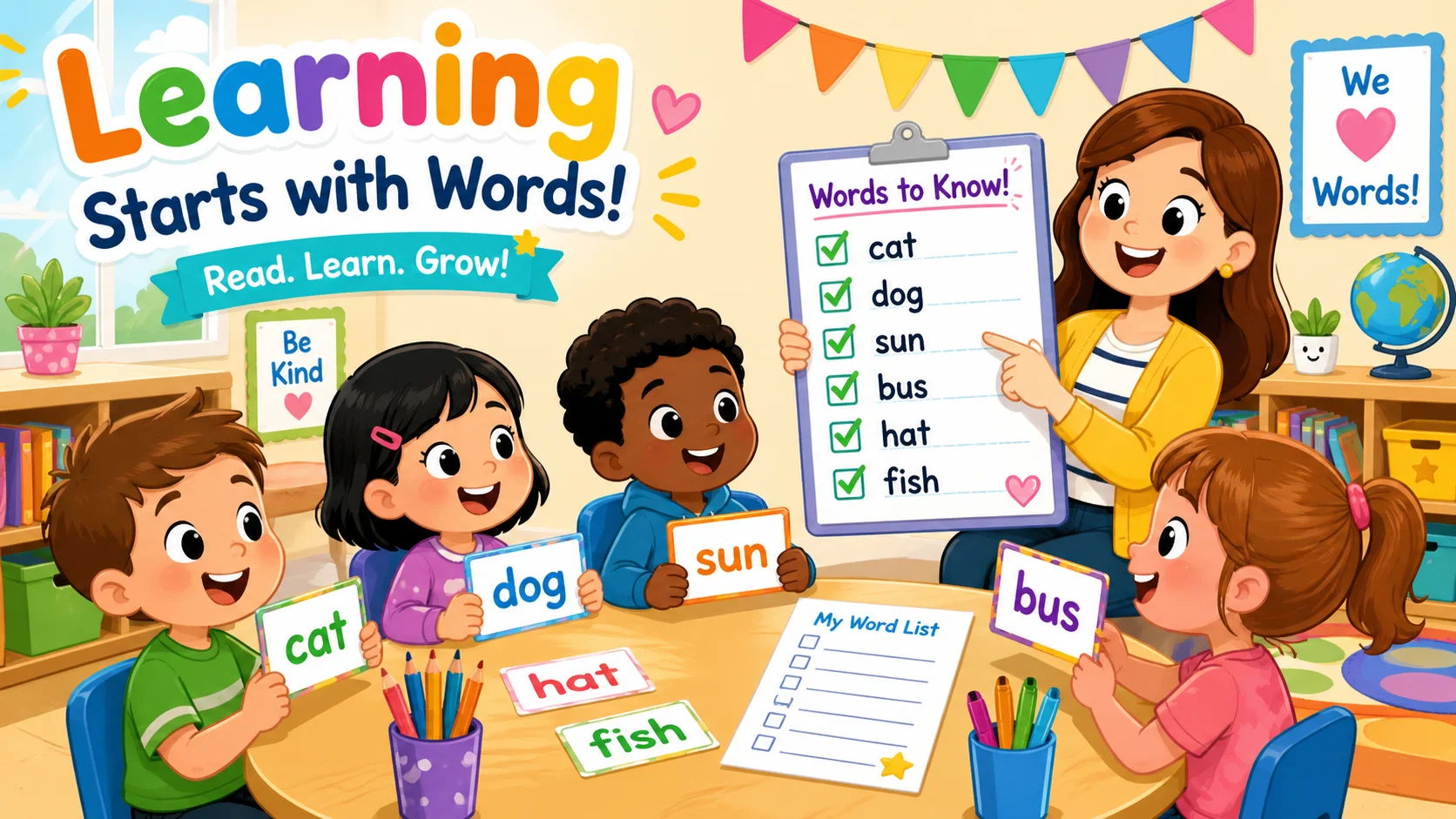
Teaching a child to read is one of the most important milestones in early childhood education. Parents and educators often look for a clear guide to essential kindergarten vocabulary and printable lists that build a strong foundation for early literacy. This comprehensive guide offers structured lists, sight vocabulary, themed vocabulary, and spelling practice to help children build early reading skills. With structured materials, engaging games, and practical teaching tips, you can make word practice enjoyable while building reading skills and confidence.
What Are Kindergarten Words to Know?
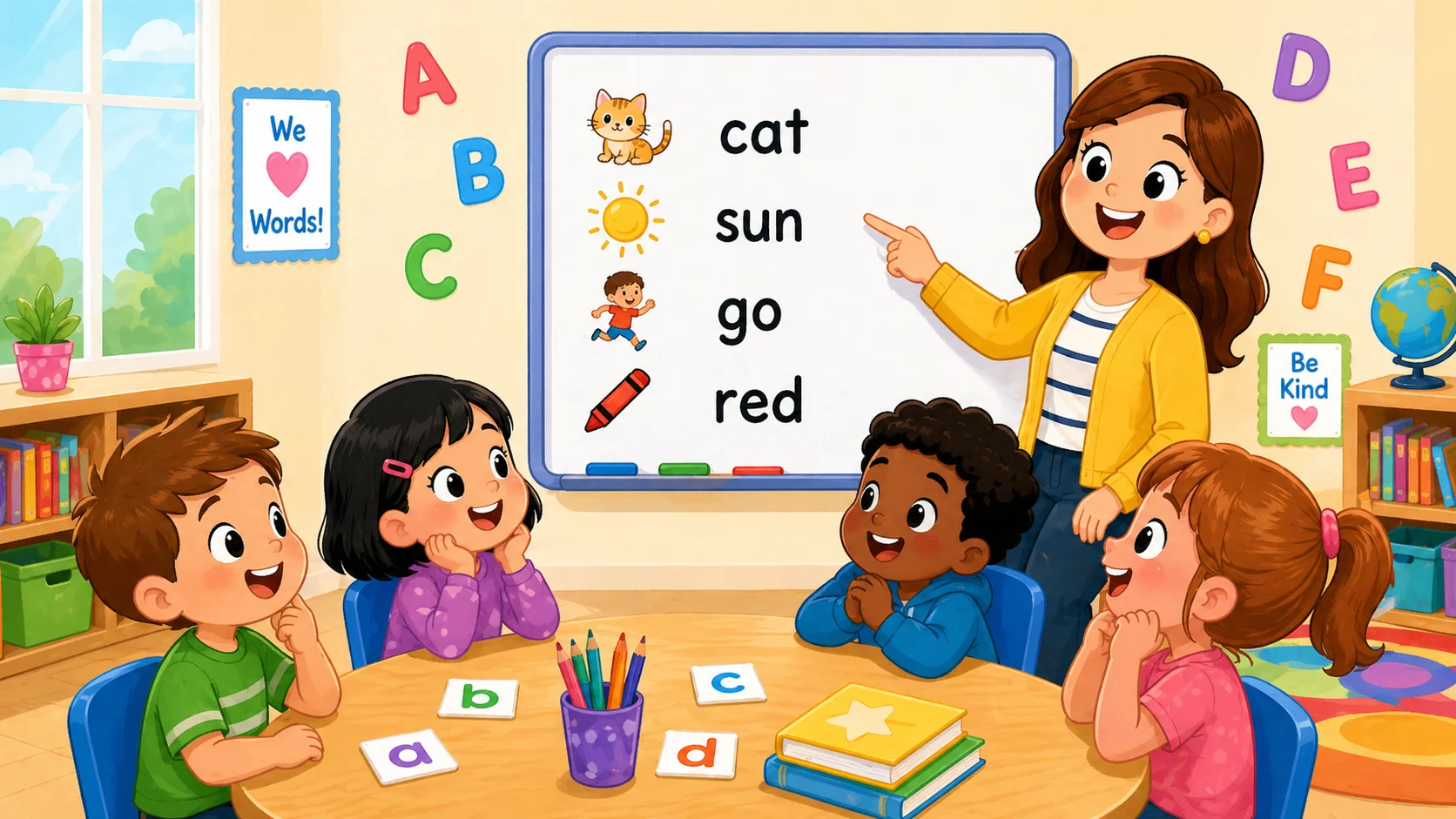
Kindergarten vocabulary includes the essential language and high-frequency terms children encounter in preschool, kindergarten, and early reading activities. These include entries children learn to recognize instantly, as well as decodable examples they can sound out using letter-sound knowledge. Mastering these building blocks helps kindergarteners move from recognizing letters to reading simple sentences.
Sight Words
Sight vocabulary includes high-frequency terms that appear often in print and may not always follow the phonics patterns children have already learned. Kindergarteners learn to recognize words like “the,” “said,” and “come” by sight because some of them have irregular spelling patterns or are introduced before children have learned the phonics patterns needed to decode them. Recognizing these automatically can improve reading fluency and comprehension.
Vocabulary
Vocabulary includes the broader language children use to describe their world, including nouns, actions, colors, feelings, and everyday objects. In a classroom setting, educators introduce terms related to colors, numbers, and school objects to help children build a robust mental dictionary. A rich vocabulary base supports later literacy development and overall academic success.
Spelling
For kindergarteners, this typically focuses on simple consonant-vowel-consonant (CVC) patterns. When children learn to spell “cat” or “sit,” they are practicing the concept of phoneme mapping and letter-sound correspondence. This process helps children understand how spoken sounds map onto written letters.
High Utility Terms
High-utility terms are functional vocabulary items that appear across classroom instructions, worksheets, and daily routines. Items such as “put,” “find,” and “under” are vital for following directions in a classroom or at home. Mastering these words helps a child follow directions and complete daily classroom tasks more independently.
Practice Material
Practice items are selected for repetition to reinforce a new reading skill or phonics pattern. Rather than relying only on flashcards, use these words in short phrases and simple sentences so children can understand them in context. This strategy helps move the target item from short-term recall to long-term recognition.
Kindergarten Words to Know: Free Printable List
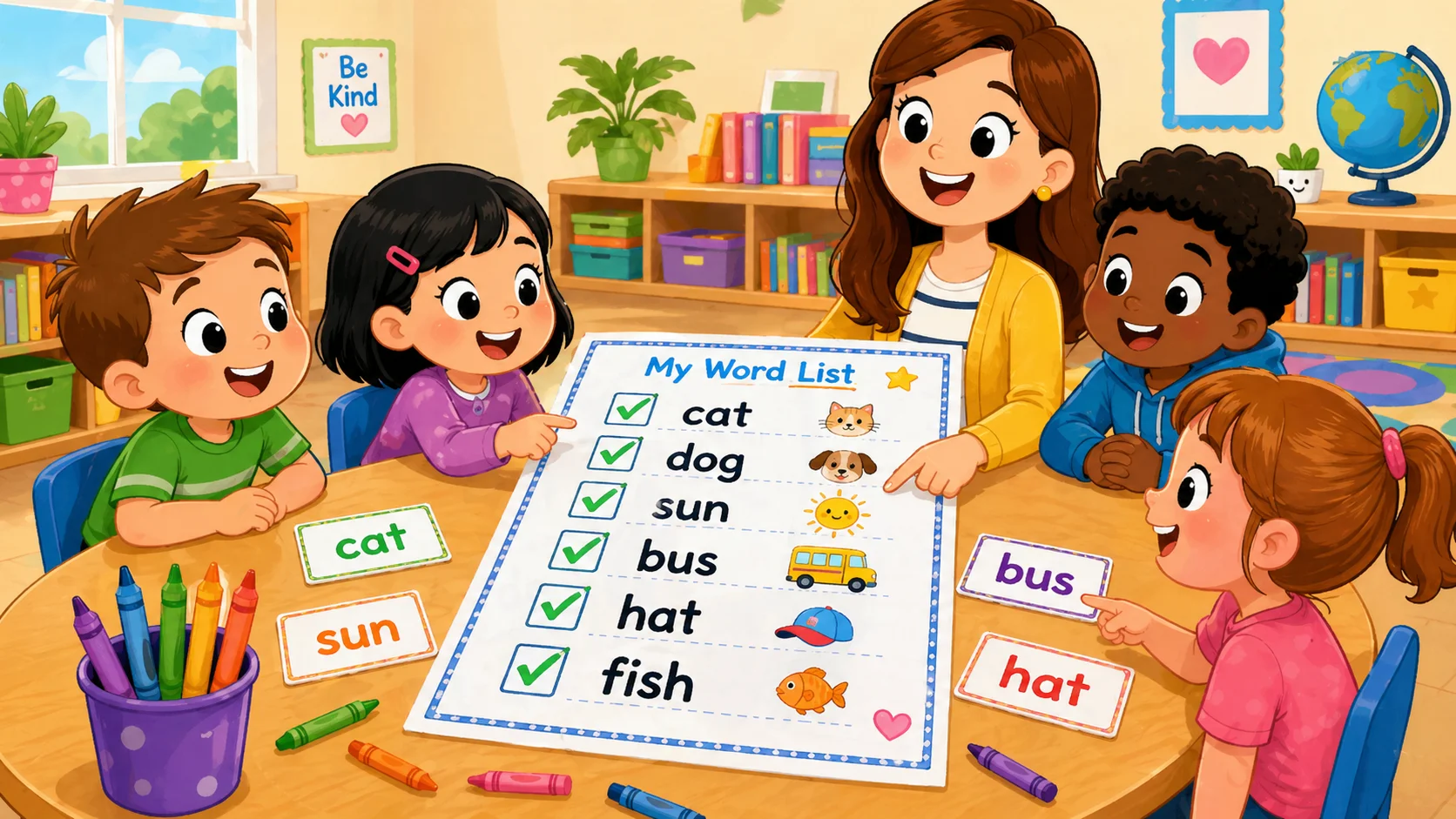
The following lists are organized by category to help you introduce new vocabulary in a logical order. You can use these tables to create flashcards, posters, or a printable checklist for home practice.
Dolch Primer Sight Words List Often Used in Kindergarten
The Dolch list includes high-frequency words commonly found in children’s books. These words are widely used to support early reading fluency.
| A – G | H – N | O – S | T – Y |
| all, am, are, at | have, he, into, like | on, our, out, please | that, there, they, this |
| ate, be, black, brown | must, new, no, now | pretty, ran, ride, saw | too, under, want, was |
| but, came, did, do | on, our, out, please | say, she, so, soon | well, went, what, white |
| eat, four, get, good | no, now, on, our | that, there, they, this | who, will, with, yes |
Fry High-Frequency List
These words appear often in reading materials, worksheets, and classroom texts.
- Group 1: the, of, and, a, to, in, is, you, that, it, he, was, for, on, are, as, with, his, they, I.
- Group 2: at, be, this, have, from, or, one, had, by, words, but, not, what, all, were, we, when, your, can, said.
- Group 3: there, use, an, each, which, she, do, how, their, if, will, up, other, about, out, many, then, them, these, so.
- Group 4: some, her, would, make, like, him, into, time, has, look, two, more, write, go, see, number, no, way, could, people.
- Group 5: my, than, first, water, been, called, who, am, its, now, find, long, down, day, did, get, come, made, may, part.
CVC & Short Vowel Practice (100 Decodable Examples)
These consonant-vowel-consonant examples support phonics and blending practice.
| Vowel | Examples |
| Short A | bat, cat, fat, hat, mat, rat, sat, cap, lap, map, nap, tap, bag, rag, tag, wag, can, fan, man, tan. |
| Short E | bed, fed, led, red, wed, beg, keg, leg, peg, den, hen, men, pen, ten, jet, net, bet, met, pet, wet. |
| Short I | bib, rib, bid, did, hid, kid, lid, rid, big, dig, fig, jig, pig, wig, bin, fin, pin, hit, pit, sit. |
| Short O | bob, job, mob, rob, sob, cod, nod, pod, rod, sod, dog, fog, hog, log, hop, mop, cot, dot, hot, pot. |
| Short U | cub, rub, sub, tub, bud, mud, bug, dug, hug, jug, lug, mug, pug, rug, gum, sun, cup, pup, fun, run. |
Categorized Vocabulary
- Question Terms: who, what, where, when, why, how.
- Color Names: red, blue, green, yellow, black, white, brown, pink, orange, purple.
- Number Terms: zero, one, two, three, four, five, six, seven, eight, nine, ten.
- Themed (Nature): tree, flower, grass, leaf, hill, lake, bird, bug, sky, sun.
- Themed (Family): mother, father, sister, brother, baby, aunt, uncle, home.
50-Word Kindergarten Spelling List
Spelling practice helps reinforce the connection between reading, writing, sounds, and letters. Start with these groups to build confidence.
Weekly Spelling Breakdown
- Week 1 (Foundations): I, am, my, me, the, see, like, can, is, it.
- Week 2 (CVC Basics): mom, dad, cat, dog, bed, red, sun, big, up, go.
- Week 3 (Actions & Describing Words): run, sit, hop, ten, hot, cold, sad, mad, get, did.
- Week 4 (School Setting): book, pen, box, bag, in, on, off, bus, stop, look.
- Week 5 (High Utility): one, two, blue, and, was, for, you, play, are, come.
Word Patterns and Types Kindergarteners Should Know
Compound Structures
Show how two smaller words can form one compound word: cupcake, rainbow, sunshine, playground, bathtub, starfish. This demonstrates how language is built.
Synonyms And Antonyms
Use beginner-friendly pairs to expand vocabulary: big/large, small/little, hot/cold, and happy/sad. Keep examples visual and kid-friendly.
Plurals and Homonyms
Explain adding -s or -es with classroom examples: cats, dogs, boxes, buses. Use simple homonyms like bat as an animal and bat as sports equipment to show how one word can have more than one meaning.
Rhyming and Families
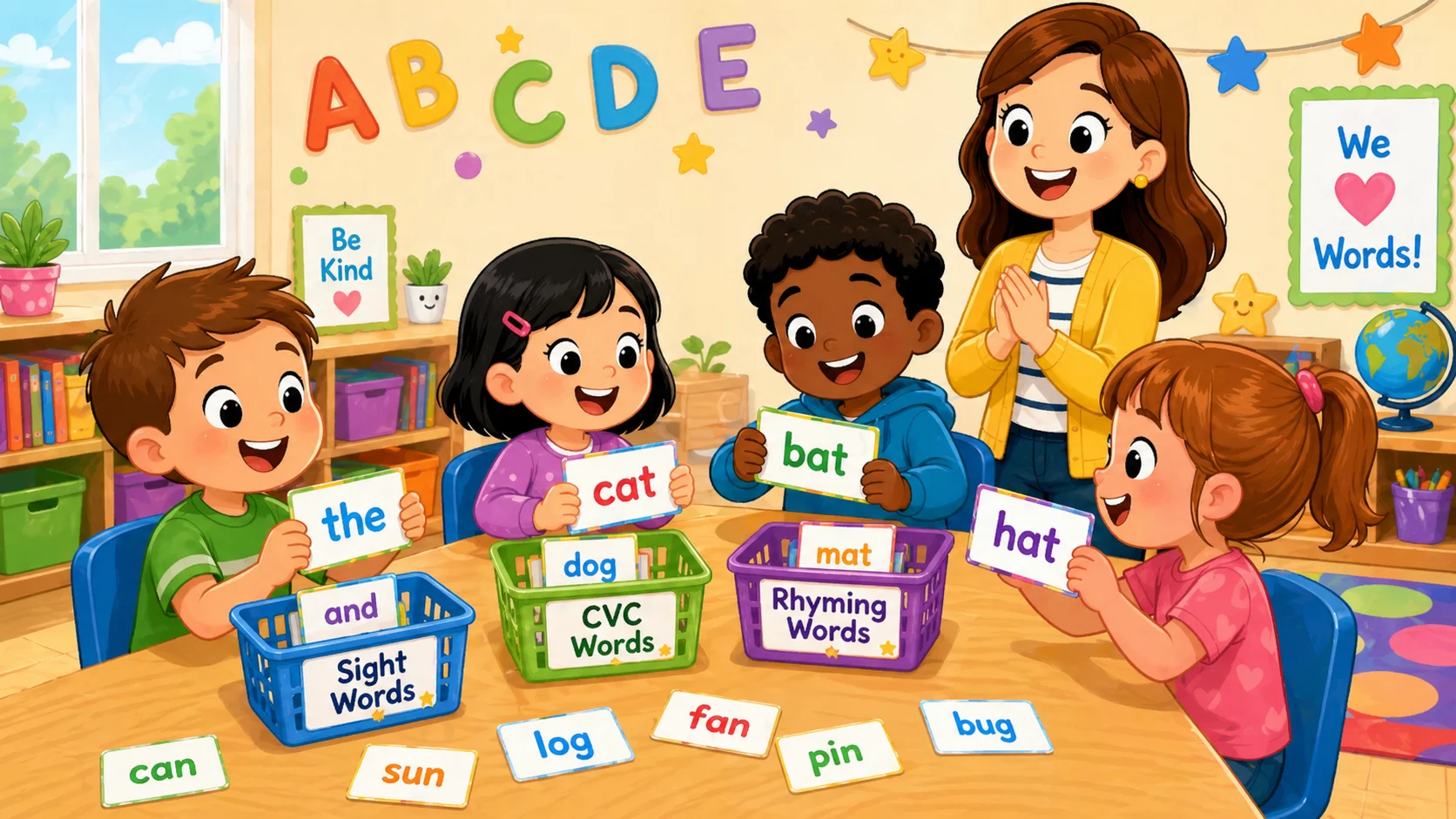
Connect rhyming to phonological awareness and early sound play. Show families like -at (cat, hat, mat) or -og (dog, log, jog). Explain how children can learn many examples through one shared spelling pattern.
Benefits Of Learning Kindergarten Words
Developing a solid grasp of early language skills provides a strong foundation for later learning. Longitudinal research on early learning shows that early reading-related skills are closely connected with later school performance. By supporting early word recognition, parents can help children build confidence and reduce frustration with beginning reading.
Reading Fluency
Reading fluency is the ability to read text accurately, quickly, and with proper expression. When a child can instantly recognize many high-frequency entries, they do not have to stop and decode every unfamiliar item, which can reduce frustration. This smoother reading process allows children to focus on the meaning of the story rather than only on decoding each word.
Early Literacy Development
Early literacy development involves the integration of listening, speaking, reading, and writing. Learning new words encourages children to express ideas more clearly and supports phonemic awareness, oral language, and comprehension. Phonemic awareness – the ability to identify and manipulate individual sounds in spoken words – is a strong predictor of early reading success.
Spelling Confidence
Confidence grows when children learn to write common words and spell simple CVC patterns. Early success in spelling encourages children to attempt “invented spelling,” which is a crucial step in the learning process. This willingness to write helps children build the stamina needed for first-grade writing tasks.
Classroom Readiness
Social and academic language skills help children feel more comfortable and successful in the classroom. A kindergartener who understands words and phrases like “calendar,” “share,” and “line up” can follow teacher instructions more effectively. This readiness connects directly to following directions and joining group activities.
Reading Motivation
Motivation increases when children realize they can read parts of the books they choose. Seeing familiar words on a page gives children an immediate sense of achievement and builds confidence. This positive feedback loop is essential for turning a beginning learner into a lifelong reader.
How Many Words Should a Kindergartener Know?
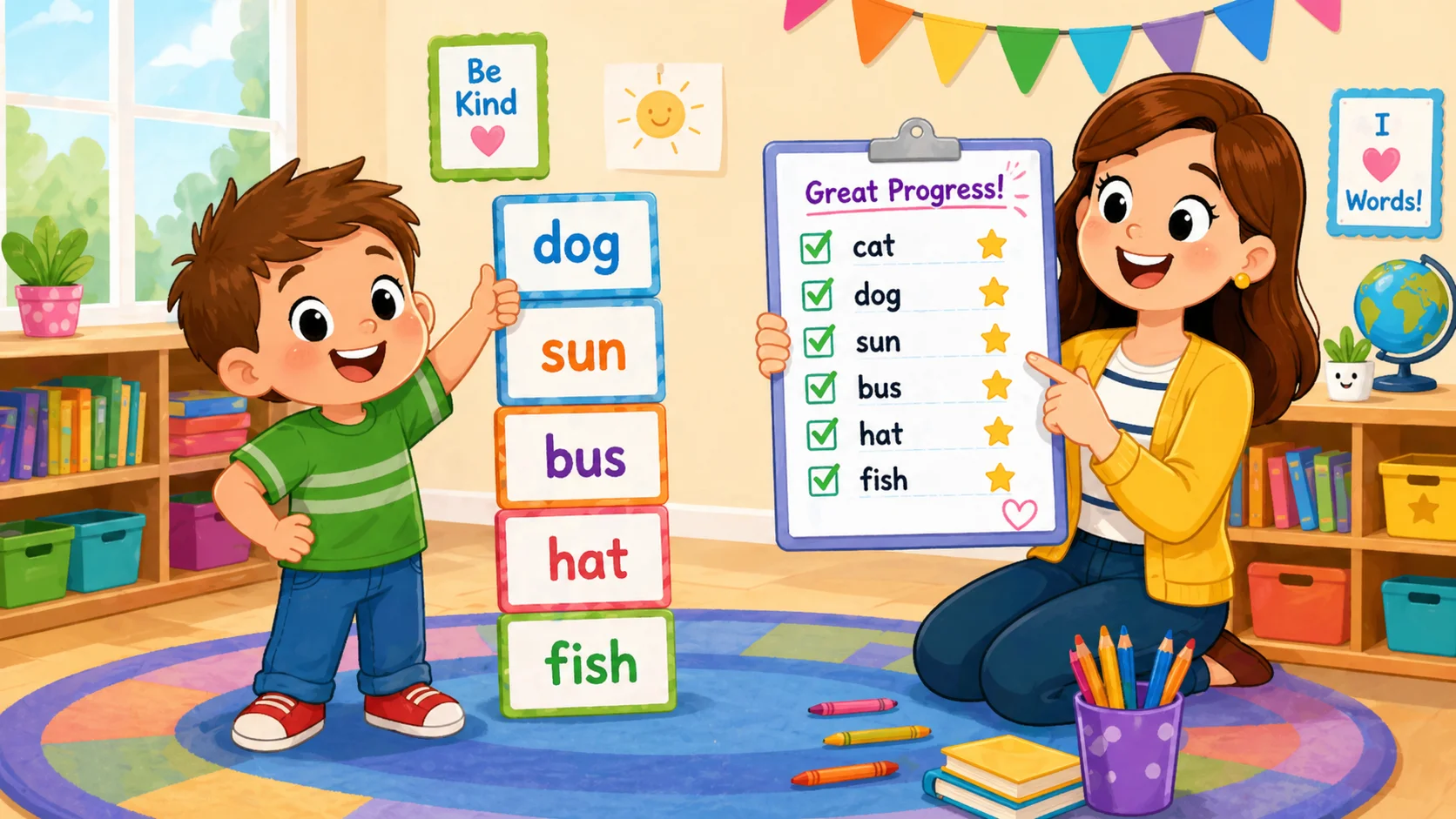
The number of words a kindergartener should know varies by curriculum, but general benchmarks can guide parents and educators. While there is no “one-size-fits-all” number, the focus should be on accurate recognition and the ability to use words in simple sentences.
Typical Sight Word Range
Many kindergarten programs target roughly 50–100 sight words by the end of the year, depending on the pace of the curriculum. Programs such as Dolch and Fry organize high-frequency words by level or frequency, often starting with the most common words first. By first grade, students usually build on this foundation with more high-frequency vocabulary, decodable words, and some irregular words.
Spoken Vocabulary Growth
Children usually know far more spoken words than printed words. By age five, many children understand and use thousands of spoken words from daily life, school, and play. This oral foundation is critical because it provides the context needed for comprehension later on. Parents can support this growth by introducing new language during daily routines.
Spelling Goals
The primary spelling goal for kindergarteners is to understand the relationship between sounds and letters. Start with simple CVC patterns, names, color terms, and family vocabulary before moving on to longer spelling patterns. This shows that the child can segment a spoken word into individual phonemes.
When To Start Practice
Children can start with oral vocabulary, letter recognition, and letter sounds before moving on to formal word lists. Formal word-list practice usually begins once a child knows most letters and understands that letters represent sounds. Keep practice age-appropriate and low-pressure so the learning process stays positive.
Signs a Child Needs Extra Practice
Some children may need extra support or more targeted practice. Gentle signs that extra support may be helpful include:
- Frequent guessing based on the first letter only.
- Avoiding reading activities or showing signs of high frustration.
- Difficulty blending simple three-letter CVC words.
- Difficulty remembering a high-frequency item even after several short review sessions.
Free Games And Activities For Kindergarteners
Sight Word Games
Try Bingo, Memory Match, or a word hunt where children find hidden cards around the house. Online games and read-and-tap activities can also engage children who enjoy screen-based practice.
Flash Cards & Tracing
Use flashcards in a way that keeps practice short and engaging: review five words at a time and mix familiar words with new ones. Try printing or tracing words in sand trays, finger paint, or on dry-erase boards.
Matching & Movement
Pair words with pictures or colors, and match uppercase letters with lowercase letters. Invite parents to find text on cereal boxes, signs, and labels at home. Songs and videos that use rhythm and repetition can make word practice more memorable.
4 Tips For Teaching Kindergarten Words
- Teach 3–5 Items at a Time: Small sets prevent overload. Move on only after the child can read the current set in a sentence.
- Use Context: Practice target vocabulary in short books, labels, and questions instead of relying only on isolated memorization.
- Mix Tools: Use flashcards as one tool, not the entire strategy. Add games, movement, and read-aloud practice.
- Daily Routines: Practice during breakfast, car rides, or bedtime reading. Track progress with a checklist or printable tracker, and emphasize praise and patience.
Conclusion
Mastering early literacy vocabulary is a gradual process that involves sight recognition, vocabulary, spelling, and phonics. Parents should remember that short, playful, repeated practice works best. A strong foundation in these early building blocks supports future literacy growth.
Quick Parent Takeaway
Start small, practice daily for 5–10 minutes, use terms in a sentence, and keep the learning process playful.
Next Step For Practice
Use the printable lists above, create your own flashcards, and explore interactive games to help children learn with confidence.
Frequently Asked Questions
Which Kindergarten Words Should Kids Learn First?
Start with examples such as I, am, can, see, my, like, go, we, you, is, it, in, and on, plus simple CVC patterns. These allow for immediate sentence construction.
How Many Terms Should Kids Know?
A flexible range is 50–100 sight words, but this depends on the curriculum and individual pace. Reading level and practice frequency are more important than a strict count.
Are Sight Words the Same as Vocabulary?
No. Sight vocabulary includes high-frequency terms children learn to recognize quickly in print to support reading fluency. Vocabulary includes all the spoken and written language a child knows and uses to communicate.
Can Games Help With Practice?
Yes! Games add repetition, movement, and motivation. They are one of the most effective ways to add repetition, movement, and motivation to word practice.
How Often Should Kids Practice?
Choose short daily sessions instead of long drills. Often, 5–10 minutes is enough for young learners to maintain focus and retain new information.
What Should I Do When My Child Forgets a Word?
Review the item, reduce the number of new examples, use visual cues, and practice it in a sentence. Always offer praise for effort.
How Can I Help My Child Practice Reading and Spelling at the Right Grade Level?
To help your child stay on track, choose activities that match their grade level and keep practice short, playful, and consistent. For pre-k and kindergarten learners, start with letter sounds, consonant practice, simple phonetic patterns, and short sentences. These tips to help children practice reading also support early reading and spelling confidence without making learning feel stressful.
What Are Fun Ways to Make Learning Kindergarten Vocabulary Easier?
Introducing kindergarten vocabulary through games, songs, picture cards, and movement is a fun way to keep children engaged. Auditory activities, such as rhymes and read-aloud games, can support listening skills, while hands-on resources for teaching help children connect sounds, letters, and meaning. These are simple strategies that make early literacy practice feel more natural.

Take a short quiz to find out what your everyday choices say about your parenting style
When your child is curious about something new, what’s your instinct?
Take a short quiz to find out what your everyday choices say about your parenting style
“Can I download this app?” What happens next?
Take a short quiz to find out what your everyday choices say about your parenting style
When it comes to rules at home, which sounds most like you?
Take a short quiz to find out what your everyday choices say about your parenting style
If you could give your child one life skill today, what would you pick?
Take a short quiz to find out what your everyday choices say about your parenting style
Your child gets to choose what to watch. What would your ideal setup look like?
Take a short quiz to find out what your everyday choices say about your parenting style
Pick your parenting superpower ✨



